For distinguished musical composition by an American that has had its first performance or recording in the United States during the year, Ten thousand dollars ($10,000).

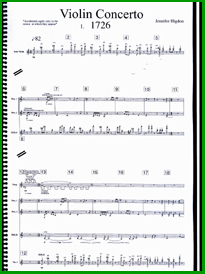
Violin Concerto, by Jennifer Higdon (Lawdon Press)

Premiered on February 6, 2009, in Indianapolis, IN, a deeply engaging piece that combines flowing lyricism with dazzling virtuosity (Lawdon Press).
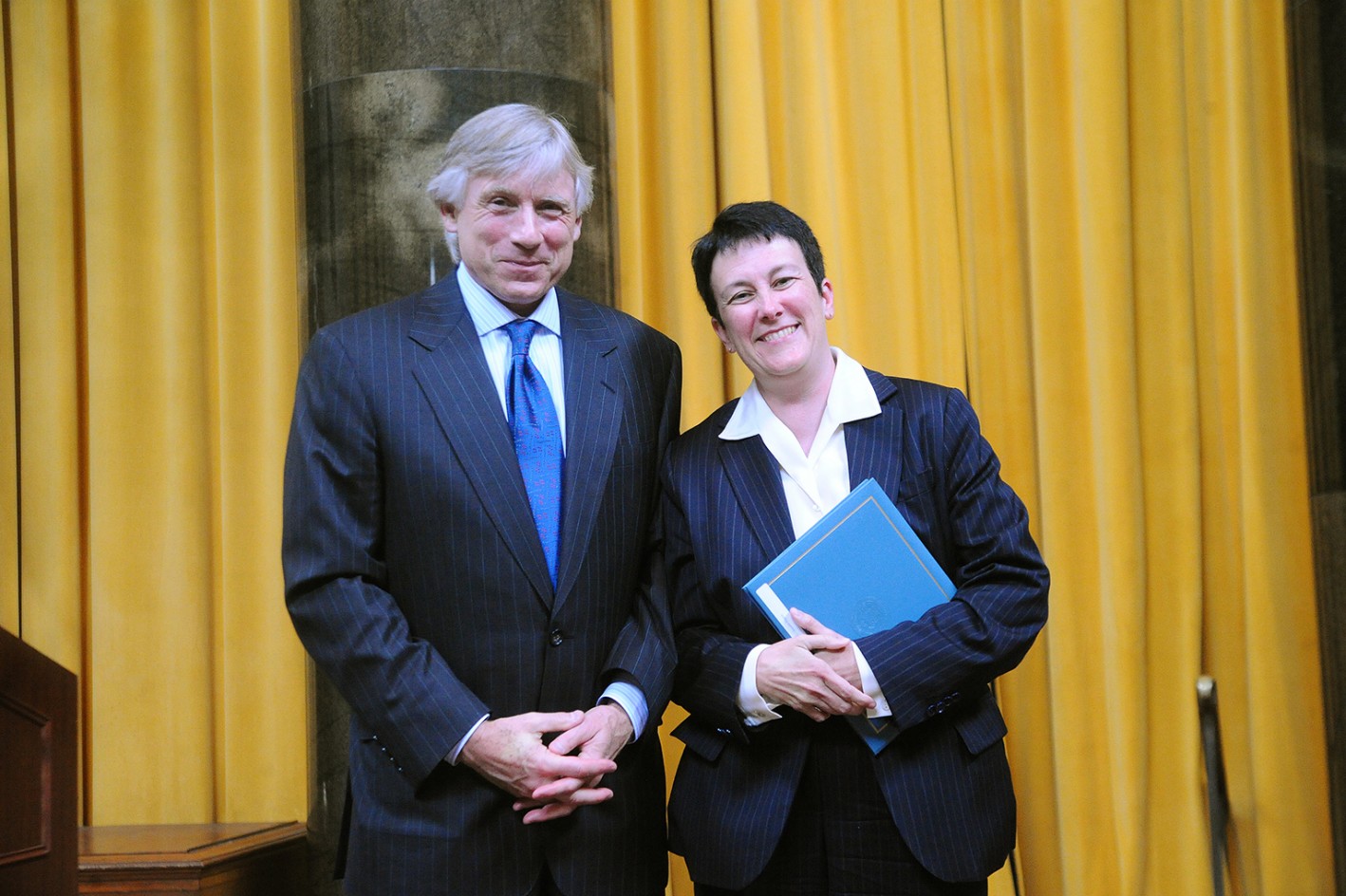
Lee Bollinger and Jennifer Higdon

Lee C. Bollinger, President of Columbia University, presents the 2010 Music prize to Jennifer Higdon.

Winning Work

Violin Concerto

PROGRAM NOTES: “Violin Concerto”

I believe that one of the most rewarding aspects of life is exploring and discovering the magic and mysteries held within our universe. For a composer this thrill often takes place in the writing of a concerto…it is the exploration of an instrument’s world, a journey of the imagination, confronting and stretching an instrument’s limits, and discovering a particular performer’s gifts.

The first movement of this concerto, written for the violinist, Hilary Hahn, carries a somewhat enigmatic title of “1726”. This number represents an important aspect of such a journey of discovery, for both the composer and the soloist. 1726 happens to be the street address of The Curtis Institute of Music, where I first met Hilary as a student in my 20th Century Music Class. An exceptional student, Hilary devoured the information in the class and was always open to exploring and discovering new musical languages and styles. As Curtis was also a primary training ground for me as a young composer, it seemed an appropriate tribute. To tie into this title, I make extensive use the intervals of unisons, 7ths, and 2nds, throughout this movement.

The excitement of the first movement’s intensity certainly deserves the calm and pensive relaxation of the 2nd movement. This title, “Chaconni”, comes from the word “chaconne”. A chaconne is a chord progression that repeats throughout a section of music. In this particular case, there are several chaconnes, which create the stage for a dialog between the soloist and various members of the orchestra. The beauty of the violin’s tone and the artist’s gifts are on display here.

The third movement, “Fly Forward”, seemed like such a compelling image, that I could not resist the idea of having the soloist do exactly that. Concerti throughout history have always allowed the soloist to delight the audience with feats of great virtuosity, and when a composer is confronted with a real gift in the soloist’s ability to do so, well, it would be foolhardy not to allow that dream to become a reality.

This work was commissioned by The Indianapolis Symphony, The Toronto Symphony Orchestra, The Baltimore Symphony Orchestra, and The Curtis Institute of Music. This commission was made possible with the generous support of the LDI, Ltd., and the Lacy Foundation, the Randolph S. Rothschild Fund, as well as the commissioning orchestras.

-- Jennifer Higdon
Biography

GRAMMY winner Jennifer Higdon (b. Brooklyn, NY, December 31, 1962) started late in music, teaching herself to play flute at the age of 15 and then beginning formal musical studies at 18, with an even later start in composition at the age of 21. Higdon makes her living from commissions and her music is known for its technical skill and audience appeal. Hailed by the Washington Post as "a savvy, sensitive composer with a keen ear, an innate sense of form and a generous dash of pure esprit," the League of American Orchestras reports that she is one of America's most frequently performed composers. Higdon's list of commissioners is extensive and include The Philadelphia Orchestra, The Chicago Symphony, The Atlanta Symphony, The National Symphony, The Minnesota Orchestra, The Pittsburgh Symphony, The Indianapolis Symphony, The Dallas Symphony, and The Oregon Symphony. Most recently, Higdon wrote a violin concerto for Hilary Hahn which was commissioned by the Indianapolis Symphony, Toronto Symphony, the Baltimore Symphony Orchestra, and the Curtis Institute Symphony Orchestra. This new work was recorded during the 2008-09 season by the Royal Liverpool Philharmonic.

She has received awards from the Guggenheim Foundation, the American Academy of Arts & Letters (two awards), the Pew Fellowship in the Arts, Meet-the-Composer, the National Endowment for the Arts, and ASCAP. In addition she has received grants from the Pennsylvania Council on the Arts.

Higdon has been a Featured Composer at festivals including Tanglewood, Vail, Norfolk, Winnipeg and Cabrillo. She has served as Composer-in-Residence with the Pittsburgh Symphony Orchestra (2005-06 season), the Green Bay Symphony Orchestra (2006-07 season), and the Philadelphia Orchestra (2007-08).

Higdon enjoys more than two hundred performances a year of her works. Her orchestral work blue cathedral is one of the most performed contemporary orchestral works in the United States, having been performed by more than 200 orchestras since its premiere in 2000.

Her works have been recorded on over two dozen CDs. In Spring of 2003 Telarc released blue cathedral with the Atlanta Symphony, Robert Spano, conducting, on a disc that made the Classical Billboard charts. In 2004 the Atlanta Symphony released the Grammy-winning Higdon: Concerto for Orchestra/City Scape. December 2006 saw the release of a compact disc of Higdon's chamber music on Naxos, as well as a Grammy-winning recording with eighth blackbird. During the 2008-09 season, the London Philharmonic released Higdon's Percussion Concerto with Colin Currie, soloist, and Marin Alsop, conducting. That same season featured a release by Naxos of Higdon's Short Stories performed by the Ancia Saxophone Quartet and a release by Koch of Higdon's flute and chamber works. The 2009-10 season will feature two releases from Telarc, Higdon's Dooryard Bloom and The Singing Rooms.

Higdon received a 2010 GRAMMY for Best Contemporary Classical Composition for her Percussion Concerto. She currently holds the Milton L. Rock Chair in Composition Studies at The Curtis Institute of Music in Philadelphia.

Finalists

Nominated as finalists in Music in 2010:

Fred Lerdahl

Premiered on December 8, 2009, in Cleveland, Ohio, a remarkable work that displays impeccable technical facility and palpable emotion.

Julia Wolfe

Premiered on November 13, 2009, in Gainesville, FL, an innovative composition that, with voices and old-time instruments, turns the old folk tune "John Henry" into an epic distillation of Appalachia.

The Jury

Delta David Gier

music director

Chuck Owen

composer and professor of jazz studies

John Rockwell

author and music critic

Maria Schneider

composer and orchestra leader

Winners in Music

Steve Reich

A major work that displays an ability to channel an initial burst of energy into a large-scale musical event, built with masterful control and consistently intriguing to the ear.

David Lang

Co-commissioned by the Carnegie Hall Corporation and The Perth Theater and Concert Hall, and premiered October 25, 2007 in Zankel Hall at Carnegie Hall, New York City (G. Schirmer, Inc.).

Yehudi Wyner

Premiered February 17, 2005 by the Boston Symphony Orchestra. (Associated Music Publishers, Inc.)

2010 Prize Winners

Paul Harding

A powerful celebration of life in which a New England father and son, through suffering and joy, transcend their imprisoning lives and offer new ways of perceiving the world and mortality.

Hank Williams

For his craftsmanship as a songwriter who expressed universal feelings with poignant simplicity and played a pivotal role in transforming country music into a major musical and cultural force in American life.

Liaquat Ahamed

A compelling account of how four powerful bankers played crucial roles in triggering the Great Depression and ultimately transforming the United States into the world's financial leader.

Rae Armantrout

A book striking for its wit and linguistic inventiveness, offering poems that are often little thought-bombs detonating in the mind long after the first reading.