The Boston Globe, by Farah Stockman
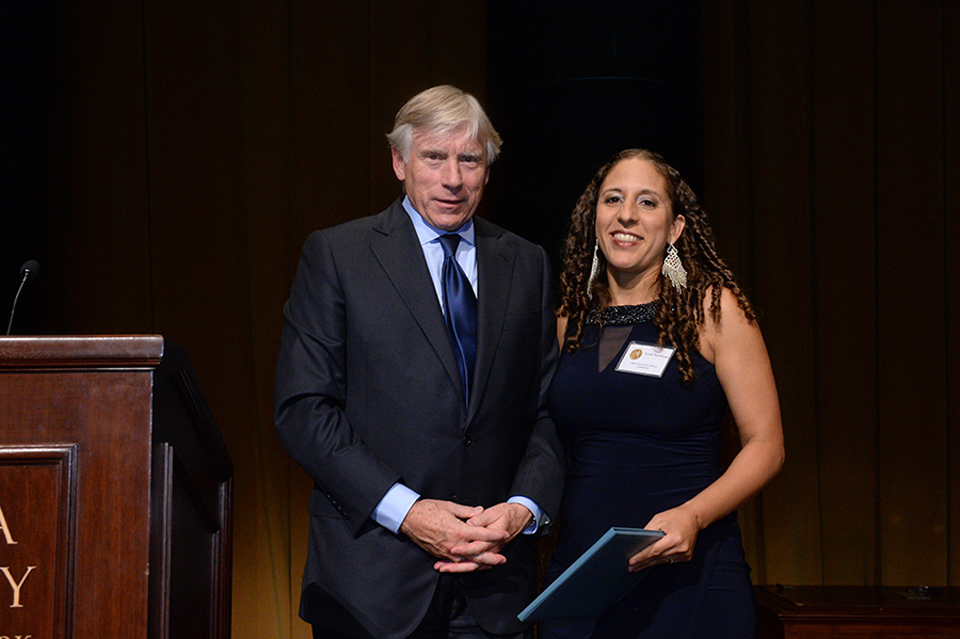
Columbia University President Lee C. Bollinger presents the 2016 Commentary Prize to Farah Stockman of The Boston Globe.
Winning Work
By Farah Stockman
We’re entering a new era of race relations in America — a crazy, conflicting, potentially explosive era yet to be named.
Maybe it’s an era of white insecurity about racial identity as the country moves toward a nonwhite majority. Dylann Roof, who murdered nine black people in a church, and Rachel Dolezal, who declared herself black on national television, could be two sides of that coin.
Or maybe it’s an era of increasing black confidence. What’s unprecedented about the spate of black people who’ve died in police custody is not the deaths themselves — those are sadly not new — but rather the fact that they’re being covered prominently on national news.
There’s something else notable about our conversations on race today: the disconnect between where we are in 2015 and where we thought we’d be. The half-finished project of racial equality in the United States leaves us with a parade of endless contradictions.
We overwhelmingly support the idea of integration. Yet, 75 percent of white people don’t have a single black friend, and 66 percent of black people don’t have a white one.
We elected a black president. Yet we still incarcerate blacks at nearly six times the rate of whites. We’ve had not one but two black secretaries of state. Yet, a study shows that women with “black-sounding” names — like Lakisha and Aisha — still have a hard time getting hired as secretaries.
On television, the most powerful woman in the world is a black woman, Olivia Pope, who speaks her mind to the president of the United States on ABC’s “Scandal.” In real life, black women like Sandra Bland and Ersula Ore get arrested for speaking their minds to white police officers.
Where does that leave us, America? Slavery is over. Jim Crow, as our parents knew it, has ended. The civil rights movement is ancient history to kids today. Even the era of race-based remedies — court-ordered busing, affirmative action, majority-minority political districts — is fading. What happens next?
After Barack Obama’s election, some declared that we’d reached a “post-racial” age. That we’d finally given up, in the words of Chief Justice John Roberts, this “sordid business” of divvying ourselves up by race. Then we got Trayvon Martin. We got Ferguson. We got Baltimore. Today, Americans are talking more about race — and doing more divvying — than they have in years.
The thing about this new era, however, is that we don’t agree any more on what race means. In Martin Luther King Jr.’s day, everybody knew that blacks were treated as second-class citizens. Today, half the country complains that being black gets you killed, while the other half complains that it gets you into college.
In the past, stereotypes of black poverty were the problem. Today, it’s stereotypes of black success. The black faces on television today drive luxury cars. They live in the White House. Nearly 60 percent of whites believe that blacks earn the same salaries as whites. Three percent think blacks actually earn more. In reality, the median household income for whites is $54,000, compared with $32,000 for blacks and $38,000 for Hispanics, a disparity that has grown since the 1970s. Meanwhile, the median net worth of a white family is $142,000. For Hispanics, it’s just $13,700. For blacks, it’s $11,000.
Despite decades of government policies aimed at leveling the playing field, significant disparities remain. That’s a source of outrage among blacks. Yet, enough black people have climbed the ladder to wealth and influence that we have the illusion of equality. That’s left whites outraged at policies that still tip the scales in favor of one race.
Therein lies the deepest disconnect: A majority of whites don’t believe racism still exists. Or they suspect they’re the real victims of it. A study by Tufts researchers showed that most whites agree that blacks faced serious racism in the past but feel that “anti-white bias” has become the bigger problem in the past 15 years.
This is the unfinished business of the ’60s and ’70s. The most ambitious and far-reaching government effort to bring us together — court-ordered desegregation of schools — was supposed to connect us, and make us equal. Race was supposed to disappear as a salient factor in American life.
But it hasn’t. Today, most blacks in Boston still lack quality schools, while many whites still resent the government takeover of schools. The life expectancy for residents in parts of the Back Bay is 91.9 years, compared with 58.9 years in parts of Roxbury. The struggle for equality hasn’t been won. Yet many people feel exhausted. They want to declare victory (or defeat) and go home.
Over the next few months, I’ll explore how the history of desegregation shaped the era we’re living in today. But first, let’s give this era a name.
E-mail me your ideas at [email protected] or tweet them to @fstockman: #NameThisEra.
This piece is part of series of columns about Boston — four decades after busing — supported by the Sigma Delta Chi Foundation.
By Farah Stockman
What would you do if you ran into the person who drove you out of your home decades ago? What if that person had once been your friend? Not long ago, Robert Lewis Jr., a black civic leader, faced those very questions. He was giving a speech at a community center in East Boston, his old neighborhood, basking in the glow of old times. Then he recognized a face he hadn’t seen in years. His smile faded. Sweat soaked through his suit.
For a moment, Junior (as his friends call him) was 16 years old again, looking out the window of his apartment in the Maverick public housing development. His friend, a white boy, stood in the street. They’d gone to summer camp together. Played football together. Junior had eaten at this boy’s dinner table more times than he could count. But instead of walking up to Junior’s door, the boy raised his arm. His fingers clenched a glass bottle stuffed with rags. The bottle sailed through the air and smashed. Fire spread across Junior’s yard. The “friend” ran off into the dark.
After that, Junior’s family moved away, along with nearly every other black family in Maverick. The Swans, whose entire apartment burned. The Carnes, who had a Molotov cocktail crash through their little girls’ bedroom window. The Hornes, whose kitchen windows had been broken with baseball bats. Of 20 black families, only Ma Porter stayed. She announced on the nightly news that she’d never leave.
Junior never forgot. And he never forgave. And he never breathed a word about who’d done it. The firebomber’s family had been so kind to Junior. He didn’t want to break their hearts.
But now — decades later — the firebomber limped toward him, on a cane.
“All these years I always wondered what I would do if I saw him,” Junior told me. “In my head, I thought I would hurt him. I’m thinking: ‘My professional career is about to end.’ ”
It’s one thing to be harassed in your new home by strangers who wish you hadn’t moved in. It’s another to be uprooted from the place you grew up by your former playmates. Read about “ethnic cleansing” in Iraq or Bosnia, and you’ll always hear a sense of betrayal and surprise: We lived together. We were like one family. Overnight, they changed.
When toxic politics turn neighbor against neighbor in foreign lands, we inquire on the fate of the displaced. We study their trauma. We set up truth and reconciliation commissions.
But in Boston, we just try to forget. We’ve erased this episode from our collective memory and replaced it with a myth: that no integration existed here back then. That Boston public housing didn’t desegregate until 1988. In fact, Boston public housing quietly desegregated in the 1960s.
“It’s absolutely a forgotten part of Boston’s history,” said William McGonagle, administrator of the Boston Housing Authority.
Black kids in Maverick grew up racing and kissing and going to school with Irish and Italian neighbors. But in 1974, when a federal judge ordered a more sweeping plan to desegregate schools using busing, whites seethed. Teenagers turned on the easiest target: their black neighbors.
In 1970, 164 blacks lived in the census tract containing the Maverick and Orient Heights housing developments in East Boston. A decade later, there were only 48. The tract containing two public housing developments in Charlestown was home to 68 black residents in 1970. A decade later, there were only 15. Even South Boston, a famously insular enclave, counted 155 blacks in the tract that includes Old Colony and Mary Ellen McCormack in 1970. Ten years later, how many remained? None.
This is one reason Boston remains one of the most segregated major cities in the country.
Joyce Horne, who fled Maverick only to be firebombed in her new home in Brighton, finally moved deep into Mattapan. (Ironically, her daughter got bused to high school in East Boston.) Her experiences left her pessimistic that racism will ever be overcome.
“I don’t think things are ever going to change,” she said.
Which leads me to one of the deepest racial disconnects in our society today: 48 percent of blacks don’t believe they’ll achieve racial equality in their lifetime, or ever. That’s incredible, given how hard blacks have fought for it and how much progress has been made. Meanwhile, half of all whites believe equality has already been won.
Whites have a vested interest in believing that equality is already here. Why else did we go through the pain of court-ordered busing?
But for many blacks, the backlash to busing looms even larger in the mind. It felt personal and unforgettable.
“It was horrible because we started out as friends,” said Darneese Carnes, who was just 12 years old when a Molotov cocktail exploded through her window. “I never got over it. It made me hate. I know that I am mean and I’m hard, and I tell people that’s just who I am, because of how I grew up.”
Steve Weine, a professor of psychiatry at the University of Illinois at Chicago who has studied Bosnian teens, says being forced from your home as a child shapes your worldview forever.
“It’s a tremendous sense of betrayal when your neighbors all of a sudden turn on you, dehumanize you, and get rid of you,” he said. “We all walk around feeling safe and confident because we think things like that aren’t going to happen. Once it does, how can you ever establish trust again?”
Junior’s family had been the first black family in Maverick. His mother, who’d moved up from North Carolina as a teenager, worked as a hall monitor at East Boston High. Other black families followed. The mothers used to joke about who’d arrived second and third.
As kids, Junior and his friends played black-against-white basketball games with Timothy Bibbo and Billy Marangiello, older white boys from Maverick. Racial slurs got tossed around. But in the end, poverty and fatherlessness bonded them.
Junior enjoyed the fame that came from playing running back in Eastie-Southie football games. He dated an Italian girl, served as prince of his junior prom and vice president of his class.
But busing — which began his freshman year of high school — changed his life. Fistfights broke out with Bibbo, Marangiello, and their friends. Over time, it got more violent.
One night in August of 1975, a mob of white teenagers amassed outside Junior’s apartment, with stones and bats. Some people said they saw Marangiello with a gun. Junior’s mother called everybody she could think of — the police, the FBI, a priest, and a group called “People Against Racism” — to help her protect her home.
The police arrived. But they did not disperse the crowd. Instead, they ordered the “People Against Racism” to leave, claiming that their presence was agitating the mob.
“You can’t tell my friends to leave,” Junior’s mother said. “I pay rent here.”
“Just watch me,” the officer replied, according to testimony in a lawsuit Junior’s mother filed.
In the end, police carted her off in a police van, along with seven of her friends. Junior, away at football camp, watched it in horror on TV.
“What outrages me is that East Boston didn’t stand with us, as a collective community,” Junior said. “But I can tell you 20 or 30 people who did.”
Sal LaMattina, now a Boston City Councilor, stood by him.
Sal and Junior had gone to school together ever since the first grade. Junior loved Sal’s grandmother’s risotto. Sal loved Junior’s apartment in Maverick, which contained luxuries that Sal’s house lacked: a bathtub and a living room. Sal’s mother didn’t mind when black kids from Roxbury were bused to his middle school. But when a federal judge ruled Sal could be bused to Roxbury, she got upset.
“My mother was scared to put us on a bus to a neighborhood that she knew nothing about,” Sal said. “She didn’t own a car.”
A few days before his freshman year of high school, Sal’s mother took him to an antibusing rally. It was his first time to see City Hall. He still remembers the colored bon-bons on Pixie Palladino’s hat.
Meanwhile, Junior’s mother supported busing. Junior got to school early to welcome the buses, so they’d see a friendly black face.
Despite their differences over busing, Sal and Junior remained friends for life.
When Junior moved away, Sal was the first to visit him in Villa Victoria. Junior — who still attended East Boston High — often stayed at Sal’s house after school. They roomed together in college, where Sal became a member of the New Africa House at UMass-Amherst. And when Junior’s mother lay on her deathbed, Sal came to the hospital and drank champagne with Junior’s oldest friends.
Only once did their friendship falter: last year, nearly four decades after busing began.
Sal declined to support a symbolic resolution on the City Council, commemorating the anniversary of Brown v. Board of Education. He apologized later, saying he’d confused the resolution with an endorsement of busing. Angry constituents took him to task for it.
“What were you thinking?” Junior asked him. “Our friendship is on the line here.”
Sal didn’t have to tell Junior what busing had cost him. Sal’s brother had been stabbed at school, by a kid who’d been bused. Another brother had dropped out. His cousins moved to New Hampshire to get away from the chaos. And to the litany of disasters, Sal always adds this: Junior, his best friend, had been firebombed.
“Come on, Junior,” Sal told him. “You know me.”
IT’S STRIKING HOW “busing” came to define a generation in Boston. Perhaps even more than the black kids who’d been forced out of Maverick, it defined the bullies who’d chased them away. For a time, opposition to busing gave their criminal mischief the veneer of respectability. But eventually, it caught up with them.
Timothy Bibbo, who’d broken the Horne’s windows, got shot to death by an MBTA cop in 1983. Billy Marangiello, who’d allegedly brandished a gun outside Junior’s house, got sentenced to Walpole for robbing and beating a deaf man.
Even the firebomber went to jail for stabbing a white classmate. Recently, I tracked him down and left a message asking him to tell me his side of the story. But he never called back.
“He’s changed,” his sister told me. “He’s made his peace with God.”
Junior heard a rumor about how that night had gone: Older boys put a Molotov cocktail in his friend’s hand and asked, “Are you one of us or one of them?”
How many others in this city had been forced to make the same fateful choice? For years, Junior wanted justice. Revenge. Or an apology.
This was his chance. The firebomber inched toward him, looking old and broken. Junior felt successful and fit. He’d worked at City Year and the Boston Foundation. Recently, he founded his own successful sports program for youth called The Base.
The firebomber stood in front of him. Junior thought of all the times he’d dreamed of knocking him down. But instead, without fully understanding why, Junior opened his arms and hugged him. “Great to see you,” Junior said.
This piece is part of a series of columns about Boston — four decades after busing — supported by the Sigma Delta Chi Foundation. Farah Stockman can be reached at [email protected]. Follow her on Twitter @fstockman.
By Farah Stockman
We like to think of public schools as the great equalizers, with the capacity to bridge the deepest racial and economic divides. But all too often, schools do just the opposite. In a city like Boston, poor kids tend to go to poor schools, and wealthy kids to affluent schools. That’s the way the world works, unless someone makes a special effort to change it.
Forty years ago, a federal judge attempted to do just that. Judge Arthur Garrity ruled that the Boston School Committee had, for years, “intentionally brought about and maintained racial segregation” to keep black children away from the best schools in the city. He ordered that black kids be bused to white schools, and vice versa, to rectify the injustice.
But segregation didn’t go away. It simply morphed into something more difficult to tackle.
The middle class — both white and black — left town. They didn’t want to gamble on a school lottery. Today, the outer suburbs are full of good schools attended by well-off students who are mostly white. The city is full of failing schools attended by poor children who are mostly black and Latino.
But fate has given us a do-over. White middle-class families are moving back to Boston, and they’re testing the waters of public education. Once again, schools in upscale neighborhoods are filling with well-off white students, while schools across town are becoming overwhelmingly black or Latino. This time, it’s not the result of a deliberate policy, but rather economic forces beyond our control. The question is: What should we do differently this time around? It’s a question parents themselves are actively trying to answer.
On a recent Friday night, the Eliot K-8 Innovation School, an elementary school in the North End, hosted a fund-raiser at the Liberty Hotel. Women in cocktail dresses swayed on the dance floor. Champagne chilled in buckets at the bar. Silent auction items sold for hundreds more than the asking price. A perfect event. The only thing missing? Diversity. I counted just one black parent.
At first, I thought the ticket price — $100 a head — may have kept some parents away. Then I realized how few black students actually attend the school. In a district that’s 13 percent white, 35 percent black, and 40 percent Latino, the Eliot is conspicuously Caucasian: It’s 53 percent white, 11 percent black, and 25 percent Latino.
The Eliot is one of a tiny handful of Boston public elementary schools that have amassed a majority-white student body. Warren-Prescott in Charlestown, just a block from Whole Foods, is 53 percent white, up from 30 percent in 2000. JP Manning, in Jamaica Plain, is 44 percent white, up from 25 percent that year. The Henderson in Dorchester, is 42 percent white, up from 29 percent.
For a cash-strapped school district that has been hemorrhaging students, that’s good news. These new kids speak English. They read at grade level. They’re well fed. In short, they’re easier and cheaper to educate. Moreover, they come with parents who fund-raise, volunteer, and lobby their elected representatives. No wonder cities like Chicago and Philadelphia are bending over backward to convince them to enroll.
But as some schools grow whiter and richer, others grow more racially isolated. For instance, the Donald McKay School in East Boston is 90 percent Latino. The Charles H. Taylor School in Mattapan is nearly 90 percent black.
“Some of us fear we’re going to return to a very segregated school system,” said Barbara Fields, a former equity officer for the Boston Public Schools. “We’re going to repeat this cycle.”
Despite a much-needed change to the student funding formula that takes poverty and English language learners into account, elementary schools in Mattapan are still a world apart from schools in Charlestown.
Sociologists are just beginning to study what that means for the system as a whole.
“School systems seem to be banking on the idea that middle-class parents can improve schools for everybody, but that may not be the case,” said Chase Billingham, an assistant professor at Wichita State University, who wrote his dissertation on Boston.
If well-connected parents advocate only for their own children, it can be detrimental to those who don’t have as much clout.
Some parents “go directly to the mayor,” said Fields. “Parents of color don’t even think about going to the mayor. They beg and plead to the School Committee, and it falls on deaf ears.”
When parents at the Murphy School in Dorchester complained about emotionally impaired students who’d been sent there, school officials agreed not to send more. Instead, the district paid for private placements outside the city, at a cost of $54,601 per child.
On the other hand, these new middle-class parents have improved their own children’s schools dramatically in ways that benefit every kid in the class. The Eliot gala raised funds for special classes in robotics and Italian. The Warren-Prescott’s “Spring Fling” dinner bought art programs and laptops. The Manning’s “Burger Slam” funded field trips and teaching supplies.
But the better a school does, the more well-off families will apply to send their children there, instead of moving to the suburbs. That could mean fewer slots for low-income students.
JUST AS THE Eliot School was planning its gala, parents at the Channing School in Hyde Park were mulling over their own ideas for fund-raising. Don’t kids at the Channing — which is 54 percent black, 38 percent Latino, and 3.7 percent white — also need art? Don’t they need to know about robotics? Of course they do. They need it far more. Half of students there are classified by the state as “economically disadvantaged.” And half failed to meet their academic targets. (At Eliot, 25 percent of students are “economically disadvantaged,” and 97 percent met their targets, according to state data.)
“Channing wasn’t my first choice,” said Nancye Francois-Cajuste, a social worker whose daughter attends the school. “Or my second. Or my third.”
But once her daughter got assigned there, Francois-Cajuste made the best of it.
Born in Haiti, Francois-Cajuste grew up in Boston public schools. She has fond memories of her mother making food for her entire elementary school on Haitian flag day. After her daughter got sent to the Channing, she organized a few parents to put on a teacher appreciation breakfast. Then a letter came, explaining that the school was failing so badly it got “turn-around” status. No one knew what that meant. Some parents left. Others just grew more determined.
“It lit a spark in us,” Francois-Cajuste recalled. “We wanted our school to survive. We started asking the questions: What do we need to do?”
She got to know the principal, and they started working together to change the school culture. Channing didn’t have an active parents site council at the time. So Francois-Cajuste revived it, with little guidance or support. They tried their hand a fund-raising. Francois-Cajuste suggested they sell chocolates, but other parents worried that it would put them into debt. They thought of soliciting donations door-to-door, but that was considered too dangerous in their neighborhoods. In the end, they sold scholastic books and netted $900.
To be sure, it was far less than the $50,000 raised at the Eliot School. But money is only a part of the value. “Parents are powerful,” Francois-Cajuste said. “They have to believe they can make a difference.”
Schools that don’t engage parents are failing, in the truest sense of the word. A tiny investment — a grant of a few hundred dollars, or even a phone call by an official — could light the kind of spark that helps turn them around.
PERHAPS THE WORST thing about Judge Garrity’s desegregation order was the way it separated parents from schools. Kids were bused to faraway places. Parents didn’t feel ownership anymore.
Garrity understood this, so he set up the Citywide Parent Council to give parents a greater voice. It had four cochairs: one white, one black, one Latino, and one Asian. As long as Boston was under Garrity’s desegregation order, the city had to fund it. But when the order was lifted, funding dried up. The council fell apart. Its nonprofit status lapsed. For seven years, it’s been dormant.
But last September, a tiny group of mostly middle-class parents who were angry about the budget cuts to their children’s schools revived it. They started off with just six parents. Now they have at least 105 representatives from 79 schools, including the Channing and the Eliot.
Their mantra is that parents must unite across lines of race and class and neighborhood to rescue public education.
“We really understand that we are in this together,” said Heshan Berents-Weeramuni, the Asian cochair who works as a graphic designer and lives in Jamaica Plain. His daughter goes to the Curley School.
The group recently met to recap all they’d accomplished: They lobbied the State House — and got an extra $4 million for Boston’s schools. They held countless meetings with city councilors. They formed real bonds with one another.
Next year, they hope to raise money collectively and distribute funds equitably. It won’t be easy.
“There are schools that told us they’d be better on their own,” said Kenny Jervis, the white cochair who lives in South Boston and has a child at the Roger Clap.
But other places around the country have done it. In Portland, Ore., nonprofits connected to schools keep the first $10,000 they raise, but donate 30 percent of anything beyond that to a common fund that benefits the poorest schools in the district. And in Howard County, Md., school officials refused in 2004 to let a private donor install stadium lights on a football field in one school, unless other schools received the same. Eventually, the effort led to the creation of Bright Minds, a foundation that raises money for all county schools.
Those are creative ways to leverage the energy and resources of affluent parents, without demanding so much from them that they’d rather move to Newton.
But perhaps the most hopeful thing about this group wasn’t the money, but the spirit. The faces around the table were white, black, yellow, and brown. Everybody’s voice was heard. As they sat there, it seemed the dream that eluded us 40 years ago — of a truly integrated school system — was still possible, and more urgent than ever.
This piece is part of a series of columns about Boston — four decades after busing — supported by the Sigma Delta Chi Foundation. Farah Stockman can be reached at [email protected]. Follow her on Twitter @fstockman.
By Farah Stockman
One of the best schools in this city — and perhaps the whole state — sits on the edge of Mattapan, a stone’s throw from Blue Hill Avenue. It has the feel of a high-end private school: Kids wear khaki pants and monogrammed shirts bearing the names of universities like Harvard and Yale, their homeroom teachers’ alma maters.
It also gets results like a private school: Sixty-seven percent of eighth-graders scored “proficient” or better in science and technology on the MCAS tests. Translation: They beat Boston Latin.
But there’s something else notable about Brooke Mattapan Charter School: Out of 508 students, just three are white, including the codirectors’ daughter.
Forty years after a judge ordered that busing be used to desegregate Boston’s public schools, charter schools are upending conventional wisdom about how academic excellence for black and Latino students is achieved. For decades, we’ve tried every trick in the book — from court-ordered busing to magnet schools — to get poor black and Latino kids into classrooms with middle-class whites. Integration was billed as not just a moral and legal imperative, but a panacea for the racial achievement gap.
Many charter school educators today, however, say that way of thinking is itself rooted in racism.
“There’s nothing about a school that makes it better by having more white kids,” says Kimberly Steadman, codirector of Brooke, who is white.
What about “separate can’t be equal”? Is that wrong?
Steadman doesn’t flinch.
“Yes,” she says. “I don’t believe separate schools are inherently unequal.”
And why settle for equal? Steadman has set her sights on superior. Her students routinely outperform those in predominantly white schools across the state.
Nobody argues anymore over whether Linda Brown, a black third-grader in Topeka, Kan., deserved the right to attend her local school, along with the white girls on her street. Nearly every American agrees with that landmark 1954 Supreme Court decision in Brown v. Board of Education, which struck down laws mandating segregation in public life. But considerable disagreement remains over just how far we should go to ensure racial mixing in schools, in a country that remains heavily divided along geographic lines of class and race.
After decades of mandating that school districts combat segregation by adopting race-conscious school assignment plans, the Supreme Court reversed course and limited the use of race as a factor in 2007. Nevertheless, some communities continue to find ways to promote integration.
Hartford has spent $2 billion over the last decade building magnet schools — including one with a planetarium! — to attract white families. It’s an impressive effort. And yet, only about half of Hartford’s kids get into a magnet school.
To Steadman, that money might be better spent building excellent schools for black and Latino kids. Instead of bending over backward to attract white, middle-class families, Steadman avoids them. The dance studio with the ballet bar, the music room full of xylophones, and the computer room aren’t featured on the school’s website. Too many white people might apply.
It’s not that middle-class white kids aren’t welcome here, she says. It’s just that those families have other good options. Why should they take a space from a kid that really needs it?
Steadman’s way of thinking flies in the face of the social science behind the Brown decision, which said that separation is inherently harmful to black kids.
“Racial separation has powerful and injurious impact on the self-image, confidence, motivation, and school achievement of Negro children,” Owen B. Kiernan, the Massachusetts commissioner of education, wrote in 1965. His report aided the passage of the Racial Imbalance Act — one of the most progressive laws of its time — which deemed any school that was more than 51 percent minority “racially imbalanced,” while a lily white suburban school got a clean bill of health.
Back then, people who cared about black kids’ education measured their level of exposure to white kids in school just as obsessively as we measure MCAS scores today. To veteran racial justice activists like Gary Orfield, co-director of the Civil Rights Project at UCLA, the drift away from those metrics is a tragic step backward. In 2010, Orfield released a report accusing charters of helping to “re-segregate” America’s schools.
But if we really care about the academic success of black and Latino kids, shouldn’t we look at where they’re doing the best?
In Boston, black and Latino kids in the top charter schools outperformed their peers in traditional public schools by significant margins, with just a few exceptions. That’s incredible, given that Boston’s top charter schools are overwhelmingly black and Latino, while most of the top traditional public schools are disproportionately white.
Steadman argues that integration can actually be more harmful than separation if it sends the message that blacks and Latinos can’t achieve.
In Boston public schools, black and Latino students make up only 41 percent of “advanced work classes,” even though they’re 75 percent of the student body.
And here’s a stunning statistic: Nearly 40 percent of black American boys in middle school were classified as “special education” students. To their credit, Boston school officials involved with the “Boston Compact” set out to study schools that were doing better.
“They came and asked us about our special programs for black boys,” Steadman said. “We told them we didn’t have any special programs. We just treat them like everybody else. We teach them to read. To think. To stand up for their thoughts.”
Charter school critics suggest that they do better because they have fewer English language learners than the school population itself. There’s some truth to that. State statistics say just 5 percent of students at Brooke Mattapan are learning English in a school district where 30 percent are English language learners. But guess what? That’s also true of sought-after non-charters as well. For instance, at Mary Lyon in Brighton, only 6 percent are learning English.
Others suggest that charter schools do so well on the MCAS because they teach to the test. But if you visit Brooke Mattapan, you won’t see any sign of that. You’ll see second-graders explaining how they programmed a computerized bird to walk in a circle. You’ll see sixth-graders discussing “Crispin: Cross of Lead,” a novel about feudalism. You’ll see eighth-graders writing a “white paper” on immigration for Donald Trump. You’ll see boys in cornrows pecking away on scientific calculators in algebra class — a subject that only a third of eighth-graders in this city get to take.
Others suggest that charter schools get good results because they kick out the bad apples. But Brooke has one of the lowest attrition rates in the city.
Perhaps the biggest factor in Brooke’s success is how much school the kids attend. They go from 7:45 a.m. to 4:30 p.m. every day, except Wednesday afternoon, which is reserved for teachers’ professional development. That’s about two hours a day more than most of Boston’s public schools. Their school year lasts 192 days, instead of 180. That adds up to more than 350 hours of additional instruction.
For a quality education like that, Boston’s black families seem more than willing to give up the ideal of integration. Diversity has become a luxury, not a necessity.
“Diversity is important, but I don’t think it’s a magic bullet,” said Kim Janey, senior project director at Massachusetts Advocates for Children, who was bused from Roxbury to Charlestown as a child. “The desegregation fight . . . was really a fight for quality. I want to be very respectful of those who came before me and were fighting for something better, but we did not get there. I did not get a better education in Charlestown. It was not a better school.”
Janey said many blacks of her generation became disillusioned with Boston’s public schools — and the obsession with “racial balance” — after experiencing racism and rejection as kids during the tumultuous busing era. We’ve all heard about the white flight that followed busing, but black flight has also taken a toll. The number of black kids in Boston public schools has been steadily declining. Today, nearly a third of all black school-aged children in this city don’t attend a traditional public school. Fifty percent of all charter students are black, in a school system that’s just 35 percent black.
In fact, black leaders have always debated how prominent a role integration should play in the struggle for civil rights. In 1935, WEB Dubois wrote that as long as white teachers looked down on their black students, black kids would fare better in their own schools.
And here’s a forgotten bit of history: In the 1960s, black activists in Roxbury grew so frustrated by white teachers’ low expectations for their kids that they set up their own “community” schools. Mel King — a black activist elected to the state Legislature in 1972 — tried to obtain government funding for them, as a compromise in Judge W. Arthur Garrity Jr.’s school desegregation case.
“We wanted the system developed in the way that each community could run its schools in the way that they saw fit,” King told me. “The white reps went and talked to the teachers union, and they told them no, it would cost them jobs. Because of that, we could not go to Garrity and say ‘Look, we have a different plan.’ ”
King, who went to an integrated school in the South End as a child, knew that there was nothing magical about sitting next to white students in class. He saw the Garrity case as the second-best option to the problem of how to get more resources and more black teachers into black children’s schools.
And for the most part, it worked. According to Berkeley economist Rucker C. Johnson, black kids who grew up in school districts that were under desegregation orders had higher graduation rates, went to better colleges, earned more money, and were less likely to go to prison, all without a measurable impact on whites. But a large part of that success was money. Desegregation led to huge boosts in per-pupil expenditures on black students, especially in the South. School districts that integrated but did not increase funding failed to see the same results.
What’s the lesson for today? Integration alone doesn’t produce a quality education. And as important as it is for all children to learn to live, work, and play with kids of other races, it can’t be our only strategy for success.
This is going to become even more true going forward. As our nation heads toward a not-too-distant future when whites will be a minority, demographic realities will make integration more difficult. White students are scarce in most Boston public schools, not just because of white flight, but because fewer white babies are being born. If white kids are an essential ingredient for quality schools, we’re in trouble because we’re running out of them. Luckily, schools like Brooke are proving that black and brown kids can achieve excellence on their own.
This piece is part of a series of columns about Boston — four decades after busing — supported by the Sigma Delta Chi Foundation. Farah Stockman can be reached at [email protected]. Follow her on Twitter @fstockman.
By Farah Stockman
How can we change police culture? It’s a question that activists have been asking across the country, amid allegations of racial misconduct from Ferguson to Baltimore.
But here in Boston, we already know the answer: Change happens when you go through hell and come out the other side.
This year, Ferguson and Baltimore had their racial unrest. But in the 1970s, it was Boston.
In the wake of court-ordered busing, this city saw more than 600 racially motivated incidents a year. In 1978 alone, 24 cars driven by white people were stoned in Mattapan. Thirty homes of black people were vandalized in Dorchester.
Police rarely investigated it. Prosecutors rarely prosecuted it. Sometimes the victims who complained about the abuse found themselves in the slammer.
At the time, the social norms of the city — and the police department — viewed racial harassment as a fact of life: unstoppable, inevitable, and random as a flash flood or a hurricane.
“There was a large section of Boston that thought this is just a natural part of what they had to deal with,” said Jack McDevitt, director of Northeastern’s Institute on Race and Justice. “There were questions about whether these were real crimes at all.”
But in 1978, a tiny unit of handpicked investigators inside the Boston Police Department was asked to stem the tide of racially motivated crime.
The team — known as the Community Disorders Unit — seemed destined to fail. It had almost no power to punish perpetrators, except for obtaining civil injunctions ordering perpetrators to stay away from victims. Its members were despised by fellow officers and distrusted by victims, and the unit was widely dismissed as a public relations stunt.
And yet today it is credited with ushering in a sea-change in police culture.
Under pressure from civil rights groups and the federal government, Police Commissioner Joseph Jordan knew he had to curb racial violence. He dispatched 21 officers to protect a black college student named Faith Evans, who had moved into an all-white South Boston public housing project. That was one of the Community Disorder Unit’s first assignments. But despite round-the-clock protection, Evans’s car was set on fire. She moved out, a widely publicized failure for the city.
Jordan tried again. This time, he asked his deputies to choose a new, interracial team of bright, young, talented investigators.
They got resources, including the BPD’s first computer system. They had to attend classes on the history of school desegregation in the city. Perhaps most importantly, they were chosen because of their passion for the cause.
Francis “Mickey” Roache, the unit’s first commander, combed through police reports and noticed that the same houses were being targeted again and again, until families moved away.
“This is America,” Roache said. “You can’t drive people from their homes.”
The police officers started trying to predict when attacks would happen. They waited in the dark, inside victims’ homes, so they could catch perpetrators in the act.
They set up a special hot line, so victims could talk directly to them, and not to a dispatcher who would dismiss the call. They distributed flyers across the city, asking for tips.
They learned how to predict tit-for-tat violence and sometimes closed off whole streets to prevent retaliatory racial attacks.
They went undercover, posing as interracial couples or gay men, to see whether they were beaten up or turned away from a bar.
“No one before this unit had ever taken minor crime, misdemeanors, looking at them collectively,” recalled Joseph Carter, a black officer who — with a black female officer — moved into a Hyde Park housing development to collect evidence of harassment. “People were just thinking that this was part of kids being kids . . . when these were actually very serious efforts to really intimidate people.”
A black officer named James Neal drove around for weeks with a Vietnamese student named Nguyen Pham, who’d been kicked and spat on by a Dorchester teen.
Neal eventually apprehended the teenager, who maintained that he’d done nothing wrong.
“He’s just a gook,” the kid insisted.
But the civil injunction Nguyen Pham won proved otherwise.
“I got a real sense of empowerment,” recalled Pham, who was then recruited to join the unit to encourage other Vietnamese to report such crimes.
Working together on an interracial team changed the way the officers saw the world.
“The city was so separated,” recalled Brian Flynn, a white officer who grew up in Savin Hill. “People didn’t know each other. But I spent more time with a black guy than I did with my wife.”
“It was just a great group of very bright, energetic, loyal, respectful people who all believed the same thing: that we could make a difference together,” Carter recalled.
And as they changed, the police department changed, too.
“We brought other officers to ride along and meet the victims,” recalled Billy Johnston, who eventually led the unit. “Meeting the victims was probably the best education.”
The unit, one of the first of its kind in the country, is often heralded as the origin of community policing. “That was the first time Boston police developed relationships with the Asian community, the gay community, black community,” said McDevitt. “The racial tensions would have boiled over in a much different way, if the CDU hadn’t been there.”
After Massachusetts passed a landmark hate crimes law in 1980, the unit trained the rest of the department in how to implement the new law.
“People turned around,” Roache recalled. “Even the hardest people.”
It made a difference that their work got celebrated, and that many of them got promotions. Roache became commissioner. Carter, a superintendent. Johnston traveled the country touting Boston’s success. President Bill Clinton invited him to the White House.
Just as citizens got the message that racial harassment wouldn’t be tolerated, police outside the unit got the message that they couldn’t tolerate it either.
“In Boston, you could do trainings and say ‘You’re going to get fired if you don’t do this,’ ” recalled Gail Suyemoto, a legal assistant in the attorney general’s office who worked closely with the unit. “And it was true.”
Eventually, Boston Police went from being viewed as one of the worst departments in the country on race to one of the best.
There’s still room for improvement, of course. But compared to other cities, we’re doing pretty well. Jim Fisher, a crime writer who compiled a database of 1,146 people shot by police in 2011, ranked Boston as the “least deadly city,” with only one deadly police shooting. (This year, we’ve had two.) By comparison, police officers in Cleveland — a city half the size of Boston — killed seven. St. Louis killed three. Baltimore — about the same size as Boston — killed five. The CATO institute’s National Police Misconduct database doesn’t count a single civil-rights-related allegation of police misconduct in Boston in 2010, the most recent year available. By comparison, Washington, D.C., had four such incidents; Minneapolis had six.
The old-timers who served in the Community Disorders Unit don’t take credit for all that. But it’s clear they are a part of the reason that Boston’s better off than Ferguson or Baltimore today. If whites can drive in Mattapan without a stone going through their windshield, if Asians can walk down Dorchester Avenue without an insult hurled their way, if blacks can live peacefully in South Boston today, it’s thanks to them. That’s the thing about police culture. When you change it, you change the city itself.
On a recent afternoon, a group of the original members of the unit met for lunch. Flynn, a grandfather 11 times over, clapped Carter on the back. Roache sat at the head of the table and glowed. They told war stories, laughed at old photographs that Suyemoto brought, and watched a public service announcement that had run on television warning that racial harassment is a crime.
Nearly all of them recounted running into people they’d punished back then, who sheepishly apologized for their behavior.
“I think we made people realize that it’s wrong,” said Flynn.
That’s the deepest change that there is.
This piece is part of a series of columns about Boston — four decades after busing — supported by the Sigma Delta Chi Foundation. Farah Stockman can be reached at [email protected]. Follow her on Twitter @fstockman.
By Farah Stockman
Democratic presidential candidate Senator Bernie Sanders recently pledged that “no president will fight harder to end institutional racism.” But he doesn’t have to wait for the White House to do it. He could start right now, in his own backyard.
Thanks to a lawsuit filed in Rutland, Vt., the world is about to get a rare, behind-the-dashcam look at police culture in a rural Vermont town. It ain’t pretty.
To be sure, police in Rutland have a tough job. The once-idyllic town has battled the scourge of heroin for years. New York City drug dealers flock there to sell their wares at a higher profit.
But there’s a right way and a wrong way to tackle this problem. Rutland chose the wrong way: Two white police officers — Sergeant John Johnson and Officer Earl Post — began strip-searching black men coming off the Amtrak train.
They manufactured probable cause, claiming they’d gotten a tip from a “confidential informant,” according to the lawsuit, filed by Andy Todd, who served for years as the only black officer on Rutland’s force.
“They were viewed as great cops doing great police work,” Todd told me. “They were receiving accolades.”
When Johnson found white people with drugs, he arrested them only 12 percent of the time. But when he found black people with drugs, he arrested them 87 percent of the time, according to an internal affairs investigation conducted after Todd complained.
Even when Johnson and Post opted not to arrest black people, they often took money from them — sometimes thousands of dollars — as “evidence” in a crime for which they had not been charged, according to Todd.
Maybe you think that racial profiling isn’t your problem. Or maybe you think it’s actually justified. But in fact, studies show that racial profiling actually makes police less effective.
“Despite what people think, it does not net more bad guys for the police,” said David Harris, professor of law at the University of Pittsburgh and author of “Profiles in Injustice: Why Racial Profiling Cannot Work.” “It doesn’t even net the same number as police work that doesn’t use race.”
Even worse, Harris said, police officers who are willing to break the rules on racial profiling “find themselves willing to break other rules as well.’’ Officers who have no qualms abusing their authority over black people have no qualms abusing their authority, period.
That’s exactly what happened in Rutland.
Johnson and Post let white women with drugs go free because they wanted to “cultivate” them as “confidential informants.” But “cultivating” them all too often meant having sex with them. That’s right. It was “common knowledge” among police that Johnson had inappropriate relationships with women from whom he sought drug information, according to three Rutland police officers interviewed by Todd’s lawyer.
“Was Johnson known to have sex on the job? Yes,” police dispatcher Lynette M. Gallipo said. One white woman called the station continuously when she couldn’t reach Johnson on his cell phone. “If she was taken in, she would automatically start screaming for him, knowing he would offer favors.”
Another white woman, referred to as an “unregistered drug informant,” told Thomas Tremblay, the internal affairs investigator, that she’d slept with Johnson for years. She “felt like he used her when she was younger and struggling with drug addiction,” Tremblay wrote in his report.
“She said that Sergeant Johnson was very racist,” the report went on. “Sergeant Johnson would tell her about how he would strip search black males and he would comment to her about [their genitalia].”
That’s not all: Post — also, like Johnson, a married middle-aged man — slept with a 19-year-old drug user while he worked the night shift, according to transcripts of interviews Tremblay did with the girl and her mother, who complained to police. Who got assigned to look into this sensitive matter? Johnson did. Of course.
It gets worse. In March of 2011, Johnson stopped a car carrying a black man from Brooklyn named Mark Allen, who had just come off the Amtrak train. Johnson searched the car and found a marijuana pipe. But he let the white driver and a white passenger go free while he took Allen to the station to be strip-searched.
Allen, who didn’t have drugs on him at the time, sued the city and won a $30,000 civil rights settlement. Johnson grew determined to catch him selling drugs.
“You need to help me get this guy,” Johnson told the “unregistered confidential informant” he was sleeping with, according to Tremblay’s report. She declined.
But a few months later, in July of 2011, Post found someone else to help: a white female drug user he’d stopped for a traffic violation. After Johnson told her about Allen’s lawsuit, she bought $700 worth of drugs from Allen. But he never stood trial. It’s not clear why. Sloppy police work might have had something to do with it.
Tremblay, who reviewed all 14 of the controlled-drug purchases that Johnson oversaw, noted that Johnson “couldn’t confidently demonstrate a clear recollection of who the informant was, where the purchase was made, who the target was.”
Yet Johnson was promoted. He and Post were golden boys. Heroes in the war on drugs.
They might still be considered heroes had it not been for Todd, the black Rutland police officer. Todd, a corporal on the Rutland force, himself had been the victim of racial profiling as a kid. His family, one of only two black families in North Adams, Mass., had been doubly marked: His father was in prison for murder. Years later, his brother followed.
But Todd followed the straight and narrow path. He went to college, married, and moved to Rutland. He loved the town, and he loved being a police officer — until he met Johnson and Post. They tossed the N-word around. They called Amtrak the “Soul Train.”
Plenty of white officers hated the way Johnson and Post treated black people, including Todd.
“It made my stomach sick to watch them,” former Officer Craig Hunt told Todd’s lawyer.
But everybody held their tongues, even Todd. Then one night a woman overdosed with her infant at her feet. Todd called desperately for backup. He helped save her life. But Johnson never showed. Furious, Todd wrote a bitter e-mail to the next in command.
After that, Johnson spread rumors that Todd was “not a team player.” Post threatened his life, calling him “black son of a bitch,” according to Todd’s lawsuit.
Eventually, the department opened an unofficial investigation . . . into Todd.
Demoralized, Todd left. He joined the Vermont State Police, where he investigates child abuse. But he complained about the racial profiling and a hostile work environment. City officials asked Tremblay to investigate.
Tremblay uncovered evidence of bad behavior well beyond racial profiling: Johnson punched a black 16-year-old in a jail cell, but the video of it disappeared. Other allegations surfaced as well: Johnson stole meat from the Elks Club and cheated a local grocery store out of more than $1,000.
Although Tremblay concluded that their conduct didn’t rise to the level of a crime, his report was damning enough for Post to resign and Johnson to retire — with benefits. (Their lawyers declined to comment or did not return calls.)
Tremblay’s report was so damning, in fact, that the city of Rutland kept it secret. The report hasn’t seen the light of day – until now.
That’s why Todd filed this lawsuit: to show the world what racist policing looks like, and how it can rot a police department from the inside out.
“If you don’t catch police misconduct and hold people accountable, your police department begins to decay,” said Harris, the expert on racial profiling.
If Vermont Senator Bernie Sanders is serious about confronting institutionalized racism, this would be the perfect place to start.
Farah Stockman can be reached at [email protected]. Follow her on Twitter @fstockman.
By Farah Stockman
In feudal-era Japan, grave-diggers, butchers, and garbage collectors belonged to an outcast class so lowly that a court once ruled they were worth one-seventh of a person. That is to say, you had to kill seven of them in order to be convicted of murder.
Although they looked no different from other Japanese, they were forbidden to marry outside their caste or live outside the impoverished villages — called “Burakus” — where they were born.
A government edict emancipated them in 1871, just eight years after American slaves. Yet, a full century later, the Burakumin — “people of the Buraku” — still dropped out of school and lived in poverty in far higher numbers than other Japanese.
In 1969, the Japanese government instituted a sweeping program aimed at closing the achievement gap between Burakumin and non-Burakumin. It paid for roads, clinics, and new apartment complexes in Buraku neighborhoods. It gave low-interest loans to Burakumin families to fix up their houses. It paid for extra teachers in schools and gave scholarships for high school. The policy, which was supposed to last for only 10 years, got extended until 2002. The results?
“If we define success as improving matriculation rates, increased economic security, then yes, it worked,” said Christopher Bondy, associate professor of sociology at the International Christian University in Japan, who just published a new book on the Burakumin. “Did it work for everybody? No. Did it eliminate discrimination? No.”
Why do some minorities lag behind in school, even after years of government policies aimed at leveling the playing field?
In the 1970s, a Nigerian-born anthropologist named John Ogbu at the University of California Berkeley grew curious about this question. He noticed that the descendants of African slaves in America tended to perform more poorly in school than Africans fresh off the boat.
Then Ogbu learned about the Burakumin, who lagged behind in school in Japan but excelled when they came to the United States.
They provided an intriguing piece of the puzzle. Ogbu developed a theory that there’s a difference between “voluntary” minorities — optimistic strivers who come to a country willingly, because they view it as an opportunity for a better life — and “involuntary” minorities, who have no choice in the matter. Involuntary minorities tend to view themselves as stuck in a system that’s rigged against them. “Caste minorities perceive the barriers against their full participation in society as either not changing at all, or changing only at a discouragingly slow pace,” Ogbu wrote.
In 1978, Ogbu published “Minority Education and Caste: The American System in Cross-Cultural Perspective,” which detailed educational disparities around the world. In it, Ogbu compared the plight of black Americans to the Untouchables of India, the Maori of New Zealand, and the Middle Eastern and African-born Jews of Israel. In each case, kids lagged behind their peers in school and ended up in less-skilled, low-wage jobs.
Throughout the 1970s, all those countries took measures to close the achievement gap. The United States and Israel desegregated schools. Japan, India, and New Zealand gave affirmative action scholarships and other assistance. In the 40 years since, they’ve made some progress in narrowing the gap. But so far, none has closed it.
Ogbu, who died in 2003, might have said that’s because they misread the problem. Most of those programs were built on the idea that kids end up in low-wage jobs because they do poorly in school. But Ogbu concluded that the opposite was true: Low-caste kids perform poorly in school because they believe they’re destined for low-wage jobs.
“Ten percent of black women who finish college end up as domestic workers,” Ogbu wrote in 1978. Indeed, back then 43 percent of all black women worked as maids or in other low-skilled service work. If you think you’re destined to clean toilets for a living, would you bother learning physics?
Ogbu’s theory charted a middle path between conservatives who view low academic achievement as purely a matter of individual drive and liberals who see it as the product of a racist system. For Ogbu, children from low castes weigh the odds of success and make a (sometimes rational) decision that it’s just not worth it to aim higher.
OF ALL THE COUNTRIES on earth, Israel seemed to stand the best chance of ending ethnic disparities, at least among Jews. Israel’s founders believed the very survival of the Jewish state depended on the ability to mold a disparate collection of Jewish exiles into one unified citizenry.
But Ashkenazi Jews, who immigrated to the Holy Land from Europe and America, tended to live in elegant neighborhoods with high-performing schools that prepared kids for university. Mizrahi Jews, born in the Middle East or North Africa, tended to live in ramshackle slums with schools that churned out electricians and hairdressers. In at least one case in Jerusalem, the two schools were close enough to share a playground.
The Ashkenazi didn’t harbor a visceral hatred or fear of the Mizrahi, as many white Americans harbored about blacks. But they considered the Mizrahi to be poorer. Less educated. Primitive. Meanwhile, the Mizrahi viewed all things Ashkenazi as superior.
“If I wanted to be a big shot, I had to bring home an Ashkenazi girlfriend,” Uri Umedi, a Mizrahi community leader in Jerusalem told me. “But then her parents would ask her, ‘Who’s this guy?’ ”
The stereotypes were backed up by facts. In 1975, just 9 percent of Israeli-born Mizrahi men working in salaried jobs had bachelor’s degrees, compared to 35 percent of their Ashkenazi counterparts, according to Yinon Cohen, sociology professor at Columbia University.
Over the years, the Mizrahi learned to mask their accents and change their names on their resumes to avoid subtle discrimination.
“When they look at you and they are sure you are Mizrahi, they don’t want you,” Ilana Eliya, whose family hails from Iraqi Kurdistan, told me. “When you send your resume with a Mizrahi name, it is a little bit difficult, even today.”
During her childhood, most Mizrahi kids were encouraged to go to vocational schools that didn’t have entrance exams, she said. She scored high enough to get into an Ashkenazi school, where she become a part of Israel’s first experiment with ethnic integration. But she said school authorities made little effort to actually integrate kids.
“They kept us separate,” she said, recalling that her class was made up entirely of Mizrahi students.
Initially, many in the Mizrahi community internalized their second-class status. They longed for what the Ashkenazi had, but did not demand it.
It was the American civil rights movement that changed their attitude. A group of Mizrahi youth who met briefly with Angela Davis began to call themselves the “Israeli Black Panthers.” They stole milk from Ashkenazi doorsteps and delivered it to Mizrahi neighborhoods. They held huge rallies in Zion Square.
Fearing widespread social unrest, Israel’s Ministry of Education adopted a policy of ethnic integration in schools in 1968. In the years that followed, some 7,000 Jewish elementary school children in Jerusalem were integrated in the first grade. Unlike school integration here in Boston, Israel avoided busing and started with the youngest kids. Teachers were encouraged to adopt a new curriculum of activity-based learning, which was thought to help less-academically-oriented children.
The result?
Activity-based learning was a hit. All students improved under it, even those in schools that had not been integrated. Yet, by 1984, researchers could find little evidence that integration boosted academic achievement. The push for integration faded, much as it has here in the United States. Today, wealthy parents enroll their children in semiprivate schools that require extra tuition. Special schools have been created for struggling Mizrahi kids that emphasize pride in their heritage.
The Mizrahi have gained ground, thanks to intermarriage, political clout, and common bonds formed in the army. More than 20 percent of Israelis are of mixed heritage. Increasingly, with this young generation, you can’t tell who is who. Yet the gap remains.
Last week, the Israeli newspaper Haartez reported that only 29 percent of second-generation Mizrahi have a college degree, compared to about half of Ashkenazim. And last year, researchers at Hebrew University reported that job-seekers with Ashkenazi names got twice as many interviews as those with Mizrahi names.
“Those of mixed ethnicity are doing better,” said Cohen, the sociologist. “But the ethnic disparities are still there.”
OF ALL THE DISADVANTAGED minorities in the world, the Burakumin seemed to have the best chance of erasing the achievement gap. After all, they were not from a different ethnic group. And Japan takes great pride in the country’s image as a homogenous, middle-class society.
During World War II, the Japanese government encouraged social integration — or “dowa” — in the military. After the war, the government heeded the demands of the Buraku Liberation League and passed the Special Measures Law of 1969, which allowed Buraku communities to apply for extra funding. (Half declined, fearing the social stigma.)
Osaka’s Buraku district is studded with things that funding built: a park, named after the leather drums the Burakumin once manufactured. A pink and gray apartment complex, which replaced the old shanties. A hospital that closed when the law expired, because the local community couldn’t afford it.
“This neighborhood has the highest percentage of people living on government assistance,” my guide, a researcher named Yoshiro Nabeshima, told me. At a park nearby, men in ragged coats waited for work as casual laborers.
Nabeshima got interested in the Burakumin in college, when he volunteered to tutor poor kids after school. He discovered children unlike any he’d met before, who had little interest in college.
A mentor told him that he needed to familiarize himself with the problems of the Burakumin. He was stunned. It was a subject most Japanese only encounter in history books.
But hidden in plain sight, on the industrial side of town, lay a community that still identified with that heritage. A group of devoted activists and educators fought discrimination with a curriculum that taught tolerance and self-esteem.
They’ve made great progress, with government help. In 1965, only 30 percent of students in Buraku districts enrolled in high school, compared to 71 percent of all students nationally. By 1995, they had almost caught up with their peers. More than 92 percent enrolled, compared to 97 percent of all kids.
Nevertheless, Burakumin students lag behind their peers in college.
“There’s a considerable academic discrepancy between Burakumin and non-Burakumin, even when you control for class,” Nabeshima told me. Of students whose fathers had only a high school education, about 34 percent of non-Burakumin went to college, compared to just 23 percent of Burakumin students, he wrote in his 2003 book, “High School Wars.” (About half of all Japanese ages 25 to 39 have postsecondary degrees.)
The more he studied the issue, the more he began to feel that kids in the Buraku adapted to their low status in ways that hindered their chances at school. He tested thousands of school children and found that Burakumin placed a higher value on “being macho” or “getting famous” than academic achievement. It’s a stunning parallel with the middle-class black kids Ogbu studied in Shaker Heights, Ohio, who tended to view academic success as “acting white.”
Maybe this is the universal truth of outcasts everywhere: The outcast who loves herself must by definition despise the society that shuns her. When society defines you as a failure, you must adopt your own definition of success.
That’s why Burakumin teachers didn’t appreciate Nabeshima’s focus on academic achievement.
“Some teachers think that adapting to that ‘achievement society’ is also adapting to a discrimination society,” he said. Others believed boosting academic achievement was unnecessary because the real problem is discrimination.
In a society where it’s impolite to discuss this issue — the very word Burakumin is taboo — it’s hard to gauge how closely the perception of discrimination matches reality. These days, intermarriage is common. Some successful Burakumin move away and hide the family history, even from their own children. But stories still surface of private investigators hired to trace the origin of a potential employee or a future son-in-law. The fear of discrimination is still real enough that Google sparked an uproar when it published ancient maps of feudal Japan, which identified as “Buraku” the ancestral homes of families who’ve escaped.
LIKE ISRAEL AND JAPAN, the United States has also made progress over the years. In 1975, only 6.5 percent of black Americans had college degrees, compared to 14.5 percent of whites. Today, the percentage of blacks with college degrees has nea rly tripled — to 19 percent. But that’s still far behind whites, at 30 percent.
If Ogbu were alive today, he might explain that gap by pointing out that 56 percent of recent black college graduates are working jobs that don’t require a degree. Twelve percent are unemployed, compared to 5.6 percent of all graduates their age.
The problem isn’t the kids, but their often accurate perception that they’re destined for low-wage jobs anyway. Or no job at all. The achievement gap is likely to remain for as long as kids view themselves as of a lower caste.
“To change this situation . . . requires, first a total destruction of the caste system,” Ogbu wrote. A tall order to be sure, even today.
Farah Stockman can be reached at [email protected]. Follow her on Twitter @fstockman.
By Farah Stockman
The Margarita Muniz Academy in Jamaica Plain has only been around four years, but it already looks an awful lot like the future of education in this country. Eleventh-graders listen to lectures about Che Guevara in Spanish. Then they learn about Malcolm X in English. Their math teacher can explain pre-calculus in either tongue. Muñiz, one of only two bilingual high schools in the city, expects every student to master both languages.
“Language is an asset,” said headmaster Dania Vázquez. “Not a deficiency.”
With rising test scores and more than 400 students applying each year for 80 seats, Muñiz is obviously doing something right.
But there’s one uncomfortable statistic about this innovative public school: 90 percent of the students here are Hispanic.
Vázquez says she’d like to see a more diverse student body in the future. “Our students don’t want to segregate themselves,” she said.
But Muñiz is just one of a growing number of schools in Boston with such an ethnically lopsided student body. Four decades after a federal judge desegregated Boston Public Schools, the Donald McKay School in East Boston, for instance, is 90 percent Hispanic. The Curtis Guild in East Boston is 84 percent.
That’s partly a function of demographics. Forty-one percent of all public school students in Boston are Hispanic. The larger a minority group grows, the more difficult integration becomes. In California, where 55 percent of public school students are Hispanic, 8 percent attend majority-white schools. In Boston, 2 percent do.
That has led some to decry the “re-segregation” in America’s schools.
Yet history suggests that Hispanics don’t dream of integration the same way that blacks do. In the 1960s and ’70s, as black families fought to integrate schools, Hispanic activists clamored for the opposite. They wanted their kids clustered in bilingual education programs that could celebrate their heritage, ease them into English, and counter the high drop-out rate.
In 1971, they won a huge victory: Massachusetts became the first state in the country to mandate that students be taught in their native tongue.
Those new bilingual classes were just gearing up when Judge Arthur Garrity ordered Boston to desegregate schools in 1974. At first, his ruling was a setback for Hispanics, who were reassigned away from bilingual classrooms to random schools that weren’t equipped to teach them.
But Hispanic parents petitioned for relief from the court, and Garrity agreed with them. For years, his oversight of the school system gave Hispanic activists the upper hand in negotiations over hiring more Spanish-speaking teachers. Thanks to Garrity — and the fear of another big lawsuit — the Boston School Committee grudgingly agreed to things they would never have entertained before.
But bilingual programs were costly, especially as more students arrived, speaking Mandarin, Cape Verdean Creole, and Khmer.
“It’s about money,” said Alan Rom, the lawyer who negotiated on behalf of Hispanic parents.
But critics also fretted that bilingual education was “un-American.”
In 2002, a referendum requiring that public school students be taught in English won in a landslide. Although the law made an exception for two-way bilingual schools like Muñiz, other kinds of programs must get waivers from the state.
That’s a shame. As the percentage of Hispanics grows from 17 percent to 30 percent nationwide in 2050, the demand for bilingual education is going to grow. We’re also going to have to rethink our ideas about segregation and civil rights: How will we protect the civil rights of minorities when everybody is a minority? What will “integration” mean when there is no more mainstream?
This piece is part of a series of columns about Boston — four decades after busing — supported by the Sigma Delta Chi Foundation. Farah Stockman can be reached at [email protected]. Follow her on Twitter @fstockman.
By Farah Stockman
For more than a decade, this city was held in the grip of an epic battle between two notoriously tenacious women: Ruth Batson, a black activist and mother of three, who demanded that schools be desegregated, and Louise Day Hicks, an Irish-American politician and mother of two, who denied that segregation existed in Boston.
The standoff between Batson, chair of the NAACP’s education committee, and Hicks, chair of Boston Public School Committee, evolved into the bitterest school desegregation battle any Northern city had ever seen. To this day, Boston is held up as a cautionary tale.
Maybe they fought so hard because they thought the future of their people was at stake. Or maybe it was because they were both women who’d overcome so many odds to become leaders that they refused to lose.
“If two men were in charge of the NAACP-school board dispute,” one male NAACP activist fumed in the mid-60s, “it would have been over by now.”
Hicks is sometimes remembered as the Bull Connor of Boston — the staunchest defender of a racist status quo. Batson is rarely remembered at all.
But she ought to be, because her life story — perhaps more than any other — represents both the victory and the tragedy of the struggle to integrate schools in the North. Victory, because Batson — a black woman without a college degree — took on the power structure of Boston and won. Tragedy, because the things she fought for — equality and racial integration — elude us to this day.
RUTH BATSON WAS born in Roxbury in 1921 to a single mother who spent money she didn’t have on the black nationalist cause. Batson’s mother brought her to meetings about Marcus Garvey and black empowerment. But Batson came to believe that integration was the best path for blacks to get ahead.
“Integration is as much a part of education as is reading, writing, and arithmetic,” she said in an interview with the Civil Rights Documentation Project in 1967. “I don’t see how you can live in a country where the majority of people are white and learn in an isolated situation.”
Poor and black as Batson was as a child, she experienced integration firsthand. Although the rules of the city relegated black families to the South End and Roxbury, plenty of Jews, Italians, and Irish lived in those neighborhoods as well. In the 1930s, blacks made up less than 3 percent of the city, too few to fill a neighborhood of their own.
Batson went to the Everett School in the South End, where white classmates wrote loving tributes to her in her school autograph book in 1935. In 1940, she was one of only a handful of black graduates of the prestigious Girls’ Latin school.
But by the time Batson married and had kids of her own, Boston had become far more segregated. As more and more blacks moved to Roxbury, more and more whites moved away. By 1950, Boston’s black population had nearly doubled, to 40,000.
Batson’s daughter attended a predominantly black school. Batson didn’t think much of it, until a white friend casually mentioned her child’s science project. Batson wondered why her own daughter had never been assigned homework like that.
She began to investigate and discovered vast disparities in schools. She complained to the NAACP and ended up chairing a new committee on education. She interviewed principals of predominantly black schools, all whom were white.
One admitted right away that she did not think that “Negroes could learn at the same rate at which white children learn,” Batson wrote in “The Black Educational Movement in Boston,” a manuscript kept with her personal papers at Harvard’s Schlesinger Library. “It was the general consensus among the other principals that the Negro students did not do as well.”
It didn’t help that many of the new black students hailed from the sharecropping American South, the poorest, least educated region in the country. Some kids were so backward they shocked middle-class blacks who’d grown up in Boston.
“I can’t imagine that a child should come up here from Laurel, Miss., and not know how to write his name,” Batson once declared.
“Measures should be taken to ensure that all children come to school CLEAN,” black parents at the Higgison School complained to the school committee in 1963. “Unsanitary children should be referred . . . to the school nurse, who in turn would make a home visit to instruct the parents on proper hygiene care.”
The school committee routinely took pity on whites who begged to transfer from schools that were filling with black students from the South.
“The Southern Negro pupil is not as spry usually in his eagerness to learn as other children,” one Boston School Committee member noted. “Therefore the more lively children, the lively Negro children and the lively white children, start to move out.”
But black families were rarely given permission to transfer to other schools. They found themselves increasingly trapped.
That’s what led to Batson’s first encounter with Louise Day Hicks, in the summer of 1963.
Louise Day Hicks was the daughter of a wealthy judge and banker from South Boston so beloved that they named a beautiful boulevard after him.
Legend has it that on his death bed, he made Hicks promise to take care of his “people” — the tight-knit community of working-class Irish he’d always looked after when they fell behind in their mortgages or when their kids got hauled into court.
Hicks followed in his footsteps and graduated from law school, where she was one of only nine women in the class. In 1961, she ran for the school committee, even though she and her sons had gone to Catholic schools instead of the public system. At the time, the school committee was a springboard for higher office, and the one elected position in the city deemed suitable for women. Her campaign slogan — “The only mother on the ballot” — echoed the slogan Batson chose when she had run unsuccessfully a decade earlier: “Elect a mother.”
At first, Hicks appeared to be a reformer. A black friend she made in law school helped with her campaign. When black leaders shared their concerns about the poor state of the schools in Roxbury, she expressed shock and sympathy.
And why not? Hicks’s own Irish people had experienced the same exclusion in Boston public schools a century earlier, when the Great Migration out of Ireland overwhelmed the city with impoverished, illiterate Irish kids. In the 1840s and ’50s, the overwhelmingly Protestant teaching staff looked at the newcomers with disdain and whipped them if they refused to recite the King James version of the Bible.
But over time, the Irish came to dominate the school committee and the teachers union, doling out thousands of jobs — from custodians to superintendents — to the Irish Catholics who had elected them.
Such was the state of affairs when Batson testified before the committee in June of 1963.
She demanded a review of the school transfer policy, an end to the policy of assigning temporary teachers to Roxbury schools, and a review of IQ testing, which she said was unfair to children who’d just arrived “from rural communities.”
But it was Batson’s top demand — an immediate acknowledgment of de facto segregation in Boston — that caused the biggest stir.
“The ‘best possible education’ is not possible where segregation exists,” Batson said.
But Hicks refused.
“We do not have segregation in Boston schools,” she insisted time and time again.
Outraged, Batson agreed to support a school boycott that kept thousands of students out of school. Outraged, Hicks called it illegal.
The governor tried break the impasse with a carefully worded statement that blamed “widely recognized residential patterns” for “de facto segregation” in Boston and other cities. Three school committee members agreed to sign it after a marathon meeting that ended at nearly midnight. But Hicks had refused to attend the meeting. Then Batson refused to accept the statement.
The impasse went on for years.
Each woman’s identity got wrapped up in the fight.
“Aren’t you the de facto lady?” cab drivers would ask Batson.
Hicks ran for mayor — and later briefly served in Congress — with the slogan “you know where I stand.”
Both women were inundated with hate mail and death threats, as well as gushing letters of admiration. Both women worried about the toll that their activism took on their children.
“I’m sure it wasn’t easy being the children of Louise Day Hicks," Hicks told a reporter after her sons got into trouble with the law.
Years later, Batson mused that if she had to live her life over again, she’d simply be a housewife.
“My entire family was affected by my involvement in this struggle,” Batson wrote.
AS THE YEARS wore on, segregation in the city deepened, even as demands that it end increased.
Boston’s black population surged from 63,000 to 104,000 between 1960 and 1970, as the white population in the city shrank. As blacks became a numerical force to be reckoned with — rising from 9 to 16 percent of the city, whites fought harder to keep them at bay.
In 1961, only seven schools in Boston were more than 90 percent black, according to data compiled by Harvard researcher Nancy St. John. By 1965, that had risen to 18 schools. In 1974, it had risen again, to more than 32.
Middle-class black parents tried every possible strategy to get their kids out of failing schools.
Ellen Jackson, a black parent activist, raised $80,000 to pay for private buses to transport children from Roxbury to open seats in better-performing schools in other parts of the city.
Meanwhile, Batson struck up alliances with schools in the suburbs. At first, she just took parents from Roxbury on tours there, to show them what their children’s schools were missing. “You need to know what an overhead projector is in order to advocate for your child’s school to have one,” she said. But eventually, she took the helm of METCO, a voluntary busing program that brought kids from Roxbury to Brookline, Newton, and other wealthy schools.
That was the kind of integration Batson wanted. She didn’t see much value in mixing with the kind of people who supported Hicks.
She felt they were narrow-minded, parochial, too obsessed with “little municipal jobs.”
“I’m not interested in forming any alliances with poor whites,” Batson told the Civil Rights Documentation Project. “I want the best that white people have to offer. I’ll be very honest and very selfish about it. I don’t want the worst.”
And yet, after years of wrangling with the Boston School Committee, Batson supported the NAACP’s decision to bring a federal lawsuit on behalf of black students who were stuck in failing schools. In 1974, Judge Arthur Garrity ruled that the school committee had intentionally created and maintained racially segregated schools.
At long last, Batson had won.
But Hicks didn’t give up.
She adopted Batson’s tactics. Suddenly, it was whites in South Boston who boycotted schools, held rallies, and filed lawsuits. Whites from all around the country wrote to Hicks, encouraging her to stand strong.
“You are the only woman I could vote for as president,” a white man wrote her from San Carlos, Calif.
“Don’t let the blacks do this to your children!” wrote Mrs. Howard Dodge Sumlin from Atlanta. “They have ruined the public schools here and are still not satisfied. Half of them stay out of school every day. They don’t want an education. They just want to keep whites from getting one.”
Chapters of Hicks’s organization, Restore Our Alienated Rights, cropped up elsewhere in the country, a testament to the reservoir of white resentment that spread in the 1970s.
“It is certainly gratifying to know that there is support for my position, not only in the city of Boston, but indeed in Belleville, Illinois,” Hicks wrote a young man who’d started a chapter. “We will win this fight, Gary, because we are right.”
Eventually, Hicks’s star faded. After it became clear that she couldn’t preserve neighborhood schools, she had a hard time winning elections. She retired and watched more liberal politicians take center stage in the city.
Both Batson and Hicks lived until 2003, long enough to wonder who really won that war.
Between 1970 and 1980, 27 percent of the whites in Boston left the city, so many that integration became even more elusive than it had been before.
Boston’s white flight — said to be the worst of any Northern city — has been used in more than 100 court cases around the country as fodder against desegregation plans.
States that have launched ambitious efforts to desegregate — like Connecticut — have used Boston as an example of what not to do.
And yet, Batson’s battle made important gains. Today Boston is a unified city — not just a collection of ethnic enclaves. Schools have improved. Teachers are more representative of the students they serve. And the school committee — its members no longer elected — isn’t a bunch of political hacks.
Middle-class blacks today have far more options than they did in the 1960s. They get their kids into METCO. Or a charter school. Or a parochial school. Of the 20,000 children living in Boston who don’t attend Boston public schools, 45 percent are black.
But for the poor in this city — black, white, Asian, and Latino — the struggle for better schools continues. The last battle in Batson’s war has yet to be won.
This piece is part of a series of columns about Boston — four decades after busing — supported by the Sigma Delta Chi Foundation. Farah Stockman can be reached at [email protected]. Follow her on Twitter @fstockman.
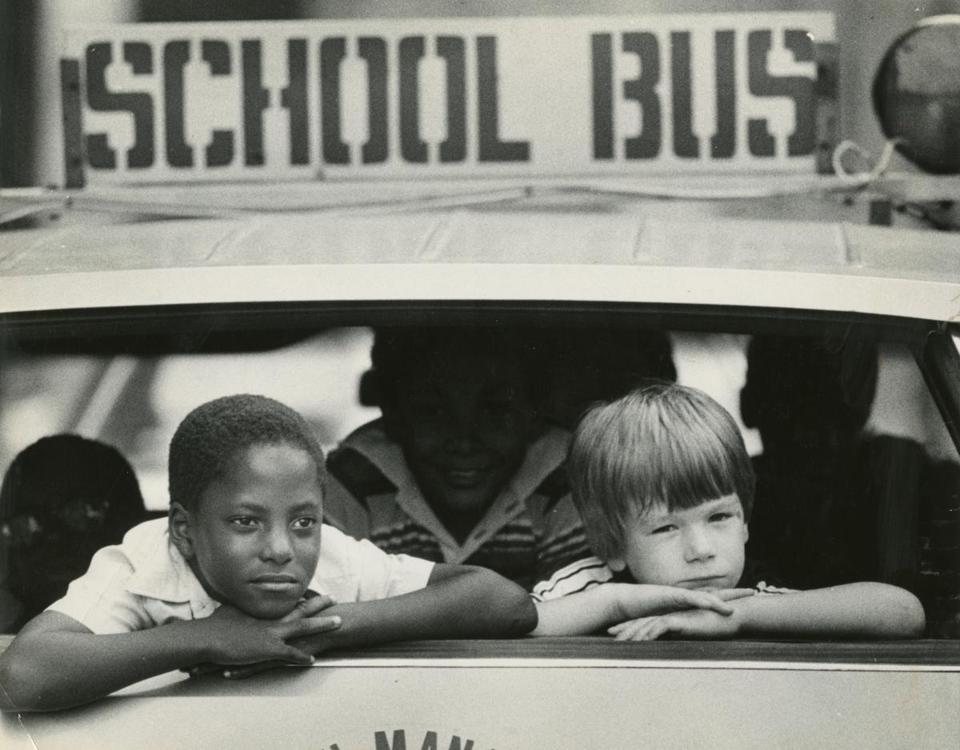
David Patterson, 8, and Chris Russell, 7, rode home from the first day at McKay School in East Boston in September 1979. (Stan Grossfeld/Globe Staff/File 1979)
By Farah Stockman
If you find yourself reading the 2,200-page spending bill that just got passed in Washington, you might stumble upon this hidden relic: “No funds appropriated in this Act may be used for the transportation of students or teachers (or the purchase of equipment for such transportation) in order to overcome racial imbalance in any school or school system, or . . . in order to carry out a plan of racial desegregation.”
Court-ordered busing to address “racial imbalance” in schools has pretty much gone the way of the dodo. Yet those words still appear in spending bills, as if busing might suddenly rise again, like a zombie from “The Walking Dead.”
Was busing really that awful? And how could a policy of educational and racial equality — one of the most idealistic projects our government ever attempted — have turned out like this?
I’ve spent much of this past year trying to answer those questions. I’ve listened to Bostonians recount their memories of 1974, the year a federal judge ordered that busing be used to desegregate Boston’s schools. I’ve looked into the lives of people who fought for it and against it. I’ve interviewed researchers from across the country about what school desegregation achieved, and where it failed. I’ve examined the racial makeup of Boston’s schools to see how they’re different today.
One thing that struck me, over and over again, is just how alive this history is, not only in this city, but across the country.
National politics today pits black against white against brown; those who have little against those who have even less. We’ve been here before. From the blue-collar disciples of Donald Trump to the revolutionary rhetoric of Black Lives Matter, we are in a tug of war over the nation’s soul. Divides over class and race have taken center stage, just as they did during the busing era 40 years ago. What, if anything, have we learned since then?
WHY SOUTHIE LOVES TRUMP
For a lot of white people who grew up in Boston, time seems to be divided into two spheres: Before Busing and After Busing. Before Busing, all the fathers drank Schlitz and listened to the baseball game together, while the mothers watched their kids play in the street. After Busing, everyone scattered to different schools or moved away. People stopped getting to know their neighbors. Before Busing, if you wanted a good job and you hadn’t gone to college, you called a politician or a priest. They’d give you something in the water department. Or the sewer department. If you were lucky, you’d get fire or police. After Busing, you couldn’t count on anything. Before Busing, you were Irish. Or you were Italian. After Busing, you were merely white — an identity that sounded more and more like an accusation with each passing day.
Don’t try to tell this crowd that the good old days weren’t so good for everybody, or that the old world they long for was already fading by the time busing came around. Their childhoods were golden. Whatever went wrong in life went wrong later, After Busing.
That’s the way they think of it. And why shouldn’t they?
As much as we’d like history to be an arc bending toward justice — each turn of the wheel making all of us a little freer — the truth is that history is more like a tug of war between demographic rivals over finite resources: Jobs. Money. Power.
In the 1970s, working-class whites in Boston lost their monopoly in this city. They watched their advantages ebb away.
They were forced to share their piece of the pie with blacks, at the very moment globalization and other forces were already making that pie smaller. Since then, working-class men with only a high school diploma have seen their median earnings fall by 41 percent. For whites without college degrees aged 45 to 54 — the generation that came of age in the 1970s — a sense of hopelessness seems to have set in: Suicide, alcoholism, and drug addiction have sparked an alarming spike in their mortality rate, even as others are living longer.
It’s no mystery why white men without college degrees flock to Donald Trump, who promises to “Make America Great Again.”
Resentment over these losses — which few politicians dare to articulate out loud — help explain Trump’s stunning lead: Three-quarters (74 percent) of Trump supporters believe that discrimination against whites has become “as big a problem as discrimination against blacks and other minorities.” Only 57 percent of those who support other Republican candidates think that way.
“Trump is not my preference,” John Ciccone, publisher of the newspaper South Boston Today, tells me. “But, boy, his appeal is incredible. People I never expected to support Trump are supporting him: people who’ve been union members for years and years and are expected to support the Democratic candidate, no matter what.”
It’s partly the economy, Ciccone said: “Around here, there’s still so many people out of work. We see families moving in with relatives.”
But maybe it’s also that Trump reminds them of a world before political correctness, racial guilt, and economic anxiety. And, at least for whites here in Boston, a world before busing.
“I’m a conservative Christian NRA member, and I consider myself a traditional American,” Ciccone said. “So many people remember a time when that was the way to be. If you needed the government, it was there, but it was not so intrusive. There’s a resentment. A feeling of being tread upon.”
WHY BLM IS AMBIVALENT ABOUT BUSING
If working-class whites count busing as a loss — many blacks think of it as a partial victory, at best. Although studies show that school desegregation, on the whole, boosted graduation rates and the lifetime earnings of blacks nationwide, huge disparities remain.
And those disparities are what we’ve focused on. Chronicling gaps has become a cottage industry. We’ve seen countless articles about the wealth gap. The health gap. Even the so-called sleep gap, which refers to the difference between how much shut-eye whites and blacks get each night.
In the past, such disparities might have been wielded by racists as proof that something was the matter with black people. But today, they’re wielded by black activists as evidence that something is very broken in America itself, unfixed even by the greatest gains of the Civil Rights movement.
Indeed, some gaps are so enduring and so vast, that people wonder if any progress has been made at all: 41.5 percent of black children lived in poverty in 1970s, compared to 10.5 percent of whites. Today, 37 percent of black kids live in poverty, compared to 12 percent of whites.
School desegregation improved black people’s lives, but not nearly as much as they had hoped.
These days, some older folks allow themselves to mourn the loss of precious things they sacrificed in the name of integration: Beloved schools closed, so kids could go to white ones. Beloved children sent to spend their day with strangers whose love could not be legislated by a court. Yet, most folks I talked to from that generation insist that the struggle to integrate was worth it.
But millennials are not so sure.
Their expectation for equality is so much higher than their parents’. In the face of so many enduring disparities, they question the tactics of the past. The whole idea that a child must be rescued from the black community — and sent to a white one — to get a good education is anathema to many activists. Isn’t there something wrong with telling young black and brown kids that their school is inferior simply because it’s full of too many kids who look like them?
This young generation — born two decades after busing — has become so accustomed to racial mixing that they seem to take it for granted. They question whether integration ought to be a goal at all.
“Integration turns into assimilation,” said Daunasia Yancey, the 23-year-old cofounder of the Black Lives Matter movement in Boston. “It’s ‘How do we fit into white society?’ instead of ‘How do we change the playing field?’ ”
Even so, Yancey’s own short life has been shaped by the battle over busing. She lives in Jamaica Plain but went to school in Newton, though METCO — a voluntary busing program established in the 1960s to combat segregation. Earlier generations of civil rights activists in Boston fought for her to have that access. But growing up in a predominantly white school fueled her sense of injustice: “I had so much interaction with white people and so much racism facing me as a super-bright, loud, and opinionated black kid,” she told me.
Today, she says, being allowed in the door of a white school is not enough: “It’s not enough to say ‘Go to these white schools and access that.’ The schools in the city should be fully resourced.”
To Yancey, integration represents economic loss, the closure of black businesses that used to thrive off black customers. “When lunch counters and restaurants were integrated, you saw black people going to white establishments that used to ban them,” she said.
If middle-aged white people long for the days of their childhood, before busing, some millennials long for the black community they never knew — that almost mythically pure society that existed before integration.
FORTY YEARS OF LESSONS FROM BUSING
Today, the concept of court-ordered busing to desegregate schools has few champions. Conservatives look back on busing in Boston as an outrageous overreach of government powers. Liberals look back on it as a policy that didn’t go far enough. It didn’t last long enough. It didn’t reach deep enough into the wealthy suburbs.
It’s a shame that busing has gone out of style at the very moment we’ve gotten a better understanding of why it failed — and where it worked.
It’s important to remember that busing did achieve success in places other than Boston. Bigger school districts, which encompassed both city and suburb, saw lasting gains. For instance, in Louisville, Ky., where the school district is 400 square miles.
Older civil rights activists in Boston blame racism for the fact that so many whites left the city in the aftermath of busing, robbing them of the gains that would have been achieved by integration. But the size of the district — and the availability of so many high-performing school districts nearby — probably mattered just as much. That’s a big reason school desegregation was more successful in the South, where school districts are larger and there are few neighboring districts. There, the percentage of black students in intensely segregated schools has dropped from 80 percent in 1968 to a little more than 30 percent today, according to a report by the Civil Rights Project at UCLA.
In the Northeast, which has so many alternative school districts where whites and middle-class families can flee, the results are far more discouraging: The percentage of black students who attend “intensely segregated” schools has actually risen, from 43 percent in 1968 to more than 50 percent today.
We know now that Boston “did not have the right conditions” for the kind of busing desegregation plan that Judge W. Arthur Garrity Jr. ordered, said Sarah Reber, associate professor of public policy at UCLA’s Luskin School of Public Affairs.
The plans that saw the best long-term results were the ones that made the most gradual changes, had the smallest number of blacks, and imposed the least inconvenience on whites.
For instance, Volusia County — which covers Daytona Beach, Fla. — managed to achieve long-term success by scattering a small number of black students across a large number of white schools. Few whites were reassigned.
But here in Boston, Garrity ordered white students in Southie to go to black schools in Roxbury that he had just condemned. Half of all white students failed to show up for school, according to Christine Rossell, a Boston University professor who helped implement Garrity’s order in the 1970s and later became one of the nation’s most outspoken opponents of court-ordered busing.
Rossell changed her mind about busing when it became clear that white flight had offset any integration that had been achieved. “Boy, were we naive,” she said.
In 1974, 62 percent of black students in Boston attended schools that were more than 70 percent black, according to Garrity’s ruling. Today, about 80 percent of black students attend schools that are more than 70 percent black or Hispanic.
Statistics like these are one reason that court-ordered busing gave way to school choice programs and magnet schools across the country. Today, there’s a nationwide trend to return to neighborhood schools.
And yet, school desegregation — including busing — achieved things that are so integral to our lives today that we don’t even notice them. In the 1970s, plenty of whites still believed the races to be inherently unequal and social contact to be taboo. Today, almost no one would say such a thing out loud. The fact that we take this for granted can be counted as progress.
Perhaps the biggest mistake we made back in the 1970s was to frame school desegregation as a battle between racists and the righteous, rather than a public policy puzzle, full of trade-offs, that had to be solved. Today, in the era of Donald Trump and Black Lives Matter, we’re back to that same polarization. It’s as if we’ve learned nothing at all.
This piece is part of a series of columns about Boston — four decades after busing — supported by the Sigma Delta Chi Foundation. Farah Stockman can be reached at [email protected]. Follow her on Twitter @fstockman.
To the Pulitzer Committee:
It's often said that we might be done with the past, but the past is not done with us. Perhaps no better truism captures the complex legacy of court-ordered busing in Boston.
As racial turmoil roiled America's cities this year, some have called for activist government solutions to problems of entrenched racism and systemic discrimination. Yet the reverberations of such controversial policies continue to shape the social fabric of Boston. Op-ed columnist Farah Stockman's comprehensive, nuanced examination of busing mapped out not only the contours of the past but also the long-tailed impact on the Boston and New England of 2015.
These aren't easy stories to tell--emotions are still raw, the scars still unhealed, the taboos unspoken, segregation as real as ever. None of this daunted Stockman, however. One of the very few women foreign-affairs columnists, she brought the same diligent, rigorous reporting skills and penetrating gaze to racial and class divides in Boston and nationwide that she normally trains on national security and world leaders. And the truths she unearthed could not be ignored: that busing was an utter failure; that separate could be not only equal but better; that despite all our best intentions kids are still not prepared to succeed in a multiracial society.
Stockman, the daughter of a black woman raised in Jim Crow Mississippi and a white man from rural Pennsylvania, has called dissecting the aftermath of busing the most difficult reporting assignment of her career. Her dedication to it--more than four months that included travel to Israel, Japan, and New Zealand--shines through in her vivid writing, moral wrestling, and graceful storytelling. It helped, too, that Stockman is already at the top of her field--she was awarded the Sigma Delta Chi Foundation 2014 Eugene C. Pulliam Fellowship to pursue thi project.
Most remarkably, Stockman managed to leave readers with a sense of hope. Massachusetts Governor Charlie Baker and other policymakers have repeatedly praised her series in recent months as a compelling case for how government can learn from its past missteps and make public education an effective tool to bridge the growing gap between rich and poor. It's hard to think of a more pressing issue in America today.
I should note that due to an editing error in one of the pieces submitted here, an apples-to-oranges comparison of state data required a factual correction. The footnote to this series does not detract from the overwhelming body of reporting and its trenchant message.
I am deeply proud to nominate Farah Stockman for the 2016 Pulitzer Prize in Commentary.
Sincerely,
Kathleen Kingsbury
Deputy Managing Editor, Editorial Page
Biography
Farah Stockman is currently a columnist and editorial writer at the Boston Globe and a term member of the Council on Foreign Relations.
Farah grew up in East Lansing, MI and attended Harvard University, where she majored in Social Studies and minored in African history. After graduation in 1996, she moved to Kenya and established an educational program for street children called Jitegemee that continues to serve 200 children each year.
In 1997, she entered the world of journalism by interning with a New York Times reporter in Nairobi, helping to cover the Kenyan presidential elections and the aftermath of the 1998 Al Qaeda embassy bombings. Her work with the New York Times led her to freelance jobs with AP, Reuters and the Christian Science Monitor. In the fall of 1998, she moved to Arusha, Tanzania to cover the International Criminal Tribunal for Rwanda.
In 2000, she took a job with the Boston Globe, working for four years as a general assignment reporter in New England. After the Sept. 11 terrorist attacks in 2001, she traveled to Pakistan to cover the investigation into Al Qaeda’s camps and the war in Afghanistan. From 2004 to 2011, she served as the Globe’s foreign affairs reporter, working from Washington DC, Afghanistan, Pakistan, Iran, the United Arab Emirates, Indonesia, Kenya, Guantanamo Bay and Britain.
Farah’s stories identifying US corporations that were using off-shore shell companies to side-step US laws won the 2009 Scripps Howard national journalism award. In 2008, she was part of a team that won 2nd place in the Daniel Pearl Award for Outstanding International Investigative Reporting.
In 2012, Farah became a columnist focusing on foreign affairs, national and local politics, and investigations that examine conventional wisdom. Farah’s columns, written in the spring of 2013, highlighted the abuse of H-1B visas by Indian outsourcing companies. Her columns help ignite a firestorm of anger over the abuses. Within months, the senate passed an immigration bill that put much tougher restrictions on Indian outsourcing companies that had been exploiting loopholes in the law.