Eli Saslow of The Washington Post
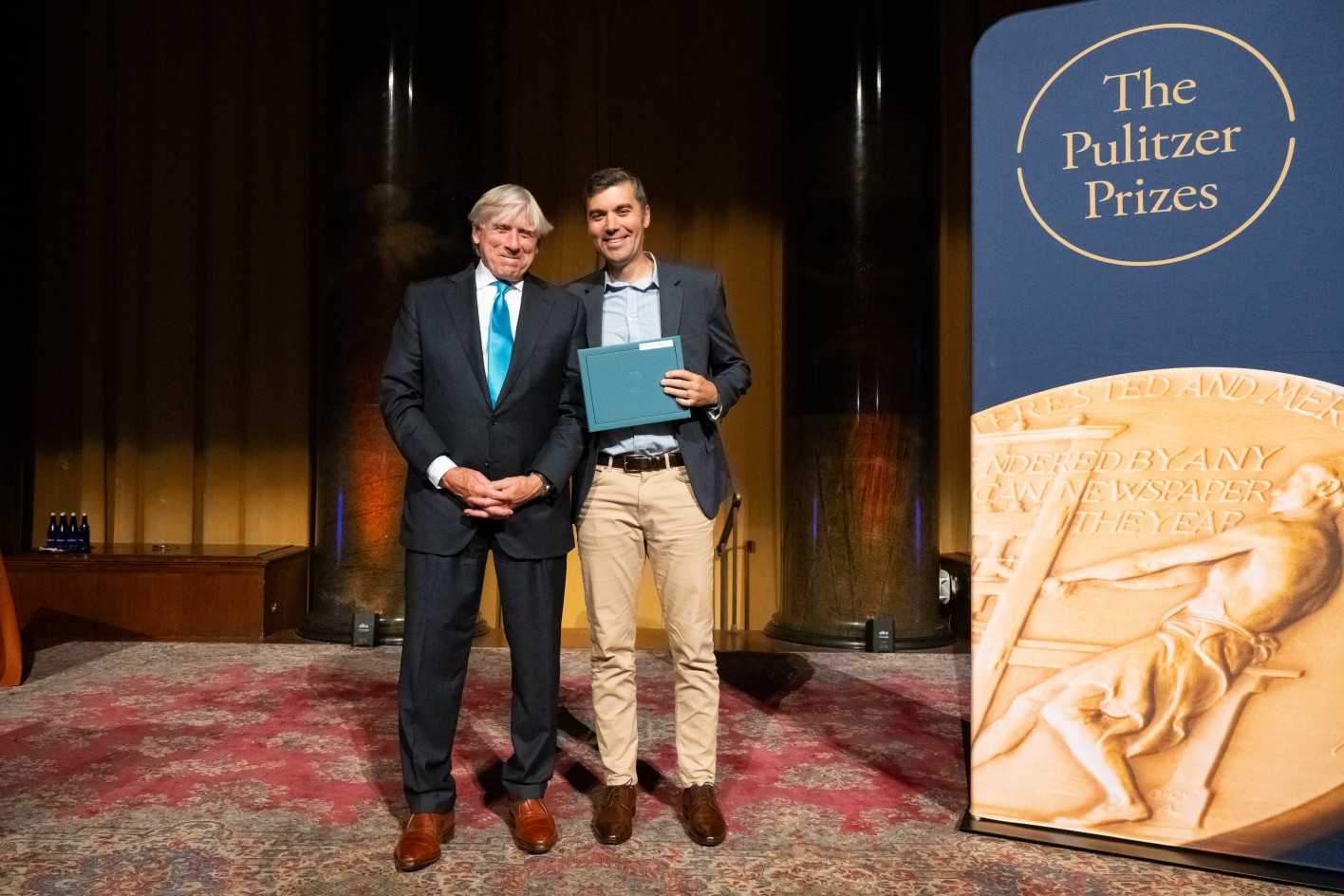
Eli Saslow accepts the 2023 Pulitzer Prize for Feature Writing from Columbia University President Emeritus Lee Bollinger. (Diane Bondareff/The Pulitzer Prizes)
Winning Work
DENVER — Suna Karabay touched up her eye makeup in the rearview mirror and leaned against the steering wheel of the bus to say her morning prayers. “Please, let me be patient,” she said. “Let me be generous and kind.” She walked through the bus to make her final inspection: floor swept, seats cleaned, handrails disinfected, gas tank full for another 10-hour shift on the city’s busiest commercial road. She drove to her first stop, waited until exactly 5:32 a.m., and opened the doors.
“Good morning!” she said, as she greeted the first passenger of the day, a barefoot man carrying a blanket and a pillow. He dropped 29 cents into the fare machine for the $3 ride. “That’s all I got,” he said, and Suna nodded and waved him onboard.
“Happy Friday,” she said to the next people in line, including a couple with three plastic garbage bags of belongings and a large, unleashed dog. “Service pet,” one of the owners said. He fished into his pocket and pulled out a bus pass as the dog jumped onto the dashboard, grabbed a box of Kleenex, and began shredding tissues on the floor.
“Service animal?” Suna asked. “Are you sure?”
“What’d I tell you already?” the passenger said. “Just drive the damn bus.”
She turned back to face the windshield and pulled onto Colfax Avenue, a four-lane road that ran for more than 30 miles past the state capitol, through downtown, and toward the Rocky Mountains. Forty-five years old, she’d been driving the same route for nearly a decade, becoming such a fixture of Denver’s No. 15 bus line that her photograph was displayed on the side of several buses — a gigantic, smiling face of a city Suna no longer recognized in the aftermath of the pandemic. The Denver she encountered each day on the bus had been transformed by a new wave of epidemics overwhelming major cities across the country. Homelessness in Denver was up by as much as 50 percent since the beginning of the pandemic. Violent crime had increased by 17 percent, murders had gone up 47 percent, some types of property crime had nearly doubled, and seizures of fentanyl and methamphetamine had quadrupled in the past year.
She stopped the bus every few blocks to pick up more passengers in front of extended-stay motels and budget restaurants, shifting her eyes between the road ahead and the rearview mirror that showed all 70 seats behind her. In the past two years, Denver-area bus drivers had reported being assaulted by their passengers more than 145 times. Suna had been spit on, hit with a toolbox, threatened with a knife, pushed in the back while driving and chased into a restroom during her break. Her windshield had been shattered with rocks or glass bottles three times. After the most recent incident, she’d written to a supervisor that “this job now is like being a human stress ball.” Each day, she absorbed her passengers’ suffering and frustration during six trips up and down Colfax, until, by the end of the shift, she could see deep indentations of her fingers on the wheel.
Now she stopped to pick up four construction workers in front of “Sunrise Chinese Restaurant — $1.89 a Scoop.” She pulled over near a high school for a teenager, who walked onto the bus as she continued to smoke.
“Sorry. You can’t do that,” Suna said.
“It’s just weed.”
“Not on here,” Suna said. The girl tossed the joint onto the sidewalk and banged her fist into the first row of seats, but Suna ignored her. She kept driving as the bus filled behind her and then began to empty out after she passed through downtown. “Last stop,” she announced, a few minutes before 7 a.m. She was scheduled for a six-minute break before turning around to begin her next trip up Colfax, but when she looked in the rearview mirror, there were still seven people sleeping on the bus. Lately, about a quarter of her riders were homeless. The bus was their destination, so they rode until someone forced them to get off. “Sorry. Everyone out,” Suna said again, speaking louder, until the only passenger left was a man slumped across two seats in the second row. Suna got up to check on him.
“Sir?” she said, tapping his shoulder. He had an open wound on his ankle, and his leg was shaking. “Sir, are you okay?”
He opened his eyes. He coughed, spit on the floor, and looked around the empty bus. “We make it to Tulsa?” he asked.
“No. This is Denver. This is the 15 line.”
The passenger stumbled onto his feet. “Do you want me to call you an ambulance?” Suna asked, but he shook his head and started limping toward the doors.
“Okay. Have a good day,” Suna said. He held up his middle finger and walked off the bus.
* * *
Five days a week she drove back and forth on the same stretch of Colfax Avenue, stopping 38 times each way, completing every trip in a scheduled time of 72 minutes as she navigated potholes by memory and tried to make sense of what was happening to her passengers and to the city that she loved. She’d started reading books about mental illness and drug abuse, hoping to remind herself of what she believed: Addiction was a disease. Homelessness was a moral crisis. The American working class had been disproportionately crushed by covid-19, rising inflation and skyrocketing housing costs, and her passengers were among the victims. She thought about what her father had told her, when she was 19 years old and preparing to leave her family in Turkey to become an immigrant in the United States. He’d said that humanity was like a single body of water, in which people were made up from the same substance and then collected into different cups. This was her ocean. It was important not to judge.
And for her first several years in Denver, that kind of compassion had come easily to her. She felt liberated driving the city bus, which Muslim women weren’t allowed to do back home in Ankara. She loved the diversity of her passengers and built little relationships with her regulars: Ethiopian women who cleaned offices downtown, elementary-school children who wrote her thank you notes, Honduran day laborers who taught her phrases in Spanish, and medical students who sometimes asked about her heart ailment. But then the pandemic closed much of Denver, and even though Suna had never missed a day of work, many of her regulars had begun to disappear from the bus. Two years later, ridership across the city was still down by almost half, and a new wave of problems had arrived in the emptiness of urban centers and public transit systems, not just in Denver but all across the country.
Philadelphia was reporting an 80 percent increase in assaults aboard buses. St. Louis was spending $53 million on a new transit security plan. The transportation union president in Tucson said the city’s buses had become “a mobile refuge frequented by drug users, the mentally ill, and violent offenders.” The sheriff of Los Angeles County had created a new transit unit to keep passengers from having to “step over dead bodies or people injecting themselves.” And, meanwhile, Suna was compulsively scanning her rearview mirror, watching for the next crisis to emerge as she began another shift.
Two teenagers were burning something that looked like tinfoil in the back of the bus. A woman in a wheelchair was hiding an open 32-ounce can of beer in her purse and drinking from it with a straw. A construction worker holding a large road sign that read “SLOW” sat down in the first row next to a teenage girl, who scooted away toward the window.
“This sign isn’t meant for me and you,” the construction worker told the teenager, as Suna idled at a red light and listened in. “We can take it fast.”
“I’m 15,” the girl said. “I’m in high school.”
“That’s okay.”
Suna leaned out from her seat and yelled: “Leave her alone!”
“All right. All right,” the construction worker said, holding up his hands in mock surrender. He waited a moment and turned back to the teenager. “But do you got an older sister?”
Suna tried to ignore him and looked out the windshield at the snow-capped peaks of the Rocky Mountains and the high-rises of the city. She hadn’t been downtown on her own time since the beginning of the pandemic, and lately, she preferred to spend entire weekends reading alone in her apartment, isolating herself from the world except for occasional phone calls with her family in Turkey. “I used to be an extrovert, but now I’m exhausted by people,” Suna had told her sister. Increasingly, her relationship with Denver was filtered through the windshield of the bus, as she pulled over at stops she associated mostly with traumas and police reports during the pandemic.
There was Havana Street, where, a few months earlier, a woman in mental distress had shattered the windshields of two No. 15 buses, including Suna’s, within five minutes; and Billings Street, where, in the summer of 2021, a mentally unstable passenger tried to punch a crying toddler, only to be tackled and then shot in the chest by the toddler’s father; and Dayton Street, where Suna had once asked a man in a red bikini to stop smoking fentanyl, and he’d shouted “Here’s your covid, bitch!” before spitting in her face; and Downing, where another No. 15 driver had been stabbed nearby with a three-inch blade; and Broadway, where, on Thanksgiving, Suna had picked up a homeless man who swallowed a handful of pills, urinated on the bus, and asked her to call an ambulance, explaining that he’d poisoned himself so he could spend the holiday in a hospital with warm meals and a bed.
“Hey, driver! Hit the gas,” a passenger yelled from a few rows behind her. “We’re late. You’re killing me.”
She stared ahead at a line of cars and checked the clock. She was two minutes behind schedule. She inched up toward the brake lights in front of her and tried to focus on a mural painted on the side of a nearby building of a woman playing the violin.
“Hey! Do you speak English?” the passenger yelled. “Get your ass moving or get back to Mexico.”
She kneaded her hands into the steering wheel. She counted her breaths as they approached the next stop, North Yosemite Street, which had been the site of another episode of violence captured on security camera several months earlier. An intoxicated and emaciated 57-year-old woman had jumped out in front of a moving No. 15 bus, shouted at the driver to stop, and then pushed her way onboard. She’d started cursing at other passengers, pacing up and down the aisle until a man twice her size stood up in the back of the bus and punched her in the face with a closed fist, slamming her to the floor. “Who ain’t never been knocked out before?” he asked, as the woman lay unconscious in the aisle, and then he stood over her as the other passengers sat in their seats and watched. “Here’s one more,” he said, stomping hard on her chest. He grabbed the woman by the ankle and flung her off the bus, leaving her to die of blunt-force trauma on the sidewalk. “We can keep riding though,” one of the other passengers had told the driver, moments later. “We got to go to work, man.”
Now, Suna pulled over at the next stop and glanced into the rearview mirror. The belligerent passenger was out of his seat and moving toward her. She turned her eyes away from him and braced herself. He banged his fist into the windshield. He cursed and then exited the bus.
Suna closed her eyes for a moment and waited as three more passengers climbed onboard. “Thanks for riding,” she told them, and she shifted the bus back into drive.
* * *
Each night after she finished making all 228 stops on Colfax, Suna went home to the silence of her apartment, burned sage incense, drank a calming herbal tea and tried to recover for her next shift. Meanwhile, many of her passengers ended up spending their nights at the last stop on the No. 15 route, Union Station, the newly renovated, $500 million gem of the city’s transportation system and now also the place the president of the bus drivers’ union called a “lawless hellhole.”
The station’s long indoor corridor had become the center of Denver’s opioid epidemic and also of its homelessness crisis, with as many as a few hundred people sleeping on benches on cold nights. The city had tried removing benches to reduce loitering, but people with nowhere to go still slept on the floor. Authorities tried closing all of the station’s public bathrooms because of what the police called “a revolving door of drug use in the stalls,” but that led to more people going to the bathroom and using drugs in the open. The police started to arrest people at record rates, making more than 1,000 arrests at Union Station so far this year, including hundreds for drug offenses. But Colorado lawmakers had decriminalized small amounts of drug possession in 2019, meaning that offenders were sometimes cited with a misdemeanor for possessing up to four grams of fentanyl — enough for nearly 2,000 lethal doses — and then were able to return to Union Station within a few hours.
The city’s latest attempt at a solution was a mental health crisis team of four clinicians who worked for the Regional Transportation District, and one night a counselor named Mary Kent walked into Union Station holding a small handbag with the overdose antidote Narcan, a tourniquet and referral cards to nearby homeless shelters.
“Can I help you in any way?” she said to a woman who was pushing a shopping cart while holding a small knife. The woman gestured at the air and yelled something about former president Barack Obama’s dog.
“Do you need anything? Can we help support you?” Kent asked again, but the woman muttered to herself and turned away.
Kent walked from the train corridor to the bus platform and then back again during her shift, helping to de-escalate one mental health crisis after the next. A woman was shouting that she was 47-weeks pregnant and needed to go to the hospital. A teenager was running naked through the central corridor, until Kent helped calm her down and a transit police officer coaxed her into a shirt. During a typical 12-hour shift, Kent tried to help people suffering from psychosis, schizophrenia, withdrawal, bipolar disorder, and substance-induced paranoia. She connected many of them with counseling and emergency shelter, but they just as often refused her help. Unless they posed an immediate threat to themselves or others, there wasn’t much she could do.
An elderly man with a cane tapped her on the shoulder. “Somebody stole my luggage,” he said, and for a few minutes Kent spoke with him and tried to discern if he had imagined the suitcases or if they had in fact been stolen, both of which seemed plausible. “Let’s see if we can find a security officer,” Kent said, but by then the man no longer seemed focused on the missing suitcases, and instead, he asked the question she got most of all.
“Where’s the closest public bathroom?” he said.
“Oh boy,” she said, before explaining that the one in Union Station was closed, the one in the nearby public park had been fenced off to prevent loitering, the one in the hotel next door had a full-time security guard positioned at the entrance, and the one in the nearby Whole Foods required a receipt as proof of a purchase in the store. The only guaranteed way to protect a space from the homelessness crisis was to limit access, so Union Station had also recently approved a plan to create a ticketed-only area inside the station to restrict public use starting in 2023.
Kent walked outside onto the bus platform, smelled the chemical burn of fentanyl, and followed it through a crowd of about 25 homeless people to a woman who was smoking, pacing and gesticulating at an imaginary audience. A few security officers walked toward the woman, and she moved away and shouted something about the devil. Kent pulled a referral card from her bag, went over to the woman and introduced herself as a clinician.
“What can we do to support you right now?” she asked.
“Nothing,” the woman said. She walked to the other end of the platform, threw a few punches at the air and boarded the next bus.
* * *
The job, as Suna understood it, was to drive and keep driving, no matter what else was happening to the city, so the next morning, she pulled up to her first stop at 5:32 a.m. and then made her way along Colfax, stopping every few blocks on her way downtown. Billings Street. Havana Street. Dayton. Downing. Broadway. She finished her first trip and turned around to start again. A woman with an expired bus pass yelled at her in Vietnamese. Two passengers got into an argument over an unsmoked cigarette lying on the floor. Broadway, Downing, Dayton, Havana, Billings. She shifted her eyes back and forth from the rearview mirror to the road as she made her second trip, her third, her fourth, her fifth, until finally she reached the end of the line at 4:15 p.m. and turned around to begin her final trip of the day. She stopped at Decatur station to pick up three women, closed the doors, and began to pull away from the stop.
“Hey!” a man shouted, standing outside at the bus stop. He wore a basketball jersey and a backward cap. He banged on the bus and Suna stopped and opened the door. “Hey!” the man repeated, as he climbed onboard, cursing at her. “What the hell are you doing pulling away? I was standing right there.”
“Watch your language,” she said. “Where’s your bus fare?”
He paid half the fare and then cursed at her again. He walked to the first row of seats, sat down and glared at her.
“What are you staring at?” he yelled. “Go. Drive the damn bus.”
“I’m not your pet,” she said. “You don’t tell me what to do.”
She pulled out from the bus stop and looked away from the rearview mirror toward the mountains. She counted her breaths and tried to think of what her father had said about humanity being a single body of water. She’d dealt with more difficult passengers during the pandemic, including some earlier that same morning, but that was 11 hours and 203 stops ago, and as the passenger continued to rant, she could feel her patience beginning to give way.
“You’re so stupid,” the passenger said, and she ignored him.
“You idiot. You’re just a driver,” he shouted, and she pulled up to an intersection, hit the brakes, and turned back to him. “Why are you calling me names?” she asked. “F-you. F-that. You don’t know a single good word.” She told him to get off the bus or she would call the police. “Go right ahead,” he said, and he leaned back in his seat as she picked up her phone and gave her location to the officer. She hung up, squeezed the steering wheel, and continued driving toward her next stop.
“You dumb ass,” he said. “You bitch.”
“Just shut up!” she shouted. “You can’t talk to me that way.” Her hands were shaking against the wheel and she could feel the months of exhaustion and belittlement and anger and sadness welling up into her eyes, until she knew the one thing she couldn’t do for even a moment longer was to drive. She pulled over to a safe place on the side of the road. She turned off the ignition and put on her hazard lights. She called a supervisor and said that she was done driving for the day, and that she would be back for her next shift in the morning.
She opened the exit door and turned back to the passenger. “Get off,” she said, blinking back tears, pleading this time. He stared back at her and shook his head.
“Fine,” she said, and she stood up from her seat and walked off the bus.
After the best year in history to be among the super-rich, one of America’s 745 billionaires wonders: ‘What’s enough? What’s the answer?’
BOCA RATON, Fla. — The stock market had been open for only 17 minutes when Leon Cooperman picked up the phone to check how much money he’d made. He dialed a private line to his trading desk in New Jersey, just as he did a dozen times each day.
“Decent start to the morning?” he asked.
“Oh yeah. The market’s shaky, but you’re up.”
“Give me numbers.”
“Looks like six, seven million.”
“Fine. Thank you. Let’s keep holding steady,” said Cooperman, 78. He hung up and watched a stock graph on his computer screen as it rose from one minute to the next, charting another good day to be a billionaire in America. Outside the office, he could see his wife leaving to play in her weekly bridge game and a group of golfers strolling past on a private course. He’d chosen to live in Florida for at least 183 days each year in part to benefit from the state’s low tax rate for residents, and from 7 a.m. until midnight he was typically seated at the desk in his office, managing the more than $2.5 billion he’d made during a career as an investor and a hedge fund manager.
He’d been earning more than his family could spend since about 1975, and in the decades since then he’d come to see the act of making money less as a personal necessity than as a serious game he could play and win. He invested it, traded it, lent it, gave it away and watched each day as the accounts continued to grow beyond his needs, his wants and sometimes even his own comprehension.
“I don’t want to say it’s all play money at this point, but what else could I possibly spend it on?” he sometimes wondered. His wife’s walk-in closet was already bigger than the South Bronx apartment where he’d grown up. Their Florida home had a custom-built infinity pool, and in five years he’d never once gone in for a swim.
He checked the stock graph on his screen and called his trading desk again.
“Still good? Any news?”
“Very good, yeah. The highfliers are getting killed, but the value stocks are doing great. You’re up about 10 million.”
The past year had been the best time in history to be one of America’s 745 billionaires, whose cumulative wealth has grown by an estimated 70 percent since the beginning of the pandemic even as tens of millions of low-wage workers have lost their jobs or their homes. Together, those 745 billionaires are now worth more than the bottom 60 percent of American households combined, and each day Cooperman could see that gap widening on his balance sheet — up an average of $4,788 per minute in the stock market, $1.9 million per day and $700 million total in 2021. As a record amount of wealth continued to shift toward a tiny fraction of people at the pinnacle of the economy, Cooperman could sense something else shifting, too.
“Billionaires shouldn’t even exist in America,” read one note he’d received after he went on TV to recommend stock picks.
“One day, we’re coming after all of you with pitchforks,” read another message.
“Wake up, moron. YOU and your insatiable greed are at the root of our biggest societal problems.”
He responded to most of the personal emails, kept record of the occasional death threats and wrote letters to politicians such as Sen. Elizabeth Warren (D-Mass.), Sen. Bernie Sanders (I-Vt.) and Rep. Alexandria Ocasio-Cortez (D-N.Y.) whenever they criticized billionaires in their speeches, because he couldn’t understand: What exactly had he done wrong? What rule had he broken? He’d been born to poor immigrant parents on the losing end of a capitalist economy. He’d attended public schools, taken on debt to become the first in his family to attend college, worked 80-hour weeks, made smart decisions, benefited from some good luck, amassed a fortune for himself and for his clients and paid hundreds of millions in taxes to the government. He had a wife of 57 years, two successful children, and three grandchildren who were helping him decide how to give most of his money away to a long list of charities. “My life is the story of the American Dream,” he’d said while accepting an award at one charity gala, and he’d always imagined himself as the rags-to-riches hero, only to now find himself cast as the greedy villain in a story of economic inequality run amok.
And now came another series of emails from a stranger who ran a charity in New Jersey. She said billionaires were avoiding paying their fair share of taxes by using loopholes in the tax code. She said their legacy of excessive wealth was “burdening future generations.” She said Cooperman had no idea what it was like to live in poverty or to choose each month between paying rent or buying food.
“She makes decent points,” Cooperman said as he read the email again, and it made him think back to a question he’d begun wondering about himself: In a time of historic inequality, what were the moral responsibilities of a billionaire?
“Thank you for your emails. It might be helpful for me to provide you with some background about myself,” he wrote back, and then he attached a short biography and copies of his letters to politicians. “There seems to be a fundamental misunderstanding of who I am.”
***
He knew what people imagined when they thought of a billionaire. He’d read the stories of excess and extravagance and witnessed some of it firsthand, but that wasn’t him. He didn’t spend $238 million on a New York penthouse like hedge fund manager Ken Griffin; or vacation at his own private island in Belize like Bill Gates; or throw himself $10 million birthday parties featuring camels and acrobats like investor Stephen Schwarzman; or drop $70,000 a year on hair care like Donald Trump; or buy a preserved 14-foot shark for an estimated $8 million like Steven Cohen; or spend more than $1 billion on art like media mogul David Geffen; or budget $23 million for personal security like Facebook did for Mark Zuckerberg.
He didn’t have his own spaceships like Elon Musk and Jeff Bezos; or a 600-foot flying airship like Sergey Brin; or a decommissioned Soviet fighter jet like Larry Ellison; or a $215 million yacht with a helipad and a pool like Steve Wynn; or a private train with three staterooms like John Paul DeJoria; or a $5 million luxury car collection like Kylie Jenner.
What Cooperman had for transportation was a 25-year-old Schwinn bicycle he liked to ride around the neighborhood and a Hyundai he used for running errands a few times each week.
He rechecked the stock graph on his screen and picked up his phone to call his wife, Toby, who was sitting in her office suite down the hall.
“I’m going to head out and grab some of those Costco lamb chops later,” he told her.
“We need anything else?” she asked.
“I don't think so,” he said. “I’ll just see what’s on special.”
They’d been together since they met at Hunter College in 1962, when tuition at the public New York university cost as little as $24 per semester and the promise of a life in America was that each generation would surpass the one before. She was the daughter of a struggling pillowcase salesman from Romania; he was the son of a plumber’s apprentice who emigrated from Poland at age 13, never finished high school, worked six days a week and later died of a heart attack while carrying a sink up the stairs to a fourth-story apartment.
His father left behind an estate worth less than $100,000, but Cooperman also inherited his father’s belief that the economic ladder between poor and rich was short enough to climb with determination and hard work. More than 90 percent of children born in the United States during the 1940s would go on to out-earn their parents; two-thirds of those born into poverty would rise into at least the middle class. Cooperman waited tables during the summers, worked for Xerox while he went to business school at night and then started as an analyst at Goldman Sachs making $12,500 a year. “My PhD is for poor, hungry and driven,” he liked to say. He told colleagues that capitalism was like a battle for survival in the African safari and that the key to success was to adopt the mind-set of a lion or a gazelle during a hunt. “When the sun comes up, you’d better be running,” Cooperman told them. Within nine years, he’d been named a partner. Within a decade, he was a millionaire.
Together, he and Toby had learned how to be rich, which mostly meant deciding how not to spend their money. He still felt most comfortable shopping for clothes wholesale and commuting to work on New Jersey public transit. Toby enjoyed her job as a special-education teacher even if she didn’t need the $25 an hour, so she continued working and donated her salary back to the school. They bought a house for $325,000 in New Jersey in the 1980s and later built their $5 million home in Florida. They worried about demotivating their two children by giving them a massive inheritance, so instead they put a small fraction of their wealth into a trust that could be accessed only once their sons turned 35, at which point one was already a successful businessman and the other was an environmental scientist with a PhD.
Cooperman eventually left Goldman Sachs to start his own hedge fund, Omega, and for two decades he compounded his millions at an average of 14 percent each year as the stock market soared, until he and Toby were among the wealthiest few hundred billionaires in the United States. They were invited to dinner in 2010 by Gates and Warren Buffett, who had just started a program called the Giving Pledge, asking billionaires to donate at least half of their money to charity, and the Coopermans committed that night.
“I could buy a Picasso for a hundred million, but it doesn’t turn me on, so then what?” Cooperman told them. “We live a very rational lifestyle. What better use is there for our money?”
They’d given away $150 million to a hospital in New Jersey, $50 million for college scholarships to Newark high school students, $40 million to Columbia Business School, $40 million to Hunter College, $30 million to performing arts, $25 million to the Jewish Family Fund, $20 million to skilled nursing, $15 million to food banks, and on and on it went. But no matter how much they gave away, their money continued to make more money even as wages for the middle class remained essentially flat. In the past 50 years, the gap between poor families and the top 0.1 percent had increased more than tenfold. Children now had only a 43 percent chance of out-earning their parents.
“Mr. Cooperman, your donation is needed to keep the American Dream off life support,” read one of the dozens of solicitations he received each day.
“Mr. Cooperman, more than 11 million American children are now living in poverty …”
“Mr. Cooperman, please help us provide clean drinking water …”
“Mr. Cooperman, the pandemic has left 60 million families at risk of losing their homes …”
He donated to more than 50 organizations each year and also to a number of people who wrote to him in personal distress. “Other than my family, writing checks is the most meaningful thing I do,” Cooperman said, and yet no matter how many zeros he included, it left him wanting to do more. “We’re going in the wrong direction in this country in so many depressing ways,” he said. He believed in the meritocratic ideal of capitalism — “equal opportunity if not equal results,” he said — but it seemed to him that the odds of success remained stacked by race, by gender and increasingly by economic starting position. Rates of intergenerational poverty had gone up in each of the past three decades. The most disadvantaged children were falling further behind. He believed from his own experience that a college education was the best answer, and yet tuition costs were continuing to skyrocket.
“It’s not exactly a fair system until you even up the odds,” he said, and after looking over the list of worthy causes, he and Toby had decided that donating half of their money didn’t feel sufficient. Sixty percent wasn’t enough to meet the country’s needs. Neither was 75. So they’d agreed to set up a family foundation that would eventually give away more than 90 percent of their money, and Cooperman had decided that rather than retiring in earnest, he would continue to manage their account so there would be more to give away.
“He who dies rich dies disgraced,” read a quotation attributed to Andrew Carnegie on Cooperman’s office desk, but on this day he was still rich and getting richer. “What’s enough?” he wondered. “What’s the answer?” He checked the stock graph on his screen — up $2.6 million in the past five hours. His accounts were equal to the average net worth of 23,000 middle-class American families.
***
Each day when the stock market closed at 4 p.m., he checked the final numbers on his 40 stock holdings, reviewed his investment strategy for the next day and then left for a two-mile walk around the palm trees and putting greens of St. Andrews Country Club in Boca Raton. The community was set off from the surrounding suburbs by a canal, a gatehouse, a 10-foot wall and an infrared security system. A few of the 700 homes were owned by other billionaires, and most others belonged to millionaires who wintered in Florida. All of the residents had gotten richer during the pandemic as the luxury real estate market exploded and their home values surged by more than 40 percent.
Cooperman walked past an old designer home that was being torn down and rebuilt into a new designer home. He continued up the road toward the clay tennis courts, the spa and the terraced clubhouse. A resident drove by in a new Bentley, and Cooperman waved and then watched the $200,000 car drive on. “You get a lot of people who show off their wealth,” he said, “but I could buy and sell that guy 100 times.”
He and Toby had spent almost all of their time during the pandemic within the gates of St. Andrews, eating dinner outside at the clubhouse and playing cards with friends, but every few days they liked to go for a drive. Once, early in the pandemic, they’d driven to a quiet, nearby park only to find more than 150 cars lined up in the parking lot as people waited for bags of canned goods at an impromptu food bank. “Depressing and staggering in a country of such wealth,” Cooperman said, and it made him remember a poem his granddaughter had written and published when she was in middle school, called “Seven Miles,” about the physical proximity between the extreme wealth of Short Hills, N.J., where Cooperman had his other home, and the extreme poverty in nearby Newark. “At one end we have too much,” she’d written. “At the other, they have nothing. Spread it all just seven miles.”
She’d gone on to graduate Phi Beta Kappa from Stanford, becoming an “ultraliberal, socialist type in favor of wealth redistribution,” Cooperman said. He adored her and admired both her empathy and her intellect, but he’d repeatedly fought against the liberal idea that one way to redistribute that wealth was to tax billionaires at a rate of 70 percent or more. He’d written to Sen. Warren about her “soak-the-rich positions,” and to President Barack Obama about “villainizing success.” He was a registered independent, and he’d voted for Joe Biden in the last election because he considered President Donald Trump a “would-be dictator whose comportment in office was beyond disgraceful,” but Cooperman believed most of all in the basic tenets of capitalism. He’d earned his money, and therefore it was his to spend or give away. He sent in a quarterly check for $10 million to the federal government in estimated taxes and said he paid an effective tax rate of 34 percent. He’d told politicians in his letters that he was willing to pay more, but he believed the highest effective tax rate should be no more than 50 percent.
“What made America great is our system of capitalism, incentivizing work and effort and ingenuity,” he’d written. “Capitalism has flaws, but socialism has no benefits. Why not spread my work ethic instead of just my wealth?”
Now he looped around a cul-de-sac and turned back toward his house. For years, he’d been doing these daily walks with his brother, Howard, until he died in December at age 85, and lately Cooperman had been thinking back over their lives. Cooperman had chosen to wake up at 5:15 each morning and devote 80 hours every week to his work, taking off only the Friday after Thanksgiving. His brother, meanwhile, had chosen not to go to college and then retired as soon as he could. He preferred to play racquetball, go to the casino with friends and volunteer as a wheelchair transporter at the hospital. Cooperman had ended up with his billions and his name on top of the hospital entrance; his brother had died with relatively modest amounts of money but with a cellphone loaded with numbers for dozens of close friends.
“We both got what we worked for,” Cooperman said. “We were best friends, and we admired what each other had, but it would have been wrong to take what I earned and given it all over to him.”
He walked up his circular driveway, into the house and back toward his office.
“Different choices, different outcomes,” he said. “The world isn’t meant to be totally even.”
***
Cooperman, left, with his brother, Howard, who died in December. (Family photo)His choice: 12 more hours anchored to the chair in his office, monitoring the market and calling in to his trading desk again and again as the sun reflected off the swimming pool outside his window. The market fell. The market rose. He bought $3 million in distressed bonds. He gave another $5 million away to charity. He was $18 million up for the day. He was $6 million down. He was beating the market again by mid-morning, losing at lunch, winning an hour later, and then losing again. “Does it make any sense?” he asked himself, watching the numbers change on his screen. “To sit inside all day in front of a machine, making money I don’t need so I can give it to someone I don’t know?”
He’d been wondering since his brother’s death whether there were better ways to spend some of his time, so one afternoon before the stock market closed, he shut off his computer and drove a few miles outside the gates of St. Andrews to visit Florida Atlantic University. The school’s president had invited Cooperman to speak to a group of low-income college students about his career and his values.
“Believe it or not, I have a great deal of commonality with all of you,” Cooperman said as he stood at the lectern and looked out at the crowd of about 40 students from a university scholarship program much like the one Cooperman and his wife had started in New Jersey. Most were students of color who had been born to immigrant parents. All of them came from families with incomes of $30,000 or less. The students had been living on campus during the pandemic as some of their families were upended by layoffs, by evictions, by a Haitian earthquake, by a Dominican drought, by coronavirus infections and covid-19 deaths.
“I can understand some of the challenges you’re facing right now,” Cooperman said, starting a short PowerPoint presentation about his journey from a one-bedroom apartment to the Forbes 400 list of wealthiest Americans.
“I worked very hard. I wanted to win,” he told them as he flipped to the next slide.
“I’m a great believer in capitalism,” he said. “We have the best economic system in the world.”
“How do you become wealthy?” he asked. “You develop a product or a service that people want. The world is better off for a Larry Ellison, a Bill Gates. Look at the jobs they created. Look at the good they did for the world. The attack on wealthy people makes no sense to me.”
“I’m giving the money away,” he said. “It’s been my pledge, and my wife’s pledge, to give it all away.”
He finished going through the slides and then asked for questions, and after a while a student in the center of the room raised her hand and waited for the microphone. She said she was also interested in a career in business, and she explained that one of the many barriers in her way was the start-up cost. “In Florida, you need $200,” she said.
“You’re going to need a lot more than that,” Cooperman said.
“I know,” she said. “I just mean two hundred to get the license, the paperwork, from zero.”
Cooperman looked at her for a moment and tried to imagine what it would mean to start again from zero, and what it would be like to ascend from poverty to extreme wealth not in the 1960s but in 2022, when that gap had multiplied 10 times. But he’d occupied these students’ place in the American economy once. His faith in the American Dream required him to believe that they could one day occupy his.
“I’ll admit, it’s very hard,” he said. “It’s gotten harder. But the 99 percent can still join the 1 percent. It’s possible with enough luck and commitment.”
He told them about how he’d gotten up each morning at 5:15; how he’d chosen a job that he loved; how he’d gotten his PhD in being poor, hungry and driven; how he’d followed his instincts; how he’d attacked each day like a lion chasing a gazelle as he raced to the pinnacle of the economy and the 99 percent receded behind him.
“I can speak to the issues of both being rich and being poor,” he told them, and as a billionaire in the bifurcating American economy, there was one truth of which he felt certain.
“Being rich is better,” he said.
Amid a historic U.S. teacher shortage, a ‘Most Outstanding Teacher’ from the Philippines tries to help save a struggling school in rural Arizona
BULLHEAD CITY, Ariz. — Carolyn Stewart had spent the past five months trying to find teachers for the Bullhead City School District, and now she walked into the Las Vegas airport holding up a sign with the name of her latest hire. The 75-year-old superintendent wandered through the international baggage claim, calling out a name she had just learned to pronounce. “Ms. Obreque?” she said. “Teacher Rose Jean Obreque?”
She saw a woman smiling and moving toward her with a large suitcase.
“Are you our new teacher?” Stewart asked, but the woman shook her head and walked by.
Stewart raised the sign above her head and took out her phone to check in with her office 100 miles south in Bullhead City, Ariz. The 2,300 students in her district had been back in school for several weeks, but she was still missing almost 30 percent of her classroom staff. Each day involved a high-wire act of emergency substitutes and reconfigured classrooms as the fallout continued to arrive in her email. Another teacher had just written to give her two-week notice, citing “chronic exhaustion.” A new statewide report had found that elementary and junior high test scores in math had dropped by as much as 11 percentage points since the beginning of the pandemic. The principal of her junior high had sent a message with the subject line “venting.”
“The first two weeks have been the hardest thing I’ve ever faced,” he wrote. “My teachers are burnt out already. They come to me for answers and I really have none. We are, as my dad used to say, four flat tires from bankruptcy, except in this case we are one teacher away from not being able to operate the school.”
Stewart had been working in some of the country’s most challenging public schools for 52 years, but only in recent months had she begun to worry that the entire system of American education was at risk of failing. The United States had lost 370,000 teachers since the beginning of the pandemic, according to the Bureau of Labor Statistics. Maine had started recruiting summer camp counselors into classrooms, Florida was relying on military veterans with no prior teaching experience, and Arizona had dropped its college-degree requirement, but Stewart was still struggling to find people willing to teach in a high-poverty district for a starting salary of $38,500 a year.
She’d sent recruiters to hiring fairs across the state, but they had come back without a single lead. She’d advertised on college campuses and at job fairs across the country and eventually come up with a half-dozen qualified applicants for 42 openings. “Basically, we need bodies at this point,” she’d told her school board, and they’d agreed to hire 20 foreign teachers with master’s degrees to move from the Philippines to the desert of rural Arizona.
“Excuse me, Dr. Stewart?” She turned around to see a young woman who at first glance Stewart mistook for one of her students. She was less than 5 feet tall, wearing a backpack, hauling two large suitcases and pointing at Stewart’s sign. “That’s me,” she said.
“Ms. Obreque!” Stewart said, pulling her into a hug. “Your suitcases are bigger than you. Let me help.”
“Thank you, ma’am, but I can handle it. I am very determined.”
Obreque, 31, grabbed her bags, and together they walked across the terminal to meet a few other Filipino teachers who had arrived in Las Vegas earlier that afternoon.
“How was your trip?” Stewart asked, and Obreque explained that she had left home four days earlier, traveled six hours to Manila, waited out a delay with her visa paperwork and then flown another 14 hours to the United States. She held up her phone and took pictures of the airport concourse, the escalators, the fast-food restaurants and a sign that said, “Welcome to Las Vegas.”
“My first international trip, and it is to my dream country,” she said.
“You must be so exhausted,” Stewart said.
“And excited,” Obreque said. “I am very eager to be in the classroom.”
Eleven different teachers had already substituted in what would soon be Obreque’s eighth-grade English classroom at Fox Creek Junior High, including the principal, the vice principal, the band director, a softball coach, a school board member and then finally Stewart, who’d volunteered one day when another substitute was called away to a different class.
Despite the fact that “superintendent” was imprinted on her name tag, some of the students had tested her, folding their handouts into paper airplanes and talking during her lectures. It had taken all five decades of her experience to harness control of the room and successfully complete her lesson, and by the end of the day she was so exhausted that she’d sat through 45 minutes of muscle cramps in the teachers’ lounge before she felt well enough to walk back out to her car.
“We’re very grateful to have you here,” she told Obreque.
“Thank you for the opportunity to teach in America,” Obreque said. “It will be the pinnacle of my career.”
***
She left the airport in a car with three other Filipino teachers and pressed her phone against the window to photograph the casino hotels, the downtown high-rises, the glistening pools of the suburbs and the neat rows of palm trees on the outskirts of town. Civilization began to give way to red dirt and jagged rock formations. The car’s thermometer showed an outside temperature of 114 degrees. Obreque put away her phone and watched heat waves rise off the desert.
“I imagined it would be greener,” she said.
“This isn’t like America in the movies,” said Anne Cuevas, a Filipina who’d already been teaching in Bullhead City for four years and had traveled to greet the new teachers in Las Vegas.
Cuevas had been hired before the pandemic as one of the first foreign teachers in Bullhead City, when the school district began to recognize signs of an impending teacher shortage. The Philippines and the United States have similar school calendars, curriculums and grading systems, which is why U.S. schools have hired more than 1,000 Filipino teachers in the past few years. Most Filipino teachers have master’s degrees or doctorates. In the Philippines, teaching is considered a highly competitive profession, with an average of 14 applicants for each open position, and teachers are constantly evaluated and ranked against their peers.
“What were your ratings?” Cuevas asked her passengers, all of whom had arrived in the United States for the first time earlier that afternoon.
“I was rated Outstanding Teacher — top five in my school,” said Vanessa Bravo, a seventh-grade math teacher who’d left behind her husband and three sons, ages 15, 12 and 10.
“Outstanding Teacher as well,” said Sheena Feliciano, whose father drove a bicycle taxi in Manila.
They looked at Obreque and waited for her answer. “It’s okay if you’re too embarrassed to tell us,” Cuevas teased.
“Most Outstanding Teacher,” Obreque said. “Last year, I ranked first of 42 teachers at my school.”
It was something she had worked to achieve for almost a decade, ever since she had earned a master’s degree in education and couldn’t find a teaching job anywhere. She’d worked the night shift at a call center, improving her English as she offered technical support for an American company based 7,000 miles away, until finally her 17th teaching application led to a job at a school in the farmland outside of La Carlota City for the equivalent U.S. salary of $5,000 per year.
Her seventh-grade students there were the children of fishermen and sugar cane farmers. They arrived for school early, even if they had to walk more than a mile to get there. They called her “ma’am.” They brought her homemade lunches. They wrote thank-you notes at the end of each week. They aspired to become engineers or doctors or teachers like her, and they volunteered to stay after school for extra lessons rather than returning home to work in the sugar cane fields. Obreque started an after-school program for struggling readers. She led the school’s innovations club to a regional first-place finish. She recorded daily video lessons during the pandemic and hiked to remote villages to make home visits, until her ambition landed her at the top of the teacher rankings and she began to hear from recruitment agencies around the world.
“Teach the World’s Best in America!” read the brochure from one international teaching agency. Obreque had talked it over with her husband and agreed that the possibility of a $30,000 raise was worth the hardship of living apart. She’d interviewed over Zoom with schools in New Mexico and Arizona and then received an offer to teach in Bullhead City under a J-1 visa, which granted her permission to live in the United States for three years. She’d taken out $8,000 in high-interest loans to pay for the agency fees, a plane ticket, two new teaching outfits and the first month’s rent on a two-bedroom apartment she planned to share with five other foreign teachers.
Now the sun set on the Mojave Desert as they drove over a hill and began descending toward Bullhead City, a town of 40,000 across the Colorado River from the casinos of Laughlin, Nev. They drove by riverside trailer parks and run-down taquerias.
“Welcome home,” Cuevas said, as Obreque stared out the window at the scattering of city lights surrounded by blackness.
“It’s smaller than I thought,” she said.
“Everything here is different from what you expect,” Cuevas said.
***
She woke up jet-lagged on a mattress on the floor, changed into one of her new outfits and piled into a car with four other foreign teachers at Fox Creek Junior High to say hello to the principal, who was busy staring at the daily class schedule on his computer, trying to solve the puzzle of another day. Lester Eastman was down to one special-education teacher when he was supposed to have three. He was missing a teacher for five of that day’s art classes, five English classes, 10 math, 10 science and five journalism. All of his available teachers would have to cover an additional class during their planning periods. Eastman would spend his day teaching math. The vice principal would babysit art. “Plugging holes on a sinking boat,” Eastman said, as he finished filling in the daily grid, and then he left his office to greet the new teachers.
“What time is it right now in the Philippines?” he asked, as he shook their hands.
“It’s tomorrow, sir,” Obreque said.
“Well, we’re going to give you a little time to adjust before we throw you in front of a class,” he said, and then he thought about what else he wanted to tell them about Fox Creek, and all the ways he could characterize their new school. There was its F letter grade from the state of Arizona, issued shortly before the pandemic. There were the standardized test scores that showed fewer than 20 percent of students were proficient in either English or math, and more than half were performing at least a few years below their grade level. There were the $4.5 billion in statewide education cuts over the past decade, which had left him with a shortened four-day school week and some of the lowest-paid teachers in the country. There was the fact that many of those teachers in the district were now working beyond retirement age and taking on extra classes because they refused to walk away from a student population that so many others had abandoned. There was the school dining room, where every student qualified for free or reduced-price meals. There was the continued fallout of the pandemic, which had decimated their working-class town of casino dealers and hotel service workers, killing almost 1 percent of the population. There was the scene that moved Eastman each morning, when 600 children from those same families managed to show up on time in matching blue Fox Creek shirts to a school he sometimes worried was failing them.
But for at least the next few weeks, Eastman had decided that he wanted his staff to focus on only one aspect of life at Fox Creek: student behavior. After years of remote and hybrid learning, some of the students had come back to school full time in 2021 with little sense of how to act in a classroom. Disruptions had been constant. Suspensions had nearly doubled. Eleven of his 28 teachers had resigned at the end of the previous school year, and now Eastman had instructed what was left of his staff to avoid teaching any new material until they had established control of their classrooms.
“Rules. Procedures. Classroom management,” Eastman said. “These middle-schoolers can be like the dinosaurs in ‘Jurassic Park.’ They test the fence. They push the boundary. It’s in their DNA.”
“Discipline is crucial,” Obreque said. “Consistency is important.”
“Some of these kids will take timid and quiet and just eat it for lunch,” he said. “Once you win their respect, you’ll all do great.”
He showed Obreque to her classroom, where her job for the day was simply to observe. She wrote notes as she watched a PE teacher silence a class with his whistle. Then Cuevas came in to teach the next class, and she called Obreque to the front of the room to introduce herself.
“I’m Ms. Obreque, and I’m honored to be your new teacher,” she said.
“Miss who?” a student asked. “Can you talk louder?”
She nodded and stepped forward. “Ms. Obreque,” she said again, and several students began to talk at once.
“Are you strict?”
“How old are you? You look like you’re in high school.”
“Are you married?”
“How do you say your name again? Miss teacher something?”
“Raise your hands, please,” Obreque said. “We will be living together in this room for the next year. If you respect me, I will respect you. If you love me, I will love you.”
Several of the boys in the room started to laugh and then shout more questions. “One at a time please,” Obreque said, but a chorus of voices overwhelmed hers, until Cuevas clapped her hands. “Guys, enough!” she said. She handed out their vocabulary work, and Obreque watched and took notes until the final bell.
“How’d everything go?” Eastman asked later, when he saw her in the hallway.
“I’m learning a lot, sir,” she said.
He gave her a thumbs-up, went into his office and opened the class grid for the next day. Twenty-six empty squares. Nineteen overworked teachers left to fill in during their only planning period. One of those teachers had diabetes, and she’d gotten a note from her doctor saying she needed more breaks to recuperate. Another had told Eastman he was worried about suffering a heart attack from stress.
“This is a very devoted staff, but we’ve reached a breaking point,” Eastman said, and he hoped that with some supervision and mentorship, the new foreign teachers could begin providing a little relief. He clicked on a blank square for an eighth-grade English class and typed in a name: “Obreque,” he wrote.
***
She stepped in front of the class and clasped her hands together to stop them from shaking. “Let’s start with something easy,” she told the students, as the PE teacher sat in the back of the room in case she needed help. She handed out a blank sheet of paper to each student and explained their first task: to fold the paper into a name tag, write their first name in large letters and copy down a few classroom rules. “See? Simple,” she said, as she held up her own paper and demonstrated folding it into thirds. “Any questions?”
A student in the front row raised her hand: “Can I go to the bathroom?” she asked.
“Of course,” Obreque said, and then another student stood from his desk.
“Me too. Bathroom,” he said.
“Next time please raise your hand,” she said. “But yes. Go ahead.”
The students began to fold their papers as Obreque walked around to check on their work. There were 24 students in the room — half the size of her typical class in the Philippines. They had backpacks and proper school supplies. They had a classroom with state-of-the-art technology and air conditioning. “Wonderful work,” she said, as she watched a student draw hearts to create a border around her name tag, and then Obreque circled toward the back row, where a group of boys were huddled in a circle. “Let’s see your progress,” she said. One boy held up a name tag that read “Donut Man,” as the others laughed. Another student had folded his paper into an airplane. Another had dropped his paper on the floor and was stabbing his pencil into the side of his desk.
“Is everything all right?” Obreque asked. “Why aren’t you participating?”
“’Cause my pencil’s broken,” he said, banging it harder against the desk until it snapped. He picked up the two broken pieces and held them out to her as proof. “What do you want me to do?” he asked, smiling at her, and Obreque looked at him for a moment and then decided that his behavior was her fault. Maybe she hadn’t communicated the assignment properly. Maybe, instead of beginning the class by making name tags, she should have started with the rules so they knew how to behave. She walked back to the front of the room. “Eyes up here,” she said, as several of the students continued to talk. “Five, four, three …” she said, as the students shouted over her, until finally the PE teacher blew his whistle. “Hey! Try doing that to me and see what happens,” he said. “Be quiet and listen to your teacher.”
Obreque nodded at him and then continued. “I want this class to be systematic,” she said. “We are not animals. We are not in the jungle. We should be guided by rules, or we will not be successful in our learning, right?”
“Yeah, guys. We’re not animals,” one student said, and then a few boys began to make jungle noises until the PE teacher blew his whistle again.
“If you want to be respected, show me respect,” Obreque said. “Human beings are supposed to be able to follow simple instructions. You come to school to learn, right?”
“Nah, I come because my parents make me,” one student said, turning to smile at his seatmate.
“Yeah, and because somehow you haven’t gotten expelled yet,” his seatmate responded, shoving his friend in the shoulder.
“And ’cause the girls here are fine as hell,” the student said, punching his friend back in the arm.
“Enough!” Obreque shouted, using a voice louder than she’d ever used in seven years of teaching in the Philippines. “What is an example of behaving with dignity and respect? Please, answer and raise your hand.”
A boy in the front row raised an arm that was covered with tic-tac-toe games played out in marker. “Yes,” Obreque said. “Thank you for volunteering.”
“Can I go to the bathroom?” he asked.
She sighed, nodded and scanned the room for another hand. “Who else?” she asked. “Anybody? Remember, cooperation is very important for a class to be successful.”
“Bathroom?” another student asked, but before Obreque could answer she heard the sound of the bell. The students rushed out. The PE teacher put his whistle in his pocket. “Sorry. They can be brutal,” he told her, and he left to teach his next class as Obreque stood alone in the room, still trying to make sense of what had just happened. Sixteen bathroom trips. Seven completed name tags.
“I am capable of doing so much better,” she said, as another class began to arrive. She would start by going over the classroom rules. She would establish control. She would demand their respect instead of asking for it.
“Can I go to the bathroom?” a student asked, a little while later, and Obreque shook her head.
“Not now,” she said. “We are in the middle of working.”
The student slapped his desk and turned to his friend. “This teacher wants me to pee my pants,” he said, and Obreque told him to move to a desk across the classroom.
“Honestly, this is America. We have a right to go to the bathroom,” another student said, and more students called out in agreement until Obreque was straining her vocal cords to shout over them. “I want you to listen!” she said. “We are not in the jungle. We are human beings, right? We cannot proceed with all this disruption.”
“We cannot proceed!” one of the students yelled out, as if declaring victory, and others started to laugh and yell, too. “Please, have some respect!” Obreque said, but only a few students seemed to hear her. “Five, four, three, two, one,” Obreque shouted, but they weren’t quieting down, and there was nothing but more humiliation waiting for her at zero. She decided to try a tactic she’d used a few times in the Philippines, planting herself quietly at the front of the room, modeling silence, looking from one student to the next and waiting for them to recognize their own bad behavior. A boy was chewing on the collar of his shirt. A girl was taping pencils to each of her fingers and then pawing at the boy next to her. Two boys were playing a version of bumper cars with their desks. A girl was pouring water from a cup into another girl’s mouth, and that girl was spitting the water onto the student next to her. “Ugh, miss teacher lady? Can I go wash off this spit water?” the student asked. A boy was standing up and intentionally tripping over his friend’s legs. A girl was starting a game of hangman on the whiteboard. A boy was walking up to the front of the classroom, holding out a piece of paper rolled into the shape of a microphone, and pretending to interview Obreque. “So, what do you think of life at Fox Creek?” he asked.
“I heard the bell ring!” one student shouted, and suddenly a dozen students were scrambling out of their desks.
“Wait for me to dismiss you!” Obreque said, looking up at the clock, because she hadn’t heard anything, and she wasn’t sure if the class was supposed to be over.
“We heard the bell,” another student said, as he opened the door to leave, and before long the students were gone and the classroom was empty. Obreque held her hand up against her sore throat. She wiped the game of hangman off the whiteboard and started to collect several paper airplanes and notes left behind on the floor. “Can you even understand her?” one of the notes read, and she dropped it into the trash and then took out her phone, where there was a message waiting from her husband. “I’m proud of you,” he’d written. “I know you will impress them.”
She wiped her eyes and put the phone back into her purse, and only then did she hear the bell actually begin to ring.
***
She wanted to quit. She wanted to leave Bullhead City, travel back across the desert to Las Vegas and fly to La Carlota City, but she was $8,000 in debt and 7,000 miles from the Philippines, and instead the only safe place she could think to go was a few doors down the hall, into Cuevas’s empty classroom at the end of the school day. Three of the other new foreign teachers were already seated around the room, recovering from their days. Obreque dropped her bag on the floor and walked over to join them.
“I don’t know even what to say,” she said.
“One day teaching here is like a month in the Philippines,” another teacher said.
“Five of these students is like 20 back home,” another said.
“I don’t know how to handle them,” Obreque said. “I can’t connect. I can’t teach.” She looked at Cuevas. “I’m sorry if I am a disappointment, ma’am. What could be a bigger failure than crying on my first day?”
“Oh, I did that every day for six months,” she said, and the other teachers looked at her in disbelief, because they knew Cuevas as the model of Americanized self-assurance, with her own YouTube channel to share teaching tips and a new designation as one of Bullhead City School District’s employees of the month. “I was the worst teacher here for a whole year,” she told them. “The students ran all over me. I lost my confidence. I wanted to go home.”
She told them that it had taken her a year to pay off her debts to the international teaching agency, two years to get her Arizona driver’s license and three years to move out of a bedroom she’d shared with other international teachers and into her own apartment. She’d applied for an extension on her J-1 visa to stay in Bullhead City for two extra years as she continued to figure out how to build strong relationships with her students. “You have to prove that you really care about them,” she said, so she’d gone to the dollar store, spent her own money on art supplies and redecorated her classroom into a movie theater on premiere night, with a red carpet and a VIP door and a banner that read: “Every Student Is a Star.” She started attending her students’ sporting events, staying after school for volleyball and basketball games, and watching YouTube videos to learn the rules for American football. She watched every one of the Marvel movies they talked about during class. She called their parents not just with concerns but also to share praise each time a student impressed her. She gradually moved beyond her Filipino instinct for classroom formality and began asking her students about their lives, and they introduced her to a version of America much different from what she’d first expected: abusive families, homelessness, surging drug overdose deaths, conspiratorial ideologies, loneliness, suicide, alcoholism and poverty every bit as bad as anything she’d encountered in the Philippines.
“In a lot of ways, they are broken and hurting,” she said, and because of that she’d come to admire her colleagues for their dedication and appreciate her students for their resilience, their irreverence, their bravado, their candor and, most of all, for their vulnerability. She’d turned herself into one of the most beloved teachers in a school that couldn’t find enough teachers, and yet she would be legally required to return to the Philippines when her visa expired in eight months.
“The students here are difficult, but they need you,” Cuevas told the other teachers now. “Maybe you can do something to motivate them, to give them more hope.”
“I don’t know if I’m going to be able to help them,” Obreque told her.
“There is literally no one else,” Cuevas said.
***
The top-ranked teacher from La Carlota City was standing outside her classroom the next morning, ready to teach her students how to learn. “This is how you enter the classroom,” she said, forming them into a line and leading them in. “This is how you throw away your garbage,” she said, as they walked past the trash can and she dropped a piece of paper directly into it. “This is how you sit and listen,” she said, lowering herself into a desk, demonstrating stillness. “This is how you participate,” she said, raising her right hand.
Their lesson for the day was a three-paragraph reading comprehension exercise, the kind of assignment that would have taken Obreque about 20 minutes to complete with her seventh-graders in the Philippines. But at Fox Creek only 19 percent of her eighth-graders were proficient in reading, based on their state assessments, so she planned to take it slowly using a teaching strategy she’d learned in her master’s program, called higher-order thinking skills, which involved asking a series of simple comprehension questions after each sentence of the story to build confidence and encourage class participation. She handed out the assignment, which came from the school’s preplanned curriculum, and read the title of the story out loud: “Life, Liberty, and Ho Chi Minh.”
“Okay, so the title of our reading today is life, liberty and what?” she asked.
“Ho Chi Minh?” a few students said.
“Yes. Very good,” Obreque told them. She asked for someone to read the story aloud, and when no one volunteered, she pointed to a boy in the front row.
“Seriously?” he said, and she nodded at him. “Fine. Whatever,” he said, leaning down to look at the story. “‘By 1941, Ho was known as a …’ Sorry. I don’t know this next word.”
“Fierce,” Obreque said, reading along.
“Okay. Yeah. Fierce. ‘A fierce supporter of Vietnamese independence. Ho …’ ”
“Ho!” another boy called out, laughing.
“Shut up and let me read,” the student said.
“Whoa. Watch your language, bro. This isn’t the jungle, remember?”
“Yeah, then how come I’m about to punch you in the mouth?”
“Enough!” Obreque shouted, but several students continued to laugh and yell and disrupt the reading, until finally another teacher came into the room from his classroom next door. “You think it’s funny that I can hear you through the wall?” he said. “It’s not funny. It’s embarrassing. Do better.” They’d been working for more than half an hour to read seven sentences, and Obreque was beginning to lose her voice. “Please, I can feel that I’m hurting myself to make you listen,” she told them, putting a hand up against her throat, and then she pointed back at the text and asked another student to read a passage about how Ho Chi Minh had drawn inspiration from the U.S. Declaration of Independence.
“Okay,” Obreque said, once the student had finished. “Ho Chi Minh lived all the way across the ocean. Why do you think he would use America as his example?”
The students stared back at her.
“Why America? What is so special about America?”
“Fast cash and fast food,” one student said.
“Okay, yes. Fast food is an export. But what makes this country great?”
She waited for a moment as the students began to talk to each other, write notes, fold airplanes, bounce in their seats, stare off into space and rest their heads on their desks, until finally one girl raised her hand and stood from her seat. “Bathroom?” she asked, and Obreque nodded and turned back to the class.
“America is a beacon of freedom, is it not?” she asked. “You have education. You have independence. You can achieve anything, right?”
She looked around the room and found no raised hands, no answers, nothing at all to quiet her own rising doubt, so she attempted the question again. “Isn’t America supposed to be a model for the world?” she asked.
As American cities deteriorate, a psychiatric nurse reckons with the high price of compassion
SEATTLE — She’d been released from the psychiatric ward with advice on the best ways to limit additional trauma and stress, so Naomi Morris, 46, walked back into her nursing job carrying a notebook of reminders. “You are not Atlas,” she’d written. “The city’s suffering does not fall on your shoulders.” She paused in the hallway to do a deep-breathing exercise and then sat down in a conference room with a half-dozen of her co-workers at a nonprofit program that served people who were homeless or formerly homeless.
“So, what all did I miss?” she asked.
“Pretty much more of the same,” one of her co-workers said, as he turned on a projector screen and pulled up a complete list of their clients, 84 of the sickest and most vulnerable people in Seattle. Most of them had been chronically homeless before getting placed into subsidized apartment buildings downtown. Many suffered from severe psychiatric disorders, at least half were addicted to methamphetamine or opioids, several were homicidal and suicidal, and ever since the pandemic began altering the character of American cities, almost every one of them had been getting progressively worse.
“He assaulted his neighbor and started a fire in his room last night,” read a caseworker’s daily report about one of Naomi’s patients, as she took out a pen and began to write notes. “Delusional. Paranoid. Police and fire called to the scene.”
“Spotted walking through traffic wearing bizarre attire,” read another daily report, on her next patient. “Menacing, disheveled, open wounds to face and ear.”
“Using a bucket as a toilet,” read another.
“Lonely. Sent texts asking how to hold a gun in case she decides to shoot herself.”
For the last two and a half years, this was how Naomi and her team of caseworkers, clinicians and addiction specialists at the nonprofit Downtown Emergency Service Center had started each morning: by making a day-by-day accounting of the rising mental health crisis that had overwhelmed and transformed Seattle and so many other places in the country. Just like most major metropolitan areas, from New York to Denver to Los Angeles, the greater King County area had experienced a historic spike in homelessness, suicides, homicides and drug overdoses in the last few years, overwhelming its already under-resourced mental health systems. The average wait time for inpatient psychiatric treatment had risen to a record 44 days. The Seattle Police Department had lost 27 percent of its force in the last two years and was increasingly reluctant to intervene in any situation involving a mental health crisis because of new laws limiting use of force. The government-run crisis team that had once responded within hours to evaluate and detain people who were considered an imminent danger to themselves or to others was now backlogged by weeks or sometimes mont
“So many parts of the system are breaking down,” one King County politician had said, and that meant it was increasingly Naomi alone who responded to each of her patients’ medical emergencies, who tried to administer their monthly antipsychotic medications, who tested their drugs for deadly traces of fentanyl, who treated them for lice, who coaxed them into appropriate clothing, who counseled them through violent delusions, who was herself often threatened and sometimes assaulted, and who occasionally went to conduct routine welfare checks and found her patients dead.
And it had been Naomi again whom King County chose to represent all of its front-line health-care workers in August and September, when she stood alongside local leaders as they declared a citywide mental health emergency and proposed a $1.25 billion tax levy in part to fund five new mental health crisis centers. “We need to fix what’s broken, and I’m part of what’s broken,” she’d said from the lectern in August, and then two months later she’d taken the day off from work, sent a few goodbye messages, and tried to poison herself by overdosing on insulin. She’d spent three days in the hospital and five more in the psych ward processing all of her recent trauma, and now she’d come back to work to find out if what had happened to her and to her city over the last few years was in fact still fixable.
“Attacked his oven and other appliances last night in what he says was self-defense,” went the next daily report, and Naomi closed her eyes and counted her breaths.
“Refusing meds and making disturbing comments about children — concerning given his history.”
“Oh no. Not again,” Naomi said. She’d been visiting that patient in his downtown apartment throughout the pandemic, and when he was taking his antipsychotic medication, he could be charming and polite. But whenever he stopped taking his medication, he acted out in frightening ways around the city. He’d been arrested and briefly jailed for trespassing, use of a weapon, harassment, indecent exposure and at least a half-dozen assaults.
“I don’t want this to turn into the next major incident,” she said. “He’s really talking about kids?”
“Yeah. It’s not headed in a good direction,” her co-worker said.
“Do we have a plan?” she asked, and she looked around the table for a moment even as she realized she already knew the plan, because it was the same for every patient on her list. At least nine people were spiraling into full-fledged crisis, and she was the only nurse on her shift.
“I’ll go see what I can do to help him,” she said.
She’d spent the last decade working as a psychiatric nurse in the most destitute parts of the city because she thought every crisis could be overcome. She’d dealt with mental illness in her own family. She’d bounced through foster care systems and abusive relationships, and she’d been homeless in Seattle herself in the late 1990s before going back to school. Her life had convinced her that anyone was capable of getting better, but lately that belief was being challenged, because each time she went to see a patient she found herself preparing for the worst.
She put up her hair so nobody could yank it. She took out her earrings so they wouldn’t get pulled. She packed a bag of antipsychotic drugs and overdose-reversal medications and then drove downtown to a subsidized apartment building called the Morrison, with 200 units reserved mostly for people with severe and persistent psychiatric disorders. Outside the entrance, six people were huddled together smoking methamphetamine. A middle-aged man in the lobby was banging his head against a trash can. A woman wearing no pants stepped off the elevator, spotted Naomi, and started throwing punches at the air. “You African,” she shouted. “You filthy Nigerian.”
“Good morning, lovelies,” Naomi said, smiling and greeting each person by name. She walked deeper into the lobby and saw the patient she’d come looking for, the man who had been refusing his medication and having delusions about children. He was mumbling to himself, pacing and spooning yogurt into his mouth with his fingers. Naomi walked over and put her hand on his shoulder.
“Okay, my friend. What arm are we doing today?” she asked, hoping to catch him off guard and administer his shot of medication quickly, so there was no time for indecision or debate.
“Huh?” he asked. “Who sent you?”
“Nobody. It’s just time again for your monthly dose,” she said, as she pulled out a vial of the long-acting medication that helped to keep him stable and limit his delusions. “Right arm or left?”
He tucked his arms behind his back. “No way,” he said. “There’s bad stuff in there.”
“It’s the same medication you’ve been taking for years,” she said. “It’s been good for you.”
“You don’t understand. People are trying to kill me!” he shouted, and he slammed his yogurt into a trash can and hurried past her. Naomi put his medication back into her bag, walked into the office of the building’s clinical director and shook her head.
“No luck, huh?” Tim Clark said. He pulled up a file on his computer and showed Naomi the patient’s latest incident report, from a few days earlier: “He said, ‘Someone is poisoning me and wants me to hurt a boy. I don’t hurt children. I don’t want to. But she said that’s the only way she would stop poisoning me.’”
“He’s decompensating,” Naomi said. “It’s probably going to get worse.”
“What the hell do we do?” Clark asked. Before the pandemic, the plan would have been fairly straightforward. Whenever people became an imminent threat to themselves or to others, the staff at the Morrison would call for one of the designated crisis responders (DCRs), the only people in King County with the legal power to evaluate and then commit someone to mandatory mental health treatment. Usually, within a few days, the person in crisis would be evaluated and then probably hospitalized for weeks or often months, until they’d stabilized enough to return to the community. But now hundreds more people were in crisis all across King County, those crises were becoming ever more urgent, and the understaffed DCR teams couldn’t keep up with a record number of requests.
Their average wait time to evaluate someone exhibiting homicidal or suicidal tendencies in King County had tripled during the pandemic, to an average of 277 hours. The staff at the Morrison had been waiting two months for a crisis evaluation on a resident who often ran through the hallways naked and compulsively flooded her apartment with so much water and human waste that it ran down the hallway, into the elevator shaft, and through the ceiling in the main lobby, causing more than $60,000 in damage to the building. They’d been waiting several weeks for crisis response on a resident who kept threatening people with a pocket knife; and on another, who had spent four weeks walking around with a dislocated arm, his condition worsening as he remained too disoriented to accept treatment; and on another, who was hoarding garbage in his apartment and defecating on the floor.
It increasingly felt to Clark like many of his residents were being neglected by the system, left to suffer and unravel in any variety of horrific ways. Thirty residents had died inside the building since the beginning of the pandemic, more than four times the normal rate. Overdoses had doubled, and assaults were up.
“I hate that he keeps talking about kids,” Clark said. “I’d sleep a lot easier if he’d just take his medication. He’s capable of some pretty scary stuff.”
* * *
Her therapist had told her she was suffering from post-traumatic stress and work-induced anxiety. Innocuous sounds startled her several times each day. Her hands sometimes shook involuntarily. “Clear evidence of both personal trauma and secondary trauma,” her therapist had called it. She’d suggested that Naomi consider changing jobs, but Naomi wasn’t ready to abandon her patients, so each morning she kept going into work with a list of people who required urgent care.
The next morning, she was back at the Morrison, hoping to try again with the patient who was talking about children. She knocked on his door and called out his name. “I’ve got your medicine,” she said, but he didn’t respond. She took out her notebook, put a question mark next to his name, and moved on to the next patient on her list.
It was a man lying shirtless in his apartment and compulsively rubbing his head. There was a dead mouse in his kitchen and a plate of rotting food in the microwave. “Why are you here? Did I start killing people or something?” the patient asked, genuinely confused, and then he started to cry. “No. You haven’t killed anybody,” Naomi assured him. “You’re doing just fine.” He refused to take his medication, so she picked up some of his trash and left the pills next to his bed.
Next on her list was a man who took off his shirt and kept trying to hug her as she gently pushed him away. Next was a woman who had overdosed two days earlier at a nearby public fountain. Next was a woman who refused to acknowledge that she had cancer and instead believed she was pregnant with 100 snake babies. Next were three more patients, who needed monthly antipsychotic injections, and then finally there was only one name left on her list — a patient suffering from paranoid schizophrenia who was five days overdue for his medication and had started harassing neighbors and punching walls.
“Can you come down to the lobby for your shot?” she asked him, over the phone, and to her surprise a few minutes later he was striding off the elevator, smiling at her, flashing a thumbs up. He followed her to a small room in the apartment lobby and rolled up his sleeves as he watched her prepare the shot. She showed him the label on his medication and explained all the likely side effects: drooling, vomiting, restlessness, headaches.
“I don’t like being scared,” he said.
“You’re safe,” she reassured him. “I’m here to help.”
“Just don’t poison me, okay?” he said, and as he watched her put on her gloves, he began to fidget and whisper to himself.
“Go away,” he said. “Shut up. … No, stop that.”
“Are you all right?” Naomi asked. “Do you still want to do this?”
He nodded at her and then clenched his fist and banged his thigh. “Get out of my head, idiot,” he said to himself. “Go away! ... I won’t do that. … I refuse.”
“It’s just me here,” Naomi said, gently massaging his arm, as she looked out the doorway to see if anyone else was nearby in case he became more agitated. The lobby was empty. The person who usually sat at the front desk was outside smoking a cigarette. She tried to focus on giving the injection instead of thinking of all the ways during the pandemic that patient interactions had sometimes gone horribly wrong: The 14 times in the last year when she’d been pushed, grabbed, slapped, sexually harassed or verbally assaulted. The nurse in a similar job who had recently torn tendons in her shoulder while fighting off an attempted rape in a patient’s room. The Seattle social worker who had been meeting with a mental health client in her office in 2021 when he stabbed her 12 times, killing her.
And then there was the last time Naomi had been alone with this same patient sitting across from her now, just a few months earlier, when he’d looked at her with wild eyes and started growling and saying something she couldn’t quite understand. “What was that?” she’d asked him. “Are you a martyr?” he’d said, and she was confused. “What?” she’d asked again. “Are you a martyr?” he’d screamed, and then he’d gotten out of his chair, grabbed her shoulders and ripped off her N95 mask. He’d pinned her against the wall and pressed his hands against her face, repeating something about blood and sacrifice until someone in the lobby overheard the assault and pulled him away. “Oh, Naomi. I’m so sorry,” he’d said, a few moments later, once the delusion had passed. “Please don’t call the police. I’m sick. I need to take my medicine.” She’d accepted his apology and given him the shot, because that was her job, and now she’d come back to administer his medication again.
“Try to relax your shoulder,” she told him.
“To all the Gods and all the saints, please forgive me,” he said to himself, as he nodded and stared up at the ceiling. Naomi took a deep breath and raised the needle.
“No!” he shouted. He jumped out of his chair and stared down at her. She raised her hands and backed away. “It’s me. It’s Naomi,” she said.
He banged his fist against his knee. “Someone will pay,” he said, and then he turned around and ran out of the room.
* * *
A few nights later, she sat down for tea with her newest colleague on the nonprofit team, a nurse whom she’d started calling “White Jesus.” Josh Potter arrived from Tennessee a few months earlier with long hair, a deeply religious background and a pious selflessness when it came to caring for their patients.
“How are you feeling about this crazy job?” Naomi asked him.
“We get to care for some really broken people,” he said. “It’s about total nonjudgment and seeing the value in every human life.”
“Compassion. Harm reduction,” she said, nodding, because they believed in the same things. She drank her tea and looked at him again.
“But doesn’t it make you exhausted?” she asked
He shrugged. “Some days, but it’s something I believe in. We’re making a difference.”
“That’s how I used to feel,” she said, and then she started to tell him about the ways that both the city and her perspective had begun to shift during the pandemic, after commuters, tourists and even most other social workers stopped going downtown and many of her patients were left increasingly on their own without the adequate medical care or societal guardrails to keep their illnesses in check. She’d put on a mask, suffered through three rounds of covid and continued to visit her patients each day. Her team’s goal was to help people improve and then graduate to less-intensive levels of care, but in the last three years she could only think of a half-dozen patients who had graduated. “No wins and so many brutal losses,” she said, and she told him about the 19-year-old who had been found dead inside her tent, the patient who had jumped out a seventh-story window, and the 56-year-old whom she’d discovered in his apartment a few days after his death.
She had yet to tell her all of her co-workers about what had been happening to her during those months, even as she’d started talking to a therapist about the hardships of her work. She’d taken up crochet. She’d booked a vacation to Belize. She’d rallied her co-workers to fight for better working conditions. And when none of that seemed to alleviate her anxiety, she’d moved out of Seattle to a quiet condo in the suburbs with a view of a lake, where it turned out she still couldn’t get away from her fears, her depression or her rising sense of anger and hopelessness for both her patients and herself, until one morning in early October when she decided to call in sick. She stayed on her couch and watched birds fly over the lake. She ignored a phone call from work. She took out the insulin she used to treat her diabetes and decided in that moment to give herself several times the normal dose, which made her start to feel dreamy and numb. She texted a co-worker to please take care of her cat. She texted her sister goodbye. She took another massive dose of insulin, which made her blood pressure drop as she slipped in and out of consciousness, and the next thing she remembered she was riding in the back of an ambulance with paramedics who explained that her sister had probably saved her life by calling 911.
“Sorry you ended up with a nursing partner who’s such a hot dumpster fire,” she told Josh, and his smile seemed so kind and understanding that she told him what she’d been thinking about over the last several days. The doctors in the psych ward had recommended a partial hospitalization program to help her deal with trauma, which would require her to leave work for at least a few months. Maybe she’d come back after that, or maybe she’d look for a different nursing job where she could see more evidence of healing.
“I have nothing left,” she said. “I need to go away for a while.”
“Get yourself right,” he said. “Take some time.”
“I know it’s what I need, but I’m not sure how I’m going to do it,” she said. “I’m a psychiatric nurse. That’s who I am. We have all these people suffering, and I’m just going to leave them behind?”
“You can’t help anyone by running yourself into the ground,” he said, and she nodded and then thanked him.
“I have a few things I still need to do,” she said.
* * *
Early the next morning, she drove back to the Morrison and saw an ambulance and a police car parked outside. “Oh, no,” she said. She hurried to the elevator and took it up to the room of the patient who had been having delusions about children and then knocked on his door.
“Hello? It’s Naomi,” she called out. She waited a few seconds and then knocked again. She leaned into the door to listen, and she heard the sound of shuffling feet and then footsteps coming closer in the hallway behind her. She swung around and braced herself.
“Good morning, Naomi,” said one of the building’s employees, smiling and carrying a cup of coffee.
“Oh, God. You scared me,” Naomi said. She pointed toward the apartment door. “Have you seen him? I noticed the police outside.”
“Oh, that was for someone else — a fight in the elevator,” the employee said. “But I did see him a while ago wandering around upstairs. He needs that shot bad.”
She thanked him and went upstairs to another apartment where her patient sometimes went to use heroin, and where he’d overdosed and been revived by a friend a few months earlier. The door was partway open. She called out, but nobody answered. “God, I hate this,” she said. She reached into her bag to locate her overdose-reversal medication and then peered through the door, half-expecting to find her patient on the floor. She could see four used syringes on the kitchen table and dozens of fast-food wrappers scattered across the ground. A handwritten sign had been taped to the wall: “Home of the forgetful and the forgotten.”
“Anyone here?” she asked, and she was about to step into the room when her cellphone rang. It was one of her co-workers, calling to tell Naomi about another patient who said she was being held captive in her apartment by a man who wanted to hurt her. “Is it real or a delusion?” Naomi asked, and the co-worker said she wasn’t sure. “I’ll go check,” Naomi said, but before she could hang up, the co-worker started telling her about another patient, who was running naked in a public stairwell. The woman’s landlord had notified the county’s designated crisis responders, but they said they wouldn’t be able to come for at least another week.
Naomi hung up and tried to decide which emergency to respond to first, but before she could make up her mind, she heard a door open behind her and saw the patient she’d been searching for step out into the hall. He was shaking his head erratically and mumbling to himself.
“Hey!” she said, trying her best to sound cheerful.
“Get lost,” he told her.
“I just want —”
“Get the hell away from me! I’m on a mission,” he said, as he clapped his hands and rushed by.
“I’m trying to help you,” Naomi called out, but all she could do was watch as he went out the doors and into the city. She stood alone in the hallway.
“How am I supposed to fix all of this?” she said.
Biography
Eli Saslow is a staff writer at The Washington Post, where he writes narrative stories for the national staff’s enterprise team. Saslow has won numerous journalism awards, including a Pulitzer Prize in 2014 for Explanatory Reporting.
A graduate of Syracuse University with a degree in journalism, Saslow lives in Portland, Ore., with his family.