For distinguished feature writing giving prime consideration to quality of writing, originality and concision, using any available journalistic tool, Fifteen thousand dollars ($15,000).

Ben Taub of The New Yorker
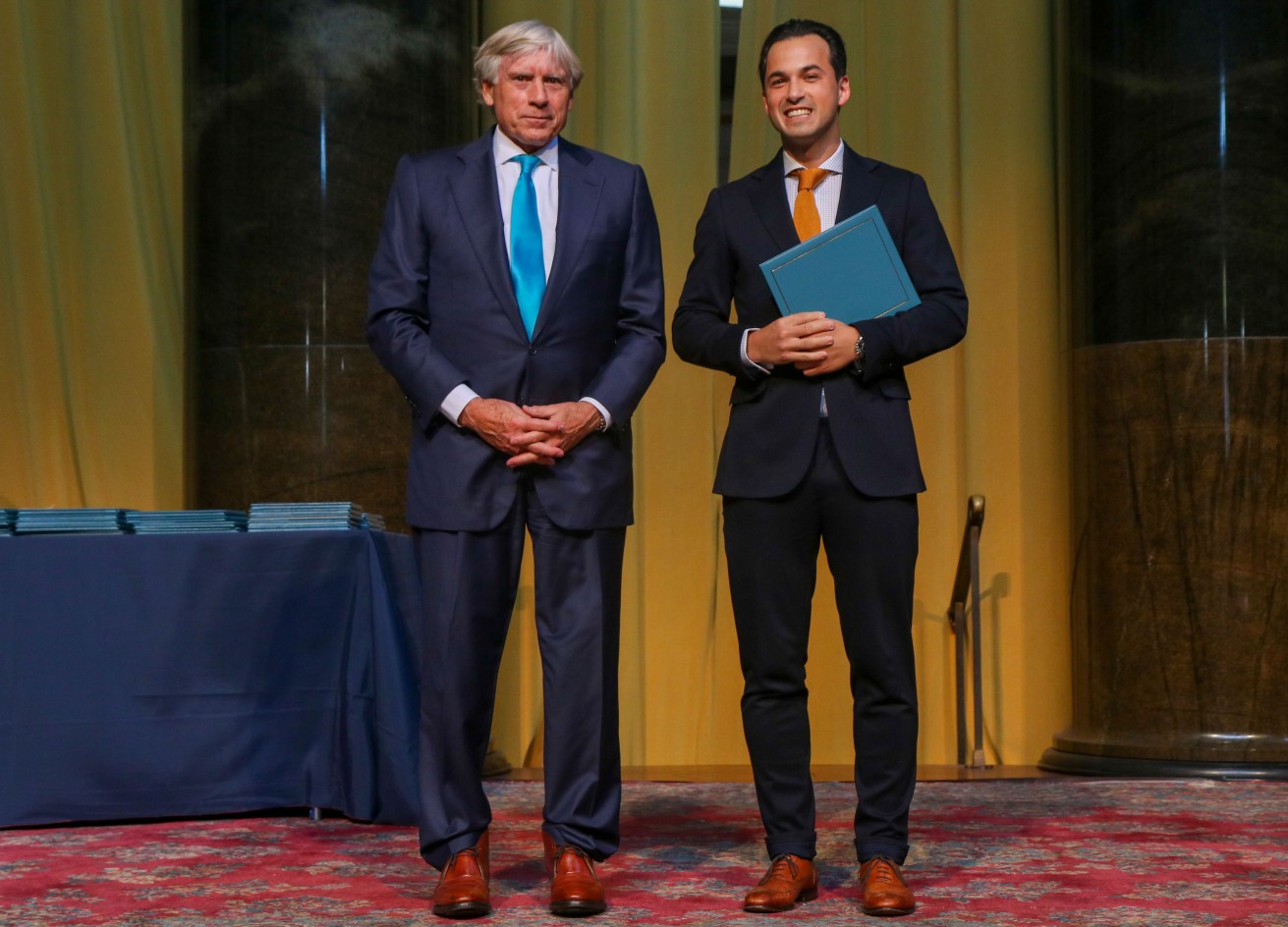
For a devastating account of a man who was kidnapped, tortured and deprived of his liberty for more than a decade at the Guantanamo Bay detention facility, blending on-the-ground reporting and lyrical prose to offer a nuanced perspective on America's wider war on terror.

Ben Taub accepts the 2020 Pulitzer Prize for Feature Writing from Columbia University President Lee Bollinger. (Jose Lopez/The Pulitzer Prizes)

Winning Work

Biography

Ben Taub joined The New Yorker as a staff writer in 2017. He has written for the magazine about a range of subjects related to jihadism, crime, conflict, and human rights, mostly in Africa, Europe, and the Middle East. In 2017, his work on Syria, which was supported by the Pulitzer Center on Crisis Reporting, was short-listed for a National Magazine Award and won the Livingston Award for International Reporting, the Robert F. Kennedy Award for International Print reporting, and the Overseas Press Club Award for Investigative Reporting. Taub also received the ASME Next Award for Journalists Under 30, and was named one of Forbes’s 30 Under 30 in Media. In 2018, his work on a convergence of crises in the Sahel won the George Polk Award for Magazine Reporting and the Prince Albert II of Monaco and U.N. Correspondents Association Global Prize for coverage of Climate Change. In 2019, his reporting on Iraq’s post-ISIS campaign of revenge won the National Magazine Award for Reporting and the George Polk Award for Magazine Reporting.

Finalists

Nominated as finalists in Feature Writing in 2020:

Chloé Cooper Jones, freelance reporter, The Verge

For her gripping portrait of Ramsey Orta, who recorded the NYPD killing of Eric Garner, using restrained yet powerful language and courageous reporting to show the police retribution endured by a forgotten figure in a story that horrified the nation.

Ellen Barry of The New York Times

For a beautifully written tale of an Indian “prince” whose story concealed deeper truths rooted in the violence and trauma of the Partition of India.

Nestor Ramos of The Boston Globe

For a sweeping yet intimate story about how climate change is drastically reshaping Cape Cod, locally illustrating the urgent global crisis.

The Jury

Mary Schmich(Chair)*

Columnist, Chicago Tribune

Maria Carrillo

Deputy Editor, Tampa Bay Times

Hannah Dreier*

National Enterprise Reporter, The Washington Post

Anne Fulenwider

Former Editor-in-Chief, Marie Claire

Rachel Kaadzi Ghansah*

Essayist and Freelance Reporter, Brooklyn, NY

Marjorie Miller

Vice President/Global Enterprise Editor, Associated Press

Héctor Tobar

Associate Professor of Literary Journalism and Chicano/Latino Studies, University of California, Irvine

Winners in Feature Writing

Hannah Dreier of ProPublica

For a series of powerful, intimate narratives that followed Salvadoran immigrants on New York’s Long Island whose lives were shattered by a botched federal crackdown on the international criminal gang MS-13.

Rachel Kaadzi Ghansah, freelance reporter, GQ

For an unforgettable portrait of murderer Dylann Roof, using a unique and powerful mix of reportage, first-person reflection and analysis of the historical and cultural forces behind his killing of nine people inside Emanuel AME Church in Charleston, S.C.

C. J. Chivers

For showing, through an artful accumulation of fact and detail, that a Marine’s postwar descent into violence reflected neither the actions of a simple criminal nor a stereotypical case of PTSD.

Kathryn Schulz

For an elegant scientific narrative of the rupturing of the Cascadia fault line, a masterwork of environmental reporting and writing.

2020 Prize Winners

Nikole Hannah-Jones of The New York Times

For a sweeping, provocative and personal essay for the ground-breaking 1619 Project, which seeks to place the enslavement of Africans at the center of America’s story, prompting public conversation about the nation’s founding and evolution.

Christopher Knight of the Los Angeles Times

For work demonstrating extraordinary community service by a critic, applying his expertise and enterprise to critique a proposed overhaul of the L.A. County Museum of Art and its effect on the institution’s mission.