
Finalist: Plantation Goods: A Material History of American Slavery, by Seth Rockman (University of Chicago Press)

A layered analysis of the manufacture and movement of tools and other everyday products between the North and South–from New England businesses to Southern planters and their enslaved workers–and how they created a shared economy.

Nominated Work

Plantation Goods: A Material History of American Slavery

Plantation Goods: A Material History of American Slavery: Rockman, Seth:  9780226723457: Amazon.com: Books=

An eye-opening rethinking of nineteenth-century American history that reveals the interdependence of the Northern industrial economy and Southern slave labor.

The industrializing North and the agricultural South—that’s how we have been taught to think about the United States in the early nineteenth century. But in doing so, we overlook the economic ties that held the nation together before the Civil War. We miss slavery’s long reach into small New England communities, just as we fail to see the role of Northern manufacturing in shaping the terrain of human bondage in the South. Using plantation goods—the shirts, hats, hoes, shovels, shoes, axes, and whips made in the North for use in the South—historian Seth Rockman locates the biggest stories in American history in the everyday objects that stitched together the lives and livelihoods of Americans—white and Black, male and female, enslaved and free—across an expanding nation.

By following the stories of material objects, such as shoes made by Massachusetts farm women that found their way to the feet of a Mississippi slave, Rockman reveals a national economy organized by slavery—a slavery that outsourced the production of its supplies to the North, and a North that outsourced its slavery to the South. Melding business and labor history through powerful storytelling, Plantation Goods brings northern industrialists, southern slaveholders, enslaved field hands, and paid factory laborers into the same picture. In one part of the country, entrepreneurs envisioned fortunes to be made from “planter’s hoes” and rural women spent their days weaving “negro cloth” and assembling “slave brogans.” In another, enslaved people actively consumed textiles and tools imported from the North to contest their bondage. In between, merchants, marketers, storekeepers, and debt collectors laid claim to the profits of a thriving interregional trade.

Examining producers and consumers linked in economic and moral relationships across great geographic and political distances, Plantation Goods explores how people in the nineteenth century thought about complicity with slavery while showing how slavery structured life nationwide and established a modern world of entrepreneurship and exploitation. Rockman brings together lines of American history that have for too long been told separately, as slavery and capitalism converge in something as deceptively ordinary as a humble pair of shoes.
Biography

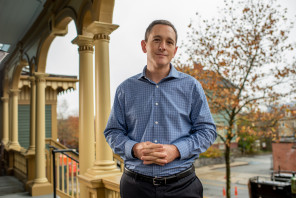
Seth Rockman is a scholar of American history, focusing on the period between the American Revolution and the Civil War. His books include the award-winning Scraping By: Wage Labor, Slavery, and Survival in Early Baltimore (2009) and the co-edited Slavery’s Capitalism: A New History of American Economic Development (2016). Rockman attended Lowell High School in San Francisco, and then earned his undergraduate degree at Columbia University and a PhD at University of California at Davis. Before joining the faculty of Brown University in 2004, he taught at Occidental College in Los Angeles. At Brown, Rockman sits on the faculty advisory board of the Simmons Center for the Study of Slavery and Justice, as well as that of the Rhodes Center for International Economics and Finance. In 2022, Rockman presented testimony to the US House Financial Services Committee on the entanglements of slavery and the American financial sectors. He lives in Providence, Rhode Island.
 

Winners

Prize Winner in History in 2025:

Edda L. Fields-Black

A richly-textured and revelatory account of a slave rebellion that brought 756 enslaved people to freedom in a single day, weaving military strategy and family history with the transition from bondage to freedom. History

The Jury

Jefferson Cowie(Chair)

James G. Stahlman Professor of History, Vanderbilt University

Daina Ramey Berry

Michael Douglas Dean of Humanities and Fine Arts, University of California, Santa Barbara

Julio Capó Jr.

Associate Professor of History, Florida International University

Julian Lim

Arthur Eisenberg and Susan Engel Associate Professor of History, Johns Hopkins University

Sarah Pearsall

Professor of History, Johns Hopkins University

Winners in History

Jacqueline Jones

A breathtakingly original reconstruction of free Black life in Boston that profoundly reshapes our understanding of the city’s abolitionist legacy and the challenging reality for its Black residents.

Jefferson Cowie

A resonant account of an Alabama county in the 19th and 20th centuries shaped by settler colonialism and slavery, a portrait that illustrates the evolution of white supremacy by drawing powerful connections between anti-government and racist ideologies.

Ada Ferrer

An original and compelling history, spanning five centuries, of the island that became an obsession for many presidents and policy makers, transforming how we think about the U.S. in Latin America, and Cuba in American society.

Marcia Chatelain

A nuanced account of the complicated role the fast-food industry plays in African-American communities, a portrait of race and capitalism that masterfully illustrates how the fight for civil rights has been intertwined with the fate of Black businesses.

2025 Prize Winners

Staff of The Wall Street Journal

For chronicling political and personal shifts of the richest person in the world, Elon Musk, including his turn to conservative politics, his use of legal and illegal drugs and his private conversations with Russian President Vladimir Putin.