The Washington Post, by Robin Givhan
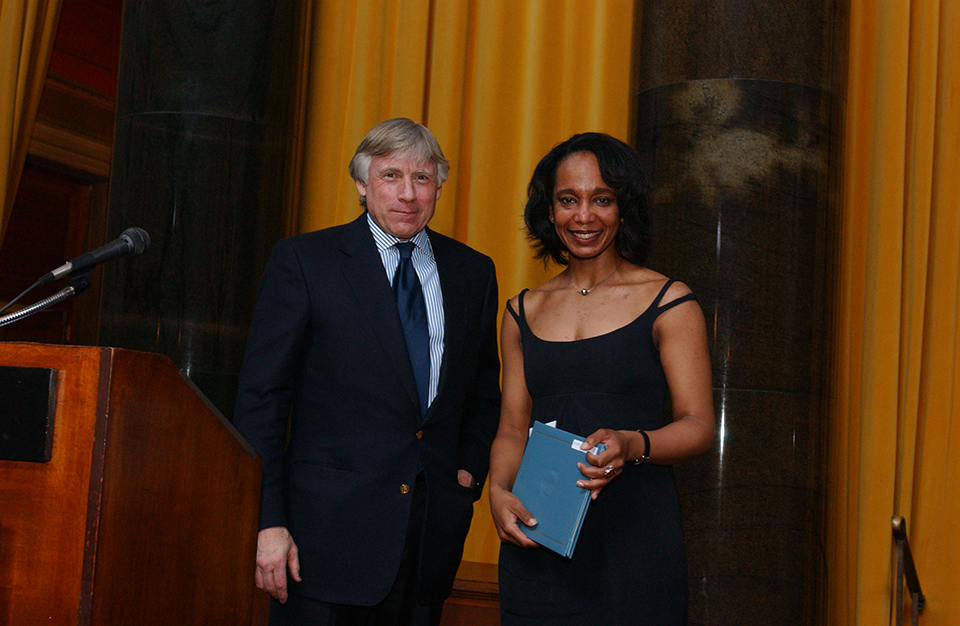
Columbia University President Lee C. Bollinger presents Robin Givhan with the 2006 Pulitzer Prize in Criticism.
Winning Work
By Robin Givhan
In "Hotel Rwanda," Don Cheadle, the film's star, is almost always wearing a suit and tie. They form the unremarkable workday wardrobe of his character, a hotel manager named Paul Rusesabagina. Rusesabagina continues to wear his rigidly professional attire even as his country collapses in bloody genocide and his luxury hotel is transformed into a refugee camp. Rusesabagina's clothes serve as complex visual markers of civility, order and authority.
During his long career selling service, luxury and panache, Rusesabagina has become adept at the arts of flattery, cajolery and even bribery. He has learned that a box of imported cigars is worth far more than its price tag when it can be used to coax a government official into giving his Hotel des Mille Collines a fair shake. Rusesabagina is not simply a student of the hospitality industry; he is well versed in human nature both at its best and at its craven worst. The suits put a sheen of refinement on all of his shadowy dealings.
The story of "Hotel Rwanda" is not only about genocide and the world's indifference to it. It is equally a portrait of one man and his response to mayhem. Rusesabagina, a man initially concerned only with the safety of his own family, eventually saves 1,200 Rwandans from being murdered. Business attire serves as both his comfort and his weapon.
In one scene in the film, Rusesabagina returns to the Mille Collines after having ventured into the increasingly dangerous city of Kigali to negotiate for supplies. His car rumbles along a road shrouded in fog. The driver can barely see and soon the car begins to bounce and swerve wildly. Certain they have veered off the road, Rusesabagina yells to the driver to stop. Rusesabagina opens his door, stumbles out and then falls. He quickly realizes they have been driving across a field of bodies -- bloodied and lifeless from the blows of machetes.
When the innkeeper returns to the hotel, he yanks at his tie and strips off his bloody shirt. He washes himself. And then he begins to dress -- once again in a suit. But in his distress, he is unable to knot his tie. He collapses in a heap and cries. The emotional weight Rusesabagina has been carrying becomes evident in that small, incomplete gesture. Rusesabagina is a dignified man. He is civilized and reasonable. He is a businessman. The formality of his appearance functions as scaffolding, propping him up and preventing him from slipping into despair -- or, worse, into barbarity. In that moment of undress, he realizes that he is slowly losing his footing.
Throughout the film, when Rusesabagina dresses for his meetings with murderous thugs, he affords them a degree of respect that they do not deserve but clearly crave. With his jacket and four-in-hand, he strokes their egos, bribing them with a show of esteem and honor as valuable as a gold watch or a stack of cash -- maybe more so. They are the Mafia, the drug crew, or any other gang of killers that fancies itself an organization of entrepreneurs and not simply a mob of killers. Rusesabagina's suit says he is prepared to play their game. He will do what is necessary. In some ways, the suit is as much for them as it is for him.
Cheadle's character doesn't make overt references to his clothes. But he makes it clear how they fit into his plan for survival. Rusesabagina must maintain the reputation of the hotel. He must uphold its commercial value and not allow it to be seen as a squatters' camp. He believes that even if the owners do not care about people they have never met, they most certainly will care about valuable real estate. And so he delivers bills to hotel rooms knowing that the occupants cannot pay them. The hotel bar serves expensive whiskey. The bribes continue. And Rusesabagina dresses for business every day.
The clothes provide reassurance for him -- like a nicely tailored security blanket. With death all around, who could blame him for seeking support wherever he can? In the same subtle ways, clothes offer security on a daily basis. Few garments offer as much protection as a suit. Walking into an interview, a presentation or an interrogation wearing a suit shortens the list of reasons to fret. Putting on the suit is the sartorial equivalent of standing up straight and pulling the shoulders back. Of bucking up. The tie is shorthand for maturity. It helps to identify the adult in the room, the leader in the group.
And for Rusesabagina, when his world was falling apart, a tie marked him as the man others would follow to safety.
© 2005 The Washington Post Company
By Robin Givhan
At yesterday's gathering of world leaders in southern Poland to mark the 60th anniversary of the liberation of Auschwitz, the United States was represented by Vice President Cheney. The ceremony at the Nazi death camp was outdoors, so those in attendance, such as French President Jacques Chirac and Russian President Vladimir Putin, were wearing dark, formal overcoats and dress shoes or boots. Because it was cold and snowing, they were also wearing gentlemen's hats. In short, they were dressed for the inclement weather as well as the sobriety and dignity of the event.
The vice president, however, was dressed in the kind of attire one typically wears to operate a snow blower.
Cheney stood out in a sea of black-coated world leaders because he was wearing an olive drab parka with a fur-trimmed hood. It is embroidered with his name. It reminded one of the way in which children's clothes are inscribed with their names before they are sent away to camp. And indeed, the vice president looked like an awkward boy amid the well-dressed adults.
Like other attendees, the vice president was wearing a hat. But it was not a fedora or a Stetson or a fur hat or any kind of hat that one might wear to a memorial service as the representative of one's country. Instead, it was a knit ski cap, embroidered with the words "Staff 2001." It was the kind of hat a conventioneer might find in a goodie bag.
It is also worth mentioning that Cheney was wearing hiking boots -- thick, brown, lace-up ones. Did he think he was going to have to hike the 44 miles from Krakow -- where he had made remarks earlier in the day -- to Auschwitz?
His wife, Lynne, was seated next to him. Her coat has a hood, too, and it is essentially a parka. But it is black and did not appear to be functioning as either a name tag or a billboard. One wonders if at some point the vice president turned to his wife, took in her attire and asked himself why they seemed to be dressed for two entirely different events.
Some might argue that Cheney was the only attendee with the smarts to dress for the cold and snowy weather. But sometimes, out of respect for the occasion, one must endure a little discomfort.
Just last week, in a frigid, snow-dusted Washington, Cheney sat outside through the entire inauguration without so much as a hat and without suffering frostbite. And clearly, Cheney owns a proper overcoat. The world saw it during his swearing-in as vice president. Cheney treated that ceremony with the dignity it deserved -- not simply through his demeanor, but also through his attire. Would he have dared to take the oath of office with a ski cap on? People would have justifiably considered that an insult to the office, the day, the country.
There is little doubt that intellectually Cheney approached the Auschwitz ceremony with thoughtfulness and respect. But symbolism is powerful. That's why the piercing cry of a train whistle marked the beginning of the ceremony and the glare of searchlights signaled its end. The vice president might have been warm in his parka, ski cap and hiking boots. But they had the unfortunate effect of suggesting that he was more concerned with his own comfort than the reason for braving the cold at all.
© 2005 The Washington Post Company
By Robin Givhan
NEW YORK -- There were a lot of things on the runway Friday night when entertainer Jennifer Lopez presented the clothing collection that bears her name. It is unclear whether fashion was one of them. To her credit, there were probably more models of color than on most of the catwalks this season. And while there were any number of television crews and celebrity hunters roaming between the aisles and ambush-interviewing anyone with a familiar face, there was little chaos -- just the unavoidable foot stomping, bumping and accidental hair-pulling that occurs when media and celebrities are thrown into the same three-ring circus. There was high-wattage synergy and audacious me-ism on display. Lopez may very well have set a new standard for branding in the fashion industry. The fashion show will be the subject of an MTV documentary scheduled to air later this month. The gift bags were stuffed with bottles of Lopez's fragrance Miami Glow as well as her latest CD, "Rebirth." And the runway was awash with a parade of mini-me's as models were done up to resemble the various versions of Lopez that have been etched into the pop culture record.
The show was a lesson on how to dress like Lopez on the cheap -- without the stylists, the loaner clothes and the many, many carats of diamonds both borrowed and bought. Is that fashion? Or just an elaborate fan club come-on in an era when admirers demand more than just an autographed picture and a T-shirt, and stars willingly oblige?
Lopez presented her collection -- the one in which she has very loudly gotten "more involved" -- under the tent in Bryant Park. It was the last show of fashion week during which designers have presented their fall 2005 collections. The tent had been transformed from its usual configuration of a U-shaped runway into a grid of walkways that allowed the models to meander through much of the audience trailed by an MTV cameraman circling around them like a buzzard with a battery pack.
The show was called "The J-Lo Story" and was organized into three parts. The opening segment celebrated the up-from-the-Bronx portion of Lopez's life. There was a lot of cropped denim, hot pants, tiny jackets and hoop earrings. Apparently Lopez did not own a coat during this portion of her life and spent much of the winter dressed in miniskirts. Part 2 of the story coincides with Lopez's success as a singer. This is the period of dating Puff Daddy, avoiding gunplay and pleading with her fans not to be "fooled by the rocks that I got, I'm still Jenny from the block." In this portion, fur is introduced into Lopez's wardrobe as well as oversize sweaters that fall off the shoulder, fuzzy sweats and hooded ponchos. The final third of the show, with even more fur -- including one flying-saucer-size fur hat worn by the model Naomi Campbell -- reflects the entertainer's arrival as a star in music, movies and tabloids. This is the era of Cris Judd, Bennifer and Marc Anthony. Overall, the collection recalls a host of her more famous looks, although there are no references to the infamous green floral Versace gown that plunged to her navel. After all, the collection is mostly aimed at the teen set.
The look of the collection is young and lively and between the tight jeans and the ruffled miniskirts there is plenty that might capture the attention of a teenage girl or even a young woman. But the essence of fashion -- good fashion, at least -- is that it looks forward. Even when it finds inspiration in the past, it looks for ways to make the 1940s or the 1950s seem fresh and relevant. The two collections on the runway -- J-Lo by Jennifer Lopez and the more expensive Sweetface -- look like a scrapbook of styles from the Lopez closet. It is a rolling rack of castoffs.
Celebrity is a kind of embalmment. And celebrity designers operate on the principle that consumers will want to purchase knockoffs of their past glories.
© 2005 The Washington Post Company
By Robin Givhan
Secretary of State Condoleezza Rice arrived at the Wiesbaden Army Airfield on Wednesday dressed all in black. She was wearing a black skirt that hit just above the knee, and it was topped with a black coat that fell to mid-calf. The coat, with its seven gold buttons running down the front and its band collar, called to mind a Marine's dress uniform or the "save humanity" ensemble worn by Keanu Reeves in "The Matrix."
As Rice walked out to greet the troops, the coat blew open in a rather swashbuckling way to reveal the top of a pair of knee-high boots. The boots had a high, slender heel that is not particularly practical. But it is a popular silhouette because it tends to elongate and flatter the leg. In short, the boots are sexy.
Rice boldly eschewed the typical fare chosen by powerful American women on the world stage. She was not wearing a bland suit with a loose-fitting skirt and short boxy jacket with a pair of sensible pumps. She did not cloak her power in photogenic hues, a feminine brooch and a non-threatening aesthetic. Rice looked as though she was prepared to talk tough, knock heads and do a freeze-frame "Matrix" jump kick if necessary. Who wouldn't give her ensemble a double take -- all the while hoping not to rub her the wrong way?
Rice's coat and boots speak of sex and power -- such a volatile combination, and one that in political circles rarely leads to anything but scandal. When looking at the image of Rice in Wiesbaden, the mind searches for ways to put it all into context. It turns to fiction, to caricature. To shadowy daydreams. Dominatrix! It is as though sex and power can only co-exist in a fantasy. When a woman combines them in the real world, stubborn stereotypes have her power devolving into a form that is purely sexual.
Rice challenges expectations and assumptions. There is undeniable authority in her long black jacket with its severe details and menacing silhouette. The darkness lends an air of mystery and foreboding. Black is the color of intellectualism, of abstinence, of penitence. If there is any symbolism to be gleaned from Rice's stark garments, it is that she is tough and focused enough for whatever task is at hand.
Countless essays and books have been written about the erotic nature of high heels. There is no need to reiterate in detail the reasons why so many women swear by uncomfortable three-inch heels and why so many men are happy that they do. Heels change the way a woman walks, forcing her hips to sway. They alter her posture in myriad enticing ways, all of which are politically incorrect to discuss.
But the sexual frisson in Rice's look also comes from the tension of a woman dressed in vaguely masculine attire -- that is, the long, military-inspired jacket. When the designer Yves Saint Laurent first encouraged women to wear trousers more than 30 years ago, his reasons were not simply because pants are comfortable or practical. He knew that the sight of a woman draped in the accouterments of a man is sexually provocative. A woman was embracing something forbidden.
Rice's appearance at Wiesbaden -- a military base with all of its attendant images of machismo, strength and power -- was striking because she walked out draped in a banner of authority, power and toughness. She was not hiding behind matronliness, androgyny or the stereotype of the steel magnolia. Rice brought her full self to the world stage -- and that included her sexuality. It was not overt or inappropriate. If it was distracting, it is only because it is so rare.
© 2005 The Washington Post Company
By Robin Givhan
Washington Post Staff Writer
There are any number of striking aspects to Camilla Parker Bowles's fashion sense, but the most startling is that, after more than a decade in the public eye, it does not seem to have changed at all. After so many years of having her looks dissected and ridiculed, Parker Bowles has not been bullied into a makeover. She has abstained from fashion, keeping her sensibly shod feet firmly on the side of unremarkable tweeds, Sunday service hats and silhouettes that are more rectangular than hourglass.
Whatever one might think of her long relationship with Prince Charles, there is something admirable in her extraordinary willpower in leaving her hair and wardrobe alone.
Parker Bowles and Charles will wed Friday in a ceremony that will not be attended by his mother, Queen Elizabeth II. The exact nature of the relationship between Parker Bowles and Prince Charles -- before, during and immediately after his marriage to Princess Diana -- may never be fully known. The seemingly endless affair has been filled with sordid twists and with what some might regard as morally bankrupt behavior. But there has also been plenty to suggest that everyone involved was the victim of suffocating royal traditions. All of this, of course, has been chronicled in a vast assortment of photographs.
In almost all of them, Parker Bowles looks particularly staid. She chooses suits and dresses that are generally shapeless. Her clothes steer clear of any curves that might be lurking beneath all of that tweed and silk. Staying true to British fashion stereotypes, she wears hats of enormous proportions. Occasionally, the hats make her look quite regal -- if one dares to use such a word to describe her. They call to mind something that might be found in Queen Elizabeth's wardrobe. The queen has been particularly skilled in elevating frumpy stateliness to iconic stature.
The black hat that Parker Bowles wore this year to Westminster Abbey was dignified with its angled brim and matching Christmas-present bow. It was perfectly accessorized with a striking triple strand of black pearls. The hat did not make Parker Bowles look sophisticated or chic, but it did give her an air of grandeur and tradition. Another hat, this one dating back to a photograph from 1998, was a sort of lilac dome that hovered over her cloud of blond hair. The hat appears to have a small swarm of butterflies stuck in its tucks and folds. It is not an attractive hat, but it loudly announces an unwavering adherence to propriety and social rank.
Parker Bowles's hair has not been significantly altered for more than a decade. She maintains a style that combines Farrah Fawcett's 1970s layers with Linda Gray's 1980s angel wings. The color is a rather harsh ash blond that adds little warmth to her face. She is not a "Bergdorf Blonde," a Madison Avenue blonde or a golden girl.
To be fair, it's worth noting that Prince Charles does not have anything close to the elegant style made famous by the Duke of Windsor. But he benefits from the masterful tailoring that comes with a bespoke suit. The suit has endured because it flatters every man -- creating square shoulders where nature has given him sloping ones, creating the illusion of a taut tummy where a life of leisure has led to a protruding one. He, too, looks dignified.
But he is not being compared to a former spouse. Parker Bowles is not so lucky. It is difficult not to consider her in the context of Princess Diana, who famously transformed from a young awkward bride prone to wearing clothes that neither fit nor flattered her figure into a woman who had more than a few sexy Versace ensembles in her wardrobe. Her evolving style reflected her changing sense of self. It reflected a realization that during every outing the public is judging and in most cases, all they have to go on is the packaging.
The public is judging Parker Bowles, too. And if there is anything that her clothing has said over the years, it is that she will not be swayed by public perceptions. Rare is the person who can withstand withering public scrutiny without trying to put a more pleasing gloss on her appearance. But Parker Bowles's appearance over the years has shown a more natural evolution than concerted effort. Instead, she has wrapped herself in a wall of horsy tradition and the kind of conservative frocks that some might call frumpy but that could just as easily be described as aggressively dignified -- unflappable, steely, confident.
In looking at her style over the years, it mostly seems impenetrable. The public thrashing left no visible marks. In the last few years, Parker Bowles looks happier in the photos. But the clothes look pretty much the same. They offer no hints that her sense of herself has shifted. There are no stylistic cues that she has come into her own. She is where she has always been. Parker Bowles hasn't changed, only her circumstances have.
Correction to This Article:
In the first edition of the Style section on April 3, a passage was omitted from an essay on Camilla Parker Bowles's dowdy wardrobe. The passage should have read: All of this, of course, has been chronicled in a vast assortment of photographs. In most all of them, Parker Bowles looks particularly staid. She chooses suits and dresses that are generally shapeless. Her clothes steer clear of any curves that might be lurking beneath all of that tweed and silk. Staying true to British fashion stereotypes, she wears hats of enormous proportions. Occasionally, the hats make her look quite regal -- if one dares to use such a word to describe her. They call to mind something that might be found in Queen Elizabeth's wardrobe. The queen has been particularly skilled in elevating frumpy stateliness to iconic stature.
© 2005 The Washington Post Company
By Robin Givhan
Washington Post Staff Writer
The opening of "Star Wars: Episode III -- Revenge of the Sith" has brought out the expected array of incorrigible fans who do not seem the least bit queasy walking around dressed as stormtroopers, queen-turned-senator Padme Amidala, Obi-Wan Kenobi, Darth Vader or any of the freakish characters who have populated the various installments of the "Star Wars" saga.
When observing the painstakingly accurate, expensive and emotionally invested costuming of the film's fans, one feels a brief flicker of admiration. Here are people with a remarkably high threshold for public embarrassment. No one may be kicking sand in their faces or plotting to give them wedgies, but rest assured there is laughter, eye-rolling and generous servings of get-a-life pity dished out by those who believe themselves too old and too smart to play dress-up.
The costumed groupies are the walking embodiment of full-blown pop fanaticism; but they are okay with that. They do not appear to fret about being hip or cool or possessing any of the valuable social currency that would gain them admission into the in-crowd. The only thing they're looking to gain entry to is the next screening of "Episode III."
To the casual observer -- which would be anyone who has never worn Princess Leia hair buns or a Luke Skywalker costume -- there is little difference between the fans of Tatooine and Death Stars and those who show up in a Capt. James T. Kirk jumpsuit for "Star Trek" conventions. "Live long and prosper." "May the Force be with you." Same sentiment. Same difference. (Still, the crew of the Starship Enterprise had far more chic uniforms -- very Andre Courreges, Rudi Gernreich -- than the rebels and Jedis in their sheepherding robes.)
Those who prefer looking back rather than into the future truss themselves into corsets for Renaissance festivals. It is only a small leap from here into the realm of Civil War reenactors, but they are reluctantly given a pass since they try to adhere to historical record in determining who lives or dies. The reenactment community could loosely be construed as educational.
Trekkers and jousting fanatics may be able to rattle off details about Klingon mating rituals and the real truth about the Black Death, but if that was all they did, they'd simply be science-fiction buffs or amateur historians. The clothes identify them as more than dabblers. They distinguish them as true believers in a folklore created in Hollywood studios and suburban fairgrounds. (The clothes are also what leave one wondering if perhaps Pfizer makes something that, taken twice daily with water, could snap them out of their delusions.) The opportunity to wear a replica of Lt. Uhura's mini-dress or to have one's bosom heaving from the decolletage of a fair maiden's frock transports groupies into a future of warp drive or a past of starvation and pestilence. They wear the clothes without shame or self-consciousness -- ignoring their weight and restrictiveness -- because the mythology of heroics is so convincing.
A "Star Wars" fan will empty his wallet of thousands of dollars for a couture stormtrooper costume complete with macho laser blaster, but would likely balk at the idea of spending that much for a classic one-button suit. The point is not that one is more practical than the other. (And one can only assume that a man has more call for a business suit than a white plastic militaristic ensemble with a matching helmet.) There's a whole bravura mystique of power and control and transformation associated with a stormtrooper get-up. A suit's charisma is far more subtle. It cannot compete.
"Star Trek" mythology is so persuasive that a fan will spend valuable time making himself up like a Klingon, but probably feels overburdened if his standard grooming ritual starts to take longer than 10 minutes. And for the damsels of the Renaissance festival, there are no worries about the discomfort of lacing oneself into a corset, but just let a fashion magazine suggest that they should do so and the publication will be greeted with anger and petulance.
These theatrical costumes are worn at singular events -- a far cry from a fashionable ensemble that one would be expected to wear on a regular basis. But just as the movie industry constructs a mythology to captivate filmgoers, the fashion industry bases its seasonal sales pitch on elaborate story lines streaming from a painstakingly created fantasy world. In the current Versace advertisements, for instance, Madonna wears brightly colored, hypersexy daywear while playing corporate executive. It is the umpteenth episode in the Versace saga of a superhero corporate titan closing deals with her mental acumen and intoxicating men with her overt eroticism. Throngs of Versace-clad women have not camped out at the design house's headquarters, but they do crowd the aisles when the new season's collection is unveiled.
And there are fashion gatherings -- runway shows, store openings, cocktail parties -- at which the guests' attire rivals a Wookiee costume in absurdity. A particular Comme des Garcons show comes to mind at which fans of the designer wore pieces from an earlier collection that intentionally gave the wearer the look of a hunchback. Enthusiasm, admiration and devotion trump any fear of embarrassment -- no matter the groupie's particular obsession.
© 2005 The Washington Post Company
By Robin Givhan
Washington Post Staff Writer
The one thing that Oprah Winfrey and Hermes agree on is that the talk show host did not get a chance to do any early-evening shopping recently at the company's Paris store. Why she was denied an opportunity to spend her money at the expensive boutique is what has gossip columnists, radio commentators and, in particular, the Internet reverberating with a chorus of girrrrrrlllll.
On June 14, Winfrey arrived at the Hermes shop at 24 Faubourg Saint-Honore. The street is well traveled by tourists and the well-to-do because of its abundance of famous designer boutiques. In the first (and untrue, both sides say) version of the incident, reported Monday in the New York Post, Hermes staff members stationed at the door failed to recognize Winfrey, as she was not in full glamour makeup with her TV hair. They denied her entry and, the gossip item claimed, told her that they have been "having a problem with North Africans lately."
The bloggers raced to their computers: "Oprah Musta Forgot She Is Black." "Oprah w/out makeup, hair done, etc. is really ugly. Seriously, I love Oprah, but what we see on TV is very different from how Oprah really looks."
"That's France for you."
On Wednesday, the New York Daily News weighed in with a different version of the story, saying Winfrey arrived just after the store had closed at 6:30 p.m. and there was no doubt about her identity. She saw shoppers still milling about inside and asked the Hermes staff at the door if she could dash in to make a quick purchase. A clerk said no, and so did a store manager. An unnamed "friend" quoted in the Daily News didn't use the term racism but suggested that if Celine Dion or Barbra Streisand had made a similar request, there wouldn't have been a problem. In this telling of the tale, the entire population of northern Africa was not maligned.
Internet postings often blended the two versions and were accompanied by outraged commentary, indignation and suggestions that Hermes start putting together an especially nice gift basket in the form of a crocodile Birkin. (The company had no comment on the subject of apologetic bouquets, jewelry or handbags.)
A spokeswoman at Winfrey's Harpo Productions confirmed the Daily News version of the story, saying that the incident was "Oprah's 'Crash' moment" -- a reference to the film in which racism unfolds in complex, subtle and surprising interactions. Winfrey also contacted Hermes' U.S. president to inform him of the incident. She plans to tell the story on her show when it returns from hiatus in September.
With the Internet painting an ever-grimmer portrait of the 168-year-old French company, Hermes issued a statement from its Paris headquarters apologizing for "not having been able to accommodate Ms. Winfrey and her team and to provide her with the service and care that Hermes strives to provide to each and every one of its customers worldwide. Hermes apologizes for any offense taken due to such circumstances."
The company also tells a slightly different version of the story. Hermes shuts its doors at 6:30, but on this particular evening the staff was preparing the store for a private event -- a presentation of ready-to-wear. As a result, there was a significant amount of activity in the boutique, which may have given the impression that shoppers were still browsing.
A Hermes spokeswoman said Winfrey arrived about 6:45, accompanied by three other people. A clerk and security guard were at the door and there was no discussion of North Africans or anyone else, according to the store's security videotape, which the company inspected after the incident. The guard explained that the store was closed. The clerk offered up her business card with an invitation for Winfrey to return the next day. The store manager, preparing for that evening's event, was not at the door.
Hermes regularly lavishes celebrities with all of the attention they have come to expect, the spokeswoman said. But Winfrey's visit was an after-hours surprise at a particularly inopportune moment.
One could argue that perhaps this was simply an example of employees not empowered to be proactive, even for a celebrity who could purchase every watch and handbag in the place and come back the next day for more. (The clerk, by the way, has not been forced to take up with an organ grinder on Boulevard Saint Germain; she remains gainfully employed.) It could be an example of a store treating a wealthy celebrity just like anyone else. It could be a case of rudeness. It could be racism. It could be a complicated blend of all that and more.
Hermes is a family-owned business that was founded as a harness shop in Paris in 1837. It is known for its luxuriously printed silk scarves and its handmade bags, namely the Birkin and the Kelly bag. It is one of fashion's most exclusive brands thanks to its high prices and its years-long Birkin waiting list that has risen to near mythic importance among high-end shoppers. The company makes little effort to reach a broad demographic. One of its silk squares retails for $320. A simple tie is $145. A basic Birkin costs about $6,000. A starter handbag is still a thousand-dollar investment.
Brands that cultivate an air of exclusivity breed paranoia, insecurity and suspicion as a byproduct. If the brand is perceived as being for a select few, there's a heightened sensitivity to the perception that the brand is not for you -- even if you happen to be extremely wealthy.
The fashion industry also is particularly ruthless about choosing its customers. Through sizing, pricing, geography and attitude, companies attempt to weed out those they don't deem representative of their image. There's a reason why so many designers steer clear of plus sizes. Fat women are not part of their fashion fantasy.
And there have been countless stories of well-known African Americans feeling snubbed. Cornel West in a three-piece suit couldn't get a cab in Manhattan. Vanessa Williams was mistaken for a waitress at a private dinner party even though she was wearing an evening gown. Condoleezza Rice -- before she became secretary of state -- reprimanded a salesgirl for showing her costume jewelry after she had requested the better pieces.
It is easy to believe that a clerk in a fancy store could be plagued by prejudices. But is it utterly naive to think she could also be indiscriminately brusque, dismissive or inflexible? The public probably will never know precisely what transpired in the case of Winfrey versus Hermes. The story has been taken over by the Internet, a forum not known for its subtlety and accuracy. (One posting had Winfrey going to Hermes to "get her hair done.")
People have argued that no matter what was going on inside the store, no matter what time it was, Winfrey -- the billionaire with millions of devoted fans who ask "How high?" when she says "Jump" -- should have been allowed to shop. It certainly would have been beneficial for the Hermes bottom line. But after-hours shopping is a favor, a perk. Not a right. There's nothing wrong with a store saying not tonight, madame, as long as the reason doesn't have anything to do with skin color. It's okay to say no to a celebrity, even when her name is Oprah.
© 2005 The Washington Post Company
By Robin Givhan
Washington Post Staff Writer
Coincidence had two dissimilar women sentenced to jail time on Wednesday. New York Times reporter Judith Miller was incarcerated for refusing to reveal the name of a source. And rap entertainer Lil' Kim was given one year and a day for the crime of perjury.
Both of them had to walk through a gantlet of media on their way into and out of the courtroom. Miller's media march took place in Washington. The rapper, whose real name is Kimberly Jones, endured hers in Manhattan. There is no way to know what sort of turmoil each may be dealing with in private, but the manner in which they publicly presented themselves, upon hearing the news that they were going to the pokey, was a telling shorthand to their supporters.
For Miller, this was a day of reckoning. It was her final ensemble before heading off to jail, where her clothes will no longer be an expression of individuality but rather the loss of it. For Jones, who will not be imprisoned until September, Wednesday began the slow dismantling of the elaborate image she has constructed. A little less makeup, not so much hairspray, a little less glitz. Get the fans ready.
Jones emerged from Manhattan federal court dressed in a blue-gray blazer and trim trousers with a simple white blouse. A belt with a large decorative buckle hung low around her hips. She was carrying a rather large blue Louis Vuitton handbag -- Le Fabuleux. It is $3,200 worth of goatskin and brass hardware that says "fabulous." One can imagine that a cell phone, a lipstick and a tin of Altoids make up its entire contents.
Jones's hair, which during her trial was often worn in a prim bun or sweet ringlets, hung loose and straight down her back. Her jaw was set. She did not look angry or sad as much as she looked resigned. (Indeed, her face displayed more emotion when she arrived -- and before punishment had been meted out -- and she had to squeeze through the crowd to get into the courthouse.) To use a description often used in the context of hip-hop, Jones looked hard. She released a statement in which she thanked her fans for their support and noted that her prison sentence was just one more hurdle in her short but difficult life. No worries; she would persevere.
In contrast, Miller arrived at U.S. federal district court dressed in black trousers, a quilted black jacket, a yellow shirt and tortoise frame sunglasses. She was clutching a wad of papers and the usual wireless, digital gear. She was also carrying a black shoulder bag whose most distinguishing feature was its ability to keep a multitude of writing tools within easy reach. In essence, it was an elaborate form of pocket protector. Miller was smiling. It was a pleasant smile. And it was still spread across her face as she was driven off to jail.
The women seemed acutely aware that the sentencing walk -- like its predecessor, the perp walk -- defines them in the public's mind. In its execution, it is not enough to stand straight and hold one's head high. This is a powerful visual image capable of conveying subtleties and broad strokes. Both women were playing to their fans.
For Jones, prison time may not be particularly easy, but it will likely have no ill effect on her career. Rap fans typically don't mind a star with a shady past. (See Billboard's "Hot R&B/Hip-Hop Singles and Tracks" for the name 50 Cent.) For a performer such as Jones who has built her career on the image of gangster girls and sex queens, spending some time in prison will only add to the realism of her story line. The prison term seems less an ordeal than a right of passage.
Jones stepped before the cameras with a perfect blend of flamboyance and toughness, with just a hint of a martyr complex for emotional spice. Her attire was far more subdued than her stage costumes would have suggested possible. But there was still a bit of celebrity ostentation on display with her color-coordinated handbag that announces itself from 50 paces. Jones was appropriately dressed for court, but she was still identifiably Lil' Kim.
Miller looked like she was dashing into the courthouse on her way to an interview. As much as Jones stood out, Miller blended in. The cameras made her the center of attention, but she was dressed to be a fly on the wall. She was wearing the sort of practical, comfortable and just-stylish-enough clothes that can be worn in any situation, never looking quite right but never looking too terribly wrong either. With her sensible pageboy and its trim bangs, she has the look of an English lecturer at Barnard. Her quilted jacket speaks of Barbour and the Upper East Side. And the black reads like a nod to glamour and chic and the thing that proclaims: I'm a New Yorker and not some well-to-do lady from Chicago. Her style shouts smart, organized and efficient. But mostly, it is flexible. She wore reporter clothes -- almost a suit, but not really.
Miller has made it clear that she is going to jail to make a point -- she will protect her sources. And so her style plaintively cries out: The news is not me; it's the principle. But that smile and those sunglasses -- don't celebrities always wear sunglasses when they're pretending to hide? -- suggest an unavoidable truth. It is about her as well. Of course it is. She is the one ducking the cameras. She is the one who will sit in jail. She is the reporter whose stature will be elevated in the eyes of her fans for defending a source's anonymity.
Jones was wrong to lie and Miller may or may not be right to stand her ground. But both of them sent all the right messages to their supporters. And both of them may well be rewarded.
© 2005 The Washington Post Company
By Robin Givhan
Washington Post Staff Writer
Dressing appropriately is a somewhat selfless act. It's not about catering to personal comfort.
It has been a long time since so much syrupy nostalgia has been in evidence at the White House. But Tuesday night, when President Bush announced his choice for the next associate justice of the Supreme Court, it was hard not to marvel at the 1950s-style tableau vivant that was John Roberts and his family.
There they were -- John, Jane, Josie and Jack -- standing with the president and before the entire country. The nominee was in a sober suit with the expected white shirt and red tie. His wife and children stood before the cameras, groomed and glossy in pastel hues -- like a trio of Easter eggs, a handful of Jelly Bellies, three little Necco wafers. There was tow-headed Jack -- having freed himself from the controlling grip of his mother -- enjoying a moment in the spotlight dressed in a seersucker suit with short pants and saddle shoes. His sister, Josie, was half-hidden behind her mother's skirt. Her blond pageboy glistened. And she was wearing a yellow dress with a crisp white collar, lace-trimmed anklets and black patent-leather Mary Janes.
(Who among us did a double take? Two cute blond children with a boyish-looking father getting ready to take the lectern -- Jack Edwards? Emma Claire? Is that you? Are all little boys now named Jack?)
The wife wore a strawberry-pink tweed suit with taupe pumps and pearls, which alone would not have been particularly remarkable, but alongside the nostalgic costuming of the children, the overall effect was of self-consciously crafted perfection. The children, of course, are innocents. They are dressed by their parents. And through their clothes choices, the parents have created the kind of honeyed faultlessness that jams mailboxes every December when personalized Christmas cards arrive bringing greetings "to you and yours" from the Blake family or the Joneses. Everyone looks freshly scrubbed and adorable, just like they have stepped from a Currier & Ives landscape.
In a time when most children are dressed in Gap Kids and retailers of similar price-point and modernity, the parents put young master Jack in an ensemble that calls to mind John F. "John-John" Kennedy Jr.
Separate the child from the clothes, which do not acknowledge trends, popular culture or the passing of time. They are not classic; they are old-fashioned. These clothes are Old World, old money and a cut above the light-up/shoe-buying hoi polloi.
The clothes also reflect a bit of the aesthetic havoc that often occurs when people visit the White House. (What should I wear? How do I look? Take my picture!) The usual advice is to dress appropriately. In this case, an addendum would have been helpful: Please select all attire from the commonly accepted styles of this century. (And someone should have given notice to the flip-flop-wearing women of Northwestern University's lacrosse team, who visited the White House on July 12 for a meet-and-greet with the president: proper footwear required. Flip-flops, modeled after shoes meant to be worn into a public shower or on the beach, have no business anywhere in the vicinity of the president and his place of residence.)
Dressing appropriately is a somewhat selfless act. It's not about catering to personal comfort. One can't give in fully to private aesthetic preferences. Instead, one asks what would make other people feel respected? What would mark the occasion as noteworthy? What signifies that the moment is bigger than the individual?
But the Roberts family went too far. In announcing John Roberts as his Supreme Court nominee, the president inextricably linked the individual -- and his family -- to the sweep of tradition. In their attire, there was nothing too informal; there was nothing immodest. There was only the feeling that, in the desire to be appropriate and respectful of history, the children had been costumed in it.
© 2005 The Washington Post Company
By Robin Givhan
Washington Post Staff Writer
PARIS, Oct. 3 -- Popular culture assumes that both men and women long to be physically attractive. A woman may seek power, demand respect and delight in her intellect, but her desire to be pretty is such a natural assumption that it goes unspoken.
Three designers who opened the spring 2006 fashion shows here pose a rhetorical question: How important is "pretty" in an industry based on appearance? The designers Rick Owens and Yohji Yamamoto, who showed their collections Sunday night, and Jun Takahashi, who showed his Undercover line Monday, all approach fashion from the point of view that clothes can be camouflage, they can be confrontational, and they can be a shrill announcement of one's presence. They do not always have to make one look desirable, pleasant or even approachable. These designers take a risk. Few women -- or men -- are willing to dress the part of the contrarian.
Pause on the streets of Washington -- or New York or Paris or most any other city -- and watch the passersby. Most are dressed to blend into the crowd, to uphold the status quo or, perhaps, to attract a discreet, admiring glance.
Bu t occasionally, one spots a rebel.
Standing and waiting for the Owens show to begin, one scans the rows of empty chairs and the crowded aisles. (For some reason, the organizers have told the guests not to sit down just yet. No matter that it is time for the show to begin and there we all are staring at the empty seats awaiting our eager derrieres.) Then one sees a fashion regular -- she is a designer, retailer and consultant -- gliding around the room. She is, as always, dressed in flowing black clothes. She has mounds of jet-black hair piled high and topped with the equivalent of a mantilla. She is the fashion infanta. Call her mysterious, bleak, even a bit frightening.
(And at Yamamoto's show, photographers snap pictures of a gentleman dressed in a tiger-striped suit and leopard-print hat. He is cartoonish, foppish, even a bit sad. And at a Left Bank hotel over breakfast one morning, the quiet is broken by a dilettante in black, his long hair twisted into a loose bun and held in place by a decorative chopstick. His gray beard trembles from his incessant chatter about his creative needs; his demeanor is so akin to a character from the "Saturday Night Live" of yore -- the "Sprockets" man -- that one half expects him to ask the waiter, "Do you want to touch my monkey?")
None of these characters has turned to attire to pretty herself or himself up. None looks particularly attractive.
They are the sort who would be drawn to designers such as Rick Owens, whose signature shorn jackets twist around the body with angled zippers and fabric ties. His long skirts slither down the legs leaving a trail of halfhearted ruffles and unfinished hems. In shades of black, white, taupe and ecru, his collection is unhurried and distracted.
Owens is a designer who does not envision his clothes on fast-moving city dwellers but rather on those well-to-do rebels who slouch through life fueled by organic produce, yoga and cigarettes. They are a contradictory lot, spending large sums of money on clothing designed to look as though it has been pulled from a 2-for-1 bin. It is expensive dishevelment, for those who have the kind of wealth that allows them the luxury of complaining about the lack of fulfillment in their lives. While the less-well-off are fretting about how to pay the light bill, they sit around over $20 mixed drinks, wearing sad-sack faces and $300 self-consciously wrinkled tops, cursing the relentless march of gentrification and the dislocation of the poor.
No, these aren't clothes meant to make anyone look pretty. They are costumes for those seeking a connection to something they perceive as less processed, less commercialized and somehow more real.
Undercover, Yamamoto
What sets many of the designers in Paris apart from those who show their collections elsewhere is the desire to create clothes that are more than decoration.
It is an enormous burden to place on a few yards of chiffon or silk. Often these designers get overwhelmed by their own big ideas and turn out garments that look silly and leave the casual observer to mutter about how ridiculous it all is.
So laugh. Get it all out. And then consider their point:
Jun Takahashi expresses modern tribalism with a collection derived from T-shirts. A T-shirt is rarely ever worn to be pretty but is often donned to communicate a message, whether political, social or humorous. It connects strangers of like minds with a word, a brief phrase or an image. Takahashi's T-shirts (and ultimately the clothes made from them) look faded and worn, as if his raw materials had been pulled from one of the many pallets of old clothes off-loaded to the poor.
He opened his Undercover show with a group of models in white skirts -- one could see vestigial sleeves hanging loosely along the hips. Their chests were bare except for the chalky white dusting across the torso -- a white stencil of a tee. Simple tops stretched into long dresses. ("Chuuuut!" reads a silkscreen of a screaming woman on one tee; on other garments, the words are nearly illegible.) They are stitched together into jackets and twisted around the waist into skirts. Takahashi put shirts on the models' heads, sometimes draped over cones so they looked like medieval maidens, or wrapped and tied with a glimmering string so their profiles evoked that of an African woman.
With his models walking between thick ivory candles (some of which were elaborately carved like totem poles), Takahashi underscored the connection between T-shirts and the basic power of communication, suggesting that in contemporary times, a T-shirt can be as personal and evocative as the beating of a drum.
Go ahead and chuckle at the Yohji Yamamoto collection, with its giant dog-eared collars, bat-wing shoulders and jagged trains that look like dinosaur tails. The shapes are crazy and exaggerated; they are meant to be. Can you handle his intellectual come-on? Be confident enough to call some of it dreck and independent enough to declare other pieces masterful?
After all, that's why some people love his work, just to show how smart they are. (How absurd is that? To wear a dress with a tail to prove that one is an intellectual giant?) Others love it because they can't stand the thought of a white shirt that's so straightforward it looks like it came from Thomas Pink. They can't stand looking like everyone else.
Yamamoto's skirts have wired hemlines, so they stand away from the body and make it look as though the model's torso has poked its way through a pup tent. Midnight blue dresses are adorned with cables that wrap around the shoulders like a stole.
With their slicked-back hair -- wrecked and splashed with paint -- muddy eye makeup and glowering expressions, the models looked like angry urban refugees battling modern life. With a group of garments stitched from camouflage fabrics, one infers references not just to warfare but also survival. Yamamoto juxtaposes the harshness of camouflage trousers with heavily ruffled jackets and even a camouflage ball skirt with an enormous bustle. His use of cables feels makeshift, as if a woman has simply made do with whatever material was available to construct some semblance of elegance or propriety out of wreckage.
Much of this collection left one uncomfortable. Some of the silhouettes were silly -- such as the saber-tooth-edge trains. But other elements suggested a kind of longing to create order out of chaos. Yamamoto implies that long before so me people can even consider trying to be pretty, they must first find their dignity and their humanity, so they can make themselves whole.
© 2005 The Washington Post Company
Biography
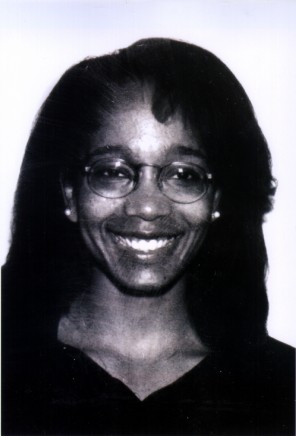
Robin Givhan was born and raised in Detroit. She left the Midwest to attend Princeton University, graduating in 1986 with a bachelor's degree in English. She received a masters in journalism at the University of Michigan in 1988.
Givhan's first newspaper job was with the Detroit Free Press, where she worked as a general assignment reporter writing about nightclubs and reviewing B-list movies for the entertainment section. Eventually, she became a feature writer and went on to cover the fashion beat. She spent almost seven years at the Free Press, leaving only briefly to work as a feature writer for the San Francisco Chronicle.
Givhan came to The Washington Post in 1995 to cover the fashion industry. She left The Post in March of 2000, spending six months at Vogue magazine as associate editor, returning to The Post in September of the same year.
Robin is 41 years old and lives in New York City.