Finalist: Los Angeles Times, by Richard Marosi
Nominated Work
Luis Luna, 20, was smuggled to the U.S. from Mexico when he was 3. He grew up, went to school, found jobs. Then the Washington state resident was deported after a cop pulled him over for a broken headlight. He hopes to return on the undercarriage of a boxcar.

Luis Luna anxiously watches a U.S.-bound freight train move slowly through downtown Nogales, Mexico. He wants to hide underneath one of its cars and stowaway across the border into Arizona. After nearly all his life living in America, the Mexican citizen was deported 8 months ago from his home in Washington state. (Don Bartletti / Los Angeles Times)
By Richard Marosi
Reporting from Nogales, Mexico — The freight train slowed through downtown and screeched to a stop in front of Luis Luna. He scrambled under a boxcar and climbed onto narrow beams that crisscrossed the undercarriage.
He lay on his back, suspended 12 inches off the tracks. His nose almost touched the bottom of the boxcar.
Seconds later, the train lurched forward and rolled across the border into the U.S. It accelerated and the undercarriage began to sway. Luna tightened his grip and braced his legs against a beam to keep his balance. He had tucked his sweatshirt into his pants and his shoelaces inside his boots; the tiniest shred of clothing could get snagged and yank him under the wheels.
It had been nine months since Luna was deported from the U.S., where he had lived since his mother smuggled him from Mexico when he was a toddler. In America, he played point guard on an intramural basketball team, grilled burgers at a McDonald's and looked forward to the senior prom. In Mexico, he had no family. He was a stranger sleeping on the streets, scruffy and destitute.
He felt hopeless — until he figured out how to stow away on this Union Pacific train headed to Tucson, 70 miles away.
The train had covered 10 miles through the high desert when it stopped at a U.S. Customs and Border Protection checkpoint. An inspector and his canine walked by on the gravel path. Luna stifled his breath and prayed. Then he felt a sharp tug and a dog's hot breath.
A German shepherd sank its teeth through Luna's two shirts, locked onto his ribs and dragged him out from under the train. He clutched his side.
A few hours later, he was taken back to the border by U.S. agents. He walked into Mexico and eventually made his way to the garbage-strewn lot where he slept with other penniless migrants looking to sneak into America. Unlike the others, Luna didn't consider the U.S. a mythic land of opportunity. It was simply home.
There would be another train. He would try again.
"The wheels start moving. It starts picking up speed. It gets bumpy. You have nothing to hold on. But the hunger that you have to get to the United States just to be with your family, that's all that's in your head," said Luna, 20. "I'm going to make it."
Luna was on his way to work in January 2010 when a police officer in Pasco, Wash., pulled him over because of a broken headlight on his Honda Accord. He was arrested for driving without a license and taken to the county jail, where the next day an Immigration and Customs Enforcement agent arrived on his rounds.
The agent was part of a rapidly expanding program to scour the country's jails for illegal immigrants. Those with serious criminal histories were priority targets, but thousands of people charged with relatively minor infractions, like Luna, were also being swept up in the federal agency's largest ever deportation effort.
The agent discovered that Luna was in the country illegally and started deportation proceedings against him. A few days later, he was sent to a detention center in Tacoma, handcuffed and still wearing his Pizza Hut uniform. His badge read: "Hablo Espanol."
The smelly bunks, rude guards, prison uniforms and other indignities of confinement bewildered Luna. The threat of being deported had always seemed to him the stuff of breathlessly reported Spanish-language television news. Violent people were the ones he thought were targeted. Not someone like him, who, aside from driving without a license, had no criminal record and no say in coming to this country in the first place.
He felt that he had earned his place in America. Now the country wanted to kick him out.
Later that year at an immigration court hearing in Seattle, Luna presented school records in a bid to stop the deportation. He wanted to establish that he had lived in the country for at least 10 years, had been a person of good moral character, and that his absence would cause undue hardship for his family — factors that could allow the judge to cancel the deportation.
Friends, relatives and court records backed up the account Luna presented to the immigration judge.
Luna's mother, Demi, a native of Monterrey, brought Luna into the country illegally when he was 3. He started working in downtown Los Angeles, peddling Helen Grace chocolates and flowers at intersections and garment district sweatshops. He was 5 years old.
"He became a great salesman, and he helped me pay the rent," Demi said.
When money was tight, Luna, his older brother and his mother would sleep on the streets or under the trees at South Gate Park, their belongings piled into shopping carts. Luna remembers rummaging through trash cans looking for food scraps.
When he was 15, the family moved to Washington state, where rents were cheaper and jobs more plentiful. His tall, lightly freckled good looks landed him a job as a greeter at an Abercrombie & Fitch store. He moved into a studio apartment and decorated it with a poster of his hero, Michael Jordan. He took two restaurant jobs to pay the bills; work pressures forced him to drop out of Pasco High School a few months short of graduation.
"I know Luis to be an upstanding young man with great potential," said John Wallwork, then assistant principal at Pasco High, in a letter submitted to the immigration judge. "He was a model student."
Jeffrey Murrill, a U.S. Marine Corps veteran whom Luna helped with yardwork, wrote to the court: "This is a driven young man being faulted for no fault of his own."
In December 2010, the judge denied Luna's application to halt the deportation and gave him two months to leave the country.
Before he left, Luna married his high school sweetheart, a U.S. citizen who planned to seek legal residency for him.
On Feb. 13, 2011, Luna took a bus to El Paso, Texas, and started walking toward the Bridge of the Americas spanning the Rio Grande. To confirm his return to Mexico, he was required by the court to report by Feb. 14 to the U.S. Consulate in Ciudad Juarez, his birthplace.
Glimpsing Juarez beyond the border fence, Luna hesitated. He had only $300. He had no memories of Mexico and no one to stay with. Juarez, plagued by drug cartel violence, was the most dangerous city in the hemisphere. He could hop on a bus for home and melt back into American society like millions of other illegal immigrants, he thought. But Luna decided that he'd get his life back on track if he did the right thing. He crossed into Juarez: "This is just my little sacrifice that I have to do."
Among the first things Luna learned in Juarez was to press himself tightly behind a street post when a slow-moving car drove by, lest he be mistaken for a rival gang member. He saw people shot down in four separate attacks. He was constantly harassed by thugs.
By July, Luna was getting impatient waiting for the U.S. to approve his return as a legal resident. Guilt-ridden about leaving his family without financial support, Luna went to the border crossing and tried to walk into the U.S. He didn't have a passport, so he presented the Washington state driver's license he had obtained while out on bail awaiting his immigration hearing.
A U.S. Customs agent questioned him and quickly determined that he was trying to sneak into the country. He was arrested. After two weeks at an immigration detention center, he was sent back to Juarez.
In September, he hitchhiked and walked 300 miles in 90-degree heat to Nogales, Mexico, shredding the soles and rubber lining of his Nike high-tops. He had heard that Nogales was a popular staging area for illegal journeys into the U.S., but he soon found out that the desert crossings into Arizona were perilous.
Later that month, Luis sat down at a soup kitchen and met a young smuggler who gave him another idea.
Every weekday afternoon, the man said, a Union Pacific train carrying Ford Focus cars crossed through Nogales on its way to Tucson. There were dozens of boxcars, but only a few with undercarriages that could hold a person, he said. One day, Luna watched the man stow away on one. A few hours later the man called Luna, saying he had held on all the way across the mesquite-dotted Green Valley to Tucson.
The smuggler reminded Luna to focus on the subtle features differentiating the special boxcars from the dozens of others.
Luna memorized them and kept them to himself.
Luna walked to the railroad tracks nearly every day to wait for the 3 p.m. train, hoping to spot the specially designed boxcars. But the few he saw stopped in areas patrolled by police.
The rest of the time he hung out with homeless immigrants at a dusty bus yard dotted with shabby trailers that housed deportees. There, Luna could get an oatmeal breakfast and coffee, and bathe with a bucket of water.
Young men from Mexico and Honduras sat on ripped-out bus seats and plotted how to get into the U.S. Luna, who speaks accent-free English, made some of them wary. One accused him of spying for the U.S. by collecting intelligence on their crossing routes.
Luna sought out deportees like himself, longtime U.S. residents craving burgers and fries and a little cultural kinship. At dusk, he lingered at the shelter hoping to grab a bunk even though he had reached the shelter's three-day limit. A supervisor ordered him off the property.
He walked to a weed-choked cemetery to hang out with other migrants, some of whom spent the night atop the graves. "I can't sleep here — I'm scared a dead person will grab my feet. I've seen too many zombie movies," he said.
On most nights, Luna would spread his blankets in a vacant lot. He didn't sleep much. He was surrounded by strangers, and he had nightmares of U.S. immigration agents chasing him. He wondered whether he'd wake up alive.
It was six days after he was attacked by the dog, and Luna was at the railroad tracks. He was worried about his socks. They were dirty, and he feared the smell would alert the canines at the U.S. checkpoint. He was wearing a clean, donated shirt and had washed thoroughly, even scrubbing the iodine from his bite wound.
The tissue paper for his runny nose had to go. His pockets contained only his Mexican passport and his wallet with snapshots of him with his wife and a folded copy of Psalm 91: "…no harm will overtake you…"
The half-mile-long train was slowing, and one of the boxcars with the steel-beam undercarriage stopped in front of him. "This is it," said Luna, tucking in his sweatshirt and his shoelaces.
He braced himself for a jolt of pain from his bite wound — he expected it to be rubbed raw when he scrambled under the train. "If I do get caught, I hope I don't get bit on the same side," he said.
A truck filled with Nogales police officers appeared on the road parallel to the tracks. Cops regularly stopped Luna and checked his pockets for pesos to steal. He ducked behind a wall separating the road from the tracks. The truck disappeared into traffic.
Luna pursed his lips. Time was running out. If the train moved while he was crawling under, a wheel could slice off a leg. His head throbbed and he suddenly needed to urinate. He crouched, ready to go.
"Hey, what are you doing there?" It was a man wearing an orange vest, accompanied by another man: railroad workers. "This is the third time this week I've seen you here," he said.
Luna said he was just waiting to cross the street, and the workers left.
Luna turned toward the train. The boxcar was still there, but the moment didn't feel right. He yanked the shirt from his pants and walked away. "I take it as a message. Maybe God doesn't want me to leave today," he said.
He headed back downtown, walking next to the moving train.
The day before, he had climbed the stairs of a pedestrian bridge that offers a view of the border fence and the town of Nogales, Ariz. He could see the boxcars rolling into the U.S. without him. An American flag fluttered above the historic courthouse. There was a Burger King sign and the golden arches of a McDonald's. Luna felt like he could reach out and touch his past life, almost.
About this story
The U.S. has deported more than 1 million illegal immigrants since 2008. This is one in a series of occasional stories chronicling the people and communities affected.
For this article, Times staff writer Richard Marosi spent several days in early October with Luis Luna, conducting interviews and reporting on his life as a deportee in Nogales, Mexico. He was there when Luna made several attempts to stow away on a freight train. The dog attack on Oct. 7 was confirmed by U.S. Customs and Border Protection officials.
The once-grand El Hotel Centenario is now the decrepit El Hotel del Migrante Deportado — the Hotel of the Deported Migrant. It hosts a procession of lost souls.
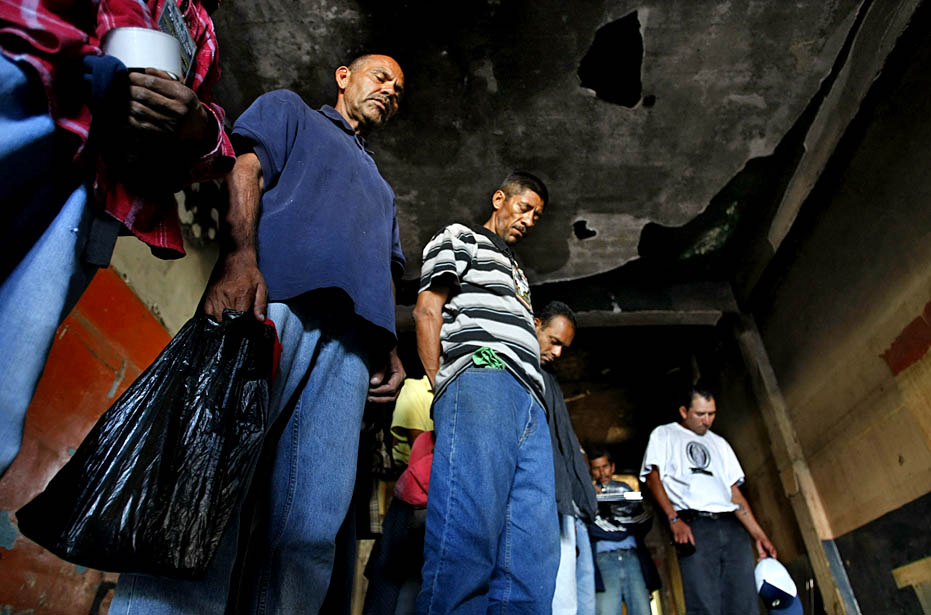


Clutching their possessions, recently deported immigrants stand and pray in the Hotel of the Deported Migrant in Mexicali, Mexico. A fire-scarred room used to be a restaurant but now serves as a dorm where they can sleep on the floor. (Don Bartletti / Los Angeles Times)
By Richard Marosi
Mario Ramos stirs a pot of beans with a bent spatula as the men crowd into the kitchen, the ragged line stretching out the splintered doorway.
Years ago, Ramos, 45, grilled up pricey seafood in a tiki-themed restaurant on Pacific Coast Highway in Laguna Beach. Now, he's serving starchy meals on plastic plates. One of his busboys worked at the Shanghai Grill in Beverly Hills; another is a 28-year-old U.S. Marines veteran.
The diners, who remove their sweat-stained caps to accept the food with grateful nods, have been deported from the U.S. as recently as eight hours ago. They are penniless, unshaven. Some are barefoot.
Mario Ramos has served thousands like them.
Some helped build Las Vegas subdivisions. There was a sushi chef from Anaheim, a tree trimmer for the city of Oakland and a man who swept the stands at Chicago's Soldier Field. There was a pig farmer from South Dakota and a Hollywood High School graduate who helped design sets. A janitor from Philadelphia who had learned Hebrew working at a yeshiva.
Ramos keeps one eye on the food and another on the dining area with the torn tablecloths. He spots a man reaching for his plastic fork. "No eating until we pray," he says. After the last man takes his seat, heads bow.
In this quiet moment, the men think about how they got to this decrepit hotel named for their plight: El Hotel Del Migrante Deportado — the Hotel of the Deported Migrant. Traffic infractions, drug offenses and drunk driving tickets mostly; in some cases, violent crimes.
They blame America for exploiting their labor, then discarding them. But they also are haunted by their mistakes, accomplices to their own downfall.
The U.S. offered me opportunities, and I blew it.
We're here for being reckless.
I lost everything because of my stupid mistake.
My wife warned me: You shouldn't be drinking and driving.
Honestly, the American dream is over.
A 39-year-old former day laborer dedicates a prayer to his teenage son in the San Fernando Valley: "For our families who lack food because of our absence, we pray that we are reunited one day."
Ramos, too, feels the tug of family in the U.S. He lived in Rancho Santa Margarita until 2010, when he says police found cocaine in a car he was in with friends. Within weeks, he was deported and living at the hotel. Ramos plans to embark on an illegal journey back to Orange County. Until then he cooks for dozens every day.
He slides his cap back onto his bald head, the signal for the men to begin eating. Some pause to wipe away tears before digging in.
El Hotel Centenario was among the grandest in Mexicali, in an era when the arcades and honky-tonks of downtown drew round-the-clock revelers.
Over the decades, vice blighted downtown. Drug addicts carved the Centenario's 50 rooms into crack dens.
Two years ago, Sergio Tamai, a civic activist and candy store owner, visited the building. He was searching for a place to house the rising number of deportees. "The hotel had been vandalized and destroyed," he says. "It looked good to me."
Mexicali, a long bus ride from major illegal crossing routes, had become a strategic place for the U.S. to send illegal immigrants. In 2011 alone, some 63,000 deportees — a population about half the size of Pasadena — arrived in this sprawling desert city, the capital of Baja California.
Many had spent much of their lives in the U.S. and were rootless in Mexico. They clustered around all-night taco stands, slept in parks and streets, cowered before corrupt cops.
A former Mormon bishop who slept on a cot in a print shop, Tamai had drained his business profits to bankroll causes helping the poor. With a flair for fiery rhetoric, the wiry 59-year-old had taken on governors and mayors over high utility bills. He had led protests at the border, wielding his bullhorn against U.S. and Mexican officials alike. "They can't criticize the U.S. for criminalizing immigrants when we do the same here," Tamai said.
In January 2010, temperatures dipped into the 40s and Tamai saw the number of shivering migrants keep growing. He rented the building for $1,000, using profits from his candy store.
Tamai rounded up deportees, handed out brooms and led them to the old hotel.
Over eight days, he watched them cart out the filth. There was no electricity, running water, functioning bathrooms or beds. But when the doors opened, the migrants came.
El Hotel del Migrante Deportado, the Hotel of the Deported Migrant, Tamai called it, and he hung a banner from its rose facade. It was different from other shelters, which catered to migrants headed north. It was open all night. Most migrants stayed a couple of days, but those with nowhere to go could stay as long as they wished if, like Ramos the cook, they joined the fellow deportees working as cleaners, night porters and security guards.
City officials donated water and electricity at reduced rates. Tamai sent the men out in four-person shifts, 24 hours a day, to roam the car lanes at the border, where they rattled tin cups asking for donations.
Tamai calls those who follow his rules angeles sin fronteras, angels without borders. Fighting and drinking are not allowed. Those who slip from grace, los angeles caidos, the fallen angels, are banished to the building's gutted first-floor storefront, where men sleep under pop-up tents. He calls this Area 2.
The incorrigibles, the brawlers, the chronic alcoholics fall further yet. Escorted by fellow angels, they are walked down the street and through a crooked door into an abandoned nightclub. Drunks babble in the dark, bodies wither from illnesses and the air is thick with the stench of urine and vomited blood.
A burly former Latin Kings gang member from Chicago oversees Area 3. He keeps vampire hours, blasting Pink Floyd and pulverizing a lumpy punching bag under a bare light bulb.
His neck tattoo reads: Perdition.
The procession of lost souls never ceases. It's midnight when a group of men trudge up the staircase, slip around a body asleep on the landing and enter a dim corridor, where a fat man with broken teeth and two missing fingertips rouses himself off a saggy couch. "Pasale," he croaks. Come in.
They've come on the advice of strangers: Go around the corner, walk half a block down Callejon Reforma and take the stairs next to the double doors of the Bar 13 Negro. But doubt grows as they acclimate to the half-light and stare at fractured walls and floors. Frigid air wafts through broken windows, and the floor pulses with the pounding bass from the hooker bar downstairs.
The night porter, Gerardo Cano, hands out blankets to the grateful men. In the last eight hours, they have been flown in shackles from Texas to Arizona, bused through California to the border and dumped in this city at midnight.
They pepper Cano with questions.
"Do you have anything to eat?" asks a young man who once trimmed hedges at Napa Valley estates.
"How far is San Antonio?" a former busboy wants to know.
A shoeless man who cleaned carpets for a living wants to call his sister. "What time is it in North Carolina?"
Cano, grabbing a broom and a flashlight, beckons the group of 25 to follow him. The men own the clothes on their backs but little else. Most have never been in Mexicali. Their stomachs growl, but Ramos won't start cooking breakfast for a few hours yet.
Down a narrow, pitch-black hallway they go, following Cano's flashlight beam: Dangling electrical cords. Rusty rebar poking out from gutted walls. Signs deploring the poor treatment of migrants: "Don't visit Arizona."
Around a corner, Cano's flashlight illuminates rooms packed tightly with men lying on floors. One man pokes his head up, rubs his eyes, then disappears under the covers. Up ahead, along a long corridor, more men huddle under blankets, a carpet of disheveled migrants stretching 30 feet into the darkness.
Cano finds an open space and sweeps the concrete. "Mexicali dust is a strong strain, carries viruses," he says. The men bury themselves under shared blankets. Cano shuffles down the hallways, his belly distended from a medical condition that developed during a stint in federal prison for cocaine trafficking. He was deported straight from jail in 2010 and has lived on a lumpy couch here ever since.
Cano knows that many of these men will never regain their lives in the U.S., and Mexico doesn't offer much more than the cold floor they're sleeping on.
"They need the rest so they can figure out what to do next," Cano, 52, says later. "The world has changed."
After breakfast, deportees crowd into the shelter's cluttered office to plug their cellphone chargers into a dangling electrical cord. Two blocks away, an 18-foot-tall fence separates Mexicali from Calexico to keep people out, but not American cellphone signals.
Men pace the corridors with phones pressed to their ears. Homes are on the verge of being lost to foreclosures and evictions. Wives and children have gone on welfare. One man cries after learning that his wife is in a Riverside hospital giving birth to their fourth daughter.
Migrants in ripped pants take turns trying on donated clothes. A barefoot man finds a pair of scuffed work boots that fit him. He beams with gratitude. The shoes take the man down the steps and out the door, on his way to meet smugglers who promised to get him back to North Carolina.
"I tell them, 'If you want to try, good luck, maybe you'll make it and never return,'" Cano says. "But remember one thing: Stop doing the bad things you were doing over there. Change your lives, so your mom and siblings are proud of you again."
His flashlight tucked away by day, Cano remains among the angels, minding the registry, sweeping the corridors. In the afternoons, he grabs a tin cup and begs in the car lanes, sometimes dancing a cumbia that gets him fistfuls of pesos.
Other angels tend to the building with skills they honed in the U.S. They patch drywall and ceilings, repair shattered windows, re-wire rooms and re-plumb bathrooms. One has painted the shelter's logo on a wall: four immigrants scaling a barbed-wire fence.
The image, meant to reflect the perseverance of migrants, doesn't inspire Cano. By his count, very few migrants have been able to get through beefed-up border defenses. He hears stories of repeated failures, deadly crossings. At least two men who traveled with deportees from the shelter have died in the Arizona desert. The cremated ashes of one of them, a former waiter at a Denny's restaurant in Lakewood, were sent to his family in Norwalk.
Some of Cano's fellow angels fear he may die at the hotel. His fistula seems ready to burst through his flimsy bandages. One day a man doubled over in pain from a perforated ulcer. His groans echoed down the hallway for hours until a few angels helped him into a taxi for a ride to the hospital. No ambulance ever came.
By the time Cano finishes sweeping the long front corridor, only a few migrants remain slumped on couches or chairs. Many have rushed to the bus station to catch rides to hometowns across Mexico.
He'll never join them. He has no relatives left in Guanajuato, the city he left 38 years ago. Nor will he ever go back to his home in Los Angeles. As a convicted felon, he would receive a long prison term if he got caught.
Twice a year, home comes to Cano. Several brothers and nieces drive four hours from Los Angeles. They greet him with hugs before taking him to one of the city's famous Chinese restaurants.
But they don't ask to come upstairs and see where he lives. And he doesn't offer.
One cold night in February, black smoke spreads through the hallways of the Hotel of the Deported Immigrant. The angels grab their flashlights and follow the fumes to a rear service porch. Shirts from a clothesline had been tossed underneath an old water tank attached to the building and torched. The angels douse the flames, but they are shaken: Someone has tried to burn down the building.
Suspicion falls on the cook, Ramos. Some residents say they saw him running away just before the fire was discovered. The next day, someone else serves breakfast. Ramos is a fallen angel.
A flimsy plywood door opens to Area 3. The Chicago gang member in charge agrees to look for Ramos. It's a bright afternoon, but darkness blots the building. Men lie motionless behind the bar. Next to a platform where strippers once danced, a man suffering from liver disease coughs incessantly. An image of the Virgin of Guadalupe is nailed to a wall.
The gang member walks past his punching bag and pulls back a dusty curtain. He shines a flashlight in the corner. Two men, wild manes matted, mouths dribbling spittle, shield their eyes. One had an epileptic seizure the previous night. He lived for 30 years in Queens, N.Y., before the bottle consumed him. "I'm an alcoholic, but a respectful alcoholic," he says.
The flashlight beam searches more dark corners, empty but for urine stains and filthy blankets.
Ramos has not yet fallen this far. Outside, an angel says he's seen the cook in Area 2. He leads the way into what used to be a bathroom. Ramos has spread a blanket atop the crumbling concrete and folded his clothes inside a luggage bag, a picture of tidiness amid decay.
Ramos denies everything, saying he is neither a drunk nor an arsonist. Cooking for dozens of ragged migrants every morning and afternoon, though, has sapped his will, he says. So many will try to go back to America; so few will succeed. "I see the same faces over and over again," he says. "It breaks you."
He runs through his options. A good friend in Tijuana, he says, has a room available. Another man offered him $25 a day to work on a fishing boat in La Paz. He still may try to cross the border and return to Laguna Beach; his former boss has said his job is waiting for him. But there are so many patrol agents, he says. And the journey is dangerous.
Ramos folds a shirt and puts it in his backpack. He sits down in the dark ruins and buries his head in his hands.
Not even a church-run shelter is safe for migrants sent back to a dangerous region of Mexico by the United States. Viewed as rich targets, the deportees are vulnerable to kidnapping — and worse.
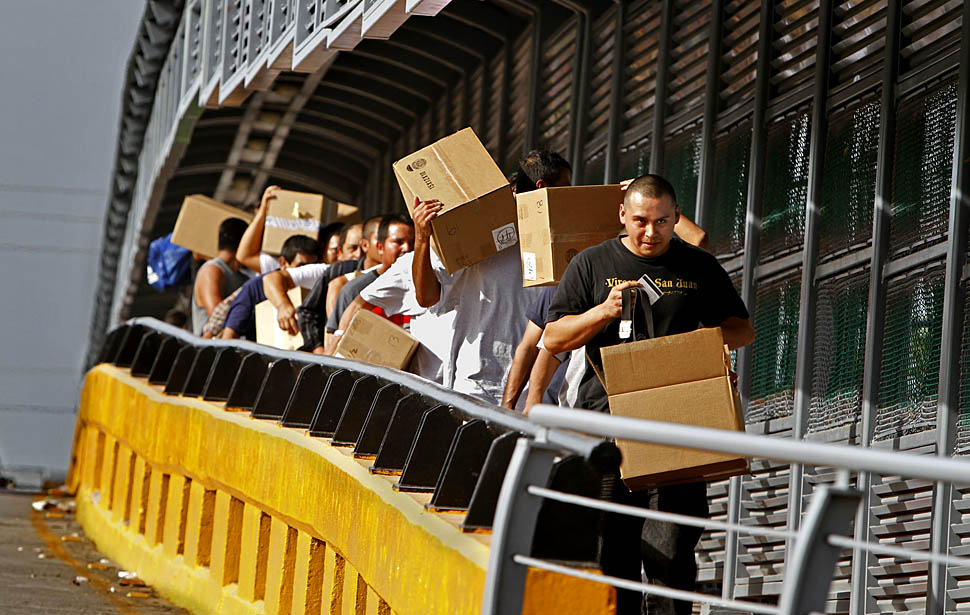
Deportees carrying personal items in boxes provided by U.S. authorities file across the Gateway International Bridge over the Rio Grande from Brownsville, Texas. They will soon be warned by Groupo Beta, the Mexican migrant safety force, about dangers they are about to face. (Don Bartletti / Los Angeles Times)
By Richard Marosi
MATAMOROS, MEXICO — They stuck together, walking slowly on busted sidewalks, approaching corners warily. They hurried past smoky taco stands and fleabag hotels. Nobody strayed.
Deported from Southern California the night before, the 20 men had gotten a few hours of fitful sleep at the bus station of this lawless border city. Now they just wanted to get out of town.
"We were moving as one, like a ball," said Rodrigo Barragon, 35, formerly a construction worker in Los Angeles. "But when I looked back, the ball had a tail."
Five men were following them. Up ahead, three vehicles screeched to a stop, blocking their way down Avenida Washington. The migrants scattered, tearing through streets and alleyways, clutching small bags that held their belongings.
Hours later, they straggled through the door of the Diocese of Matamoros migrant shelter, beneath an image of the Virgin of Guadalupe. A plaque beside the entryway bore a dedication: "To the 72 murdered migrants and to those we know nothing about," men and women who were massacred or who simply disappeared.
Even this shelter couldn't guarantee safety: Fifteen residents were dragged away at gunpoint on Christmas Eve from the dining room where the newcomers now stood.
The men headed deeper into the compound, through an open yard surrounded by razor-wire fence, to the dormitory. There, they found a man sprawled on the floor, his legs bloodied and bruised.
The migrants had been flown 1,500 miles to the Texas-Mexico border as part of a U.S. enforcement program aimed at making it harder for them to return. Many were deported after traffic violations or drunk driving arrests exposed their undocumented status, or after repeatedly entering the country illegally.
Now, they joined in prayer, then quietly ate dinner.
"I feel like something bad can happen at any time," said Serafin Salazar, formerly a car mechanic in El Monte.
U.S. immigration authorities have sharply increased deportations to one of Mexico's most fiercely contested drug-war battlegrounds, the northeastern state of Tamaulipas, where few migrants have any connections or family.
Repatriations to the besieged border cities of Matamoros, Reynosa and Nuevo Laredo jumped nearly fivefold to 124,729 last year from 25,376 in 2006, according to Mexico's National Institute of Migration. More than one-fourth of all deportees from the U.S. are sent to Tamaulipas, even as violence here escalates.
Deportees arriving in Matamoros are schooled quickly about the dangers they will face. The moment these 20 men crossed Gateway International Bridge from Brownsville, Texas, orange-shirted agents from Grupo Beta, the Mexican migrant safety force, gathered them for a lecture:
Criminal gangs consider you rich targets.
They will try to get phone numbers of your relatives in the U.S. for ransoms.
Dial 0 after making calls on public phones so previously dialed numbers can't be accessed.…
Some of the new arrivals scribbled phone numbers backward, in case they fell into the wrong hands. They stuffed the pieces of paper into their shoes. Then they squeezed onto the Grupo Beta pickup trucks, which whisked them to the city bus station.
Stay inside, the agents told them, promising to pick them up in the morning and help arrange discounted bus fares for trips home. Many of the migrants were heading to towns and cities deep in Mexico's interior, a two-day bus ride away.
But the Grupo Beta agents, busy handling more repatriations, never returned for these men. They were now at the mercy of organized crime groups that have gripped Tamaulipas.
Lookouts track new arrivals from the moment they enter Mexico. Gunmen intercept deportees at migrant shelters and buses and outside money-transfer businesses. They hold them for ransom, recruit them into gangs, sometimes assault, torture and "disappear" them. Church-run shelters and social service groups, once safe ground, no longer are.
"Deporting people here is like sending them into a trap … to be hunted down," said Father Francisco Gallardo, a Roman Catholic priest who oversees the diocese's shelters in Matamoros and Reynosa.
Tamaulipas, sharing a 150-mile border with Texas, is a battleground between the Gulf Cartel and the paramilitary-style Zetas. Warring groups have blockaded highways, launched grenade attacks against government buildings and confronted Mexican military units in firefights that have left cities shrouded in smoke.
Organizations trying to document the migrants' plight have been chased out. A human rights group in Nuevo Laredo shut down last year after receiving threats. Local journalists have stopped covering cartel-related crime after at least 13 reporters were kidnapped or slain in recent years.
Many police departments have been disbanded. Criminal gangs have seized control of major streets and highways, as well as transportation hubs including bus stations. On a highway leading to Matamoros in 2010, 72 migrants, most of them from Central America, were massacred after being hauled off a bus. The bodies of some 200 other migrants have since been found in clandestine graves. Many northbound migrants now avoid the region, leaving criminal gangs with a new prey: deportees.
The Mexican government successfully petitioned U.S. authorities to reduce deportations to violence-plagued Ciudad Juarez, across from El Paso. But the change merely increased deportations to Tamaulipas.
Last year, 21 illegal immigrants at a detention center in New Mexico enlisted the help of migrant and civil-rights rights groups in asking authorities not to deport them across the Texas border, for their safety. The efforts failed. All were expelled through Texas, 10 of them to Tamaulipas, according to U.S. Immigration and Customs Enforcement, which said detainees are not permitted to specify where they will be deported.
Most paths out of Matamoros lead through the downtown bus station, a low-slung, yellow building bustling with vendors, travelers and gang crews. Several migrants have been kidnapped from bus platforms, including one woman who was pulled by the hair into a waiting car. Getting on a bus is no guarantee of safety. In May, a deportee was hauled off a bus. His battered body was found on a highway south of the city.
In the station, gang members sidle up to migrants and ask questions. Those with deep ties to the U.S. are deemed secuestrable, or "kidnapable." Young migrants are potential recruits.
The gangs' dominion is absolute. "When I go and look for somebody, they approach me and say, 'You can't take anybody because everyone in the bus station is accounted for," said Gallardo, the priest. "They call the shots.... They decide who comes and who goes."
Outsiders rarely escape notice. Two men identified by several migrants as gang members interrupted a Times reporter conducting interviews. The one said to be the boss, a neatly dressed man in his mid-30s, sported a silver thumb ring and a new Puma watch. He said he had been deported from Chicago for a drunk driving offense last year.
Breezing through the corridor, flashing an easy smile, he told migrants they had nothing to fear, that the gang was there to protect migrants from the Zetas.
But he was firm on the rules: The charge was $500, he said, for anyone trying to reenter the U.S. through gang-controlled territory. As he made the rounds, heavily tattooed men hovered nearby, wielding walkie-talkies that migrants said were used to summon convoys of gunmen.
The boss didn't seem to sympathize with the plight of the migrants — they had committed crimes, he noted. "The U.S. opens its doors and we close them on ourselves," he said.
Unlike many deportees, he felt no urge to return to the U.S.
"We're doing just fine here," he said, chuckling with an underling.
::
A shelter run by a priest ought to be one of the safest places in Mexico. In Matamoros, it's one of the more dangerous. Grupo Beta agents stopped taking people to the Diocese of Matamoros shelter months ago after kidnappings and assaults in and around the compound escalated.
But the 20 deportees who arrived July 10 had nowhere else to go after they were left at the bus station by Grupo Beta and nearly captured by gang members on nearby streets.
"I was scared to death," said David Espinoza, 28, formerly a construction worker in Oregon, who was sitting inside the fenced compound. "I ran like the devil."
"More like Speedy Gonzalez," joked Octavio Ordaz, 43, formerly a welder in Sacramento.
The shelter was spotless and offered showers and clotheslines and plates spilling over with beans. But small comforts couldn't ease the dread.
Gang lookouts on bicycles prowled the street. Just a week earlier, gunmen armed with AK-47s marched through the front door and forced residents to take their shirts off. They were looking for rival gang tattoos. One gunman tried to persuade the men to join their ranks. "I used to be just like you," he said. "You don't have to go to the U.S. to make money."
The newcomers now worried about their tattoos, mostly homages to children or long-forgotten girlfriends. Would they be misinterpreted? They still needed to take risky walks around the city, to collect money transfers from family members. They wondered if they would ever get out of Matamoros.
The man with the scarred legs lay on the floor next to his crutches. He told the new arrivals he had been mistaken for a Zeta the week before, kidnapped, beaten and driven from safe house to safe house. He said he shared the back seat of the car with the corpse of a man who had been tortured to death.
The deportees reminded each other not to walk the streets alone. "They are like the wolves and we're the sheep," said Carlos Valdivia Nunez, 43, who was a day laborer in Huntington Beach before being deported. "If you leave the herd, they go and attack. You can't wander off."
As the sun dipped and mosquito swarms buzzed the compound, more deportees walked through the front door. Sympathetic city bus drivers had given them free rides across the city, they said.
By nightfall, a head count showed that they were one short of the original 20. Missing was a boyish-looking 30-year-old from Tijuana wearing a green checkered shirt over his portly frame. Maybe he caught a long-distance bus or made it to the Grupo Beta office, a few migrants offered.
"We never saw him again after the chase," said Salazar, the former El Monte mechanic. "Who knows where they grabbed him?"
At 9 p.m. the lights went out. As the men slipped under clean sheets, an elderly security guard made the rounds. He was unarmed. The only thing keeping out intruders was a metal screen door.
Floor fans whirred beside the neatly made bunk beds. The men tried to sleep.
Times researcher Cecilia Sanchez in Mexico City contributed to this report.
Thousands of U.S.-born children now live throughout Mexico as a result of deportation of a family member. Disoriented, they struggle in a society that views them with a mix of envy and pity.
By Richard Marosi
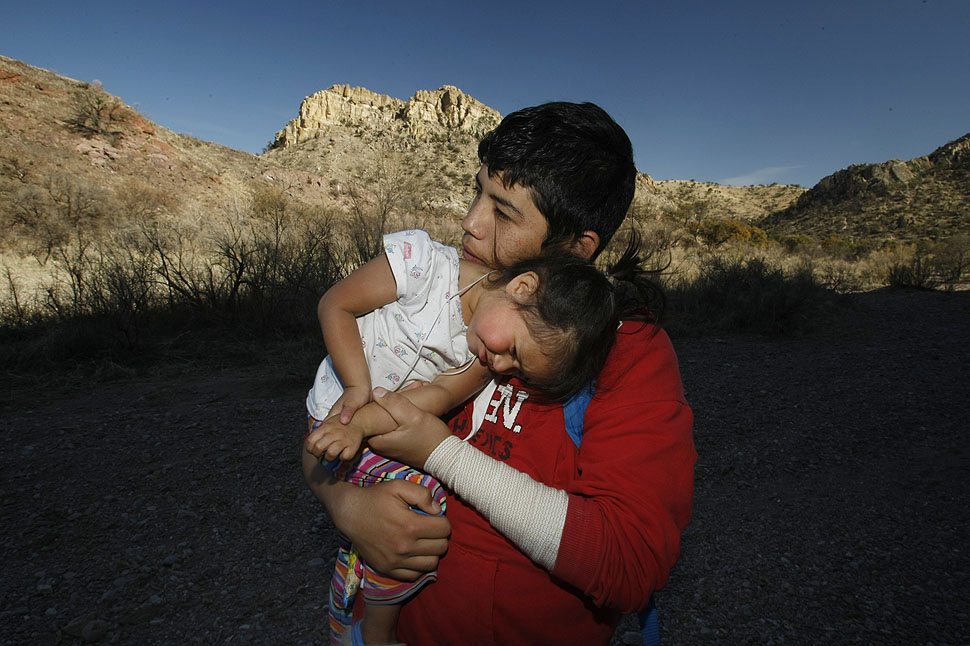
Luis Martinez holds his younger sister Amor during a visit to the river wash where they and their grandmother ended their nearly two-day walk with smugglers who guided them to Nogales, Ariz. (Don Bartletti / Los Angeles Times)
CUATRO MILPAS, MEXICO— In this hardscrabble farming village, an American teenager like Luis Martinez was bound to stand out.
Raised on Little Caesars pizzas and Big Gulps, Luis, 13, was portly. The village kids, subsisting on bowls of chicken broth, were all bones and elbows.
Luis wore Air Jordan high-tops. The kids wore sandals made of rubber tires.
He shot at birds with his BB gun and pedaled around on a Mongoose bike. They scurried up mango trees and chased iguanas.
He seemed like many visitors from America, with new clothes and good health, and the quiet confidence of someone who knew he wouldn't have to endure this place very long.
Then one day Luis and his step-grandfather, Juan Leyva, started standing up sheets of scrap metal on a treeless patch of dirt. They covered the jagged edges with cardboard, straightened the frame and slid corrugated metal sheets atop the walls, fastening it all together with electrical wire.
The teenager they had treated like a rich American cousin was going to live with his family in a shack, next to a chicken coop.
That summer night in 2010, Luis fell asleep on a squeaky mattress next to his baby sister and his dog-eared Harry Potter book, one of the treasured possessions from his days at James Madison Elementary School in Ogden, Utah.
"He was a very good kid," said Daniel Ibarra, 43, who had watched Luis patch together the shanty on that summer day. "But he was poor — poorer than the poorest person here."
Luis never imagined living a peasant's life in Sinaloa. But like other children whose parents or other family members were deported, he was swept into the current of reverse migration. Thousands of U.S.-born children of former illegal immigrants now live in cities and towns across Mexico. Disoriented by cultural differences and often unable to speak the language, they often struggle, clinging to one another in a society that views them with a mix of envy and pity.
Luis' life spiraled further than most. After Leyva, the breadwinner of the family, was deported in 2010, the family languished in Ogden. Eventually, Dominga Leyva, 49, the boy's maternal grandmother and a U.S. citizen, packed her grandson and his 3-month-old sister, Amor, into their Oldsmobile Alero and drove to the Mexican border town of Nogales.
Juan Leyva got in, and they began the 500-mile drive to the western Mexican state of Sinaloa, passing endless rows of vegetable fields to a one-road village where shirts hung from barbed-wire clotheslines, stray dogs feasted on corn husks and boys playfully swung machetes at stick fences.
::
"Dónde está Ooo-tah?" the students asked the chubby-cheeked norteamericano with the gringo accent. Where is Utah?
Luis told them of days ice fishing and snowboarding, of falling asleep on the couch watching horror movies. Back there, he had five video game players, indoor plumbing and shelves full of comics.
It seemed far-fetched; many of the children at the two-room schoolhouse considered them tall tales. When they asked why he came to Mexico, he told them that Leyva had been deported for driving without a license. "They called him a dummy," Luis said.
But Luis could never blame Leyva. His U.S.-born mother, who struggled with drugs, was in prison, and he never knew his biological father. Luis loved his step-grandfather — he called him Dad. Leyva, a wiry man with an easy smile, told everyone that Luis was his son.
In Utah, Leyva had supported the family by working on construction crews, a roofer for all seasons who drew curious stares from passers-by when he pounded shingles in snowstorms. "A man in a car called him 'crazy Mexican,'" Luis recalled proudly.
In Sinaloa, Leyva, 39, toiled even harder, but snow wasn't the problem.
He picked vegetables in the torrid plains inland from the Sea of Cortez, where his family had worked for generations. His light skin would shrivel and turn red, earning him the nickname Ciruela, or prune.
At school, Luis ducked behind torn textbooks, a teenager unable to read Spanish in lessons aimed at 7-year-olds. He soon dropped out, hoping to boost the family's finances by joining Leyva and his grandmother in the jalapeño fields. He got sunstroke the first day and his skin blistered and turned red. The villagers started calling him, Ciruelita, little prune.
On many days, Luis picked vegetables alongside the same children who had envied him when they first met. Now they felt sorry for him, urging him to cloak his skin in a flannel shirt and a hoodie. But Luis withered in the intense heat.
One day a crop-duster zipped low over the tomato fields. Everyone ducked, except him. He was sprayed with a pesticide that coated his arms in an orange liquid. He scrubbed it off in the irrigation canal, but it did not stop the itch.
Luis returned to the fields, this time wearing the tool belt of a chanatero, a human scarecrow tasked with ridding tomato fields of chanates — blackbirds. Up and down the rows he walked, rattling rock-filled bottles, firing off bottle rockets with a flame-tipped stick that he wielded like a wand.
His newfound ability to paint the sky black with flocks of startled birds delighted a boy who enjoyed the fantasy tales of Harry Potter. Alone in the maze of tomato plants, he could raise a ruckus, set off explosions, shout at the top of his lungs.
"It was like yelling out your anger," Luis said. "I liked that part."
The harvest season ended. Luis took to walking up and down the canals and railroad tracks, scavenging for tuna cans and metal scraps. His clothes turned to rags, his weight loss accelerated. He looked like a scarecrow.
"The poor boy. He lived a precarious existence," said bodega owner Jesus Alfredo Gaxiola, who often gave the teenager and his sister crackers and Coca-Cola. "I would ask him, 'What are you doing here? You have [U.S. citizenship]. You're only suffering here.'"
After a year earning only $10 per day in the fields, Leyva and Dominga were almost broke. Even the money they got selling the Alero was gone. One morning in May 2011, Leyva and Luis woke up and started taking down the walls of their home. They reduced the shack to a pile of scrap within a couple of hours. A recycler gave them $40 — enough money, along with some borrowed funds, to buy four bus tickets to the border.
::
At the border crossing station in Nogales, Ariz., the U.S. Customs officer eyed Luis' creased birth certificate. According to the document, the youngster was born in El Paso. But was this scrawny boy in front of him the same Luis Martinez listed on the paper?
Luis watched the plump people in clean clothes walking through the turnstile into Arizona, hoping and praying he would soon be following them down shop-lined North Grand Avenue. But agents at the Nogales port of entry were on guard against one of the oldest smuggling tricks: American women attempting to pass off illegal immigrant children as their own grandkids. They were also on the lookout for child abductions in disputed custody cases.
Dominga Leyva didn't share the children's last names. Nor could she show proof of custody. With her Utah driver's license and birth certificate, she was free to enter the U.S., the officer said, but not the children — at least not until she provided a power of attorney document, signed by the boy's biological mother. But Dominga's daughter was in prison in Utah.
Dominga grabbed the documents and turned back, crying. Luis walked past the long line of people waiting to cross. The looks of pity angered him. "I felt really bad, like I was being betrayed by my own country," Luis said. "I wanted to yell, 'I'm an American!'"
Sinaloa had been harsh. The Mexican border city of Nogales was harsher.
The family slept on park benches next to a four-lane highway. They scoured the streets for aluminum cans. On good days, they earned enough for a loaf of bread and some slices of ham. On many days, they went hungry. Once, workers at a migrant shelter took pity on the bedraggled American family and let them dine with deported illegal immigrants.
Luis dropped to 115 pounds, 50 pounds lighter than his Utah days. Dominga had to re-stitch his nylon basketball shorts so they wouldn't fall to his ankles. Leyva sought day labor work, waving at passing cars to no avail. The guilt of seeing his family suffering weighed on him.
"If I'm hungry, I can endure, but the children can't," Leyva said.
Leyva hatched a desperate plan. He found smugglers willing to guide Dominga, Luis and Amor through the high desert. The smugglers wondered: Was it even illegal to smuggle U.S. citizens into their own country? The risks would be lower — they just needed to get the family to Nogales, not through the checkpoints farther inland. They offered a discounted fee: $500.
Much of the money for the trip came from a most unexpected source.
Every day in late spring of 2011, giant construction cranes rose above the border. Hard-hatted U.S. government contractors were tearing down the border fence to make way for a taller barrier. Every day, they flung pieces of the old fence into Mexico, where frenzied mobs vied for the scraps.
Some people used the metal panels to build shanties. Luis and Leyva had other ideas. Scrap was selling for two pesos per kilo, so each 80-pound sheet could fetch about $8 from recyclers. It would take a small mountain of scrap, but they could start.
Each day they awoke at 2 a.m. and walked into the hills toward the construction site. When they came upon a fence panel, each would grab a jagged end and haul it to a waiting recycling truck. Then they would scramble back into the unruly line for a chance at another piece.
Three miles of fencing was replaced. Luis and Leyva shadowed the crews almost the entire way.
::
The two smugglers kept a fast pace through the canyons of the Pajarito Mountains. Luis struggled to keep up, his arms sagging under the weight of his 20-month-old sister. He looked back and saw his grandmother illuminated under the crescent moon, her labored breathing drowned out by the rustling of mesquite bushes. She was hobbling on her arthritic knee, clutching her purse, which contained their birth certificates.
Leyva had stayed behind, holding back tears as he watched them get into the smugglers' van. He would try some other day, he promised.
The men kept their flashlight beams low. Luis remembered their instructions: Don't talk, don't look at anyone on the trail and, if U.S. Border Patrol agents appear, claim to be lost hikers.
For nearly two days, they walked under craggy ridges and limestone bluffs. Luis never slept, fearing the smugglers would abandon them. At times, Amor's cries pierced the silence. Luis would play with her to calm her down under the impatient stares of the smugglers.
The smugglers were edgy for good reason. A few months earlier, bandits had ambushed a squad of U.S. Border Patrol agents, killing one. The smugglers had already stumbled upon one standoff between groups of Mexicans. They kept their cool and led the family down the trail, away from trouble.
When the group emerged from Peña Blanca Canyon in the predawn darkness, a car was waiting for them near a small lake. They jumped in and sped out of the wilderness, passing a sign on the twisting road: "Smuggling and illegal immigration may be encountered in this area."
::
The smugglers dropped the family at a Food City supermarket in Nogales, Ariz. Luis watched his grandmother count out 75 pennies from her pocket, all they had left for food.
A year later, she is still counting her pennies. The family lives in a creaky single-wide trailer on the edge of Nogales, the rent partly covered by disability benefits Dominga received since her arthritic knee gave out.
Earning money at a car wash on North Grand Avenue, Luis regained weight eating fast-food burgers and pizza. He was baptized into a local Mormon church, where volunteers had provided food and clothing after the family's desert journey. Last month, he entered Nogales High School in Arizona. He has his high school identification card and birth certificate to identify him as a U.S. citizen.
Twice a week, he crosses the border to Mexico, clutching grocery bags filled with fresh meat and vegetables. Waiting for him on one such visit was Leyva, wearing a crumpled cap and a weary smile. Only a few days had passed since Luis last saw Leyva, but he looked even skinnier.
His step-grandfather still couldn't find steady work, even after passing his sixth-grade equivalency test, which he incorrectly believed would make him eligible for a job in a factory assembling goods for export into the U.S.
The American teenager and the Mexican peasant walked through downtown, up a steep dirt path to the hillside shack where Leyva lived. Leyva fired up the oven top, grilled the meat and stuffed it into a tortilla. He gave the first one to Luis and prepared another for him.
"No. Save the food for yourself," Luis remembers telling Leyva.
Luis and Leyva talked about school, and about Dominga and Amor, as the sun dipped over the shanties. After a while, they walked quietly down the hill and said their brief goodbyes at the border fence. Then Leyva turned and climbed back up the hillside, and Luis walked down North Grand Avenue into Arizona.
A father's long battle for his daughters
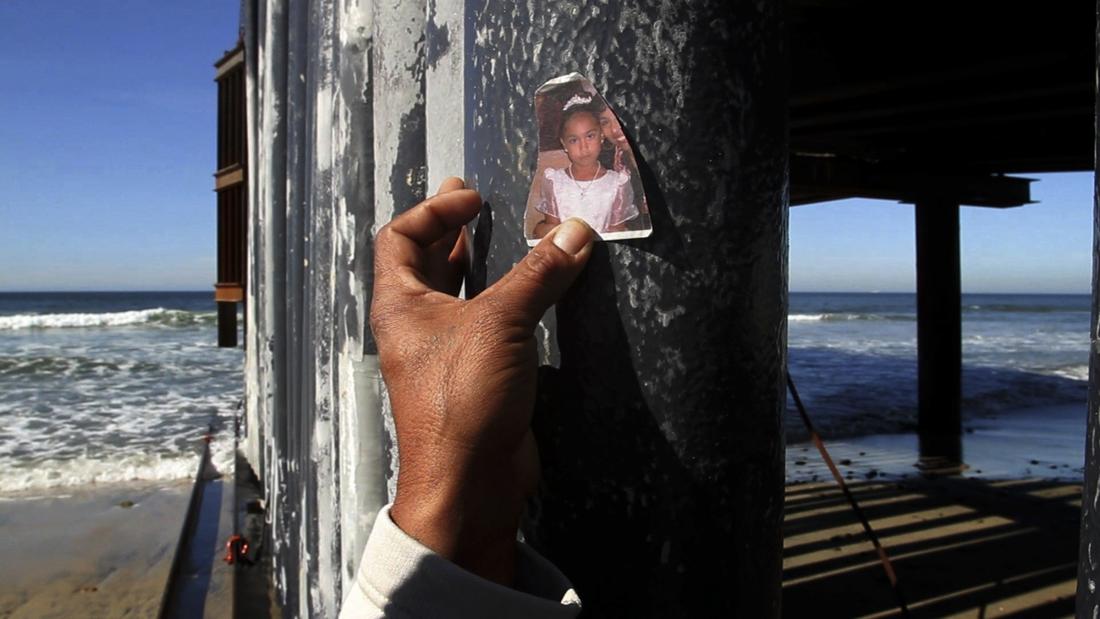
The case of Luis Ernesto Rodriguez, a native of El Salvador, exemplified the struggle many deported parents go through to reunite their families. But circumstances conspired against him. (Don Bartletti / Los Angeles Times)
By Richard Marosi
Luis Ernesto Rodriguez eyed the metal door as he waited for his little girls. Now 6 and 5 years old, they were his only children, inseparable, with thick black hair and mischievous smiles that reminded people of little mermaids.
More than two years had passed since he had last seen them. What would they be like now? Would they recognize him? He had shed 20 pounds during the long journey north.
The door opened and his girls bounded into the tiny room. They shouted and laughed the same way they did when he used to carry one in each arm on the way to day care.
But their smiles melted away when they saw the thick wall of Plexiglas between them and their father, clothed in an orange jumpsuit worn by detainees at an immigration detention center in California's Imperial Valley. There would be no hugs, no kisses.
The girls pressed their palms to the barrier. Rodriguez did the same. His older daughter showed him how to shape a heart with her hands. Rodriguez did the same.
"Be patient," Rodriguez said. "I promise I'll be with you again."
::
Rodriguez last caressed his daughters in the predawn darkness of their cluttered apartment in South Los Angeles. The girls were asleep under the pink sheets of their shared bed when he kissed them and then rushed out to seek day laborer work at the Home Depot store on Slauson Avenue.
It was there, on that morning in November 2008, where police converged on Rodriguez, weapons drawn, and arrested him on suspicion of armed robbery. A short man with a bristly mustache, Rodriguez, then 39, fit the description of a man who had swiped three gold rings from a woman.
It was an apparent case of mistaken identity. No charges were filed, but Rodriguez wasn't going back to his girls.
An immigrant from El Salvador with a troubled past, he had a deportation order dating to 1991. He spent the next two months in jails.
The girls ended up with their maternal grandmother, who was destitute and suffered from memory lapses, so social workers took them away. They joined the thousands of children nationwide who are under custody of child protection agencies after their parents have been placed in deportation proceedings or deported. An estimated 5,000 such children are in foster care, about 1,000 of them in Los Angeles County, according to juvenile court attorneys and the Applied Research Center, a nonprofit racial justice think tank.
Many follow their deported mothers and fathers, if the parents can convince U.S. agencies that they can provide a stable life in their home countries. In such cases, social workers from Los Angeles escort the children to parents at joyous airport reunions, usually in Mexico and El Salvador.
But sometimes parents fail. Their children either languish in foster care or they're adopted by American couples. Some never see their biological parents again.
::
In January 2009, Rodriguez was placed on a flight to El Salvador, a nation he had fled as a teen, when it was rife with war.
He had hours to agonize over his girls' fate. "Being away from them was tearing me apart," he recalled.
Rodriguez had been through such a separation before. In 2007, social workers had taken his daughtersfrom Rodriguez's dirty, near-empty apartment in South Los Angeles. Rodriguez and his wife, Blanca, were cocaine users.
He was not arrested and, after 13 months of parenting classes and drug tests, Rodriguez got them back. Blanca was deported and eventually lost her custody rights. He became a single father. A social worker who visited his home a few months later gave him high marks.
Now, Rodriguez was headed back to El Salvador with only an extra pair of pants in his backpack. He settled in with his brother, another deportee, in Quezaltepeque, a crime-ridden city outside the capital. He sold quesadillas at a textile factory and began the work of getting his children back. He got in touch with his attorney in Los Angeles. He took drug tests. He attended parenting classes. He called his daughters regularly, hoping that would prove that their bonds remained deep.
His persistence impressed officials at the Institute of Human Rights at the University of Central America, who decided to pay some of his legal costs.
The case of Luis Ernesto Rodriguez was now a cause: a symbol of the struggle many Salvadoran parents go through to reunite their families.
::
Back in Los Angeles, the girls missed their father. They didn't like living with strangers. They cried and fought and were passed from one foster home to another.
On May 14, 2010, several attorneys and social workers gathered in Room 415-2 at the Children's Court in Monterey Park. Presiding was the former mayor of Los Angeles, James Hahn, now a Superior Court judge.
Rodriguez pressed a cellphone to his ear and paced around his home in Quezaltepeque, straining to hear the proceedings 2,000 miles away.
He heard his attorney, Thomas Pichotta, tell the court that Rodriguez had passed the drug-testing and counseling requirements. His housing situation was more problematic. A video of the home sent to social workers showed saggy ceilings, an outhouse and a dirt kitchen floor. In a letter, the Salvadoran human rights group made a case that housing in El Salvador should not be judged by U.S. standards.
Midway through the hearing, Rodriguez's phone died. He ran to buy another $20 calling card, but by the time he restored communication the hearing was over. Pichotta gave him the news: Hahn had approved the reunification. His daughters were coming to El Salvador.
"I felt such peace at that moment," Rodriguez said.
::
Rodriguez had only weeks to prepare. He put up shelves and set up a reading table in the girls' room. He pictured sweeping them up in a hug, buying them secondhand clothes, showing them the volcano towering over their new hometown.
But then he looked more closely and saw a less idyllic picture: The ramshackle house was little more than a shelter. The girls' room was dank and stained with water marks. His brother, whom he barely knew, was abusing drugs; his brother's girlfriend, who had offered to provide day care for his daughters, wasn't interested anymore. The tiny house shook with the couple's arguments.
Outside, gang members controlled the streets. They extorted from Rodriguez $2 of the $7 he earned daily. Thugs clustered outside corner stores and were known to recruit children.
Would a responsible father bring his daughters to this place of grinding poverty and danger?
"I found myself in a country where there is nothing for me. Maybe it's my fault. But I never thought I'd be thrown out empty-handed."
Rodriguez begged the court for more time. In June, the court rejected his request.
Social workers canceled the girls' flight and mounted the girls' photos in albums that were browsed by parents seeking to adopt children.
::
Through the summer and into winter, Rodriguez tried to return to Southern California, where he knew he could find an apartment and a job and establish the stable home life that the court required if he wereto get his daughters back. He hitchhiked and rode atop trains across Mexico, taking odd jobs along the way. Twice he was caught by Mexican authorities and sent back to El Salvador.
On Feb. 9, 2011, Rodriguez made it to the mountainous border between Tecate, Mexico, and the backcountry east of San Diego. The date was fortuitous, he thought: his younger daughter's birthday. For six hours he hiked through canyons, reaching state Highway 94, where he heard a dog running after him. He lay on the ground, motionless. Then he felt the hot breath of a Rottweiler beside him and the boot of a U.S. Border Patrol agent against his neck.
Rodriguez was held at the El Centro Service Processing Center in California's Imperial Valley. He asked for asylum, claiming that gang members would kill him if he were deported. He would wait two months for a hearing.
On March 12, 2011, a guard told him he had visitors. A social worker had escorted his daughters to the detention center. They were waiting for him.
Rodriguez didn't expect the Plexiglas wall that separated them in the visitors' room. The reunion dissolved into tears, despite his best efforts to cheer up his girls. "My heart broke," he said.
But he had reason for optimism. They had not been adopted yet. And they still called him Daddy.
In May 2011, a judge rejected the asylum claim. Rodriguez was sent back to El Salvador.
::
A few weeks after the reunion, a couple knocked on the front door of the girls' foster home. They were in their 40s, childless, with a large home in the Inland Empire.
They had seen the girls playing at an adoption fair at a park. Now they wanted to spend time with them. They took them out that day. Soon, they started visiting the girls every weekend, taking them for pizza, to movies, to the aquarium in Long Beach.
They took them to their home. The girls, whose names are being withheld to protect their privacy as minors, had never seen anything like the couple's house — two stories, on a cul-de-sac. Lawns carpeted the neighborhood, and they could walk to parks. In June 2011, the girls moved in.
There would soon be a court hearing to terminate Rodriguez's parental rights.
::
Pichotta, Rodriguez's attorney, wanted to stall the process, but he couldn't find his client. It turned out Rodriguez was making another months-long journey back to California and had lost his backpack trying to outrun Mexican police. It contained his Bible, where he had scribbled the phone numbers of his attorney.
In November 2011, Rodriguez surfaced at the border, in Mexicali, Mexico. He lived in an abandoned hotel and was earning pesos washing cars outside the post office. He planned to apply for political asylum in the U.S.
He looked forward to Sunday afternoons. That's when he got to speak with his girls. He knew their foster family's telephone number by heart.
One day in January 2012, his older daughter picked up the phone. She said she had learned her multiplication tables. He was impressed.
"You've got to keep practicing, OK, mama?"
"I miss you big time," he said. "Pretty soon I hope and I pray to God that we will be together."
"OK," she said.
The younger daughter got on the phone. She seemed distracted.
"You don't want to talk to me? Are you busy or something?"
He told her he loved her. "I miss you so much."
"OK," she said.
They hung up. Rodriguez slumped on the park bench. Something didn't seem right.
A few days later, one of Rodriguez's attorneys finally reached him by phone. He had terrible news. His parental rights had been terminated at a hearing in October 2011, three months before. Too much time had passed for him to appeal, the attorney added. The girls' adoption would soon be final.
His three-year ordeal ended in the shadow of the 18-foot border fence.
The new parents would give them a good life, he acknowledged. There would be toys, dresses and schooling that he could never provide. The only thing left for him to offer his daughters was love, Rodriguez said.
"It's important that they know that I'm fighting, doing everything possible to see them again, to hug them again," he said. "They need to know that I didn't abandon them."
Rodriguez crossed into the U.S. in February and requested political asylum. Once again, his claim was denied. Once again he was sent back to El Salvador.
While he was detained in California, he tried calling his daughters many times.
No one ever answered.
Special correspondent Alex Renderos in El Salvador contributed to this report.
By Richard Marosi
The barrilero never stops moving.
All day he wheels cardboard barrels stuffed with used clothing through the narrow aisles of the warehouse. He dumps the apparel atop tables for sorters, who separate nylons from cottons, satins from silks, denims from plaids. If a sorter is standing around with no garments, it's the barrilero's fault. Supervisors hover nearby.
Tons of old clothing come in every week, and tons go back out, to India and Pakistan, where it's sold at outdoor markets.
The factory hired the barrilero in September, a few weeks after the now-21-year-old showed up at the manager's door looking for work. Right away, the manager had recognized him as Anthony, that cute kid who walked his factory floor selling Helen Grace chocolates to workers years ago.
Anthony didn't say much about where he'd been, or what he'd been doing since. He was polite, upbeat, and his knock on the door still had the soft touch of a child. But his hair was falling out, and there was something unfamiliar in his eyes.
"He seemed sadder," the manager said, "like he wanted to say something but didn't know how."
There were many things the barrilero would keep to himself. First among them: His name wasn't Anthony.
::
Luis Luna returned to his hometown of South Gate in May. His arms and legs were scraped raw from cactus needles and his eyes kept blinking, still starved of moisture from his eight-day journey through the Arizona desert the week before.
His friend, Julio Cortez, said it was hard to believe that this gaunt young man with patches of missing hair was the same person he knew at Southeast Middle School.
"I was in shock to see him back and see all he had gone through," Cortez said. "It made me sad and angry."
Cortez, a 22-year-old Cal State Long Beach student, took Luis to buy some clothes. Another former classmate gave Luis a cellphone. Luis slept on couches and in spare bedrooms and spent his days passing out resumes filled with the jobs of his teen years: flipping burgers, waiting tables at I-Hop. He fudged the dates to account for the 15 months he spent in Mexico after he was deported for being in the country illegally.
Luis had been pulled over three years ago for a broken headlight in Pasco, Wash., where he and his mother lived. He was cited for driving without a license, jailed and ordered out of the country in February 2011.
He had a wife back in Washington, but she had left him, in part because of the long separation. Luis decided to build a new life in Southern California, where he had grown up and where he still had friends
Weeks after arriving, he was still jobless and borrowing money to eat when he decided his future might lie in his past. He started retracing the route he took as a boy selling chocolates at warehouses and factories. The assembly line workers, truck drivers and managers knew him as Anthony, the name his mother told him to use to hide his identity.
They could vouch for his strong work ethic — that he'd been working for a living since he was 5 years old.
He eventually found the barrilero job, and a place to live. A swap meet vendor who picked through the bins of cast-offs looking for vintage garments told Luis he had extra space at his house.
Luis goes home to a converted two-car garage with no address in a middle-class neighborhood with trim lawns and streets lined with late-model cars. Much of his clothing is stuffed in a battered dark green suitcase that sits at the foot of his bed. The only other furniture is a mini refrigerator and two lawn chairs.
In some ways, he's a typical youngster with edgy tastes. He has a sleeve tattoo, wears skinny jeans and earrings, and is part of a deejay crew that plays at house parties. He cheers his beloved Los Angeles Lakers and hangs out in hookah bars, and is constantly texting flirty messages.
But his future is dimmer than most. Many of his friends are planning for life after college. Some are applying for work permits and temporary reprieves from deportation, taking advantage of an Obama administration program, announced in June, to help young people who were brought into the country as children.
::
Luis was 3 when his mother smuggled him across the border. But Luis won't be getting a reprieve. His attorney told him that he's disqualified because he was arrested twice trying to re-enter the U.S. after his deportation.
Luis eventually told friends that his struggles to get back in the country had been chronicled in a Los Angeles Times story that appeared in January. The article had ended with Luis stranded and homeless in Mexico.
A teacher at South Junior High School in Anaheim who had read the story found out Luis was back and invited him to speak to students. The students, some of whom were undocumented immigrants, sat riveted as Luis spoke in a soft but steady voice.
He described days of hunger, homelessness and disorientation wandering through pueblos and cities of Sonora and Chihuahua, the bodies discarded on the streets of Ciudad Juarez, victims of that border city's drug wars.
It was desperation that drove him to risk his life repeatedly to get back to the U.S., he told them. He rode underneath a freight train once, he said, and almost died from dehydration after collapsing in the Sonoran desert on his final, successful try.
After the speech, children crowded around him and asked to see his scars from the police dog that bit him the time he was caught clinging to the undercarriage of a boxcar.
In a class that in the past had featured Holocaust survivors and Vietnamese boat people as guests, Luis' tale resonated. All of the students later wrote letters to U.S. Rep. Loretta Sanchez (D-Garden Grove) urging her to support Luis' effort to gain legal residency.
Luis believes he deserves U.S. citizenship, but he knows his situation may never get better than this. He long ago accepted the limits of living a life in the shadows. But he takes comfort in familiarity.
"I actually have a bed and a roof over my head. I can close my eyes and sleep until I wake up, knowing that I'm going to be alive," Luis said.
::
The barrilero doesn't have time to chat. For eight hours a day, he jumps inside crates, hoists 80-pound bales and digs deep inside barrels, lifting armfuls of clothes onto tables already piled high with garments.
"Do you want more?" he asks one sorter, a young woman barely visible behind the mountain of rags. "Si," she said.
It's 10 a.m. and he's already sweaty and tired. There are several more barrels to move, an empty sorting table beckons, and a large truck outside is waiting to be unloaded.
"This beats being stuck in Nogales," the barrilero said. He had spent months on the dirty and dangerous streets of the Mexican border town bordering Arizona.
When the warehouse owner who hired the barrilero eventually learned of his past, he had no regrets for unwittingly hiring an illegal immigrant. "He is a decent young man and he never loafs," he said. "Any businessman wants a worker like him."
The barrilero has formed a special bond with the manager, a woman who has a son his age. He is in college and she wishes the barrilero could have the same opportunity.
"I'm hoping this is a temporary job," she said. "This is hard labor and I feel he should be doing more. He's meant for greater things."
She still calls him Anthony.
For now, the barrilero grapples with a recurrent nightmare. He is in a desert running from headlights bearing down on him through the fog. U.S. Border Patrol agents are after him. The sand turns to concrete. He is back in Southern California. It is foggy, and there are the same headlights, closing in. He keeps running. Then he awakens.
Luis leads a careful existence. He steers clear of drug users and lawbreakers who could draw police attention. He obtained a driver's license from Washington state, which doesn't require U.S. citizenship. Julio, his friend, instructs him to take off his cap in the car because gang members wear distinctive hats, and police might profile him.
Any ill-timed slipup and Luis could wind up back in Mexico.
::
One recent evening, he drove off in his 1994 BMW 318 to play basketball with friends.
The car had creaky suspension, a missing front grill and a burned-out taillight.
Biography
Richard Marosi has been San Diego bureau border reporter at the Los Angeles Times since 2004.