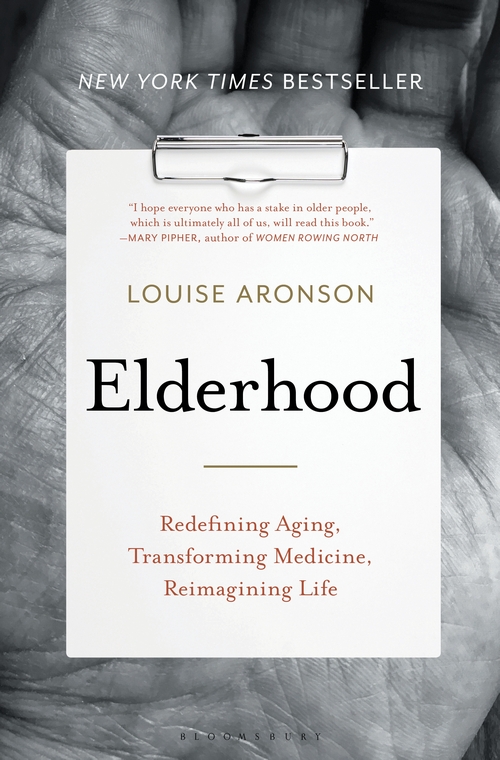
Finalist: Elderhood: Redefining Aging, Transforming Medicine, Reimagining Life, by Louise Aronson (Bloomsbury)

An empathetic and nuanced critique, informed by the author’s decades of experience as a geriatrician, of the ways in which our society and healthcare system neglect, stereotype and mistreat the elderly.

Nominated Work

Elderhood


As revelatory as Atul Gawande's Being Mortal, physician and award-winning author Louise Aronson's Elderhood is an essential, empathetic look at a vital but often disparaged stage of life.

For more than 5,000 years, "old" has been defined as beginning between the ages of 60 and 70. That means most people alive today will spend more years in elderhood than in childhood, and many will be elders for 40 years or more. Yet at the very moment that humans are living longer than ever before, we've made old age into a disease, a condition to be dreaded, denigrated, neglected, and denied.

Reminiscent of Oliver Sacks, noted Harvard-trained geriatrician Louise Aronson uses stories from her quarter century of caring for patients, and draws from history, science, literature, popular culture, and her own life to weave a vision of old age that's neither nightmare nor utopian fantasy--a vision full of joy, wonder, frustration, outrage, and hope about aging, medicine, and humanity itself.

Elderhood is for anyone who is, in the author's own words, "an aging, i.e., still-breathing human being."

-- from the publisher

Biography

Louise Aronson MD, MFA is Professor of Geriatrics at UCSF where her interests include optimizing healthcare for older adults, medical education, reflective learning, integrative geriatrics, and public medical writing. A graduate of Brown University, Harvard Medical School and the Warren Wilson Program for Writers, Dr. Aronson has served as director of the Northern California Geriatrics Education Center, UCSF's Pathways to Discovery (scholarly concentration) program, and UCSF Medical Humanities. She has received the Gold Professorship in Humanism in Medicine, the California Homecare Physician of the Year award, the AOA Edward D. Harris Professionalism Award, and the American Geriatrics Society Clinician-Teacher of the Year award, as well as numerous awards for her teaching, educational research and writing. Her articles, essays and stories appear regularly in newspapers, literary and medical journals including the New York Times, Washington Post, New England Journal of Medicine, Health Affairs, and Lancet. As an educator, she has developed innovative programs for geriatrics training for non-geriatricians, interprofessional education, reflection in medical education, and use of writing to harness the expertise and unique experiences of clinicians and medical scientists in service of health and health care.

Winners

Prize Winner in General Nonfiction in 2020:

Greg Grandin

A sweeping and beautifully written book that probes the American myth of boundless expansion and provides a compelling context for thinking about the current political moment. (Moved by the Board from the History category.) General Nonfiction

Finalists

Nominated as finalists in General Nonfiction in 2020:

Albert Woodfox with Leslie George

An unflinching indictment of Louisiana's most notorious prison and the racist criminal justice system as told through an innocent man's redemptive journey faced with a life sentence in solitary confinement.

The Jury

Gilbert King(Chair)*

Author, New York City

Christopher Carduff

Books Editor, The Wall Street Journal

Anne Fadiman

Francis Writer-in-Residence, Yale University

Anand Gopal

Assistant Research Professor, Center for the Study of Religion and Conflict, Arizona State University

John Leland

Author; Metro Reporter, The New York Times

Winners in General Nonfiction

Eliza Griswold

A classic American story, grippingly told, of an Appalachian family struggling to retain its middle class status in the shadow of destruction wreaked by corporate fracking.

James Forman Jr.

An examination of the historical roots of contemporary criminal justice in the U.S., based on vast experience and deep knowledge of the legal system, and its often-devastating consequences for citizens and communities of color.

Matthew Desmond

For a deeply researched exposé that showed how mass evictions after the 2008 economic crash were less a consequence than a cause of poverty.

Joby Warrick

A deeply reported book of remarkable clarity showing how the flawed rationale for the Iraq War led to the explosive growth of the Islamic State.

2020 Prize Winners

Nikole Hannah-Jones of The New York Times

For a sweeping, provocative and personal essay for the ground-breaking 1619 Project, which seeks to place the enslavement of Africans at the center of America’s story, prompting public conversation about the nation’s founding and evolution.

Christopher Knight of the Los Angeles Times

For work demonstrating extraordinary community service by a critic, applying his expertise and enterprise to critique a proposed overhaul of the L.A. County Museum of Art and its effect on the institution’s mission.