Finalist: The Washington Post, by Eli Saslow
Nominated Work
By Eli Saslow
Their public conference had been interrupted by a demonstration march and a bomb threat, so the white nationalists decided to meet secretly instead. They slipped past police officers and protesters into a hotel in downtown Memphis. The country had elected its first black president just a few days earlier, and now in November 2008, dozens of the world’s most prominent racists wanted to strategize for the years ahead.
“The fight to restore White America begins now,” their agenda read.
The room was filled in part by former heads of the Ku Klux Klan and prominent neo-Nazis, but one of the keynote speeches had been reserved for a Florida community college student who had just turned 19. Derek Black was already hosting his own radio show. He had launched a white nationalist website for children and won a local political election in Florida. “The leading light of our movement,” was how the conference organizer introduced him, and then Derek stepped to the lectern.
“The way ahead is through politics,” he said. “We can infiltrate. We can take the country back.”
Years before Donald Trump launched a presidential campaign based in part on the politics of race and division, a group of avowed white nationalists was working to make his rise possible by pushing its ideology from the radical fringes ever closer to the far conservative right. Many attendees in Memphis had transformed over their careers from Klansmen to white supremacists to self-described “racial realists,” and Derek Black represented another step in that evolution.
He never used racial slurs. He didn’t advocate violence or lawbreaking. He had won a Republican committee seat in Palm Beach County, Fla., where Trump also had a home, without ever mentioning white nationalism, talking instead about the ravages of political correctness, affirmative action and unchecked Hispanic immigration.
He was not only a leader of racial politics but also a product of them. His father, Don Black, had created Stormfront, the Internet’s first and largest white nationalist site, with 300,000 users and counting. His mother, Chloe, had once been married to David Duke, one of the country’s most infamous racial zealots, and Duke had become Derek’s godfather. They had raised Derek at the forefront of the movement, and some white nationalists had begun calling him “the heir.”
Now Derek spoke in Memphis about the future of their ideology. “The Republican Party has to be either demolished or taken over,” he said. “I’m kind of banking on the Republicans staking their claim as the white party.”
A few people in the audience started to clap, and then a few more began to whistle, and before long the whole group was applauding. “Our moment,” Derek said, because at least in this room there was consensus. They believed white nationalism was about to drive a political revolution. They believed, at least for the moment, that Derek would help lead it.
“Years from now, we will look back on this,” he said. “The great intellectual move to save white people started today.”
***
Eight years later, that future they envisioned in Memphis was finally being realized in the presidential election of 2016. Donald Trump was retweeting white supremacists. Hillary Clinton was making speeches about the rise of white hate and quoting David Duke, who had launched his own campaign for the U.S. Senate.
White nationalism had bullied its way toward the very center of American politics, and yet, one of the people who knew the ideology best was no longer anywhere near that center. Derek had just turned 27, and instead of leading the movement, he was trying to untangle himself not only from the national moment but also from a life he no longer understood.
From the very beginning, that life had taken place within the insular world of white nationalism, where there was never any doubt about what whiteness could mean in the United States. Derek had been taught that America was intended as a place for white Europeans and that everyone else would eventually have to leave. He was told to be suspicious of other races, of the U.S. government, of tap water and of pop culture. His parents pulled him out of public school in West Palm Beach at the end of third grade, when they heard his black teacher say the word “ain’t.” By then, Derek was one of only a few white students in a class of mostly Hispanics and Haitians, and his parents decided he would be better off at home.
“It is a shame how many White minds are wasted in that system,” Derek wrote shortly thereafter, on the Stormfront children’s website he built at age 10. “I am no longer attacked by gangs of non whites. I am learning pride in myself, my family and my people.”
Because he was home-schooled, white nationalism could become a focus of his education. It also meant he had the freedom to begin traveling with his father, who left for several weeks each year to speak at white nationalist conferences in the Deep South. Don Black had grown up in Alabama, where in the 1970s, he joined a group called the White Youth Alliance, led by David Duke, who at the time was married to Chloe. That relationship eventually dissolved, and years later, Don and Chloe reconnected, married and had Derek in 1989. They moved into Chloe’s childhood home in West Palm Beach to raise Derek along with Chloe’s two young daughters. There were Guatemalan immigrants living down the block and Jewish retirees moving into a condo nearby. “Usurpers,” Don sometimes called them, but Chloe didn’t want to move away from her aging mother in Florida, so Don settled for taking long road trips to the whitest parts of the South.
Don and Derek always stayed on those trips with Don’s friends from the white power movement, and soon Derek had heard many of their stories. There was the time his father, then 16, was shot in the chest while working on a segregationist campaign in Georgia. There was the day in 1981 when he and eight other extremists made plans to board a boat stocked with dynamite, automatic weapons and a Nazi flag. Their plan, called Operation Red Dog, was to take over the tiny Caribbean island nation of Dominica, but instead Don had been caught, arrested and sentenced to three years in prison. He learned some computer programming in federal prison and eventually launched Stormfront in 1995 under the motto: “White Pride World Wide.”
Over the years, his website attracted all kinds of extremists: skinheads, militia groups, terrorists and Holocaust deniers. According to the Southern Poverty Law Center, a hate-watch group, a handful of the people who posted on Stormfront had gone on to commit hate crimes, including killings. One message board user shot and wounded three children at a Jewish day-care center in Los Angeles in 1999. Another killed his Jewish neighbor in 2000 in a town near Pittsburgh. “We attract too many sociopaths,” Don posted, and he decided that more moderation would give Stormfront greater mainstream credibility.
By then Stormfront had become his full-time job, even though he wasn’t making much money and the family was getting by on Chloe’s salary as an executive assistant. Each morning, she would go to work, and Don would go to his crowded desk in their single-story house, where he recruited authors and academics from the alternative right to post on his site.
In 2008, he banned slurs, Nazi symbols and threats of violence, even as other parts of his own language remained unchanged. He didn’t have friends so much as “comrades.” Everyone was either “with us” or “against us,” “sympathetic” or an “enemy,” so Derek strengthened his relationship with his father by becoming his greatest ideological ally.
Derek learned Web coding and designed the Stormfront site for children. He was interviewed about hate speech on Nickelodeon, daytime talk shows, HBO and in USA Today. “The devil child,” was how Don sometimes referred to him, with pride and affection.
But Don also read through nasty emails his son received from strangers who were offended by the Stormfront children’s page, and he began to worry about a 13-year-old who was becoming so familiar with the two-way transaction of prejudice and hate.
“You will rot in hell,” read one email, in 2002.
“I WISH you were in the same room as me right now,” read another. “You would have to eat through a straw, you low life scumbag.”
Don told Derek to stop checking his messages. He would later remember wondering: “Did I foist this onto him? Is he just doing this for me?” He asked Derek whether he wanted to shut down the children’s page, but Derek said the emails didn’t bother him. That was the enemy. Who cared what they thought?
***
After that, Don began to see something different when he looked at his son: not just a child born into the movement but also an emerging leader, with drive and conviction that seemed entirely his own. Don had spent more than four decades waiting for whites to have a racial awakening in America, and now he began to think that the teenager living in his house could be a potential catalyst.
“All of my strengths without any of my weaknesses,” Don would later say about Derek back then. “He was smarter than me. He had more insight. He never held himself back.”
So many others in white nationalism had come to their conclusions out of anger and fear, but Derek tended to like most people he met, regardless of race. Instead, he sought out logic and science to confirm his worldview, reading studies from conservative think tanks about biological differences between races, IQ disparities and rates of violent crime committed by blacks against whites. He launched a daily radio show to share his views, and Don paid $275 each week to have it broadcast on the AM station in nearby Lake Worth. On the air, Derek helped popularize the idea of a white genocide, that whites were losing their culture and traditions to massive, nonwhite immigration. “If we say it a thousand times — ‘White genocide! We are losing control of our country!’ — politicians are going to start saying it, too,” he said. He repeated the idea in interviews, Stormfront posts and during his speech at the conference in Memphis, when he was at his most certain.
Derek finished high school, enrolled in community college and ran for a seat on the Republican committee, beating an incumbent with 60 percent of the vote. He decided he wanted to study medieval European history, so he applied to New College of Florida, a top-ranked liberal arts school with a strong history program.
“We want you to make history, not just study it,” Don and Chloe sometimes reminded him.
New College ranked as one of the most liberal schools in the state — “most pot-friendly, most gay-friendly,” Don explained on the radio — and to some white nationalists, it seemed a bizarre choice. Once, on the air, a friend asked Don whether he worried about sending his son to a “hotbed of multiculturalism,” and Don started to laugh.
“If anyone is going to be influenced here, it will be them,” he said. “Soon enough, the whole faculty and student body are going to know who they have in their midst.”
***
At first they knew nothing about him, and Derek tried to keep it that way. New College was in Sarasota, three hours across the state, and it was the first time Derek had lived away from home. He attended an introductory college meeting about diversity and concluded that the quickest way to be ostracized was to proclaim himself a racist. He decided not to mention white nationalism on campus, at least until he had made some friends.
Most of the other students in his dorm were college freshmen, and as a 21-year-old transfer student, Derek already had a car and a legal ID to buy beer. The qualities that had once made him seem quirky — shoulder-length red hair, the cowboy hat he wore, a passion for medieval re-enactment — made him a good fit for New College, where many of the 800 students were a little bit weird. He forged his own armor and dressed as a knight for Halloween. He watched zombie movies with students from his dorm, a group that included a Peruvian immigrant and an Orthodox Jew.
Maybe they were usurpers, as his father had said, but Derek also kind of liked them, and gradually he went from keeping his convictions quiet to actively disguising them. When another student mentioned that he had been reading about the racist implications of “Lord of the Rings” on a website called Stormfront, Derek pretended he had never heard of it.
Meanwhile, early each weekday morning, he would go outside and call in to his radio show. He told friends these were regular calls home to his parents, and in a way, that was true. Every morning, it was Derek and his father, cued in by music from Merle Haggard’s “I’m a White Boy.” Derek often repeated his belief that whites were being wiped out — “a genocide in our own country,” he said. He told listeners the problem was “massive, nonwhite immigration.” He said Obama was an “anti-white radical.” He said white voters were “just waiting for a politician who actually talks about all the ways whites are being stepped on.” He said it was the “critical fight of our lifetime.” Then he hung up and went back to the dorm to play Taylor Swift songs on his guitar or to take one of the college’s sailboats onto Sarasota Bay.
He left after one semester to study abroad in Germany, because he wanted to learn the language. He kept in touch with New College partly through a student message board, known as the forum, whose updates were automatically sent to his email.
One night in April 2011, Derek noticed a message posted to all students at 1:56 a.m. It was written by someone Derek didn’t know — an upperclassman who had been researching terrorist groups online when he stumbled across a familiar face.
“Have you seen this man?” the message read, and beneath those words was a picture that was unmistakable. The red hair. The cowboy hat.
“Derek black: white supremacist, radio host…new college student???” the post read. “How do we as a community respond?”
***
By the time Derek returned to campus for the next semester, more than a thousand responses had been written to that post. It was the biggest message thread in the history of a school that Derek now wanted badly to avoid. He returned to Sarasota, applied for permission to live outside of required student housing and rented a room a few miles away.
A few of his friends from the previous year emailed to say they felt betrayed, and strangers sometimes flipped him off from a safe distance on campus. But, for the most part, Derek avoided public spaces, and other students mostly stared or left him alone, even as their speculation about him continued on the forum.
“Maybe he’s trying to get away from a life he didn’t choose.”
“He chooses to be a racist public figure. We choose to call him a racist in public.”
“I just want this guy to die a painful death along with his entire family. Is that too much to ask?”
“I’d like to see Derek Black respond to all of this. …”
Instead of replying, Derek read the forum and used it as motivation to plan a conference for white nationalists in East Tennessee. “Victory through Argumentation: Verbal tactics for anyone white and normal,” he wrote in the invitation. He had spoken at several conferences, including the one in Memphis, but only now did he feel compelled to create another event as white nationalism continued to spread. The white genocide idea he had been championing had finally become a fixture of conservative radio. David Duke had started trying to build a relationship with “our friends and allies in the tea party.” Donald Trump had riveted the alt-right with his investigation into Obama’s birth certificate, and one Gallup poll suggested that only 38 percent of Americans “definitely” believed Obama was born in the United States.
“A critical juncture to keep increasing the profile of our movement,” Derek said on the radio, so he registered 150 attendees and scheduled speeches by his father, Duke and other separatist icons.
Another New College student learned about the conference and posted details on the forum, where gradually a new way of thinking had begun to emerge.
“Ostracizing Derek won’t accomplish anything,” one student wrote.
“We have a chance to be real activists and actually affect one of the leaders of white supremacy in America. This is not an exaggeration. It would be a victory for civil rights.”
“Who’s clever enough to think of something we can do to change this guy’s mind?”
One of Derek’s acquaintances from that first semester decided he might have an idea. He started reading Stormfront and listening to Derek’s radio show. Then, in late September, he sent Derek a text message.
“What are you doing Friday night?” he wrote.
***
Matthew Stevenson had started hosting weekly Shabbat dinners at his campus apartment shortly after enrolling in New College in 2010. He was the only Orthodox Jew at a school with little Jewish infrastructure, so he began cooking for a small group of students at his apartment each Friday night. Matthew always drank from a kiddush cup and said the traditional prayers, but most of his guests were Christian, atheist, black or Hispanic — anyone open-minded enough to listen to a few blessings in Hebrew. Now, in the fall of 2011, Matthew invited Derek to join them.
Matthew had spent a few weeks debating whether it was a good idea. He and Derek had lived near each other in the dorm, but they hadn’t spoken since Derek was exposed on the forum. Matthew, who almost always wore a yarmulke, had experienced enough anti-Semitism in his life to be familiar with the KKK, David Duke and Stormfront. He went back and read some of Derek’s posts on the site from 2007 and 2008: “Jews are NOT white.” “Jews worm their way into power over our society.” “They must go.”
Matthew decided his best chance to affect Derek’s thinking was not to ignore him or confront him, but simply to include him. “Maybe he’d never spent time with a Jewish person before,” Matthew remembered thinking.
It was the only social invitation Derek had received since returning to campus, so he agreed to go. The Shabbat meals had sometimes included eight or 10 students, but this time only a few showed up. “Let’s try to treat him like anyone else,” Matthew remembered instructing them.
Derek arrived with a bottle of wine. Nobody mentioned white nationalism or the forum, out of respect for Matthew. Derek was quiet and polite, and he came back the next week and then the next, until after a few months, nobody felt all that threatened, and the Shabbat group grew back to its original size.
***
On the rare occasions when Derek directed conversation during those dinners, it was about the particulars of Arabic grammar, or marine aquatics, or the roots of Christianity in medieval times. He came across as smart and curious, and mostly he listened. He heard a Peruvian immigrant tell stories about attending a high school that was 90 percent Hispanic. He asked Matthew about his opinions on Israel and Palestine. They were both still wary of each other: Derek wondered whether Matthew was trying to get him drunk so he would say offensive things that would appear on the forum; Matthew wondered whether Derek was trying to cultivate a Jewish friend to protect himself against charges of anti-Semitism. But they also liked each other, and they started playing pool at a bar near campus.
Some members of the Shabbat group gradually began to ask Derek about his views, and he occasionally clarified them in conversations and emails throughout 2011 and 2012. He said he was pro-choice on abortion. He said he was against the death penalty. He said he didn’t believe in violence or the KKK or Nazism or even white supremacy, which he insisted was different from white nationalism. He wrote in an email that his only concern was that “massive immigration and forced integration” was going to result in a white genocide. He said he believed in the rights of all races but thought each was better off in its own homeland, living separately.
“You have never clarified, Derek,” one of his Shabbat friends wrote to him. “You’ve never said, ‘Hey all, this is what I do believe and this is what I don’t.’ It’s not the job of someone who’s potentially scared/intimidated by someone else to approach that person to see if they are in fact scary/intimidating.”
“I guess I only value the opinions of people I know,” Derek wrote back, and now he was beginning to count his Shabbat friends among those he knew and respected. “You’re naturally right that I deemphasize my own role,” he wrote to them.
He decided early in his final year at New College to finally respond on the forum. He wanted his friends on campus to feel comfortable, even if he still believed some of their homelands were elsewhere. He sat at a coffee shop and began writing his post, softening his ideology with each successive draft. He no longer thought the endpoint of white nationalism was forced deportation for nonwhites, but gradual self-deportation, in which nonwhites would leave on their own. He didn’t believe in self-deportation right now, at least not for his friends, but just eventually, in concept.
“It’s been brought to my attention that people might be scared or intimidated or even feel unsafe here because of things said about me,” he began. “I wanted to try to address these concerns publicly, as they absolutely should not exist. I do not support oppression of anyone because of his or her race, creed, religion, gender, socioeconomic status or anything similar.”
The forum post, intended only for the college, was leaked to the Southern Poverty Law Center (SPLC), which kept a public “Intelligence File” on Derek and other racist leaders, and the group emailed Derek for clarification. Was he disavowing white nationalism? “Your views are now quite different from what many people thought,” the email read.
Derek received the message while vacationing in Europe during winter break. He was staying with Duke, who had started broadcasting his radio show from a part of Europe with lenient free-speech laws. “The tea party is taking some of these ideas mainstream,” Duke said on a broadcast one morning. “Whites are finally coming around to my point of view,” he said another day, and even if Derek now thought some of what Duke said sounded exaggerated or even alarming, the man was still his godfather. Derek wrote back to the SPLC from Duke’s couch.
“Everything I said (on the forum) is true,” he wrote. “I also believe in White Nationalism. My post and my racial ideology are not mutually exclusive concepts.”
***
But the unstated truth was that Derek was becoming more and more confused about exactly what he believed. Sometimes he looked through posts on Stormfront, hoping to reaffirm his ideology, but now the message threads about Obama’s birth certificate or DNA tests for citizenship just seemed bizarre and conspiratorial. He stopped posting on Stormfront. He began inventing excuses to get out of his radio show, leaving his father alone on the air each morning to explain why Derek wouldn’t be calling in. He was preparing for a test. He was giving those liberal professors hell. Except sometimes what Derek was really doing was taking his kayak to the beach, so he could be alone to think.
He had always based his opinions on fact, and lately his logic was being dismantled by emails from his Shabbat friends. They sent him links to studies showing that racial disparities in IQ could largely be explained by extenuating factors like prenatal nutrition and educational opportunities. They gave him scientific papers about the effects of discrimination on blood pressure, job performance and mental health. He read articles about white privilege and the unfair representation of minorities on television news. One friend emailed: “The geNOcide against whites is incredibly, horribly insulting and degrading to real, actual, lived and experienced genocides against Jews, against Rwandans, against Armenians, etc.”
“I don’t hate anyone because of race or religion,” Derek clarified on the forum.
“I am not a white supremacist,” he wrote.
“I don’t believe people of any race, religion or otherwise should have to leave their homes or be segregated or lose any freedom.”
“Derek,” a friend responded. “I feel like you are a representative of a movement you barely buy into. You need to identify with more than 1/50th of a belief system to consider it your belief system.”
He was taking classes in Jewish scripture and German multiculturalism during his last year at New College, but most of his research was focused on medieval Europe. He learned that Western Europe had begun not as a great society of genetically superior people but as a technologically backward place that lagged behind Islamic culture. He studied the 8th century to the 12th century, trying to trace back the modern concepts of race and whiteness, but he couldn’t find them anywhere. “We basically just invented it,” he concluded.
“Get out of this,” one of his Shabbat friends emailed a few weeks after Derek’s graduation in May 2013, urging Derek to publicly disavow white nationalism. “Get out before it ruins some part of your future more than it already irreparably has.”
Derek stayed near campus to housesit for a professor after graduation, and he began to consider making a public statement. He knew he no longer believed in white nationalism, and he had made plans to distance himself from his past by changing part of his name and moving across the country for graduate school. His instinct was to slip away quietly, but his advocacy had always been public — a legacy of radio shows, Internet posts, TV appearances, and an annual conference on racial tactics.
He was still considering what to do when he returned home to visit his parents later that summer. His father was tracking the rise of white nationalism on cable TV, and his parents were talking about “enemies” and “comrades” in the “ongoing war,” but now it sounded ridiculous to Derek. He spent the day rebuilding windows with them, which was one of Derek’s quirky hobbies that his parents had always supported. They had bought his guitar and joined in his medieval re-enactments. They had paid his tuition at the liberal arts college where he had Shabbat dinners. They had taught him, most of all, to be independent and ideological, and to speak his beliefs even when doing so resulted in backlash.
He left the house that night and went to a bar. He took out his computer and began writing a statement.
“A large section of the community I grew up in believes strongly in white nationalism, and members of my family whom I respect greatly, particularly my father, have long been resolute advocates for that cause. I was not prepared to risk driving a wedge in those relationships.
“After a great deal of thought since then, I have resolved that it is in the best interests of everyone involved to be honest about my slow but steady disaffiliation from white nationalism. I can’t support a movement that tells me I can’t be a friend to whomever I wish or that other people’s races require me to think of them in a certain way or be suspicious at their advancements.
“The things I have said as well as my actions have been harmful to people of color, people of Jewish descent, activists striving for opportunity and fairness for all. I am sorry for the damage done.”
He continued to write for several more paragraphs before addressing an email to the SPLC, the group his father had considered a primary adversary for 40 years.
“Publish in full,” Derek instructed. Then he attached the letter and hit “send.”
***
Don was at the computer the next afternoon searching Google when Derek’s name popped up in a headline on his screen. For a decade, Don had been typing “Stormfront” and “Derek Black” into the search bar a few times each week to track his son’s public rise in white nationalism. This particular story had been published by the SPLC, which Don had always referred to as the “Poverty Palace.”
“Activist Son of Key Racist Leader Renounces White Nationalism,” it read, and Don began to read the letter. It had phrases like “structural oppression,” “privilege,” “limited opportunity,” and “marginalized groups” — the kind of liberal-apologist language Don and Derek had often made fun of on the radio.
“You got hacked,” Don remembered telling Derek, once he reached him on the phone.
“It’s real,” Derek said, and then he heard the sound of his father hanging up.
For the next few hours, Don was in disbelief. Maybe Derek was pulling a prank on him. Maybe he still believed in white nationalism but just wanted an easier life.
Derek called back, and this time his mother answered. She said that she didn’t want to speak to him. She handed the phone to Don, and his voice was shaky and tearful. Derek had never heard him that way. “I can’t talk,” Don said, and he hung up again.
Later that night, Don logged on to the Stormfront message board. “I’m sure this will be all over the Net and our local media, so I’ll start here,” he wrote, posting a link to Derek’s letter. “I don’t want to talk to him. He says he doesn’t understand why we’d feel betrayed just because he announced his ‘personal beliefs’ to our worst enemies.”
For the next several days, Don couldn’t bring himself to post anything more. “I was a little depressed anyway, but at that point I wanted to quit everything,” he said later, remembering that time. “What’s the point? I didn’t do much of anything for probably 10 days. It was the worst event of my adult life.”
He logged back onto Stormfront a week later. “After a miserable seven days, I feel the need to vent,” he wrote. “I only know what Derek tells me, which has been baffling. I’ve decided he really believes this crap. Derek repeated his belief that family ties are separate from politics. I said that obviously wasn’t true with a family centered around political activism.”
Hundreds of posts quickly followed. Some offered Don condolences. Others said that Derek was a traitor or that Don could no longer be trusted, either. Don wrote a few posts in response, sometimes defending Derek and other times distancing himself, until after a few weeks it all hurt too much.
“I’m closing this thread,” Don wrote, finally, describing it as an “open wound.”
***
Derek returned home a few weeks later for his father’s birthday, even though his mother and his half-sisters had asked him not to come. “I think I might be getting disowned,” Derek had written to one college friend. But he was about to leave Florida for graduate school, and he wanted to say goodbye.
He arrived at his grandmother’s house for the party, and he would later remember how strange it felt when his half-sisters would barely acknowledge him. His mother was polite but cold. Don tried to invite Derek inside, but the rest of the family wanted him to leave. “I got uninvited to my own party,” Don later remembered. “They said if I wanted to see him, we both had to go.”
They left and went for a drive, first to the beach and then to a restaurant, where they sat at a booth near the back. Derek still had his dry sense of humor. He still made smart observations about politics and history. “Same old Derek,” Don concluded, after a few hours, and that fact surprised him. His grief had been so profound that he’d expected some physical manifestation of the loss. Instead, he found himself forgetting for several minutes at a time that Derek was now “living on the other side.”
Don asked Derek about the theories that had emerged on the Stormfront message thread. Was he just faking a change to have an easier career? Was this his way of rebelling?
When Derek denied those things, Don mentioned the theory he himself had come to believe — the one David Duke had posited in the first hours after Derek’s letter went public: Stockholm syndrome. Derek had become a hostage to liberal academia and then experienced empathy for his captors.
“That’s so patronizing,” Derek remembered saying. “How can I prove this is what I really believe?”
He tried to convince Don for a few hours at the restaurant. He told him about white privilege and repeated the scientific studies about institutionalized racism. He mentioned the great Islamic societies that had developed algebra and predicted a lunar eclipse. He said that now, as he recognized strains of white nationalism spreading into mainstream politics, he felt accountable. “It’s not just that I was wrong. It’s that it caused real damage,” he remembered saying.
“I can’t believe I’m arguing with you, of all people, about racial realities,” Don remembered telling him.
The restaurant was closing, and they were no closer to an understanding. Derek went to sleep at his grandmother’s house. Then he woke up early and started driving across the country alone.
***
Every day since then, Derek had been working to put distance between himself and his past. He was still living across the country after finishing his master’s degree, and he was starting to learn Arabic to be able to study the history of early Islam. He hadn’t spoken to anyone in white nationalism since his defection, aside from occasional calls home to his parents. Instead, he’d spent his time catching up on aspects of pop culture he’d once been taught to discredit: liberal newspaper columns, rap music and Hollywood movies. He’d come to admire President Obama. He decided to trust the U.S. government. He started drinking tap water. He had taken budget trips to Barcelona, Paris, Dublin, Nicaragua and Morocco, immersing himself in as many cultures as he could.
He joined a new online message group, this one for couch surfers, and he opened up his one-bedroom apartment to strangers looking for a temporary place to stay. It felt increasingly good to trust people — to try to interact without prejudice or judgment — and after a while, Derek began to feel detached from the person he had been.
But then came the election campaign of 2016, and suddenly the white nationalism Derek had been trying to unlearn was the unavoidable subtext to national debates over refugees, immigration, Black Lives Matter and the election itself. Late in August, Derek watched in his apartment as Hillary Clinton gave a major speech about the rise of racism. She explained how white supremacists had rebranded themselves as white nationalists. She referenced Duke and mentioned the concept of a “white genocide,” which Derek had once helped popularize. She talked about how Trump had hired a campaign manager with ties to the alt-right. She said: “A fringe movement has essentially taken over the Republican Party.”
It was the very same point Derek had spent so much of his life believing in, but now it made him feel both fearful for the country and implicated. “It’s scary to know that I helped spread this stuff, and now it’s out there,” he told one of his Shabbat friends.
He also wondered whether he would ever be able to completely detach himself from his past, when so much about it remained public. He was still occasionally recognized as a former racist in graduate school; still written into the will of a man he had befriended through white nationalism; still the godson of Duke; still the son of Chloe and Don.
Late this summer, for the first time in years, he traveled to Florida to see them. At a time of increasingly contentious rhetoric, he wanted to hear what his father had to say. They sat in the house and talked about graduate school and Don’s new German shepherd. But after a while, their conversation turned back to ideology, the topic they had always preferred.
Don, who usually didn’t vote, said he was going to support Trump.
Derek said he had taken an online political quiz, and his views aligned 97 percent with Hillary Clinton’s.
Don said immigration restrictions sounded like a good start.
Derek said he actually believed in more immigration, because he had been studying the social and economic benefits of diversity.
Don thought that would result in a white genocide.
Derek thought race was a false concept anyway.
They sat across from each other, searching for ways to bridge the divide. The bay was one block away. Just across from there was Mar-a-Lago, where Trump had lived and vacationed for so many years, once installing an 80-foot pole for a gigantic American flag.
“Who would have thought he’d be the one to take it mainstream?” Don said, and in a moment of so much division, it was the one point on which they agreed.
A story of truth, lies and an American addiction
By Eli Saslow
FARMINGTON HILLS, Mich.
She had already made it through one last night alone under the freeway bridge, through the vomiting and shakes of withdrawal, through cravings so intense she’d scraped a bathroom floor searching for leftover traces of heroin. It had now been 12 days since the last time Amanda Wendler used a drug of any kind, her longest stretch in years. “Clear-eyed and sober,” read a report from one drug counselor, and so Amanda, 31, had moved back in with her mother to begin the stage of recovery she feared most.
Is this everything I have?” she asked, standing with her mother in the garage of their two-bedroom condominium, taking inventory of her things. There were a few garbage bags filled with clothes. There was a banged-up dresser she had put into storage before moving into her first abandoned house.
“Where’s my good makeup?” Amanda asked.
“Maybe you pawned it with the jewelry,” said her mother, Libby Alexander.
“What about all of my shoes?”
“Oh, God. Are you serious?” Libby said. “Do you even know how many pairs of shoes you’ve lost or sold?”
Amanda lit a cigarette and sat in a plastic chair wedged between the cat food and the recycling bins in the garage, the only place where she was allowed to smoke. This was the ninth time she had managed to go at least a week without using. She had spent a full decade trying and failing to get clean, and a therapist had asked her once to make a list of her triggers for relapse. “Boredom, loneliness, anxiety, regret, shame, seeing how I haven’t gone up at all in my life when the drugs aren’t there,” she had written.
She had no job, no high school diploma, no car and no money beyond what her mother gave her for Mountain Dew and cigarettes. A few days earlier, a dentist had pulled all 28 of her teeth, which had decayed from years of neglect. It had been a week since she’d seen her 9-year-old twin sons, who lived in a nearby suburb with their father, and lately the most frequent text messages coming into her phone were from a dealer hoping to lure her back with free samples: “Got testers,” he had just written. “Get at me. They’re going fast.”
In the addicted America of 2016, there are so many ways to take measure of the pain, longing and despair that are said to be driving a historic opiate epidemic: Another 350 people starting on heroin every day, according to estimates from the Centers for Disease Control and Prevention; another 4,105 emergency-room visits; another 79 people dead. Drug overdoses are now the leading cause of injury-related death in the United States — worse than guns, car crashes or suicides. Heroin abuse has quadrupled in the past decade. Most addicts are introduced to heroin through prescription pain pills, and doctors now write more than 200 million opiate prescriptions each year.
But the fact that matters most for a chronic user is what it takes for just one addict to get clean. The relapse rate for heroin has been reported in various studies to be as high as 97 percent. The average active user dies of an overdose in about 10 years, and Amanda’s opiate addiction was going on year 11.
She believed her only chance to stay sober was to take away the possibility of feeling high, so she had decided to pursue one of the newest treatments for heroin. It was a monthly shot of a drug called naltrexone, which blocks the effects of opiates on the brain and makes getting high impossible. But the shot came with dangerous side effects if she still had opiates in her system. Doctors had told her that first she needed to pass a drug test, which required staying clean for at least two weeks, which meant her appointment for the shot was still four days away.
“Soon you can breathe. You can start getting your life back,” Libby said. “That’s all just days away.”
“Days are forever,” Amanda said. “Do you even know how hard it is to go for one minute?”
She had been trying to occupy herself with coloring books and cellphone games, anything to keep her hands busy. Now she picked up a hand-held mirror and began reapplying her makeup for the second time that morning, even though she hadn’t left the house in a few days. She had worked as a model in high school, but now her gums were swollen and her arms were bruised with needle marks. She tugged down her sleeves and put away the mirror. Shame was a trigger. Regret was a trigger. She grabbed her phone and looked at the dealer’s latest text message. She wondered if her mother was still locking her car keys in a safe. She wondered if she could find a ride into Southwest Detroit for one last $10 bag: the euphoria when the drug entered her bloodstream, the full-body tingling that moved in from her hands to her chest, erasing pain, erasing fear, erasing sadness, erasing anxiety and feelings of failure until finally the tingling stopped and the only thing left to feel was blissful numbness, just hours of nothing.
One minute — she could make it one minute. She watched a video on her cellphone. She sorted her nail polish and lit another cigarette. Libby came back into the garage, setting off the burglar alarm she had installed a few years earlier, after Amanda had helped a boyfriend steal $5,000 worth of guitars from Libby’s husband.
“I hate that sound,” Amanda said. “It brings everything back. It’s a trigger.”
“I’m sorry,” Libby said. “It’s our reality.”
“Yeah, I know,” Amanda said. “And reality’s a trigger.”
***
Their condo was tucked away in a small development surrounded by pine trees and occupied mostly by retirees: no loud noises, no solicitors, no unauthorized visitors allowed beyond the guard shack after 8 p.m. Libby was usually in the living room with the TV on mute. Amanda’s stepfather was in the study, playing chess online. It was a place so quiet that Amanda could sit in the garage and literally hear the clock tick. Seventy-two hours left until the shot. Seventy-one. Seventy.
“No way I’m going to make it,” she said. She was sweating and picking at her nail beds, and when she said that she might know of a few clinics where she could get the shot right away, Libby agreed to drive her.
They drove out of the exurbs, through the suburbs and into the city. Libby tucked her purse against the driver’s side door, where Amanda wouldn’t be able to reach it. She relocked the doors as she drove and cupped her hands over the car keys, remembering a time when Amanda had grabbed her keys and refused to give them back unless Libby paid her. For most of the last week, she had been requesting time off from her job as a beautician, afraid of what could happen if she left Amanda alone.
Amanda sat in the passenger seat and stared out the window as they came into Southwest Detroit, passing the overgrown lots and decaying houses where she had spent so much of her adult life. Her first opiates had been a prescription for 120 tablets of Vicodin, offered by a doctor to treat a minor snowmobiling injury in high school. The pills chased away that pain and also the anger left over from her parents’ divorce, her depression, ADHD and self-doubt, and soon she was failing out of high school and becoming increasingly dependent on pills. Just one or two to make it through another shift at work, a pawnshop where she stood behind the counter and gave addicts their $25 loans. Just two more to pass the time spent alone watching TV while her husband, a truck driver, was traveling. Just three or four to get going with the twins in the morning, to feed them, to sing to them, to feed them again, to sit and play all day in a lonely trailer out in Macomb. Just five when it started to feel like she was suffocating, 24 years old, divorced and already so stuck. Just a dose every five or six hours throughout the day to quiet the noise in her head, so why wasn’t she numb? Why was 15 pills each day still not enough? If only there was something cheaper, stronger, and so in 2012 a boyfriend had introduced her to heroin, and she had been injecting it into a vein in her forearm twice a day ever since.
Now they drove past the boarded-up trap houses where she’d met dealers and learned how to buy a $10 bag, until her tolerance grew and she needed five or six bags each day. They continued past the corner where she’d panhandled; and the blocks of abandoned houses where she’d learned how to strip out copper wire and sell it for scrap; and the motel where she’d worked from 4 a.m. to 4 p.m., shooting up before and after each shift, the only housekeeper in a 31-room motel where the rooms were rented in three-hour blocks and the best tips were drugs left behind by customers.
They continued past a decaying apartment tower and then a small Victorian with busted windows. It reminded Amanda of a vacant house where she’d squatted for a while with a dozen other users, a rat-infested place without heat or electricity. She’d tried to make it feel like home, scrubbing the floors with Pine-Sol and hanging a poinsettia wreath on the boarded-up bedroom door. She’d met a girl there who had become like a little sister — a young runaway from Tennessee who was always using too much at once and risking an overdose.
“I want to go find Sammy,” Amanda said now, turning to her mother.
“What? Who’s that?” Libby said. “What about finding a clinic?”
“This is more important,” Amanda said, and so she began to explain how Sammy reminded her of herself, and how they had looked out for each other in the abandoned house. “If she sees I’m doing good, maybe I can convince her to go into rehab.”
“This better not be some kind of scheme,” Libby said, but she also remembered this side of her daughter from before the addiction — selfless, determined, enterprising, sometimes sneaking extra cash into the loans she handed out to desperate customers at the pawnshop. Maybe helping someone would boost her self-esteem.
“Okay,” Libby said. “Tell me where to go.”
“Up there,” Amanda said, pointing to a two-story building with no windows, no door and trash spilling out from the entryway. Libby pulled over and Amanda jumped out. “How long?” Libby said. “Not long,” Amanda told her, and then disappeared into the building. Libby tapped her hand against the steering wheel and stared out the window. She could see a sleeping bag and a needle near the building’s entrance. She saw something moving on the second floor. “Come on, come on,” she said, until a minute or so later Amanda stepped out.
“She’s not in there,” Amanda said. “Try that next one,” and so Libby pulled up to another decrepit house, where a few people were sitting on the porch and others were pacing outside. One of the men waved to Amanda. “Be back in a minute,” she told Libby, and then she hurried out of the car.
Libby checked the clock on her dashboard and thought about all of the other times she had watched Amanda disappear. Once she had stolen Libby’s car and run off for a week; another time she had gone out to buy a Mountain Dew and then called a few days later from Florida. “Let Go and Let God,” was the advice some other mothers had repeated in Nar-Anon group meetings, but instead Libby had gained weight from stress, developed insomnia and started losing her hair. How many times had she filed a missing persons request? How often had she called the police station, and then the hospitals, and then the morgue to ask again for Jane Doe and to describe Amanda’s birthmarks and her “Wild At Heart” tattoo?
“This was so stupid. This was a mistake,” she said now, banging her fist against the steering wheel. She checked for her keys. She felt for her wallet. It was all there, but Amanda had been gone for seven minutes. Libby sent her a text message.
“This doesn’t look good at all,” she wrote.
“I’m about to walk back,” Amanda responded.
Libby drove around the block and pulled closer to the house. She saw a man digging into his pockets. She saw other people walking up to that man carrying cash. Twelve minutes Amanda had been gone now. Libby drove around the block again, drumming her hands against the steering wheel, possibilities racing through her head. Was Amanda using? Where had she gotten the money? What had she done to get it?
She felt again for her wallet. She checked again for her keys.
“This is bullshit,” she texted to Amanda, but there was no response.
“Come on,” she wrote, and still nothing.
“So over this.”
“Come on right now.”
She started to circle the block for a third time, and then suddenly there was Amanda, walking down the sidewalk and opening the passenger door.
“What the hell was that?” Libby said.
“What do you mean?”
“Where the hell were you? Where’s Sammy?”
“I found her, and we called her parents, but she decided she didn’t want help,” Amanda said, and to prove it she handed Libby her phone and showed her a seven-minute call made to a number in Tennessee.
“So that was it?” Libby said, staring at her daughter. Her eyes were clear. Her hands were steady. She looked the same as she had when she’d left the car. Another 79 opiate addicts dying every day, but today her daughter wouldn’t be one. A 97 percent chance to relapse, but at the moment Amanda looked clean.
“Okay,” Libby said. “Let’s get the hell out of here.”
***
She had been an admitted opiate addict for 11 years, five months and 14 days, and on almost every one of those days she had promised to quit. She had tried therapy and group counseling, inpatient and outpatient. She’d run up thousands of dollars in credit-card debt to pay for a wellness retreat in the woods, and she’d slept on a cot in the hallway of a Medicaid addiction center. She had tried flushing away her supply; and erasing every number in her phone so she couldn’t contact dealers; and waiting again on the long list to get into the city’s free medical detox; and showing up at the hospital psych ward to say that she was suicidal. She’d searched for God at 12-step meetings and instead found new dealers. She’d tried methadone and Suboxone, two synthetic opiates used to treat heroin addiction, but instead wound up abusing those synthetics to get high.
She had even tried an earlier version of the naltrexone shot a few years back, and it had helped her stay clean for five months until she relapsed. Maybe this time it would last. Nineteen hours now until her appointment. She lit a cigarette and sat down in the garage. The air was still and the neighborhood was quiet. A group of retired women walked by in visors and spandex, making their usual morning loop.
She had been warned by a doctor that it was normal in the first year of sobriety to feel “bored, flat, depressed, blah, tired, anxious” — a change in brain chemistry that exacerbated so many of the longings that made heroin appealing in the first place. “I’m not seeing what’s so great about being clean,” Amanda already had told her mother once, and in an effort to feel better she had started thinking back to a time when she was 19, hopeful and sober.
For most of that year she had traveled with her husband as he drove long-haul loads. They had made it to 48 states without ever planning beyond the next week. Maybe they would stay for a while in Texas. Maybe they would move up to the Rocky Mountains in Colorado. All that sky. So many possibilities. And then eventually the job had gone away and the road had led them back to Michigan — to the trailer, to the pawnshop, to the pills, to the twins, to a dissolving marriage and a courtroom dispute for custody, and it felt to Amanda like she’d been fighting to hang on ever since.
The walkers circled past the garage on another loop. Amanda stomped out her cigarette and headed inside.
“Seventeen hours,” her mother said, greeting her.
Amanda sat down next to Libby on the couch, where Libby was watching daytime TV and scrolling through Facebook on her phone. Lately, Libby had been spending a few hours each day in a conversation group for addicts’ mothers. It had more than 20,000 members, and Libby came to them for support, advice and most of all for a reminder that the addiction overtaking her house was also ongoing for 1.6 million other chronic heroin users and 8 million abusers of prescription drugs.
“I just got the call,” read the first post of the day. “My son was alone in his hotel room. I can’t breathe.”
“OD #6 but he’s alive,” wrote another mother. “Hospital kept him a couple hours and put him back on the street barefoot in scrubs with a map.”
Libby set down her phone. She looked up at the clock. Still almost 17 hours to go. “These days are like dog years,” she said. She leaned her head against Amanda’s shoulder and kept scrolling through her phone.
“My addict son and his girlfriend were just found passed out at home with their baby crying. When does this nightmare end?”
“Dead in a walmart parking lot . . .”
“On our way to view her remains . . .”
“My daughter was last seen around midnight ...”
Libby stood up and walked into the kitchen. How many times had she reworked Amanda’s obituary in her head: a sarcastic sense of humor, a sharp wit, a patient mother of young twins, a woman so disarming that once, when agents from the Drug Enforcement Administration came to confiscate her prescription pills, she wound up dating one of the agents.
“Do you want a Mountain Dew?” Libby called out to Amanda, but when Libby looked into the living room, Amanda was pacing and talking on her phone.
“What do you mean there’s a problem with my appointment?” Amanda was saying now, and Libby started cursing under her breath.
“I really need this to happen tomorrow,” Amanda was saying, and Libby balled her fists and knocked them against the kitchen counter.
Amanda hung up and told Libby there had been a miscommunication between her Medicaid insurance and the doctor’s office. She said Medicaid needed more time to approve coverage of the shot, and without coverage it would cost more than $1,000. Instead of getting the shot in 16 hours, she would have to wait five more days.
“That’s not possible. Call back,” Libby said, because she wasn’t sure if Amanda was telling the truth or inventing a reason to put it off. Amanda dialed again. Libby stood close so she could listen.
“I’m seriously worried I’m going to relapse,” she heard Amanda say.
“Please, I’m trying to do good here,” she said. “There’s really nothing you can do?”
“Fine. See you next Tuesday,” she said, and then she hung up.
Amanda walked out to the garage to light a cigarette and Libby followed. “If this is all a big lie, just tell me now,” Libby said.
“Jesus. Can’t you ever trust me?” Amanda said. “I want this shot way more than you.”
“How are you going to make it five days?” Libby said, her tone softening. “You need a plan.”
“You’re the one freaking out,” Amanda said. “What about you?”
***
Four days left to go, three days, two, and as the hours crawled by until the appointment Libby decided she needed to leave the house. She asked her husband to keep an eye on Amanda and went to have dinner with two of the women she’d met in the Facebook group for addicts’ mothers.
For nearly a decade, Libby had avoided talking to anyone about her daughter’s addiction, mostly because Amanda didn’t want people to know. “How’s Amanda doing?” friends and relatives would ask, at every graduation, wedding and baby shower, and what was Libby supposed to tell them? That while everyone else’s life was marching along in neat succession, her daughter was still sleeping late in the basement? That she was giving Amanda an allowance for cigarettes and cleaning up her moldy cereal bowls? “She’s just fine,” was what Libby had always said, until eventually people stopped asking, which felt even worse. So Libby had started spending more time at home, and then more time on Facebook, where she had connected with a group of local addicts’ mothers who had become her closest friends.
“How’s Amanda?” asked one of them, Mary Carr, as they sat down at a restaurant and ordered drinks.
“Who knows?” Libby said. “Clean? Using? You’d think by now I could figure it out, but I honestly have no idea.”
“They’re masters of manipulation,” said another mother, Dana.
“My rule at this point is don’t believe anything,” Mary said. “Otherwise you end up feeling naive. I’m done with that.”
Mary said that she had bumped into her son a few nights earlier in their neighborhood. He was 27, and he had been homeless for parts of the last 12 years, but lately he had been living with a girlfriend. He looked good and it was nice to see him, Mary said, but later that night he had called her a dozen times, harassing her and begging for money.
“Do you know how many times he’s done that?” Mary said. “So I’m finished. For the first time ever, I actually blocked him on my phone.”
“See, that’s the part I’m no good at,” Libby said. “I can’t let go. I always think I can save her.”
Libby had only been a mother for three months the first time Amanda got sick. Doctors had told her it was just a stubborn cold, until one night Libby went to check on her infant daughter and found her wheezing in the crib. The baby was turning blue. She couldn’t breathe. Libby picked her up, blew air into her mouth and rushed her to the emergency room. They stayed in the neonatal unit for the next two months as doctors ran tests to see what was wrong. Finally Amanda had been diagnosed with a severe kind of asthma, treated and sent home, and for the next year Libby had stood over her crib for a little while each night watching her breathe.
Now she had spent 11 more years trapped in that cycle — expecting her daughter to die, sacrificing her sanity to save her, and doing most of it alone. She rarely talked to her ex-husband about Amanda’s addiction; her current husband was patient and supportive, but sometimes, as Amanda's mother, Libby felt that the responsibility was mostly hers. So Libby had gone by herself to heroin awareness rallies at the state capitol. She had forced Amanda to take monthly drug tests and locked her out of the house. She had gone through the medical records Amanda left lying around and cursed out the doctors, pill mills and pharmacists who continued filling her prescriptions. She had tried, most of all, to be loving and patient with her daughter and to remember what so many experts had told her, that addiction was not a choice but a disease, even as Amanda stole her checks and then her credit cards, running up more than $50,000 of debt.
And then, finally, nine years into her daughter’s addiction, Libby had come up with a plan to be done with all of it. She had put on a bathing suit beneath her beautician uniform one morning and driven out of the city toward Kensington Lake. She had been a competitive swimmer as a teenager, but now she was out of shape. If she could swim out for a mile or so, she would be too exhausted to make it back. Nobody would see her. Nobody would hear her. She sat at a picnic table and stared out at the water. She watched a family shove their canoe into the lake. She watched two kids throwing rocks. She sat for hours until the sun descended over the water and then she got back in her car and drove home, resolved to seek help. She met with a therapist, confided in her husband, consulted with a bankruptcy lawyer and started talking regularly with the mothers she’d met online.
“If I cut the cord with Amanda, would she recover faster?” Libby asked them now. “Would it be easier on both of us?”
“There’s no one right way,” Mary said.
“I worry about enabling,” Libby said. “But what if I kick her out and she dies in some abandoned house? How do I live with myself?”
Nobody answered. They sat in silence for a moment and Mary reached for Libby’s hand. “You’re doing everything you can,” she said.
“I don’t know where to draw the line,” Libby said.
***
“I need your pee,” Amanda was saying to her mother now, on the last day, just hours before her appointment for the shot. She had come upstairs with darkened eyes, a runny nose and a confession.
“Excuse me? You need what?” Libby said.
“I need your pee. For the drug test. Otherwise I’m not going to pass and I can’t get the shot.”
“What are you even saying?” Libby said, and so Amanda began unwinding the lies she had been telling her mother for the past week. That day she jumped out of the car in Southwest Detroit and then disappeared for 12 minutes? She had been trying to find Sammy, but she had also been trying to buy heroin, and she hadn’t been able to find any. The appointment five days earlier that had been postponed at the last minute because of insurance? She had actually canceled it and then made a series of fake phone calls to confuse her mother. That night earlier in the week when she said she was going to sleep over with her twins? She had stayed with them for a while, played with them and taken them to a movie, but then she had found a babysitter and gone to a motel with a friend, where she had gotten high on $50 worth of methadone, a long-acting opiate that was still running through her body now.
It would be at least two weeks before the methadone was out of her system and she could pass a drug test. In two weeks, Amanda said, “I’ll probably be using and back out on the street.”
Libby started to shake her head and bite her nails, cursing under her breath. “It’s always the same with you, isn’t it?” she said.
“I need the shot now or I’ll never do it,” Amanda said. “I can deal with the sudden withdrawal.”
“I can’t believe you’re even asking me to do this,” Libby said, but she had already decided that she would help Amanda, even if it required going to extremes. Withdrawal might send Amanda to the emergency room, but it was still safer than going back on heroin.
Libby went into the bathroom and came out carrying a small bottle, and they drove together to a clinic wedged between a liquor store and a pharmacy near the Detroit River. Amanda checked in at the main desk and then waited outside the front door, smoking a cigarette until a nurse came out to get her. “There are a few things we need to go over first,” the nurse said, leading her back to a small exam room.
She explained that the shot was an opiate antagonist. She explained that if Amanda still had drugs in her body the shot would cause an immediate and severe reaction: muscle spasms, cold sweats, abdominal cramps, vomiting, diarrhea, fever, impaired breathing.
“When did you last have opiates in your system,” the nurse asked.
“I’m not really sure,” Amanda said, looking down, picking at her nail beds.
“Has it been over 14 days?”
“I think so.”
“No heroin? No Suboxone or methadone?”
Amanda looked across the room at Libby, who stared back at her and nodded. Amanda sat for a minute and thought about telling the truth. Her appointment would be rescheduled. No shot. No muscle spasms or impaired breathing. She would be outside in a few minutes smoking a cigarette, and she could catch a ride to Southwest Detroit and be high within an hour.
“Yes. I’m clean,” Amanda said finally. “It’s probably been like 20 days.”
“We’ll need to do a drug test,” the nurse said, handing her a small cup for a urine sample. She said the test was mostly for record keeping.
“Right now?” Amanda said. “I don’t really have to go.”
“That’s fine. You can do it after the shot,” the nurse said.
The nurse left and returned with a long needle. “I’m not ready. I’m not ready,” Amanda said, and then she said to just do it and closed her eyes. The shot was over in 10 seconds. She thanked the nurse, went into the bathroom to leave Libby’s urine sample and then hurried outside. She lit a cigarette. She took a deep breath and wiggled her toes and squeezed her arms and rolled her neck and decided she felt . . . fine. “I think I’m actually okay,” she told Libby.
“You’re great. You’re clean,” Libby said. She looked at Amanda with relief and then reached over to squeeze her shoulders. “Twenty-eight days without having to worry about this nightmare.”
“I can’t believe I actually did it,” Amanda said.
“Pretty damn brave,” Libby said, but now as she looked at her daughter she saw that her face was turning pale and there was sweat on her forehead. Amanda’s right leg began to tremble. Her left leg jolted forward and she almost fell to the curb. She dropped her cigarette and crawled into the back seat of the car. “Take me to the emergency room,” she said, and Libby started driving.
By the time they arrived at the hospital 10 minutes later, Amanda was in full withdrawal because of the methadone that had still been in her system. She couldn’t stand, so Libby got her into a wheelchair. She couldn’t steady her hand to fill out the intake forms, so Libby helped do them for her.
“Heroin?” the receptionist asked, because the hospital had already seen 11 of those cases in the last 24 hours.
“Yes,” Libby said, and then added: “Recovering.”
“Okay. Have a seat and wait to be called,” the receptionist said. They sat in the waiting room for five minutes, then 10, then 30. “I need medicine,” Amanda began to moan. “Put me to sleep. Give me something.” She started to tremble and then convulse. Her arms swung wildly and collided hard against her legs. Her muscles cramped, and she slumped in the wheelchair and slid toward the floor. “Can I get some help over here?” Libby asked, but nobody answered. Amanda threw up in the bucket, in a trash can, and then all over the bathroom floor.
“How much longer until we get seen?” Libby asked, and finally after about half an hour a nurse came out to check on them.
“Sorry, ma’am,” she said. “We’ll get to you soon.”
“But there’s no one else here,” Libby said, gesturing around the empty waiting room.
“We have to go by priority,” the nurse said. “People who are having chest pain come before other things.”
“And this isn’t a priority?” Libby said, pointing to Amanda, who now was crying and saying that she needed a sedative, that she wanted to be knocked out. She had vomit caked in her hair and welts rising on her legs in the places where she’d been hitting herself.
“She’ll make it,” the nurse said, looking down at Amanda. “We see a lot of addicts in withdrawal.”
“She needs help,” Libby said, her voice rising. “It’s too much. Can’t you see that?”
The nurse walked away and then a few minutes later a doctor came out into the waiting room. He grabbed Amanda’s wheelchair and started rolling her back into triage. He told Amanda the hospital would take good care of her. He said she would be out of withdrawal and feeling better within three or four days. “Congratulations on Day One,” he said, but Amanda didn’t seem to hear him. Every nerve in her body was on fire. She was sick. She was clean. She was scared. She was feeling all of it now, so many sensations rushing in at once. “Please,” she said, reaching up for the doctor’s arm, tugging at it. “Make me feel nothing.”
As white women between 25 and 55 die at spiking rates, a close look at one tragedy
By Eli Saslow
TECUMSEH, Okla.
They had been expecting a full processional with a limousine and a police escort, but the limousine never came and the police officer was called away to a suspected drug overdose at the last minute. That left 40 friends and relatives of Anna Marrie Jones stranded outside the funeral home, waiting for instruction from the mortician about what to do next. An uncle of Anna’s went to his truck and changed from khakis into overalls. A niece ducked behind the hearse to light her cigarette in the stiff Oklahoma wind.
“Just one more thing for Mom that didn’t go as planned,” said Tiffany Edwards, the youngest surviving daughter. She climbed into her truck, put on the emergency flashers and motioned for everyone else to follow behind in their own cars. They formed a makeshift processional of dented pickups and diesel exhaust, driving out of town, onto dirt roads and up to a tiny cemetery bordered by cattle grazing fields. In the back there was a fresh plot marked by a plastic sign.
“Anna Marrie Jones: Born 1961 — Died 2016.”
Fifty-four years old. Raised on three rural acres. High school-educated. A mother of three. Loyal employee of Kmart, Walls Bargain Center and Dollar Store. These were the facts of her life as printed in the funeral program, and now they had also become clues in an American crisis with implications far beyond the burnt grass and red dirt of central Oklahoma.
White women between 25 and 55 have been dying at accelerating rates over the past decade, a spike in mortality not seen since the AIDS epidemic in the early 1980s. According to recent studies of death certificates, the trend is worse for women in the center of the United States, worse still in rural areas, and worst of all for those in the lower middle class. Drug and alcohol overdose rates for working-age white women have quadrupled. Suicides are up by as much as 50 percent.
What killed Jones was cirrhosis of the liver brought on by heavy drinking. The exact culprit was vodka, whatever brand was on sale, poured into a pint glass eight ounces at a time. But, as Anna’s family gathered at the gravesite for a final memorial, they wondered instead about the root causes, which were harder to diagnose and more difficult to solve.
“Life didn’t always break her way. She dealt with that sadness,” said Candy Payne, the funeral officiant. “She tried her best. She loved her family. But she dabbled in the drinking, and when things got tough the drinking made it harder.”
There were plots nearby marked for Jones’s friends and relatives who had died in the past decade at ages 46, 52 and 37. Jones had buried her fiance at 55. She had eulogized her best friend, dead at 50 from alcohol-induced cirrhosis.
Other parts of the adjacent land were intended for her children: Davey, 38, her oldest son and most loyal caretaker, who was making it through the day with some of his mother’s vodka; Maryann, 33, the middle daughter, who had hitched a ride to the service because she couldn’t afford a working car; and Tiffany, 31, who had two daughters of her own, a job at the discount grocery and enough accumulated stress to make her feel, “at least a decade or two older,” she said.
Candy, who in addition to being the officiant was also a close family friend, motioned for Tiffany and Maryann to bring over the container holding their mother’s cremated remains. They opened the lid and the ashes blew back into their dresses and out into the pasture.
“No more hurt. No more loneliness,” Candy said.
“No more suffering,” Tiffany said.
They shook out the last ashes and circled the grave as Candy bowed her head to pray.
“We don’t know why it came to this,” she said. “We trust You know the reasons. We trust You have the answers.”
***
All anyone else had so far was a question, one that had become the focal point of congressional hearings, health summits and presidential debates: Why?
Why, after 50 years of unabated progress in life expectancy for every conceivable group of Americans – men, women, young, old, rich, poor, high-school dropouts, college graduates, rural, urban, white, black, Hispanic or Asian — had one demographic group in the last decade experienced a significant increase in premature deaths? Why were so many white women reporting precipitous drops in health, mental health, comfort and mobility during their working-age prime? Why, over the last eight years alone, had more than 300,000 of those women essentially chosen to poison themselves?
“It’s a loss of hope, a loss of expectations of progress from one generation to the next,” said Angus Deaton, a Nobel Prize-winning economist who had studied the data.
“What we’re seeing is the strain of inequality on the middle class,” President Obama said.
“Erosion of the safety net,” Hillary Clinton said. “Depression caused by the state of our country,” Donald Trump said. “Isolated rural communities,” Bernie Sanders said. “Addictive pain pills and narcotics,” Marco Rubio said.
There were so many paths in the America of 2016 to what coroners termed “a premature and unnatural death,” and one version was what had happened to Jones: Another night of drinking that ended in the emergency room, her seventh trip in the last four years. A diagnosis of end-stage liver failure. A week in a nursing home. A quiet death followed by burial four days later.
And now her family had caravanned from the graveyard to a memorial potluck, hosted at a senior center in a part of the country where fewer people were becoming seniors. The early death rate had risen twice as fast in rural Oklahoma as in the rest of the United States, and the walls of the center were adorned with posters about prescription overdose and the phone number for a suicide hotline. Candy set up a buffet table and brought in her homemade biscuits. Other relatives came with macaroni salad, coleslaw and baked chicken. They lined the food on a foldout table near a collection of photos from Anna’s life. Here she was riding a horse on her 10th birthday. Here she was behind the register at the hamburger counter, 13 years old and straight-shouldered in her uniform.
“So proud. So confident,” said Kaitlyn Strayhorn, a friend, looking at the photo.
“She had to lie and say she was 16 to get that hamburger job,” said Junior Sides, her brother. “She was a hard worker. Had it going good there for a while.”
She had been born on the way to the hospital in the back seat of her father’s car, the ninth of 10 children, and the family joke was that Anna had never stopped hurtling her way into the world. At a time when life on the far edges of the middle class came with dependable opportunities, her older siblings left home for the quarry, the machine shop and the military, and Jones moved out along with them even though she was only 17. She rushed off to get married in Reno, Nev. She got a job at a Kmart snack bar in California and worked her way up to manager. She was good at making people feel comfortable, at listening without judgment and aligning herself with the customer. She clipped coupons for regulars and gave free drinks to people who couldn’t afford them. By the time she reached her mid-20s, Kmart was training her to become a regional manager. She had her own trailer in Ferndale, Calif., two children, two cars and a retirement savings account.
But the promotion never materialized and the marriage took work, and after a while her eagerness turned to restlessness. She drank more. She tried drugs. She left Kmart. She was arrested for drinking and for failing to pay her taxes. Her marriage unraveled and she moved home to Oklahoma with the kids. She helped push Maryann and Tiffany to finish high school, and then once all of her children left home she lived for a while with her mother, then her daughter, then her fiance and finally her son for the last years of her life.
Her brother Junior hadn’t seen her for the last several months, and in the most recent photos her skin had turned pale and the fatigue lines beneath her eyes had hardened into deep red marks. “Sick and tired of being sick and tired,” Junior said, and then he filled his plate and sat down at a table with her children and her friends.
“I think in some ways she was ready,” he said. “You can see how much it took out of her.”
“Sometimes the hard things in life eventually break you,” said Kaitlyn, Anna’s friend. Kaitlyn had lost one infant child to SIDS. She had lost another to miscarriage in the third trimester.
“It’s a test of how much you can take,” Junior said. He had been addicted to prescription pills and then recovered. He had been shot five times by his son and chosen to forgive him.
“But there’s a choice in how you handle it,” Candy said. “That’s what I always told her: You’re choosing this. I’m sorry, but you are.”
“Alcohol is a powerful drug,” Davey said.
“Everybody needs a little something,” Maryann said.
They finished eating and cleared their plates. Davey went outside to smoke a cigarette. Maryann found her way to an empty car and took a nap. After a while it was just Tiffany and a few others left in the senior center to clean up the dishes. “You have all this under control?” the last remaining relative asked Tiffany, already heading out the door, because with Tiffany it never seemed like a question. She always had it under control. She was the strongest sibling, the most responsible, the one who had gone to a year of college, the head of pricing at a grocery store, the dieter, the rare woman in rural Oklahoma whose well-being nobody seemed to worry about. And now she was alone at the sink, gripping hard onto the handle, closing her eyes.
“When does it get easier?” she said.
***
She finished the dishes and drove home to a trailer where everyone was waiting for her, and where all of them needed something. Her 4-year-old daughter wanted dinner. Her disabled 1-year-old daughter had another doctor’s appointment in Oklahoma City. Her husband, Chad, needed their car to run errands. Her boss missed her at work. Her brother needed money for rent or a place to live. And then there was their trailer itself, which they had purchased for $2,000 from a cousin because they wanted to tear it down and put a new trailer on their beautiful country lot. But now it was two years later and they were still in the old trailer, with faulty electricity, a broken shower and no door for the bathroom.
“A work in progress,” Tiffany called it, and sometimes she thought that was true of so many lives in this part of Oklahoma. Goals receded into the distance while reality stretched on for day after day after exhausting day, until it was only natural to desire a little something beyond yourself. Maybe it was just some mindless TV or time on Facebook. Maybe a sleeping pill to ease you through the night. Maybe a prescription narcotic to numb the physical and psychological pain, or a trip to the Indian casino that you couldn’t really afford, or some marijuana, or meth, or the drug that had run strongest on both sides of her family for three generations and counting.
“Shot and a beer for Mom?” she said now, raising a shot glass to her husband. He shook his head. She drank the shot and sat down next to him in the living room.
They had gotten drunk with her mother dozens of times, and it was almost always fun. She was a happy drinker who made for good company around a fire, with fun stories and a throaty laugh. After she was diagnosed with cirrhosis in 2009, doctors had said her prognosis was good if she stopped drinking. Her liver had a few years left. She would be eligible for a transplant. And for a few months at a time she had managed to quit, but reality often left her depressed. Her fiance died. A few nephews were arrested for using drugs. She filed for bankruptcy. Her mother died. She drank until she was too sick to work.
“I could be mean to her sometimes,” Tiffany said now, in the living room. “I kept saying to her, ‘You’re killing yourself.' ”
“You were watching her die,” Chad said. “You were the one taking her to all those doctor appointments.”
“It made me so angry,” Tiffany said.
“You were just trying to pull her out of the spiral,” Chad said.
They each had gone through spirals of their own. Chad had been arrested for driving under the influence three times in the years after his mother’s death before straightening himself out to take care of the children. Tiffany had sometimes been going to work hung over until she became pregnant, and then she went nine months without a beer or cigarette. “I’m not going to make my problems my kid’s problem,” she had told her mother then, because there was still hope that her children would have it easier. Maybe the world would open up to them.
“Don’t you want to see what your grandchildren become?” Tiffany would ask her mother. “Don’t you want to be there for them?”
But even though Anna loved her granddaughters — babysat them, admired the way Tiffany and Chad cared for them, bought them whatever she could — she could never give them that. She quit drinking and then started again, quit and then started. She fell down at her house and broke a leg. She had to use a wheelchair. She lost her car and then her driver’s license. She stayed in her living room and watched TV for hours at a time unless Tiffany came to pick her up.
Tiffany stood up from the couch. She walked to the kitchen and reached into the cooler.
“Babe,” Chad said, looking at her.
“What?” she said, but she closed the cooler and came back to him empty-handed. She wrapped her hand around his and leaned against his shoulder.
“She had family. She had friends,” she said. “I don’t understand why it wasn’t enough.”
***
There were days when the vast emptiness of rural Oklahoma could make someone feel alone — when the only sound was wind, and the prairie looked small beneath the sky, and the one car bouncing along the rutted gravel roads was Candy Payne’s mail truck, circling its way from one house to the next.
It had been four days since she presided over her friend’s funeral, and now she was back on her usual U.S. Postal route: 404 mailboxes in 126 square miles of Pottawatomie County. The roads were in fact dirt trails, the houses were mostly farmsteads equipped with well water and what she called the “traffic considerations” were turkey, deer and coyotes that darted across her route. In one of the most isolated parts of the United States, she was the only thread that connected one house to the next, and her customers were often standing at their mailboxes and watching for her. There were pill poppers waiting for packages of medication and people on disability waiting for their government check. There were lonely retirees who waited only for a wave, a smile or a few minutes of conversation with their only visitor of the day.
“Anything for me today?” said one woman, as she watched Candy drive by the long dirt driveway to her house.
“Not today,” she said. “Better luck tomorrow.”
The route took six hours, and she drove with a cigarette in one hand and an inhaler on the dashboard. She followed unsigned roads to addresses she knew by heart, stopping at houses in disrepair with cars rusting away in the weeds. Most of her route had been settled by land run in the late 1800s, all property free to whomever came first, and for generations it had been populated by farmers, dreamers and opportunists. But now the farming had gone away to big companies and the poverty rate had climbed above 20 percent. “A whole lot of places just going to pot,” she said, grabbing another phone book out of the mail sack in her passenger seat, stuffing it into a box.
She was 62 with bad knees and a nagging cough, but she had no intent on retiring. Many of her friends had died in their 40s and 50s. Her husband was dead of cirrhosis and the Vietnam War veteran she lived with now was managing his way through liver disease with narcotic pain patches. She believed she had made it into her 60s as a woman in rural Oklahoma not just by avoiding alcohol and pills but also by forcing herself out into the world. “You see people. You talk a little bit,” she said. “Otherwise you just sit at home and the end closes in.”
A pickup came moving toward her from the opposite direction, and she pulled over to let it pass.
“Howdy, Candy,” the driver said, slowing down to wave. “Sure is a windy one.”
“I’m eating dust,” she said, smiling back, continuing down the road.
She had watched the end close in on Anna, even as she tried to draw Anna out. They had talked over the phone every few days, and then a week before Anna’s death Candy had gone over to visit her house, a two-bedroom rental near the funeral home in Tecumseh. Anna’s clothes were piled up in a corner and there were no sheets on her bed. There was a hole in the living room wall, and the air smelled of sweat and smoke. Candy went into the kitchen to try to clean up a week’s worth of unwashed dishes — “Relax. Breathe through your mouth. You can do this,” she had told herself — but the plastic plates were covered in mold and eventually she had decided to throw them out.
When Anna lost consciousness for the final time in the nursing home, Candy had gone to sit with her and hold her hand. All of Anna’s children were also there — Davey, Maryann and Tiffany — and they looked exhausted from sitting by her bed through the night. Candy sent them home to rest, and after a while she went home, too. She had seen so many people die of cirrhosis, and the disease usually took its time in the final stages. Sometimes weeks. Sometimes months. But then the next morning she got a call telling her Anna had died in the night.
“That’s one thing I keep thinking about,” Candy said now, stuffing a phone book into another mailbox, nearing the end of her route. “I wish she wasn’t alone at the end.”
She drove up to the last address, hers, and turned off the engine. “The route’s complete,” she said, notifying a supervisor. The road behind her was quiet. There was only wind and a few hundred homes scattered across the plains.
***
One of those homes had been Anna and Davey’s, and now it was just Davey inside with the doors locked and bed sheets blocking the windows. His mother’s medications were still stacked on the counter. Those were her clothes strewn across the living room, her microwaved jambalaya leftovers in the sink and her $8.75 liter of Heaven Hill Vodka pushed against the couch. Davey reached for the bottle and took a gulp. He chased it with water and then drank again.
“Last day,” he said. “Tomorrow it’s detox, getting a job, all that.”
The day before had also been the last day, and so had the weekend before that, and now it was two weeks until $350 in rent came due on the house. He had no money of his own and nowhere else to go. For the last five years he had been living with his mother and surviving on her disability payments and $197 in food stamps. She had supported him and he had been her caretaker, lifting her out of bed in the mornings and pushing her wheelchair up the hill to a tornado shelter whenever a storm hit. He had monitored her medications, washed her jaundiced skin and dealt with the diapers.
He had even tried to keep her from drinking, just as the doctors insisted. But he was buying vodka with her money and drinking it in front of her, and she would yell and beg and then threaten to withhold Davey’s cash so he couldn’t drink either. Eventually he had decided to compromise by rationing out her liquor, filling half of a pint glass with vodka that she could nurse through the night. But sometimes he would pass out on the couch or go to the bathroom, and whenever he came back the bottle looked emptier than before.
“Do you blame me?” he had asked Tiffany once, a day after the funeral.
“You did the best you could,” Tiffany had told him. “There’s no sense obsessing over it.”
Now the house was empty and there was nothing to do except reach back for the vodka and watch the same shows they’d always watched together: “Family Feud,” “Sleepy Hollow,” “Modern Family” and whatever else came through on the rabbit ear antenna. Day turned into night. Night turned back into day. He needed to shave, cut his hair and start putting in applications. “Last day,” he said again, rolling his own cigarette, reaching down for the bottle.
They had lived together for five years, and yet there were so many questions he had never asked her. Did she know she was dying? Was she scared? Was she ready? “I keep having these conversations in my head,” he said, and sometimes, as the days stretched on with no visitors, he would pick up his phone and call another relative to talk. “What happened? Was it my fault?” he would ask each time.
It was a choice, Tiffany said.
It was stress, Maryann said.
It was everything wearing her down, Junior said.
It was just the way it went, Candy said.
Davey sipped from the bottle. He gulped from the water. He lay back on the couch, where lately he had been having a recurring dream. He was sitting in the living room with his mother, a woman not yet 55 who had some color back in her cheeks and her hair pulled into a braid. He wanted to be honest with her, to tell her she was dying, and finally he blurted it out: You’re dying, he said, but she didn’t look back at him. You’re dying, he said again. You’re dying! But the TV was blaring, the bottle was in her hands, her eyes were glazed over, and she was too far gone to hear him.
After losing their parents to overdoses, three children confront America's opioid epidemic
By Eli Saslow
SOUTH CHARLESTON, W.VA.
The midmorning sun came in through the curtains and Zaine Pulliam awoke to the debris of a weekend party. There were blankets strewn across the floor and half-finished plates of food on the couch. Zaine, 17, picked his way around a sleeping teenager and walked into the kitchen, where his grandmother was already drinking coffee. “Look at you,” she said. “Long night?”
Madie Clark had allowed her three grandchildren to host a sleepover for friends the night before, and it had begun with pizza, Sunkist and board games. But eventually she had gone to bed, and now she could see a few beer cans and nicotine vaporizers scattered around the house. On the other side of the wall, in the bathroom, it sounded like a teenager was throwing up.
“You were being good last night, right?” she asked Zaine. “Nobody was driving? Nobody was acting stupid?”
“Of course not,” he said. “We were fine. Everything was fine.”
She looked at him and rolled her eyes. “Yeah, okay, bubby,” she said. “I trust you. But you’re walking right up to that line.”
Nearly everyone in Zaine’s life had been anxiously monitoring that line for the past year and a half, ever since both of his parents died of heroin overdoses in April 2015. His parents had become two of the record 33,091 people to die of opioid overdoses that year in a national crisis that has been worst of all in rural West Virginia, where health officials estimate that overdose rates are now eight to 10 times higher than the national average. Middle-aged white men in this part of the country have lost a full year of life expectancy during the past two decades. Middle-aged white women have lost more than two years. The opiate epidemic has essentially wiped out an entire generation of health advances, and now West Virginia has begun to focus more of its resources on prevention and preservation among the next generation entering into the void.
These children are sometimes referred to by health officials here as opiate orphans, and three of the most recent ones live in a small house in South Charleston: Zoie, 10, who believed that her parents had died in their sleep; Arianna, 13, who was just starting to wear her mother’s old makeup; and Zaine, 17, who had been the one to discover his parents that morning on their bedroom floor, and whose grades had begun to drop ever since.
Now Zaine started to clean up the house, carrying plates from the living room into the kitchen. Every wall was decorated with pictures of his parents, Austin and Amanda. They had started dating during their freshman year of high school and stayed together for nearly 20 years, spending most of that time in this house. Their clothes were in the closet and their old fish tank was still in the living room. Zaine dumped some fish food into the tank and his grandmother tapped her hand against the glass to make sure a fish was alive. “Wake up, buddy,” she said.
Madie, 53, had retired from her maintenance job at the public schools and moved into the house to help take care of the children after the overdoses. “Mah-maw,” they called her, and she told salty jokes, cooked their breakfast and slept in Zoie’s bedroom when she had nightmares.
But, on some nights, it was Madie who couldn’t sleep, when neither her doctor-prescribed antidepressants nor her occasional swallows of Fireball whiskey could quiet her grief or her rising anxiety. She had once struggled with addiction herself before getting clean. She had raised a daughter who had become an addict. Now she was responsible for three more children in a place where that same disease had officially been classified as a “widespread, progressive and fatal epidemic.”
“What’s to keep these kids from getting over on me?” she sometimes wondered. “How do I know they won’t go the wrong way?”
Now one of Zaine’s friends was calling his phone. He answered and spoke in a whisper. He hugged Madie, told her he loved her and then said he needed to go.
“Go where?” she asked.
“I’ll be back,” he said. He started walking toward the door and grabbed her car keys.
“Don’t you take my car,” she said.
“Love you,” he said, as he got into her car.
“When will you be back?”
“So many questions,” he said, and then he smiled and waved to her as he drove away.
***
The most pressing question of all in the days after the overdoses was one that so many people here had begun to ask: What would happen to the kids? How could a generation of children in West Virginia overcome two decades of decay and despair?
The Kanawha Family Court, which lately had dealt with addiction and its impacts in about 80 percent of its cases, had begun considering some of the options available to the Pulliam children soon after the death of their parents. There was a great aunt who the children had sometimes stayed with during the summer, but she was already letting a few recovering addicts live in her basement. There was a grandfather in Georgia who thought he could help, so the court had sent the children to go for a trial visit, but they had gotten homesick and returned within the week.
So eventually it had been decided that the best place for the Pulliams was where they had always been: in West Virginia, where overdoses were continuing to rise; and in Kanawha County, which had more overdoses than anywhere else in the state; and in a three-bedroom house where two of those overdoses had happened in the back room. Madie had moved into her daughter’s old bed. The Pulliam children’s other grandmother had become their legal guardian, paying their bills and inviting Zaine to live with her during the school week.
Theirs was a big, loyal family that had persevered for five generations in West Virginia. Seemingly every relative wanted to help, and each had a different idea of what the children might need. Maybe more toys and video games to provide distraction. Maybe occasional drug tests for Zaine to make sure he stayed clean. Maybe a strict 11 p.m. curfew. Maybe therapy and counseling. Maybe more hugs and constant affection. Maybe weekend hunting trips. Maybe a military-style boarding academy across the state. Maybe helping to spread information about the danger of addiction, and so now one of Zaine’s relatives was pulling up to the house and telling him to get dressed.
“I want you to see the place that saved my life,” said Scott Hudson. He was taking Zaine to a weekly meeting of about 100 addicts at a rehab facility in Huntington, an hour down the highway. “These guys have stories you should hear, and they should hear from you, too,” Scott said.
“That’s good if somehow I can help them, but it's not like I need to be scared straight,” Zaine said. “I’ve already seen what happens. I would never put a needle in my arm.”
“I know, buddy,” Scott said. “That’s exactly what I said. That’s what everyone says.”
They drove to Huntington down a winding road known to some locals as the heroin highway, passing chemical plants and coal towns where opioid pain pills had first become popular as a salve for workers enduring long days in the mines. But, during the last decade alone, 65,000 of those mining jobs had disappeared from the West Virginia economy, and now there was so much more poverty, pain and hopelessness to chase away. Drug companies had bombarded West Virginia’s rural towns with record numbers of narcotics, according to court records: 300,000 tablets of hydrocodone to the mom-and-pop pharmacy in the town of War, population 808; half a million oxycodone pills to Kermit, population 400. During a five-year period ending in 2013, a single drug company had shipped more than 60 million doses of hydrocodone into a state with fewer than 1 million working-age adults.
Though hydrocodone was essentially the same drug as heroin, heroin was stronger and also cheaper to buy on the street. Now the heroin highway had billboards advertising rehab programs, suicide hotlines, clean needle exchanges and budget funeral homes.
“It’s the West Virginia disease,” Scott said as he drove. “You don’t even know you’ve started and you’re already spiraling down.”
Scott often talked about his own spiral, which had continued for much of his adult life, from meth to pills to heroin. Only after his 34th arrest had he finally ended up at Recovery Point, a rehab facility run by former addicts in a converted elementary school. He had stayed for a year and remained clean for more than four years since.
Now he led Zaine into the meeting a few minutes late. The room was packed, so they grabbed extra chairs and squeezed in near the back. A recovering addict was telling a story about begging for money in his coal miner clothing. “I promised myself I wouldn’t ever use a needle,” he said. He finished his speech and then Scott walked to the front of the room. Everyone already knew who he was. After he had gotten clean, he had walked around South Charleston in a shirt that read “Neighborhood Hope Dealer” and persuaded dozens of addicts to enter treatment. He had spoken at these meetings several times. “I lit myself on fire twice while I was high and kept using,” he said. “I lost my kid. I got high around her. I thought she’d be better off without me. How many people have lost their kids to this?”
About half of the people in the room raised their hands.
“Come on. Don’t lie to yourselves,” Scott said, and another 20 hands lifted into the air.
“There’s someone here who can tell you about what that does to a kid,” Scott said, and then he pointed to Zaine. “Come on up here, bud,” Scott said, but Zaine shook his head. “Come on,” Scott said again, but instead Zaine stood and walked out into the hallway to go to the bathroom. He could hear Scott stalling at the front of the room, telling the group about Zaine’s parents and how they had been “high functioning addicts.” Austin had run the kitchen at a restaurant; Amanda had sometimes worked as a nurse aide and taught her daughters to play volleyball. They had been trying to get clean — always trying to get clean — and they had both gone away to detox early that April with plans to quit for good. But they couldn’t afford to miss very many days of work, and they couldn’t stand being apart from the kids, so they had come home early and then overdosed a few days later.
Zaine tried to slip back into the room. Scott noticed and pointed at him again. “Let’s hear it for Zaine,” he said, and when everyone started to applaud, Zaine walked to the front.
“It’s a pretty normal story around here,” he said, and then he started to tell them about Easter morning in 2015. It had been so quiet in his parents’ room that morning, even though his father always snored. He had knocked on the door and gotten no answer. He had sent his sisters to wait in the car and then walked around the back of the house to look through a window into his parents’ room. They were both lying on the floor. He thought they were passed out. He opened the window and leaned into the room to push over a fan, but his parents still didn’t startle. He ran back into the house, called 911 and slammed into the locked door. He knew CPR. Maybe he could save them. He busted through the lock and fell into the room, landing on his father, whose body felt cold.
“It was a shock, but then again I always knew what they’d been doing, so it kind of wasn’t,” he said.
“If you don’t think your kids know what’s going on, they’re smarter than you think,” he said. “We might not be able to put words to it, but we feel it.”
“It sucks. I know I’m trying to be positive, but I’m just telling you the truth. It’s kind of hard to explain,” he said.
***
There was one place where he did feel understood, so one Saturday night he rode out of town and up into the hills alongside the Big Coal River. He crossed an unsigned railroad track and turned down a dirt road that led to a small house guarded by a Rottweiler. His uncle, Zach, was standing outside near an aluminum garage, holding a saw in one hand and a nicotine vaporizer in the other.
“Hand me my drill, will ya?” he said, when Zaine got out of the car.
“Where is it?” Zaine said, kicking through a pile of tools on the garage floor.
He found the drill and then sat in a plastic chair to watch his uncle work. The garage was cold and dark except for the sparks flying off the drill. There was poor cellphone service, nothing to eat other than a few hot dogs and nothing to do except help his uncle repair old cars. But Zaine had been coming here almost every weekend since his parents’ deaths. Out here nobody was asking him to spread hope or pass drug tests or be responsible for his sisters. There weren’t so many questions, and he could sit with another relative who seemed as grief stricken and uncertain as he sometimes was.
Zach had been two years sober and earning a good salary as a highly regarded mechanic until his only brother, Austin, died of the overdose. Now he said he was up and down, surviving on odd jobs and managing his way through addiction with a doctor-prescribed opioid called Suboxone. It dulled the cravings but didn’t do much for the anger or the guilt. How many times had he gotten high with Austin and Amanda in that same bedroom? He had saved his brother in that room once after another overdose, giving him CPR until the paramedics came to revive him with an opiate antidote called Narcan. Now he wondered: Why couldn’t he have been there to help again?
Zach set down the drill and lit a fire for warmth. The garage filled with smoke, but they stayed there anyway.
“I’ve been thinking about my worst memories with all of this,” Zach said. “A lot involve you.”
“Like what?” Zaine said.
“Mostly all those times you’d be sitting outside their bedroom and the door would be locked. We could hear you out there making noise.”
“I was listening to make sure everybody was breathing,” Zaine said.
“I hate myself for that,” Zach said. “How early did you figure out what was going on?
“Probably when I was 10. Maybe 11,” Zaine said.
“What kind of childhood is that?”
“It was mostly okay,” Zaine said, because he had lots of good memories, too. His mother had made it to almost every school event, taken the children shopping for nice clothes and planned their annual summer vacation to the beach. His father had taught him jokes, introduced him to music, hired him at the restaurant and showed him how to cook. But, by the time Zaine was 12, he was also beginning to notice how his parents would sometimes nod off at the dinner table, and how his father’s hands were bruising around the veins. Sometimes, when the refrigerator started to get empty, Zaine would ask neighbors for eggs, cook breakfast for his sisters and then walk them to the school bus so that they didn’t suspect anything was wrong.
He was used to assuming responsibility for his sisters, so that Easter morning he had tried to take control, too. He had made sure his sisters stayed in the car. He had sat with his parents for six minutes while he waited for the paramedics to come, counting out his breaths and telling himself not to cry. He already knew they were dead, and he already knew what some people in South Charleston would say. Just addicts. Just a couple more overdoses. Nobody’s fault but their own. So, while he waited for the medics, he had cleaned the drug residue off the bedroom counter and hid his parents’ used needles in his shoe, hoping the police might mistake it for carbon-monoxide poisoning.
Soon after Zach learned of his brother’s death, he had gone out to buy a pistol. He wanted revenge, but first he had to figure out whom to blame. Was it the dealers who were bringing heroin and pain pills to South Charleston? Or the rural doctors who had first prescribed those pain pills at record rates? Or the small-town pharmacies that had profited off extra-strength oxycodone and fentanyl lollipops? Or the drug companies that had increased sales of their opioids by marketing pain as the “fifth vital sign”? Or the politicians who had been slow to recognize a crisis and slower still to allocate adequate funding for treatment?
Eventually Zach had become so frightened by his own rage that he had given the gun to his mother. He had two daughters of his own, and he didn’t want to spend his life in prison.
“As far as most people are concerned, drugs are just killing off the lower class,” he said now. “Who’s going to fix that? What do they care?”
“As soon as you’re on drugs, it’s like everything is your fault,” Zaine said. “People think you’re trash.”
“You’re a damn druggie. You’re nothing.”
Zaine wanted to be a welder. He was tall, muscular and congenial like his father, and he had always liked hard work. He had done some basic welding in high school and found that he was good at it. He wanted a union job that paid $20 an hour so he could buy his own house nearby. Maybe his sisters could come live with him. Maybe he could help take care of them as they finished high school. He was already beginning to worry that Arianna was withdrawing little by little to spend more time with her friends.
“It’s on me to make sure nothing goes bad for them,” he said.
“They’ll be okay,” Zach said. The garage was almost entirely filled with smoke now. He stood up to douse the fire. “They’re smart and tough.”
“They’re Pulliams,” Zaine said.
***
Maybe the only way for a generation of children to recover from a drug epidemic was gradually, by making one good decision at a time: A Saturday night. Another party at a friend’s house. The parents were out of town and somebody had already gotten the beer. Zaine’s girlfriend was on her way there and she wanted him to meet her.
“You’re going to be safe and smart tonight, right?” Madie asked him.
“Yes. Of course. You don’t even need to ask that,” Zaine said.
“You’re a good kid, so make good decisions,” Madie said, as she watched him grab his vaporizer.
“You’re a good kid,” she said again, as he stuffed a blanket into his backpack in case he decided to spend the night.
He hugged her goodbye and went out the door, and then the house was quiet. Arianna, the 13-year-old, was away at a sleepover of her own. Zoie, the 10-year-old, was finishing a board game. Madie walked into her bedroom, where sometimes she still thought she could see the imprint of her daughter and her son-in-law on the floor. She had moved the bed and switched around some of the furniture to make the room feel different. She never locked the door and always left it open.
Zoie came in and tugged at her leg. “Let’s watch a movie,” she said, and Madie sat down next to her on the couch. She pulled a blanket over her legs. She thought about Zaine at his house party and what it was like to be on the verge of adulthood at 17. She thought about everything that adulthood had come to mean in rural West Virginia.
They started a movie and watched it for a few minutes, until she saw headlights pulling into the driveway. Zaine got out of a car and came back into the house with his backpack. He had only been gone for half an hour. “What are you doing back here so quick?” Madie asked, and so he told her about the party. Too many people had come. A few of his friends had gotten into a fight. It had felt out of control and like a bad place to be.
“I’d rather just hang out here and watch TV,” Zaine said, squeezing in next to them on the couch.
He reached for the remote and grabbed some of his sister’s candy. He noticed that Madie was still staring at him. “What?” he said.
“Nothing. Just glad you’re doing good,” she said.
“I’m fine,” he said. “What were you worried about?”
By Eli Saslow
HUNTINGTON, Ind. —Chris Setser worked a 12-hour graveyard shift while his children slept, cleaned the house while they were at school and then went outside to wait for the bus bringing them home. He stood on the porch as he often did and surveyed the life he had built. The lawn was trimmed. The stairs were swept. The weekly family schedule was printed on a chalkboard. A sign near the door read, “A Stable Home Is A Happy Home,” and now a school bus came rolling down a street lined by wide sidewalks and American flags toward a five-bedroom house on the corner lot.
“Right on time,” Setser called out to the driver, waving to his children as they came off the bus.
It had been two months since Setser and 800 others in Huntington were told their manufacturing jobs would soon be outsourced to Mexico, but so far nothing about his routine had changed. He was still making $17 an hour on the third-shift line at United Technologies. The first layoffs wouldn’t take place for a year, maybe more. “We’ll be fine because we’ve always been fine,” Setser had said again and again, to his fiancee, his four children, and most of all to himself, but he was beginning to wonder if the loss of something more foundational in Huntington was underway.
Into the house came 10-year-old Johnathan, who had heard a rumor at school that factory workers would also be moving to Mexico. “No way, bud,” Setser told him. “We’re staying right here.”
In came 14-year-old Ashley, holding a payment notice for a school field trip. “Are we going to become one of those families with a voucher?” she asked.
“Don’t worry,” he said, handing her $20 from his wallet.
All around him an ideological crisis was spreading across Middle America as it continued its long fall into dependency: median wages down across the country, average income down, total wealth down in the past decade by 28 percent. For the first time ever, the vaunted middle class was not the country’s base but a disenfranchised minority, down from 61 percent of the population in the 1970s to just 49 percent as of last year. As a result of that decline, confusion was turning into fear. Fear was giving way to resentment. Resentment was hardening into a sense of outrage that was unhinging the country’s politics and upending a presidential election.
But Setser remained a believer in what he called the “basic guarantees” of the working class. He had his work history of near-perfect attendance. He had his home mortgage, his two cars, his weekly bowling night and his annual family trip to a small Indiana lake.
Most of all he had the assurances of what life had always been in Huntington, a town of 17,000 that remained a living museum to the iconic middle class. It was located not on the marginalized fringes of America but on the Heartland Highway, a place where 85 percent of the residents were considered working class. For generations it had helped manufacture the country’s baby shoes, ice cream cones, barbecue grills and dentures, and even if the recession had taken many of those good-paying jobs from Huntington, it had yet to take away from the middle class mythology at the town’s core. “Time honored American strength,” read one motto on a city website. “Tenacious! Industrious! Resilient! Strong!”
Now Setser’s oldest child, 16-year-old Krystal, walked into the house holding an envelope from Indiana University. It was her first college solicitation letter, and she tossed it aside on the kitchen counter. She was a smart student and a voracious reader. She had always assumed she would go to college, but lately she wasn’t so sure. “Like we are going to be able to pay for that,” she said.
“Things have a way of working in the end,” Setser said.
“Yeah, right,” she said.
The family china was polished in its cabinet. The spices were alphabetized on the shelf.
“You’ll see,” he said. “Life always evens out.”
That was the philosophy he had been living out for 13 years by packing a lunch and leaving for the third shift at exactly 9:30 p.m., which was what he had done one night in February, back when his biggest complaint about a job in the middle class was its utter predictability. He had driven past the same farms and Little League fields to the same United Technologies factory. He had parked in the same space and then changed into the same blue uniform to plug the same small parts into the same electronic control boards for heating and air conditioning units.
The temperature inside was always set to 70 degrees. Oldies music piped onto the factory floor. A few minutes before 10 p.m., the regular call came over the speakers. “Lights.” “Positions.” “Lines are rolling.”
Setser had heard rumors earlier in the day that the company had decided to move its operations to Mexico, but he found them hard to believe. While dozens of other manufactures had left Northeast Indiana, his factory, United Technologies Electronic Controls, or UTEC, was still taking back contracts from China and winning president’s awards for performance. It was the area’s largest employer and also a rare place where America’s fraying social contract had remained mostly intact: Employees helped the factory’s parent corporation earn more than $6 billion in annual profit. In return they got a decent hourly salary with good overtime, bonuses for completing work-training programs, a turkey to take home on Thanksgiving and a ham on Christmas. “Successful businesses improve the human condition,” read one sign posted on the factory wall.
Setser and his parents had moved to Huntington in the 1990s in part because of that idea. “The Town That Works!” was what one Huntington advertisement had promised in those years, and so they had moved from Chicago for lower rent, better schools and reliable union work. First Setser’s mother had been hired at UTEC, then his brother-in-law, and then eventually Setser himself was called in off the wait list. “From Day One to Day Dead,” was the saying about a job at UTEC, because once people were hired they usually stayed until retirement.
But on that night in February, another announcement had come over the factory speakers, instructing all UTEC employees to report to the cafeteria. The factory manager was standing at the front of the room, holding a piece of paper and reading into a microphone.
“A difficult decision,” he said.
“Relocation is best,” he said.
“Northern Mexico,” he said.
“No questions,” he said, and then he told employees they would have an hour-long break in the cafeteria to process the news before returning to their lines.
A similar announcement had come earlier that day at one of UTEC’s partner factories, a Carrier air conditioning plant in Indianapolis, where the mention of Mexico to the plant’s 1,300 employees had been followed by cussing and boos. Donald Trump had issued a statement — “disgusting,” “un-American” — and some Carrier employees had threatened to destroy equipment in the latest wave of the betrayal and rage that had become so much of a part of the political moment.
But in polite-and-steady Huntington, the cafeteria stayed quiet except for the hum of the vending machines. A psychologist who had been brought in to counsel workers waited alone at her table. The company security guards eventually wandered off to eat lunch. UTEC employees sat quietly in the cafeteria and watched the clock, until finally Setser stood and motioned for others to follow. “Let’s go,” he had said, and none of his co-workers had any doubt about where he was going, because there was no other choice.
They still had their jobs. Those jobs were the thing keeping them in the shrinking 49 percent of the middle class. So with five minutes left before the end of the hour, all 250 UTEC employees returned to their places on the lines.
His solution to every problem had always been work. Work harder. Work weekends. Work doubles. Work a second job. In Northeast Indiana, the epicenter of American manufacturing, everything was right there if you were just willing to work for it, so in the weeks after the announcement Setser had taken every available shift, increasing his hours and working 19 consecutive nights while still making it back home on school days to stand on the porch and wait for the bus.
Every evening was a sit-down family dinner. Every dinner they took turns going around the table to talk about their days. Every night they finished dinner and sat together to watch movies in the living room, where now Setser’s fiancee, Jennifer Bowers, was looking over plans for their summer wedding. It would be her first marriage and his third. She had been looking online for a photographer, but so far the only one she liked charged more than $1,000.
“I know we have to start cutting corners, but we don’t want to cut on this,” she said.
“It’s just bad timing,” Setser said. He had done the math, and the photographer would cost the equivalent of a little more than two weeks in take-home pay. And while that wouldn’t have mattered before February, now it did.
“We’re only getting married once,” Bowers said. “A good wedding, some nice family pictures — that seems like a basic thing to have.”
“What about building up a little cushion?” he said, because that seemed like a basic thing, too.
Together between his overtime and Bowers’s small salary at another manufacturer in Fort Wayne, they had remained firmly in the middle class by finding ways to make their money stretch. When they wanted to drive to Florida for their first overnight vacation in a decade, Setser could volunteer for more overtime to save up the cash. When they wanted a new TV, he could spend the 10 percent premium he earned for working third shift. He had cashed out part of his 401(k) account to pay for his daughter’s braces, purchased some of their basic household items with credit cards and taken out a no-money-down loan on their $95,000 house.
He had never worried too much about saving money, because there was always more to make. Every night was another shift. Every week was another paycheck. It was Day One to Day Dead, but now a few executives from Mexico had begun visiting the UTEC factory to prepare for the move and the layoff was closing in.
“I don’t want to spend too much and put us in a bad position,” Setser said, thinking of the photographer.
“We’re talking about a family heirloom,” Bowers said. “This is what we will look back on. This is who we are.”
He squinted and pursed his lips. He looked back at her and nodded.
“You’re right,” he said. “We can make it work.”
It was beginning to seem to him as though that was the new ethos of Huntington: from “The Town That Works” to making it work, and now the sun was rising on the cornfields, the local radio broadcaster was shouting, “Good morning Hoosier Heartland!” and Mark Wickersham was in his downtown office as director of economic development.
It was his job to recruit businesses into Huntington — to sell the viability of the town and its workforce — and for generations the product had mostly sold itself. It had state-of-the-art manufacturing parks and easy shipping by train or freeway. It had two lakes, an operating drive-in theater and a museum to honor Vice President Dan Quayle, a longtime resident whose endorsement of the city during one campaign stop in the 1980s had been reprinted and displayed all across town: “Here we’re taught the values of middle America, like faith in God, family, neighbor helping neighbor, the dignity of work, morality, integrity and personal responsibility,” he had said.
“Through hard work and determination we can achieve anything!” Wickersham had written in his own business recruiting pitch, and somehow during his career he had successfully helped Huntington’s leadership stave off one crisis after the next while upholding a middle class life for the 85 percent. They had saved downtown from the drain of the freeway bypass. They had opened job centers and retrained the manufacturing workforce. They had used generous state and local tax breaks to lure manufacturers from Germany, Japan, Brazil and Australia. A year after the recession, the town’s manufacturing parks were nearly full and the unemployment rate had dropped to 5 percent, even if some of those new jobs paid 10 or 15 percent less than what the middle class had been earning a decade before.
“We are certainly aware and concerned that Joe Lunchbox is still behind the eight ball,” Wickersham said, and now he was at already at work staving off another crisis, this time at UTEC.
“There’s always another big blow, but we always recover,” he said. “That’s ingenuity. That’s a community that comes together during the hard times and pushes ahead.”
But that was also first-shift optimism in a three-shift town, where it was Tom Lewandowski’s job to protect the other two shifts. “We’ve got a whole lot of smart people in smart suits, just whistling their way through a graveyard,” said Lewandowski, a union organizer in Fort Wayne, who was now traveling to Huntington to survey the mental health of employees at UTEC.
He had made the drive enough times to already suspect what he might find. Stride Rite had left Huntington for Mexico at the tail end of the recession; Breyers Ice Cream had closed its doors after 100 years. In the weeks after each factory closing in his part of Indiana, Lewandowski had listened to politicians make promises about jobs — high-tech jobs, right-to-work jobs, clean-energy jobs — but instead Indiana had lost 60,000 middle-class jobs in the past decade and replaced them with a surge of low-paying work in health care, hospitality and fast food. Wages of male high school graduates had dropped 19 percent in the past two decades, and the wealth divide between the middle class and the upper class had quadrupled.
“These jobs aren’t the solution so much as they’re part of the problem,” Lewandowski said, and now the result of so much churn was becoming evident all across Indiana and lately in Huntington, too. Fast-food consumption was beginning to tick up. Poverty was up. Foreclosures were up. Meth usage up. Heroin up. Death rate up. In Dan Quayle’s Middle America, one of the biggest news stories of the year had been the case of a mother who had let her three-week-old child suck heroin off her finger.
“Despair is our business, and business is booming,” Lewandowski said. “Workers have lost all agency in their lives. They’ve based their lives on believing in something that turned out to be a lie. They work when they can, for what they can, for as long as they can until it ends.”
As second shift finished in Huntington, several of those UTEC workers gathered at an Applebee’s that displayed construction hats on the wall. Earlier in the day, an employee had been suspended for taping a “Run for the Border” bumper sticker to one of the company’s roving robots — the biggest act of rebellion yet. A few employees had been trying to popularize a boycott of United Technologies products, and others had started using their regular 10-minute breaks to campaign for Trump in a traditionally Democratic factory. But for the most part their work was continuing unchanged, with attendance steady and factory production on the rise. They couldn’t risk losing their jobs or their UTEC severance packages, so the only way to vent was to come here, where the discussion on this night was of a country in decline.
“This is how it feels to be sold out by your country.”
“It’s pure greed.”
“They wanted to add another 6 feet to their yachts.”
“You’re telling me those people down there are going to be able to crank out 12 million units a year — no drop in quality, no incidents, no safety issues? Yeah. Okay. Good luck with that. There’s a reason they’re going to make $3 an hour.”
“We’re becoming like a third-world country. We’re going to have nothing left but fast food.”
“Fast food and hedge funds. That’s where we’re going.”
“What in the world is happening to this neighborhood?” Setser was saying now, waiting again for the school bus on his front porch. In the months since the announcement at UTEC, the steady march of anger and anxiety had been moving down his manufacturing line, part after part, shift after shift, and lately he had begun to notice things about Huntington that he had once overlooked. There were weeds creeping up around the neat craftsman homes, a stray needle in the alley and a fresh layer of graffiti on the nearby apartment building. “Can’t anyone keep up a house anymore?” he said.
His children came home on the bus, and they sat down for family dinner and took turns talking about their days. Bowers had booked the wedding photographer. “Expensive but worth it,” she said. The two boys had decided they wanted to go back to Florida, where they had vacationed, because they thought it might be nicer than Indiana. Krystal had met with an adviser at school and decided she wanted to become a dental hygienist, because the adviser thought there were lots of openings, and if so Krystal was happy to clean teeth.
Setser had begun looking for his next job, too, because he had heard rumors that UTEC might begin layoffs sooner than he originally thought. He had inquired about work at a local milk factory and at the General Motors plant in Fort Wayne, but both places already had waiting lists and both would likely require a shift change and an initial pay cut.
“We’re getting to the point where there aren’t really any good options left,” he said. “The system is broken. Maybe its time to blow it up and start from scratch, like Trump’s been saying.”
Krystal rolled her eyes at him. “Come on. You’re a Democrat.”
“I was. But that was before we started turning into a weak country,” he said. “Pretty soon there won’t be anything left. We’ll all be flipping burgers.”
“Fine, but so what?” she said. “We just turn everything over to the guy who yells the loudest?”
Setser leaned into the table and banged it once for emphasis. “They’re throwing our work back in our face,” he said. “China is doing better. Even Mexico is doing better. Don’t you want someone to go kick ass?”
“That doesn’t really seem like you,” she said, and for a few seconds she stared back at him, as if examining someone for the first time. The spices were alphabetized on the shelves. The family schedule was printed on the wall. Theirs was a happy home, a stable home.
“You said it always evens out,” she told him.
“Maybe I was wrong,” he said, but now his voice was quiet.
“You said things just have a way of working.”
“Maybe not,” he said, because with each passing day he was seeing it more clearly. The town was losing its best employer, and all around him stability was giving way to uncertainty, to resentment, to anger, to fear.
He stood up from the table and looked at the clock. For now the factory in Huntington was still open, and he had a routine to follow. He washed the dishes. He helped his children with their homework and got them ready for bed. He told them everything was going to be okay. Then he waited as night closed in on a three-shift town, and at exactly 9:30 he left for work.
Biography
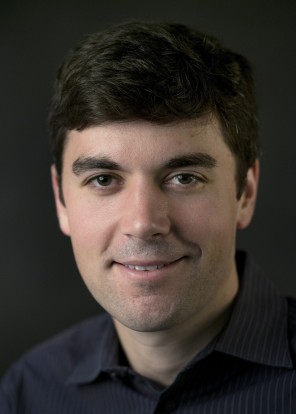
Eli Saslow is a staff writer at The Washington Post, where he writes narrative stories for the national staff’s enterprise team. Saslow has won numerous journalism awards, including a Pulitzer Prize in 2014 for Explanatory Reporting. His first book, Ten Letters, was published by Doubleday in 2011.
A graduate of Syracuse University with a degree in journalism, Saslow lives in Portland, Ore., with his wife, two daughters and son.