The New York Times, by John Branch
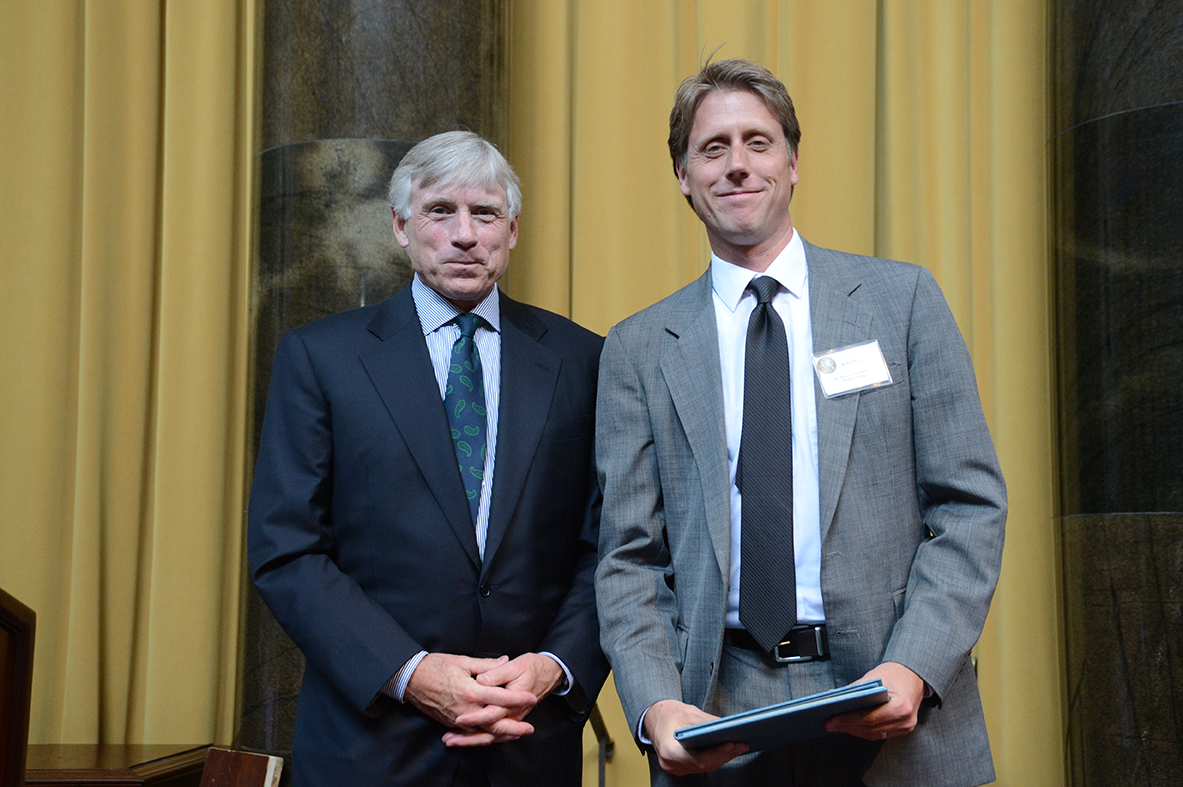
Lee C. Bollinger, President of Columbia University (left), presents the 2013 Feature Writing prize to John Branch of The New York Times.
Winning Work
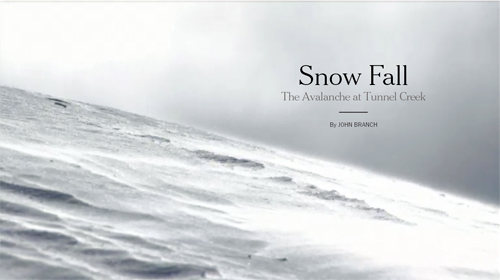
Photo by Eric Miller
On Dec. 20, 2012, The New York Times published on its Web site “Snow Fall: The Avalanche at Tunnel Creek.” It instantly became a storytelling sensation.
For those who had worried about the future of longer form storytelling in the digital age, the future had suddenly, spectacularly arrived.
People posting on Twitter appreciated the distinctiveness and the promise most immediately:
“Mindblowing.”
“The New York Times wins the Internet.”
“This is what the future of reading online looks like.”
“This changes everything.”
“Truly one of the most beautiful things I’ve ever seen on the web.”
Here’s what bowled readers over: a scrupulously reported, gorgeously written story by John Branch about a fatal avalanche in Washington State in February 2012, and a presentation online that gave credibility to the elusive dream of a truly immersive reading experience.
“Riveting,” The New Yorker declared.
Rebecca Greenfield, in a generous tribute on The Atlantic Wire entitled “What The New York Times’s ‘Snow Fall’ Means to Online Journalism’s Future,” noted how the presentation “integrates video, photos, and graphics in a way that makes multimedia feel natural and useful, not just tacked on.”
“The Times’s first bold leap into an experience-based feature,” she wrote, “has so far received an overwhelmingly positive reception online.”
Of course, great journalism — past, present, future — has and must be founded on the bedrock components of solid reporting and compelling writing. It would be hard to overstate Branch’s performance in those respects.
Branch, a Pulitzer Prize finalist last year in the Feature Writing category, interviewed every survivor of the avalanche, and the families of its three victims; he researched the world of backcountry skiing, the fastest-growing corner of a handsome, but dangerous sport; he traveled to Alaska to speak with snow scientists and to enlist their help in recreating in words and graphics the physics of the avalanche on Cowboy Mountain; he hiked the terrain, clawed through the avalanche’s path, and established a precise chronology of the disaster; he read formal accident reports, pieced together ski patrol and police photographs, reviewed dozens of 911 calls, and unearthed the formal avalanche warnings that all but predicted trouble the night before the accident.
And then Branch told a story of suspense and heartbreak with perfect pacing and devastating detail. Readers can all but feel the snow — and taste the panic; they can’t help but be swept up in a growing sense of dread as group psychology takes hold, caution is cast aside and the mountain gives way. The story, of a single terrible accident, speaks to universal human issues — the allure of risk, the power of trust, the nature of grief.
“Branch’s story is a meticulous investigation into the hazards of group decision-making: the insidious role that peer pressure, deferral to (imagined) authority, and presumption of expertise can play in undermining intelligence and experience,” Nick Paumgarten of The New Yorker wrote. “In this respect it is a worthy case study even for non-participants, much as, say, ‘The Perfect Storm’ or ‘Black Hawk Down’ or ‘Into Thin Air’ were. Avalanche accidents, as it happens, make for excellent exercises in human error.”
The piece — a print version was published in a 14-page special section on Dec. 23 — generated more than 1,100 comments online. Unqualified praise dominated them. “Tired and grumpy, avoiding chores, I read everything BUT this story, and then reluctantly clicked on it, expecting to be annoyed by some silly ski article,” wrote Susan Bein, a reader in Portland, Ore. “Within seconds, I was drawn in by the exquisite writing, which was almost three-dimensional in its ability to make me feel like I was there, hearing the sounds, feeling and experiencing along with the people being written about. I had to stop and re-read several sentences, because they were so beautifully, almost poetically expressed that I wanted to take them in in a deeper way and really savor them and enjoy being able to see through someone else’s richly perceptive eyes.”
The avalanche’s survivors, their families, and the families of the dead, people who knew the facts and the pain, all thanked Branch.
Selina Peikert, the wife of a survivor, put it this way:
“Thanks John, and thank you for telling what Wenzel and I have been holding in our hearts for the last 10 months. Thank you for telling the story in all of its awful detail, yet so beautifully. I quit trying to talk about it since it seems no one would give it the time and reverence it deserves, and it made me angry. Tomorrow, we lie our story to rest, as the country opens their newspaper, and we quit having to try to explain why our hearts still ache for those we lost. They will know the story. They can read it.”
And read it they did. “Snow Fall” online accounted for more than a million unique visits; a significant percentage of the people who found the story online were first-time visitors to nytimes.com; huge numbers of those readers came to the story through social media; the average time of reader engagement was off the charts. “At 66, I have no interest in doing either back country skiing or mountain climbing, but I follow both, and you and your colleagues at the New York Times have pulled off a monumental 2012 journalism achievement,” Charles Montague of The Akron Beacon Journal wrote to Branch. “Thanks for telling a great story and for using all the resources of 21st century journalism.”
The Pulitzer board, and the juries that send finalists to it, have in recent years rewarded the evolving journalistic work of the digital age — the novel and the experimental, the groundbreaking and the envelopepushing. The guidelines for the Feature Writing category include the following: “While juries will place primary emphasis on the quality of the writing, multimedia elements are welcome in order to enhance an entry.”
Rarely, we suspect, has there ever been a more fully realized partnership of fine writing and state of the art multimedia put before the features jury, and we encourage you to experience the story the way our online readers did: by clicking on the link submitted here.
The New York Times is proud to nominate “Snow Fall” for the Pulitzer Prize for Feature Writing, and in so doing invites you to recognize a truly trailblazing 2012 storytelling accomplishment.
Biography

John Branch joined The New York Times in September 2005 as a reporter in Sports. Mr. Branch was a sports columnist at The Fresno Bee from 2002 to 2005, and worked at The Colorado Springs Gazette as a business reporter from 1996 to 1998 and a sports reporter from 1998 to 2002.
Mr. Branch’s 2011 series "Punched Out," about Derek Boogaard, a professional hockey player valued for his brawling, shed light on the sport’s embrace of potentially brain-damaging violence. The series won several awards, including a Dart Award for Excellence in Coverage of Trauma, and was a finalist for the 2012 Pulitzer Prize in Feature Writing.
Born in Redondo Beach, Calif., Mr. Branch earned a Bachelor of Science in business from the University of Colorado Boulder in 1989 and a Master of Arts in journalism from the University of Colorado Boulder in 1996.