
A lost war, sinking national pride, the resignation of a disgraced president, uncertainty over the way forward: This was not exactly an ideal set of circumstances for a new president to inherit. But on Aug. 9, 1974, the day President Nixon resigned, it was the lot of Vice President Gerald R. Ford.
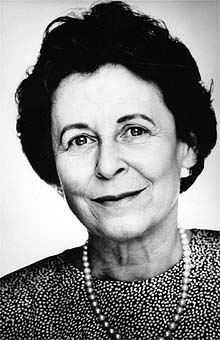
Meg Greenfield
And, by the lights of Meg Greenfield, editorial page editor of The Washington Post, Ford was not the best choice to take the reins of the country.
Two and a half years later, as Ford prepared to leave office, she ate crow. Her editorial on the Ford presidency was part of a package that won her the 1978 Pulitzer Prize for Editorial Writing.
Decency in the White House
By MEG GREENFIELD
“At no point has he shown a keen or impressive grasp of the complexities of hard questions. Pedestrian, partisan, dogged — he has been the very model of a second-level party man. It is no accident that over his quarter-century of unremarkable service in the House, he has never been put forward for the Presidency.”
So we spoke in this space a little over three years ago upon learning that Gerald Ford was about to ascend to the office of Vice President. We do not cite our respondent appraisal because we think it was on the money, but rather because we think it was not. Having been forced to replace his Vice President, and being in not-so-secure condition in office himself, Richard Nixon had just informed a waiting world that Gerald Ford was the one. Frankly, it did not occur to us that Gerald Ford was the right one.
But we were wrong; he was. The President who will leave office this week brought precisely the needed temperament, character and virtues to the high offices he has temporarily held. These qualities are regularly subsumed under the familiar general heading of “decency,” a word that does indeed fit the man. What is so revealing about the times in which we live — and the horrendous political circumstances surrounding Mr. Ford’s accession to office — is the vaguely condescending way in which this particular tribute is paid to him: Well, you have to admit he is a decent human being ... or ... Don’t get me wrong: Of course I think he’s a decent person ... and so on.
Decency, in this context, becomes as an attribute something roughly comparable to good posture or punctuality. How odd that so few of us have been willing to acknowledge that decency in the White House can be regarded as a luxury or bonus or fringe benefit only at our peril.
It is central. And its absence was central to the sorrows this country endured in the years preceding Mr. Ford’s Presidency. In his first days and months, it was as if he had liberated Washington — from its personal fears and hostilities and suspicions, from the dark and squalid assumptions that people had come reflexively to make about one another and the way things “really” worked. God knows who was (and is) still listening in on whose line and who is plotting what gruesome revenge against what political foe. Our point is merely that Gerald Ford brought to the White House an open, unsinister and — yes — decent style of doing things that altered the life of the city and ultimately of the country. We have found many of the President’s programs and positions (and lack of both in some cases) dismal news indeed. But that is yesterday’s laundry list. Our summing up of the Ford Presidency draws us only to the overriding legacy he leaves.
Will this city under the Carter Democrats be able to preserve that political and personal civility that Gerald Ford did so much, so unexpectedly, to revive? The Carter administration, more activist and energetic, we would guess, than its predecessor, faster-paced, more intellectually self-certain and combative, is almost by nature destined to put some of these homely but hard-won virtues at risk. We can only hope that the new administration will understand their indispensability. Mr. Ford has left it an incomparable gift in the detoxified political atmosphere of the capital and the institutions it is about temporarily to inherit.
The outgoing President has also done a great deal for the honor of his party, although you wouldn’t necessarily know it to listen to the samurai-like grunts and howls coming out of the struggle for party control. But Gerald Ford did indeed redeem the Nixon moral disaster. His two and a half years gave point and purpose and respectability to those innumerable straight-arrow Republicans who had come to work in Washington and who had been let down, in fact betrayed, by their own White House. And the exceptional quality of Mr. Ford’s own high-level appointments — John Paul Stevens, Edward Levi, William Coleman, to name just a few — went a long way to erase the memory of earlier indictment and disgrace.
We will leave it to others to tote up the pluses and minuses of the Ford administration in strict program and/or policy terms. We can frankly do without reviewing it ourselves. We think it is enough to point out that Gerald Ford had an all but impossible assignment — and that he did a hell of a job.