
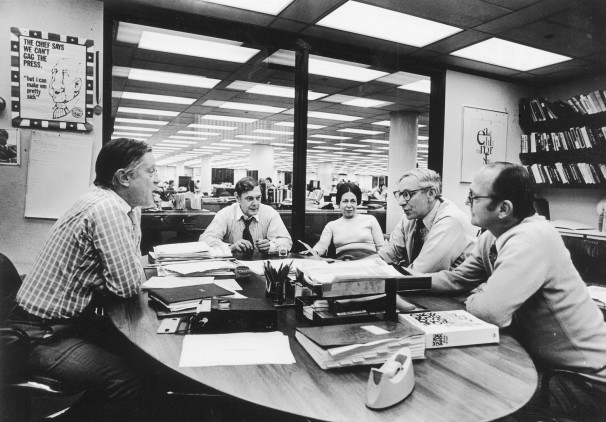
Geyelin, far right, at The Washington Post with Ben Bradlee, Richard Harwood, Meg Greenfield and Howard Simons.
When he moved from The Wall Street Journal to The Washington Post, Philip Geyelin certainly had the credentials for his new job as deputy editorial page editor. After covering the presidential campaigns of Thomas E. Dewey, Dwight D. Eisenhower and Adlai E. Stevenson for The Journal, he became its White House correspondent. He had also worked as the paper’s chief European correspondent and covered the Vietnam War.
In Vietnam, “He was amazed by what he saw,” his widow, Sherry Geyelin, told The New York Times after his death in 2004.
What he saw turned him against the war, a position contrary to The Post’s when he arrived. A year later, when he was promoted to the editorship of the page, he conferred with Katharine Graham, the publisher. Gradually, the paper also turned against the war.
It fell to Geyelin to write the Post editorial that ran on the last full day of the presidency of Lyndon B. Johnson. His assessment was part of a package that won him the 1970 Pulitzer Prize for Editorial Writing.
He wanted nothing more than to succeed
By PHILIP GEYELIN
They have not been dull, the Johnson years. From the first crisis in Panama to Santo Domingo and South Vietnam, from the wild campaign of 1964 to the triumphs in Congress, the protests on the campus, the riots in the cities and the sudden abdication in 1968. And they have not been unproductive, in their rich yield of civil rights and social welfare legislation. More than anything, perhaps, they have been sad, in the sense that Franklin D. Roosevelt thought of Lincoln as a “sad man because he couldn’t get it all at once — and nobody can.”
Lyndon Johnson tried, you have to give him that. He brought more raw force and endless energy and craving for accomplishment to the office of President than anyone could ask. Where he succeeded, he succeeded big, in education and civil rights and all the rest. And while it can be said that he also failed big — by not being able to win his way in the war in his time, and by having to acknowledge such a division in the country that he could only carry on in his final year by foreswearing his candidacy for another term — not the least of his legacies to President Nixon is what he himself did to turn the war around and head it in the direction of a gradual American disengagement and a political settlement. Serious peace talking is to begin in Paris this coming week not so much because Lyndon Johnson halted the bombing of North Vietnam in October but because he stared down his generals last March and made the much more difficult decision to refuse them the massive reinforcement of American troops that they were asking for.If this seems like a somewhat negative legacy there are more than enough that are positive. The list of legislative accomplishments runs on and on from the 1964 Civil Rights Act to rent supplements, voting rights, model cities, Medicare, control of water, pollution, immigration reform, job training, educational aid. And while some of this was the finishing of unfinished business, well begun before his time, some of it broke new ground. A landmark aid to education act, for elementary and secondary schools, cracked a constitutional and political impasse over church-school relationships, and it was brought into being not by past momentum or by parliamentary manipulation, but through the innovation and sheer determination of the President.
And yet, for all of this, how history will judge him, in the main, is going to hang very heavily on how the war evolves and what it will be said, many years from now, was lost or gained in that conflict. It is sometimes argued that Vietnam wasn’t everything, that the American commitment didn’t begin with Lyndon Johnson anyway, that the great domestic problems probably would not have been dealt with, let alone disposed of, much differently if there had been no great expansion of the war in the Johnson years. Perhaps. But the fact remains that Vietnam was, of course, the thing that seemed to be the well-spring of dissent, the issue that shook public confidence, the great preoccupation of the top men of government, the spoiler of relationships with allies and antagonists abroad, and the crisis that brought Lyndon Johnson down.
There were other sources of dissent, other spoilers; there would have been trouble anyway because there always is trouble enough somewhere, growing out of something or other, for any President. But it was always President Johnson’s firm belief that a Government which lost its mastery over Congress, and in the process lost the faith of the people, on one critical issue, was in grave danger of losing its capacity to command support or trust in anything it touched. This, in a sense, is what happened to Lyndon Johnson with Vietnam, and it happened because the President never managed until much too late to reconcile what he was trying to accomplish in the war, first with what the military men were trying to accomplish, and then with what the public thought he was trying to accomplish. He did not lead or educate or rally the country until it was too late.
And so the dissent grew and the war dragged on and finally it had to be conceded, if not acknowledged publicly, that pouring on more pressure and projecting the possibility of an ever-widening, open-ended war was not going to compel the enemy to stop doing what it was doing, in Dean Rusk’s phrase. Finally, it had to be conceded that there were limits to this new thing called limited war, and while this is progress of a kind it is not quite the same thing as success.
It is often said of Mr. Johnson that his trouble came from some incapacity to inspire, and thus to lead. He would say, on the contrary, that he was unjustly victimized by Easterners and intellectuals and liberals and the Kennedy people who scorned him for his regionalism and his roughness, his table manners and the twang of his voice. There is truth to both, and also irony, because the sad thing is that his origins are the best thing about him, the thing he has going for him whenever he is himself, and he didn’t know it. Or maybe he just wasn’t confident about it. Whatever it was, he tried to run this country the way he ran the United States Senate and it didn’t work. He wheedled and cajoled and high-pressured and over-sold, and seemed to be counting the legislation passed not so much for its contents as its bulk, and this wasn’t what people were concerned about. They were worrying about casualty figures and about how the combat troops got to Vietnam in the first place and how they got involved in combat operations when the Secretaries of State and Defense had said they weren’t supposed to; they were worrying about how it was all going to end and what it was doing to this country and whether it was worth it, and by the time the Administration got around to leveling a little more on the subject it was too late, because the confidence was gone.
This isn’t the whole story by any means but it was a big part of the story of how Lyndon Johnson lost his majority. If he was like Lincoln, a sad man, he didn’t show it and he didn’t let it slow him; he was forever driving. He wanted nothing more than to succeed — and he did, in many, many ways. But he wanted support for the war and money for a bigger antipoverty effort and safety in the streets and housing for the poor and education for all our children and medical care for all the elderly and love and respect of all the people, and it wouldn’t stretch. He wanted to get it all at once and Roosevelt was right: nobody can.
Source: Pulitzer Prize Editorials: America’s Best Writing, 1917-2003 (Third Edition), William David Sloan, Laird B. Anderson (eds.), Iowa State Press, 2003, pp. 177-80.