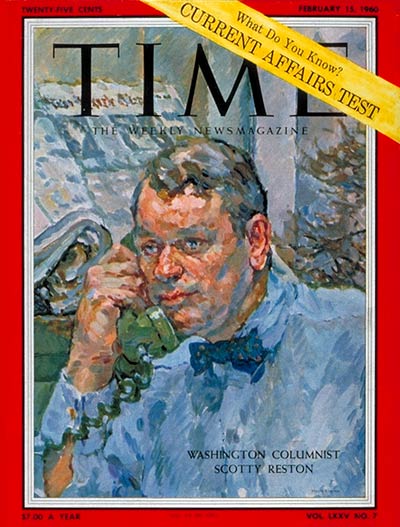
Reston on the cover of Time magazine
Born in Scotland and known as “Scotty,” James Reston was a longtime reporter and columnist for The New York Times.
In 1945, he won the Pulitzer Prize for Telegraphic Reporting for his coverage of the Dumbarton Oaks Conference, which established the framework for the United Nations. Twelve years later, he won again, this time for National Reporting.
His winning entry in 1957 included a five-part analysis of the effect of President Dwight D. Eisenhower’s health on the performance of the executive office.
Eisenhower had had a major heart attack in September 1955, and whether he would run in 1956 was an open question. When Reston wrote, Eisenhower had just returned to the White House fulltime and his cardiologist had announced that he was capable of serving a second term. But Eisenhower had his own impolitic medical opinion.
Here is how Reston saw it.
Ike: a paragon of simple goodness
By JAMES RESTON
The Republicans did everything but canonize President Eisenhower this week at the start of his fourth year in the White House, but, in a way, they forgot their best point.
He is not another Washington or Lincoln, as the party orators proclaimed Friday night, but an honest man who has proved that simple goodness is still a great force in national and world politics.
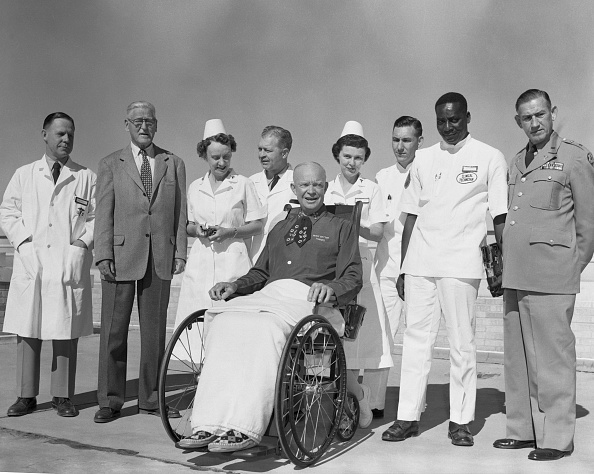
Eisenhower following his September 1955 heart attach.
In a city and a world that have lately been rewarding men for their bad qualities rather than their good qualities — for slickness rather than genuineness, for glibness rather than sincerity, for appearance rather than for substance and character — this just happens to be about the most important contribution a public man can make.
To puff him up into a genius, as his well-meaning partisan colleagues have been doing this week, blurs his true quality and denies him the satisfaction he would treasure the most.
This is the realization that the American system of government will work under the leadership of a man who is faithful to the ordinary decencies and durable principles of American life and that the people will instinctively prefer such a man to more brilliant and profound competitors.
The success of his simple honesty is startling, and overwhelms numerous other obvious defects. The events of this week illustrate the point.
He was involved in three controversies all at once: Secretary of State Dulles’ interview in Life magazine; General Matthew B. Ridgway’s charge that the President had misled the country by implying that the 1954 defense program was supported by Ridgway; and the internal White House controversy about what the President should say to the voters of New Hampshire about putting his name in the state primary election.
The President was ill-informed about the Life article. Every Ambassador in the capital was waiting to hear whether he actually had “decided” to order a limited atomic war under certain circumstances in Manchuria and South China without informing the Congress or his allies. He did not answer the question. In fact, he admitted that he hadn’t even read the article. This made him probably the only world statesman who hadn’t read it, but at least it was an honest answer. Same with the Ridgway charges. He didn’t know the facts. The issue was over one of his own State of the Union messages, but he referred the whole thing to the Pentagon.
He took the New Hampshire controversy head on. He invited other candidates to get into the primary. He urged the voters to consider all personalities. He stated with astonishing candor that his health would never be as good as it was before his heart attack, and that his future life “must be carefully regulated to avoid excessive fatigue.”
So what did the Republicans do? They treated him to the biggest dinner party on record, raised a whopping big sum to re-elect him in 1956, and put the Citizens for Eisenhower organization back in business!
What is back of all this? Why did the President make such a damaging and unnecessary confession about his health? Having made it, why is he still in doubt? And having heard it, why do the other Republican leaders refuse even to discuss another candidate?
The President made the statement because it is true, and he is an honest man. Having made it, he still delays because delay permits him to keep control of the political situation in the party, gives him more time to ponder the alternatives, and postpones the terrible choice between going on and giving up.
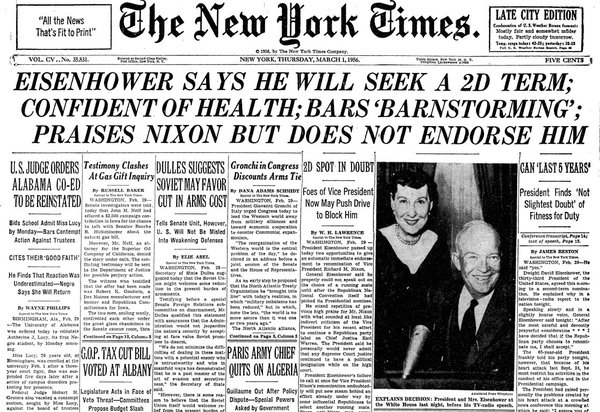
Reston's front-page Times story declaring Eisenhower would seek a second term.
Finally, the other Republican politicians refuse to think about the alternatives, because the alternatives are so difficult or unpleasant. Also they know their man. Eisenhower has often said one thing in politics and done another. He wasn’t going to get into politics originally, but he did. He wasn’t going to wage a pre-convention fight for the nomination in 1952, but he did. He wasn't going to get into a rough and tumble with [Adlai] Stevenson, but he ended by clubbing him all over the country.
This encourages the Republican leaders to wait and hope. They like Ike and believe in him, and they will do anything for him except to listen to what he says. They have read his New Hampshire statement, of course, but they have spent most of the week looking for the hooker. This is the way with Washington. It reads so much between the lines that it forgets about the print. It can deal with the half-true, half-false partisan politician. It can handle frauds or boobs or political twisters, but the dead-level, candid, spontaneous character puts it in a spin.