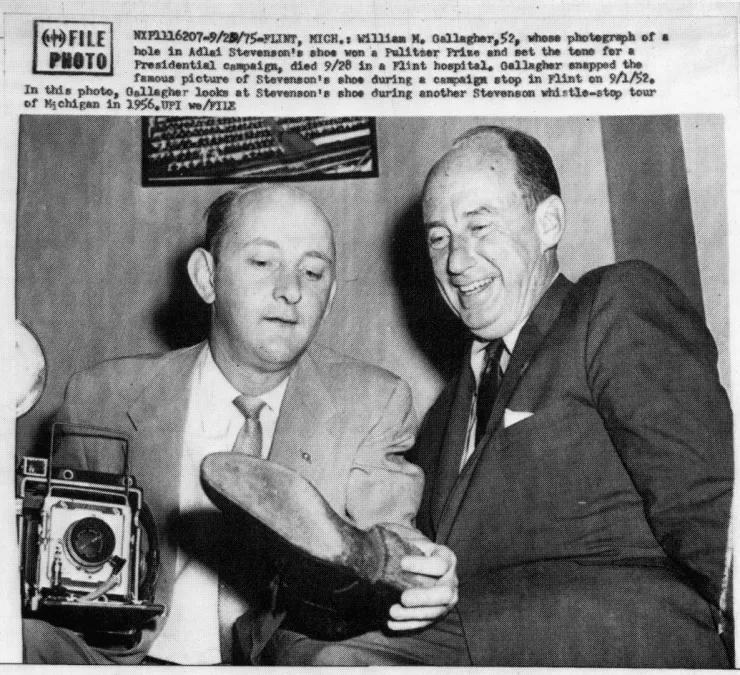
As a teenager in the 1930s, Bill Gallagher sold enough magazines to win a camera. He took a picture of the Detroit skyline, and it won him $5 in a contest. He spent the prize money on a home photo-developing kit. He drove around Flint, Mich., looking for traffic accidents. When he found one, he photographed it and sold the picture to an insurance company. He spent nearly everything he made on more photo equipment.
After other military assignments during World War II, Gallagher wound up shooting combat photographs for the Army Air Corps in North Africa, the China-India-Burma Theater and the Pacific. He returned home in 1945 and worked his way up to a job as a photographer with the Flint Journal.
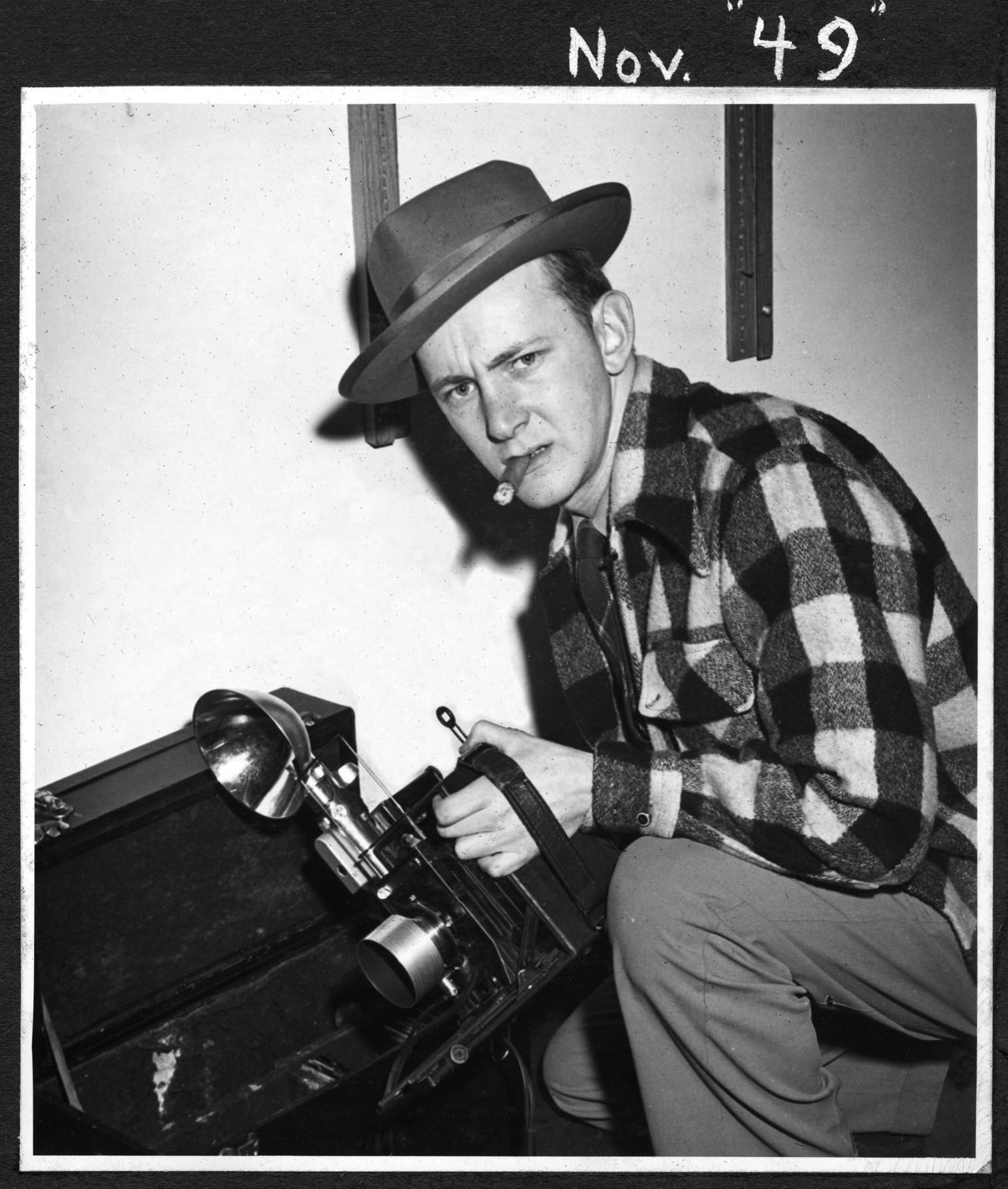
William Gallagher
A Catholic who never missed Mass, Gallagher was also a practical joker who liked cherry bombs. As a person and as a photographer, he had a common touch. He developed a great eye. He found the humanity in ordinary people and ordinary events. At Detroit Tigers games, he saw pictures that other photographers didn’t. He was a master of capturing the moment and filling the frame in a novel way.
Never were these professional qualities more in play than on Labor Day in 1952 when Adlai Stevenson, the Democratic presidential candidate, came to Flint for a campaign stop. The date was Sept. 1, and Gallagher turned the assignment into a picture that won the 1953 Pulitzer Prize for Photography. Courtesy of his family, which recently shared his papers and scrapbook with the Pulitzer office, he tells that story here.
Bill Gallagher died of spinal meningitis in 1975 at the age of 52. His friend, Flint Journal columnist Doug Mintline, wrote of him: “Gallagher was one of those rare persons who quickly peeled away the sham of society, mingling freely with janitors, cooks, cops, corporation presidents, union management and the guy next door.”
The man with a hole in his shoe
By WILLIAM M. GALLAGHER
On Labor Day in 1952, Gov. Adlai Stevenson of Illinois visited Flint during a political tour of Michigan. He was campaigning for president. My paper, The Flint Journal, assigned me to cover him at Flint Park, an amusement park in the city.
While lesser dignitaries spoke, Stevenson went over his own speech as he sat on the platform in the first row with Michigan’s Gov. G. Mennen Williams. The platform was six or seven feet high, and most of the photographers were on it. They were shooting for local labor unions, Detroit newspapers, wire services and magazines. Several were traveling with Stevenson. Most of us were using old 4-by-5 Speed Graphic cameras, so we had to be close for our close-ups.
I moved to the front of the platform almost directly in front of Stevenson to get in position for my close-up once he reached the lectern and started to speak. I could then get a couple of shots and move back so someone else could have my place.
As I knelt there waiting, he had his legs crossed, which put the sole of his shoe a little below eye-level for me. I couldn’t help but notice the hole. When I spotted it, I thought that here was a man running for president, and he was supposed to be a wealthy man, but he had a hole in his shoe. I figured it would make a picture but had no idea it would be any better than any other run-of-the-mill picture I might shoot that day.
I set my focus on about six feet, set the lens opening and removed the flash gun from the camera. Worried that Stevenson might uncross his legs, I calmly set the camera on the platform floor. Because I couldn’t lie down and sight the camera, I had to guess the alignment. I fired one bulb. Stevenson casually looked at me, uncrossed his legs, and returned to his notes. The one shot was all I got.
When I returned to the office to develop my stuff, I saw that my negative was almost perfectly exposed. More important, the image filled my negative with the important subject matter. Had I tilted the camera either way, I would have cut off some of the picture; up or down, missing part of the head or shoe. The 4-by-5 negative had almost no space to spare.
My date was waiting for me to finish so we could go to Detroit, but when I saw that negative, I thought I might have a picture different from any I had taken. I wanted to get it in the mail right away and hoped to sell it to Life magazine for its Picture of the Week series. This paid $125.
I sent my girl home in a cab and said I would call later. I called a reporter who was working that day and asked if he would come down and write captions for the picture. He said yes, and I started making prints from the negative. After he wrote the cut-lines, I took the prints to the post office.
The next day was Tuesday, and I was running the wire-photo machine until noon. During the morning my boss suggested I offer the photo to the wire-photo network. I balked because if AP used it and it got any play at all, Life would not buy the thing. But he said to offer it, so I did.
I asked the guy in Detroit if he wanted anything on Stevenson’s Flint visit. He asked what I had, and I said, “Oh, just a picture of Stevenson with a hole in his shoe.” He said it didn’t sound like much. I said okay and added that I had offered it only because my boss had told me to. If that was the case, he said, he’d better take if after all.
I wish I had kept my mouth shut, but it was too late. I made up a print to transmit. I printed it at just before noon, my quitting time. The guy in Detroit said the picture arrived okay. I told him I was shutting down. I went home to pack for a trip to Philadelphia to race a sailboat.
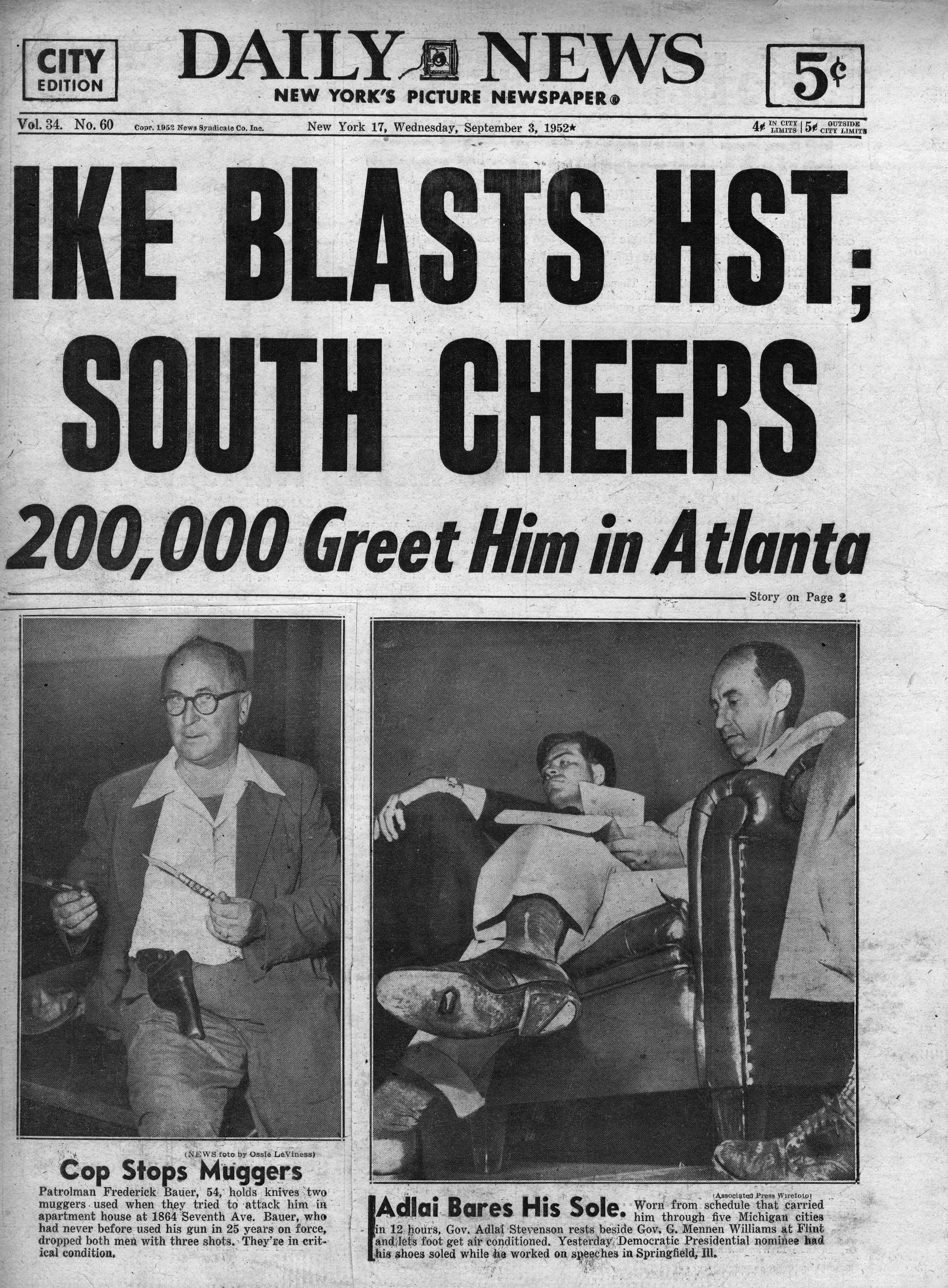
Gallaher's shot on the front page of the New York Daily News.
The next morning at the airport I went to the newsstand for something to read. Almost every paper there carried my Stevenson picture on the front page. I could hardly believe it. I called AP in Detroit and asked what had happened. The guy said New York kept calling for reruns of the picture. Detroit had transmitted it seven times.
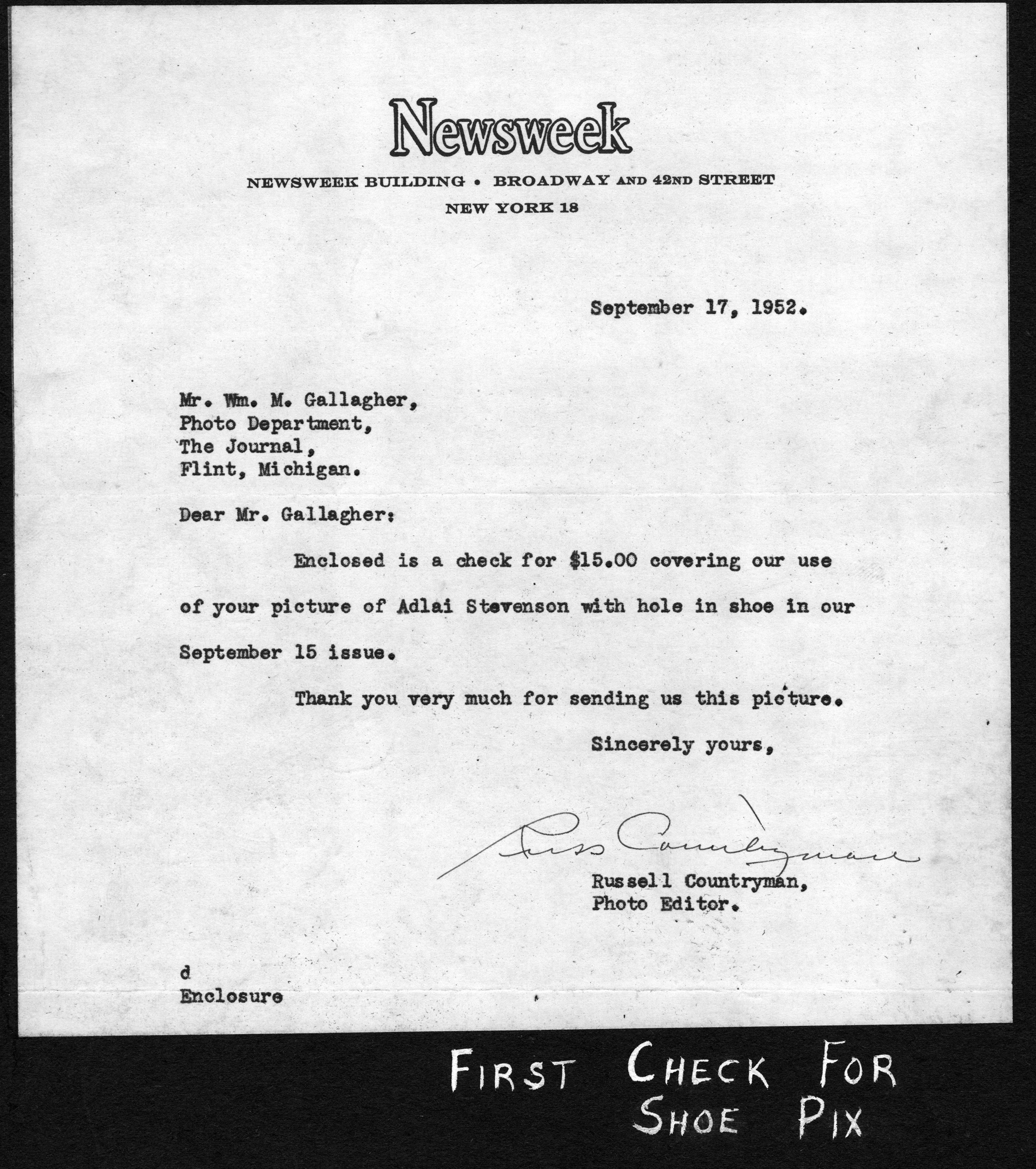
The first check Gallagher received for his photo, for $15 from Newsweek.
Now Life would never use the picture, so I decided to do what I could to promote it and keep it alive. I asked if AP would like a follow-up. I told them a guy in Flint planned to send Stevenson a pair of shoes and suggested they call the Journal and have a picture taken of the guy and transmitted to AP. They said they would look into it.
I hung up and called the Journal and said I had heard that Fred Elliott, who had just opened a shoe store across from the paper, was going to send Stevenson a pair of shoes and it might make a good picture. They wanted to know how I knew, and I said Fred had mentioned it the night before and I forgot to tell anyone.
Then I called Fred Elliott and suggested he send Stevenson a pair of shoes. He didn’t want to, but I told him the Journal would probably call shortly and want to take his picture, and he would get some publicity out of it. It would cost him only the price of the shoes. He still wasn’t hot on the idea, but I told him AP was also going to service the picture. I think that did it. He finally said okay.
The next day in Philadelphia, I watched the papers. Quite a few carried pictures of Elliott sending shoes to Stevenson.
Later, back in Flint, my editor, Mike Gorman, told me to make up a print and give it to his secretary, who in turn would send it to the Pulitzer committee. In early May of 1953, I was notified that my picture had won a Pulitzer Prize in News Photography.
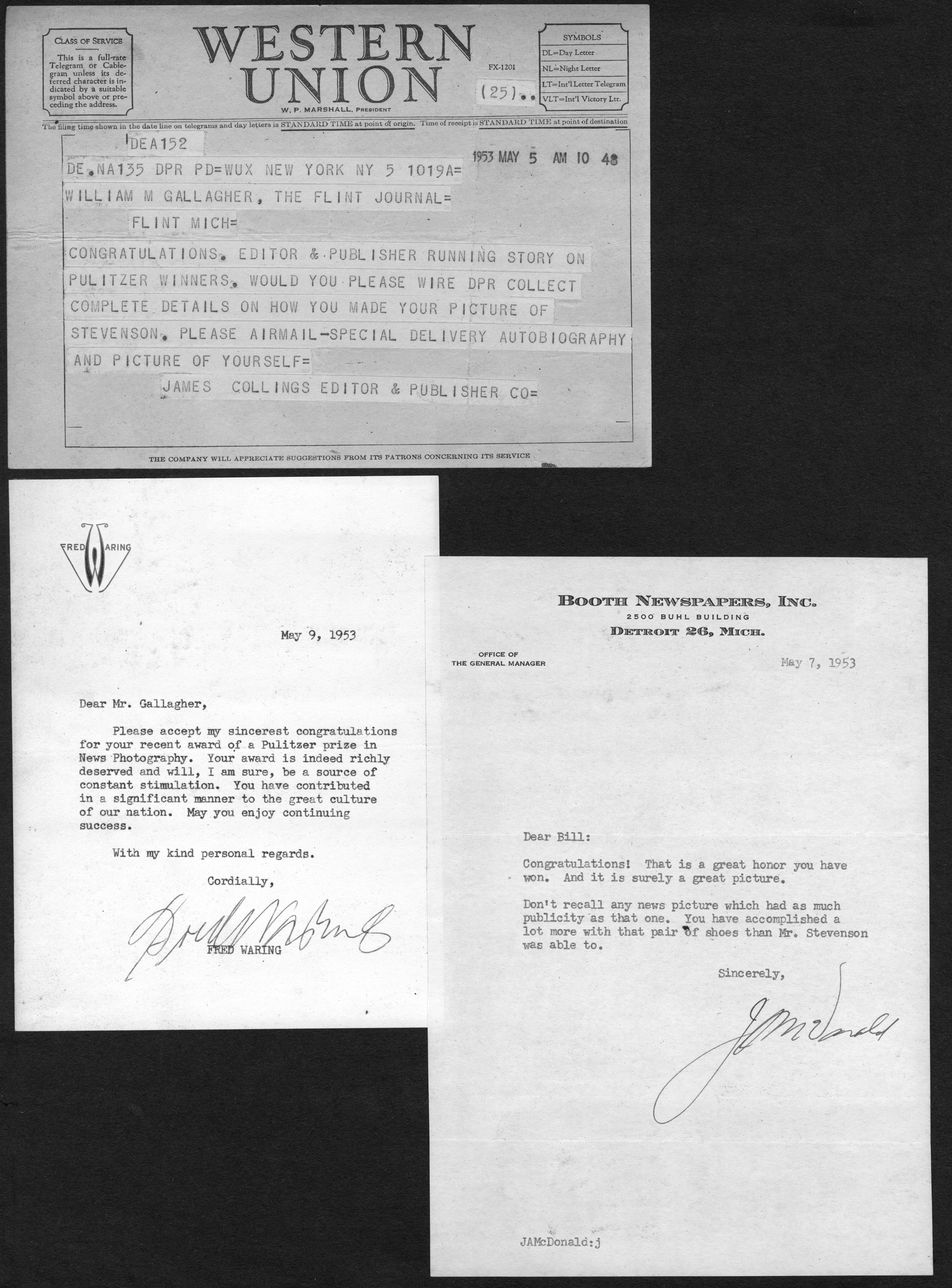
Congratulatory messages on Gallagher's Pulitzer Prize.
Of all the print organizations I had sent the photo to on the night I took it, only Newsweek bought it. For that I got $15. I received a mimeographed letter from Life thanking me for submitting the picture but saying they had their own man on tour with Stevenson and he had gotten the same picture. I wish I had saved the letter.
When it was all over, I had made about $1,600 from the picture — $1,000 from Pulitzer, the rest from other photo contests. Originally all I had wanted was $125 from Life. I figured fate had dealt me a lucky hand.
Sources: Gallagher family papers; Bill Gallagher’s scrapbook; Doug Mintline quotation from “A Man and His Camera,” Michigan History, September/October, 2006. (Special thanks to Joseph P. Gallagher.)