
Merriman Smith might have been the unhappiest reporter in President Kennedy’s motorcade in Dallas on November 22, 1963. He had split from his wife, he was broke, and United Press International, his employer, wouldn’t pay an advance for the trip because he was behind on his expense reports.
The night before he left Washington for Texas, Smith picked up a sheaf of thank-you notes his bosses had sent him over the years and tossed them into his apartment building incinerator. “That’s where this sort of crap belongs; that is how much it is worth,” he wrote his editors in an angry memo.
But he was ready that day in Dallas. He was always prepared for news, for the big stories that could suddenly happen on the White House beat. Smith had covered the White House for UPI and its predecessor, United Press, for 22 years. His enthusiasm for the job had not waned over those decades — and the contacts he’d amassed among the White House staff had grown. His knowledge and experience of his beat prepared him to write the story that win the 1964 Pulitzer Prize for National Reporting.
As the president’s motorcade prepared to leave Love Field that sunny morning, Smith climbed into the front seat of the White House pool reporters’ car, which was five cars behind Kennedy’s limousine. The car, provided to the press by AT&T, was equipped with a radiotelephone, a two-way radio with a telephone-style handset that was connected to the local telephone exchange. Smith loved any gadget that could help him report his stories faster. His insistence on sitting in front by the radiotelephone — the only mobile phone available to the 58 White House reporters on the trip — was a running joke among his colleagues, since he was usually the only reporter who wanted to use it. If it was the Associated Press’s turn to sit by the phone that day, its reporter, Jack Bell, didn’t know or didn’t care. Bell sat in the back. In the bureau, rookie reporter Wilborn Hampton typed Smith’s dispatch and called out to his boss, Jack Fallon, UPI’s Southwest Division manager, who was working at a Teletype machine a few desks away. Fallon grabbed the phone, and Hampton showed him what he’d just typed. “Send it!” Fallon yelled to a Teletype operator.
At 12:34 p.m. Central time, four minutes after the shooting, UPI’s A-wire clattered out the first news of the assassination:
“DALLAS, NOV. 22 (UPI) – THREE SHOTS FIRED AT PRESIDENT KENNEDY’S MOTORCADE TODAY IN DOWNTOWN DALLAS.”
What happened next is journalism lore: Smith crouched down with the phone while Bell pummeled his back. “Give me the goddamn phone!” the AP reporter yelled. Smith held on to the phone’s handset and tried to avoid Bell by crouching down in his seat. He didn’t know Dallas well, and wasn’t sure where Kennedy’s car was going — it seemed to be headed toward the Dallas Trade Mart, where the president was to deliver a luncheon speech. Maybe no one was hurt. Smith and Fallon talked over what happened, trying to get the facts right for the follow-up dispatches Fallon was writing.
Smith later said he believed he had to hang on to the phone while Bell tried to grab it from him. “On a story of this magnitude, I was not about to let it go until I knew the office had it all,” he said. “I told them to read it back fast. They did. Several words had been misunderstood or were missing and I filled in the blanks.”When the pool car arrived at the hospital about six minutes after the shots were fired, Smith finally gave the phone to Bell. But when Bell tried to call AP’s Dallas bureau, the line went dead.
While Bell fumbled with the phone, Smith and the other reporters in the pool car jumped out and ran up to Kennedy’s limo, which was parked a few yards away at the emergency room entrance. In his prize-winning story, he told readers everything he had witnessed: “Governor Connally was on his back on the floor of the car, his head and shoulders resting on the arm of his wife, Nellie, who kept shaking her head and shaking with dry sobs. Blood oozed from the front of the governor’s suit. I could not see the president’s wound. But I could see blood spattered around the interior of the rear seat and a dark stain spreading down the right side of the president’s dark gray suit.”
As he took in the horrible scene, Smith turned to Secret Service agent Clint Hill. “How bad was he hit, Clint?” he asked.
“He’s dead, Smitty,” Hill answered. The hospital litters hadn’t even arrived yet.
Smith ran into the hospital, commandeered a phone from an emergency room clerk, and began dictating to his bureau as Kennedy and Connally were wheeled in behind him. He quoted Hill by name saying, “He’s dead,” in a follow-up dispatch that also reported White House aides were uncertain of Kennedy’s condition.
It wasn’t until 12:39 p.m. that the AP moved its first account of the shooting, based on a report from an AP photographer who was standing feet away from Kennedy’s limousine when the bullets struck. AP’s initial dispatch only reached newspapers in the western states. At that hour, AP’s A-wire was on a split, transmitting breaking news in the West and a story budget in the East. It wasn’t until 12:40 p.m. — 1:40 p.m. Eastern time — that AP transmitted the news to East Coast newsrooms. As New York and Washington editors saw it, the AP was six minutes behind.
Smith, Fallon and the rest of UPI’s staff in Dallas kept up a steady stream of dispatches for the next hour. They were ahead of the AP at nearly every turn – including the official announcement of Kennedy’s death. UPI flashed Kennedy’s death at 1:35 p.m., two minutes before the AP. UPI didn’t want to be seen as taking advantage of the tragedy, so it did not publicize that it had beaten the AP so soundly. Smith’s Pulitzer-winning story was a dramatic recounting of the days’ events aimed at morning newspapers. His deep knowledge of his beat helped him get the story.
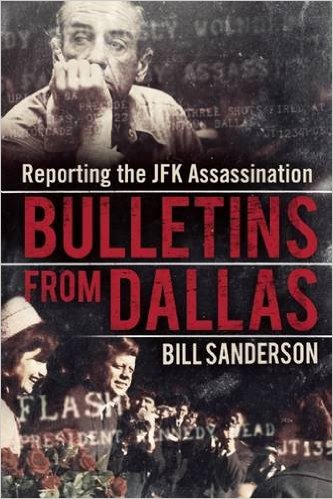
Bill Sanderson's new book on reporting the JFK assassination.
After Air Force One landed at Andrews Air Force Base, Smith flew to the White House in a military helicopter. That flight gave him a good detail for his prize-winning story. He wrote: “In the compartment next to ours in one of the large chairs beside a window sat Theodore C. Sorensen, one of Kennedy’s closest associates... Sorensen sat wilted in the large chair, crying softly. The dignity of his deep grief seemed to sum up all of the tragedy and sadness of the previous six hours.”
UPI entered Smith’s story in the breaking news category. It won the Pulitzer for national reporting. Despite the daunting professional and personal problems he faced that tragic day in Dallas, Smith’s razor-sharp journalistic instincts and his long experience on the beat came through for his readers on one of the biggest stories of the 20th century.