Staff of The Wall Street Journal
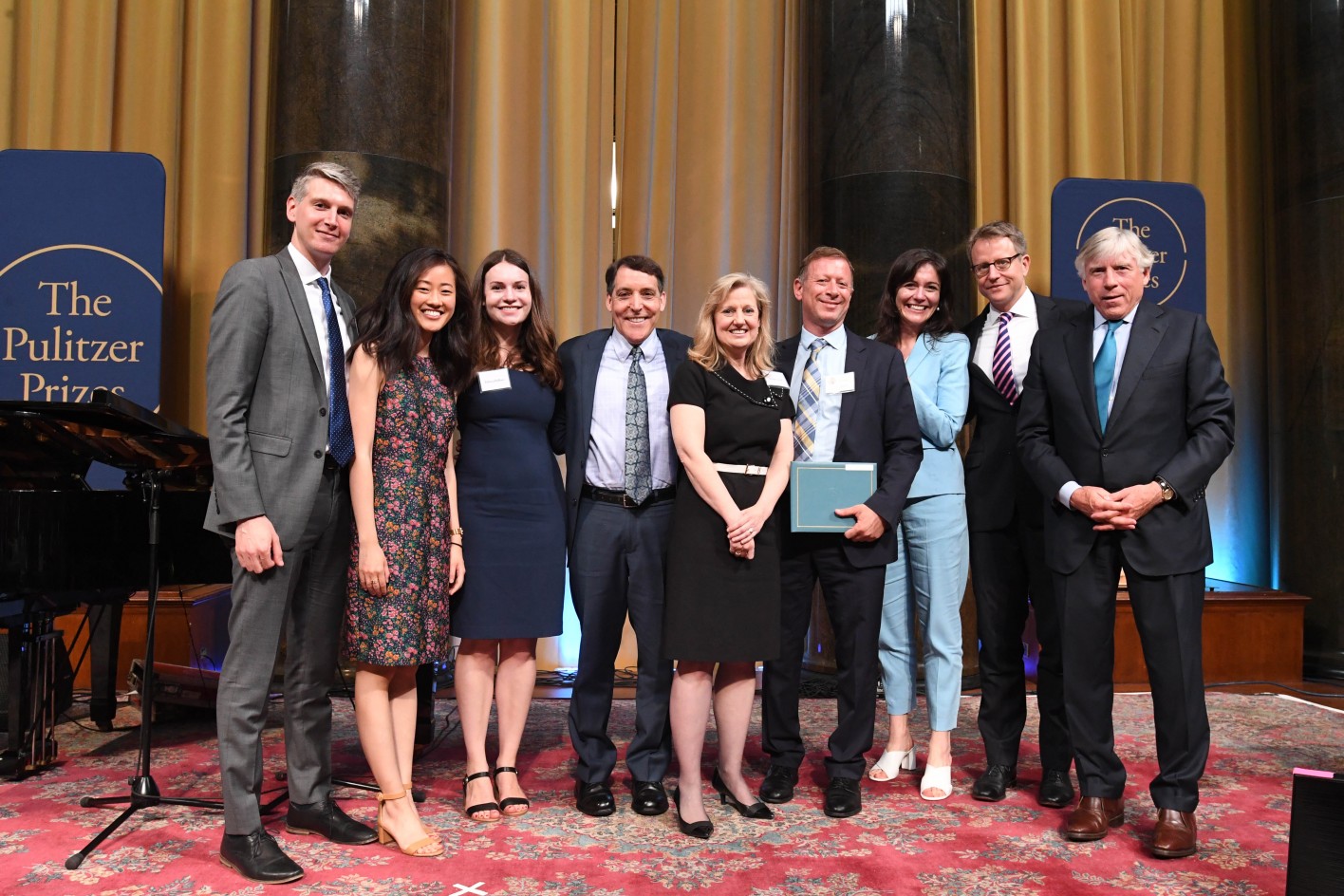
Staff members from The Wall Street Journal (from left: Joe Palazzolo, Nicole Hong, Rebecca Ballhaus, Michael Siconolfi, Jennifer Forsyth, Michael Rothfeld, Rebecca Davis O'Brien and Ashby Jones) accept the 2019 Pulitzer Prize for National Reporting from Columbia University President Lee Bollinger. (Eileen Barroso/Columbia University)
Winning Work
By Michael Rothfeld and Joe Palazzolo
A lawyer for President Donald Trump arranged a $130,000 payment to a former adult-film star a month before the 2016 election as part of an agreement that precluded her from publicly discussing an alleged sexual encounter with Mr. Trump, according to people familiar with the matter.
Michael Cohen, who spent nearly a decade as a top attorney at the Trump Organization, arranged payment to the woman, Stephanie Clifford, in October 2016 after her lawyer negotiated the nondisclosure agreement with Mr. Cohen, these people said.
Ms. Clifford, whose stage name is Stormy Daniels, has privately alleged the encounter with Mr. Trump took place after they met at a July 2006 celebrity golf tournament on the shore of Lake Tahoe, these people said. Mr. Trump married Melania Trump in 2005.
Mr. Trump faced other allegations during his campaign of inappropriate behavior with women, and vehemently denied them. In this matter, there is no allegation of a nonconsensual interaction.
“These are old, recycled reports, which were published and strongly denied prior to the election,” a White House official said, responding to the allegation of a sexual encounter involving Mr. Trump and Ms. Clifford. The official declined to respond to questions about an agreement with Ms. Clifford. It isn’t known whether Mr. Trump was aware of any agreement or payment involving her.
In a statement, Mr. Cohen didn’t address the $130,000 payment but said of the alleged sexual encounter that “President Trump once again vehemently denies any such occurrence as has Ms. Daniels.”
Mr. Cohen added in the statement, addressed to The Wall Street Journal: “This is now the second time that you are raising outlandish allegations against my client. You have attempted to perpetuate this false narrative for over a year; a narrative that has been consistently denied by all parties since at least 2011.”
The Journal previously reported that Ms. Clifford, 38 years old, had been in talks with ABC’s “Good Morning America” in the fall of 2016 about an appearance to discuss Mr. Trump, according to people familiar with the matter. In that article, the Journal reported the company that owns the National Enquirer agreed to pay $150,000 to a former Playboy centerfold model three months before the election for her story of an affair a decade earlier with the Republican presidential nominee, which the tabloid newspaper didn’t publish. The company said she was paid to write fitness columns and appear on magazine covers.
Mr. Cohen also sent a two-paragraph statement by email addressed “TO WHOM IT MAY CONCERN” and signed by “Stormy Daniels” denying that she had a “sexual and/or romantic affair” with Mr. Trump.
“Rumors that I have received hush money from Donald Trump are completely false,” the statement said.
Ms. Clifford didn’t respond to multiple emails seeking comment.
After the agreement, Ms. Clifford’s camp complained the payment wasn’t being made quickly enough and threatened to cancel the deal, some of the people familiar with the matter said.
The payment was made to Ms. Clifford through her lawyer in the matter, Keith Davidson, with funds sent to Mr. Davidson’s client-trust account at City National Bank in Los Angeles, according to the people.
“I previously represented Ms. Daniels,” Mr. Davidson said, referring to Ms. Clifford’s stage name. “Attorney-client privilege prohibits me from commenting on my clients’ legal matters.”
A spokeswoman for City National Bank declined to comment.
The agreement with Ms. Clifford came as the Trump campaign confronted allegations from numerous women who described unwanted sexual advances and alleged assaults by Mr. Trump.
In October 2016, the Washington Post published a videotape made, but never aired, by NBC’s “Access Hollywood” in which Mr. Trump spoke of groping women.
Mr. Trump denied all allegations of inappropriate sexual conduct and apologized at the time for his remarks on the tape, calling them locker-room banter.
Mr. Cohen worked at the Trump Organization from 2007 until after the election. As Mr. Trump took office, Mr. Cohen said he would work in private practice and act as Mr. Trump’s personal attorney. “I am the fix-it guy,” he said in an interview in January 2017 before Mr. Trump’s inauguration.
Ms. Clifford has appeared in about 150 adult films, and was considered among the industry’s biggest stars when the then-27-year-old met Mr. Trump at the American Century Championship in 2006, held at Edgewood Tahoe golf course in Nevada.
Another adult-film star, Jessica Drake, later alleged in an October 2016 news conference that Mr. Trump kissed her and two other women without permission in a hotel suite after the same 2006 golf event.
“I did not sign [a nondisclosure agreement], nor have I received any money for coming forward,” Ms. Drake said this week in an emailed statement. “I spoke out because it was the right thing to do.”
A White House official responded to questions about Ms. Drake by referring to a previous statement by the Trump campaign, which called her account “totally false and ridiculous.”
—Alexandra Berzon contributed to this article.
Michael Cohen and tabloid publisher traded favors over many years; the Omarosa mediation
By Michael Rothfeld, Joe Palazzolo, Lukas I. Alpert and Rebecca Davis O’Brien
Michael Cohen and the publisher of the National Enquirer forged an alliance over the years, looking out for the interests of Donald Trump and each other. Now, federal investigators are examining those ties as part of a wide-ranging probe into Mr. Cohen’s personal business dealings and his self-described role as Mr. Trump’s fixer.
In previously unreported interactions, some of which are memorialized in emails now under review, Mr. Cohen mediated a dispute between Omarosa Manigault-Newman, who had been a star on Mr. Trump’s “Apprentice” reality TV show, and the Enquirer over a story about her brother’s murder. He intervened in a separate legal case on behalf of David Pecker, chief executive of Enquirer parent American Media Inc. And when American Media paid a doorman who alleged that Mr. Trump fathered a child with one of his employees, a company executive ordered reporters to stop investigating after speaking with Mr. Cohen.
The revelations show a relationship characterized by mutual benefit and favor-trading on a greater scale than was previously known. The shared history could expose American Media, Mr. Cohen and by extension, Mr. Trump, to criminal campaign-finance charges. For example, federal agents and prosecutors in New York are investigating whether Mr. Cohen, acting as Mr. Trump’s representative, improperly coordinated with American Media to keep an ex-Playboy model’s account of an affair with Mr. Trump under wraps in the months before the 2016 presidential election, people familiar with the matter said.
One looming issue for both prosecutors and AMI is the publisher’s status as a media organization, which would afford it First Amendment protections. The Justice Department is examining whether American Media at times acted more like an extension of Mr. Trump and his campaign, a person familiar with the matter said. The legal bar is high to strip any media organization of its constitutional protections.
The Manhattan U.S. attorney’s office subpoenaed American Media and the Trump Organization on the same day in early April that the FBI raided Mr. Cohen’s home, office and hotel room. It is unusual for investigators to subpoena media organizations for information related to their newsgathering without advance warning.
Investigators personally approached Mr. Pecker with a subpoena and delivered a separate subpoena to American Media seeking information related to the payment to the ex-Playboy model, among other things, according to people briefed on the matter.
Federal law bars candidates from accepting campaign contributions from corporations. The law defines a contribution as anything of value given to influence a federal election. It also requires candidates to disclose political contributions and expenditures.
Mr. Cohen hasn’t been charged and denies wrongdoing. Mr. Trump denies the affair, and his attorney, Rudy Giuliani, has said Mr. Trump broke no election laws.
Lanny Davis, an attorney for Mr. Cohen, declined to answer a list of questions “out of respect for the process” but added, “I ask everyone to remember the difference between innuendo and fact.”
An American Media representative declined to comment. The White House didn’t respond to a request for comment.
American Media’s deal with the former Playboy model, Karen McDougal, surfaced days before the 2016 presidential election, when The Wall Street Journal reported that the company paid $150,000 to buy—but not publish—her story of having an affair with Mr. Trump.
American Media briefed Mr. Cohen on the deal, people familiar with their communications said; the publishing company said it was simply seeking his comment on the matter for a possible article.
In September 2016, Mr. Cohen and Mr. Trump discussed the possibility of buying the rights to the model’s story from American Media.
A recording Mr. Cohen made of that conversation was seized by federal agents investigating the attorney, said people familiar with the matter. While Mr. Trump seemed open to the idea, the rights remained with American Media until this April, when the company returned them to Ms. McDougal as part of a legal settlement, the people said.
Mr. Cohen created a Delaware shell company, Resolution Consultants LLC, on Sept. 30, 2016, to buy the rights to the McDougal story from American Media, according to a person familiar with the matter.
Among the emails in the possession of federal investigators are those showing Mr. Cohen’s previously unreported involvement in the dispute involving Ms. Manigault-Newman, a person familiar with the matter said.
Ms. Manigault-Newman threatened to sue American Media in 2011 over “exclusive” coverage of her brother’s murder after the publisher sent a reporter to his funeral in Ohio. The reporter spoke with attendees but didn’t identify herself, so mourners assumed she was part of the family, angering Ms. Manigault-Newman, people familiar with the episode said.
Mr. Cohen stepped in to defuse the situation and orchestrated a resolution in which Ms. Manigault-Newman dropped her legal threat in return for a job from American Media, these people said.
American Media announced in December 2011 that Ms. Manigault-Newman, then known as Ms. Manigault-Stallworth, had become West Coast editor of the company’s now-defunct Reality Weekly, a magazine about reality shows. After that publication shut down, she worked for American Media’s OK! Magazine.
Jerry George, National Enquirer’s West Coast bureau chief at the time, recalled his superiors instructing him to find an office for Ms. Manigault-Newman. Mr. George, who left the company in 2013, said he was never told what duties Ms. Manigault-Newman would perform.
Mr. George found a space for Ms. Manigault-Newman on the other side of the office from his reporting staff, near the advertising department, he recalled, adding: “I don’t think attendance was mandatory for her.” Her mother sometimes came to American Media’s offices, where she was known as “Mamarosa,” Mr. George said.
Ms. Manigault-Newman joined Mr. Trump’s White House staff to do public outreach until she was forced out in December.
Ms. Manigault-Newman has been interviewed by federal investigators, according to people familiar with the matter. There has been no suggestion that the resolution of her dispute with American Media was improper, but it highlights the overlapping interests of the media company and the Trump Organization that prosecutors want to understand better, according to people familiar with the matter.
Federal investigators have obtained emails showing that Mr. Cohen intervened in another legal dispute on Mr. Pecker’s behalf in 2016, shortly after American Media completed the $150,000 deal to buy the rights to Ms. McDougal’s story—-and as he was contemplating buying those rights from American Media.
Mr. Pecker had recently joined the board of payment-processing company iPayment Inc. After the board ousted the iPayment Chief Executive Carl Grimstad in August 2016, he sued the firm, its investors and its directors.
The iPayment board that forced Mr. Grimstad out was controlled by the same investors who had taken American Media private several years earlier.
Marc Kasowitz, a longtime attorney for Mr. Trump, represented Mr. Grimstad.
Mr. Cohen’s emails show him trying to mediate the dispute, according to people familiar with the records. He reached out to Mr. Kasowitz, and they arranged for a settlement meeting overseen by Mr. Cohen. Mr. Pecker went, along with lawyers for other defendants.
“Mr. Cohen asked Mr. Grimstad’s lawyers at our firm to meet to discuss a resolution of the litigations, which Mr. Grimstad authorized his lawyers to do,” Sheron Korpus, Mr. Kasowitz’s partner who led the case, said in an emailed statement. “No resolution was reached.”
The parties settled in 2017 with a payout to Mr. Grimstad valued at nearly $20 million, according to court documents.
A spokeswoman for Paysafe Group, which acquired iPayment this year, declined to comment on Mr. Cohen’s efforts to resolve the litigation.
Mr. Trump’s relationship with Mr. Pecker dates to at least the 1990s, when Mr. Pecker was president and chief executive of Hachette Filipacchi Magazines. The publisher put out Trump Style, a custom quarterly magazine distributed to guests at Trump properties. Mr. Pecker hosted a party for Hachette at Mr. Trump’s Mar-a-Lago resort in Palm Beach.
When Mr. Pecker took over American Media in the late 1990s, he imposed a moratorium on negative stories about Mr. Trump, according to former employees of the company.
Mr. Cohen, who joined the Trump Organization in 2007 as special counsel to Mr. Trump, developed an independent friendship with Mr. Pecker, according to people who know both men.
A person who knows Mr. Pecker professionally and personally said he viewed himself as an outsider in polite society and gravitated to others similarly placed, like Messrs. Trump and Cohen. Mr. Cohen has praised Mr. Pecker as “a great guy,” according to an acquaintance of both men.
Tips about Mr. Trump poured into the Enquirer during the height of the popularity of “The Apprentice” and its spinoff, former employees said. Enquirer editors rejected any that painted Mr. Trump in a bad light, knowing Mr. Pecker wouldn’t allow them, they added.
At the time, National Enquirer editors faxed or emailed stories and printed them out, scrawling edits in pen on hard copies before sending them to other editors or reporters. Sometimes Trump stories would have changes labeled “per Pecker” that seemed aimed at flattering Mr. Trump, such as identifying him as a “multibillionaire” instead of merely a billionaire, Mr. George recalled.
Throughout Mr. Trump’s 2016 presidential campaign, American Media used its pages to bolster the candidate and bash his opponents. Mr. Cohen, as Mr. Trump’s fixer, privately communicated with the company on a range of issues, according to people familiar with the matter.
He developed a close working relationship with American Media’s chief content officer, Dylan Howard, who joined Mr. Cohen to drink at Mr. Trump’s victory party at the New York Hilton in Manhattan on the night of Nov. 8, 2016, people familiar with the matter said.
During Mr. Trump’s campaign, the National Enquirer sent some of its unpublished stories about Mr. Trump or his rivals directly to Mr. Cohen for review, said people familiar with the practice. The tabloid also cobbled together columns under Mr. Trump’s name—“I am the only one who can make America great again!” one began—and cleared them with Mr. Cohen, according to one of the people.
American Media executives also talked to Mr. Cohen in late 2015, as Mr. Trump prepared to enter primary season with a major lead on his opponents in opinion polls, about a tip the National Enquirer received from a former doorman who had been fired from a Trump-branded apartment building, people familiar with the matter said.
American Media paid the doorman, Dino Sajudin, $30,000 for exclusive rights to his story alleging that Mr. Trump fathered a child with one of his employees, bucking its usual practice of paying sources upon publication, the people said.
Mr. Sajudin passed a lie-detector test but offered no proof of the relationship, the people said. Enquirer staff staked out the woman’s home attempting to get a picture and learned that she, her husband and daughter all had worked at Mr. Trump’s company.
Mr. Cohen called Mr. Howard after word got back to him that a National Enquirer reporter had reached out to Mr. Trump’s assistant to ask about the alleged love child, said one person familiar with the conversation.
The reporter hadn’t told her superiors about her plans to approach the Trump Organization, the person said.
“He is furious,” Mr. Howard told Enquirer editors, referring to Mr. Cohen, the person said. He then ordered staff to stand down on any additional reporting on Mr. Sajudin’s story.
A year later, other media organizations began to chase rumors about the doorman’s story. A Journal reporter visited the home of the employee identified by Mr. Sajudin in late 2016. A couple of hours later, Mr. Cohen called the reporter unsolicited and said the allegations were “baseless.”
American Media executives told the Journal in December 2016 that the company paid Mr. Sajudin because he had threatened to take his tip elsewhere and they didn’t want to lose a potentially big scoop. The Enquirer didn’t publish a story because Mr. Sajudin “was unable to provide one shred of information to support his fanciful claims,” Messrs. Pecker and Howard said in a written statement at the time.
“I don’t think they had any intention of doing a story,” Mr. Sajudin said in an interview with the Journal at the time. “I think it was just about paying some money to make it go away.”
Mr. Sajudin declined to comment for this article.
Because the Journal found no evidence to support Mr. Sajudin’s claims and because the woman told the Journal she didn’t have an affair with Mr. Trump, the newspaper didn’t publish an article about the payment to Mr. Sajudin.
The stakes were much higher the following summer, as the election drew near, when Ms. McDougal, the former Playboy playmate, began considering telling her story alleging she had an affair with Mr. Trump in 2006.
At the same time, the former adult-film star Stephanie Clifford, also known as Stormy Daniels, tried to sell to American Media her story of an alleged sexual encounter in 2006 with Mr. Trump, according to people familiar with the matter.
American Media rebuffed her. Reports of that alleged sexual encounter had surfaced years earlier in the celebrity press and Ms. Clifford had denied them.
Without American Media’s help, Mr. Cohen made a $130,000 deal to buy Ms. Clifford’s silence himself through a shell corporation, less than a month before the election.
Mr. Cohen’s friends said he was doing his job as Mr. Trump’s attorney when he tried to soften or kill media stories about Mr. Trump. Mr. Cohen said in an interview this month with ABC News that he tried to made good-faith judgments in his work for Mr. Trump, adding, “I am not perfect.”
Now, Mr. Pecker’s collaboration with Mr. Cohen may be nearing an end.
A few weeks after FBI agents searched Mr. Cohen’s properties, the Enquirer targeted the attorney in a two-page article under the headline, “Payoffs & Threats Exposed: Trump Fixer’s Secrets & Lies!”
The tabloid reported in the same issue that Mr. Trump had passed a polygraph “Proving No Russia Collusion!”
—Nicole Hong and Rebecca Ballhaus contributed to this article.
Donald Trump’s self-described ‘fixer’ brooded about failing to get a White House post; now under criminal investigation, he has the president’s atteDonald Trump’s self-described ‘fixer’ brooded about failing to get a White House post; now under criminal investigation, he has the president’s atte
Donald Trump’s self-described ‘fixer’ brooded about failing to get a White House post; now under criminal investigation, he has the president’s attentio
Donald Trump’s self-described ‘fixer’ brooded about failing to get a White House post; now under criminal investigation, he has the president’s attention
By Michael Rothfeld, Alexandra Berzon and Joe Palazzolo
In the 15 months since Donald Trump shut him out of a White House job, Michael Cohen, the president’s personal lawyer, has made a show of publicly dining with a vocal Trump critic, the billionaire Dallas Mavericks owner Mark Cuban.
After lunch at Freds restaurant in New York in April 2017, a gossip item appeared in the New York Post. When they had breakfast at the Time Warner Center in November, paparazzi “somehow” showed up, Mr. Cuban said. “I think he does it to piss off Trump when Trump is ignoring him.”
The second meeting, reported by celebrity-news outlet TMZ, did catch Mr. Trump’s attention. He called Mr. Cohen to complain. The attorney sought to reassure him, according to a person familiar with the conversation. “No, boss, I had breakfast with him to set him straight. I told him he has to respect the office, to respect you,” Mr. Cohen said, according to this person.
“Boss, I miss you so much,” he said later in the conversation. “I wish I was down there with you. It’s really hard for me to be here.”
Federal prosecutors are investigating Mr. Cohen’s work for Mr. Trump, including his $130,000 pre-election payment to a former adult-film actress, as well as his taxi businessand other personal dealings. Federal Bureau of Investigation agents raided his premises earlier this month.
Looming over all of this is an investigation by special counsel Robert Mueller into whether associates of Mr. Trump, including Mr. Cohen, colluded with Russians to influence the 2016 presidential election. Mr. Cohen and the White House have denied any collusion.
Prosecutors may not find evidence of wrongdoing by either man. Mr. Trump and his lawyers nonetheless are now grappling with the question of how the president’s self-described “fixer” may respond if charged and presented with the choice of turning on his boss or facing prison time.
Mr. Cohen has memorably said he would “take a bullet” for the president. But in a sign of Mr. Cohen’s state of mind, he has in recent months privately groused about being excluded from White House posts he believed he deserved, according to people familiar with his thinking. He has struggled to get Mr. Trump’s attention. And two new business engagements he started during that time that could have profited from his Washington connections have instead languished.
The Wall Street Journal reported last week that a longtime Trump legal adviser had warned the president that Mr. Cohen would likely cooperate if charged. Since then, Mr. Trump called Mr. Cohen “a fine person with a wonderful family” on Twitter and expressed confidence he would stand strong.
“Most people will flip if the Government lets them out of trouble, even if…it means lying or making up stories,” Mr. Trump tweeted. “Sorry, I don’t see Michael doing that despite the horrible Witch Hunt and the dishonest media!”
Mr. Cohen declined to be interviewed and provided a two-word response to a list of questions sent by email: “Completely inaccurate.” He didn’t respond to a request to elaborate.
The White House didn’t respond to a request for comment.
The recent actions have represented a remarkable turnabout for Mr. Cohen since the November 2016 election of Mr. Trump, whose presidential aspirations he had been encouraging for years.
Mr. Cohen had no official role in Mr. Trump’s 2016 campaign but informally advised him and served as a surrogate on TV. Behind the scenes, he tried to kill damaging stories about Mr. Trump, including reaching out to discourage women who had spoken negatively about the candidate, according to several of the women. He also paid for the silence of Stephanie Clifford, the former porn star known as Stormy Daniels, who alleges she had a 2006 sexual encounter with Mr. Trump.
Mr. Cohen and the White House have denied any sexual encounter took place.
In the months before the election, when Mr. Trump reshuffled his campaign for a third time and named Steve Bannon as campaign chief, Mr. Cohen told associates he had expected to be tapped for the role, according to people familiar with the matter. He also told people at the time he expected to be named White House chief of staff, people familiar with the matter said.
Mr. Trump decided that bringing Mr. Cohen inside the White House carried too many risks, according to people familiar with the discussions. Mr. Trump privately has described Mr. Cohen as a “bull in a china shop,” who when brought in to fix a problem sometimes breaks more china, according to a person close to the president.
On Jan. 5, 2017, two weeks before the inauguration, Mr. Cohen, camped in his cluttered office on the 26th floor of Trump Tower, a few doors away from the president-elect, still didn’t know what his future role would be.
Mr. Cohen juggled two phones with the backdrop of mixed martial-arts paraphernalia in his office. Mr. Trump “doesn’t operate with timelines,” Mr. Cohen explained to a reporter. Then he corrected himself: “I am not a timeline item,” he said. “He knows that an hour before he leaves, if he calls me and says, ‘I need you in D.C.,’ I’ll be there.”
About a week later, Mr. Cohen had grown more frustrated. He still hadn’t solidified his role. “I still don’t know exactly what I’m going to do, whether I need to stay here for a while or go to D.C.,” he said in a phone interview. “It’s crazy we’re talking about this three, four days before which everybody starts heading down and I have no idea.”
Mr. Cohen said he believed he might become Mr. Trump’s personal attorney, which he said would keep their communications confidential. “My sole purpose is to protect him and the family from anyone and anything,” he said in the January interview.
The conversation occurred less than three months after his deal with Ms. Clifford—then not publicly known—in which Mr. Cohen has said he used his home-equity line to finance an agreement in which she promised not to discuss her allegation of a 2006 sexual encounter.
Federal investigators are now probing whether the payment violated campaign-finance or other laws. Mr. Cohen has denied wrongdoing.
In a Fox News interview Thursday, Mr. Trump said of the Cohen investigation: “I’ve been told I’m not involved.” He added of his longtime lawyer: “From what I can tell, he did nothing wrong.”
Since the recent raids, which were approved by a federal judge, Mr. Cohen and Mr. Trump have argued that the government punctured attorney-client privilege in its seizure of his records.
Mr. Cohen has long surrounded himself with the trappings of wealth. In the Long Island enclave where he grew up, prep-school classmates recall him being part of a crowd of kids who flaunted family money and wore flashy brands. Mr. Cohen drove to law school in a Jaguar, two of his law school classmates recall.
Mr. Cohen, who as a teenager frequented Brooklyn’s ethnic Russian neighborhoods and married into a Ukrainian family, cultivated a rough-and-tumble, streetwise image.
Gregory Ehrlich invited Mr. Cohen to his wedding and was amused to hear he bragged to another guest that he belonged to the Russian mob. Mr. Ehrlich, who is now estranged from Mr. Cohen, said he doesn’t believe his former friend had any such ties.
Mr. Cohen joined the Trump Organization in 2007, after years of practicing law and doing business deals on his own, holding the title of Mr. Trump’s special counsel.
Mr. Trump didn’t always demonstrate respect for his employee. After saying he’d attend Mr. Cohen’s son’s bar mitzvah in 2012, Mr. Trump was late, and the blessings were delayed, according to an attendee.
After Mr. Trump arrived, he gave a speech, telling guests he hadn’t planned to come, but he relented after Mr. Cohen had repeatedly called him, his secretary and his children begging him to appear, the attendee said. The guests laughed because “everyone knew it was very realistic-sounding,” the attendee added.
Mr. Cohen found himself on the outside during the presidential transition, said a person close to Mr. Trump. He tried to find a role for himself by building bridges between Mr. Trump and the business community, but never got traction, this person said.
During the inaugural festivities, Mr. Cohen and his guests weren’t given priority access, the person said, noting that the hurt was visible on Mr. Cohen’s face: “He was always just at the edges.”
Now on his own, Mr. Cohen has had mixed success in business since Mr. Trump went to Washington. He re-established a solo legal practice, taking space on the 23rd floor of a skyscraper in Rockefeller Center, in the law and lobbying firm Squire Patton Boggs, less than half a mile from his old office at Trump Tower.
Under a “strategic alliance” with Squire Patton Boggs, Mr. Cohen received an annual fee of $500,000 from the firm for business development, according to court documents and a firm spokesman. His agreement with the firm also entitled him to a percentage of the fees the firm received from the five clients he referred, according to court documents.
His work for the firm appeared to be anchored in Washington, D.C. He was recruited by Edward Newberry, a top lobbyist in D.C. and global managing partner at the firm, said a person familiar with the matter. A firm spokesman declined to make Mr. Newberry available for comment.
Some firm partners opposed the alliance, because they weren’t privy to the terms of the agreement and feared Mr. Cohen’s reputation would jeopardize that of Squire Patton Boggs, people familiar with the matter said.
Asked for comment, a firm spokesman referred the Journal to a recent court filing by prosecutors opposing Mr. Cohen’s challenge to the search warrants executed against his property. The filing says Mr. Cohen “maintained complete independence” from the firm, used a separate computer server and had an office that locked with a key the law firm didn’t have.
Earlier this month, on the day of the FBI raid, Squire Patton Boggs said it was ending its relationship with Mr. Cohen, “mutually and in accordance with the terms of the agreement.”
Mr. Cohen also went into business with 4C Health Solutions, a Midlothian, Va.-based startup that works with governments and companies to help them detect questionable or fraudulent billing.
A consulting agreement reviewed by the Journal entitles Mr. Cohen to a 5% commission on contracts he delivers for the company, as well as the possibility of earning equity. The company told the Journal last year that it was in the hunt for large federal contracts, but more recently it has focused on states and the private sector, said Chief Executive David Adams.
Mr. Adams said Mr. Cohen has advised 4C on capital structure and introduced executives to potential clients, but the company has “paid zero dollars to Mr. Cohen,” because he hasn’t brought in any business.
The company last year said Mr. Cohen would join the board but later reversed itself to avoid unwanted attention, according to Tommy Thompson, the former Republican Wisconsin governor, who is chairman of 4C’s board.
Mr. Cohen, asked about the consulting agreement in January, said in an email he was “confused as to how or why you question my involvement in a startup company.”
It is unclear what work, if any, Mr. Cohen performed for Mr. Trump since the election. There is no known record of his involvement in legal matters for the president since the start of the Trump administration.
In the Jan. 5, 2017, interview, Mr. Cohen said: “Let’s just say I have no shortage of work. It encompasses all aspects of his life from his business to the personal,” adding: “It’s private between Mr. Trump and myself unless it’s made public because of a lawsuit or a news story.”
Mr. Trump said Thursday on Fox News that Mr. Cohen has done “a tiny, tiny little fraction” of his legal work, including “this crazy Stormy Daniels deal he represented me on.”
Mr. Cohen was one of Mr. Trump’s fiercest defenders last year, on Twitter and elsewhere. On May 24, he urged followers to retweet “if every morning you wake up and thank the Lord that @POTUS @realDonaldTrump won the election! I do…”
Privately, Mr. Cohen already had begun complaining to associates, both about being left in New York and about Mr. Trump’s then-failure to repay him for the $130,000 he had drawn off his home-equity line to pay Ms. Clifford, people familiar with the matter say.
Mr. Cohen even was contemplating “defecting” from Mr. Trump, according to a person familiar with these conversations. Mr. Cohen stopped complaining about Mr. Trump not repaying him around mid-2017, according to another person familiar with the situation. Mr. Cohen has said he wasn’t repaid by the Trump Organization or Mr. Trump’s campaign, but has declined to answer questions about whether Mr. Trump himself repaid him.
In the weeks since the FBI raid, Mr. Cohen has been out on the town, smoking cigars with friends and frequenting tony restaurants such as Nobu in midtown, in what some who know him interpret as an attempt to show he isn’t frightened of what the investigation will bring.
—Rebecca Ballhaus and Lisa Schwartz contributed to this article.
Since 2011, Stormy Daniels and Trump lawyer Michael Cohen have battled over her allegations of an affair, a standoff that has now reached the White House
By Joe Palazzolo and Michael Rothfeld
The extraordinary legal battle between the president of the United States and a former adult-film star has been building for seven years.
The standoff is rapidly escalating, as the porn actress, Stephanie Clifford, seeks to go public with details of her claims of an extramarital affair, and President Donald Trump and his attorneys fight to stop her.
A turning point came during a February phone call, after Michael Cohen, Mr. Trump’s personal lawyer, acknowledged publicly he paid Ms. Clifford $130,000 but didn’t say why.
In the call, Ms. Clifford’s lawyer told Mr. Cohen the actress believed his comments breached a nondisclosure pact they had signed in October 2016—and that she was now free to discuss the alleged affair.
“I didn’t f—ing breach it!” Mr. Cohen yelled, people familiar with the call said. Mr. Cohen warned her lawyer that if Ms. Clifford were to talk, he would seek to enforce the agreement.
It isn’t known whether Mr. Trump was aware of the agreement. But the Federal Election Commission is reviewing complaints by interest groups that the agreement violated campaign-finance law because of its timing, two weeks before the 2016 election.
The allegations pivot on whether the payment was made to influence the election to Mr. Trump’s benefit, said Thomas Frampton, a lecturer at Harvard Law School.
“It may be one of the least scintillating issues that Ms. Clifford could speak about, but from the perspective of Cohen’s and the president’s legal liability, it could be the most dangerous,” he said.
In a court filing Friday, Mr. Trump’s lawyers said they intend to pursue damages against Ms. Clifford—better known by her professional name, Stormy Daniels—for alleged violations of the contract, which they said could surpass $20 million. White House representatives and Mr. Cohen have denied any sexual encounter between Ms. Clifford and Mr. Trump, who hasn’t addressed the matter publicly.
The 39-year-old Ms. Clifford, who now mostly directs adult films and performs at strip clubs, has sued Mr. Trump, 71, seeking to extricate herself from the deal. She has taped an interview with “60 Minutes” expected to air this Sunday.
Ms. Clifford considered selling her story as early as April 2011, when she contacted her friend Greg Deuschle, a retired adult-film star known as Randy Spears.
At his urging, his ex-wife, Gina Rodriguez, a former pornographic actress-turned entertainment manager, called Ms. Clifford and offered to help.
Ms. Rodriguez sent an email to a reporter for Life & Style magazine, owned by Bauer Publishing, with the subject line, “Donald Trump Cheating Story.”
“I wanted to see if you were interested in a very bigh [sic] cheating story with Donald Trump and a Porn Star,” Ms. Rodriguez wrote, according to a copy of the email reviewed by The Wall Street Journal. “He was with her several times right after his current wife had there [sic] baby.”
Ms. Clifford agreed to Bauer’s $15,000 offer. Reporter Jordi Lippe-McGraw said she interviewed Ms. Clifford and recorded her discussing alleged encounters with Mr. Trump, starting with dinner and sex at his hotel room after they met at a celebrity golf tournament in Lake Tahoe in 2006, according to a transcript published by Bauer.
Lie-detector tests supported the accounts of Ms. Clifford, her ex-husband Michael Mosny and Mr. Deuschle, according to reports reviewed by the Journal.
After the magazine called Mr. Trump’s representatives for comment, Mr. Cohen threatened to sue, say people familiar with the matter. Mr. Cohen, 51, didn’t respond to requests for comment.
He also called Ms. Clifford’s manager, Ms. Rodriguez, said Mr. Deuschle, who answered the phone.
“He said, ‘You tell Gina if she ever wants to work in this business again then she needs to call me immediately,’ ” Mr. Deuschle recalled.
Ms. Rodriguez instead called Keith Davidson, a Los Angeles lawyer with a history of representing people who had come into possession of compromising information about celebrities.
Mr. Deuschle said Mr. Davidson advised Ms. Rodriguez to back off the story, because Ms. Clifford lacked proof, other than the names of Mr. Trump’s bodyguard and one of his assistants.
In late May 2011, Life & Style informed Ms. Clifford’s camp it wasn’t publishing her story, according to an email reviewed by the Journal.
Ms. Clifford’s current lawyer, Michael Avenatti, said Friday in an interview on MSNBC that Ms. Clifford had been threatened with physical harm if she spoke publicly about interactions with Mr. Trump.
The White House didn’t respond to requests for comment. Mr. Cohen said in an interview with Vanity Fair published Monday he didn’t threaten Ms. Clifford. When asked if anyone else had, he said, “I can only speak for myself.”
Mr. Avenatti declined to comment in detail about Ms. Clifford’s earlier attempt to sell her story.
“Unfortunately, and despite the prior WSJ reporting which was credible, this story is far more fiction than fact. Too many inaccuracies to count,” he said in a written statement.
The story returned in October 2011, when a gossip website called “The Dirty” alleged that Ms. Clifford “had sex with Donald after one of his golfing events.” Ms. Rodriguez leaked the information to the site’s author, Nik Richie, he later revealed on his blog.
The post prompted Life & Style to publish a two-page spread about Mr. Trump’s alleged affairs with Ms. Clifford and other women—although it didn’t include the interview with Ms. Clifford.
Five years later, Mr. Trump’s rise from reality-television star to Republican presidential nominee presented Ms. Clifford with a more lucrative opportunity.
Mr. Cohen learned Ms. Clifford was again in discussions with news media and contacted Mr. Davidson in September 2016, a person familiar with the matter said.
Mr. Cohen told Vanity Fair that Ms. Clifford’s lawyer proposed the $130,000 figure. “He said that she needed the money,” Mr. Cohen said.
Ms. Clifford signed the contract on Oct. 28, 2016. Less than two weeks later, Mr. Trump won the election.
Several experts in campaign-finance law said the timing raises red flags. Whether the payment to Ms. Clifford amounted to a campaign contribution depends on whether it was coordinated with Mr. Trump or his campaign and whether Mr. Cohen would have paid Ms. Clifford irrespective of the election, they said.
Mr. Cohen’s willingness to negotiate in 2016 could amount to powerful evidence the payment was made “because Mr. Trump was Candidate Trump,” said Jessica Levinson, a law professor at Loyola Marymount University in Los Angeles.
In his Vanity Fair interview, Mr. Cohen said he made the payment out of friendship to Mr. Trump. “If she would have come to me a month before, or three months before, I would have done the same thing,” he was quoted as saying.
In January 2018, the Journal began asking about the nondisclosure agreement. Mr. Cohen requested Ms. Clifford and her attorney draft a denial, people familiar with the matter said.
Mr. Cohen emailed the Journal a statement signed by “Stormy Daniels,” denying that she had a “sexual and/or romantic affair” with Mr. Trump or received payment from him.
The Journal article revealing the $130,000 agreement ran on Jan. 12, 2018.
Five days later, Bauer dusted off the 2011 interview with Ms. Clifford and published it in its larger magazine, “In Touch Weekly.”
Ms. Clifford took advantage of the attention with media appearances. On the day of a Jan. 30 appearance on “Jimmy Kimmel Live!,” Mr. Davidson informed her Mr. Cohen wanted another statement of denial, people familiar with the matter said. Ms. Clifford was eager to appear on the show and complied, these people said.
She also got word that pornography publisher Larry Flynt was offering to pay her potential legal expenses if she told her story on air. Ms. Clifford, wary of the offer, maintained her silence as Mr. Kimmel pressed her for details. A spokesman for Mr. Flynt confirmed the outreach, but said “nothing came of it.”
The turning point for Ms. Clifford—when she began to seriously consider speaking out—was a statement Mr. Cohen provided to news media on Feb. 13 acknowledging the deal with Ms. Clifford, people familiar with the matter said.
“Just because something isn’t true doesn’t mean that it can’t cause you harm or damage,” Mr. Cohen said.
Ms. Clifford viewed his comment as Mr. Cohen calling her a liar, and she questioned why Mr. Cohen could speak freely while she had to remain silent, according to people familiar with the matter.
In the call soon after, Mr. Davidson told Mr. Cohen that Ms. Clifford believed he had breached the agreement. Mr. Cohen explained the FEC had sought his response to a complaint about the payment, according to people familiar with the call. Mr. Cohen has called the allegations in the complaint meritless.
Ms. Clifford asked her lawyer to contact California billionaire Tom Steyer, who is bankrolling an anti-Trump ad campaign, to ask if he would indemnify her, a person familiar with the discussion said. Mr. Davidson declined to make the call.
In late February, Ms. Clifford decided she wanted to blow up the deal and that Mr. Davidson wasn’t the man for a full-on confrontation, people familiar with the matter said.
She hired Mr. Avenatti, an aggressive, media-friendly Los Angeles lawyer who last year won a $454 million verdict in a lawsuit alleging fraud against Kimberly-Clark Corp. and its spinoff Halyard Health Inc.
Around the same time, Mr. Cohen obtained a temporary restraining order against Ms. Clifford in arbitration.
Mr. Avenatti then filed a lawsuit in Los Angeles County Superior Court asking a judge to declare the nondisclosure agreement invalid on the grounds that Mr. Trump didn’t sign it and Mr. Cohen had breached it.
Ms. Clifford, who has been drawing big crowds lately at strip clubs around the country, recently established a crowdfunding site to finance her legal battle. As of Tuesday evening, it had raised more than $270,000.
Former prosecutor Jay Goldberg says he cautioned president that his personal lawyer, Michael Cohen, could be compelled to cooperate with prosecutors
By Joe Palazzolo, Michael Rothfeld and Michael Siconolfi
One of President Donald Trump’s longtime legal advisers said he warned the president in a phone call Friday that Michael Cohen, Mr. Trump’s personal lawyer and close friend, would turn against the president and cooperate with federal prosecutors if faced with criminal charges.
Mr. Trump made the call seeking advice from Jay Goldberg, who represented Mr. Trump in the 1990s and early 2000s. Mr. Goldberg said he cautioned the president not to trust Mr. Cohen. On a scale of 100 to 1, where 100 is fully protecting the president, Mr. Cohen “isn’t even a 1,” he said he told Mr. Trump.
Mr. Cohen is under criminal investigation for potential bank fraud and campaign-finance violations. FBI agents raided Mr. Cohen’s home, hotel and office last week, seeking documents about, among other things, a $130,000 payment he made in October 2016 to a former adult-film actress to prevent her from publicly discussing an alleged sexual encounter with Mr. Trump in 2006, The Wall Street Journal previously reported, citing people familiar with the matter.Messrs. Trump and Cohen deny such an encounter occurred.
Investigators are examining whether Mr. Cohen committed bank fraud in using a home-equity line of credit to pay the former porn star for her silence, as well as potential campaign-finance violations related to the payment, the people said.
“Michael will never stand up [for you]” if charged by the government, Mr. Goldberg said he cautioned the president.
Neither Mr. Cohen, who hasn’t been charged, nor his lawyer responded to requests for comment. The White House confirmed the phone call of Messrs. Trump and Goldberg.
The 15-minute discussion between the two men provides an inside peek at the president’s efforts to seek guidance amid the rapidly escalating developments involving Mr. Cohen. Mr. Goldberg is one of several longtime advisers Mr. Trump has reached out to as he and his legal team try to assess the potential fallout from the criminal investigation of Mr. Cohen and devise a response.
Mr. Goldberg said the volume of correspondence taken and the potential pressure the government can bring to bear on Mr. Cohen to testify put the president in more potential peril from the Cohen matter than from special counsel Robert Mueller’s investigation. Mr. Mueller is examining whether members of Mr. Trump’s campaign team colluded with Russians to affect the 2016 election. Russia officials have denied meddling in the election, and Mr. Trump has denied any collusion took place.
Messrs. Trump and Cohen have publicly supported each other. Mr. Goldberg said Mr. Trump told him on Friday that Mr. Cohen is “very strong.” For his part, Mr. Cohen this month tweeted: “I will always protect our @POTUS.”
In the call, Mr. Goldberg, a former prosecutor who represented Mr. Trump in divorce and real-estate matters, said he told the president Mr. Cohen could even agree to wear a wire and try to record conversations with Mr. Trump. “You have to be alert,” Mr. Goldberg said he told the president. “I don’t care what Michael says.”
Mr. Goldberg recalled the conversation in a two-hour interview in his apartment on New York’s Upper East Side Wednesday, emphasizing that he didn’t believe Mr. Trump had broken the law.
Speaking from his experience as a prosecutor, he said even hardened organized-crime figures flip under pressure from the government. “The mob was broken by Sammy ‘The Bull’ Gravano caving in out of the prospect of a jail sentence,” Mr. Goldberg said.
Mr. Goldberg provided fresh details about the search warrants executed against Mr. Cohen, which he said he learned after recent conversations with Mr. Trump and his lawyer, Ty Cobb. Mr. Cohen faces scrutiny over his payment to the former adult-movie star Stephanie Clifford for her silence, as well as his taxi business, according to people familiar with the matter.
On April 9, six agents showed up at Mr. Cohen’s suite at the Loews Regency Hotel on Manhattan’s Park Avenue, where he is staying temporarily while his home is renovated, with a warrant, Mr. Goldberg said. The agents “were perfect gentlemen,” but their guns were visible, he said. They also went to Mr. Cohen’s office at law firm Squire Patton Boggs in Rockefeller Center, where they gathered his files and placed them in cartons in a truck, Mr. Goldberg said.
Representatives for the FBI and Manhattan U.S. attorney’s office declined to comment.
Mr. Goldberg’s legal career has included stints as an acting U.S. attorney in Indiana, a special attorney to the Justice Department in Washington, and an assistant district attorney in New York.
Mr. Goldberg said he warned Mr. Trump in the Friday call against submitting to an interview with Mr. Mueller’s team, telling him “talking is a certain trap,” adding: “Don’t ever do it.”
Prompted by the president for his advice, he also said he recommended Mr. Trump fire Rod Rosenstein, the deputy attorney general who appointed Mr. Mueller.
Mr. Goldberg, who is 85 years old and has practiced law for more than five decades, said he suggested that Mr. Trump add a well-known New York lawyer to his legal team. Mr. Goldberg declined to name the lawyer, but a person familiar with the matter said it was Frederick Hafetz, a former chief of the criminal division of the Manhattan U.S. attorney’s office.
Mr. Hafetz confirmed receiving a call on the matter from Mr. Goldberg but said he wasn’t interested in joining Mr. Trump’s legal team.
Mr. Trump’s lawyer, Mr. Cobb, sent Mr. Goldberg an email Friday thanking him for “importuning Fred” and for providing a legal citation that Mr. Goldberg thought might be helpful to challenge the government’s use of records collected with the search warrants executed against Mr. Cohen, according to a copy of the email reviewed by The Wall Street Journal.
A White House official said that following the call with Mr. Goldberg, the president was “complimentary” about his former lawyer and relayed the suggestions to his legal team on hiring Mr. Hafetz and other matters. The president asked Mr. Cobb to call Mr. Goldberg “as a courtesy,” the official said. Neither Mr. Hafetz nor Mr. Goldberg are expected to join the legal team, the official said.
—Rebecca Ballhaus and Erica Orden contributed to this article.
By Rebecca Davis O’Brien, Nicole Hong and Joe Palazzolo
Michael Cohen had many reasons to play ball last weekend when his legal team sat down to talk to federal prosecutors.
The Manhattan U.S. Attorney’s office had testimony from Mr. Cohen’s accountant and business partners, along with bank records, tax filings and loan applications that implicated not only Mr. Cohen in potential criminal activity, but also his wife, who filed taxes jointly with her husband. Prosecutors signaled Mr. Cohen would face nearly 20 criminal counts, potentially carrying a lengthy prison sentence and staggering financial penalties.
Adding to the pressure, David Pecker, the chairman of American Media Inc., which publishes the National Enquirer, provided prosecutors with details about payments Mr. Cohen arranged with women who alleged sexual encounters with President Trump, including Mr. Trump’s knowledge of the deals.
This account of how Mr. Cohen went from a pugnacious defender of the president to turning on Mr. Trump is based on details provided by people close to Mr. Cohen and others briefed on the discussions with prosecutors.
For weeks, the president had been distancing himself from Mr. Cohen, including by stopping paying his longtime attorney’s legal fees, making clear amid the pressure that he was on his own.
Under oath on Tuesday, before a packed courtroom, Mr. Cohen created a spectacular moment without parallel in American history when he confessed to two crimes that he said he committed at the behest of the man who would become president.
Mr. Cohen pleaded guilty to eight federal crimes, including tax evasion and making false statements to a bank, capping a monthslong investigation into his business dealings and work as Mr. Trump’s personal lawyer. For the president, it opens up a perilous new legal front.
Mr. Cohen in court said Mr. Trump directed him to arrange payments during the 2016 campaign to two women who alleged they had sexual encounters with Mr. Trump. The payments violated caps on campaign contributions and a ban on corporate contributions, prosecutors said.
On Wednesday, Mr. Trump denied he directed Mr. Cohen to buy the women’s silence. Contradicting earlier statements, the president said he became aware of the payments to the women “later on” and said Mr. Cohen was reimbursed from his personal funds, not his 2016 campaign coffers.
The investigation is continuing, according to a person familiar with the matter.
Although the plea deal doesn’t require Mr. Cohen’s cooperation, it leaves the door open for him to talk with both the Southern District of New York and special counsel Robert Mueller. The court restricted Mr. Cohen’s travel to New York City; Chicago, where he owns taxi medallions; South Florida, where his parents live; and Washington, D.C., where the special counsel is based.
The deal doesn’t preclude further prosecutions, including other charges against Mr. Cohen.
Prosecutors built their case partly by using materials seized in April 9 raids of Mr. Cohen’s home, office and hotel, including recordings and other items that provided evidence of campaign-finance violations.
Investigators quickly zeroed in on Mr. Cohen’s relationship with American Media, including its role brokering deals on behalf of Mr. Trump. Mr. Pecker had been an open supporter of Mr. Trump’s candidacy. Prosecutors say Mr. Pecker offered to help keep quiet negative stories about Mr. Trump that might come to the National Enquirer, a practice in the business known as “catch and kill.”
American Media executives were involved in both hush-money deals that formed the basis of Mr. Cohen’s guilty plea to campaign-finance violations, prosecutors said on Tuesday. One was a $130,000 payment to Stephanie Clifford—a former porn star who goes professionally by Stormy Daniels—as part of an agreement to keep her from publicly discussing an alleged affair with Mr. Trump. The payment was first reported by The Wall Street Journal in January.
The second was a $150,000 payment to former Playboy model Karen McDougal for her exclusive story of an alleged extramarital affair with Mr. Trump, a story that was purchased by American Media in August 2016 at Mr. Cohen’s urging, and then never published. The payment was first reported by the Journal in November 2016.
On April 5, days before the raids, Mr. Trump told reporters on Air Force One he didn’t know about the payment to Ms. Clifford, and referred questions about the matter to Mr. Cohen. “You’ll have to ask Michael Cohen,” Mr. Trump said. “Michael is my attorney.”
Mr. Cohen, who that night was staying aboard the yacht of Trump donor Franklin Haney, which was docked in Miami, grew irate on the ship soon after Mr. Trump made his remarks distancing himself from the Clifford payment, according to a person familiar with the episode. Mr. Cohen was swearing loudly as others on the boat were sipping their drinks, the person said.
The search warrant executed on April 9 sought materials and information related to a wide range of communications, including ones related to the payments to Ms. Clifford and Ms. McDougal. At the same time, investigators subpoenaed Mr. Pecker, American Media and the Trump Organization, Mr. Trump’s business.
Prosecutors had reason to be concerned that without raiding Mr. Cohen’s office, “records could have been deleted without record and without recourse for law enforcement,” according to a court filing.
Prosecutors in the Southern District said the investigation into Mr. Cohen was, in part, a referral from the special counsel’s office. It isn’t clear when the referral took place, or if the office was already investigating Mr. Cohen when the referral came through.
The special counsel’s office was examining Mr. Cohen’s finances since at least October 2017, according to a person familiar with the matter.
Prior to the raids, investigators had already obtained covert search warrants on multiple email accounts used by Mr. Cohen, prosecutors said in a court filing. Early this year, they also had subpoenaed Mr. Cohen’s former accountant, Jeffrey A. Getzel, who handled Mr. Cohen’s personal and business tax returns.
In May, Michael Avenatti, a lawyer for Ms. Clifford, released a memo detailing payments made to Mr. Cohen from companies including AT&T Inc. and Novartis AG , as well as an investment firm linked to a Russian oligarch. Federal agents investigated whether Mr. Cohen lobbied Trump administration officials on the companies’ behalf without registering as a lobbyist, the Journal previously reported.
Initially, Mr. Cohen seemed unlikely to turn on the president. Although their relationship was at times turbulent, Mr. Trump appreciated Mr. Cohen’s absolute loyalty. On the day of the raids, Mr. Trump called the move a “disgrace” and a “witch hunt.”
Soon after the April raids, Mr. Cohen’s relationship with Mr. Trump began to deteriorate.
The estrangement began over legal bills, said a person who has spoken with Mr. Cohen about the matter. The Trump family covered part of Mr. Cohen’s legal fees after the raids, but then stopped paying.
Mr. Cohen felt exposed. Public comments by Rudy Giuliani, Mr. Trump’s lawyer, put distance between the president and Mr. Cohen and further alienated the attorney, the person said.
Mr. Cohen told associates and friends he felt Mr. Trump didn’t have his back and vented that the president hadn’t personally offered to pay his legal bills in the Manhattan investigation, which he said were “bankrupting” him.
Mr. Cohen’s troubles increased in May, when Evgeny “Gene” Freidman, a New York City taxi mogul who managed taxi medallions owned by Mr. Cohen and his relatives, pleaded guilty to state criminal tax fraud and agreed to cooperate with federal prosecutors in their probe of Mr. Cohen.
By then, prosecutors and the Internal Revenue Service had focused on Mr. Cohen’s personal income taxes. In conversations with a potential witness in June and July, investigators asked “very pointed” questions about various tax filings, according to a person familiar with the conversations.
“They knew what they wanted, they knew what they had, and they went after it,” the person said.
In late June, Mr. Cohen openly broke with Mr. Trump.
A personal turning point for Mr. Cohen was a conversation with his father, Maurice Cohen, a Holocaust survivor.
Mr. Cohen’s father urged him not to protect the president, saying he didn’t survive the Holocaust to have his name sullied by Mr. Trump, according to a person who was told about the conversation. The elder Mr. Cohen couldn’t be reached for comment.
On June 20, Mr. Cohen stepped down from his position as the Republican National Committee’s deputy finance chairman and tweeted his first public criticism of his former boss: “As the son of a Polish holocaust survivor, the images and sounds of this family separation policy [are] heart wrenching.” The tweet no longer appears on Mr. Cohen’s Twitter account.
By then, Mr. Cohen had hired New York lawyer Guy Petrillo to represent him in the Manhattan U.S. attorney’s probe. The choice of Mr. Petrillo, who had once served as the chief of the office’s criminal division, was seen as a sign that Mr. Cohen hoped to cooperate. Mr. Petrillo began to signal this intent to prosecutors.
Shortly after Mr. Petrillo’s hiring, Mr. Cohen told ABC News in an interview that his first loyalty was to his family and country, not to the president.
In July, a recording became public that Mr. Cohen surreptitiously made of a conversation he had with Mr. Trump in September 2016 about buying the rights to Ms. McDougal’s story. The president has denied the affair.
The president’s legal team had waived attorney-client privilege on the recording, which had been seized in the April 9 raids.
The week of the recording’s release, the investigation appeared to accelerate, people familiar with the investigation said.
Federal prosecutors faced an early September deadline to charge Mr. Cohen. After that, they would have to wait until after the midterm elections, under Department of Justice guidelines, or risk criticism of potentially affecting the election’s outcome. They had follow-up witness interviews scheduled as recently as this week, a person familiar with the investigation said, but canceled them as the plea agreement came together over the weekend.
Given the Justice Department’s policy of not indicting sitting presidents, a guilty plea from Mr. Cohen and his public implication of Mr. Trump were among the strongest outcomes prosecutors could have hoped for, according to former federal prosecutors. For prosecutors, the guilty plea meant they could avoid a contentious trial and free up resources to pursue other investigations.
On Monday, Manhattan federal prosecutors filed a court document, in a case then labeled as U.S. v. John Doe, indicating a guilty plea was forthcoming.
By Tuesday night, hours after Mr. Cohen implicated Mr. Trump in a possible crime, one of Mr. Cohen’s lawyers, Lanny Davis, appeared on cable news shows to say Mr. Cohen wouldn’t accept a pardon from Mr. Trump and “is more than happy to tell the special counsel all that he knows.”
—Michael Rothfeld contributed to this article.
At the Trump Organization, the future president appreciated lawyer’s loyalty but doubted his professional abilities and judgment; a big pay cut
By Rebecca Ballhaus, Michael Rothfeld, Joe Palazzolo and Alexandra Berzon
Donald Trump summoned senior aides to his 26th floor office at Trump Tower around 2009 for an unpleasant task: persuade Michael Cohen—a top lawyer at his company—to resign, according to one of the aides.
Mr. Trump’s frustration had reached a breaking point, the aide said. Mr. Cohen wasn’t getting things done and Mr. Trump didn’t believe he was a good fit at the Trump Organization, even though he liked him and didn’t want to fire him. “What’s he doing here?” Mr. Trump demanded.
The message was relayed to Mr. Cohen. Visibly upset, Mr. Cohen pushed back. “I will try to prove myself,” Mr. Cohen replied, a person familiar with the matter said.
Mr. Trump eventually dropped the issue, but not before dealing another blow to Mr. Cohen by way of a big pay cut, slashing his annual income of more than $400,000 roughly in half, according to another person familiar with the matter.
The episodes, never previously reported, cast in new light the decade-long relationship between now-President Trump and Mr. Cohen. The lawyer found his niche as a fixer of some of Mr. Trump’s thornier problems, including playing the heavy with potential deal partners, and helping the real-estate developer write some of his meaner tweets.
At the same time, Mr. Trump throughout held Mr. Cohen at arm’s length. Interviews with two dozen friends and acquaintances of the two men and others familiar with their relationship suggest Mr. Trump appreciated the unswerving loyalty. But he also came to doubt Mr. Cohen’s professional abilities and judgment.
From this improbable relationship comes an extraordinary test of how far Mr. Cohen’s loyalty will stretch, and whether Mr. Trump’s treatment of Mr. Cohen over the years will come back to bite him, jeopardizing them both in the process.
Federal authorities seized millions of files from Mr. Cohen during an April raid. They’re investigating potential campaign-finance violations and bank fraud surrounding, among other deals, Mr. Cohen’s October 2016 payment to Stephanie Clifford, the former adult-film star called Stormy Daniels, to keep her from discussing an alleged sexual encounter with Mr. Trump, according to people familiar with the matter.
Some allies of Mr. Trump have expressed concerns that Mr. Cohen, who is shopping for a new legal team, will cooperate with investigators—a decision that one person close to Mr. Cohen said he hadn’t yet made. The outcome is likely to determine how the final chapter of the 12-year-long relationship between the two men is written.
Mr. Cohen didn’t respond to a detailed request for comment, except to write back: “Your entire set of facts, as put forth below, lack any accuracy and demonstrate you are just another member of the fake news propaganda machine.”
The White House didn’t reply to requests for comment. Mr Trump told reporters on Friday: “I always liked Michael and he’s a good person,” adding that Mr. Cohen is no longer his lawyer and that they hadn’t spoken “in a long time.” Asked whether he’s worried Mr. Cohen would cooperate with authorities, Mr. Trump said: “No, I’m not worried because I did nothing wrong.”
The Trump-Cohen relationship began with real estate. Mr. Cohen bought an apartment in Trump World Tower, a 72-floor skyscraper near the United Nations, for a little more than $1 million in 2001, public property filings show. It was his first purchase in one of the glitzy Trump buildings and one of many by Mr. Cohen and relatives. His wife’s parents bought four other units at the same building.
Three years later, Mr. Cohen met Donald Trump Jr., Mr. Trump’s eldest son, as he sought to buy into the mogul’s newest building, Trump Park Avenue.
Messrs. Cohen and Trump Jr. hashed out the details at Geisha, a restaurant on Manhattan’s Upper East Side, said Greg Ehrlich, a friend at the time. Mr. Cohen agreed to buy and combine multiple units for just under $5 million. He and his wife closed on the apartment at 502 Park Avenue on Feb. 3, 2005. Donald Trump Jr. didn’t respond to a request for comment.
Mr. Cohen’s relationship with the elder Trump blossomed the next year, as he rallied to the developer’s side in a dispute with a condo board at Trump World Tower.
The row was over an assessment on condo owners that amounted to tens of thousands of dollars per unit. In 2003, the building’s board, then controlled by Mr. Trump, agreed to raise condo fees to pay the developer $30 million. The sum was compensation for legal fees and other expenses Mr. Trump incurred in two lawsuits against the city, including one that won the building a $94 million tax abatement.
Other condo owners bristled at the hefty fees, a former owner recalled. They gained a foothold on the board and moved to review and potentially undo the assessment.
Mr. Trump sued the owners reviewing the assessment, accusing them of squandering condo resources. He recruited Mr. Cohen and others on his side to run for the seven-member condo board, culminating in a March 2006 vote in a packed church basement next door, current and former owners recalled.
Mr. Trump jabbed at his opponents, including board member Stephen Wolf, who had been chief executive of US Airways Group Inc. before the airline filed for bankruptcy. “What does he know? He ran his airline into the ground,” Mr. Trump said from the podium with Mr. Wolf nearby, according to several attendees. Mr. Wolf declined to comment.
Mr. Cohen, who sat with Mr. Trump at the meeting, stood to make a speech in support of quashing the board’s uprising, current and former owners said. “What are we doing as a group? What are we trying to accomplish?” Mr. Cohen asked, recalled Keith Kantrowitz, who attended and still lives there.
Mr. Trump’s slate of candidates, including Mr. Cohen, won seats on the board and preserved the assessment. Mr. Trump dismissed his lawsuit against the board members, requiring two of them to resign as a condition of a confidential settlement, a person familiar with the deal said.
Mr. Cohen and his wife by then had spent about $6.8 million to buy units in three Trump buildings. In February 2007, Mr. Cohen publicly promoted Mr. Trump, telling a New York Post reporter that “Trump properties are solid investments” for him and his relatives. Mr. Trump repaid the compliment.
“Michael Cohen has a great insight into the real-estate market,” he said. “He has invested in my buildings because he likes to make money—and he does.”
Three months later, Mr. Cohen went to work at the Trump Organization, according to his LinkedIn profile.
Top executives were told that Mr. Cohen, as an involved investor in his buildings, would be Mr. Trump’s “eyes and ears” and represent his interests to condo owners, a person familiar with the matter said. He was given an office and an executive vice president title, but the precise nature of his job wasn’t clear to others in the organization, including other lawyers.
Almost immediately, Mr. Trump tapped Mr. Cohen as his point man to buy an unfinished golf course development called Running Horse in Fresno, Calif., that was enmeshed in bankruptcy proceedings.
Lawyers for the developer who controlled the project recalled Mr. Cohen trying to coax them into a deal on unfavorable terms. “I would have guessed he had been Trump’s consigliere for 30 years,” said Harry Pascuzzi, one of the lawyers.
When his entreaties didn’t work, Mr. Pascuzzi said, Mr. Cohen told him Mr. Trump wanted to offer him a job as West Coast counsel. Mr. Pascuzzi, wanting to avoid a potential conflict of interest, told Mr. Cohen he’d accept the offer after the negotiations. “No, it’s got to be right now,” he said Mr. Cohen replied, withdrawing the offer.
Mr. Cohen aggressively promoted Mr. Trump’s message with radio appearances in Fresno and visited the area with Mr. Trump. They told the media, local politicians and residents that they could turn Fresno around, while threatening to walk away and vilifying the developer and his lawyers for refusing their offers.
“No one in the world other than Mr. Trump could make this project a success,” Mr. Cohen said publicly.
He was “a little heavy handed,” said Riley Walter, a bankruptcy lawyer who worked with the developer. “It’s not the way we do [deals] here in the Central Valley of California. You don’t have to use veiled threats.”
At one meeting, Mr. Pascuzzi said, Mr. Cohen participated by speakerphone from New York when he and Mr. Trump’s California lawyers decided to break off the negotiations for a day.
Mr. Cohen blew up. “He wanted it done right then and have us concede everything we were disputing,” Mr. Pascuzzi recalled. The lawyers ignored him and walked out of the room while Mr. Cohen ranted on the speakerphone.
They eventually struck an agreement, but Mr. Trump backed out, saying the local redevelopment zone wasn’t big enough to make the deal worthwhile, Mr. Pascuzzi said.
Back at the Trump Organization, Mr. Cohen appeared “star-struck” around Mr. Trump, so intent on pleasing him that colleagues questioned his judgment, some of them said. He was secretive about the work he was doing, they said, keeping others in the legal department in the dark about his projects and, unlike most of his colleagues, locking the door to his office at Trump Tower.
Some colleagues were puzzled by Mr. Cohen’s unending—and largely unrequited—affection for Mr. Trump. Mr. Cohen said Mr. Trump’s 1987 book, “The Art of the Deal,” was the only one he had ever read twice.
He helped negotiate several high-profile Trump deals, including a 2008 branding pact between Mr. Trump and Affliction Entertainment, a clothing line that branched into fight promotion. Thomas Atencio, Affliction’s former vice president, recalled having lunch with Mr. Cohen, who acted as Mr. Trump’s lawyer, a few times during the negotiations.
It didn’t take long for Mr. Trump to grow skeptical of Mr. Cohen’s legal skills, people close to the company said. He doled out projects he had previously assigned to Mr. Cohen to others, the people said.
Mr. Trump routinely asked other lawyers to review documents Mr. Cohen drafted. “Why does someone else have to look at my work?” a former colleague said Mr. Cohen asked.
For a while, Mr. Cohen seemed on track to lead several Trump projects in the former Soviet Union. One brought in $1 million in the beginning stages of a licensing deal. But the effort later petered out.
He frequently battled Mr. Trump’s enemies. He killed a magazine story in mid-2011 about an alleged sexual encounter between Mr. Trump and Ms. Clifford, by threatening to sue Bauer Publishing. A few months later, after Ms. Clifford’s agent leaked the story to a gossip website, Bauer published a story anyway.
Not realizing the magazine had already gone to press, Mr. Cohen warned Bauer’s general counsel again in an email that unless he removed the “unsubstantiated” story, Mr. Trump “shall avail himself of every available remedy,” warning: “Guide yourself accordingly.” Mr. Trump didn’t sue.
One of Mr. Cohen’s roles was to tell outside lawyers Mr. Trump wasn’t going to pay them the amount they were seeking for billed services, according to several people who worked at the Trump Organization or were outside counsel for the company.
In 2011, he interceded after a Virginia lawyer, David Hopper, refused a request from Eric Trump, one of Mr. Trump’s sons, to reduce fees he was charging the Trump Organization by 70% for representation in a case involving a Trump family winery.
Mr. Hopper’s firm had said it would withdraw from the case, according to legal filings.
Later, Mr. Hopper got a call from Mr. Cohen, whom he’d never heard from before, a person familiar with the matter said. Mr. Cohen, friendly at first, asked the firm not to withdraw while still accepting the lower fees, according to a legal filing by Mr. Hopper. When Mr. Hopper refused, Mr. Cohen warned him that the firm should expect very bad publicity unless it reconsidered, according to the filing.
The Trump Organization denied in court filings Mr. Cohen had said this. Later that day, then-Trump General Counsel Jason Greenblatt told Virginia Lawyers’ Weekly that Mr. Hopper’s work was “shoddy” and at times had to be redone. Mr. Hopper sued his onetime client in federal court alleging defamation and breach of contract. The parties settled, drafting a statement that the Trump Organization “appreciated” Mr. Hopper’s services.
Other days, Mr. Cohen spent time in Mr. Trump’s office helping his boss compose nasty tweets about talk show host Rosie O’Donnell, with whom Mr. Trump was engaged in a Twitter war, Mr. Cohen later told a colleague. Mr. Trump’s tweets included calling Ms. O’Donnell “an ass” and “a true loser.”
Mr. Cohen later told a colleague those were his “glory days” because he felt particularly close to Mr. Trump.
Mr. Cohen has credited himself as an originator of Mr. Trump’s run for president. In an interview last year, he said he had shown Mr. Trump a magazine article in October 2010 referencing a poll about the idea of a Trump presidency.
Mr. Cohen and several New York lobbyists set up a website, ShouldTrumpRun.com. He visited Iowa a few months later to explore a campaign.
The effort seemed to help reinvigorate Mr. Cohen’s standing with his boss. “He found his sweet spot again,” said one former associate. In early 2011, Mr. Trump tweeted: “The people at shouldtrumprun.com have got it right!”
Mr. Trump didn’t run, but the seeds were sown for the announcement of his candidacy in June 2015. Mr. Cohen didn’t officially join the campaign.
Instead, he stayed in his job, launching another failed attempt at a Trump-branded overseas tower, in Moscow. That deal later came under investigation by Special Counsel Robert Mueller and in congressional committees examining whether Trump associates colluded with Russia’s efforts to interfere in the 2016 campaign. Mr. Trump has denied collusion, and Moscow has denied election meddling.
Mr. Cohen got Mr. Trump’s signature on a nonbinding letter of intent in October 2015, going outside the chain of command in the legal department, according to a former colleague of Mr. Cohen.
The deal fell through, despite Mr. Cohen’s last-ditch effort in January 2016 to salvage it with an email to Russian President Vladimir Putin’s press secretary, according to documents submitted to Congress. Mr. Cohen said he didn’t recall receiving a response, and the Kremlin spokesman said he didn’t show the email to Mr. Putin.
As the 2016 presidential campaign heated up, Mr. Cohen acted as a surrogate for Mr. Trump on television and handled problems, including making a $130,000 hush payment to Ms. Clifford the month before the election after she and her manager had again shopped the story of an alleged affair with Mr. Trump to news outlets.
Two months after Mr. Trump was elected, Mr. Cohen announced he was leaving the Trump Organization to serve as the president’s personal attorney.
Last fall, Mr. Cohen sold his Trump World Tower apartment, netting a $2 million profit. He remained on the condo board for a time and ran for re-election this month. But questions arose about his eligibility for the position, given that he no longer owned an apartment there. A Trump Organization spokeswoman said Mr. Cohen recently resigned.