The Washington Post, by Leon Dash and Lucian Perkins
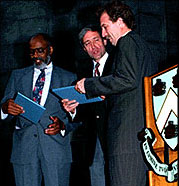
Leon Dash (left) and Lucian Perkins (right) receiving their 1995 Pulitzer Prize from Columbia President George Rupp.
Winning Work
(Note: Lucian Perkins's Prize-winning photos will be added to this entry as the new pulitzer.org continues to evolve.)
By Leon Dash
In 1932, in the midst of the Great Depression, Rosa Lee Cunningham's grandparents and parents gave up their North Carolina sharecropping life for an uncertain journey north. Rosa Lee is the link between past and present, between a world that has disappeared and the one that her children and grandchildren face today in Washington. Her life spans a half-century of hardship in blighted neighborhoods not far from the majestic buildings where policy-makers have largely failed in periodic efforts to break the cycle of poverty.
Many of Rosa Lee's relatives, including two of her eight children, managed to secure footholds in the mainstream of American society; their relative success makes it all the more important to try to understand Rosa Lee's life. Although her story is discomforting and disturbing, she wants it told. "Maybe I can help somebody not follow in my footsteps," she says. That story -- of the choices she had and the choices she made -- offers a chance to understand what statistics only suggest: the interconnections of racism, poverty, illiteracy, drug abuse and crime, and why these conditions persist from generation to generation.
This series of articles grew out of Washington Post reporter Leon Dash's reporting on these interrelationships. It was edited by Steve Luxenberg, The Post's assistant managing editor for special projects. The articles were published daily from Sunday, Sept. 18 through Sunday, Sept. 25.
© 1994, The Washington Post
By Leon Dash
If 53-year-old Rosa Lee Cunningham was bothered by the crowded, chaotic scene in her Southeast Washington apartment on the morning of Sept. 5, 1990, she wasn't showing it. She didn't have time to worry about her "grown-ass" children, as she often calls them, and their daily bickering over money and drugs.
Even if she had wanted to stay in bed, she couldn't. Stomach pains awaken her every morning by 6:30, an enduring reminder of her years as a heroin addict. The cramps linger until she can get to the city methadone clinic for the 55-milligram dose that curbs her craving for the drug.
She doesn't mind getting up early. It gives her a little extra time to make herself look nice. She favors bold earrings, necklaces with gold crosses and colorful paste-on fingernails, which she chooses to match the stylish pantsuits that she likes to wear. So she is dressed and ready for our interview long before I knock on the brown metal door of her apartment, part of a low-income housing complex near the District-Prince George's County line.
There are so many people living with Rosa Lee that I never know who might answer the door; this time it is Bobby, the oldest of Rosa Lee's eight children at 39.
He leads me to the living room, his home for the past few months. It is 9 a.m., and the day is bright and sunny, but the shades are drawn in the two-bedroom apartment, leaving the room in shadows. Ducky, 30, exhausted from a night of cleaning ovens at a Kentucky Fried Chicken outlet followed by several hours of smoking crack, is sleeping on the sofa. Patty, 32, emerges from the bedroom she shares with Rosa Lee; I ask why she looks so grumpy, but she just grunts and says she doesn't feel like being cheerful. Her 17-year-old son, Junior, is asleep in the same bedroom; he's been living at Rosa Lee's for several months, ever since his release from a group home for juvenile delinquents.
Rosa Lee's other daughter, 29, occupies the second bedroom, along with her three children, ages 7, 11 and 13. She's just completed 11 months in the D.C. jail for cocaine possession. She is trying to overcome her drug addiction and find a job; later, she succeeds and asks not to be identified in this series of articles.
That nine people from three generations could get along in such cramped conditions is a tribute to Rosa Lee and her housekeeping skills. She's a compulsive cleaner, often jumping up during conversations to snatch a dirty dish or straighten the Disney figurines that she keeps on the glass table in her living room.
Rosa Lee is a safety net for most of her children. Bobby, Ducky, Patty, Ronnie and Richard live a kind of nomadic existence, bouncing from friends' apartments, to jail, to the street, to Rosa Lee's. All five are addicted to heroin or cocaine. On this particular day, Ronnie, 38, is staying with one of Rosa Lee's brothers; Richard, 36, is in jail on a parole violation.
Rosa Lee's two other sons, Alvin, 37, and Eric, 34, don't need her safety net. They have jobs, families and homes of their own. They don't use or peddle drugs, and they despise what drugs have done to their mother and their siblings. "I'm tired of you living off Momma," Alvin often yells at Patty and Ducky. "I'm sick and tired of you worrying Momma about money and drugs."
Despite their frustration, they respond to Rosa Lee's calls for help, whether it's to take in a grandchild suddenly left homeless because his mother has gone to jail or to help Rosa Lee with one of her many medical emergencies.
My interviews with Rosa Lee and her family grew out of a reporting project exploring the interrelationships among racism, poverty, illiteracy, drug use and crime, and why these problems sometimes persist from generation to generation. I first met her in 1988 in the D.C. jail, where she was serving seven months for selling heroin; a jail counselor who was aware of my project had suggested that I talk to her. "She was arrested for selling drugs to feed three of her grandchildren," he told me.
As Rosa Lee answered my initial questions, it was apparent that her life was an intricate tapestry, each thread reflecting issues that have absorbed and frustrated experts on urban poverty for years. She grew up poor on the fringes of Capitol Hill, the daughter of North Carolina sharecroppers. At 13, after getting pregnant, she dropped out of school without learning to read. At 16, she married to get away from her mother. Within months, she moved back to her mother's after her husband began to beat her. Most of the men she met, including the five who fathered her children, came from the same poor D.C. neighborhoods where she lived; some of her pregnancies were the result of a desperate but futile attempt to hold on to the men.
She raised her children by herself, supporting them as best she could by waitressing in nightclubs, selling drugs, shoplifting and working as a prostitute. Uncertainty and instability became a fact of everyday life: Since 1950, when Bobby was born, Rosa Lee has moved 18 times, always within the District of Columbia, twice to shelters for the homeless. Since 1951, when she was first arrested for stealing, she has gone to jail 12 times, serving a total of five years for theft or drug convictions. Now, some of her children were cycling through the D.C. prison system, repeating the pattern set by their mother.
The more I learned about Rosa Lee and her family, the more I felt that spending time with her offered a chance to get beyond the stereotypical notions that seem to dominate discussions about poverty in America. Some friends and colleagues doubted that I would learn much that was new. But I had written extensively about the District's poorest communities since the late 1960s and had found that I learned the most by forgetting what I thought I knew and immersing myself in the subject as deeply as I could.
Poverty is a phenomenon that has devastated Americans of all races, in rural and urban communities, but it has disproportionately affected black Americans living in the nation's inner cities. As someone who grew up in a black middle-class family in Harlem in New York, I have always been perplexed by the differing outcomes of African Americans who had migrated in massive numbers in the first half of this century from fields of rural poverty in the South to cities across America, looking for factory jobs and a better life. How is it, I wondered, that many children and grandchildren from migrant families had prospered against considerable odds while some, like Rosa Lee, had become mired in lives marked by persistent poverty, drug abuse, petty and violent crime and periodic imprisonment?
All of them carried out of the South the debilitating history of racial oppression and segregation. Once in the city, they still faced pervasive racial barriers in employment, housing and education. Many managed to overcome these roadblocks, while others remained locked in desperate circumstances. Why did Rosa Lee and six of her children take one path, while her sons Alvin and Eric took another?
When I asked Rosa Lee for permission to spend time with her and write about her life, she was eager to cooperate. "I'm not saying I'm going to change," she told me. "But maybe I can help somebody not follow in my footsteps if they read my life story. There have been some good times. Some real good times. But it's also been rough. Lord knows, it's been rough!"
I told her I was skeptical that her story would reach those who might follow in her footsteps.
"That's all right," she said. "You never know who you may help. You write it like I tell it."
Her children were more wary, but they eventually agreed to talk with me too. So in the fall of 1990, two years after we first met, I began to make regular visits to her apartment. It was the beginning of a relationship unlike any other in my 27 years as a Washington Post reporter.
CHAPTER ONE: A Survival Network
Rosa Lee and I are sitting on a couch in her living room on this warm Sept. 5 morning in 1990, trying to decide what to do. Bobby has left us alone to talk, Patty has gone back to her bedroom, and Ducky is still asleep on the other sofa. I had planned to take Rosa Lee to the methadone clinic and then to a restaurant so I can interview her for several hours in relative quiet. Rosa Lee has other ideas.
She wants to go to the Pepco office so she can talk to someone about restoring the electricity; it's been off since June 12 because Rosa Lee has fallen behind in her payments. Patty has been cooking meals on a neighbor's stove, and she's tired of bringing the food back and forth. And now that summer's almost over, it will be getting dark sooner and they will need the lamps again.
Rosa Lee pulls from her purse a set of tattered, rolled-up papers, slips off the rubber band and leafs through them. They are her most important papers -- her apartment lease, medical records, Medicaid documents and bills of all sorts. Rosa Lee hands me the pile. I find the electric bill, and we drive to the Pepco office on Martin Luther King Jr. Avenue SE.
Rosa Lee is eager for me to come with her. My suit and tie, she believes, might give her greater authority with the bureaucracy. I tell her that I'm a reporter and can't get involved in her affairs. But I see from her puzzled expression that she doesn't understand what I'm talking about.
It's hard to imagine Rosa Lee having trouble getting someone's attention if she wants to. She has learned how to bring smiles or tears to her long, handsome face whenever it's necessary. Her hips are broader than they once were, but her 145 pounds settle easily on her 5-foot-1-inch frame, and she likes to boast that her narrow waist still turns heads. Her hands are firm and strong, the result of washing countless baskets of laundry on a scrub board when she was a child.
I wait in my car while she goes inside. Half an hour later, she comes out with a Pepco employee. Rosa Lee has told her that a "Mr. Dash" is waiting outside. And the somewhat exasperated clerk tells me that Rosa Lee doesn't understand the bill. The clerk explains the situation: Rosa Lee owed $528 when the electricity was cut off. She had applied for emergency aid, and the D.C. Emergency Energy Office had paid $150 and the D.C. Department of Human Services had paid $238, but Rosa Lee needed to pay half of the remaining $140 to get the electricity back on.
Rosa Lee says she doesn't have $70. We drive downtown to the D.C. Energy Office, but an official there says Rosa Lee isn't eligible for another emergency grant until 1991.
Over lunch at a Chinese restaurant, another crisis emerges. Rosa Lee needs a refill for medication she's been taking and she can't find her Medicaid identification card, which allows her to pay 50 cents for a prescription.
Suddenly, she begins to cry.
Through her tears, she tells me that she has the AIDS virus, HIV. So do Patty and Bobby. Rosa Lee says she doesn't remember exactly when she found out -- six months ago, maybe longer. So far, she says, none of them has the disease.
She doesn't know for certain how they got the virus. But they fit the profile of those most at risk for HIV: All three have shared needles while injecting heroin. And all three have engaged in prostitution.
"Why didn't you tell me you were HIV-positive?" I ask.
"I was afraid to tell you," she says. "Because I felt you wouldn't come around me."
No, I assure her, I have no intention of staying away. She seems relieved.
Several questions pop into my head: Is she still shooting heroin? Are Patty and Bobby taking precautions with their sex partners? But Rosa Lee is so wound up, so emotional that I decide to save them for another day.
We drive to a pharmacy in Northeast, where the pharmacist knows her and has a record of her Medicaid card. He agrees to fill Rosa Lee's prescription for AZT, a medication that sometimes delays the onset of AIDS. A monthly supply of 100 pills costs $147.95, so she could not possibly afford them without Medicaid. She shares them with Patty, who has let her own Medicaid eligibility lapse.
When we finally return to Rosa Lee's apartment late in the afternoon, she asks me to look through her papers to see if she is behind in her rent. I realize that she is drawing me into her survival network, but I offer to sort the thick sheaf of papers at home.
The next night, I return them, divided into oversized envelopes with bold, printed capital letters to help Rosa Lee recognize the words: WELFARE, MEDICAL, RENT, PATTY, BIRTH CERTIFICATES, and so on.
Patty, Rosa Lee and I sit on the bed in Rosa Lee's bedroom. A crucifix is on a table next to her bed; often, when she is upset, she holds the crucifix close to her chest as she prays for relief or forgiveness.
Patty points to an envelope marked RICHARD. "What does that say?"
"Don't you know your own brother's name?" Rosa Lee says in disbelief.
Patty shrugs. Her reading skills, it turns out, are no better than Rosa Lee's.
They decide to draw up a plan to straighten out their tangled finances, and they ask me to write it down. Patty, who hasn't received welfare or Medicaid benefits for eight years, will reapply. Rosa Lee's situation is more complicated. She has been receiving $350 a month in welfare and $280 a month in food stamps for herself and two of her grandchildren; now that her daughter is out of jail and caring for her own children, Rosa Lee will lose some of that income. So she's going to find out if she's eligible for other assistance.
It sounds good, but it's impossible to ignore this fact: Welfare payments and food stamps don't begin to account for all the money that comes and goes in the apartment.
CHAPTER TWO: The Torn Photo
"Mr. Dash," Rosa Lee says one day in early October 1990. "Why is it I can't find a place with no drugs?"
She is standing in her living room, her hands spread in a gesture of frustration and resignation, her voice competing with the sound of an afternoon soap opera on television.
Within a week of moving into a federally subsidized housing complex in Washington Highlands in March 1990, Rosa Lee ran into several drug dealers she had known for years. As broken ties were renewed, heroin and cocaine began to flow into her newly renovated apartment, just as they had flowed into her apartment on Blaine Street NE in 1989 and into various apartments on Clifton Street NW for years before that.
In recent months, she tells me, she has cut back her drug use to an occasional "speedball," a mixture of heroin and cocaine that she lets Patty inject into her hand. "The dope {heroin} I don't need," she says. "It's that 'caine. The 'caine gives you a rush. It stays with you a little while, and it makes you want more. You want that rush again. If I go get a $10 bag of 'caine and shoot it all by itself, ZOOM!"
She says these infrequent lapses don't make her an addict, but I don't think she's being candid with herself. For the first time since I became a regular visitor six weeks ago, her eyelids have drooped noticeably during our conversations and she constantly rubs the backs of her swollen hands. When I ask her about these symptoms, she insists she hasn't gone back to full-time drug use.
By now, Rosa Lee is comfortable with me, putting up with my tape recorder and agreeing to let a Washington Post photographer, Lucian Perkins, accompany me on some of my visits. Her background could not be more different from mine: When Rosa Lee was struggling to take care of eight children in the early 1960s, I was a teenager attending high school in Manhattan. When she was serving her first prison term for theft in 1966, I was earning a college degree at Howard University and working for The Post as an intern. When she was selling heroin on the streets of Northwest Washington in the mid- 1970s, I was writing about the devastating effects of heroin trafficking on some of those same streets.
She doesn't understand why I ask so many questions about her childhood and her family, but she does her best to remember details that are important to me but not to her. She knows that her grandparents, Thadeous and Lugenia Lawrence, picked cotton in North Carolina before coming north sometime in the mid-1930s, but she doesn't know much else.
In fact, she has no keepsakes, no mementos, no record of her parents or her grandparents -- except for a single black-and-white photograph of her mother and grandmother that somehow has survived over the years. When I first saw it, it was lying loose atop a bureau in Rosa Lee's bedroom, unframed and unprotected, its edges torn, its emulsion cracking.
Her mother, Rosetta Lawrence Wright, dominates the photo, much as she seems to have dominated Rosa Lee in her youth. Rosetta is sitting on a chair that is too small for her large body, dressed in what appears to be a white uniform, probably something she wore in her job as a domestic worker. She dwarfs her own mother, Lugenia, who is sitting in an overstuffed flower-print chair that seems to swallow her slight, almost frail body.
The memory of her mother, who died in 1979, stirs feelings of anger in Rosa Lee, not tenderness. There was the time, Rosa Lee remembers, when her mother accused her of stealing a welfare check out of the mailbox. Rosa Lee was about 9. She ran to her grandmother's house, a block away. "She came around to my grandmother's house and whupped me. I mean really whupped me! ... The next morning the mailman brought the check. My mother didn't say nothing. She just got mad at the mailman."
Most of Rosetta's other children don't share Rosa Lee's view of their mother. They remember her as a woman working hard to keep her family together under difficult conditions. "She taught me, 'If you want something, work for it!' " said Jay Roland Wright, one of Rosa Lee's seven brothers. "I've always lived by that."
Jay Wright is 15 years younger than Rosa Lee; her memories go back before he was born. As a little girl, she says, she became devoted to her father, Earl Wright, an alcoholic who died when Rosa Lee was 12. Her father doted on her, but he also took his fists to Rosetta, much as Rosetta took hers to Rosa Lee. "He'd go upside her head, bam, all the time. He'd be drunk. She'd take it dead out on me. I never did nothing. I was too scared."
We look again at the photo. Rosa Lee has no idea when it was taken or why she has it. She knows only that her mother and grandmother are sitting on the screened-in back porch of her grandmother's house at 204 17th St. NE and that her grandmother bought the house in the early 1960s.
This seems curious. Buying property is a sign of prosperity, not poverty. How had Lugenia Lawrence scraped together enough money to become a homeowner? And why, two generations later, was her granddaughter Rosa Lee a permanent resident of public housing, with drug dealers never far from her door?
CHAPTER THREE: Sharecropping Days
Ben Wright is Rosa Lee's older brother. He also is the family historian.
"You have to ask Ben," Rosa Lee would say to my questions about her parents and grandparents. "Ben is the one who knows about that."
For years Ben had organized family reunions, large gatherings that brought together descendants of the Lawrences and the Wrights, four generations that trace their roots to fertile farmland along the northern bank of the Roanoke River in eastern North Carolina and the tenant sharecropping system that served as the backbone of Southern agriculture until World War II.
The reunions brought together relatives from up and down the East Coast. Branches of the family have put down roots in New Jersey, Philadelphia as well as Washington, and many have secured a foothold in working-class and middle-class communities. Rosa Lee had little in common with these more successful relatives, so after attending two reunions in the 1960s, she stopped going.
She kept in touch with Ben, but their relationship had soured in recent years. When I asked Rosa Lee why, she was uncharacteristically vague, hinting that it was Ben's fault. Later, Ben told me that there was nothing vague about their falling-out: He told her that he would never set foot in her apartment as long as she was dealing drugs.
When Rosa Lee was jailed in New York on a theft charge in 1964, Ben bailed her out. But when she started shooting heroin, he drew the line. Ben's world -- good job, steady income, retirement benefits -- had no place for Rosa Lee.
So when Rosa Lee and I knock on the door of a trailer at the D.C. Department of Public Works storage yard where Ben worked, I'm not sure what to expect. It is a raw, cold day, and I can feel the bite of the wind as I explain my project to Ben. He listens, looks at Rosa Lee, and then invites us to come inside to talk during his lunch break. Over the next several months, Ben and others provide bits and pieces of the family history.
Ben Wright was Rosetta and Earl Wright's first child, born on the first day of summer in 1932, the year the Great Depression forever changed the lives of the Lawrences and the Wrights. Rosetta was 15 at the time, and living with Lugenia and Thadeous on the cotton farm where they worked as sharecroppers, about four miles south of the market town of Rich Square, N.C.
Thadeous was the second generation of Lawrences to sharecrop on the property, known as the Bishop and Powell plantation. By the time Rosetta became a teenager, she had already helped with several cotton crops. The countless hours she spent in the fields changed her body and shaped her soul, and taught her the importance of discipline and stamina. She developed quick, powerful arms and a tough, stern demeanor -- a younger version of the grim, brooding woman in the photograph in Rosa Lee's bedroom.
There is no available record on the Lawrence "share" in 1932, no way to know whether the family earned enough to repay the white landowner for the money he had advanced them over the course of the year. According to family lore, Thadeous had a hidden source of income that kept the family from falling into debt: a moonshine still that he kept going even after the family moved up north. "My grandmother said my grandfather did a lot of bootlegging," said Ben.
Many sharecroppers, however, remained perpetually in debt, unable to make their share, yoked to the same landowner year after year. Most could not read or write, add or subtract, so they had no way to challenge the landowner's tally at harvest time. It was a harsh life, made even harsher by the effect the Depression was having on the cotton farms around Rich Square. The price of cotton dropped from $500 a bale to $25 a bale. Joe Purvis, who owned the land where the Lawrences were farming, was forced to close down the farm after the 1932 harvest. So when a Maryland tobacco farmer came through Rich Square looking for sharecroppers, the Lawrences decided to leave their friends and relatives and the land they knew so well.
They packed their meager belongings and headed with their four children to Maddox's farm in St. Mary's County, Md. Rosetta, her infant son Ben and her new husband, Earl Wright, joined the Lawrences on the journey north.
Ben and his brother, Joe Louis Wright, vividly remember the stories that his mother and grandmother told them about their harsh life in Southern Maryland. They had almost no money. Meals frequently consisted of whatever they could pick or trap. "They were eating a lot of muskrat and watercress," Joe Louis said. Watercress grew abundantly in the clear springs nearby, and muskrat was then a popular Southern Maryland dish that the family never got used to. "My mother would say, if she ever got a job and made any money, she was never going to eat another muskrat," Joe Louis said. "Had to eat it, because that's all they could trap."
After the 1935 tobacco harvest, like thousands of other sharecroppers during the 1930s and 1940s, Rosetta and Earl Wright gave up rural life and headed for the city. The Lawrences stayed behind with 3-year-old Ben, afraid that the boy might starve if his parents couldn't find work in Washington. Within a year, they too moved to the District. Their sharecropping days were over.
CHAPTER FOUR: Segregated City
Washington in the 1930s was not a land of opportunity for black migrants from the South, especially poor sharecroppers. It was a segregated city, but within the black community was a well-established and educated middle class that traced its roots to the freed slaves who stayed here after the Civil War. Over the years, these local black families had built an extensive network of churches, schools, theaters and other institutions. It wasn't a closed society, but neither did it reach out to embrace the rural migrants.
Some of the more fortunate newcomers had friends or family here to help them through the resettlement. Others, like the Lawrences and Wrights, were on their own. Finding a job, any job, was a challenge. Most of the government jobs then open to blacks -- the clerks and messengers and cafeteria workers -- went to middle-class blacks who had connections or education. "Those jobs were very competitive," Portia James, the chief researcher at the Anacostia Museum, said when I asked her to put the family's history into perspective. "Those weren't considered regular working-class jobs. Those were considered highly desirable jobs."
Like hundreds of other rural black women who migrated to Washington, Rosetta became a domestic worker. Earl found work as a cement finisher for a paving company. This fit a familiar pattern, according to Elizabeth Clark-Lewis, a Howard University professor who has interviewed domestic workers in her study of the period. "The middle class was not standing waiting for these people with open arms," Clark-Lewis said. "Very few men could come in and get a government job." For most poor, rural women, she said, "domestic work was the reality."
Thadeous and Lugenia found work too, but it was Thadeous's bootlegging that kept the family afloat. He would disappear for several months at a time; only later did Ben learn that he was going to North Carolina to tend the still.
Rosetta and Earl settled in the neighborhood just north of the Navy Yard, within a mile of the Capitol, renting a series of houses that had outdoor toilets and no electricity. Rosa Lee remembers the smell of the kerosene lamps they lighted each night. As the family grew -- Rosetta gave birth to 22 children, 11 of whom died before reaching adulthood -- Rosa Lee became accustomed to bedrooms crammed with too many people and living rooms with no place for private conversations.
Ben has no way to prove it, but he's certain that Thadeous's moonshine sales provided the money that enabled Thadeous and Lugenia to become homeowners. The house in the photo, the one on 17th Street NE, turned out to be the third of three houses owned by the Lawrence family.
Thadeous and Lugenia bought their first property, a decaying two- story, wood-frame house on the outskirts of Capitol Hill, for $1,400 in 1949. Four years later, they bought a second house nearby for $8,000. The seller gave them a mortgage so they could make the purchase.
The first house went to Rosetta; two years later, however, the city condemned the property and Rosetta's family had to move.
Thadeous died a few years later. Lugenia lived in the second house until the city claimed it for the Southwest Expressway, paying her $11,500 in compensation. She bought the third house, and when she died in 1985, she owned it free of debt. An appraiser estimated its value at $56,000.
In her will, Lugenia directed that the house be sold and the proceeds divided among five grandchildren. Rosa Lee was not among them. I asked her why. "Because I was an addict when she died," she said, and Lugenia was determined not to squander this asset that had taken a lifetime to build.
The house wasn't sold immediately. Instead, the grandchildren decided to use it as collateral to borrow $55,000, which was divided among the five grandchildren after expenses. That satisfied the conditions of the will, and left one granddaughter with the house, a monthly mortgage payment and a place to live.
But it didn't work out as planned. Within a few months, the granddaughter fell behind on the mortgage payments. In late 1987, Lawan Wright, Rosa Lee's youngest sister, moved in after serving a two-month sentence for drug dealing. For the next two months, Lawan says, she used the house to sell crack.
The mortgage holders decided to foreclose. So in February 1988, Lugenia Lawrence's house passed out of the family's hands for good.
CHAPTER FIVE: Emergency
It is Wednesday afternoon, Nov. 28, 1990, and Rosa Lee is stretched out on a bed in emergency room 63 at Howard University Hospital, telling me about the seizure that has landed her there. Actually, she's not telling me much, because she blacked out and she can't remember exactly what happened.
The room is cool, and she has pulled the blankets up to her chest, exposing only the shoulders of her white hospital gown and her drawn, tired face. She looks awful.
This is her second seizure in two days, her third in six months. The doctors don't know the cause of the seizures, so they have been putting Rosa Lee through a series of tests, which don't bother her nearly as much as the telephone calls from Patty and Ducky to settle minor squabbles. "Why are they worrying me, Mr. Dash, while I'm in the hospital?" she says.
The doctors suspect that Rosa Lee's drug use has something to do with triggering the seizures. On Monday afternoon, Rosa Lee and Patty shared a "billy" of heroin -- a small bag that sells for about $20. Immediately afterward, she had a mild seizure that sent her to the emergency room but didn't require a hospital stay. Still, she seemed shaken enough by the experience that I thought she would stay away from heroin for a while.
Not shaken enough.
On Tuesday afternoon, she and Patty bought another heroin billy at an "oilin' joint" for heroin addicts on Georgia Avenue. Patty gave herself a hit, then Rosa Lee. As they went outside to hail a taxi, Rosa Lee suddenly went limp and her eyes rolled back in her head.
Patty struggled to keep Rosa Lee from falling, and heard a man shouting from across the street. It was Alvin, her brother. He was on duty, driving a Metrobus north on Georgia Avenue, when he saw Patty trying to hold Rosa Lee. "Get Momma to the hospital," he yelled from the driver's window of his packed bus.
Patty, still high from the heroin, maneuvered Rosa Lee into a taxi. At the hospital, Rosa Lee's doctor, Winston Frederick, was furious. "If you suffer another one of these seizures, we may not be able to bring you back," she remembers him saying.
When she goes home on Dec. 10, she vows to herself that her heroin days are over. But home is still the same apartment in Washington Highlands in Southeast, where Bobby, Patty and Ducky spend much of their time in pursuit of their next high.
CHAPTER SIX: Rosa Lee's Christmas
"Boy, what a night," Rosa Lee says, settling into the front seat of my car on Christmas morning 1990 for a trip to the methadone clinic.
Recovering drug addicts don't get holidays off. If Rosa Lee wants her daily dose of methadone, she still has to make the cross-town trek from her apartment in Southeast to the clinic on N Street NE, not far from the Capitol. On the best of days, it's a 30-minute trip requiring two buses; the holiday bus schedule makes it an uncertain journey that can last more than an hour. She's still weak from her hospital stay, so I have offered her a ride.
When I arrive at 8:30 a.m., Rosa Lee is ready as usual, but everyone else is asleep, including her grandchildren. Unopened gifts lay waiting under an artificial tree decorated with plastic yellow garlands, candy canes and colored glass bulbs. Patty is stretched out on a living room couch, her left forearm bandaged in white gauze.
As we drive through the deserted streets, Rosa Lee explains why everyone's so exhausted.
It all started with Ducky's paycheck. Late in the afternoon, Ducky brought home $270 from his job at Kentucky Fried Chicken, gave $150 to Rosa Lee for his share of the rent, food, cable TV and utilities and left to buy crack with the rest of the money.
Ducky owed Patty $20, so Rosa Lee gave it to her, setting off a chain reaction that lasted all night long. Patty spent the $20 on crack, smoked it and wanted more. She begged Rosa Lee for another $20.
"I just gave her $10," Rosa Lee says.
As soon as the $10 was gone, Patty was pleading for more. Instead of saying no, Rosa Lee asked Patty to buy her some ice cream and handed over another $20.
A few hours later, Patty returned with one of her regular "tricks" -- men who trade her drugs for sex. Selling sex provides Patty with a steady source of drugs, and other things seem secondary, including the risk of spreading the AIDS virus.
The "trick" prepared a mix of powdered cocaine in Rosa Lee's bedroom, gave himself a hit and offered some to Rosa Lee. She said no. "I didn't even hesitate, Mr. Dash," she says. "I was so proud of myself."
After Patty left, Rosa Lee fell asleep with the TV set on. About 2 a.m., she heard someone banging on the door. It was Patty's boyfriend, Howard, demanding to know where Patty was. Rosa Lee didn't know.
At 6 a.m., Ducky woke Rosa Lee to say that Howard and Patty were fighting in the hallway. Ducky pulled Patty, strung out from smoking crack and drinking liquor, into Rosa Lee's apartment. Patty's left forearm was bleeding. She told Rosa Lee that she had cut herself with a knife during an argument in Howard's apartment.
Two paramedics arrived and bandaged Patty's arm. Moaning that she still loved Howard, she cried herself to sleep as Rosa Lee held her.
As I drop Rosa Lee off at her apartment, I try not to think about what awaits her inside.
"Merry Christmas, Rosa Lee," I say softly as she opens the car door. "I'll see you next week."
"Merry Christmas, Mr. Dash."
© 1994, The Washington Post
By Leon Dash
Rosa Lee Cunningham guided her 10-year-old grandson through the narrow aisles of the Oxon Hill thrift shop, past the crowded racks of secondhand pants and shirts, stopping finally at the row of children's jackets and winter coats.
The boy picked out a mock flight jacket, with a big number on the back and a price tag stapled to the collar.
"If you want it," Rosa Lee said, "then you're going to have to help me get it."
"Okay, grandmama," the boy said nervously. "But do it in a way that I won't get caught."
Like a skilled teacher instructing a new student, the 54-year-old Rosa Lee told the boy what to do. "Pretend you're trying it on. Don't look up! Don't look around! Don't laugh like it's some kind of joke! Just put it on. Let Grandma see how you look."
The boy slipped off his old coat and put on the new one. It was too big. Rosa Lee whispered, "Now put the other one back on, over it." She pushed down the new jacket's collar so that it was hidden.
"What do I do now?" the boy asked.
"Just walk on out the door," Rosa Lee said. "It's your coat."
Four days later, Rosa Lee is recounting this episode for me, re- creating the dialogue by changing her voice to distinguish between herself and her grandson. It is January 1991, and it has been five months since she agreed to let me spend time with her as part of a reporting project on how several generations of one Washington family have lived with poverty, crime and drug abuse.
By now, I have spent enough time with her that her shoplifting exploits no longer surprise me. One day before Christmas, Rosa Lee was searching for something in a large shopping bag in her bedroom and dumped the contents onto the bed. Out spilled dozens of bottles of expensive men's cologne and women's perfume, as well as leather gloves with their $60 price tags still attached. She leaves the tags on when she sells the goods to prove that the merchandise is new.
"Did you get all this in one trip?" I ask.
"Oh, no," she says. "This is a couple of weeks' worth."
In Rosa Lee's younger years especially, shoplifting was a major source of income, supplementing her welfare payments and the money she made during 15 years of waitressing at various nightclubs. She had eight children to feed and clothe; stealing, she says, helped her to survive. Later on, when she became a heroin addict in the mid- 1970s, she paid for her drug habit through her shoplifting.
She stole from clothing stores, drugstores, grocery stores, stuffing the items inside the torn liner of her winter coat or slipping them into the oversized black leather purse that she carries wherever she goes. Her favorite targets were the department stores. One of her older brothers, Joe Louis Wright, joked with me one day that Rosa Lee "owned a piece" of Hecht's and had put Lansburgh's out of business. "Man, she would get coats, silk dresses," he recalled. "She got me a mohair suit. Black. Three-piece. I don't know how the hell she'd get them out of there."
Her stealing has caused divisions and hard feelings in her family, and is one reason why Rosa Lee has strained relationships with several of her brothers and sisters. They see Rosa Lee's stealing as an extreme and unjustified reaction to their impoverished upbringing. Two of her six sons, Alvin and Eric, always have refused to participate in any of their mother's illegal activities; today, they are the only two of Rosa Lee's eight children who don't have prison records.
Rosa Lee has served eight short prison terms for various kinds of stealing during the past 40 years, dating to the early 1950s. Her longest stay was eight months for trying to steal a fur coat from a Maryland department store in 1965. She says that she went to prison rehabilitation programs each time but that none had much of an effect on her. "I attended those programs so it would look good on my record when I went before the parole board," she says.
Nothing seems to deter her from shoplifting, not even the specter of another jail term. On the day that she stole her grandson's coat, she was awaiting sentencing in D.C. Superior Court after pleading guilty in November 1990 to stealing bedsheets from the downtown Hecht's store.
"I'm just trying to survive," she says.
CHAPTER ONE: A Day in Court
Rosa Lee had chosen her clothes carefully when she appeared two months earlier before Commissioner John Treanor on Nov. 13, 1990. She wanted to look as poor as possible to draw his sympathy.
She had worn an ill-fitting winter coat, gray wool overalls and a white wool hat pulled back to show her graying hair. She had removed her upper dental plate, giving her a toothless look when she smiled. "My homey look," she called it. "No lipstick. No earrings. No nothing!"
Her lawyer's statements that day matched her downtrodden look. Rosa Lee's life was a mess, he told Treanor. She was addicted to heroin, a habit she had developed in 1975. She had the HIV virus. She was caring for three grandchildren because their mother was in jail.
Rosa Lee told Treanor that she was trying hard to turn herself around. She was taking methadone every day to control her heroin addiction and had turned again to the church. "I got baptized Sunday, me and my three grandchildren," she said, her voice breaking. "And I'm asking you from the bottom of my heart, give me a chance to prove that I'm taking my baptize seriously, 'cause I know I might not have much longer."
Tears ran down her cheeks. "I'm asking you for a chance, please," she begged Treanor. "I know I have a long record."
Rosa Lee was stretching the truth. Yes, she had been baptized, and yes, she was taking methadone. But no, she wasn't caring for her grandchildren alone. Their mother's jail term had ended several months earlier, and she had returned to Rosa Lee's two-bedroom apartment to take care of the children, with help from Rosa Lee.
Treanor hadn't seemed moved by Rosa Lee's tearful performance. He glowered at her, and Rosa Lee braced for the lecture she knew was coming. Both had played these roles before.
"Every time you pump yourself full of drugs and spend money to do it," he said, "you're stealing from your grandchildren. You're stealing food from their plates, clothes from their backs, and you're certainly jeopardizing their future. You're going to be one of the youngest dead grandmothers in town. And you're going to have three children that will be put up for adoption or going out to some home or some junior village or someplace."
That had been Rosa Lee's opening. "Can I prove to you that my life has changed?"
"Yeah, you can prove it to me, very simply," Treanor answered. "You can stay away from dope. Now I'll make a bargain with you. . . . You come back here the end of January and tell me what you've been doing, and then we'll think about it. But you're looking at jail time. You're looking at a cemetery."
Rosa Lee had won. Stay out of trouble until January, Treanor had suggested, and she would stay out of jail.
Rosa Lee came over to me, her cheeks still tear-stained but her face aglow.
"Was I good?" she asked.
"Yeah," I said, startled at her boldness.
"Thank you," she said, smiling.
CHAPTER TWO: Transformation
When she returns for sentencing on Jan. 22, 1991, a transformed Rosa Lee stands before Treanor. She looks good. She has a clean report from the methadone clinic. She seems to have done everything Treanor has asked.
She usually dresses well, but I think she has outdone herself today: two-piece, white-and-gray cotton knit suit, tan leather boots, tan pocketbook.
"What would you like to say, Mrs. Cunningham?" Treanor says.
"Well, your honor, I know I haven't been a good person. I know it," she begins.
Treanor cuts her off. His demeanor is softer, his words more sympathetic than in November. "Wait a minute, now. Why do you say that? . . . You're taking care of those three grandchildren, isn't that right?"
"Yes, sir," Rosa Lee says, keeping up the pretense.
"All right," he says. "Now you've raised one family, and now you have another one."
"Yes, sir," she says.
"Which is really too much to ask of anybody. So I don't think you should sell yourself short. You're doing the Lord's work. Your daughter's in jail for drugs, right?"
"Yes, sir," Rosa Lee says.
"And you have or have had a bad drug problem yourself."
"Yes, sir."
Then Treanor launches into another lecture about drugs. He doesn't ask Rosa Lee why she steals. "You steal to support your habit," he says. "It's as plain as the nose on your face."
But it isn't that plain. Rosa Lee began stealing long before she became a drug addict.
Finally, Treanor announces his decision: no jail. Instead, he gives her a suspended sentence and one year of probation with drug counseling.
"Now, don't you come back here," he says.
CHAPTER THREE: Lunch Money
Rosa Lee sometimes puts on a public mask, the way she wants the world to see her. She fudges a little, omits a little there, even when she is trying to be candid about her behavior. By her account, her stealing started when she was a teenager. It was an older brother, Ben Wright, who told me that Rosa Lee's stealing started when she was 9 years old. Her target: the lunch money that her fourth-grade classmates at the District's Giddings Elementary School kept in their desks.
"Jesus, Ben!" Rosa Lee shouts when I ask her about it
"What's the matter?" I say. "You said I could interview Ben."
It is a late afternoon in January, not long after her court appearance. We are talking in my car, which is parked outside Rosa Lee's apartment. We watch the teenage crack dealers come and go, making their rounds of the low-income housing complex in Washington Highlands, a Southeast Washington neighborhood near the D.C.-Prince George's County line. Rosa Lee's grandson and granddaughter are playing nearby on a patch of dirt where the grass has been worn away. The sun is beginning to sink behind the buildings as she tells me about her first theft.
The year was 1946, and Giddings's imposing red-brick building at Third and G streets SE was a bustling part of the District's then-segregated education system. The school, now an adult education center, served black children living in Capitol Hill neighborhoods; some, like Rosa Lee, came from poor sharecropping families who had moved to Washington during the Depression, and they did not have the new clothes and spending money that their better-off classmates did.
Rosa Lee's father, Earl Wright, was an alcoholic who worked for a paving contractor until drinking became the primary activity in his life. He died of liver disease just after Rosa Lee turned 12. Her mother, Rosetta Lawrence Wright, brought in most of the family's money, working as a domestic on Capitol Hill during the day and selling dinners from the family's kitchen in the evening, always for cash so the welfare officials wouldn't know about the additional income. They lived in a rented house in the 800 block of Third Street SE that had no electricity and no indoor toilets.
Other girls came to school with change to buy "brownie-thins" -- penny-a-piece cookies that the Giddings teachers sold with the free milk at lunch. Rosa Lee's family was too poor to spare even a few pennies. She knew it was wrong to steal from her classmates' desks, she says. But she couldn't stand being poor, either.
Rosa Lee soon found that she had plenty of opportunities to steal, if she were daring enough. Selling the Afro-American newspaper door- to-door on Tuesday and Thursday evenings during the summer of 1948, when she was 11, gave her a chance to slip into neighborhood row houses and rifle through the pocketbooks that women often left on their dining room tables. Washington was a safer place in those days, and Rosa Lee discovered that many families would leave their front screen doors unlatched while they chatted in their back yards, trying to cool off on hot summer nights.
In the fall, she found a new source of money: the coatroom at Mount Joy Baptist Church, a nearby church where her family had worshiped for many years. She had started ushering during Sunday services and was assigned to help in the coatroom. She noticed congregation members often left money in their coat pockets. "I felt like if they wanted {the money}, they wouldn't have left it in their damn pocket," she said.
Rosa Lee said she would wait until the "singing and praying" started before going to the racks of coats, patting the pockets and listening for the jingle of coins. Once in a great while she would find dollar bills.
Her coatroom thefts continued undetected until one Sunday, when Mount Joy's minister, the Rev. Raymond M. Randall, announced to the astonished congregation that someone had stolen several dollars from a member's coat pocket during the previous Sunday's service. Randall offered forgiveness and asked the culprit to come forward. If the thief was hungry, the minister said, the church would try to help.
Rosa Lee could not bring herself to confess in front of her mother, her family and her friends. "My mother would have KILLED ME! Do you hear me? KILLED ME!" she shouted at me as she recalled the scene. "And who is going to go up there and tell him that you're hungry? That would only embarrass the hell out of you!"
For the next few weeks, she stayed away from church. When she returned to her ushering duties, she was careful to steal only change. She often did not know what to do with the money she stole. Her immediate needs were small and simple: 35 cents for the Saturday movie matinee at the old Atlas Theater on H Street NE, or a dime for the snow cones that she loved. She gave away small amounts to brothers and sisters and friends, but never enough to attract her mother's attention.
Rosa Lee hid her stolen coins from her mother. "I would roll it up in a stocking," she said, and put the stocking under a rug, or under her mattress or in her underwear.
Forty years later, Rosa Lee still hides her money every night -- not from her mother, but from her five drug-addicted children. Sometimes she goes to bed with a wad of bills stuffed into her sock. "If I don't hide it, they'd steal it," she said.
CHAPTER FOUR: Out of Style
If Rosa Lee felt bad about not having a few pennies to buy cookies in fourth grade, she felt even worse about not having a stylish wardrobe to match those of her friends in seventh grade. She hated the secondhand clothes that her mother bought for her; they were almost always out of style.
Rosa Lee already felt at a disadvantage in attracting boys, and thought fashionable clothes might help. "I was dark-skinned," she said. "I wasn't like the girls with long hair and light skin. The boys always went for them.''
One morning, a girlfriend lent Rosa Lee a new gray skirt with "two pockets on the hip," one of the newest fashions. "My mother would never buy me one," Rosa Lee told me, her voice still smoldering with resentment. Rosa Lee loved how she looked in it.
During lunch, the girlfriend asked Rosa Lee in front of some classmates to share her 35-cent meal. "I wouldn't give it to her," Rosa Lee said. "I was hungry!"
The girlfriend blurted out, "I didn't say that when you borrowed my skirt!"
Rosa Lee's classmates howled with laughter at her embarrassment. As she retells the story, I can see that time has not healed her wound. Her voice hardens, her eyes narrow, her expression conveys the raw power of the memory. "That hurt," Rosa Lee says. "I thought, 'God, this will never happen again to me.' "
Days later Rosa Lee walked into a five-and-dime store in the 600 block of Pennsylvania Avenue SE. She picked out a gray skirt and a white lace blouse, folded them into two tight bundles, slipped them under the skirt she was wearing and slowly made her way out of the store. As she turned the corner, she crushed the skirt and blouse to her chest in glee.
She hid the skirt and blouse from her mother. Emboldened, Rosa Lee branched out to other stores in the Capitol Hill area. "I was determined to have what other girls had," she said.
At a party in early 1950, she met a light-skinned boy who was attracting attention from the other girls. And Rosa Lee wanted to impress her friends by getting his attention; she enjoyed the other girls' envious looks when he asked to walk her home.
She thought having sex would cement their relationship. She became pregnant. "I haven't seen him since," she said.
When school officials found out she was pregnant, they told her she would have to leave school until the baby was born. She never went back. In November 1950, she gave birth to Bobby, naming him Robert Earl Wright.
Not long after Bobby was born, Rosa Lee decided to dress for church in one of her stolen outfits. She knew it was risky, but she was tired of wearing hand-me-downs when the other ushers usually came in stylish clothes. As soon as her mother spotted the gray pleated skirt, she confronted Rosa Lee.
"Where did you get this from?" Rosetta demanded.
"I stole it out of a store. Please don't make me take it back to the store, Momma!"
Rosetta was furious. "I ain't going to say nothing to you now because you told the truth, but don't bring nothing else in here that you've been stealing! DO YOU HEAR ME?
"Yes, ma'am," said Rosa Lee, trembling as she waited for her mother to hit her.
But her mother just said: "Put it on. Let's see what you look like in it."
CHAPTER FIVE: The Stolen Scarf
Rosa Lee ignored Rosetta's order to stop shoplifting. Whenever her mother questioned her about some new item, Rosa Lee just denied that she stole it. "My mother would tell me, 'Stop that lying,' and then let it go," Rosa Lee said.
But a judge wasn't so kind when Rosa Lee was caught shoplifting a few months later at a downtown department store, her first arrest. He sent her to a facility for juveniles for 19 days in early 1951. But the lesson seemed lost on the 15-year-old Rosa Lee; after her release, she went right back to shoplifting
When Rosa Lee was away, her mother cared for 1-year-old Bobby. Rosetta, who had her first child at age 15 in North Carolina, had accepted Rosa Lee's first pregnancy, but she was angry because Rosa Lee was pregnant again. The father was another teenager in the neighborhood. "What do you think you doing, bringing all these babies in here?" Rosa Lee remembers her mother saying.
Rosetta demanded that Rosa Lee have an abortion, but Rosa Lee wasn't about to let her mother tell her what to do -- about babies, or shoplifting, or anything else.
Anxious to win her mother's affection, Rosa Lee decided to steal something for Rosetta. One day after Rosetta came home from work, Rosa Lee took a multicolored, cotton scarf from under her coat and handed it to her mother.
Rosetta took the scarf, turned it over in her hands and looked questioningly at her daughter. Rosa Lee waved both her hands, a sign to her mother not to ask where she had gotten the scarf.
Her mother didn't. "Rose, I NEVER had something like this!"
Rosetta threw her arms around Rosa Lee. "She grabbed me, and I grabbed her," Rosa Lee recalls. "I couldn't believe it!"
But the stolen scarf, and other stolen gifts that followed, did not bring Rosa Lee the close relationship that she wanted. Rosa Lee says her mother didn't like her shoplifting and continued to badger her about it. The tension between them was always there, waiting to explode. One day, when Rosa Lee was 22 and raising five children in an apartment next door to her mother's, it did.
Rosa Lee and a neighbor had a shouting match after the neighbor had hit one of Rosa Lee's children. When Rosetta heard about it, she was angry. She stormed into Rosa Lee's home.
"She told me that all I am is a troublemaker," Rosa Lee recalled. "I told her that {the neighbor} shouldn't have hit my child. Momma said, 'You nothing but a damn nuisance,' and pow, right in my mouth."
Rosetta's blow left her daughter with one visible legacy of their relationship: an upper denture to replace the front teeth that Rosetta knocked out.
It also left a lasting impression on Bobby, who saw the confrontation. He was 8. "It was spooky," he told me. "Ain't nobody supposed to beat up Mom. As much as she went to get food for us and clothes for us. I don't care who it was."
CHAPTER SIX: 'We Started Grabbing'
On the balmy Thursday night of April 4, 1968, a few hours after the assassination of civil rights leader Martin Luther King Jr., looting and arson erupted in several of the District's major commercial corridors, overwhelming the city's police force.
Rosa Lee watched as looters carried bags, boxes and portable televisions past the ramshackle house she was renting at 149 L St. SE.
"Where ya'll get that stuff?" Rosa Lee called out from her porch.
"H Street," folks shouted.
Rosa Lee, 31 at the time, had a vague idea of King's efforts to improve life for African Americans. Still, the destruction did not disturb her. She did not believe the torching and trashing of businesses had any connection to her. The shops, she said, were run by "greedy" merchants who gouged customers and took "whatever little money I had."
So when her son Bobby, then 17, drove up in a Buick that Rosa Lee instinctively knew had been stolen, she didn't hesitate.
She turned to her seven other children and said, "All right! Who wants to go?" As usual, Alvin and Eric, then 15 and 12, held back.
On H Street, Rosa Lee said, "everybody was grabbing everything they could get their hands on. We started grabbing too. Didn't know what we were taking. Just grabbing, grabbing, grabbing."
The next day, when the looting began again, Rosa Lee kept her children at home. "We already had so much stuff," she said. "There was no need to go out."
CHAPTER SEVEN: Shopping for Bread
"Mr. Dash," Rosa Lee says as I am driving her to her apartment in February 1991, "stop at that High's so I can get a loaf of bread."
I glance at her, and she knows what I'm thinking. "I'm not doing any shoplifting," she says.
I have told Rosa Lee that I cannot be a party in any way to her shoplifting. So when we pull into the parking lot at High's, she makes a big show of leaving her oversized black bag on the seat. Wallet in hand, she heads for the store.
Fifteen minutes go by. My feet are getting numb from the cold, so I decide to see why she's taking so long. Her head is visible above the display counter of canned goods. She is putting something into a large brown paper bag, too busy to notice I've come inside the small store.
"ROSA LEE!" I shout.
She jumps at the sound of her name. She spots me standing near the smudged glass door. She crumples the top of the bag and walks toward me. I feel her cold anger as she breezes past.
"That's the last time I wait for you outside of a store!" I yell as we walk to the car. "You told me you weren't going to steal anything!''
She fires back, her words coming out in a steamy vapor from the cold. "I'm trying to feed my family and I don't have any money. We're just trying to survive!"
"That's dead!" I say. "Save that for the judges at Superior Court. You just threw away several hundred dollars buying dope and crack for your children."
"You know so goddamn much!" she snaps as I start the car. "I ought to go upside your head!"
"You threaten 'to go upside my head' every other day," I say.
She laughs, and the tension evaporates. She shows me what's in her bag: a loaf of bread that she bought, and the items she stole -- two cans of spray starch and a can of baked beans.
I am angry with Rosa Lee for violating my trust, and I am angry with myself. The incident is a lesson to me: Why did I think that she would behave differently around me?
CHAPTER EIGHT: Second Thoughts
A few weeks after the shoplifting incident at High's, Rosa Lee and I are talking in her apartment. After spending so much time with her, I realize I don't always ask the questions that need to be asked.
"Rosa Lee," I say, "there's something I want to work out with you about how you look at the world."
I remind her of the time she took her granddaughter to steal a coat. They were on their way to church, but Rosa Lee thought the girl's coat looked ragged, so they went to the thrift shop to shoplift.
Rosa Lee nods.
"How do you put those two together?" I say. "One Sunday going to church to be baptized, and the next Sunday going to shoplift a coat?
"I don't know," she says. "I didn't like to take her to church with that dirty-looking coat."
"But how do you take her out stealing then?" I say.
She protests that the thrift shop's white owner takes advantage of his customers, who are mostly black. "I don't understand how a thrift shop can charge so much for things," she says. "Do you know that he charges $8.95 for stuff that don't cost that much brand-new?"
"That's a rationalization, and it doesn't dance," I say.
That night, I am surprised to find a message from Rosa Lee on my answering machine in the newsroom, telling me that she had had "second thoughts" about taking her grandchildren to shoplift. The next day, she explains. "You gave me something to think about," she says. She told her grandchildren that our conversation had made her see that it was wrong to steal coats for them.
Her granddaughter immediately went to the closet and got the pink coat that Rosa Lee had helped her steal.
"What you want me to do with the coat?" she asked Rosa Lee.
"Keep it. Keep the coat. But we're not going to do any more stealing," Rosa Lee replied.
"Are you going to stick to that?" her granddaughter asked.
"So help me to God," Rosa Lee said. "I'm going to stick to that."
Rosa Lee looks at me, waiting for my reaction. I study her face. She isn't promising never to shoplift again, only that she won't involve the children. Nonetheless, she seems sincere.
"You have a powerful influence on those children," I say.
"I know it," she says.
In a Northeast Washington fast-food restaurant in March 1992, Rosa Lee Cunningham and her son Ducky disagree over what price to charge for shirts and sweaters Ducky had stolen. Stealing has been a way to supplement the family's income.
Rosa Lee, her son Ducky and daughter Patty assess the sweaters and shirts that Ducky stole during a burglary. They then pack the clothing in a suitcase and go to a fast-food restaurant to sell the items. Rosa Lee began stealing when she was a child. It is an activity that she carried into adulthood, and several of her children followed her example.
Rosa Lee and Ducky leave the restaurant after selling as many of the shirts and sweaters as possible. They then try to peddle their goods to a motorist in the parking lot.
After a successful outing, mother and son head to the bus stop with an empty suitcase. It is a cold day in March 1992, and as Rosa Lee and Ducky wait for the bus, she wraps her coat around him to keep him warm. For most of his adult life, Ducky has depended on Rosa Lee.
© 1994, The Washington Post
Rosa Lee Cunningham is so weak she cannot get out of bed.
I cradle one of her limp arms while Richard Cunningham, 36, one of her eight children, grips the other. Gently, we lift her up and support her as she tries to stand. She rocks unsteadily, groaning and whimpering from the exertion. We slowly lean her back against a tall wooden chest of drawers to brace her, but she slumps against it, banging the chest into the wall. We hastily return her to bed.
It is clear she needs immediate medical attention. I tell Richard that I am taking Rosa Lee to the Howard University Hospital emergency room. "An excellent idea," Richard declares.
Later that morning -- Tuesday, March 12, 1991 -- doctors began searching for the cause of her dangerously weak condition. The next afternoon, with Rosa Lee resting comfortably in Room 5N9, the mystery unraveled.
Rosa Lee was a victim, it turned out, of her inability to read.
The first clue came from a blood test. It showed that she was overdosing on Dilantin, a medication that helps prevent seizures. She had twice the recommended level in her system.
She had been taking Dilantin only a few weeks. Doctors had prescribed it for her after another seizure -- her fourth since the fall of 1990 -- had landed her in Greater Southeast Community Hospital. When they sent her home, they gave her a written schedule of the four medications she was to take each day. Under Dilantin, it said "100 mgs 3Xdaily."
"The nurse didn't ask me if I could read the instructions," Rosa Lee said. "I wouldn't have told her if she had asked."
Rosa Lee didn't know that "100 mgs" meant 100 milligrams, or that she was supposed to take one 100-milligram tablet three times a day. She thought she could take more than one pill if she wanted, as long as she took them three times a day. "Sometimes I would take two of them," she said.
It became an unending cycle: The extra Dilantin doses made her feel disoriented and weak; as she grew weaker, she would add another pill, thinking it would make her feel better.
"I didn't know, Mr. Dash," she said, her voice reflecting pain and embarrassment. "I was trying to get well."
CHAPTER ONE: Breaking the Code
Rosa Lee cannot read these words I have written about her life. She is aware that I planned to use intimate details from her past and present for this series of articles about how several generations of one Washington family have lived with poverty, drug abuse and illiteracy. We have spent hours discussing what I intended to write. But she will have to rely on someone else's eyes to find out just what I have written.
She can recognize certain words -- enough to fool strangers -- but the newspaper itself is like a long string of indecipherable code: Here's a word she knows, and here's another, but together they make no sense.
She often asks me to break the code for her. One 1991 morning at McDonald's on New York Avenue NE, where we often have breakfast after her daily visit to the methadone clinic nearby, she asks me to explain a letter she has received from the D.C. public housing agency.
She rifles through a rolled-up sheaf of tattered papers she always carries in her pocketbook, scrutinizing each piece of paper for the housing agency's recognizable letterhead. The bulky stack is her portable filing cabinet, the place where she keeps all her documents, some dating back years. She never throws anything away, because she can't read well enough to decide what she needs and what she can discard.
Finally, she finds what she is looking for and hands it to me
"This is the wrong letter," I say.
"No, it isn't!" she retorts. "Read the letter. It's from public housing!
I shake my head and point to the date at the top of the letter: 1989. "This refers to public housing you lived in on Blaine Street NE two years ago," I say, "not to the application you have filed for a new apartment."
"Are you sure, Mr. Dash? Read it and make sure."
"This is not the letter. I've read it. In fact, you can throw this away."
"Don't you dare!" she says, snatching it. "I might need it."
It is infuriating that someone with such a sharp and quick mind is shut out from much of the world around her. She cannot find an unfamiliar street on a D.C. map, but she skillfully navigates the complicated bureaucracy of D.C. public housing, repeatedly securing apartments for herself and her family ahead of other applicants on the waiting list. Balancing a checkbook is out of the question, but she successfully handled large sums of money when she was dealing drugs in the 1970s and 1980s, satisfying customers and suppliers not known for patience.
She tries to hide her illiteracy by going on the offensive. Anyone spelling a name for her is ordered to slow down while she prints each letter in big, blocky capitals. Sometimes, she casually hands over pen and paper and asks the person to write it for her, as if she were too busy to be bothered. She's so good at covering up her illiteracy that I find myself forgetting that she can't even read the few words on a medicine bottle label.
On the afternoon after her release from the hospital -- a blustery March day that makes us welcome the warmth of her apartment -- Rosa Lee and I are sitting on the plaid couch in her living room. The hospital has given her a new prescription schedule, and she has asked me to help her take the medicine correctly this time.
I pick up one of the amber-colored plastic containers. "This is the phenobarbital. I noticed they reduced the amount down to 30 milligrams. When you left Greater Southeast, they had you up to 60 milligrams."
I shake several into my hand. "Now, do you recognize this tablet? What do you see it as?"
Rosa Lee squints at it. "The little white pill. That's the kind that makes me drowsy."
I print "little white pill" on a sheet of paper and hold up a different pill. "Tell me what you see this pill as. This is the Dilantin."
"Is that one of the seizure pills?"
"Yes."
"A white and orange pill," she says. "That's the one I took so many of."
"Right," I say. "That's what made you sick." I write "white and orange" on the list.
"Now this one," I say, displaying a folic acid tablet that she takes as part of her HIV treatment.
Rosa Lee studies it. "Little white pill," she says tentatively.
"No, no, no. That's the phenobarbital. This pill is the yellow pill. Here, look at it again."
"The yellow pill," she repeats, staring at the tablet.
"All right," I say, moving on to the last container. "This is the retrovir, the AZT. This is for your condition of being HIV-positive. Now, you tell me how you see this pill."
"My blue and white."
I show Rosa Lee what I am writing.
"Okay," she says, "but please put the p.m. and the a.m. for me."
"I am. Now read this to me.''
She reads each word slowly, carefully, like a rock climber ascending a cliff. "Little white pill: 8 a.m., 1 p.m. and 6 p.m. The white and orange pill: 8 a.m., 1 p.m. and 6 p.m. The yellow pill: 8 a.m."
I interrupt. "You only take that once."
"Once. Okay. Blue and white pill: 8 a.m., 2 p.m. and 8 p.m."
"Right," I say. "Now, will that work for you?"
"Yes," she says.
Rosa Lee taped the list to the wall outside her bedroom so that her grandchildren, who read better than she does, could help her. As her strength returned and she spent more time away from home again, she stuck it in her pocketbook. After several weeks, she memorized the routine and the list became just one more out- of-date item in her portable filing cabinet.
CHAPTER TWO: The Lessons Learned
Rosa Lee has no trouble remembering when she began hiding her illiteracy.
It was 1953, and she was 16 years old, separated from her husband of a few months and raising three children in her mother's house near Capitol Hill. It was the last place she wanted to be. Living in Rosetta Wright's house meant living by Rosetta Wright's rules, and those rules were choking Rosa Lee.
Rosetta and her family had come to Washington in 1935, seeking refuge from their harsh lives as sharecroppers in North Carolina and Maryland. Her husband, Earl Wright, worked intermittently on construction jobs until his death in 1948, but Rosetta's domestic work brought in money more regularly.
Just as Rosetta's mother had prepared her to be a sharecropper, Rosetta schooled Rosa Lee in domestic work. Long before Rosa Lee turned 10, her mother taught her to scrub laundry on a washboard, to wash a floor so it shined, to make a bed so it looked crisp and neat. Rosa Lee's apartment is a monument to those lessons; no matter how many people are living there, it is always tidy and well organized.
As the oldest girl, Rosa Lee was expected to do laundry for ev eryone in the house; by the time she was in the third grade, she was spending hours at the scrub board every week, washing sweaters and shirts for her parents and their 11 children. "My mother didn't ask me did I have my homework done," Rosa Lee said. "School wasn't important to her, and it wasn't important to me."
Rosa Lee remembers asking her mother why she had to do so many chores. Her mother told her, "You're going to find out. This is the only kind of job we can find for black people."
Rosa Lee isn't sure how she made it as far in school as she did. Each year, she was promoted to the next grade, despite her reading problems. In the seventh grade, not long after her 13th birthday, Rosa Lee became pregnant and was forced to drop out of school. She was supposed to return after the baby was born, but she had a second child at 15 and then, at 16, she married the father of her third child
Rosetta had insisted that Rosa Lee marry 20-year-old Albert Cunningham. Rosa Lee didn't love Albert, but she was thrilled anyway. Marriage meant she could leave her mother's house forever. Four months later she was back; her husband beat her after he found out that Rosa Lee had been sleeping with a neighborhood boy. Rosetta told Rosa Lee to come home.
Those few months of independence made it hard for Rosa Lee to return. She and her mother argued often about Rosa Lee's welfare checks; Rosa Lee wanted the money to come to her, but Rosetta said she was too young. "What are you going to do with it?" Rosa Lee remembers her mother saying. "You don't even know how to pour piss out of a boot."
Rosa Lee craved her mother's love and affection, but she also feared her. She looked at her mother's broad back and powerful hands, and could think only about how to avoid the stinging slaps Rosetta often delivered during their arguments. Forty years later, she has almost nothing good to say about her mother. "My mother classified me as very dumb," Rosa Lee told me one day. "It was almost as if she was making fun of me."
Rosa Lee saw public housing as her escape. With the help of friends, and without telling her mother, she found her way to the public housing agency one afternoon.
She asked a clerk there for help, telling him that she could not fill out the application by herself. The memory of his sneer still causes her mouth to tighten and her voice to thicken. "Back in those days, they didn't give you any sympathy when you said you couldn't read," she said. "It was like, 'So what? It ain't my fault.'"
Humiliated, she trudged back to her mother's house. She vowed never again to reveal her illiteracy to someone she didn't know.
"Can you read?" she asked her then-current boyfriend that day. Of course he could read. Couldn't she?
No, Rosa Lee said defiantly. She sat next to him, brooding silently, while he filled out the application to switch the welfare payments.
The showdown with Rosetta came four days later.
Rosa Lee was relaxing on the front porch, feeling good that she had completed her chores for the day, when she felt Rosetta's strong fingers jab her in the shoulder.
"Why didn't you tell me that you went and applied for welfare?" Rosetta demanded.
Rosa Lee had forgotten to check the mailbox. Now it was too late. She decided it was time to stand up to her mother. "I wanted to get me and my kids out of your hair," she remembers saying. "It seems like my kids were getting on your nerves."
Her mother's questions were tinged with anger: Who helped her? How did she know where to send it?
"I got somebody to help me! You wouldn't help me!" Rosa Lee retorted.
"Who are you talking to like that?" Rosetta said in the tone that Rosa Lee knew so well.
"Momma," Rosa Lee pleaded, "you would not help me fill it out."
"How am I going to help you fill it out when I can't even read myself?" Rosetta shouted.
Rosa Lee was stunned. "Why didn't you tell me you couldn't read?"
"Cause it wasn't none of your damn business!" Rosetta said.
CHAPTER THREE: 'She Was Teaching!'
The first-grade classroom that welcomed 6-year-old Rosa Lee Cunningham in the fall of 1942 was a long way from the kind of school that Rosetta Wright had attended 20 years earlier in rural North Carolina.
Rosetta's school year didn't begin in September and end in June. It was geared to the rhythms of the cotton fields; from the spring through the fall, the sharecroppers had to work the crop, leaving the winter months as the primary time for school. The harvest came first, the classroom second.
The white landowners had no interest in encouraging the black sharecroppers to send their children to school. Education was a threat to the sharecropping system that dominated much of North Carolina and the South when Rosetta was growing up in the 1920s; sharecroppers who could read and write might take their labor elsewhere. Rosetta's parents, Thadeous and Lugenia Lawrence, had no formal education; Rosetta went to school, but when she reached puberty, she went to work full-time in the fields.
There was one similarity between the schools that Rosetta and Rosa Lee attended: Both were part of segregated school systems.
Rosa Lee's difficulty with reading and writing began in first grade, soon after she enrolled at Giddings Elementary at Third and G streets SE. She does not remember getting any special help from her teachers. "If you didn't learn it, you just didn't learn it," she said.
Then one morning at the beginning of fourth grade in 1947, she saw that school could be something more than a place of frustration.
She was talking with a girlfriend in her girlfriend's classroom when the teacher appeared and shut the door before Rosa Lee could leave. Trapped, Rosa Lee decided to take a seat rather than draw attention to herself. Besides, she was curious about the teacher, Miss Whitehead; Rosa Lee had heard Miss Whitehead did things differently in her second-floor classroom.
Within a few hours, Rosa Lee felt as if she had stumbled into a new school. On the first floor, where Rosa Lee had always been assigned, she and her classmates rotated among four classrooms every day. But Miss Whitehead's students stayed all day in the same classroom, and Miss Whitehead handled all the subjects.
On the first floor, the teachers seemed to spend a lot of time in the hall, talking to each other, while Rosa Lee and her first-floor classmates played "and meddled with each other." By contrast, Miss Whitehead's class seemed calm, orderly and exciting.
For three straight days, Rosa Lee climbed the stairs to Miss Whitehead's classroom and sat there, undetected. For the first time in her life, she found school fascinating. "She was teaching!" she told me. "She made you feel like you were learning something." Rosa Lee planned to stay upstairs forever.
Why weren't the children downstairs taught like that, she asked her girlfriend? The friend told her that the first-floor class was an "ungraded class for slow learners."
No one had told Rosa Lee that she was "a slow learner." She remembers angrily cutting her friend off.
It seems difficult to believe, but Rosa Lee went unnoticed in the class for three days. On the fourth day, she raised her hand to ask a question. Miss Whitehead appeared to notice her for the first time. She asked Rosa Lee to stay behind during recess.
After the other students left, Miss Whitehead asked Rosa Lee where she was supposed to be, and then told her that she would have to return to her assigned classroom.
"But I like the way you teach up here," Rosa Lee said. "Why won't you let me come up here?"
"You're not supposed to be up here," she remembers Miss Whitehead saying. "You're supposed to be downstairs."
"Why?" Rosa Lee asked.
"Because you're a slow learner!" Miss Whitehead replied.
Rosa Lee retreated to the first floor. Her teacher, who seemed not to have missed her, told Rosa Lee never to go upstairs again.
Later that school year, Rosa Lee began skipping school frequently. On many mornings, she left the house as if she were going to school, but she spent the day roaming the streets of Capitol Hill instead. Despite her unexplained absences, she was promoted to the fifth and sixth grades.
In the spring of 1949, after being held back twice, Rosa Lee was called to the principal's office. It was the end of her sixth-grade year, and a school official told her she would be allowed to graduate to junior high. "She told me I was being passed on account of my age," Rosa Lee said, "not because I had passed any of my classes."
CHAPTER FOUR: 'Read It for Me'
Forty-three years later, on a January morning in 1992, Rosa Lee is fretting over her telephone bill. She stares at the eight pages, trying to figure out how her bill could be $241 when her monthly service costs $15.38.
She thrusts the bill into my hands. "Read it for me, Mr. Dash," she says, her lower lip trembling as it always does when she's upset.
As we talk, Ronnie, Ducky and Richard are in the living room. They are watching a movie on cable, which Rosa Lee had installed for them. Patty is asleep on the couch. None of them is working at the moment, and no one is helping to pay the $64 monthly rent, the electricity and phone bills, or the cable.
Rosa Lee has the only steady income, not all of which is legal. She receives $437 a month from the Supplemental Security Income program for the disabled poor; the government considers her disabled because her medical problems and lack of skills limit her job prospects. The rest of her money comes from selling shoplifted goods.
Money never lasts long in the Cunningham household, so when the phone bill arrived in late December, Rosa Lee was frantic. The words on the first page -- "Message Units" and "Federally Ordered Subscriber Line Charge" -- meant nothing to her. The subsequent pages, each showing totals and subtotals, confused her even more. She can't add or subtract, so she couldn't check the numbers, much as her sharecropping grandparents could not check the landowner's math when he added up their "share" after each harvest.
She put the bill aside. Three days after Christmas, the phone company disconnected the line. When her disability check came after New Year's, Rosa Lee paid $140 and the service was restored. But with $101 unpaid, Rosa Lee is worried.
I wasn't eager to get caught up in her personal affairs again. I suggested she call her son, Alvin, who is literate and willing to help when his mother calls. Alvin and his brother, Eric -- who live on their own -- are the only two of Rosa Lee's children who have never used drugs.
"NO, NO, NO," Rosa Lee screamed at me, tears trickling down her face. "Alvin's going to be angry and fuss at me for letting these grown-ass children live off of me! No! You've got to help me! You've got to call the phone company. If I call them, I'll only get flustered, and they'll find out I can't read. These bills are kicking my butt, and I'm not getting any help to pay them. PLEASE? PLEASE?"
"Okay, okay, okay," I reply, my head pounding, "but they won't be able to hear me if you're crying."
I scan the bill, which shows a balance of $137 from November, and quickly notice several problems.
Someone has been making calls to "900" numbers that charge $4 a minute for sexually explicit conversations. After checking with Rosa Lee, I ask the C&P billing office to put a block on the line that would prevent any more calls to 900 numbers.
There also are 38 calls to directory assistance, at a cost of $9.88. That made sense: No one in the house can read well enough to use the printed phone book, so everyone uses directory assistance to find phone numbers.
And there are 511 "message units" for local calls outside the District -- to phone numbers in Maryland and Virginia. This is a mystery: Rosa Lee, who didn't realize that she had to pay extra for such calls, says she doesn't know who might be making so many calls.
As I get an explanation of the bill from C&P, I look at Rosa Lee accusingly. The 511 "message units" were all calls to the same number in Prince George's County. This was on top of 340 calls made to that number in November. What is going on? I ask.
Rosa Lee looks both surprised and sheepish. She had been letting a young woman down the hall use the phone to call her boyfriend in Prince George's County. The woman's phone had been disconnected for several months. But Rosa Lee had no idea the woman had been making so many calls.
It didn't make sense. Why would the woman call her boyfriend 511 times in one month, nearly 20 calls a day? And how did she do it without Rosa Lee's knowledge?
The answer, it turned out, was drugs. The woman's boyfriend was a crack dealer, and the woman was relaying orders for neighborhood customers. She made most of the calls early in the day, when Rosa Lee was out. One of Rosa Lee's children would let her in.
Rosa Lee is upset that the woman has taken advantage of her. But she is reluctant to cut off her use of the phone.
"What?" I say. "Why?''
"Sometimes I need some bread," Rosa Lee says. "Sometimes I need some sugar, or something . . . and I ask her to get it for me."
When Rosa Lee's arthritic knee is too painful to walk to the store, she would rather send the woman than one of her children. "They spend my money on crack and don't come back with my change or my food," Rosa Lee says.
I get up to leave. "NO!" she shouts. "Don't leave! Stay with me a little while!"
She picks up the large brass crucifix that she keeps on top of her television, clasping it to her chest.
"I need somebody to stand by me!" she says, her voice reverberating off the walls and into the second-floor hallway outside. "I don't have nobody. I don't have nobody. I can't do it by myself."
© 1994, The Washington Post
By Leon Dash
A crowd is milling around the bank of aluminum mailboxes that sits on a grassy island outside Rosa Lee Cunningham's apartment building. The midday sun is warm on this spring day in 1992, and my car window is open as Rosa Lee and I pull into the parking lot.
"Has the mailman come yet?" Rosa Lee shouts to her neighbors.
"No," comes the reply.
Ordinarily, the mailman's whereabouts don't generate much interest at the Southeast Washington housing complex where Rosa Lee lives. But today is the first of the month, the day when government checks are due to arrive.
Standing off to the side, surveying the scene, is a group of teenage boys who sell crack cocaine in the Washington Highlands neighborhood that surrounds the federally subsidized complex. They too are waiting for the mailman. As soon as the checks are cashed, they will begin their rounds, making new sales and collecting old debts.
Even before Rosa Lee reaches the door to her second-floor apartment, it flies open. Her 34-year-old daughter, Patty, sticks out her head. "Momma, have the checks come yet?" Patty says urgently in a loud voice.
"Patty, you don't have to shout," Rosa Lee says. "You know the checks don't come until 1 o'clock."
We step into the living room and the reason for Patty's nervousness becomes clear: Seated on the couch are two teenage crack dealers, known to me only as Two-Two and Man. Between them is Ducky, 32, another of Rosa Lee's eight children. All three are staring at the television, watching an afternoon soap opera.
Two-Two and Man have come to collect from Patty and Ducky. The teenagers know they have a better chance of getting their money if they show up early, before Rosa Lee and Patty have cashed their checks. I have seen this ritual many times since I began spending several days a week with Rosa Lee to learn how several generations of one family have lived with poverty, crime and drugs. Even so, Two-Two and Man barely acknowledge my presence.
Rosa Lee greets them. The boys nod, their facial expressions masks of cool indifference. They are dressed in hip-hop style: oversized jeans, baggy shirts, expensive sneakers and baseball caps. Rosa Lee has asked Two-Two and Man several times not to sell c rack to Patty and Ducky on credit, but they ignore her. I once asked her why. "Because they know Momma is going to bail her children out," she says.
There is no hint of sarcasm or irony in Rosa Lee's voice, just a simple statement of fact by someone trapped in a drug culture she helped perpetuate. For years she sold heroin to addicts who would do almost anything for a fix; now her own children beg her for money to feed their habits. She herself is a recovering heroin addict who didn't quit until the fall of 1990, when an injection sent her into a life-threatening seizure. But Patty and Ducky haven't quit, nor have three of her other children.
It's the kind of environment that sociologist William J. Wilson has studied in his work on urban neighborhoods that have become dominated by what Wilson calls "a concentration of poverty." Wilson said it is "extremely difficult" for family members living in close quarters with drug users to come away unscathed. Rosa Lee and her family, he told me, reflect "the effects of living in neighborhoods that are overwhelmingly impoverished with all the opportunities for illegal activities, with limited opportunities for conventional activity."
Illegal activity swirls around Rosa Lee every day. She resents having to protect her adult children from drug dealers, but she always comes to their rescue. With some pride, she tells me about the time she saved Patty and Ducky from Two-Two's wrath.
It was Labor Day weekend in 1991. The checks had come early, on Friday and Saturday, because Sept. 1 fell on a Sunday. Before Two-Two and Man could find Patty, she had cashed her $252 welfare check and spent it all in a few hours. She paid Rosa Lee the $100 that she had borrowed for crack the month before, paid off several of the other dealers who found her first and then spent the rest on more crack.
So when Two-Two showed up Saturday afternoon to collect $30 from her, $80 from Ducky and $150 from Patty's boyfriend, Patty hid in Rosa Lee's bedroom and Ducky hid in the hall closet. "I want my goddamn money," Two-Two yelled, banging his fist on Rosa Lee's apartment door. "Mama Rose, I don't mean no harm. If we let them go, everybody will think they can do it. Would you rather I knock on the door or do you want me to knock them on their ass?"
Rosa Lee knew Two-Two and Man meant business. Though she called them "young'uns," they were tougher and less patient than many of the dealers she knew in the 1970s and 1980s, when she made a living selling heroin in Northwest Washington.
She didn't want to pay them out of her $422 monthly disability check. "I didn't see any way to make it through the month if I paid all my bills and paid off their debts too," she told me.
"All of a sudden," she said, "my mind started working." She decided to become a crack seller, just for the weekend. She asked Two-Two to introduce her to a crack supplier.
"What can I make with $300?" Rosa Lee asked the supplier, a man in his late twenties.
"You can double it," he said. Later that evening, Rosa Lee handed over $300 in return for 30 plastic bags of crack, each containing one "$20 rock." She then sent Patty and Ducky to round up customers.
As the supplier prepared the packages, Rosa Lee's 14-year-old granddaughter walked in. She understood immediately. "I don't want you to go back to jail, grandma," she told Rosa Lee.
Buyers trooped up to Rosa Lee's apartment until 5 a.m. She sold some bags at a discount and gave in to Patty's and Ducky's pleas for free samples. When it was all over, she hadn't made enough to cover her $300 outlay. She ended up paying off the debts out of her own funds
"I could have made more if I hadn't given Ducky something now and then, and Patty something now and then," she said.
Exhausted from being awake all night, she washed up and got ready for church.
Since that weekend, Two-Two and Man have looked to Rosa Lee whenever Patty or Ducky can't pay up. This particular afternoon is no different. The mailman finally arrives, Rosa Lee agrees to cover the debts, the checks are cashed at a nearby liquor store and the money changes hands.
As soon as Two-Two and Man leave, Patty and Ducky are off in search of more crack.
CHAPTER ONE: 'Mama Rose'
At 8:15 one January morning in 1992, Rosa Lee slams the brown metal door to her one-bedroom apartment and walks slowly down the stairs to meet the government-run van for the six-mile ride to the city methadone clinic.
She steps out into a biting wind, but is glad to leave her crowded apartment. Inside, her sons Richard, Ronnie and Ducky are asleep on makeshift beds in the living room. Patty is in Rosa Lee's double bed, which they have been sharing for weeks
Rosa Lee looks forward to this part of her day. At the methadone clinic, she sees old friends she has known since she lived at Clifton Terrace in the 1970s and early 1980s. They greet her with affection.
"Hi ya doing, Mama Rose?"
"Ya' looking good, Mama Rose."
"Nice to see you, Mama Rose."
"Mama Rose" is what they called her at Clifton Terrace. She likes the name and the respect it implies. She drifts to the back of a line that stretches down the corridor toward a counter encased in plexiglass. A sign on the plexiglass sets the rules: "Attention . . . Your methadone will be in 3 ounces of water. Please do not ask the nurse for less." Some patients believe the methadone works better if less diluted.
The line moves forward methodically, dozens of people from different neighborhoods and different backgrounds, all bound together by their addiction. Behind the glass, the nurse measures out the blood-red methadone into a plastic cup, places it on a revolving tray, then spins it so the patient can take the cup through the opening. The patients receive different doses, depending on their weight and how much they need to effectively curb their craving for heroin.
The nurse measures out Rosa Lee's dosage. Following the rules, Rosa Lee drinks it down as a nurse watches. The glass between them doesn't encourage conversation. The transaction over, Rosa Lee heads for the door.
On many weekday mornings, I meet her outside at the clinic, a modern two-story coffee-colored building at 33 N St. NE, and we ride two blocks to the McDonald's on New York Avenue NE.
The McDonald's is Rosa Lee's preferred spot for breakfast. She spends several hours there each day, chatting with other patients from the methadone clinic and "regulars" who hang out there. Her routine is the same: She orders Cheerios or the breakfast special of pancakes, sausage and scrambled eggs.
This particular morning, she settles on Cheerios. She tears open seven packages of sugar, dumps them in her coffee and then rips open several more and empties them onto her cereal. She can't stand to eat anything until she drinks her methadone, so this is her first food of the day.
A woman approaches. She hands Rosa Lee $3 in a folded lump.
"More Darvon sales?" I ask.
"Yeah," Rosa Lee says
Darvon is a prescription painkiller that some methadone patients use for a cheap high. They like Xanax, a prescription tranquilizer, even more. Rosa Lee often has a supply of Darvon and Xanax to sell. She was prescribed both drugs after she injured her back slightly in a bus accident in August 1991. She has used the injury as an excuse for getting refills. As a Medicaid patient, she pays just 50 cents for the 60 pills that come in each prescription. She resells Darvon at $1 a pill and Xanax at $2.
She can't refill them too often without drawing suspicion, so it's not something that brings in a lot of money. But it gives her a certain stature with the McDonald's crowd.
Some days, she will bring in clothes that she has shoplifted to sell or give away. One time, she brought a toddler-sized yellow sweat suit that her sons stole in a burglary; she gave it away to a homeless woman who was there with her 3-year-old daughter. "I just felt guilty trying to sell it to her," she told me.
A few months after I began visiting Rosa Lee regularly in the fall of 1990, she told me that several of her McDonald's buddies couldn't understand why she was allowing me to write about her. "They told me, 'Stay away from reporters. They put people's business in the street.' "
I smiled and told her it was true. "We're nosy and intrusive. I want your permission to follow you for a long time. There will be many days when I will ask you about the same thing over and over again, and then come back months later and ask you again. You might end up cussing me out.''
She laughed. "That's all right. You look like you could handle it."
Our relationship has evolved from those early days. I have tried to remain an impartial observer, but, inevitably, I have become a vital part of her life. Sometimes I am her driver, ferrying her to the methadone clinic or the welfare office. Sometimes I am her translator, helping her to decipher paperwork that baffles her because she can't read. More often, I am her confidante, listening to her painful recriminations about her life and her children.
Staying at arm's length is difficult. My refusals don't deter her from trying to get me involved.
"Mr. Dash," she says, tilting her head and softening her voice, "tell me, what should I do?"
"I'm not in it, Rose," I'll say.
"'I'm not in it, Rose,' " she mimics. "Why do you always say that? I need your help. I don't have anyone else to talk to."
That's why she enjoys her McDonald's visits. There, she can escape her problems for a while. One day, as she ranted about her children's drug habits, she broke down in tears about how trapped she felt.
"Mr. Dash," she said, "I don't have no friends. The only friends you know I got is up there."
"At McDonald's?"
"McDonald's. That's all. And they're not what you call friends, but that's all I got."
CHAPTER TWO: The Cocoa Club
Most of the McDonald's crowd is a generation younger than Rosa Lee. Once in a while, though, she runs into one of her old heroin customers from the days when she waited tables at the Cocoa Club, a nightclub that once operated at the corner of Eighth and H streets NE. "That's way back," she says. "Not too many alive from those days."
"Those days" were the 1950s and 1960s. In the world that Rosa Lee knows, in the neighborhoods where she grew up, in the places where she raised her children, on the streets where she once bought and sold drugs, there are many people whose lives ended too early, cut short by too much heroin or too much alcohol or just simply too much misfortune.
One day at McDonald's, Rosa Lee pulls an old photograph out of her pocketbook. It is a Polaroid, and it shows a younger Rosa Lee, in her early thirties, dressed in a sleek black outfit, with matching pants and top. Behind her is the dance floor of the Cocoa Club.
The photo was taken sometime in the late 1960s by a regular customer at the club. Rosa Lee had run into the man recently, and he remembered the photo. He ran home to get it, and insisted that Rosa Lee keep it.
It is the only photo I have ever seen of Rosa Lee at this age; she looks smashing and vibrant. She looks as if she belongs.
She never planned to work at the club. As a teenager in the early and mid-1950s, Rosa Lee often went with her girlfriends to the Cocoa Club to dance and drink. The club's owner noticed her and asked her if she wanted to wait tables. It was her first job. She was 20, and had just given birth to Eric, her fifth child. The year was 1956.
The pay was good, and it was in cash, so she could hide it from the welfare office. She worked at night, leaving her mother to take care of her children. It was fun and exciting. There was live music and flashy customers.
One was a heroin dealer. Soon after she started working at the club, he took her aside and offered her a chance to make a little extra money: If she would sell heroin to customers that he sent her way, she could keep $25 of every $100 she sold.
She concealed the heroin, which was contained in small capsules, inside her bra. The capsules sold for $1 each, and customers usually bought three. "Friday nights was when I would sell them," recalled Rosa Lee. "Friday nights, I would sell hundreds in there. The owner never knew I was selling heroin, but he was always asking me why my tables would be full with customers when the other tables were empty. I told him, " 'Cause I take care of my customers!' "
The heroin business, she said, was nothing like the crack business today. She never treated her customers the way Two-Two and Man now treat Patty and Ducky. She thought of herself as several cuts above the "jugglers," the dealers who sold their heroin on the streets. She was a high-class dealer with high-class customers; they paid promptly and in cash.
She resisted the temptation to take a hit herself. She saw the powerful grip that heroin held on her customers, and it frightened her. Besides, she couldn't afford a heroin habit. By 1961, she had eight children to support. She took a second job at another H Street nightclub, the 821 Club, as a "shake dancer" -- slang for strip tease. Soon, she was engaging in prostitution with club customers.
"The men would ask if they could take me home," Rosa Lee said. "I'd come right out with it. 'Yeah, you can take me home. I got eight children at home. We need some money for food!' "
She also picked up additional things by shoplifting: shoes for little Patty, pants for one of the boys. She was caught occasionally, but the judge always gave her probation and sent her home. Then, in October 1965, her luck ran out.
She was arrested as she tried to steal an expensive coat from a Maryland department store. Two security guards spotted her as she went to the coat rack, took off her raggedy brown wool coat, slipped into the plush new coat and hung the old one in its place.
She pleaded guilty. On Christmas Eve, the judge sentenced her to a year in prison.
Her mother was sitting in the first row of spectator seats. "You're not going to forget this!" yelled Rosetta Wright, waving her right forefinger at Rosa Lee's face. "You hear me? Leaving all those goddamn children! You're not going to forget this!"
CHAPTER THREE: 'Are You Doing It?'
Rosetta took care of Rosa Lee's children for the eight months that Rosa Lee spent in jail, but Rosa Lee felt little gratitude. The tension between them was as bad as ever. Rosetta told the welfare office that Rosa Lee's prison term showed she was an unfit mother; this convinced Rosa Lee that Rosetta would like nothing better than to have custody of the children and the welfare payments that came with them. Their battles only deepened Rosa Lee's resolve to retrieve her children and move away from her mother's apartment as quickly as she could.
After her release, she returned to her waitress job at the Cocoa Club and resumed her heroin sales. Within a few months, she found a one-bedroom apartment on Bates Street NW, near North Capitol Street. It was small and roach-infested, but it meant that she was no longer under her mother's thumb.
The children, especially the older ones, remember these years as a time of constant turmoil. Between 1966 and 1968, they moved four times before ending up in a public housing complex in the Marshall Heights area of Southeast Washington. The apartments had one thing in common: All were located in areas known for illegal drug activity.
Heroin was available to anyone who wanted it, including teenagers. In 1967, Ronnie became the first of Rosa Lee's children to try it. He was 15 and in the seventh grade.
As he remembers it now, his best friend offered him a capsule at a party, suggesting that Ronnie snort the whitish powder. He had been searching for something that would give him more confidence, help him to overcome his fear of girls and to control an em barrassing stammer that took over whenever he was under stress.
"I tried some," Ronnie said. "It stopped my stammering." Within a few months, he and his new girlfriend were "skinpopping" the drug in their arms.
He tried hard to hide his addiction from Rosa Lee, but there was a trail of evidence: He needed money to pay for his habit, so he would sell household items or steal from Rosa Lee's purse. He skipped school often and finally just dropped out in the eighth grade.
Rosa Lee didn't connect any of this to a heroin habit. She had never paid much attention to her children's performance in school, much as Rosetta had never paid much attention to hers. Then, one day in 1969, she found empty heroin capsules and syringes in Ronnie's room.
"Are you doing it?" she asked him in a soft voice.
"Yeah," Ronnie said, ashamed. "You want me to get out?"
Rosa Lee shook her head. Ronnie was surprised by what she said next.
"She told me, just like she told me when I started smoking cigarettes, 'You got to take care of your own habits!'"
CHAPTER FOUR: 'Get Outta Bed!'
In the neighborhood where Rosa Lee lived in the late 1960s, word got around that she had heroin to sell. Addicts flocked to her apartment on 57th Place SE, a long street that ends in a cul-de-sac near the Prince George's County line. Some were banging on her door before the sun rose.
"Some of them would be shaking," Rosa Lee told me. "Some said their stomachs hurt. Some said their backs hurt. And they were always begging, begging, begging. They did not have the full price. I'd sell to them at a discount because I couldn't stand the begging and sniffling and wiping their noses... I wanted them to come back. They'd pay full price when they came back that afternoon, after they had a chance to steal something or hustle up some money."
She sometimes let them use her bedroom to inject the drug. Her youngest children often were getting ready for school, so Rosa Lee told her customers to make sure the door was closed.
"After a few minutes, they come out of there completely changed," she said. "They were relaxed, not worried about anything. They'd tell me how good the dope made them feel. I was curious about what dope could do for me, if I could feel good all day. . . . But I was still too scared to try it."
It wasn't long before police also heard about Rosa Lee's business. That's when the raids began.
One night in 1969, the police battered down the door and the children woke up to find officers, their guns drawn, waving flashlights and shouting, "Get outta bed! Get outta bed!" Rosa Lee's youngest daughter, then 8, remembers she was so afraid that she wet her bed.
The police never found anything. Rosa Lee kept her stash at a friend's house nearby. But the raids continued, sometimes as often as once a month.
The younger children had no idea why the police kept breaking down the door. But the older children knew too well what was going on. "They raided us so often," Ronnie said. "We were so hot."
CHAPTER FIVE: Rosa Lee's First Hit
Rosa Lee's first drug use started with her desire to lose weight.
It was 1973, and the family was living in a four-bedroom apartment at Clifton Terrace. The police had battered the door at the 57th Place apartment so many times that D.C. housing officials grew weary of fixing it. In the summer of 1972, they ordered Rosa Lee to move. Rosa Lee said she gave $100 to someone in authority and her name went to the top of the waiting list at Clifton Terrace.
One day, Rosa Lee found out that Lucky, a close friend, was regularly injecting something called "bam," the street name for Preludin, an amphetamine-like stimulant. Lucky told her that bam helped reduce her weight by curbing her appetite.
Bam didn't frighten Rosa Lee the way heroin did. Lucky had been using it for months, and Rosa Lee hadn't noticed any change in Lucky's behavior.
Rosa Lee's weight had been creeping up. She asked Lucky for a hit. "Lucky wouldn't hit me," she said.
Rosa Lee asked one of Ronnie's girlfriends if she knew anything about bam. The friend, a school-crossing guard at nearby Eugene Meyer Elementary School, told Rosa Lee that she used bam in the morning before she went to her post.
Every morning for the next year, the woman brought bam to Rosa Lee's apartment. In the pre-dawn darkness, she would prepare the solution and inject Rosa Lee and herself.''
"I liked the feeling," Rosa Lee said. "I could feel it all in my stomach. That's the first thing that shrinks. Your stomach. I would go the WHOLE DAY without eating, with a WHOLE lot of energy! I would clean up the whole house. Nothing was clean enough. I'd take two or three baths. I was on top of everything. In three weeks, I lost about 20 pounds."
By 1975, two more of her children had joined Ronnie as drug users. Bobby, then 25, began smoking opium while serving in the Army in Vietnam. And Patty, who had watched Ronnie shoot up when she was 11, became a regular user when she was 17.
Rosa Lee had plenty of opportunities to try something stronger than bam, but she still resisted. Then, at her 39th birthday party, she gave in.
It had been a difficult month. She was going through a breakup of a three-year relationship. At her party, all she could do was cry. Patty suggested "a shot of dope" might help her get over her pain.
After that October night in 1975, mother and daughter became daily heroin users. Rosa Lee was never able to inject herself. If Patty or Ronnie or Bobby weren't available, she went to a Clifton Terrace "oilin' joint," and paid $3 for someone to give her a hit.
For 19 years, she had resisted the lure of the drug she sold. Now, she fell to the same depths as the addicts who had knocked on her door and begged for a fix: Her eyes were red and watery. Her stomach hurt when the heroin wore off. Her body quaked and shivered as it waited for the next hit.
Over the next 15 years, nothing motivated her to stop. In 1983, she survived a misplaced injection that caused a bone in her neck to become infected, and went right back to using heroin. In 1988, she learned that she, Bobby and Patty had HIV, the virus th at causes AIDS. She continued to shoot up. Then a series of seizures nearly killed her in the fall of 1990, and a doctor warned her that her next injection might be her last.
Now her life is a daily struggle to stay on methadone and stay away from the drug use that spins around her. Mostly, she succeeds. There is no evidence that she took a single hit in all of 1991; she was doing so well that the clinic invited her to speak to a group of addicts about her experience. That's why I am startled one day in early 1992 to notice that the back of her left hand is swollen and red. It looks like the traces of "skinpopping," a method of injecting heroin.
"What are you looking at?" she demands, hiding her hands in the folds of her winter coat.
"I'm looking at your swollen left hand," I say.
CHAPTER SIX: 'Would It Kill Me?'
Rosa Lee isn't pleased that I have noticed the tell-tale sign of heroin use, but she decides to tell me the story anyway.
Earlier in the week, she had been sitting in McDonald's with several of her methadone buddies. Everyone was chattering excitedly about the Christmas gifts they had received from their children. Everyone except Rosa Lee.
Most of Rosa Lee's children hadn't given her anything. "I couldn't say a word," Rosa Lee told me. "I just sat there and looked, and before I knew it, I went into the bathroom and started crying."
To cheer her up, one of her friends suggested they share a "billy" or two of heroin, the quarter-teaspoon package commonly sold on the streets of Washington. Ordinarily, Rosa Lee would have dismissed the idea. Not this time.
She wondered if it would be dangerous. "What would happen if I did some?" she asked her friend. "Would it kill me?" Her friend told her not to worry. Rosa Lee decided to risk it.
As soon as Patty heard about the plan, she was eager to join in. It would be like old times: Patty would give Rosa Lee the hit, then hit herself. Patty and the friend went looking for a neighborhood dealer.
A short while later, Patty sat on Rosa Lee's bed and stuck the needle in the back of Rosa Lee's hand.
"Momma, can you feel it?" Patty whispered.
Rosa Lee shook her head.
Patty was worried about giving Rosa Lee too much at once. She remembered Rosa Lee's first seizure, and the panic she felt as Rosa Lee's eyes rolled back in her head.
"Are you ready to take it all?" Patty asked.
"If you stay here with me," Rosa Lee said.
Patty pushed the rest of the milky liquid into Rosa Lee's vein. Rosa Lee waited for the familiar rush. But it never came. The methadone seemed to be blocking the high.
"I didn't feel anything I used to feel," she tells me.
"Why did you take a chance on dying?"
She wriggles uncomfortably in her seat. "I didn't see it that way, taking a chance on dying. I thought I might have a seizure, but I didn't think I was taking a chance on dying."
I remind her of the doctor's warning. She mutters something and averts her eyes. We spar for a few minutes, and it becomes clear that the conversation is going nowhere. She completes my next question before I can finish it.
"You really don't have a... ?" I begin.
"A good reason for why I took it?" she said. "No, I really don't."
© 1994, The Washington Post
By Leon Dash
"That's my son!" she said in a voice filled with pride, as Eric stood by, embarrassed. "That's my son!"
Eric Wright hung up the telephone in his Prince George's County apartment and cursed out loud. He couldn't decide what angered him more -- that his 33-year-old brother Ducky was badgering his mother again for money to buy crack cocaine or that his mother was calling him once more to eject Ducky from her apartment.
As Eric, then 35, drove his white Jeep through the suburbs toward his mother's apartment in the District, he steeled himself for the impending confrontation. He didn't mind getting involved. It just didn't do any good. No matter what he said, no matter what he did, nothing seemed to change.
Of Rosa Lee Cunningham's eight children, only Eric and his older brother Alvin have never used drugs. They are the only ones who have never been in prison. Both have worked for most of their adult lives, and they have taken care of themselves and their families. Both are Army veterans; both have worked primarily in government jobs since leaving the military 20 years ago.
As adults, they have defined themselves in ways that set them apart from the rest of the family. Eric has maintained a lifelong passion for music, hosting occasional talent shows and hiring himself out as a disc jockey for local parties. Alvin and his wife saved enough money to buy a comfortable two-story red-brick bungalow in a middle-class neighborhood. He is the only one of Rosa Lee's children who owns his own home.
Both men have made it through rough passages -- both were teenage fathers and dropped out of school -- but neither one let those events knock him off the path to responsible adulthood. "Ducky reminds me of myself at one time," Eric told me, "but I caught myself."
His mother's phone call on this June night in 1991 was just another reminder of what Eric had worked so hard to escape. By the time he reached Rosa Lee's apartment in the low-income neighborhood of Washington Highlands, he was steaming. He strode into the living room and stood in front of Ducky, who was lounging on the c ouch after a nightlong crack binge.
"You've got to go," Eric shouted
"This is Momma's house," Ducky said. "I ain't got to go nowhere!"
"You're going out of here!" Eric said heatedly.
Ducky looked at Rosa Lee. She refused to intervene, so Ducky rose from the sofa with a resigned shrug, shoved some clothes in a plastic bag and left.
Still smoldering, Eric turned to Rosa Lee. Recalling the scene for me later, Eric said that he felt Rosa Lee was playing the victim to win his sympathy. But he had no sympathy for her at that moment, only anger -- the same anger that has burned within him since he was 5 years old and learned that he was wearing clothes shoplifted by his mother.
"You never instilled any kind of values in us that were worth anything!" he raged at her.
"What do you mean, Cheetah?" she remembers shouting, using the nickname she gave him as a little boy because of his tree-climbing skills. "I'm not a good mother?"
Eric shouted louder. "You never made it a point to see that we went to school! The things that you have taught us is that manipulating is good, if you can do it. Stealing is good, if you can do it and get away with it. Using someone is good, if you can get away with it."
But Rosa Lee gave as good as she got, shouting louder still that she had taught all her children "to survive!"
Eric stormed off. He had heard it all too many times. Survival was always his mother's excuse. Well, he didn't buy it. He had survived too -- without resorting to drug dealing, prostitution or stealing.
CHAPTER ONE: Motivating Forces
On a spring night in 1991, not long before Eric's confrontation with Rosa Lee, Alvin Cunningham is struggling to explain why he, like Eric, had turned out differently from his brothers and sisters.
We are sitting at his kitchen table in his Northwest Washington home. A lawn service tends the grass; an alarm system protects the house. He and his wife have government jobs; Alvin drives a bus for Metro, where he's worked since 1981. It's the kind of st ability that was missing from Alvin's childhood; Rosa Lee moved the family nine times before he turned 16.
Alvin leans back in his chair, contemplating his response. His face is small and angular, and he looks much younger than 38. He is self-effacing and slow to anger. When he loses his temper -- as he sometimes does when he visits Rosa Lee's apartment and finds his sister Patty or his brother Ducky engaged in drug activity -- everyone knows it is best to scatter.
"It's not very complicated," he said finally. "For one, I don't like drugs because I saw what they could do to you."
I press him to say more, but he's not given to long, introspective statements. Initially he didn't want to be interviewed. Eric too was unwilling at first. Not only would my questions open some painful and personal chapters that they would rather forget, but they were concerned about being associated with the family's troubled history.
As they learned more about my efforts to understand how poverty, criminal recidivism and drug abuse had affected their family, they concluded that there was some value in discussing the contrast between their lives and those of their brothers and sisters.
Over the course of several interviews, it slowly became clear that Alvin and Eric began to set themselves apart from the family during their first years of elementary school. It was not something they coordinated. Nevertheless, both somehow came to recognize that they had real alternatives within their reach, that they had the power to make something of themselves if they didn't give up.
Their reactions to their upbringing became motivating forces in their lives. For Alvin, it was the shame and humiliation that he felt as a young boy; for Eric, it was the anger and disgust that he has carried to adulthood. At critical points, they benefited from an outsider's intervention -- a teacher in Alvin's case, a social worker in Eric's.
By the time they reached their late teens, both decided that separation was the best way out. Alvin joined the Army at 18, married the mother of the daughter he had fathered at 16, received his high school general equivalency degree and took some college courses. He has been steadily employed since his discharge from the Army 17 years ago. Divorced from his first wife in 1978, he has since remarried.
Eric followed Alvin into the Army, spent a year in the Job Corps learning the fine points of wallpapering and then tried to make a living as a singer. When that didn't work out, he bounced from one job to another before landing a contract as a street sweeper with the District's Public Works Department. He worked his way up, earning several promotions and pay raises; he learned to operate heavy equipment and secured a good job at the District's Blue Plains Treatment Plant. Then in 1992, he was laid off because of the District's financial woes. Since then, he has taken several temporary jobs while looking for something permanent.
He has raised his son on his own; his rocky relationship with the boy's mother ended in 1982, when he discovered that she was using heroin -- and that Rosa Lee had introduced her to the drug. Eric has never forgiven his mother for that. "She would do things that made me turn totally away from her," he told me.
In their family, drug abuse has become the dividing wall that no one can scale. Alvin and Eric don't spend holidays with their brothers, and neither one can remember the last time that Bobby, Ronnie, Richard or Ducky came to their homes for a visit. If they see each other at all, it is usually when Alvin or Eric comes to straighten out a problem at Rosa Lee's apartment.
Rosa Lee can't explain the different outcomes for her children. "I didn't do anything more for them than I did for any of my other children," she said during one of our many interviews on the subject. "They always acted different, like they were shamed by it all. Even when they were little."
Alvin, in particular, showed his independence early, she said. "There wasn't any what you call 'role model' for him to copy," she said. "His father only came around a couple of times when he was a boy, and Alvin didn't see him again until he was an adult. No, he just sort of grew up like he did all by himself."
CHAPTER TWO: Young Alvin
Alvin Cunningham heard the horn of the green "welfare truck" and bolted out the back door of his mother's apartment as fast as his 8-year-old legs would carry him. Whenever the flatbed truck arrived at the public housing complex for its monthly distributi on of food, Alvin would make himself scarce.
Alvin still remembers the contents of those bags: tins of canned meat and corned beef, rice, powdered eggs, cheese and pinto beans, along with other bulk items. Rosa Lee saw these staples as a godsend in her daily struggle to feed her eight children, including a baby girl born just a few months earlier. Alvin saw the handouts as an embarrassment.
His brothers and uncles noticed his tendency to disappear when it came time to unload the surplus goods that the government gave to poor families. They assumed he was avoiding work. "He was embarrassed?" Eric said. "All these years, I thought he refused to go to the truck because he was lazy!"
"Sometimes I did go," Alvin said. "But it would bother me. I HATED it!"
It annoyed Alvin that the truck's driver beeped his horn when he pulled into the small courtyard near the side-by-side apartments where Alvin's mother and grandmother were raising their families in 1961. Alvin had a crush on a girl who lived across the courtyard; she was a year older than Alvin and a grade ahead of him at Richardson Elementary School. Both her parents had jobs, and although they still qualified for public housing, they made enough money that they didn't receive any surplus food. He was afraid the girl would shun him if she saw him carrying the sealed bags into his home.
Alvin didn't understand why the family needed to take the free food. His mother was working every night, waiting tables at the nightclubs on H Street, and she often came back in the afternoon with new clothes for the family. "We had the best of shoes," he remembers. "Foot-Joys. She picked up expensive things for us. On Sunday or Easter, we looked real nice. Extra nice! It never dawned on me that she was shoplifting."
Rosa Lee didn't know what to make of her third-born son. Even as a toddler, he had behaved differently from his older brothers. He would follow her around the apartment, observing everything she did. If she stopped to do something, he sat nearby and watched. Some of Rosa Lee's friends noticed his quiet behavior; Alvin overheard them telling Rosa Lee that he would grow up to be a "good person." He liked the sound of that.
He didn't like the things he overheard at school. Some of his better-off classmates at Richardson Elementary, where he was a third-grader in early 1961, made fun of children from "the 'jects" -- the Lincoln Heights public housing community where Alvin's family lived.
Alvin managed to escape much of this "Jone'in'," or teasing. Maybe it was because he didn't respond to the taunts; maybe it was because he befriended some of the boys who lived in the private homes along nearby East Capitol Street NE. Whatever the reason, the things he saw and heard while visiting his new friends opened his eyes to a new way of life.
He took a close look at the well-kept furniture at his friends' homes, comparing it with the worn secondhand furniture at his own. His friends had a bedroom and a bed all to themselves; he shared a bed with one, sometimes two of his brothers.
Alvin made other comparisons. His friends' parents were teachers, office secretaries, Post Office clerks; his mother left her children at night to wait tables at nightclubs. His friends' families ate their meals at a dining room table set with flatware; h is family's meals were haphazard at best.
"You look at the way they were living and you knew there was a difference," Alvin told me. "You'd see that difference. That's what I picked up on, and I started to pick up on that more and more."
CHAPTER THREE: Young Eric
Eric has never had Alvin's quiet temperament, not even as a little boy. "I was a bad-ass child!" he says. "You couldn't make me do nothing!"
He says this with the conviction of a man who knows himself and the forces that shaped him. We are seated at his new dining room table; the shiny black top gives the room a sleek, modern look. Eric leans forward as he speaks, making sure the tape recorder catches his words. "I remember my mother saying I wasn't going to be nothing!" he thunders.
He is unaware of how often he raises his voice when he talks about Rosa Lee. "My mother makes me feel like I owe her something, and I don't think I owe her anything!" he says. He focuses mostly on her mistakes; he's too angry to see any of the obstacles s he faced.
Evictions forced Rosa Lee to move the family in 1961 and 1962, and Eric attended three schools for kindergarten, first and second grades. He fell behind; some days, he didn't go to school at all.
Soon after the family moved to Ninth and F streets NE in the fall of 1961, the principal at nearby Goding Elementary School spotted Rosa Lee's children playing in the street one day during school hours. Rosa Lee hadn't enrolled them yet. The principal knocked on Rosa Lee's door and told her, "It's not permitted to let your kids run around without being in school." She registered them the next day. Eric was assigned to second grade and Alvin to fourth.
Halfway through elementary school, Eric told one of his teachers that he was having trouble learning to read. He remembers the teacher telling him, "Don't worry, you'll get it in the next grade."
Rosa Lee wasn't much help. She had dropped out of school in the seventh grade and couldn't read well enough to help her children with their school work. On many days, she wasn't home when Eric and the other children returned from school, so she wasn't there to check on their homework.
Eric often found himself the target of taunts at school. Rosa Lee was selling some of her shoplifted goods to the parents of Eric's classmates. Word got around. "Your momma steals!" he remembers some of his new classmates yelling.
Eric couldn't shrug off the teasing as easily as Alvin. "I fought quite a bit," he said. "I fought boys, girls. It didn't matter. If they were too big, I'd throw bricks at them."
Worst of all, he suspected the taunts were true. "My mother would leave the house empty-handed in the morning and come back with four shopping bags of anything you can name," he said. "Clothing. Appliances. Curtains."
One day, he remembers saying to Rosa Lee, "People say that you're stealing stuff."
Rosa Lee didn't deny it.
"Why do you do that?" he asked.
"So you can eat!" his mother said.
"But Ma, we're eating every day!" he said.
Rosa Lee said her welfare check was too little to feed and clothe all eight of them, but that didn't satisfy Eric. "I just never understood why she had to do that, but I think I was really affected the older I got," he says now. "I really started feeling and knowing the meaning of embarrassment."
CHAPTER FOUR: Disillusionment
Amid the constant turmoil, Bobby represented stability and order. Rosa Lee often left her oldest son in charge when she went out, and he did his best to make sure the children did the dishes and went to sleep at assigned hours. Although Bobby was just 13, Alvin and Eric saw him as the father they never had.
That began to change in 1964. Police caught Bobby breaking into a drugstore at 11th Street and Constitution Avenue NE. He was sent off to the city's institution for juvenile delinquents on Mount Olivet Road NE. At the time, Alvin and Eric didn't know that Bobby and several of his friends had been burglarizing stores and schools for months.
A schoolmate taught Bobby how to break into stores. "The first store we got was Circle Music, if you remember that on 11th and H," Bobby told me during an interview at Lorton prison, where he has served several sentences for theft and parole violations since 1974. "I went in there from the roof and got about two or three thousand dollars worth of musical equipment. Lord knows I didn't know what to do with it. ... I took it back up to my Mom and said, 'We'll have some money now!' "
The family was living in a row house at 11th and C streets NE, along with Rosa Lee's mother, Rosetta, and nine of her children -- 19 people in all. Rosa Lee was looking over the equipment in the basement when Rosetta appeared on the stairs.
Rosetta immediately understood the scene. She kicked off one of her slippers, grabbed it and smacked Bobby on his backside. She screamed at Rosa Lee to get the stolen equipment out of the house.
That night, Rosa Lee passed the word to several musicians at the club. They bought everything for $275. Bobby remembers that Rosa Lee gave him $200. It was the most money he had ever seen. He gave her $50 and split the remainder with two friends who had helped in the burglary. Over the next several years, he broke into more than a dozen stores, schools and churches.
Then, six months after Alvin's 12th birthday, Rosa Lee was arrested for stealing a coat from a Montgomery Ward's in Prince George's County and jailed in a Maryland prison for eight months. Upon her release, she collected her children from her mother and began a series of moves that took the family to five apartments over the next three years.
Finally, in 1968, the family settled into a two-story apartment on 57th Place SE, part of the sprawling public housing complex in Marshall Heights near the District-Maryland line. Alvin enrolled at Evans Junior High School, where he met a teacher who saw something in Alvin -- and he set about to help Alvin see it too.
CHAPTER FIVE: Alvin's Friend
Gartrell Franklin remembers the exact date that he met Alvin -- Nov. 1, 1968, Franklin's first day as a history teacher in the D.C. public schools.
Both were newcomers to Evans Junior High School, an imposing red-brick building on East Capitol Street in Southeast Washington. Gartrell was 23, fresh from Howard University and bursting with energy and idealism. Alvin was 15, an eighth-grade transfer.
Alvin wasn't Franklin's best student that first year. But Franklin was drawn to him. "He seemed more mature than children his age," Franklin recalled as we talked about Alvin at Franklin's suburban Maryland home. They have been friends now for 25 years. " He would ask you things after class. Students didn't normally do that."
Just as the 8-year-old Alvin studied the differences between his life and that of his middle-class friends, now the teenager Alvin soaked up the guidance and friendship of Gartrell Franklin. His conversations with Franklin revolved around black history and the black consciousness movement that had gotten started in the 1960s. Franklin organized an after-school Black History Awareness group; Alvin joined and brought along three of his friends.
It was an exciting and difficult time to be young and black in America. Six months earlier, civil rights leader Martin Luther King Jr. had been assassinated. His death sparked civil disorders in many major cities, including Washington. Stores were looted, buildings burned.
Only a month before King's death, a presidential commission had issued its findings on similar disturbances the previous summer in Newark, Detroit and other cities. The commission's conclusion was stark. "Our nation is moving toward two societies, one black, one white -- separate and unequal," its final report stated. "Discrimination and segregation have long permeated much of American life; they now threaten the future of every American."
In this atmosphere, Franklin preached against drugs and pushed Alvin and his friends to make something of themselves. Alvin remembers Franklin saying over and over: "Get that education. You need that education!" Franklin was the first person in his life to emphasize the importance of education, Alvin said.
The boys regarded Franklin as more than just a teacher. "He said all the things that a father, if he were there, would say and do," Alvin said. None of the boys had much, if any, contact with their father.
The boys wanted to know everything they could about every black leader, living or dead, in America. The boys even visited Franklin at home on Saturday afternoons. They talked about the Black Panthers, Malcolm X and the Nation of Islam and King's Poor People's Campaign. They hung on Franklin's every word, Alvin said.
He listened to Franklin because he was educated and forceful. "He always carried paperwork around with him," Alvin said. "He looked like a professor. Upright! Strong!"
Then, on a spring night in 1969, Alvin put his future in jeopardy. Bobby invited him along on a school burglary; for reasons he can no longer fathom, Alvin said yes.
Alvin waited outside while Bobby and another boy broke into the school. In the still night air, he heard the wail of a police siren. Someone had spotted them. Bobby and his friend emerged from the building, empty-handed, and they all ran.
Alvin eluded the police by hiding in the bushes of a nearby back yard, where he found himself face-to-face with a startled German shepherd. Even in his terror, he was angry at himself. He hadn't stolen anything. He hadn't even gone into the building. Yet here he was, fleeing the police. "I knew I would have been charged if the police would have caught us," Alvin said. "From then on, I knew I had to make a drastic change in my life to stay away from this atmosphere."
CHAPTER SIX: Eric's Mentor
The 1968-69 school year also marked a turning point for 12-year-old Eric.
Until then, Eric had found school an exercise in frustration and anxiety. He prayed every day that teachers wouldn't ask him to read aloud. If they did, he would create a diversion "by saying something smart and getting in trouble." He often ended up in the principal's office.
Then he transferred to Shadd Elementary, where he met sixth-grade teacher Hank Wilson. "He worked with you all the way to the point that you could understand what he was teaching," Eric said.
Eric confided in Wilson that he had trouble with reading and spelling. Wilson gave Eric special exercises to create sentences using the words Eric knew. When Eric accomplished the task, Wilson took him out for pizza as a reward.
Wilson told Eric that the exercise demonstrated that Eric had an aptitude for learning. No other teacher had ever said that. "I felt great about myself," Eric said, his voice still reflecting his excitement 25 years later. "I even went to school! I'd get up early and go to school!"
Eric's sudden enthusiasm for school ended when he graduated from Shadd and entered seventh grade at Evans Junior High School. No teacher encouraged him or worked with him as Wilson had the year before. He remembers being placed in an ungraded class with unruly, slower learners. He stopped going to school, and Rosa Lee didn't intervene.
About this time, social worker Nancy H. McAllister walked into his life. She came to Rosa Lee's apartment one morning to check on 15-year-old Richard, who had just returned home after three weeks at the juvenile detention center for burglarizing a Marshall Heights home.
As a frequent visitor to Washington's poorest neighborhoods, McAllister wasn't surprised to find several of Rosa Lee's children at home during school hours. "For three or four families on that street at that time, school was not a priority," McAllister told me during an interview. "The children knew that their parents wouldn't bother them too much if they didn't get up."
McAllister asked Eric why he wasn't in school.
"He came out with some flimsy excuse," McAllister recalled.
Then Rosa Lee chimed in. "They won't listen to me. I try to get them up. Maybe you could do something."
McAllister did not believe Rosa Lee's protestations. She sent Eric back to Evans Junior High that afternoon.
Eric latched onto her as a mentor, frequently dropping by her office at Shadd, his former elementary school. She gave him books; he eventually told her that he had trouble reading them. She arranged for him to be tested and found the results significant: They showed that Eric had no apparent learning disabilities.
She persuaded him to accept tutoring on Saturdays. Over the next 18 months, she drove him to the tutor's house. Gradually his reading improved, although it never became easy for him. Still, McAllister was pleased.
It wasn't McAllister's job to keep up with Eric. She did that on her own. She saw something in him -- a strength of character -- that she wanted to preserve. But she was fighting against forces outside of her control.
One force was sexual activity. In the spring of 1970, Eric learned that he was about to become a father. He was 14 -- the same age as Rosa Lee when she gave birth to Bobby. As soon as the pregnant girl's mother told him, he went to Rosa Lee. "My mother had no problem with it," Eric said. "Alvin had already gotten someone pregnant."
Alvin's daughter and Eric's son were born about 10 months apart. Eric now thought of himself as a father and too "grown" to go to junior high. McAllister implored him to stay in school, but Eric had made up his mind. Alvin already had dropped out; at the end of the school year, he quit too.
He passed the time by hanging out on 57th Place. Three female prostitutes who lived near Rosa Lee's apartment offered him a deal: Would Eric like to work for them, procuring customers? Eric agreed.
"I used to set them up with old guys," he said, his voice conveying a tone of wonderment at his own behavior. "I didn't fully understand what I was doing. They liked me because they said I did not treat them badly."
After several weeks, he bragged to McAllister about what he had been doing. He was not prepared for the blistering lecture that followed. He doesn't remember her exact words, but he remembers how humiliated he felt. "She just said, 'What do you think you are doing!' " He stopped working for the prostitutes soon after.
Eric and McAllister have stayed in touch. Eric credits her and Hank Wilson with steering him away from a life of crime. "I was on my way" to jail, he said. "They showed me a better way of living. They showed me the positive side of life. I already had the negative. They showed me what was possible if I just cared about myself."
CHAPTER SEVEN: 'That's My Son!'
On a July afternoon in 1991, Alvin and I are talking at his house, reflecting on all that has happened to his family in the last 20 years. He and Eric went into the Army after their 18th birthdays, served two-year stints and came back to Washington to find the family in the grip of drug addiction.
"I didn't let drugs grab me," he says softly. "They were there. My friends were using drugs. I'd seen them shoot needles into their arms. Heroin. Cocaine. See, I was around it. I've seen them wrap a belt around their arms and pump the veins up. I saw it. I ignored it. I couldn't see myself doing it. My friends respected me. They would say, 'He don't do it!' "
He is pleased that Rosa Lee, after years of heroin, has enrolled in a methadone treatment program and is sticking to it. Like Eric, he is tired of Rosa Lee's calls for help, tired of rushing over to her apartment to act as a referee in a game that never ends, tired of holding money for her so that Ducky or Patty or Richard won't be able to get their hands on it.
There is a story that Eric tells about the divergent paths that he and Alvin took from the rest of the family. It happened in 1982, while Eric was working briefly as a D.C. correctional officer.
Getting the job made him feel good. Not only had he established himself as a law-abiding citizen, he was now being entrusted with the responsibility of guarding those who had taken the path he had avoided. "I felt great," he said. "I was in the government!"
He was assigned to one of the Lorton prisons, but he often picked up additional money by taking an overtime shift at the understaffed D.C. jail. One night, he saw Rosa Lee. She was locked up on a shoplifting charge.
She spotted Eric in his navy blue uniform and shouted out excitedly to the other prisoners.
"That's my son!" she said in a voice filled with pride, as Eric stood by, embarrassed. "That's my son!"
© 1994, The Washington Post
By Leon Dash
Patty Cunningham is sitting up in her mother's bed, dressed in her mother's white nightgown and surrounded by her mother's belongings. At 34, she is very much Rosa Lee Cunningham's little girl. Rosa Lee bustles around the bedroom, straightening this and dusting that, although the room is as clean as ever.
Patty's feeling much better today than she did yesterday, when she ran out of money and went into heroin withdrawal. Yesterday was a day to forget, a day of sweating, watery eyes and a runny nose. When Patty awoke this mild morning, June 16, 1992, she was ready to face the world again. Later on, she hopes, her friend Steve Priester will give her money that she can use to buy drugs.
Priester is lounging in a chair, listening as I interview Patty. He is one of Patty's three "boyfriends," as she calls them. They've known each other for about nine months, ever since he moved into an apartment on the ground floor. When Priester's roommate kicked him out in December 1991, Patty invited him to stay with her for several weeks in Rosa Lee's one-bedroom apartment.
Patty knows little about him, except that he is 57 and comes from West Virginia. He receives some sort of monthly check, which he is eager to spend on her. In some ways, their relationship is simple enough: She sleeps with him, he gives her money. That is Patty's relationship with many of the men she brings to Rosa Lee's apartment.
But Priester wants more than sex. He tells Rosa Lee that he loves her daughter and that he intends to break Patty of her drug habit. His declarations seem odd because he knows that his money ends up financing Patty's drug use. Still, his concern for her seems genuine.
More than once, Rosa Lee has complained to Patty about her prostitution. She can't understand why Patty, who is carrying the AIDS virus, makes no attempt to protect herself or anyone else. Patty doesn't tell anyone that she is HIV-positive, and it angers Rosa Lee that Priester and one of Patty's other boyfriends don't know.
Rosa Lee engaged in prostitution herself when she was younger, before anyone ever heard of AIDS. She did it, she said, primarily to feed her children, not her drug habit. There is a difference, she said. Now, at 56, it kills her to see her daughter travel this road.
"Patty makes me so shamed," Rosa Lee said one day. "I tell her, 'When you go outside, Patty, don't you feel those people talking about you? Don't you feel it?' "
And what does Patty say? I asked.
Rosa Lee's lower lip trembled, the way it always does when she is upset. "She says, 'Momma, don't get mad at me. Ain't that the way you did it?'"
CHAPTER ONE: Meeting Patty
"You're going to have to take off that damn tie and jacket before we go in there," Rosa Lee said as I parked my car outside the three tan brick buildings that make up Clifton Terrace, the federally subsidized housing complex.
That was fine with me. It was a hot, humid Sunday afternoon in May 1988, and my shirt was already soaked. We had come to Clifton Terrace to look for Patty; Rosa Lee had offered to introduce her to me.
I had known Rosa Lee for five months at that point. Our relationship consisted of several lengthy interviews at the D.C. jail, where she told me in detail about her family. She was serving seven months for possession of heroin; I was interviewing the jail's officers and inmates about drug trafficking inside the jail. She was eager to share her story, and I was interested in learning how her life had affected the lives of her eight children. We agreed to get together after her release from jail
Rosa Lee wasn't sure of Patty's whereabouts. She had heard through the prison grapevine that Patty had turned over her Clifton Terrace apartment to several New York crack dealers, who were using it as a base of operation. In return, they were paying her $50 a day in cash, and $50 worth of crack.
Rosa Lee hoped that her son Ducky, who lived on the top floor of one of the Clifton Terrace buildings, could tell us where Patty was staying. The last time Rosa Lee had seen Ducky, he had been working for the same New York dealers.
Ducky answered our knock. His slight frame was swimming in a badly wrinkled pin-striped, three-piece suit. It was light green. The collar of his tan shirt was open and darkly soiled. The sag in his shoulders, the weary look in his eyes, the way he moved, all made it hard to believe he was 28 years old.
He listened warily as Rosa Lee explained that I was interested in writing about the family. He said he had just returned from church. "I'm very religious," he said. "I've been born again." As he talked about his renewed commitment to Christ, Rosa Lee shook her head as a warning to me not to believe him.
Finally, I interrupted. "Your mother has told me that you cook powdered cocaine into crack for New York City dealers operating out of your sister Patty's apartment in this building and that you have been addicted to crack for some time now."
Ducky shot his mother a questioning, alarmed look.
"I told him everything, Ducky," Rosa Lee said, "so you can stop all that 'born again' shit."
Ducky's religious cloak fell away. He said that he and the New Yorkers had split. They had accused him of stealing some of the cocaine and beat him. Now he was trying to sell crack on his own.
Rosa Lee asked if he knew where Patty was staying.
"Pussycat's," he said.
Rosa Lee scowled. Pussycat ran an "oilin' joint" in an apartment one floor below, a place heroin users could gather in privacy and relative safety. Pussycat charged $3 for entry. She also rented "works" -- a syringe and a hypodermic needle -- for $3.
I asked Pussycat's real name. "I don't know her real name," she said brusquely. "I wish you'd stop asking me about last names and real names. People don't want you to know that. You might be setting them up to be arrested by the police or something."
Rosa Lee rapped hard on Pussycat's door. Someone opened it a crack. "Hello, Mama Rose," a man's voice said.
The door swung open. When the man saw me, he quickly began to close it. Rosa Lee stopped him.
"He's with me, Bernard," she said with quiet authority.
Bernard stood aside. Behind him, two women lay on stained, sheetless mattresses on the living room floor, their bodies limp. We had found Patty and Pussycat.
It was so hot it was hard to breathe.
"You can go into the back!" Rosa Lee commanded Bernard.
She bent down over Patty, who wore black slacks, a red shirt and no shoes. "Wake up, Patty, wake up," Rosa Lee said, slapping her face. "I want you to meet someone." Each time Rosa Lee slapped her, Patty's eyelids opened for a few seconds.
"This isn't going to work," Rosa Lee said. "You'll have to meet Patty another day."
CHAPTER TWO: A Conversation in Jail
Two months later, I finally talked with Patty. I met her at the D.C. jail, where she was being held on a drug charge. Jail meant a forced withdrawal from heroin, so I didn't know what to expect. But she seemed to be bearing up well. She had gained weight and looked nothing like the emaciated woman I had seen on that mattress.
She spoke rapidly, looking down at the chewed fingernails of her right hand as she described some painful or embarrassing incident. I was not prepared for her candor: Within the first hour, she told me that a male relative had raped her when she was 8. He threatened to hurt her if she told anyone, and the assaults continued over the years. I later confirmed her account with the relative, who agreed to discuss it as long as he was not identified.
When Patty was a teenager, several of her brothers found out about the relative's behavior and beat him soundly, they said.
The first rape happened in 1966, while Rosa Lee was in jail. When Rosa Lee was released a few months later, Patty tried to tell her about it, but she didn't know how. Looking back, she said she believes her mother should have known something was wrong, should have wondered why the man was hanging around her room. "I feel like she could have done something to stop it," Patty said.
CHAPTER THREE: The Unbreakable Bond
By the time Patty was born in January 1958, Rosa Lee already had five children, all boys. Rosa Lee named her Donna, but no one has ever called her that. When she was little, she was known as "Papoose," because Rosa Lee thought the shape of her eyes resembled those of an American Indian baby. Over time, Papoose became Patty.
When she was young, Patty had long, straight hair that Rosa Lee liked to twist into a single braid down her back. She had her mother's dark skin and her father's round, cherubic face. Otherwise, her father didn't have much of a role in her life; when he died in 1982, Patty didn't even consider attending his funeral.
Things might have turned out differently. Rosa Lee met Patty's father, David Wright, in the mid-1950s. They had a long relationship that lasted until the early 1960s, and he fathered three of Rosa Lee's children. But he never lived with the family. "Back in them days, the welfare didn't permit no man to live with you," Rosa Lee said. "That's how I lost him. We were going to try to live together, but the welfare wouldn't let us."
The man had a job, but Rosa Lee didn't see how they could make it without welfare. Eventually, the man married someone else. Occasionally, when Rosa Lee needed money, she would gather up the children and march them over to his house. If he was there -- and his wife was not -- he would give her $15 or $20.
Home during the 1960s was a succession of row houses and apartments that never had enough beds for all the children to sleep alone. The boys shared mattresses, while Patty often slept in her mother's room and, at times, the same bed. At bedtime, Patty usually had the room to herself because Rosa Lee worked nights as a waitress at the Cocoa Club and as a dancer at the 821 Club, two popular spots on H Street NE.
On many nights, Rosa Lee brought home some of the customers, who paid her for sex. Rosa Lee didn't try to hide her prostitution from the older children. Afraid that some of her customers might rob her, she enlisted the help of her oldest son, Bobby. He was 11 when she started bringing men home. She remembers telling him, "You're Momma's little man. You have to help me. I'm doing this to feed y'all!"
She would telephone ahead and instruct Bobby to meet her at the door. As soon as she entered the apartment, she demanded that the man pay the $20 in advance. Bobby took the money and hid it. "I didn't want one of these 'tricks' trying to take the money back or something like that," she told me. "That was a rough crowd that came to those H Street clubs. It was just me and my kids in that house!"
Bobby didn't challenge his mother's explanation. "I didn't see it as having anything to do with sex," he told me. "It was all about making money to feed us. It was all about us surviving as a family."
Survival is a word that Rosa Lee often uses to explain her actions, a battle-hardened shield that she puts up to fend off further discussion. "You keep talking about prostitution," she said heatedly one day. "I saw it as survival."
Rosa Lee had sex with the men in the same room where Patty often slept; from a young age, Patty learned the art of pretending to be asleep. It could have driven a wedge between mother and daughter, but those nights in the dark seemed to forge an unbreakable bond.
In 1969, when Patty was 11, one of her mother's customers made an unusual request: He asked Rosa Lee if he could have sex with Patty.
There's no way to recapture exactly what went through Rosa Lee's mind as she considered this request. It is not something that she wanted to remember or talk about. After Patty told me about it, I waited a long time before broaching the subject with Rosa Lee. When I did, she angrily denied that it ever happened and accused Patty of lying. She was sure that if I asked Patty again in her presence, Patty would admit that it was a lie.
Several months later, I gingerly raised the issue while the three of us were eating lunch.
Rosa Lee turned to Patty and waited in silence for her daughter to answer.
Patty looked her mother in the eye and named the man.
Rosa Lee began questioning Patty, as if getting more facts might help jog her memory. "How old was you, Patty?" and "Was I on drugs then?" and "Did he approach me, or did he approach you?"
"He approached you about it," Patty said calmly. "Cause I was a little girl. You asked me about it, and I said, 'Yeah, I want to help you.' Remember that? You were feeding everybody and doing it all on your own."
Rosa Lee turned toward me. There was pain in her eyes. "Okay," she said. "I just feel so shamed."
Piece by piece, the story came out. Patty said her mother asked her to have sex with the man, who was then in his mid-forties. Patty agreed. Rosa Lee told the man it would cost $40 -- twice as much as she had been charging him. The man then drove Patty to his Capitol Heights home. When Patty returned, she put two $20 bills in Rosa Lee's hand.
There were other men after that, perhaps as many as a dozen. The men offered to pay much more than Rosa Lee's usual rate, $100 or more, amounts that made Patty's head swim. Patty said her mother always asked her if she was willing. Patty never turned her mother down. "I went with 'tricks' for my mother," she said. "I saw how hard it was for her to take care of all of us. I love my mother, so I would do it all over again. ... At times I wanted to hate her, but I couldn't see myself doing that 'cause my mother's too sweet for that."
CHAPTER FOUR: Trouble at School
As a third-grader at Shadd Elementary School in the fall of 1969, Patty stood out for all the wrong reasons. At 11, she was three years older than most of her classmates. She couldn't read. Her attendance was spotty. She was headed for trouble, and her teachers didn't know what to do about it.
Nancy H. McAllister, a social worker who had an office at Shadd that year, tried to intervene. McAllister already knew the family. She had been assigned to work with Patty's older brother, Richard, 15; he had just returned home after serving time in a juvenile detention facility for burglary. McAllister established relationships with four of Rosa Lee's children. Eric, who was 13 when he met McAllister, credits her with helping him to make something of his life and avoid drug use and criminal behavior.
McAllister made frequent visits to Rosa Lee's apartment during the day, and she often found Patty there. Rosa Lee would tell her that Patty was sick, but McAllister didn't believe it. "I'd see her just laying around in bed," she said. "I would get her to go to school."
But what concerned McAllister most was the way Patty dressed on Fridays. "I remember being so amazed at this girl," McAllister said. "She used to come to my office in a wig. ... She always wore tight, short skirts. At 11, she was very shapely."
McAllister asked Patty why she dressed the way she did.
"Oh, this is my evening to do my thing," McAllister remembers Patty saying.
"What thing?" McAllister asked.
"Oh, you know," is all Patty would say.
"She was really beyond her years," she said. "The kinds of things that she would talk about were not kid things." McAllister suspected something was wrong, but she had no conclusive evidence that she could report to authorities. Besides, Patty wasn't the only student whose home life seemed troubled. "The teachers probably had 10 to 12 other kids with the same kind of background. It was just overwhelming."
Rosa Lee didn't even enroll Patty in school until she was 7 or 8. The other children teased her because she couldn't read. "Girls used to do it all the time in front of boys who might like me. 'Spell cat! Spell I!' "
Change the name and go backward 20 years, and it's hard to tell the difference between Patty's school record and Rosa Lee's. Both fell behind at an early age. Both began skipping school regularly. Neither one had a parent who believed education was important. Neither one learned to read by the time she dropped out.
There's one more parallel: Rosa Lee was 14 when she gave birth to Bobby, her first child. Patty was 14 when her son, Rocky, was born. And like her mother, that's also when she dropped out of school.
CHAPTER FIVE: Ties That Bind
Patty learned about drugs much the same way that she learned about sex.
She was about 11 years old. She had noticed that her older brother, Ronnie, 17, and his girlfriend would lock themselves in his room in the afternoon. Patty wondered what they were doing. One day, when she should have been at school, she hid in the bedroom closet. Ronnie and his girlfriend hurried in. They took out a bag of white powder, cooked it into a liquid and filled a hypodermic needle. Patty had a clear view through the slightly open door. "I watched Ronnie put the needle in his arm," she said.
After Ronnie had pushed the liquid into his vein, she watched as her brother's worried frown changed to a look of pleasure.
She stepped from the closet. Neither Ronnie nor his girlfriend showed any reaction until she told Ronnie she wanted to try it. "You better not," he said, "but then again, if you're going to try it, let me hit you first."
Ronnie refused to inject her that day. But, Patty told me, "I knew then, 'Well, I'm a gonna try that one day.' "
That day came in late 1973, just a few weeks before Patty's 16th birthday. Early one morning, as the gray-light of dawn seeped into the bedroom where Patty lived with her infant son, she woke up to find Rosa Lee and another woman huddled in a corner. Patty pretended to be asleep and watched.
She saw the woman prepare some sort of liquid, draw it into a hypodermic and inject Rosa Lee. Then, using the same needle, she injected herself. Patty wasn't sure what drug they were using, but she was sure that she wanted to try it.
The drug was "bam," slang for an amphetamine-like stimulant that produces a feeling of euphoria and high energy. Rosa Lee and her friend had been using bam for months. They had tried to hide it from Rosa Lee's children by shooting up early in the morning, before anyone was awake.
Patty sat up in bed, startling the two women. "I want a hit," she said.
Rosa Lee refused. "You're too young to start drugs," she said.
Patty told her mother that if she couldn't have a hit, she would find someone in the hallways of Clifton Terrace who would pay her for sex and use the money to buy the drug on her own.
As Rosa Lee tells me about this critical moment, she looks pained. She says she did too much "dirty living," that if she hadn't used drugs, her children wouldn't have either. But at the time, she felt as if she had no choice, that she had no way to stop Patty from traveling the same road she had.
"Give her a hit," she told her friend.
A year later, Patty graduated to heroin. A year after that, so did Rosa Lee. For the next 15 years, they shared heroin and needles.
Now, there is yet another tie that binds: Both are carrying the virus that causes AIDS.
CHAPTER SIX: Life With Patty
It is a July morning in 1992, and Rosa Lee has Patty on her mind.
We are having breakfast at McDonald's, as we often do after Rosa Lee's visit to the methadone clinic. Rosa Lee is upset: Her latest urine sample was "dirty" -- the second time she has tested positive for heroin in recent months. One more strike and she would be required to appear before a team of counselors, who could decide to suspend her from the program.
"Mr. Dash," she says, "I can't go back to the way I used to be."
For more than a year, her urine samples had been clean; she had such a good record that a market developed for her urine among the other methadone patients. In the bathroom, someone would whisper, "Rosa Lee, you clean?" and hand over a dollar or two. The clinic didn't monitor the bathrooms closely, so the risk of getting caught was low.
Then, for some reason, she began to slip. Over the next six months, she used heroin six times. Every time, Patty was involved. Six times is not the same as a daily habit, but it's still not good enough.
Patty is part of the problem, Rosa Lee tells me. If only Patty weren't addicted to heroin, if only Patty didn't bring heroin into her apartment, if only she could get Patty into methadone treatment -- if only she could do something about Patty, then she wouldn't be facing the risk of getting thrown out of the program.
She tells me that she plans to take Patty to the methadone clinic the next Monday and enroll her. Monday comes and goes, without Patty enrolling, and I hear nothing more about it.
A few weeks later, on Aug. 11, 1992, Rosa Lee is arrested for shoplifting several expensive scarves from the downtown Hecht's store. After spending a night in jail, she called the next day to tell me about it. She needed money, she said, to pay off one of Patty's drug debts. The dealer had threatened to hurt Patty.
Rosa Lee is planning to plead guilty. I remind her that the last time she appeared in court, in early 1991, the commissioner had warned her that another shoplifting charge would land her in jail for a long time.
On Sept. 2, she tells Commissioner John W. King that she is guilty. King listens intently as her criminal record is outlined -- a total of 13 convictions for shoplifting and drug-related charges -- and then pronounces sentence: two years probation.
Rosa Lee decides to celebrate. On the way back to her apartment in Washington Highlands, we pick up a pizza. Lucian Perkins, a Post photographer who has been working with me since the beginning of the project, arrives.
Patty is happy to hear the good news. As we eat, I notice a flurry of activity. There's a knock at the door. It's a drug dealer who lives on the first floor. He and Rosa Lee talk quietly and the dealer leaves. I assume that Patty has persuaded Rosa Lee to buy her a bag of heroin. Sure enough, Patty brings out a metal bottle cap, mixes some powdered heroin with water in the cap, and heats it with a match. She injects herself in her abdomen.
Patty motions to Rosa Lee to lie down. To my surprise, she does. Using the same needle, Patty injects her mother in the leg. Her eyes flutter for a brief second, and our eyes meet.
Patty has allowed Lucian to photograph her before while injecting heroin, but this is the first time that he has seen Rosa Lee do it. Over my left shoulder, I can hear the whir and click of his camera. When we leave, neither Patty nor Rosa Lee say anything about what has happened, and neither do I.
When I return from a few days of vacation, there is an urgent message on my answering machine from Rosa Lee. I call her. As soon as she hears my voice, she interrupts. "I want to apologize. I know you didn't like what you saw, and I wanted you to know I'm sorry. Very sorry!"
"You don't have to apologize to me," I tell her.
"You can try that on someone else, buddy," she says. "I saw your face when Patty hit me. You were in front of me. I saw your eyes! I'll never let you see me take another hit!"
I hadn't realized I had shown any reaction, even though it was difficult for me to watch. Nor was I prepared for her apology. After all, she had told me about other slips. Why did it matter so much if I saw it rather than heard about it?
But it did matter. To Rosa Lee, it mattered a great deal.
Over the next several months, the slip-ups stopped. She began badgering Patty once more about having unprotected sex with Priester and other men. She talked about moving again -- this time to a senior citizens' housing complex -- to get away from the drug traffic in her apartment.
Rosa Lee had tried to cut ties with Patty before, without much success. This time, she told me, would be different: She would make arrangements for Patty to take over her apartment; Patty would pay the $64 rent out of her welfare check.
I asked Rosa Lee what she would do if Patty spent the money on drugs and lost the apartment.
"Mr. Dash, that's her business," she said. "I don't care."
© 1994, The Washington Post
By Leon Dash
"my mom I hope she give up coke so she can get her own apartment. you stop the coke from taking your life and you feel good. my mom needs that feeling. ... I will make my mom see the light because here make me see it."
Rosa Lee Cunningham sensed that something was wrong as soon as she stepped off the A-6 bus and started to walk up Fourth Street SE. On most sunny afternoons, the drug market outside her apartment building is in full swing. But on this Saturday in June 1991, the crack dealers who usually congregate on the parking lot and sidewalks were nowhere to be seen.
Squinting in the midday sun, Rosa Lee scanned the street. To her surprise, she spotted two of her grandsons, 11 and 12 years old, standing at the entrance to the parking lot. One was looking up Fourth Street, the other down. Across the street, in a cluster of teenagers, stood another grandson, 18-year-old Junior. Rosa Lee knew that Junior occasionally sold crack, but she didn't know why his young cousins were hanging around.
"What are you doing?" she demanded of one of her grandsons.
"I got Junior's back," the 11-year-old said.
"What do you mean, 'You got Junior's back?' " Rosa Lee sputtered.
Before the boy could explain, Junior sprinted over.
"Grandma," Junior said. "They ain't doing nothing. All they doing is earning a few dollars."
"Yeah, and earning a little time in jail," Rosa Lee said.
Later, when I interviewed Junior, I found that his behavior that day was a striking example of the dangerous tests of manhood that occur on the streets of some Washington neighborhoods and take the lives of so many young black men.
Junior said he had paid the boys $10 each to keep watch for a neighborhood drug dealer who had been selling crack to his mother, Patty. Junior believed the dealer was planning to kill him to settle a grudge. He told the boys to warn him if they saw the dealer's white car.
The previous day, Junior had "stepped to" the dealer. "It was a beef about my mom, at first," Junior told me. "My mom owed him money and never paid him. My mom wasn't ever going to pay him. So he said that he was going to hurt her. I said, 'Hey, if I catch you, I'm going to have to hurt you.' "
Rather than hide, Junior had decided to bring the confrontation to a head. He had to be on the street or lose face. He borrowed two guns from a friend and hid them in bushes nearby; first sign of the dealer's white car and Junior would retrieve either the .44 with the extended clip or the Tec-9, whichever was closer.
Word of the possible shootout had spread through the Washington Highlands neighborhood, clearing the street of all but the fearless, the foolish and the unsuspecting. But the dealer never showed up; he later decided to let Patty's debt go.
Rosa Lee didn't know any of this when she confronted her three grandsons. She knew only that the drug culture had worked its way into a third generation of her family.
CHAPTER ONE: Junior's Mask
Unlike his mother and grandmother, Junior has never used drugs. "The people who use leave their minds on the street," he tells me one day in September 1991. "I'm not going for that."
The idea scares him, just as it scared Rosa Lee when she started selling heroin in the late 1950s. For more than 19 years, Rosa Lee shunned the drug while selling it to others; when she finally tried it -- at Patty's suggestion -- she got as hooked as her customers. Now she is on methadone, which satisfies her craving for the drug. Patty, however, is a regular user of heroin and crack.
As a young boy living in the Clifton Terrace housing complex, Junior watched the stream of men and women come to his grandmother's apartment to buy heroin and inject it. He saw how heroin destroyed his mother. Drugs were a fact of life at Clifton Terrace, and he decided at an early age that he wanted no part of it. "I wasn't interested in drugs at all," he says. "When I heard about pot and all that, I wasn't with that. ... I wasn't with all that smoking and getting high."
He says this matter-of-factly, as if we might be talking about yesterday's weather. It is our third interview, but I have yet to break through Junior's mask. He only lets people see as much of himself as he wants them to. If someone shouts at him, he rarely shouts back. His doelike eyes remain blank, his voice stays level, his facial expression reveals nothing.
He smiles, though, when I challenge his reputed ability as an excellent boxer and an above-average basketball player. "I don't beat up on old men," he says, offering instead to take me one-on-one in basketball "any time and any place."
Junior's controlled demeanor resembles that of the teenage "enforcers" who come by Rosa Lee's apartment once a month to demand that Patty and Ducky pay their crack debts. It is the demeanor that psychologist Richard G. Majors calls "cool pose."
Majors, a researcher at the Urban Institute, has studied the attitudes of teenage boys in poor urban communities. "The emotionlessness is nothing more than the notion of masculinity," Majors said. "These youths are obsessed with issues of pride and dignity. Never lose your cool, even when you are fighting. All they have is this cool. All they have is this mask."
Junior's uncle Ducky, one of Rosa Lee's six sons, knows better than to cross Junior. Ducky once tried to steal some of Junior's money so he could buy crack; when Junior found out, he wasted no time in setting his uncle straight. Using boxing techniques that he learned during his years in juvenile detention, he pummeled Ducky until he had to be pulled away. As his fists flew, his face remained impassive. Afterward, he showed no sign of anger or satisfaction. Ducky may have been family, but this was business.
I don't know how extensively Junior has become involved in dealing crack. He tells me that he is working occasionally as an enforcer for some of the neighborhood's top dealers but that he isn't selling right now because his new 15-year-old girlfriend has asked him to stop. "She felt it might take me away from her," he says. "I was making money. I was making over $600 a night."
Earlier in the week, I had suggested that we go together to see "Boyz N The Hood," the John Singleton movie about three boys growing up in south central Los Angeles. Doughboy, played by rap star Ice Cube, deals in drugs and sees no future for himself; Doughboy's brother, Ricky, has a chance at a football scholarship if poor grades and test scores don't get in his way; the third, Tre, has the brightest prospects thanks to a strict father who has raised Tre with strong values. An argument over a girl and turf ends with a gang of boys hunting down Ricky and killing him in a drive-by shooting.
Junior seemed interested in my offer, but before we could make plans to go, he saw the movie on his own. He doesn't trust me yet. I may be brown-skinned like him, but I grew up in a middle-class section of Harlem and graduated from college. I expect he'll always see me as just a middle-aged man with a graying beard and a good job.
He liked the movie, he said, because it was real. It reminded him of Clifton Terrace and Washington Highlands, the two neighborhoods he knows best. He has seen "guys bumping you just to get some attention" and then pulling out a gun.
He says he identifies more with Doughboy than with Tre. Doughboy wouldn't back down from a fight; Tre did.
"I grew up like that," he tells me. "Tre didn't. Ice Cube was like me."
CHAPTER TWO: How He Grew Up
He was born when Patty was 14. By the time he was 2, his mother was using heroin. Some days, she says, she was so high that she has a hard time remembering how she performed even the simplest tasks -- changing his diaper, feeding him, getting him ready for bed.
One of Junior's earliest memories is of police breaking down the door of Rosa Lee's apartment looking for drugs. He was two months shy of his fourth birthday. "I just remember them knocking on the door," Junior says. "We all woke up. They hollered, 'Open the door or we're going to chop it down!' "
He remembers the sounds more than the sight: the sound of ax on wood, then shoes, then the shouts of the officers. One image stays with him: his grandmother, her hands cuffed behind her back, being led out of the darkened apartment. Police found 60 bags of marijuana that day in Rosa Lee's apartment. She served seven months in jail, records show.
At the time of the raid, on Aug. 18, 1976, Rosa Lee was selling heroin and marijuana from the four-bedroom apartment, where she was living with Patty, Junior and three of her other children.
By the time he was enrolled at Meyer Elementary School at age 6, Junior already had a reputation for being hard to handle. Patty says she was summoned to school several times during Junior's first-grade year because he was threatening classmates with a knife and demanding they pay him a dollar.
That same year, 1979, Patty and Junior moved into another Clifton Terrace apartment with a man she refers to as her common-law husband. His nickname was Joe Billy, and he sold heroin on 14th Street NW. Patty and Joe Billy lived together until 1985, when Joe Billy died of a stroke while in custody at the D.C. jail.
Junior has always blamed Joe Billy for his mother's heroin addiction, although he knows now that Patty had her first hit three years before she ever met Joe Billy. "He brought my mom down," Junior says. "That's why I hated him."
Junior remembers the first time that he saw Joe Billy and Patty us ing heroin together. They had just moved to the new apartment, and he was walking past their bedroom. He saw two needles on the dresser and Patty and Joe Billy hunched over a "bright light." They looked up, saw him and shut the door.
CHAPTER THREE: 'I Can't Control Him'
By age 9, Junior had a reputation at Clifton Terrace. He hung out with the older boys in the housing complex -- teenagers who had dropped out of school and already spent time in juvenile institutions. The older boys liked him, Junior says, because "I was vicious back then. I'd take you out in a minute, whether you were grown or not. 'Cause growing up around Clifton, you grew up like that. Everybody was wild around there!"
Occasionally, Junior would do something to annoy Patty and she would use her fists to let him know. "Junior mostly had his way, but when I did hit him, I was mostly high," she told me one day at Rosa Lee's apartment. "I would whale on his ass with my fists!"
To fend off her beatings, he threatened to use his knife on her. He now says his threats were justified. "She was trying to hurt me! She was using her fists. I remember she blacked my eye. That was child abuse, what she was doing. ...That's my mom and everything, but I wasn't going to let her hurt me.''
By the fall of 1982, when Junior was 10, Patty had lost what little control she had over him. He began to commit burglaries with some of his teenage friends; he shared some of his take with Patty and she used the money to support her heroin habit.
Junior was arrested six times between October 1982 and the following summer, mostly for committing robberies with a knife. Suddenly, the outside world became intensely interested in Patty, Junior and their life at Clifton Terrace.
One social worker concluded that Patty was afraid of Junior and rarely attempted to discipline him; another social worker said the 24-year-old Patty seemed to treat Junior more like a brother and did not take his delinquency seriously. Junior skipped school about half the time, missing 87 days of the 1982-83 school year.
The breaking point came at a September 1983 hearing in juvenile court.
Patty says she didn't realize until she arrived that the judge, who was aware of her drug problem, was considering taking Junior away from her. When the crucial moment came, she found herself giving up rather than fighting. "There's nothing else I can do," she remembers telling the judge. "I can't control him. Go ahead and take him."
The judge ordered a U.S. marshal to take custody of Junior, who remembers the scene vividly. "I went off," he told me. "Started cussing, throwing chairs."
A second marshal was called to help. Junior kicked at them, desperately trying to work himself free. "Momma," he cried, "don't let them take me! I'll be good!"
He turned toward Rosa Lee. "Grandma! Grandma!" Rosa Lee shrugged her shoulders in a show of helplessness.
Junior screamed obscenities as the marshals wrapped their arms around his chest and legs. Years of anger about his mother and her relationship with Joe Billy began to spill out: "You let that {expletive} MAN IN OUR HOUSE! HE MESSED UP EVERYTHING!"
CHAPTER FOUR: Exile
For the next seven years, the government was Junior's parent and the juvenile system was his home.
His first stop was the D.C. Receiving Home, where officials quickly concluded that he needed a highly structured program to help him overcome his severe educational deficiencies and emotional difficulties. He made progress during his two years there, then was sent to a foster home in Virginia. Within a few weeks, however, he was arrested on theft charges with two older boys. After his conviction in 1985, he was shipped off to a juvenile group home in Pittsburgh.
A few months after arriving in Pittsburgh, Junior ran away. Still only 13, he made his way back to Washington and showed up at Patty's Clifton Terrace apartment. After five days, Patty notified the city's human services agency. He was shipped back to Pittsburgh.
Twice over the next year, he came to Washington for approved visits. Both times he ended up in trouble. He was caught in a stolen car. He ran away from the counselor who was supposed to escort him on the return trip to Pittsburgh. He was arrested by police for possession of a handgun.
By the summer of 1987, the juvenile authorities decided Junior needed more discipline if he was ever going to straighten himself out. They sent him to Vision Quest, a program in rural Pennsylvania for teenage delinquents who have washed out of more conventional group homes. "We take the toughest of the tough," said Michael Noyes, a Vision Quest spokesman.
Developed in the 1970s when pressure began building to do more than just warehouse delinquents in decaying urban facilities, Vision Quest symbolizes the evolution of society's thinking about juvenile crime. The program seeks to take troubled youths out of their urban environments and teach them a new set of values in the wilderness. The teenagers learn to "master any environment," Noyes told me -- and thus, the theory goes, build a sense of self-sufficiency and self-esteem that will turn their lives around.
The different quests are modeled after American Indian rites of passage, Noyes said, and are structured "to provide the opportunity for the kids to reflect on past" behaviors and future goals.
Junior had a difficult time adjusting to the strict discipline and limits. He went on 10-day hikes with no eating during the day, then spent a year on a horse-drawn wagon train quest to Florida and back, a 4,000-mile round-trip with 75 other teenagers. The trek itself is arduous, and the counselors impose a work ethic that matches. The youths work with animals, prepare meals, set and break camp, all in an effort to foster a sense of cooperation and self-discipline.
"You chop wood," Junior said. "You stay in tepees. Then you go on a quest. A quest is if you want to starve yourself for three days, you can. Hiking to meet your destiny. After the quest, you go on the train. You clean the wagon. You clean the horses. And you move, move, move. ... When it gets cold one place you move somewhere where it is hot. In that period of time, you're suppose to change in all that time. Then you're out."
As far as he was concerned, the counselors and wagon masters had nothing but contempt for black kids like himself. "There's a lot of prejudice there," he said. "They used the word, 'nigger.' A lot of them are from Georgia, and a lot of them are from Tennessee."
He said some tobacco-chewing counselors would get so close to him that they would spray brown spittle on his face as they yelled at him. He got into a fight with a wagon master for choking him and leaving marks on his neck.
Is this a fair description of what he experienced? There's no way to know. Vision Quest officials don't think so. This much is certain: Junior completed his quests but changed little. He went back to the Pittsburgh group home in 1989 and immediately landed in trouble. He and several friends from the Pittsburgh home stole a car, went joy riding and were caught. Junior spent the next nine or 10 months in the home's "lockup," its most restrictive living quarters.
In July 1990, the home's officials decided he had been there long enough. "They gave me a bus ticket back to D.C.," Junior said.
CHAPTER FIVE: 'A Nomadic Existence'
Junior and I are still getting to know each other when I hear that two police officers came to Rosa Lee's apartment complex with a warrant for his arrest. They found him in a hallway with Rosa Lee's 11-year-old grandson, handcuffed him and took him to the D.C. jail.
Two weeks later, on Feb. 25, 1992, I am interviewing him in a small conference room at the jail. He is wearing an orange jumpsuit, the standard garb for a new prisoner awaiting trial. There's an irony to the scene: I first interviewed his mother, Patty, in the jail in 1988, when she was awaiting trial on a drug charge.
Junior doesn't want to say much about the case. I know from court records that he is charged with attacking Deon Cheeks, 18, on Nov. 30, 1991, at Clifton Terrace NW. According to the records, Junior surprised Cheeks in a corridor about 11:30 p.m., stabbed him and fled with $100 that Cheeks had in his pocket. Cheeks was treated for a cut at a hospital and sent home. Junior says he doesn't have any idea why he's been charged. He says he wasn't anywhere near Clifton Terrace that night. He remembers spending the evening at Rosa Lee's apartment in Southeast Washington.
He says he knows Cheeks -- the two grew up together at Clifton Terrace in the 1970s. He says the police might be confused because he and Cheeks had a fistfight not long before the night in question.
Junior is upset because no one in his family has come to bail him out. "I don't like this," he tells me. "I have never been locked down. I've just been in group homes and Vision Quest. This is the first time I've ever been in a secure jail."
His bail had been set at $1,000, which meant under court rules that he needed to post $100 -- 10 percent -- to be released. He's particularly mad at his mother and her crack habit. If she wasn't so addicted to that "little nasty stuff, she could have got me out of here," he tells me.
But Junior has learned not to rely on his mother for money. If she doesn't pay her debts to an impatient crack dealer, there's no reason to expect that she is going to come up with $100 for Junior's bail.
His lawyer tried to get the court to reduce his bail. But Judge Cheryl Long looked at Junior's juvenile record and decided that Junior was "likely to flee" before his trial.
"The defendant does not appear to be a stable member of the community," Long wrote. "He is 19 years old, has virtually no record of employment and has lived intermittently with his mother and his aunt, and with other undisclosed persons prior to his residence with his aunt. This is an extremely nomadic existence for a person of his age."
CHAPTER SIX: Reunion at the Jail
Prosecutors held Junior's case for grand jury action, which meant it would be months before he would stand trial. While he was waiting, he was transferred from the crowded jail to the Modular Facility at Lorton.
He made collect calls to Rosa Lee, pleading for help; he called so often that she stopped accepting them.
One day she hands me a letter from Junior and asks me to read it to her. The letter has capital letters and commas missing in crucial spots, an indication of Junior's writing skills. One test indicated that he reads at about a fourth-grade level, which is typical for inmates between the ages of 18 and 24, according to a Lorton study.
"Hi how is the family?" Junior wrote in a neat and legible script. "fine I hope. Me I am thinking like this. When I come out I will do good with some 'Help.' I mean I will do better with Help!!"
"my mom I hope she give up coke so she can get her own apartment. you stop the coke from taking your life and you feel good. my mom needs that feeling. ... I will make my mom see the light because here make me see it."
Then he returns to his own plight. "I hope God see to forgive me for the thing I did. ... Love you all. God will help the ones who need Him. He will help the ones who love him so I will try and help me."
Junior's concern about his mother is still evident when I see him at the Modular Facility a few months later. It is early August, and Rosa Lee and I have come to spend a few hours with Junior and her oldest son, Bobby, who is also locked up there.
Rosa Lee embraces Bobby and reaches out to touch Junior's shoulder. Rosa Lee and Bobby, mother and son, hold each other tenderly for a long time. Bobby's thin arms rest on Rosa Lee's broad back, a stark reminder of his recent battle with pneumonia. "I had one foot in the grave," Bobby murmurs to Rosa Lee.
Doctors feared that Bobby's immune system had succumbed to full-blown AIDS. He was diagnosed in 1989; Rosa Lee and Patty also have tested positive for HIV.
Bobby and Junior listen quietly as Rosa Lee complains about Patty's crack use and her prostitution. Bobby and Junior don't say anything, but when Rosa Lee begins to make excuses for Patty's behavior, Bobby explodes. "I don't want to hear it!" he tells her.
"I'm just letting you know how far it's gone, Bobby," she snaps.
She turns to Junior. "I'm just letting you know how far it's gone, Junior. I'm sorry, but I have to tell the truth."
Bobby is worried that Patty's luck is going to run out, that one day she won't pay off her debt and someone -- Patty or Rosa Lee or Junior -- is going to get hurt.
"Let Patty start dealing with her problem," Bobby says, agitated.
Junior jumps in. "When I get out of here, I wish to put my mom in a program. The one where you are locked down. You can't go out."
Junior wants to have his mother committed to a psychiatric hospital. I point out that the courts can't force someone into this kind of treatment unless they are a clear danger to themselves or society. Junior won't give up. He reminds me that Patty has tried to commit suicide several times, and that's proof that she's a danger.
"She just needs someone to pull her in," Junior says. "That's the only thing that's going to help my mom now."
CHAPTER SEVEN: 'What I Have Done'
After months of saying that he knew nothing about the stabbing of Deon Cheeks, Junior pleaded guilty to the attack. On June 7, 1993, the case of U.S. v. Rocky Lee Brown Jr. is called for sentencing in Courtroom 210 of D.C. Superior Court. Rosa Lee, two of her grandchildren and I take a seat near the front.
"Mr. Brown, do you have anything to say before I pass sentence?" Judge John H. Bayly asks Junior.
"Yes, I do, Your Honor. I want to say I'm sorry, you know, for what I have done. ... I'm asking you to, you know, give me a chance so that I show that I am sorry for what I have done, Your Honor."
Bayly says nothing in response. No lecture about the lure of the streets, no threats about what he might do if Junior comes back to his court on a new charge. Bayly sentences Junior to two to six years in prison, but suspends it because Junior has been locked up for 16 months awaiting trial. Then Bayly gets tough: He puts Junior on probation for three years, orders him to work 200 hours of community service, requires him to seek a job and fines him $500.
"Does he have $500 to pay today?" Bayly asks Junior's lawyer, Fred Sullivan.
"No, Your Honor, actually he's been on a $1,000 bond since February of '92, unable to pay that bond, so it is going to take him a while to accumulate that kind of money."
Bayly backs off a little. "Well, I'll make the $500 due by the third of June of 1994 in its entirety."
The prosecutor in the case, G. Michael Lennon, takes note of Junior's troubled background in telling the judge that Junior must be held accountable for his actions.
"No one could fail to recognize the problems that he had as a child and as a teenager," Lennon says, "but what's troubling is all the intervention so far appears to have very little positive effect. And I think that some of the responsibility for that has to be Mr. Brown's."
Later, I ask Junior what he thought of Lennon's remarks. Junior replies in a voice edged with anger.
"He's saying they gave me a lot of help but that I ain't respond to none of it," Junior says. "I say they didn't give me no help."
© 1994, The Washington Post
By Leon Dash
Reforming welfare doesn't stop drug trafficking; better policing doesn't end illiteracy; providing job training doesn't teach a young man or woman why it's wrong to steal.
It is early evening on Saturday, Dec. 5, 1992. I call Rosa Lee Cunningham's room at Greater Southeast Community Hospital, where she's recuperating from double pneumonia. The last time we talked, she was resting comfortably after a scary night in the emergency room. But this is her 11th hospitalization in the last four years, and her doctors are worried that her HIV condition has developed into AIDS.
I am unprepared for what she has to tell me.
"Patty's been arrested for murder," she says.
I laugh in disbelief. Patty, Rosa Lee's oldest daughter? Murder? She's never been arrested for anything even remotely violent. All her criminal convictions have been for minor charges relating to drug use.
"I'm serious, Mr. Dash," Rosa Lee says. "She set up Mr. Steve to be robbed by some crack boys, and they killed him. Patty called me from the homicide squad last night. She was crying. She said she didn't know they would kill Mr. Steve."
"Mr. Steve" was Rosa Lee's name for Steve Priester, a 57-year-old man who had befriended Patty in late 1991 and had become one of her "boyfriends." I had never entirely understood their relationship. Patty seemed to see it in business terms: She had sex with Priester, and he gave her money or bought her drugs.
Priester, though, wanted something more. He often told Rosa Lee that he wanted to save Patty from drugs and prostitution, but he had a mixed up notion of how to accomplish his goal. He gave her money so she wouldn't have to engage in prostitution, but the money only fed her drug habit.
Rosa Lee told me that Patty had admitted to participating in the robbery. The police had her confession on videotape. Even if Patty had no role in the murder itself, she could expect a substantial jail term.
In the past, whenever something had gone wrong in her family, Rosa Lee always fell back on the same litany: I did the best I could. I did what I had to. I survived.
Not this time. After Patty's phone call from police headquarters, Rosa Lee didn't know what to do. Ordinarily, she would have called someone for help or consolation. During the years I have been interviewing her about the family, she has called me dozens of times, seeking advice or just a shoulder to cry on. But after a sleepless night, she called no one -- not even Alvin or Eric, the only two of her eight children who have never used drugs or broken the law, the only two of her children upon whom she can truly rely.
On the night when her daughter was accused of first-degree murder, Rosa Lee chose to be alone.
CHAPTER ONE: The Videotape
That same weekend, police filed a warrant in court that more fully described the murder of Steve Priester.
"On Friday, Dec. 4, 1992, at about 2 p.m.," the warrant began, "officers at the Metropolitan Police Department were called to an apartment at 425 Atlantic Street SE for a complaint of a burglary. When police entered the apartment, they discovered the lifeless body of the victim, Steve Priester, handcuffed and gagged, inside a closet of the apartment. ... He had suffered a bullet wound to the head."
According to the warrant, police had arrested two suspects and were looking for three others. Police had learned about Priester's relationship with Patty from talking to his neighbors and that she was the last person seen with him before his death.
Ten days later, in Judge Cheryl Long's softly lit courtroom, the videotaped image of Patty Cunningham appears on a television monitor. The screen is positioned to give the judge the best view; she has to decide whether the videotape provides enough evidence to hold Patty for trial.
Patty is watching too, from the defendant's table.
On the videotape, Patty is sitting at a desk. She is wearing red slacks and a red blouse. A white scarf is tied around her head. The date and time flicker briefly, then disappear: "Dec. 4, 1992, 10:10 p.m."
A detective, identified as Det. Vivian Washington, asks Patty if she understands why her answers are being videotaped. Normally, a suspect is interviewed without a camera present and then is asked to review a typed transcript for accuracy and sign it.
"I can't read," Patty tells Washington.
As the videotape rolls, it is clear that Patty already has told her story to the police and is repeating it for the camera. She speaks rapidly and stammers repeatedly. Her account is confusing, but it provides the basic outline of how she became mixed up in the robbery scheme.
She and Priester were at Rosa Lee's apartment on Thursday night, Dec. 3, when someone knocked on the door about 10 p.m. It was Turk, a 16-year-old who lived in the building next door.
Turk said two friends were thinking about robbing Priester. They had seen Priester around the complex and knew that he spent a lot of money on Patty. Did Patty know if Priester had any money on him right now?
Patty said she went outside, where she met Turk's friends -- a "tall, dark-skinned dude" and a "short, brown-skinned woman with a mole on her cheek." If Patty knew their names, she didn't use them on the videotape. She told them that Priester didn't have any money on him.
A plan was hatched to rob Priester at his apartment, where presumably he kept some cash. It would be Patty's job to let the robbers in.
Patty tells Washington that she agreed to the scheme but only because the "tall dude" had threatened to hurt her if she didn't.
About 11 p.m., she says, she walked with Priester to his apartment a few blocks away. Minutes later, there was a knock at the door. It was Turk, his two friends and another man. Patty let them in. "The tall dude gave me $22 for opening the door," Patty says on the videotape.
And what was Priester's reaction when he saw the four come into his apartment and Patty leaving?
"He just looked at me," Patty tells Washington.
CHAPTER TWO: Life Without Patty
On New Year's Day 1993, about two weeks after Long held Patty for trial, Rosa Lee moved out of the federally subsidized apartment complex in Southeast Washington where she and Patty had been living.
Rosa Lee had been planning to move for several months, long before Patty's arrest, but her new apartment hadn't been ready until now. Rosa Lee was happy to leave; the old apartment held too many painful reminders of the deterioration of her family. It had seemed so chaotic when Patty was there; now it just seemed empty.
Her new place is a one-bedroom unit in the senior citizen's wing of a building on North Capitol Street NW; she had applied for it after one particularly bad weekend of fending off Patty's and Ducky's requests for money to buy drugs. She qualified not because of her age -- she was only 56 at the time she applied -- but because of her medical disability.
The new apartment still smells of fresh paint when I arrive a few weeks later for my first visit. We sit in Rosa Lee's bedroom because her son Richard is sleeping on the living room couch; he recently got out of jail, and Rosa Lee has let him stay with her.
Her bedroom television is on, as usual. It is Inauguration Day. On the screen, crowds are gathering at the Capitol to see Bill Clinton take the oath of office. Rosa Lee pays no attention. She has no interest in politics or government. She has never voted.
"It's not going to make one difference in my life," she told me one day.
In her mind, white people still had all the power and they didn't care about blacks. "I wouldn't go TWO blocks to vote," she said. "I have seen too much and hasn't nothing changed. The only thing that's changed is we don't have to ride in the back of the bus."
There is almost no connection between Rosa Lee's world and the world of Washington's policy-makers and politicians. One day soon after the election, I mentioned Clinton during a conversation with Rosa Lee; she didn't seem to know his name or that an election had been held.
On the television, Clinton is making his way to the platform for the swearing-in. Rosa Lee is showing me some of Patty's letters from jail. The letters are in someone else's handwriting.
"She sounds like a child in her letters," Rosa Lee says. "All she talks about is coming home! Coming home! It's almost like she doesn't realize what she did!"
Her lower lip is trembling. "She didn't kill him! She was drunk. I know Patty when she gets drunk. She's just like a little child. I don't think I ever let her grow up."
Rosa Lee's tears run down her face in unbroken streams, soaking her white blouse.
"She wouldn't have hurt Steve," she says. "That man took care of her so good."
It would be months before we would know how the courts viewed Patty's involvement in Priester's death. I try to divert Rosa Lee's attention. "Here comes your president," I say, pointing to the television.
"I'm not thinking about that man!" she replies.
The ceremony begins. "I do solemnly swear ..."
Rosa Lee listens to Clinton repeat the oath, then gets up heavily from her bed and goes to the bathroom to wash her face.
CHAPTER THREE: Rosa Lee's Trip
Rosa Lee can see my excitement. It is April 1993, and I have just returned from a trip to Rich Square, N.C., to research her family's history as sharecroppers. Through census records at the courthouse, I was able to trace her ancestors back to the turn of the century. Her family tree has many branches, including several in the Rich Square area; I looked up two of Rosa Lee's relatives -- cousins she didn't know -- and told them about my study of Rosa Lee and her family. They gave me a message for her: Please come for a visit.
Rosa Lee has never shown much interest in her family's history, but she is eager to do something other than sit around her apartment and worry about Patty. The case seems to drag on and on. Police have arrested three more suspects, and all five have been indicted on first-degree murder charges. Patty is willing to plead guilty to lesser charges and testify against the others, but negotiations are on hold for reasons that Rosa Lee doesn't understand.
For weeks now, Patty has been calling her collect nearly every night. Frustrated at the slow pace in the case, Rosa Lee is grateful for a reason to leave town.
She had been to Rich Square only once, when she was 9, and she didn't have fond memories. She showered me with questions. Did they still live in those gray, weathered wood shacks with the rusty metal roofs? Did they have indoor plumbing, or were they still using outhouses?
I laugh. Many sharecropper shacks still stand, I tell her, but no one lives in them. They were abandoned years ago, after the sharecropping system had faded away. Her relatives, I assure her, have indoor plumbing.
In early June, on a Thursday morning, the two of us are rolling along Interstate 95 through Virginia. The methadone clinic has given Rosa Lee enough doses for a four-day trip. As we cruise along, Rosa Lee is reminiscing about Rich Square in the summer of 1945.
She is fixated on plumbing. The two-room shack where she stayed didn't have an outhouse. During the day, people walked into the nearby woods to relieve themselves, always watchful for snakes that lay in the grass. At night, the family used a tin "slop jar." Every morning, the slop jar was emptied into a freshly dug hole.
"It smelled!" recalls Rosa Lee with an upturned nose and a shudder.
The shack resembled the typical dwellings that white landowners built throughout the South for black sharecroppers. There was a front door, but no front window. In the center of the main room was a wood-burning stove. The shack's wooden planks were the only barriers to the outdoors; there was no insulation. Rosa Lee could feel the wind when it blew through the spaces between the planks.
The house had three windows, one on each side and one at the rear. Rosa Lee remembers rubbing dust and moisture from the thick, yellowed plastic in the windows so she could see outside. Glass kerosene lamps provided light at night. There were crates and boxes to sit on, but not one chair. A hand pump outside supplied water.
Rosa Lee recalls asking her mother, "Momma, how did ya'll LIVE down here?"
She remembered Rosetta Wright looking at her with a pained expression and turning away.
CHAPTER FOUR: Forgotten Memories
We reach Rich Square in the early afternoon. As I turn into Hilda and Bud Tann's driveway, Rosa Lee stares in amazement at the large, modern tan-brick house where her cousin lives. Big Bud, as everyone calls him, answers our knock. Hilda welcomes Rosa Lee with a big hug.
Hilda, 63, is a large woman with a light-brown complexion and an infectious, high-pitched laugh. Arthritis has locked up her left hip and knee, requiring her to lean heavily on a cane or a walker -- "depending on how I'm feeling," she says.
She has prepared a big dinner, and Rosa Lee and I help ourselves to chicken and dumplings and collard greens. After the meal, Hilda and Rosa Lee settle into the two overstuffed couches in the living room. I sink down in the upholstered high-back chair to listen.
Hilda tells Rosa Lee that one of the couches belonged to Rosa Lee's maternal grandmother, Lugenia Whitaker Lawrence. Lugenia was a sharecropper here until she and her family, including Rosa Lee's mother, left during the Depression. In 1985, Lugenia came back to Rich Square after 50 years in Washington and stayed with Hilda for a few months before her death at age 88.
Rosa Lee and Hilda swap tales of the family, and Rosa Lee begins to open up about her life of crime and drug addiction. I knew that Rosa Lee was nervous about revealing too much, fearing rejection. But Hilda already knows some of the story from other family members.
"You needn't worry about it now, Rosa Lee," Hilda assures her. "That's all behind you now."
"Yes, you're right," Rosa Lee says in a quiet voice. "Praise the Lord!"
They talk until the shadows darken the living room. The only light is from the television. I say goodnight and leave for my motel. Rosa Lee is so busy talking that she hardly notices.
The next morning, we pick up another relative, 90-year-old Daisy Debreaux, at her white-and-green wood-frame house and go off in search of the land that Rosa Lee's mother and grandmother once farmed. Daisy lived on the plantation until the early 1950s but hasn't been there for 40 years.
Daisy is a thin, brown-skinned woman with a head of thick, white hair. She speaks in a deliberate cadence, barely parting her lips when she smiles. When something strikes her as funny, she lets loose with a deep, body-shaking chuckle. She and Rosa Lee's maternal grandmother were first cousins.
We turn east onto the dirt-and-gravel Benthall Cook Road and head toward Bull Neck Swamp, a fertile piece of land on the north bank of the Roanoke River. Daisy sucks in her breath in surprise.
Where generations of Lawrences once toiled stood all the components of the modern farm: a two-story office, large hangers for huge farming machinery, two large gray-metal silos. No matter which way we look, there is no visible evidence of the life that Daisy once knew. "There used to be dozens of houses on both sides along here," Daisy says, pointing to fields of young cotton and tobacco.
As we walk through the cotton fields, Rosa Lee is overcome by emotion. A forgotten memory reemerges: Every day for two weeks in that summer of 1945, Rosa Lee's mother woke her before dawn and took her to the cotton field. They worked for three hours before breakfast, returned to the fields for several hours before lunch and then again in the late afternoon.
After a few days of this regimen, Rosa Lee remembers asking her mother, "Momma, why do I have to pick cotton?"
"That's what I brought you down here for," her mother said. "To show you what we've had to go through in life to take care of you and feed you.''
CHAPTER FIVE: A Song of Redemption
On Sunday morning, we attend services at Chapel Hill Baptist Church, founded the year after the Civil War ended. The original white, wood-frame building was replaced with a red-brick one in 1973. Three generations of Rosa Lee's ancestors belonged to the church, including her grandparents and her mother. Four generations of her living relatives are active members today.
Near the end of the two-hour service, the Rev. Franklin D. Williams Sr. invites Rosa Lee to say something to the 125 or so worshipers. He had heard about her visit from one of her relatives. Rosa Lee beams. All eyes are on her as she walks quickly to the front. She is wearing a pink, two-piece suit with a wine-colored blouse and a string of white pearls. Her red shoes match her long red fingernails.
"I was 9 years old the last time I was here," she says. Until this trip, she had not understood the difficulties that grandparents and parents had faced when they sharecropped on the nearby plantation. She has looked back over her own life, she tells them, and is not proud of much of what she has done.
"When you change the way you've been living all your life, anything is possible," she says. "I thank God for giving me another chance in life."
Rosa Lee shuts her eyes, pushes her palms together and belts out the opening verse of a gospel song she learned as a child at Mount Joy Baptist Church in Washington.
"Oh, search me, Lord!
Oh, search me, Lord
Turn the light from heaven on my soul
If you find anything that shouldn't be
Take it out and strengthen me."
Older members join in. The Rev. Williams rushes to the piano and begins to play. Even the small children, who moments before squirmed with impatience, sit transfixed. The entire congregation sways in the pews.
I sit in wonder at the power of Rosa Lee Cunningham. She steps in front of people who have never seen her before and inspires them to sing this song of redemption. I can't help but think that if circumstances had been different, if she hadn't faced so many obstacles in her life, her drive and her charisma might have created a different life for herself, her children and grandchildren.
"I want to be right.
I want to be saved.
I want to be whole."
CHAPTER SIX: Painful Delays
The investigation of Steve Priester's slaying takes a turn in Patty's favor in October 1993. Prosecutor Heidi Pasichow accepts Patty's statement that her role in the robbery was to open the door for Turk and the other three. If Patty will agree to testify against the others, Pasichow will drop the first-degree murder charges against Patty.
As plea bargains go, it's not a bad deal. Patty still faces a substantial prison term, but at least she doesn't have a life sentence hanging over her head. On Oct. 22, in Judge Long's courtroom, Patty pleads guilty to first-degree burglary and conspiracy to commit robbery. She won't be sentenced, however, until she is finished testifying. If all the defendants go to trial, that could take months.
The delay is excruciating for Rosa Lee. Whenever she sees me, she badgers me for details about the case. She thinks of little else. Then, in mid-December, a late-night telephone call gives her something else to worry about.
It is 11:45 p.m. and she has just fallen asleep. The caller is the security guard in the lobby of her apartment building. A Robert Cunningham is here, the guard says. Do you want him to come up?
Rosa Lee is confused. Bobby is supposed to be in jail. What's he doing here?
A few minutes later, she opens the door and draws back in disbelief. Standing in the hallway, dressed in a prison-issue blue cotton jumpsuit and a thin windbreaker, is a shrunken version of her oldest son.
His breathing is labored and heavy. He tells her that he has just walked from the jail, a distance of about three miles. He has been given a medical parole because he is dying of AIDS. His weight has dropped from 160 pounds to less than 100.
Two days later, Bobby collapses on Rosa Lee's bathroom floor. Rosa Lee can't lift him. She calls 911, and soon her tiny apartment is filled with paramedics and equipment. They take Bobby to Howard University Hospital, where he deteriorates quickly. When he dies on Jan. 18, 1994, he weighs 72 pounds.
Bobby is the first of Rosa Lee's children to die, and she has no money to give him a funeral. Because she is poor and Bobby has no estate, the city's Department of Human Services agrees to pay the funeral costs and, later, the cremation.
CHAPTER SEVEN: Death in the Family
Rosa Lee is standing near a lavendar-colored coffin when I arrive at Frazier's Funeral Home in the 300 block of Rhode Island Avenue NW. The casket lid is closed. "I didn't want anyone to see the way he looked when he died," she whispers.
I take a seat in the second row, next to one of Bobby's cousins. Rosa Lee's son Eric comes into the parlor. He looks around the room, sees Rosa Lee in the first row then decides to sit next to me. He has never resolved his anger at his mother for the way she raised him. Several family members are late for the 11 a.m. service, so the Rev. R.E. Dinkins decides to wait a few minutes. Finally, Rosa Lee motions to Dinkins to go ahead anyway. Dinkins leads the dozen mourners in prayer, then asks anyone who wants to speak to come forward.
Richard rises. "Bobby has taken care of me and all my brothers. He had a good life, and he did the best that he could. I'll never forget him."
A female relative delivers a more pointed message.
"To the family, I would like to say, be not ashamed of your son or your brother. God had him here for some reason, some purpose in his life." She looks toward Rosa Lee. "As he sleeps away, it is time for you all to get your act together. Get your act together, acknowledge the Lord and serve Him!"
A hush falls over the room. Now it is Rosa Lee's turn.
"First, I'd like to say, thank God for giving me the strength to be and to get up here."
She pauses, then cries out: "Bobby!"
His name echoes through the silent parlor.
"I love you son," she says, "and so do your brothers and your sisters. But I know now that you are in a better place. All of us will always love you. Take care of him God, 'cause he was my oldest. Thank you."
CHAPTER EIGHT: Patty's Apology
Rosa Lee has a plan for persuading Judge Cheryl Long to release Patty on probation. The day before the sentencing, she delivers two letters to Long's chambers -- one from her doctor that details her deteriorating medical condition and a personal plea that her 17-year-old granddaughter wrote for her, imploring the judge to let Patty come home to take care of her. When I remind her that she left her old apartment to get away from Patty's drug-addicted lifestyle, she waves me away.
When I pick up Rosa Lee on the afternoon of May 10, 1994, she is nervous, almost shaking. She is still weak from her latest bout with pneumonia, which put her in the hospital for two weeks, and she uses a cane to walk from my car to the courtroom.
It is close to 5 p.m. by the time Patty's case is called. Patty is brought from the lockup. She looks healthier than she has in years. Eighteen months in jail, away from regular drug use, has given her body a chance to recover. She has lost the sallow, drug-induced pallor that I remember. She sees Rosa Lee and breaks into a big smile.
I whisper to Rosa Lee that the prosecutor's recommendation could be crucial in deciding Patty's sentence. The judge will want to know if Patty has held up her end of the plea bargain.
All the defendants in the case have pleaded guilty before trial, so Patty never had to testify in open court. Prosecutor Pasichow tells Long, "I feel absolutely compelled to let the court know that she's been cooperative."
Patty's role in Priester's murder, Pasichow says, "really comes down to, in part and to a large extent, Ms. Cunningham's greed in terms of her addiction, in terms of her need for money and in terms of the type of lifestyle that, unfortunately, Ms. Cunningham was living at the time."
That doesn't excuse her actions, Pasichow says. "What she did was set in motion something that she now regrets, but something that she really could have stopped."
As prosecutor's statements go, this is a pretty mild one. Pasichow could have asked Long to sentence Patty to the maximum time in prison, but she asked only for an "appropriate" sentence.
"Ms. Cunningham," the judge finally says, "this is your opportunity to speak to the court."
Patty stands. The words rush out. She tells Long that she agreed to let the robbers into Priester's apartment only because she was afraid that they were going to hurt her. "I'm really sorry for what happened to Mr. Priester. Because I loved him too. A lot! And I ask him every night to forgive me for what happened. And if I could have changed it, I would. ...
"This is the first time -- this is the first time that I ever been without drugs this long. And it feels really good to me. It gives me a chance to get my life together, make my life much better. So I'm asking to be put on probation."
But Long is in no mood for redemption. She is too troubled by the statement of facts on Priester's murder.
After Patty left Priester at the apartment that night, the robbers repeatedly asked Priester, "Where is the money at?" Priester pleaded with them to leave him alone. The robbers gagged him, handcuffed him and bound him at the knees and ankles with belts and ropes. All four robbers took turns hitting Priester in the face with a heavy wine bottle and a brass ornament. The robbers then tied a hood tightly over his face and shot him in the head. As far as police could determine, the assailants left without finding any money in Priester's apartment.
"What they did was just completely unnecessary," Long says to Patty. "Completely unnecessary. But they did it anyway. And I think that when you decided to let them in the house and made it possible for them to get into the house, you knew that you were doing a favor for some pretty bad people. ...
"It's bad enough that people do this to total strangers," Long says, "but there is no real way to excuse what you did to someone who is a friend to you."
Long announces Patty's sentence: one to three years for the conspiracy conviction and seven to 21 years on the burglary conviction, to be served consecutively. She will be eligible for parole in October 1998.
"You should pay a price for what you did, and you should not basically just get off the hook simply because you and your mother are in bad health," Long says.
CHAPTER NINE: Last Words
A few hours later, we sit in my car in front of Rosa Lee's apartment building and rehash the sentencing. Rosa Lee is distraught. She wanted a chance to speak to the judge. As Patty's mother, she says, shouldn't she have had the opportunity to explain
I had been warning her for months that Patty's lawyer might not let her say anything in court, that he might decide it would do Patty's cause more harm than good. But Rosa Lee kept rehearsing her speech, as if this were her trial, not Patty's. One day, months before Patty's sentencing, she gave me a preview of what she would say to the judge if she got a chance.
"I want to say, 'Judge Long, my name is Rosa Lee Cunningham. I just want to clear my conscience and my mind the way I feel about my daughter being in jail on account of I feel that I brought my child up wrong 'cause I didn't know better. I didn't know no other way. Not only Patty, all of them children.
" 'I don't feel too good about it, Your Honor. I never have.... I wasn't thinking right and I wasn't thinking clearly. I just didn't want her to become hurt like me. I didn't want her to want things and couldn't get them like me...
" 'Your Honor, I love my children very much, but somewhere down the line, I didn't raise them right, and it is hurting the hell out of me...' "
It was a harsh assessment, and undoubtedly designed to elicit Long's sympathy. Yet, it was direct and honest in a way that went far beyond our first interviews six years ago.
But then, Rosa Lee's not the same woman as she was when we first met. In 1988, she still shoplifted regularly, sold heroin on the street, used heroin and cocaine frequently while sharing dirty needles with Patty. Somehow, she also was taking care of her young grandchildren because their mother was strung out on crack.
Then Rosa Lee found herself paying a heavy price for her past. She learned she was carrying the virus that causes AIDS. She suffered a series of seizures after injecting heroin. She came close to dying from an overdose of seizure medication because she couldn't read the dosage instructions. Then came Patty's arrest for murder, followed by Bobby's death. Now she spends hours praying for herself, judging herself, endlessly asking questions for which there are no easy answers. She wants more than survival at this point; she wants peace from a life with almost none.
There are many ways to look at Rosa Lee's story. Some may say that Rosa Lee is a thief, a drug addict, a failed parent, a broken woman paying for her sins. Others may see her as a victim of hopeless circumstances, born to a life of deprivation and racism.
There may be truth in both views, but neither extreme reflects the complexity of her life, or the complexity of the crisis in the nation's inner cities. Rosa Lee's story shows the immense difficulties that await any effort to bring an end to poverty, illiteracy, drug abuse and criminal activity. In the poorest neighborhoods, white and black, these problems are knotted together; there's no way to separate the individual strings, especially in those communities overwhelmed by drug abuse. Reforming welfare doesn't stop drug trafficking; better policing doesn't end illiteracy; providing job training doesn't teach a young man or woman why it's wrong to steal.
But complex is not the same as intractable. Rosa Lee's fate was far from foreordained; her sons Alvin and Eric, both of whom rejected the lure of the street, are testament to that. So are many of her brothers and sisters. They, like many others who grew up poor, learned the importance and value of personal responsibility, and it gave them the edge they needed to invent a different way to live.
For now, Rosa Lee has adjusted to life without Bobby and Patty. Her apartment remains a haven for those children with nowhere else to go. Richard and Ronnie are staying with her; Ducky, however, is back in Lorton serving time for theft.
Rosa Lee keeps herself busy by helping to take care of the family's newest generation -- her great-grandson. The baby's father is her grandson Junior, 21; the boy's mother is a 15-year-old girl, a 10th-grader at a District high school. Rosa Lee looks after the infant on weekdays so the mother can go to school. Junior can't help out; he's in jail, awaiting sentencing on new armed robbery charges.
On school days, the baby's mother meets Rosa Lee at McDonald's, near the methadone clinic. On a recent Thursday morning, she handed Rosa Lee a still-warm bottle of formula, quickly washed down a sausage sandwich with soda, kissed her son and left for school.
"You're a good-looking boy, you know that?" cooed Rosa Lee as the eight-week- old infant sucks his bottle. He finished the milk, and his eyes began to droop.
She gently rocked the baby on her lap. "He's such a beautiful baby and so easy to look after," she said, stroking his cheek as he fell asleep.
© 1994, The Washington Post
What One Family Told Me -- And America -- About the Urban Crisis
By Leon Dash
For four intense years, I followed Rosa Lee Cunningham, her children and five of her estimated 32 grandchildren. I became absorbed by Rosa Lee's story -- and deeply troubled. I also realized that the series that followed -- on the intergenerational nature of underclass poverty, crime and drug use in one family -- would disturb and anger some readers.
Although the great majority of responses were positive, it did not surprise me that many of those the series angered most are middle-class African Americans. They felt that The Washington Post, by devoting eight days to a three-generational family of welfare-dependent petty criminals, had given this growing urban crisis the wrong kind of attention. Why, many asked, didn't I write a "positive" story about the many honest single black mothers whose children went on to lives of American success and achievement?
The answer is simple. Stories about successful individuals who have overcome societal barriers have a place in journalism, but these individuals and families are not part of the crisis in urban America. I was interested in writing about the crisis. Every one of us should be alerted to it. I wanted readers to be uncomfortable and alarmed.
Others feel the same way -- Ronald B. Mincy, for example. Ron Mincy is himself a "positive" success story of an African-American man who overcame tremendous odds. He and his two brothers were raised by their single mother in the South Bronx in the Patterson public housing project, not far from the East Harlem neighborhood where I grew up. An expert on urban poverty, Mincy earned a doctorate in economics from the Massachusetts Institute of Technology. He, his wife and two sons live in Harlem today out of a commitment to making a change where change is most needed.
Mincy also believes the crisis of poverty and crime in our cities needs to be written about in a way that people can understand it. He understands that this problem is growing not receding.
Every evening Mincy leaves his Ford Foundation office in mid-Manhattan and travels north four miles into a large swath of real estate with rows of boarded-up and deteriorated 19th century tenements. Nearing his West 122nd Street home, Mincy passes through a street-corner drug market brazenly operated by the newest male generation of Harlem's underclass.
"As I round the corner, there are drug deals happening on the corner," says Mincy. The kids attending the nearby junior high school "are coming in and out of that all the time."
This scene is replicated on street corners in every major city in America. The adolescent drug sellers and their destitute adult clients are just the observable symptoms of continuing inner-city decay. This decay is intricately interwoven with other dead-end ingredients of life within America's bottom tier of poverty: adolescent childbearing, child abuse and neglect, foster care, dropping out of school, welfare dependence, single parenthood, chronic unemployment and neighborhood crime and violence.
"In most cases, there is not a father in {these} households," said Mincy. "There is not even a positive older brother! That is a situation that is tragic. It is an intergenerational thing."
Reams of poverty statistics cross Mincy's desk every week, but the tales that drive his search for solutions are the stories he reads every day in newspapers. A Washington Post story about a 14-year-old boy who anticipates dying by age 17 still haunts him.
This, Mincy says, is "usually the only picture" the public gets. But he argues that in reading the life stories of Rosa Lee Cunningham and her family, some readers "will realize that in addition to sort of being horrifying, this is also tragic. Some will be struck by a sort of compassion" for the growing number of persons trapped in patterns of repeated criminal behavior.
That's why I wrote about Rosa Lee Cunningham. Ron Mincy and other experts say that, among those living in extreme poverty, her family is not unique. Consider the statistics:
In the past generation, America's urban underclass population has tripled in size -- to an estimated 2.7 million persons (according to Urban Institute studies): By the time of the 1990 census, the underclass was growing at a rate of 8 percent per decade. America's history of racial discrimination has had a disproportion ate impact on black Americans, who make up 57 percent of the underclass. Whites and Hispanics compose 20 percent each. The remaining 3 percent is made up of Asians and Native Americans.
Members of families like Rosa Lee's, in which criminal behavior is "a continuation from generation to generation" make up 15 to 20 percent of Washington's prison population of about 10,000, says Jasper Ormond, who directs Washington's substance abuse treatment for inmates. Ormond estimates that this population is "responsible for 60 to 75 percent of the criminal activity."
"That's why it's such a significant group to focus on," says Ormond, a clinical psychologist. "Poverty is the underlying force. Crime has been seen as a way out of {poverty}."
Half of Lorton's prison population can be classified as criminal recidivist -- men and women repeatedly arrested for new crimes a short time after being paroled. The average inmate is between 18 and 24, grew up in the city's poorest neighborhoods and reads just above the third grade level.
One measure of underclass growth is teenage childbearing in poor urban communities. Nationally, the teenage birthrate in 1991 of 94.4 children per 1,000 girls 18-19 years of age "was higher than in any year since 1972," according to the National Center for Health Statistics. The rates for teenagers ages 15-17, stable at 31-33 births per 1,000 mothers between 1977 and 1986, "have risen sharply since, by 3 to 8 percent annually."
Washington's teenage birthrate in 1990 rose to 87 babies born for every 1,000 teenage girls from a rate of 70 babies born to every 1,000 teenagers 10 years earlier. In Ward 6, which includes parts of Anacostia and Capitol Hill, 15 percent of households live in poverty. There, the teenage birthrate more than doubled to 139 babies born to every 1,000 girls ages 14 to 19 compared to a birthrate of 63 a decade earlier. Wards 7 (far Northeast Washington) and 8 (far Southeast Washington) have the highest percentage of households in poverty -- 18 percent and 26 percent, respectively. Their increases in birthrates were 95 percent and 73 percent, respectively.
Foster care is becoming increasingly dominated by minority children, because African American and Hispanic children are entering and being retained in foster care at higher rates than whites. Moreover, increasing numbers of physically and sexually abused children from poor urban communities are ending up in foster care, which is no safe haven.
In the decade since 1982, the number of children in foster care nationwide has climbed from 260,000 to 442,000 -- a 70 percent increase, according to Toshio Tatara, director of research for the American Public Welfare Association. For 1993, Tatara forecast another 5 percent increase (to 464,000 children) when all the figures are in.
"There is no single answer to account for" the increase, says Tatara. But after 1986, he adds, "parental drug abuse" caused by the crack cocaine epidemic "is one factor" in children being taken away from their parents and placed in foster care.
"You also find a lot of {child abuse} in the foster care system," says the Ford Foundation's Mincy. "The number of black children in foster care is extremely high, and they tend to remain in foster care because of the low rates of adoption. One of the real dirty little secrets of the foster care system is that those children are often victims of rape."
In Washington, the number of children in foster care jumped from 1,760 youngsters in 1992 to 2,218 by last June -- an increase of 26 percent, according to Human Services Department spokesman Larry Brown.
"Rosa Lee's Story: Poverty and Survival in Washington" ran from Sept. 18 through last Sunday. It told how the repeated imprisonment of Rosa Lee, six of her eight children and a 21-year-old grandson had no effect on their willingness to engage in new crime. Two teenage grandsons have begun dealing drugs, even though they've seen their 21-year-old cousin go in and out of prison.
Like successful African Americans, families like Rosa Lee's are not difficult to find. At the start of the project, I interviewed 20 men and 20 women, heads and members of recidivist families in Washington's jail, called the Central Detention Facility. Every family contained the same histories of drug abuse, repeated imprisonment, chronic unemployment and marginal educations extending over three generations. I selected four families to follow. From this small group, I gradually focused on Rosa Lee's family alone. Just keeping up with three living generations in her family occupied me full time for four years. Above all, I realized that most recidivists, men and women, become parents as teenagers, but that we never hear about what happens to their offspring as the parents cycle through repeated incarcerations. I wanted to know what these children face as their parents are sent off to jail.
Among the callers who complained about the series, there were those who said the articles were "racist" because they perpetuate American stereotypes about blacks living on welfare and engaging in criminal enterprises.
In fact, the stories were about human poverty at the underclass level. Tragically, many families caught in these circumstances and having a restricted vision of what their opportunities are make the same bad choices as Rosa Lee did. Many more do not.
People often asked me, "What is the solution?" There isn't one clear answer -- the many problems in families like Rosa Lee's are too intertwined. The third-grade reading levels of Washington's criminals, however, do offer one clue: They tell us when the criminals stopped learning.
Intensive work with children in the first six years of elementary school can begin to make a difference. Many of these prisoners went on to junior high school without the academic foundation to do junior high-level work much less be able to function academically at the high school level.
These men and women are not stupid. They know they do not have the academic skills to be employable in the American job market; they see crime as an alternative source of income.
Of course, providing a basic education won't save all of them. But it will give many more of them an avenue into stable employment and conventional American life. After that, you can see the connections just as you can see the connections to a life of crime -- and society should see why it needs to make sure they acquire that basic ability. There are, after all, very few high school graduates in prison.
© 1994, The Washington Post
Biography
Leon Dash, 50, is a reporter on the Investigative and Special Projects staff of The Washington Post. He joined The Post in 1965 as a copy aide and was promoted to reporter a year later. His first assignments included local beats, including suburban and D.C. government.
In 1976 and 1977, he took his first foreign assignment, spending months and walking 2,100 miles with anti-government guerillas in Angola. In 1979, he returned to Africa as a foreign correspondent based in Abidjan, Ivory Coast. After five years abroad, he joined the Investigative and Special Projects staff.
His first major project - a six-part series on teenage pregnancy - was a finalist for explanatory journalism in 1986. Dash wrote the series after spending a year living in a D.C. neighborhood with the highest rate of teenage pregnancy. The series became the basis for a book, When Children Want Children.
A native of New Bedford, Massachusetts, Dash was born March 16, 1944. He grew up in Harlem in New York City. He is a 1968 graduate of Howard University. He lives in Mount Rainier, Maryland.
Lucian Perkins, is a staff photographer for The Washington Post. He graduated from the University of Texas at Austin with a degree in biology and worked on the student newspaper, The Daily Texan. While there, he studied under photographer Garry Winogrand. In 1979 Perkins received an internship at The Washington Post. Later that year he was hired full time based partially on a photo story about the first women admitted to the U.S. Naval Academy that won the National Headliners award and was published in major magazines and newspapers throughout the world.
In 1994 he received "Newspaper Photographer of the Year" by the National Press Photographers Association for a portfolio that included projects in Russia and a "behind-the Scenes" look at the New York fashion shows. Perkins has covered many of the major events that occurred over the last twenty years including Russia since 1988, the war in Bosnia, the Palestinian uprising in the West Bank, and the Gulf War. He has also covered may of the daily and political events in Washington, D.C. and the U.S..