John Archibald, Ashley Remkus, Ramsey Archibald and Challen Stephens of AL.com, Birmingham
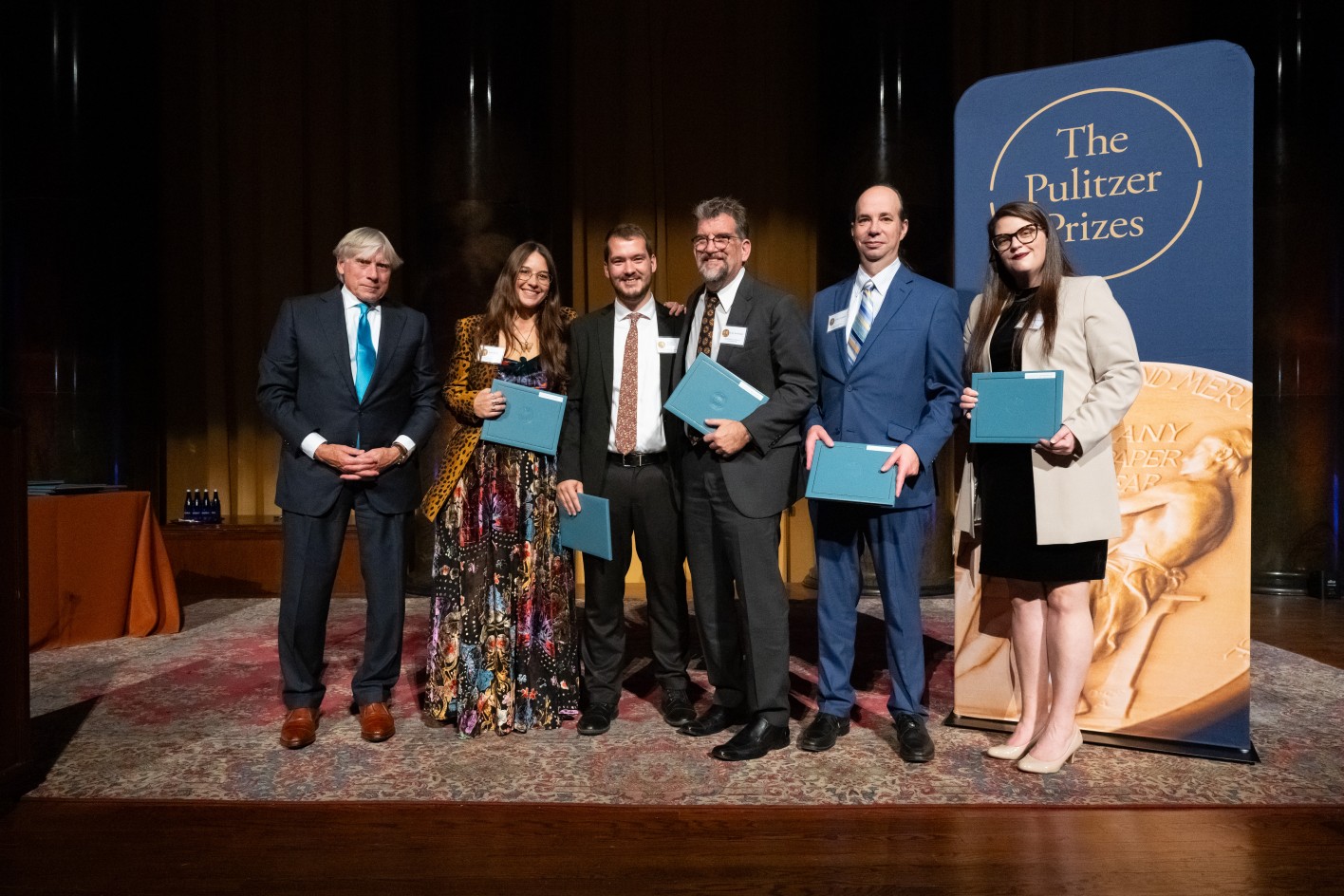
Ramsey Archibald (second from left), John Archibald, Challen Stephens and Ashley Remkus accept a 2023 Pulitzer Prize for Local Reporting from Columbia University President Emeritus Lee Bollinger. (Diane Bondareff/The Pulitzer Prizes)
Winning Work
By John Archibald
Ramon Perez came to court last month ready to fight the tickets he’d been handed by Brookside police, including one for rolling through a stop sign and another for driving 48 mph in a 40 zone.
He swore he’d seen the cop from a distance and was careful as he braked.
“I saw him and we looked eye to eye,” the Chelsea business owner said. “There’s no way I was going to run that stop sign.”
When he got to court Dec. 2, he saw scores of people just like him lining up to stand before Judge Jim Wooten, complaining of penny-ante “crimes” and harassment by officers. He saw so many people trying to park in the grassy field outside the municipal building that police had to direct traffic.
He figured there was no point.
“I saw the same attitude in every officer and every person,” he said. “That’s why I hesitated to fight it. They were doing the same thing to every person that was there. They own the town.”
Perez, it appears, was right.
Months of research and dozens of interviews by AL.com found that Brookside’s finances are rocket-fueled by tickets and aggressive policing. In a two-year period between 2018 and 2020 Brookside revenues from fines and forfeitures soared more than 640 percent and now make up half the city’s total income.
And the police chief has called for more.
The town of 1,253 just north of Birmingham reported just 55 serious crimes to the state in the entire eight year period between 2011 and 2018 – none of them homicide or rape. But in 2018 it began building a police empire, hiring more and more officers to blanket its six miles of roads and mile-and-a-half jurisdiction on Interstate 22.
By 2020 Brookside made more misdemeanor arrests than it has residents. It went from towing 50 vehicles in 2018 to 789 in 2020 – each carrying fines. That’s a 1,478% increase, with 1.7 tows for every household in town.
The growth has come with trouble to match. Brookside officers have been accused in lawsuits of fabricating charges, using racist language and “making up laws” to stack counts on passersby. Defendants must pay thousands in fines and fees – or pay for costly appeals to state court – and poorer residents or passersby fall into patterns of debt they cannot easily escape.
“Brookside is a poster child for policing for profit,” said Carla Crowder, the director of Alabama Appleseed Center for Law & Justice, a nonprofit devoted to justice and equity. “We are not safer because of it.”
“It could be more”
Brookside now faces at least five lawsuits. Advocates for justice reform, cops in other jurisdictions, even Jefferson County’s top law enforcement officials, have begun to question the town’s tactics, and its need for an expanding force.
“It’s my understanding that a guy can go out there and I mean, he can fall into a black hole,” Jefferson County District Attorney Danny Carr said of drivers getting entangled financially. “You know, we’ve had a lot of issues with Brookside.”
Jefferson County Sheriff Mark Pettway said the same.
“We get calls about Brookside quite regularly because they really go outside their jurisdiction to stop people,” Pettway said. “Most of the time people get stopped, they’re going to get a ticket. And they’re saying they were nowhere near Brookside.”
Police stops soared between 2018 and 2020. Fines and forfeitures – seizures of cars during traffic stops, among other things – doubled from 2018 to 2019. In 2020 they came to $610,000. That’s 49% of the small town’s skyrocketing revenue.
“This is shocking,” said Crowder. “No one can objectively look at this and conclude this is good government that is keeping us safer.”
Because people overwhelmed by debt have been shown to turn to crime to pay their fines “an argument can be made that this kind of policing creates crime,” Crowder said.
Brookside Police Chief Mike Jones, who spearheaded the change and grew the police department tenfold, at least, calls the town’s policing “a positive story.” Mayor Mike Bryan – a former councilman who assumed his position last year after the death of the previous mayor – sits and nods in agreement.
Jones said crime when he took over was higher than it appeared from numbers the town reported to the state. He said response times were long because Brookside often had to rely on the Jefferson County Sheriff’s department for service.
He said he’d like to see even more growth in revenue from fines and forfeitures.
“I see a 600% increase – that’s a failure. If you had more officers and more productivity you’d have more,” Jones said. “I think it could be more.”
When Jones was hired as chief in 2018, he was the only full-time police officer, he said in sworn testimony for a lawsuit filed against him and the city. By last summer, he said in a deposition, Brookside had hired eight additional full-time officers and several part-timers.
Asked in December how many officers were on staff, he refused to say, citing “security” concerns, though police staff sizes are reported regularly to the government for public consumption.
A department of nine officers in a 1,253-person town is far larger than average. Across the country, the average size of a force is one officer for every 588 residents, according to a Governing Magazine study that examined federal statistics.
Last year, based on Jones’ testimony, Brookside had at least one officer for every 144 residents.
Sheriff Pettway gaped at the Brookside ratio. “I could take over the whole county with numbers like that,” he joked.
Then this month the Brookside department posted on Facebook that it had hired six more officers “in an effort to expand our dedication and commitment to provide superior community service & protection.”
A one-store town
Brookside until recently was known for its quirky Russian food festival and the state’s only onion-domed Russian Orthodox Church. It’s a former mining town, its population about the same as it was a decade ago. Fewer than 100 of its residents graduated college.
Brookside is a poor town, 70% white, 21% Black, with a small but growing Hispanic population and a median income well below the state average. The town survives on the fringes of Birmingham with tax revenue from the Dollar General, which forms the totality of its commercial district.
In 2018, when the town had one full-time police officer and a few part-timers, it reported no serious crimes to the Alabama Criminal Justice Information Center. Brookside Police did patrol the 1.5-mile stretch of Interstate 22 within their jurisdiction and wrote tickets that brought in $82,467 in fines. That contributed a 14% chunk of the city’s total income, a number that would be considered high in much of America.
But Brookside revenues from fines and forfeitures soared after that, and the town’s law-enforcement goals — and its reputation — changed.
By 2020 officers in the sleepy town were undergoing SWAT training and dressing in riot gear, even as the city continued with only a volunteer fire department. It parked a riot control vehicle — townspeople call it a tank — outside the municipal complex and community center. Traffic tickets, and criminalizing those who passed through, became the city’s leading industry.
“We’ll make you famous!”
The police department’s Facebook page – it claims more than a million visitors – became a vehicle for public shaming with embarrassing mugshots and derision for those who owe fines and fees – “Turn yourself in. If we have to come get ya, we’ll make you famous!”
“When you look at their Facebook pages it’s almost like they are bullies. I’ve seen it,” DA Carr said. “I don’t condone it, but you know, I’m not the chief out there.”
And it’s not an idle threat. Arrests on Brookside warrants went from zero to 243 in the span of two years, according to statistics Chief Jones presented to the council.
Jones — again as Mayor Bryan nodded — said the goal of the department is only to help people.
“It’s not about making a dollar,” Jones said.
Yet the town with no traffic lights collected $487 in fines and forfeitures in 2020 for every man, woman and child, though many of those fined were merely passing by on I-22.
Total town income more than doubled from 2018 to 2020 – from $582,000 to more than $1.2 million – as fines and forfeitures rose 640%.
Jones and Bryan said neither the town nor the police department relies on the revenue officers bring in. In fact, they said in November they didn’t know how that money is spent.
Audits by Philip Morgan & Co., covering at least five consecutive years, pointed out as a shortcoming that the town did not have a budget or a policy of adopting one annually. The audits show, however, how the town came to depend on the ticket money.
As more tickets brought in more money, the town began to spend much more. From 2018 to 2020, spending on police rose from $79,000 to $524,000, a 560% increase. The town’s administrative expenditures rose 40% and overall spending jumped 112%, from $553,000 in 2018 to $1.2 million in 2020.
In December the mayor provided AL.com a budget document, based on previous years’ audits. It did not feature a breakout of the police department.
Asked why that was the case, Bryan responded there had been an error, that the heading for the ‘Municipal Court Fund’ was actually the police department budget. “Sorry for the typo,” the mayor wrote.
That document budgeted $646,620 to the police this year.
The town also provided a set of police stats Jones presented to the Brookside council to push for more resources and authority.
It showed that total arrests – custodial, misdemeanor and felony – rose 1,109% from 2018 to 2020. Brookside police made 4.4 arrests in 2020 for every household.
It showed police in 2020 patrolled 114,438 miles in the 6.3-mile town and issued more than 3,000 citations – a 692% increase from 2018.
“We don’t care about tickets,” Jones said. “We don’t like writing tickets.”
‘99 percent of them are lying’
Yet that is hard to swallow for those who line up for court and face financial ruin because of citations. Like those on Dec. 2.
John Walker was stopped in Brookside for following too closely.
“Do you understand what you are charged with?” the judge asked on that first Thursday in December.
“No,” he said. “No.”
Walker told the judge he will fight the charge.
Mayor Bryan dismissed the complaints of those who must appear in court. “Everybody’s got a story,” he said. “And 99% of them are lying.”
Yet the Brookside stories come at an alarming rate.
Sandra Jo Harris, a 52-year-old grandmother, claims in a lawsuit she pulled off I-22 at Cherry Avenue on Jan. 8, 2020, as she often did when she went to visit her daughter. It was nearing dusk, and as she drove into the neighborhood she didn’t think much about the unmarked black SUV with tinted windows on the side of the road. She turned on her lights, according to her lawsuit, because of the approaching darkness.
But when she did, the unmarked SUV pulled into the street, crossed the center line and sped toward her car, blue lights flashing. She was not speeding, or breaking the law, she argued in the suit. She pulled to the side of the road as the SUV pulled behind her, and a wrecker simultaneously parked nearby. It frightened her, and led to more trouble.
Officers, dressed completely in dark, unmarked uniforms approached her, and one accused her of flickering her lights to warn others of their presence, her suit alleges. Unsure what was happening, Harris dialed 911. But an officer grabbed the phone and threw it to the ground, breaking it, the lawsuit says. Police put her in a patrol car and searched her vehicle for drugs.
Harris’ lawyers contend she was taken to the Brookside jail, strip-searched, and told she could be jailed up to two days. She had an asthma attack and a panic attack, but when she knocked on the door to alert a guard, a jailer said if she continued to knock she would be charged with attempting to escape. Eventually she was given an inhaler and treated by paramedics.
Police charged Harris with flickering her lights – or “nuisance of casting lights from motor vehicle on real property at night,” which she argues did not happen and eventually was dropped. She was also charged with resisting arrest. A report quoted in the suit claimed she “tighten (sic) arm muscles from getting handcuff (sic).”
In addition, the police charged her with making a false 911 call, obstructing government operations by refusing to give proper papers, and disorderly conduct for yelling for others to come out of their homes. They let her out of jail at midnight, long after her family had made bond.
Her lawyers argue that the city uses “obscure possible violations” to justify stopping and searching passersby, hoping to add more offenses in a sort of highway lottery to fill the coffers.
“Brookside has operated its police and court system with the primary objective of obtaining revenue from motorists traveling on or near Interstate-22,” Harris’ lawyers wrote in a suit filed last year. “It has had a continued practice of stopping and ticketing scores of vehicles daily, doing so without probable cause or reasonable suspicion of wrongdoing.”
K9 Cash
Brookside has two drug-sniffing dogs — one named K9 Cash — to search the cars of stopped motorists.
Most of the vehicles Brookside Police drive are unmarked, and tinted.
Chief Jones testified under oath that just one of the 10 Brookside vehicles is painted with police striping, but nine others bear no emblems, and seven are tinted all the way around, making it impossible to see inside. Jones testified his officers wear gray uniforms with no Brookside insignias.
In another case, Brookside police last year confiscated a 2014 Honda Civic owned by a man named Sean Wattson, even though Wattson was not driving and was not in the car, according to a lawsuit he filed against the town. He lent his car to a friend, who was pulled over and arrested for drug possession.
Wattson claims he was unaware of the drugs. Still, police seized his car, and refused to return it, though they didn’t begin official forfeiture proceedings.
Both lawsuits continue.
Secret agent names
Neither the mayor nor chief would talk about pending litigation, but both said they have reviewed the cases involved, including bodycam footage, and said they found no wrongdoing on the city’s part. They would not share the footage.
Jones blamed the lawsuits on “ambulance-chasing attorneys.”
But lawyers and law enforcement officers across central Alabama have raised questions about things in Brookside they say they have never otherwise come across.
Lawyer Martin Weinberg had a client in Brookside, a young man named Thomas Hall, who was stopped for speeding and found with a small amount of marijuana.
He was charged with misdemeanor possession, but also five counts of possession of drug paraphernalia, for:
- Rolling papers
- The baggie that held the marijuana
- Cigar wrappers
- A small jar “that once may have held marijuana”
- And a small tray that “might have” been used to roll a joint
The names of the officers were not listed on the tickets in secretive Brookside. Instead, the arresting officer was listed as “Agent JS,” while the assisting officer was “Agent AR.”
A judge set Hall’s fines at $6,000, and he had to post $12,000 bond while he appealed the case, an amount Weinberg considered excessive, and one that would prevent defendants without money or support from arguing their cases in state court.
Hall did appeal, and a Jefferson County judge ultimately dismissed the charges.
Bill Dawson, a lawyer who has represented several clients in Brookside, said defendants have faced possession charges for a joint, with paraphernalia charges tacked on for the paper it was rolled in.
“I’ve never seen a possession case split like that,” he said. “It’s unheard of.”
“False left-lane violation”
Dawson also represents Victoria Brumlow, a young woman who – like hundreds more – was stopped on I-22 and ticketed for driving on the left lane of the interstate. Not speeding, not swerving, just using the left lane.
A Brookside officer ticketed Brumlow under Alabama code section 32-5-77, which her lawyers contend does not contain a crime. But it’s a common charge in Brookside.
She argued that she only drove in the left lane to pass other vehicles, and her ticket – on May 26, 2019 – came five months before Alabama’s Anti-Road Rage Act, a law making it illegal to drive in the left lane of an interstate for more than a mile and a half, went into effect.
Brookside police officers in sworn depositions indicated they did not follow drivers for a full mile and a half before or after the new law was passed, and they continued to write tickets under the old law after the new road rage bill passed.
In May of 2019, the month Brumlow was stopped, Brookside officers ticketed 75 people for driving in the left lane. Between April 2018 and June 2020, they handed out 406 of those tickets, or about 15 a month, according to documents filed in the lawsuit.
“It was something that I should not have been stopped for,” Brumlow said in sworn testimony. “And while sitting in court I heard that half the court was also stopped for the same thing.”
Brumlow pleaded not guilty, and had to go to court over and over again as the case was postponed. A court worker told her she would have to plead guilty or go to driving school. She fought it instead.
Dawson argued in a lawsuit against Brookside and Chief Jones that “Brookside has continuously used the false left lane violation as a reason to stop and detain hundreds of motorists. The motive … was to generate revenue for Brookside.”
Brumlow’s uncle, Jeff Brumlow, is the longtime prosecutor and city attorney for the city of Alabaster, and a GOP candidate for Shelby County district judge. He agreed to represent his niece in her traffic case.
In a sworn deposition in the civil suit Jeff Brumlow said he went to court three times before the case was ultimately dropped, and saw many people – he’d guess 25 to 30% of all defendants – charged with the dubious left lane violation.
“What I had watched in court with the use of this particular charge, I mean, just to be quite frank, it offended me that a court would act that way and that a city would act that way toward people who really don’t have that kind of money,” he testified. “So it was a bit of a moral outrage because I had sat in court three times now and it was no longer a mistake.”
“This was an intentional policy of the city and my niece just happened to get caught up in it and happened to challenge it. And it broke her heart, it broke my heart.”
“Creating a law”
Ramon Perez felt that way as well, sitting in the courtroom and hearing defendants plead to the same charges over and over.
He’d been stopped for rolling the stop sign, which he disputes, and speeding, which he also disputes. He was also ticketed for improper signal, though he can’t even fathom how that might have occurred. He was cited for driving with a suspended license — a matter he thought he’d cleared up — but he doesn’t blame Brookside for that.
It is what happened after the stop that is most concerning to him. He feels the police saw him as prey, and treated him as such.
Perez is Hispanic, and his passenger was a Brookside resident, also Hispanic, who didn’t have her purse with her, Perez said. The officer said he would take them both to jail because she didn’t have her ID.
Which is another problem altogether, Sheriff Pettway said.
“We don’t have a law that says if you don’t have ID, you go to jail,” he said. “If you want to go out there and do something like that, you are creating a law.”
Perez said the officer “went absolutely crazy” over her lack of ID. “He was very ugly from the start.”
Ultimately another officer took Perez to his friend’s house to retrieve her ID, he said. His car was towed — with apologies from the tow-truck driver — costing him several hundred dollars.
Perez ultimately decided to pay the $1,100 fine — on top of hundreds he’d already spent to get his towed car back — and get the heck out of Brookside.
Which is exactly what the town is banking on, according to those who have watched Brookside grow into one of Alabama’s biggest, most troublesome traffic traps.
Perez is angry at his treatment. But he also worries for relatives and employees who live in Brookside. Not all of them can afford to pay their fines as he did, and some have been put on payment plans.
“I feel bad for those guys who struggle,” Perez said. He is still torn, wondering if he should have fought the town harder.
“I should have brought a lawyer, but right now my time is not there,” he said. “But my behavior was right. I know that.”
Sheriff Pettway said those who face charges in Brookside and want to ensure justice can get a bond and appeal their case.
“It may cost some money to go through that process,” he said. “But if you want real justice, I think you’ll go through the process. Fairness and real justice, I believe, is something people are looking for when it comes to law enforcement.
Pettway also said issues with Brookside could draw the attention of the federal government.
“I think it’s one of those situations … that could possibly bring in the feds with some oversight,” he said. “I wouldn’t be surprised if they opened up an investigation. You can’t do what’s going on over there.”
This story was published with the support of a grant from Columbia University’s Ira A. Lipman Center for Journalism and Civil and Human Rights.
By John Archibald
It started about as bad as it can get. Then it got worse.
Rev. Vincent Witt, a Baptist preacher and chaplain of the city of Lipscomb, is angry as he talks about his trip through the Brookside police jurisdiction in north Jefferson County.
It cost him a job. It cost him money. It cost him reputation, he says.
It began in June of 2019. Witt stopped at a stop sign in Brookside, a burg with only one retail store and a volunteer fire department, but at least one police officer for every 144 people. He turned left in his new black Cadillac, and an officer stopped him almost immediately.
Witt said the officer, identified in a federal lawsuit as Marcus Sellers, told him he stopped the Witts because his car had a paper tag.
“It’s a brand new car,” Witt recalled saying. “I just bought it a few days ago.”
The officer said the Witt’s car fit the description of one recently stolen, according to the federal lawsuit Witt has since filed. As Witt pulled his ID out of his wallet, the officer noticed his chaplain’s badge and asked about it. Witt said he explained that he is chaplain for the city of Lipscomb.
“I said, ‘Do you pull everybody over like this?’” Witt recalled in a recent interview with AL.com. According to the lawsuit, the officer responded, “‘Look you f***ing n***** just stay out of Brookside.’”
Officer Sellers did not respond to requests for comment.
For the Witts, that was just the beginning.
Witt is fighting Sellers, the city, its police chief and Lt. Bo Savelle, in a federal lawsuit that alleges malicious prosecution and defamation, among other things. He’s one of at least five people currently suing the police in the town of just 1,253 people.
Witt said after the traffic stop he went home, and promptly made a complaint. He said he called the Brookside police department and asked for the chief. The next morning Savelle, a lieutenant, returned his call — asking for “Officer Witt” — and told him to come in and make a complaint. Witt replied that he was not an officer but a chaplain, adding that, “Brookside is a real racist police department.”
Witt said he decided filing a complaint wouldn’t do any good.
But it didn’t go away, he said.
In days to come, Witt and his sister, Tareya, were charged with impersonating police officers. Witt said his sister was not in the car when he was stopped nor aware of the incident at all. Brookside police splashed their faces on the department’s Facebook page, which trafficks in embarrassing mugshots and claims to have more than a million visitors. The post said Tareya and Vincent Witt were wanted by police.
Crime Stoppers, a website that displays fugitives and offers a reward for information leading to their capture, also featured their photos.
Tareya Witt, a longtime federal worker, told AL.com she got a text from a friend on a Sunday morning when she was going to hear her brother preach at a church where he was applying for a job. It said “Hey. I hope this isn’t true,” and showed her the Crime Stoppers picture of her brother, and then her. It was a picture taken from her driver’s license.
“After the church service was over,” she said, “I pulled him (Vincent) to the side and showed him the picture. And he was like, ‘What? Oh, I guess they’re getting me back because I called to report how they treat people.’ I said, ‘Well, where did they get my name from because I wasn’t even in the car?’”
Brookside Mayor Mike Bryan and Police Chief Mike Jones said they could not talk about on-going litigation.
“We, along with our attorney, have reviewed” the footage of that and other cases that spawned lawsuits, Jones said. “I’ve not found wrongdoing.“
”No,” the mayor said in agreement. “No.”
Tareya Witt said she was shocked and frightened to be drawn into the situation, to be charged and publicly humiliated as a criminal when she had nothing to do with the case. If police could blithely paint her as a criminal, she wondered, what else would they do?
When she saw the photos online she immediately notified her boss, who was understanding. But she still wonders who saw that Facebook post or the Crime Stoppers listing.
Vincent Witt said he lost work because of it.
“I was going to be sent to another church and I actually lost that job to the other church because people weren’t sure about this case. So they gave it to another guy.”
Brookside later dismissed their charges without explanation. Crime Stoppers took down their photos after intervention from Jefferson County Sheriff Mark Pettway.
Pettway, who sits on the Crime Stoppers board, says he knows the Witt family, and believes their account.
“I don’t want Crime Stoppers to be involved in something that could possibly cause a lawsuit or cause someone to have a bad reputation,” he said.
He said he met with Brookside officers to talk about the case.
“I didn’t believe the sister was in the car at all,” he said. “I didn’t really feel comfortable with them trying to go forward with charges on the sister (Tareya).
Brenda Witt, Vincent’s wife, was in the car, according the suit and to the Witts. She is a Jefferson County employee, a security guard, and had her uniform on when they were stopped, Pettway said.
“I believed that was going to be a real black eye for that department,” the sheriff said. So I talked to them about it. I said ‘Hey, I think he had the wrong person on this warrant and it’s gonna cause some problems.’”
Pettway said Brookside officers claimed they had video, but they did not produce it.
“If they have videos to back it up, I wouldn’t have any problem with it, but I don’t think there’s any video to back anything that they have said,” Pettway said.
The Witt’s lawsuit contues in federal court. The Witts claim they were maliciously prosecuted by Brookside, that its officers intentionally and recklessly defamed them and caused them shame and financial harm.
Defense lawyers for Brookside argued that the officers had qualified immunity – a legal doctrine that protects police against lawsuits in many cases when they are on the job. U.S. District Judge Abdul Kallon agreed in part.
But Judge Kallon, allowing the malicious prosecution and defamation claims to continue, wrote that “Given the alleged and, truthfully, bizarre conduct—issuing and approving fabricated charges against Pastor Witt and Ms. Witt for impersonating police officers, without probable cause, and publicizing the charges on Facebook and Crime Stoppers in retaliation for Pastor Witt’s complaint—the court is unconvinced that Officers Savelle and Jones are entitled to qualified immunity.”
He went on to say “Taken together, at this stage, the complaint plausibly alleges that Officers Savelle and Jones pursued and publicized charges against Pastor Witt and Ms. Witt willfully, maliciously, fraudulently, in bad faith, and/or beyond their authority.”
Kallon did rule that it was legal for officers to stop the Witts for the paper tag, as courts have said police are allowed to stop vehicles to make sure the paper tags are not more than 20 days old, as required by law. Thus Kallon ruled it could not be seen as a racially motivated stop, though his language was sharp.
“This alleged conduct is reprehensible, and it harkens back to the dark period in our nation’s history when officers blatantly displayed racist tendencies and weaponized their badges to keep minorities from certain communities under the guise of ‘law enforcement.’ It was shameful then and more so now for law enforcement to continue to allegedly behave in this manner.”
This story was published with the support of a grant from Columbia University’s Ira A. Lipman Center for Journalism and Civil and Human Rights.
By John Archibald
Brookside cops were on a high-priority case in 2019.
Garbage bags filled with used adult diapers, soiled puppy pads and empty oatmeal packets had been regularly dumped along the main road through the tiny town just north of Birmingham. It infuriated police and town leaders – and created quite the stink.
Officers began to pick up the bags and bring them into the little town hall, said Kimberlee Hudgens, a Brookside dispatcher at the time. Investigators stored them as evidence, diapers and all, in a closet in the lieutenants’ office.
“They were there for a good while,” Hudgens said. “We’d have to replace air fresheners, like every other day.”
That wasn’t the worst of it.
“That’s where we kept all the supplies for feeding the inmates,” she said. “Silverware, plates and everything like that.”
A year before, Brookside’s low-key, one-man police department had begun to metastasize, at the behest of town leaders, into an insatiable band of reverse Robin Hoods, stopping so many cars, detaining and arresting so many people that it couldn’t keep up.
Officers crammed evidence – like those trash bags – wherever space could be found, according to a state audit released this month. Guns, money and drugs were tossed recklessly about, as the town arrested more people, and confiscated more property than workers or facilities could handle.
Brookside, population 1,253, had never even had an annual budget. But those town bosses wanted a big, professional police department. What they got was a nightmare.
‘A year in Brookside is a pretty long time’
The transformation of Brookside’s police department began in 2018, under the direction of long-serving and now late Mayor Roger McCondichie. He and members of the town council complained of slow response times from the county, and of drug infestations in and around the area. They opted for a more aggressive approach, and found just the man for the job: Mike Jones.
Jones had been a cop in nearby Shelby County, in the affluent suburbs south of Birmingham. At the time, Jones was still president of the Helena City Council, though it was reported he later stopped attending meetings when his private security business began to struggle. He declared bankruptcy in 2019.
But Jones sold Brookside a vision of how to turn a sleepy department into an intimidating and lucrative force.
Jones put out word that Brookside was hiring officers and dispatchers for the new department, which he cast as an interstate drug unit. He promised benefits and a place to land for police who had left other agencies but hoped to keep their law enforcement certification current. He quickly built a roster of officers, some with questionable pasts that made them more loyal, adding new staff every quarter until the force eventually topped out at 13, not counting reserves.
As the department grew, employees say it reflected Jones’ vision.
“We were working under a man who used fear as a tactic to make us do what he wanted us to do,” said Brandon McDonald, the first dispatcher hired after Jones arrived.
Attempts to reach Jones have been unsuccessful since January. He left Brookside and has not commented publicly.
McDonald recalled the way Jones ordered staffers not to adjust the temperature in the town’s jail cells, so it would remain cold all the time. McDonald attributed it to “cruelty.”
Lacey Shelton experienced that when she was jailed last year on charges she disputes. She wore a tank top and was denied a long-sleeved shirt.
“They told me they don’t give blankets,” she said. “I was freezing.”
McDonald began to struggle with the ethics of it.
He complained when frozen food for jail inmates was improperly stored for long periods in refrigerators because there was no freezer. He described how Jones hoped to turn the neighboring community center – one of the few amenities for the townspeople – into a police building and jail.
McDonald was new to policing, but soon grew disillusioned with Jones’ demands and what he considered broken promises about pay and benefits.
“When you’re naive and you work with police, you assume they’re gonna do the right thing,” he said. “It’s not until you learn right from wrong in the police world that you know just what’s going on. And I didn’t realize that until some time had passed.”
By 2020, McDonald had seen enough. He complained about Jones but no one listened, including current town leaders, he said. So he quit, after about a year on the job.
“But a year at Brookside is a pretty long time.”
‘The chief’s pretty upset’
Brookside is just 10 miles north of Birmingham, but in ways it is ages away. It’s an old mining town, tucked in the hills and hollows at the southwest tip of the Appalachians. It has one retail store, the Dollar General, and three septic tank services.
And while many Brookside residents work across the Birmingham area – the largest urban center in Alabama – they enjoy the country feel of their town, the anonymity and security that used to come with it. Since 2011, Brookside reported to the state very little serious crime – one robbery and no murders.
But Jones wanted his force to show force. He acquired three military surplus trucks through the federal 1033 program, which passes used military guns and equipment to local law enforcement. The town already had weapons and a personnel carrier through the program – the feds call it a mine-resistant vehicle and residents knew it as “the tank.”
While tiny Brookside was not alone in taking such equipment and weaponry, it was particularly aggressive. The town collected surplus valued at $760,846, more than accepted by Birmingham or Montgomery, and among the highest totals in Alabama. Some residents worried the growing fleet of military equipment lined up outside town hall sent an unwelcoming message.
Jones still has some supporters in town. But his approach — which posited that Brookside was dirty, unsafe and drug-infested — offended other residents, who argued drugs exist everywhere.
Brooksiders tell vivid stories about their experiences as Jones built the police department in his image, and protected that image with intimidation, threats, embarrassing social media posts and even blue-light traffic stops.
“If you put anything on Facebook, he retaliated verbally to you,” said Brookside resident Tammy Price. “He absolutely would embarrass you. If he saw you and he was riding down the street, he would embarrass you in your front yard.”
She said she once questioned Jones’ methods in a public meeting, and he pulled up outside her house a little later. He rolled down his window and said, “I’m glad you haven’t needed me lately.”
She took that as a threat.
John Minyard told his story at a Brookside town hall meeting. Police gave him a ticket for running a stop sign, which he disputed. He posted his displeasure on Facebook, he said, and then a police officer stopped him, blue lights flashing.
Not for a crime, but for a warning.
“The chief’s pretty upset about that post you put on Facebook,” he recalled the officer saying.
Residents like Price and her neighbor Bobbie Pickle bristled when Jones began walking through backyards and into carports, posting big orange stickers on cars or boats without current tags, telling people their property would be towed.
“I had two boats in my boat shed and he put stickers on both of them and told me, because I didn’t have updated tags on them that they were gonna tow ‘em,” Pickle said.
“That’s my (late) husband’s boat,” she said. “And I don’t have to have a license for it to sit in the yard. You will not touch it.”
Strip searches and Bibles
Brookside hired Hudgens as a dispatcher in August of 2019. She’d worked for years in emergency services, but she and other dispatchers were thrust with little preparation into the job of sending new officers where they needed to go, all while using ill-suited computer equipment salvaged from Jones’ private security business, she said. They were expected to keep track of real-time police calls on Excel files.
“We were not trained whatsoever,” she said. “We were required to be jailers as well, but had no formal training.”
Hudgens oversaw inmates in the two little town hall rooms adapted as jail cells. She said she was asked to pat down female inmates, and was once made to perform a cavity search on a woman suspected of having drugs. She had no preparations for such an invasive procedure.
While police filled the cells by citing the letter of the law to drivers, they did not apply that standard to themselves. Jones made his own rules, based on his own sense of morality, Hudgens said.
“We had cameras in dispatch and there were multiple times when … he would bring an inmate into his office and shut the door,” she said. “I witnessed that he would evangelize to them. And the only way they’d be able to get out of jail is if they accepted Christ. They’d be given a Gideon’s Bible because the previous mayor was a Gideon, and they’d be released from jail.”
Brookside Mayor Mike Bryan is a former councilman who took over as acting mayor when McCondichie became ill. Bryan said he knew Jones made Bibles available in the jail, but said he had never heard of anyone being held because they did not accept Jesus.
Such a thing “would absolutely be inappropriate,” he said. “The law is the law.”
The law, according to Hudgens, was what Mike Jones said it was. It was enforced by those he picked – despite their backgrounds – to be police officers.
Jones had known James “Bo” Savelle – Agent JS, as he often wrote on his reports – from his days in Shelby County, according to former Brookside workers. Savelle became a lieutenant in Brookside.
Savelle had a history of trouble. He had past drug and alcohol charges, a DUI and an arrest for public lewdness, according to police records. And in 2019, when Jones was out of town and Savelle filling in as Brookside chief, he was charged with harassment at a Dave & Buster’s in Hoover. A police report said he drunkenly and aggressively harassed a woman and her companion.
Attempts to reach Savelle failed. His listed phone is not accepting calls and he did not respond to emails.
Savelle was not the only Brookside officer with past issues. Another Brookside officer had been indicted for the strangulation of his girlfriend in 2019, though that case was dismissed when the woman failed to show up for court. At least two others were in arrears on child support, and another had been charged with harassment, though the charges were dropped.
Another, the second-leading ticket-giver between 2018 and 2020, according to records filed in a lawsuit against the town, had been ticketed eight times by other agencies for speeding, four times for driving with no seat belt, twice for driving without insurance, twice for driving without a visible tag, and once – this one years ago – for driving on a suspended license.
Hudgens said she quit as a dispatcher because of the way the town handled — and in her mind, glossed over — Savelle’s arrest.
“I just knew that I did not want to be part of a workplace that did such low-down things,” she said.
Town officials ignored signs of trouble because they were so infatuated with the influx of money that they “had blinders on,” she said.
“It was a dictatorship.”
A revenue strategy: tickets, tows and arrests
The money Hudgens spoke of was substantial.
In 2018 total revenue for the town of Brookside was $586,000. By 2020 – due almost entirely to aggressive policing – it rose to $1.2 million. Fines and forfeitures made up 49 percent of the town revenue, and most of it went right back to the police and courts.
Jones reimagined the police department as a sort of drug task force on the corridor between Birmingham and Memphis — and he was creative.
He pushed the boundaries of the town’s police jurisdiction beyond the town limits, and blanketed nearby Interstate 22 with police cars. Traffic tickets increased more than 600 percent in a single year, arrests almost 450 percent.
While the town paid officers as little as $12 an hour, Jones used state-disbursed federal grant money to lure new hires with thousands of hours of overtime.
He expected officers to stay busy, and they were. Officers appeared to approach drivers with the presumption that they were guilty of something, many drivers would later say. And the town bought in.
Police under Jones stopped drivers for minor traffic violations. Lots of them.
If you drove too long in the left lane, you became an offender, though lawyers have argued the “crime” police often cited was not on the books. Officers detained and questioned drivers, often handcuffing them during the search as they brought in drug-sniffing dogs named Axl and Cash. When drivers asked why they were being treated as criminals, officers responded, as Jeanetta Jones claims they did to her, by saying they were the police, and could do what they wanted.
Town leaders did not question. As Brookside Mayor Bryan told AL.com when first asked about aggressive policing in December: “Everybody’s got a story, and 99% of them are lying.”
The town began to tow huge numbers of cars, and reap huge rewards. Just 50 cars were towed in 2018, but that jumped to 789 cars two years later, or an average of more than two a day. Multiple drivers say Jett’s Towing Co. showed up on the side of the road at the same time as police stops. Cars were towed for failure to show insurance, for not having a driver’s license, and lawsuits now claim officers frequently ignored insurance paperwork as an excuse to tow cars.
Although the town has no towing contract, it had a no-bid relationship with Jett’s, a state audit described. That audit report, released last week, has said such an arrangement is illegal.
The town required drivers to pay $175 in “restitution” to receive a release form — nothing but a piece of paper — to take to Jett’s to reclaim their car. Jett’s then demanded its own payment — sometimes more than the city’s, and demanded cash for owners to retrieve their vehicles. As the state audit pointed out, such fees “must be reasonably related to covering the cost of administration, not to generate revenue.”
Wayne Jett, the owner of Jett’s Towing, referred questions to his lawyer, Jay Tidwell. Attempts to reach Tidwell were unsuccessful.
Katie Baggett moved to Brookside in December of 2020. In less than three months, she said, Brookside separately pulled over both her and her housemate and impounded both of their vehicles.
She was stopped on Valentine’s Day of 2021 as she drove home during a winter storm warning. Visibility was low and she was driving cautiously, she said.
A dark, seemingly unmarked SUV pulled behind her, she said. Another SUV faced her, bright lights on, and yet another pulled at the rear. Officers said they stopped her because the tag light on her Honda Odyssey was not visible from 50 feet away.
Baggett and the officers went back to look at the tag light, and it worked. She said one officer told her “Well, we didn’t say it wasn’t working. We said we couldn’t see it from 50 feet away.”
Baggett was driving on a suspended license, though the suspension had ended and she hadn’t had the money to have it reinstated. She was ticketed for improper tag light and driving while suspended, and her vehicle was towed.
An officer insisted on taking her home – which embarrassed her. Baggett asked about her vehicle on the way.
“I said, ‘Where are y’all taking my car?’” she said. “And he’s like, ‘We can’t tell you unless you give me your phone number.’ I said ‘I don’t wanna give you my phone number.’ And he said, ‘Well, I’m not gonna tell you unless you give it to me.’”
She refused. When she called town hall a few days later, she was told Brookside needed the officer’s name to determine the location of the car, she said. The officer had identified himself only by an agent number.
It was only after she went to court six weeks later that she learned where the car was impounded. By the time she found it the storage fees topped $2,000.
“It was more than the car was worth in fines,” she said.
Her Odyssey, and all the items in it, were auctioned off, she said. Baggett took Ubers and Lyfts to the Avondale area of Birmingham to work, at $35 a pop, plus tip. It wiped out half her income.
In court she pleaded down to driving without a state license – less serious than driving while suspended – and ultimately got her license back. It took four months before she could save for another car.
“As a single mom that really messed me up,” she said. “I’m still kind of in debt from that.”
Debt collectors with guns
Brookside police didn’t just wait for the money to come to them. They went out and got it, in other municipalities, as armed debt collectors.
Chana Hodges handles billing at a mom-and-pop medical supply store in nearby Fultondale, Ala. She recounts a day in 2020 when her boss walked to the cubicle and told her a police officer was looking for her.
She wondered if her family was OK as she walked past coworkers and customers. Then she saw the officer tap the radio on his chest.
“I see her,” she heard the man say. “She’s in my sight.”
Another Brookside cop ran from the rear of the building, where he had positioned himself to prevent her escape. As she stepped out of Jernigan Healthcare the two snapped handcuffs on Hodges’ wrists and led her to the police car.
“I’m like, what have I done?” she recalled in March. “What could I have done to warrant police from a different city showing up at my work to arrest me?”
The answer would come soon, as the first officer spoke: “Do you remember getting a ticket in Brookside?”
She did. She remembered being pulled over five years before. For driving with an expired tag.
Hodges made monthly payments to chip away at the $400 fine, but moved away and forgot about it after paying about half. She was taken to jail and told she couldn’t leave without a $500 cash bond and $206 she still owed on the original offense. Her boss paid her fine.
Hodges said she asked Jones at the time why police didn’t just call her and tell her to come in.
“He told me it would be in my best interest if I just shut the F up,” she said.
“I had to be patient”
Lawyer Bill Dawson, who has filed multiple lawsuits against Brookside, first became aware of the town’s overreach in 2019.
A client came to him after she was stopped for driving in the left lane of the interstate, a crime he insists did not exist at the time. Dawson was struck by the testimony, and the sheer number of people who packed the Brookside court with similar charges.
“I’ve always been suspicious of small town courts, and I’ve seen a lot of abuses” from them, he said.
Jefferson County Public Defender Adam Danneman said he began to notice Brookside a year or so ago. He looked closer and noticed troublesome “code words” that offered vague excuses such as “driver acted nervous” to justify questionable stops. He instituted a “no pleas from Brookside” rule, and asked his workers to flag for scrutiny every case out of that town.
Dawson and Danneman suspected what the world would come to know in January, when Brookside’s reign would end as suddenly as it started.
The town became the poster child for policing for profit when AL.com published a series of revelations Jan. 19. That story unleashed a torrent of testimonials from people who said they were victimized by Brookside police, and prompted state lawmakers from both parties to call for investigations and reforms.
Chief Jones resigned on Jan. 25. Savelle left soon after, as did more than half the force. Mayor Bryan announced he had pulled police officers from Interstate 22 as the Alabama Peace Officers Standards and Training Commission and the Alabama Department of Examiners of Public Accounts swooped in for audits. The examiners’ sharp report was released this month, outlining missing guns, poor financial practices and shoddy storage of evidence, including an unmarked trash bag filled with prescription medicines that did not seem to be associated with any particular case.
The town announced that all police cars and uniforms would be clearly marked. It agreed to give back the tank. In February, Brookside even suspended court. This month the town judge, Jim Wooten, announced he would step aside and recuse himself from all pending cases. Court is now set to resume this Thursday.
Brookside hired Ken Simon, a former circuit judge and current member of the University of Alabama Board of Trustees, to investigate its own department. Simon said early findings point to a police force that preyed on people who looked like they wouldn’t be able to put up much of a fight, because of poverty, race, or previous run-ins with the law.
He spoke of “meanness.”
At a Feb. 1 town hall meeting near Brookside, residents and drivers told vivid stories of police abuses – and more meanness – and called for investigations, restitution and even dissolution of the police force and the town itself.
“I always pray, and this day has come at the right time,” Netta Womack said at the town hall. “Lord, after all this time you heard me. I had to be patient.”
The town now faces at least 13 suits – or one for every 96 residents. Lawyers for eight people argued this month in a federal lawsuit that Brookside and Jett’s Towing engaged in a “pattern of racketeering activity.” The lawyers cited federal anti-corruption RICO statutes and the Hobbs Act.
Preying on people
What happened in Brookside is a lesson for all those who fail to see the signs – in Brookside or elsewhere – and do nothing, said Carla Crowder, the director of Alabama Appleseed Center for Law & Justice.
“The abuses that have come to light in Brookside were simmering for years and no one in power was paying attention,” she said.
Brookside is one tiny place that caught the brief attention of the nation and could help people understand the dangers of using law enforcement to fund governments, she said.
“It can happen anywhere, and it should not have to happen on this scale -- with college students stranded on the side of the road, and pastors mistreated for driving nice cars, and unlabeled evidence strewn about a police station – for reform to happen.”
The Alabama Legislature in the last week of this year’s session passed a bill – sponsored in the Senate by a Republican and in the House by a Democrat – that bars municipalities from using fines and traffic fees to supply more than 10 percent of their budgets.
“The law we enacted will prevent abuses like those in Brookside from being repeated elsewhere in Alabama,” said Lt. Gov. Will Ainsworth, a Republican who vowed to do something about Brookside-style behavior. “It puts all cities, towns, and crossroads on full notice that such behavior is unacceptable. Law-abiding citizens should not fall prey to a renegade police department that is accountable to no one.”
Alabama Attorney General Steve Marshall, the state’s top law enforcement officer, has declined to comment on Brookside, but others have acted.
Jefferson County District Attorney Danny Carr asked judges to drop 69 felony drug charges that originated in Brookside, along with 22 associated misdemeanors, saying he did not want to be associated with a “rogue police force.”
Circuit Judge Shanta Craig Owens threw out another 41 cases on appeal from Brookside involving more than a dozen people, calling the evidence “garbage.” She said she would not consider a case credible if the only witness was a Brookside police officer. Brookside prosecutor Mark Parnell, fought dismissal of some of those cases, but asked for the dismissal of others.
Notably, he asked for dismissal of charges against the man who was arrested for dumping trash along Brookside-Coalburg Road. The man had admitted to the police and to the former mayor that he had dumped trash, though his lawyer argued the confession was coerced and the charges based on dates the police simply guessed about. He was charged with 31 counts of criminal littering, and town Judge Wooten had fined him $14,268. But Brookside could not make the case.
The arresting officers were gone. The evidence and testimony were insufficient. The town’s credibility was in tatters. Brookside walked away.
At a March 7 town council meeting Mayor Bryan stood in the spot where Wooten sat on court days, in the reflection of the Ten Commandments. Bryan told a supportive crowd that he is working to build a better future in a way that makes families feel safe.
The Brookside council passed three ordinances as part of the ongoing reforms. It raised police officers’ hourly pay to $18, established a police reserve program and rescinded tax collection from areas of police jurisdiction outside the town limits – which applies mainly to people in nearby Mt. Olive.
“We made the decision that we wouldn’t do that again, that this would just be a self-contained Brookside,” said council member Chris McCondichie, the former mayor’s son.
“Let’s create our opportunities here and grow Brookside and not do it any other kind of way.”
More than 200 people gathered and 31 spoke in an extraordinary town hall late Tuesday in northern Jefferson County in which people said they were victimized by a rogue police department that bullied, tormented, and in some cases ruined their lives.
“I lost my job, my dignity and my sanity because of the Brookside Police Department,” Charlena Moore told Jefferson County Sheriff Mark Pettway and Rep. Juandalynn Givan, D-Birmingham, the two who organized the event.
“I have prayed for this day.”
Residents Black and white, old and young demanded that tickets given by the tainted Brookside force be voided, that money they paid in exorbitant fines and fees be returned. Some called for dissolution of the small town itself, or its police department. They, like Givan, called for the resignations of Municipal Judge Jim Wooten and Brookside city prosecutor Mark Parnell.
But resident Randy McDuffy got wild applause when he said “We don’t just want resignations. We want people going to jail.”
Givan told the crowd she had been in touch with Alabama Attorney General Steve Marshall, and he had assured her his office is investigating Brookside.
Lawyer Allan Armstrong was skeptical. He thanked representatives from the AG’s office who were said to be in the crowded room, but added “the Alabama Attorney General defends policing for profit. That’s why this happens.”
One by one the speakers came to the podium, teary or angry, at times jubilant, because after so long they saw hope, and because they were being heard.
Netta Womack came to the mic saying “that’s me, the loud one,” and proved it throughout the two-hour meeting, cheering and urging others on.
“I always pray, and this day has come at the right time,” Womack said. “I went on Google and I saw the news… I said Lord after all this time you heard me. I had to be patient.”
AL.com two weeks ago published a story detailing how Brookside, a small town just north of Birmingham, doubled down on fines and fees in recent years, expanding the department tenfold, blanketing nearby Interstate 22, loading passersby with dubious tickets and using the fines to supply half the city income.
Pharmacist Pam Hill described a traffic stop in which she was threatened by a Brookside officer.
“I’m about to drop dead from all this trauma,” she said. “Nobody can take this.”
Themes developed throughout the meeting, as residents and drivers claimed they were targeted by aggressive and often rude police, their guns and cars taken without charge or explanation. They complained of trumped up charges, and a police department that piled on as many citations as possible and showed little respect to residents or concern about their ability to pay.
A common complaint was that Brookside frequently ticketed outside its police jurisdiction, and the signs proclaiming their jurisdiction moved outward in recent years.
“We will get in touch with the mayor of Brookside tomorrow to make them remove those signs … they are not in their jurisdiction,” said Sheriff Pettway. “If you call 911 they’re not coming.”
Pettway said he would also talk to Brookside Mayor Mike Bryan and Municipal Judge Wooten about pending cases. Because Police Chief Mike Jones and Lt. James “Bo” Savelle III resigned from the Brookside force in recent days, he said, they will not show up for court to prosecute tickets they gave. But Pettway wants clarification on the others.
“What to do? What next? We will find out,”said the sheriff.
He apologized as a law enforcement officer to those who experienced bad policing.
“I want you to know I believe everything you said tonight,” he told the crowd.
Givan said she will work to get improperly seized guns and cars back to residents, and fees returned. She promised to lead the charge to investigate how cars were towed and fees churned.
“We will be asking for restitution,” she said. “Our eyes are watching the city of Brookside. The world is watching Brookside.”
Pettway thanked the people for coming, and he thanked them.
“Drive safely,” he said as the meeting ended. “Don’t go through Brookside.”
By John Archibald
Michelle Jones made an official complaint to the Alabama Attorney’s General’s office three years ago, arguing that Brookside police stopped her out of jurisdiction, issued a bogus citation and threatened her with more charges after she criticized them on Facebook.
She thought the complaint was long forgotten or closed.
But on Wednesday morning, she said, she got a call from the Alabama Attorney General’s investigator who had worked the case after her complaint was filed in 2019,
“He informed me that my case was never closed,” said Jones, who lives in Forestdale near Birmingham.
In 2020, she had explained her case this way to the AG’s office: “The person threatened me with an arrest if I did not take down my Facebook pictures and posts of their police officers, stop sending emails to the local politicians, as well as others, and show them (Brookside police) that I understand law enforcement practices.”
Jones is not alone in complaining about Brookside. Stories from people stopped in the ticket-happy town continue to roll down like an avalanche, since AL.com last week published the story of how the tiny town turned to aggressive ticketing to build a ballooning police force that came to provide half the town’s revenue.
Police Chief Mike Jones has since resigned, Lt. Gov. Will Ainsworth has requested an audit of Brookside’s town and police force, and lawmakers across party lines have called for bills to help curb small-town policing for profit on Alabama Interstates.
The accounts told to AL.com detail harassment and intimidation. They tell, with consistency, of specious tickets and arrests, of retaliation by a police department and by a chief who challenged those who questioned him as he sought to build an empire on the backs of drivers.
Stephanie Franklin, a Jefferson County employee, told AL.com she was a passenger in a car stopped last year for an expired tag. She said she tried to record the interaction after three officers in two vehicles pulled her car over, but an officer with a “valknot” symbol – a Norse sign sometimes appropriated by white supremacists – on a ring and one of his gun clips confiscated her phone.
“The officer said ‘We have had people stop and record us,” she said, “like it explained his actions.”
Franklin said she believes the only reason she wasn’t arrested was because she works for Jefferson County. Others weren’t so fortunate.
Another woman, Emily Sierra, emailed AL.com to say she was pulled over in Brookside three years ago for a single flash of her lights to warn oncoming traffic about a speed trap.
“There were two cars and one SUV that surrounded my car and police were everywhere,” she wrote. “They gave me a ticket for running a stop sign. I clearly did not run the stop sign as I had just seen them sitting on top of I-22 overpass. I have never been in any trouble – only had one speeding ticket. They were shining these flashlights in my car and it was daylight. I was scared to death even though I was doing nothing wrong.”
Neither the police nor the town have responded to questions since the original story ran.
For Michelle Jones, it has been a dedicated three-year fight. Brookside police gave her a ticket in May of 2019 for running a stop sign at Roberta Road and Cherry Avenue across I-22 from Brookside. She insists – like many others stopped by Brookside police – that she did not run the stop sign at all. Jones says she was polite to the officer, but was convinced the ticket was unfounded and given outside the Brookside police jurisdiction.
She set out to challenge it. But not in the courtroom. She paid the $160 ticket and began to make her case through emails to public officials, complaints, a television interview and elsewhere. She complained directly to then-Brookside Police Chief Mike Jones.
In an email to her May 29, 2019, Mike Jones defended the stop, and the ability to ticket outside of Brookside.
“A Peace Officer sworn in the State of Alabama can enforce the law anywhere in the State of Alabama,” he wrote in an email. “They are sworn Law Enforcement Officers certified by the Alabama Peace Officers Standards Training (sic) Commission. Arrest powers are not confined to city limits or jurisdictional boundaries except within the State of Alabama.”
The real trouble for Michelle Jones began as she started posting on her Facebook page when she saw Brookside police stopping people in places she thought were out of bounds.
“Police Trap,” she posted in June of 2019. “Brookside Police Department of Brookside, AL spotted in the Jefferson County Sheriff Department District at Roberta Road and Cherry Avenue.”
And in July, “Brookside Police Department of Brookside, AL operating outside its city limits. This is at the corner of Roberta Road and Mulberry Road, which is far away from their city limits.”
What happened next was shocking to her.
On July 10th, 2019, 16 days after she paid her ticket, her phone rang. On the other end was a caller ID’d as coming from the Brookside Town Hall, she said. The caller identified himself as a “Det. Johnson,” though it is unclear if Brookside had a Detective Johnson.
He told her she was a wanted woman.
She spelled it out in her complaint to the AG’s office – and in notes to the Jefferson County Sheriff’s Department, county commissioners and others.
“Detective Johnson had called and asked that I come to the Brookside Police Department to talk to them. After I told him that I would not, he reported that they have two warrants for my arrest. He stated that I issued threats, incited a riot, and slandered the Brookside Police Department in my Facebook posts. He reported that his Police Chief was mad.”
An investigator with the AG responded to her, and she spelled it out again in 2020.
The AG’s office this week would not confirm or deny to AL.com the existence of any case involving Brookside.
In his call to Jones this week, the investigator said “he could not tell me anything because of the ongoing investigation,” Jones said.
In Brookside, complaints about retaliation have come time and time again, as in the case of Rev. Vincent Witt and his sister, Tareya, who said the small police department fabricated charges against them and listed them as fugitives because Witt complained about an officer’s racist remark.
Even the claims of retaliation for social media posts are not unusual in Brookside.
Alabama Senate candidate Lisa Ward said ex-Chief Jones tried to intimidate her in a social media message after she shared the AL.com story on Facebook.
And a Brookside man told AL.com police in the town pulled him over with blue lights and told him there would be consequences if he posted more about the police on Facebook.
The man is still afraid of retaliation, and asked for anonymity. He said police accused him of running a stop sign “that I never did run,” and he complained about it on Facebook. Two or three days later Brookside police stopped him again.
Not for speeding, or running a stop sign, or any violation. But for this:
The officer said “‘the chief’s pretty upset about that post you put on Facebook.’” the Brookside man told AL.com. The officer went on to say “‘any more backlash like that towards his police department and it’ll be far worse than a ticket.”
“I just stared at him,” the man said. “I was just looking at him like, so this is what this stop is about?”
“I was in pure shock,” he told AL.com.
The accounts of drivers – dozens of them – are strikingly similar. They often say they had no idea why they were pulled over while passing near Brookside on Interstate 22. Time after time they say they were pulled over by multiple officers in multiple vehicles for minor charges such as expired tag or following too closely, that they were searched, towed, and forced to pay large fines for violations many say they did not commit.
Michelle Jones said she has had friends, acquaintances and family members stopped in Brookside. She has watched and documented stops there.
“What I noticed the pattern to be among us is this: If you are in the car by yourself, you’re gonna get a ticket,” she said. “If you have a witness with you, they’re gonna issue you a warning.”
She didn’t think it was fair.
“I felt that basically, that this was a way for them to make money to fund their city off the backs of citizens from other areas. And so that’s why I decided to fight.”
By John Archibald and Ashley Remkus
Ben Blackwell and James Donahue – a couple of business owners from South Carolina – had long looked forward to their January duck-hunting trip to Oklahoma.
But when they think of it now, they can’t get beyond that night in Brookside, Alabama.
“Oklahoma was great,” Blackwell said. “But…”
Randy Ward left Alabama with bad memories, too. He and his wife, like the duck hunters, were just passing through, returning to Florida after taking care of family business in Mississippi. He’ll take another route next time.
“After what happened in Brookside, I’m not getting on I-22 no more,” he said. “I will not drive on I-22 again.”
The kind of policing seen in recent years in the tiny town of Brookside left a well-publicized mark on residents and commuters, and sometimes changed the trajectories of their lives, as they have told in public meetings, interviews and lawsuits in recent weeks. But it also left a lingering feeling with people just passing through the state that reinforces the notion that Alabama is to be avoided.
Blackwell, a construction company owner, and Donahue, who owns a heating and air service business, left their homes in Wagener, S.C., on Jan. 9. They turned off I-65 onto I-22 in northern Jefferson County, Alabama between 7 and 9 p.m. that evening, they said. Before the night ended they found themselves in jail, charged with crimes they vow they did not commit, as other inmates warned them the police simply wanted to take their guns.
Blackwell drove his truck, which pulled a 20-foot duck boat, and spotted a black Chevy Tahoe, apparently a police vehicle, that had pulled another car over on the side of the interstate. He merged into the left lane to give the officer space. But as soon as he did the blue lights came on and an officer pulled him over.
In the space of four hours everything he believed about policing was called into question.
An officer in dark clothing, with a Bible verse tattooed above a sword on his arm – Matthew 5:9, “blessed are the peacemakers, for they will be called sons of God” – told him a headlight was out on his truck, and asked for license and registration. Blackwell said, wanting to be candid, he told the officer there was a loaded pistol in the glove box and shotguns in the back, because they were going hunting.
The officer asked if either had a concealed weapons permit, and they said no. The officer soon told Blackwell to get out of the truck. He was cuffed and taken to a police car. Another cop did the same with Donahue.
The men told AL.com they were shocked when the officers said Blackwell’s pistol in the glove box, an expensive Browning, was listed as stolen, as was one of Donahue’s shotguns. Both said they bought their guns new.
The men said police drove them to the Brookside jail, took their mugshots with a cell phone, and tossed them into a dirty, moldy cell. Police said they were being charged with possession of stolen firearms. Other inmates, who said they had not been allowed showers in four days, told the men to beware of the police.
“When we went into the actual jail, as soon as we went in there, all the other people that were locked up said ‘They’re just trying to get y’all’s guns. They’re gonna take y’all’s guns and let y’all go,’” Blackwell said.
Blackwell and Donahue were doubtful. They are both big supporters of law enforcement, and at first refused to entertain that notion. At the time they still had more faith in the badge than the people they met in jail.
“I thought they just had a bad rap for police officers, but that’s exactly what they were trying to do,” Blackwell said.
Hours passed, and things did not add up. Using his one phone call, Blackwell asked his wife to send a picture of the box from the sporting goods store that his Browning came in. He showed it to the tattooed officer, and noticed the number on the box did not match the one the officer wrote on the report.
When asked about it, a clerk said she wrote the number down wrong, but assured them she ran the right number through the computer system. Blackwell was adamant. If he was going to be arrested he wanted the paperwork to match up. He asked that they run it again.
Police continued to say Blackwell’s pistol was stolen, and Donahue’s shotgun. But at some point that night Blackwell’s charge changed from possession of a stolen firearm to carrying a concealed firearm without a permit.
The officer told both men they could go if they made bail. The men said the officer seemed to make up an amount out of thin air. Police told Blackwell his bail for a permit violation would be $750, and bail for Donahue – they said he faced a federal crime of possessing a stolen shotgun and crossing state lines – would be $1,000.
They paid it with credit cards.
Then, around midnight, Brookside police suddenly changed their position.
The tattooed officer walked in and said “Do y’all boys believe in God? All charges are being dropped.”
There was no explanation or apology.
“Y’all are free to go,” Donahue quoted the officer as saying. “We’re gonna shred all the paperwork.”
As the complaints mount, Brookside has not commented on individual cases. And while the two say Brookside eliminated the reports, the two say they contacted lawyer Bill Baxley, who along with other lawyers has filed suit asking a judge to create a class of Brookside victims. The South Carolina men could fit into that class.
“Even at the end he was like, ‘Well, I could’ve still got you for the headlights,’” Blackwell said. “It wasn’t like, ‘Hey, we messed up, we’re sorry.’ It was just, ‘I could still book you if I wanted to.’”
As the officer promised, the charges on their credit cards were reversed.
“We got the hell out of Brookside,” Donahue said.
Which is a common theme.
The Wards
Randy Ward and Kim Boykin-Ward passed through Brookside on I-22 during the early morning hours of March 21, 2021. The couple was heading back home to Florida after driving to Mississippi to drop off Boykin-Ward’s granddaughter for visitation with her mother. After about 16 hours on the road, they had about four hours to go. Ward said he needed to be at work at Waffle House later that morning.
But he never made it to work that day. Instead, they spent the next 20 hours in Brookside after police pulled them over, had their Jeep towed and locked them in jail.
Ward said the officer who stopped them that night drove a blacked out SUV, wore all black and identified himself as Agent MW with the Alabama drug interdiction unit. There was no name or badge on his uniform.
Ward said the man accused him of driving too slowly and impeding traffic.
“He said, ‘Well, in my training, people who do that are often on drugs,” Ward recalled in an interview with AL.com. “I said, ‘Well people in your training who are speeding are probably on drugs, too.”
Another officer brought a police dog to sniff the Jeep as Ward and Boykin-Ward stood handcuffed on the side of the highway. Tickets show that Brookside police ended up charging Ward with improper lane usage and possession of drug paraphernalia--one count for having “metal tools for cleaning a pipe,” and another for a “torch lighter for lighting tin foil.” Ward said the metal tools were part of a nail and cuticle set, and the lighter was for their grill. Police did not find a pipe in the Jeep. They charged Boykin-Ward with illegal possession of prescription drugs after finding pills that she says were legally prescribed to her after a car accident. The tickets, attributed to Agent MW are unsigned.
At the Brookside jail, Boykin-Ward said, she saw a sign on the wall encouraging people to pay their bond with cash, instead of a bondsman. She said they told her that though a bondsman would cost less up front--about 20 percent--she would be able to get her money back if they ended up being found not guilty, but only if they paid with cash or a card.
“I knew something wasn’t right,” Boykin-Ward said.
She told AL.com they put her in a two-bed cell that didn’t have toilet paper and said they couldn’t give her a blanket or pillow because of COVID precautions. She said about 12 hours later, they finally let her post $300 bail with her credit card.
She spent the next few hours calling family members--even Ward’s ex-wife--to ask for money to post his $900 bail. Receipts show Brookside also charged them a $175 impound fee, plus they had to pay $160 to Jett’s Towing--the company that towed their Jeep.
By the time they left town, they had paid $1,743 in bail, towing costs and credit card fees.
“What we spent getting us out of jail was our mortgage payment and truck note,” Boykin-Ward said.
The couple said they were already struggling financially because of the pandemic and Boykin-Ward’s injury, which left her out of work. Ward said his relationship with his boss was strained after he missed a shift during the ordeal.
Back home in Florida, Ward said, he started searching online for information about the town that had locked them up. He found news articles about mounting federal lawsuits and called Bill Dawson, an attorney who represents many people arrested in Brookside.
Dawson said the Wards’ criminal cases are on hold. They still don’t have a trial date, nearly a year later, and the town has suspended court in the wake of state investigations. Dawson sent the town an affidavit, alerting town officials that the Wards are considering a lawsuit.
“It was all bogus,” said Boykin-Ward.
For Blackwell and Donahue, at least the ordeal is over, though Brookside police made sure they had no paperwork to take home.
Blackwell is convinced their wives made all the difference in their case. They continued to call and push, he said, and the police “knew that these boys right here are gonna push harder than everybody else who was just gonna give up their guns.”
By John Archibald
It was a little more than a year ago that Ramon Perez stood in an interminable line outside the town hall in Brookside, Ala., surrounded by men and women who swore they did not belong there, that they had been done wrong by police.
Perez came to fight tickets – a Brookside cop cited him for rolling through a stop sign and driving 48 mph in a 40 zone. But the more Perez saw that day, the more he came to believe it would do no good. He believed the fix was in, so he decided to plead guilty, and, with any luck, never see that tiny scrap of a mining town again.
A lot has happened since that day. Brookside’s police force was unmasked and disassembled, laughed out of higher courts and eventually remade in the shadow of state investigations and federal lawsuits. Perez sometimes wonders if he made the right choice to walk away.
“Of course I have a lot of points on my license and I haven’t been able to fix it yet,” he said. “But other than that it’s good.”
He is at peace. He looks at the town just north of Birmingham – he visits again sometimes now – and sees a place that is in some ways less maddening than it once was. He sees his part in making that happen and feels some satisfaction.
“I do have some friends on that side of town, and I know it’s more enjoyable even to go and visit them,” he said.
Nearly a year later, Perez and several others spoke about what they had been through in Brookside, how it affected them and where their cases stand today. Those voices – they began with a few reluctant souls but eventually swelled into outraged hundreds – forever changed that town, and perhaps policing in Alabama.
One man recalled being jailed for days, spending hours handcuffed completely naked to a bed in a makeshift cell in the Brookside town hall. It all started when police stopped him on I-22 and found marijuana with its ash in his car. Though a higher court dismissed his charges, he is out more than $10,000 in fines and other costs. He said the lasting trauma of the incident remains with him every day, as he finds himself reluctant to take a walk or go for a drive.
“I’m kinda nervous all the time, man,” said Anyl Pascal in a recent interview with AL.com. “You know, I look unapproachable, but it’s really because I’m stressed and full of anxiety. I try not to leave the house.”
Rapid fallout
In the wake of AL.com stories featuring Perez and others, the Brookside Police Department quickly became known nationally as a predatory force that used aggressive traffic stops, drug-sniffing dogs, unmarked cruisers, and code-named “agents’' to churn tickets. Fines and forfeitures supplied half the town revenue, and the outcry was swift. State and local officials, including regulators, auditors and law enforcement, opened investigations after the stories broke.
Most of the militarized department was let go, including the police chief and his top assistant. The force was rebuilt into a smaller, less aggressive department, and the former chief, Mike Jones, was arrested in south Alabama for impersonating a police officer.
The Alabama Legislature enacted several laws to prevent “another Brookside,” including one that bars towns from using traffic stops to supply more than 10 percent of their budgets.
A judge in Jefferson County threw out dozens of cases, while the district attorney dropped dozens more, saying evidence from the old Brookside PD can’t be trusted. Jefferson County Circuit Judge Shanta Craig Owens referred in court to Brookside credibility as “garbage,” and in a filing she wrote: “Due to the lack of credibility and public trust of the Brookside Police Department under previous police leadership all cases where the sole witness to the offense is a Brookside Police Officer will be met with heavy scrutiny by this Court.”
But what of the people caught there, stopped by police for questionable reasons, intimidated, held in a makeshift jail and fined more than they could possibly pay?
Many remain embroiled in as many as 13 lawsuits, individually or as part of an intended class of those harmed in the town. Others believe they received reprieves from Brookside actions, but hold their breaths as the town is still challenging dozens of dismissals. Some thank God for what took place, for it changed their lives and their direction.
The Rev. Vincent Witt, whose traffic stop got national attention after Brookside police put him on a wanted list as apparent retaliation for his claims that officers treated him badly, has thanked the Almighty on social media for Brookside’s exposure, but he can no longer say a word about what happened to him there. He reached a settlement in which he had to agree to never talk about it again.
Some of those who have been through the ringer in Brookside believe they have been given a second chance, and vow to use it well. Many are in limbo in the court system, either civilly or criminally, and do not know where they stand. Others say Brookside took their money or possessions, which they never got back, and they wonder if they will ever be whole again.
Naked and exposed
In February 2021 Anyl Pascal was stopped on I-22 by an officer – who signed the ticket “Agent MW” as was the Brookside PD’s cryptic custom. Police searched Pascal and charged him with 16 different misdemeanors, including speeding, possession of a small amount of marijuana, possession of paraphernalia – less than a gram of burned marijuana ash – and assorted other offenses, including disorderly conduct for kicking a jail door.
He knows he was speeding, admits having marijuana and acknowledges that he made mistakes. He also believes police actions drove him to some of those mistakes.
A judge dismissed all of the charges on appeal, for which Pascal told AL.com he is “elated.”
“I hate that it happened,” he said. “But I feel great about that.”
The arrest upended his life and interrupted his school. Brookside still hasn’t repaid more him than thousands in bond and other fines, fees and costs. There’s lasting damage other than financial loss, he says.
Pascal, a former New Yorker with Caribbean roots, says he was jailed for five days, and at one point cuffed naked to a bed for hours: “Completely naked. No underwear, no socks, no blanket, just a mattress and myself.”
He said he was later cuffed, still naked, to a restraint chair and moved into a hallway, where men and women casually wandered by. The ordeal has left him anxious, at times reluctant to simply walk the streets or drive.
“I’m kinda nervous all the time, man,” he said. “You know, I look unapproachable, but it’s really because I’m stressed and full of anxiety. I try not to leave the house.”
He recalls former Chief Jones looking at him across the desk, “telling me what he was going to do to me. He said he was sending me to federal prison.”
Attempts to reach Jones were unsuccessful.
“This isn’t a ‘police are all bad’ thing.” Pascal said. “I got a lot of family that are cops and military MPs. This isn’t even a Black and white thing. It’s a power dynamic. You know, all power needs to be checked.”
Brookside issued a statement in response to questions about Pascal, and the status of disputed money. Town officials said they could not talk about Pascal because of ongoing litigation, but said Brookside “has returned all bonds that are legally required to be returned.”
If someone believes that they are entitled to have their bond returned, they can contact the magistrate’s office, the statement said.
Legal limbo
As the process drags out, some still don’t know where they stand, still find themselves caught in a vast and confusing legal system.
In January of 2021, a Brookside officer stopped Melissa Pridgen for having an expired tag on a car she had just bought from a friend. She had a bill of sale, but had not yet been to the DMV for the tag.
He hit her with four tickets. She agreed to pay fines of about $1,000 before the news of Brookside’s misdeeds became public and the town suspended court. She said she has called Brookside several times to find out if she still has to pay that money but the town has not given her clarity.
Cameron Johnson said an officer pulled him over on I-22 in the late summer of 2020 because the rental car he was driving didn’t have a proper tag. Police charged him with possession of a small amount of marijuana and possession of paraphernalia. He said when he went to court he was struck immediately by the feeling that it was far less about his crime than it was about his money.
Johnson said the town offered a deal to drop the possession charge if he would plead guilty to the paraphernalia misdemeanor and pay a $1,000 fine, at $125 a month.
“They asked how much I could pay,” he said. “I was trying to let him know that I didn’t have a job right then because of COVID, and he was like, ‘No, you need you to pay me $125 a month.’”
Others said they have had cases resolved. Brookside resident Bobbie Pickle said members of her family had charges dropped, in her mind because the town sought to avoid more lawsuits.
And the town has changed, too.
“As far as the police department, they did mark the cars,” she said. “You don’t see them out as much, but I think they’re just laying low right now.”
In recent years, as the department grew from a one-man force in 2018 to one that reached at least 14 before the stories broke last year, police drove dark cars with few markings. The town, in the wake of the news stories, agreed to mark the cars, reduce the police jurisdiction and concentrate on policing within the town limits.
In their statement, Brookside officials said “the Town is pleased with its current police department. The Town’s only objective with its police department is, and has been, to make our Town and citizens safer.”
By 2020, Brookside had come to rely on fines and forfeitures for 49 percent of its revenue. An audit of 2021 finances, released recently, showed more of the same, that fines and forfeitures contributed $640,489 last year, or 45 percent of the revenue.
That audit also contains the following note, a seeming promise of a more reasonable Brookside:
“In 2022, media reports highlighted the large percentage of the Town’s revenues and expenditures related to police protection, and questioned the Town’s aggressive policing practices. In addition, the Town faces multiple lawsuits regarding police practices. The Town’s decision to reduce the size and scope of its police force, along with increased legal costs, will have a significant impact on the financial results of future periods.”
Satisfaction
Katie Baggett doesn’t know if Brookside will keep its promises. But she, like Perez, has found some degree of satisfaction. She talked to lawyers about filing a lawsuit to get compensation for the money, time and car she lost to a Brookside traffic stop. She said she doesn’t expect to pursue a case or get any money back, but has come to see Brookside in a different light.
“I don’t expect there will be any outcome for me other than the satisfaction of knowing they got in trouble for wrongdoing,” she said. “I got to see that asshole ex-(chief’s) mugshot when he got arrested for impersonating an officer, and I got to say my piece. That was all I expected to get from it to be honest.”
And for many, that is enough.
Biography
John Archibald is a Pulitzer-winning columnist and award-winning podcaster. He is the author of “Shaking the Gates of Hell: A Search for Family and Truth in the Wake of the Civil Rights Revolution.”

Ashley Remkus is an investigative reporter for AL.com. In 2021 she was part of a team that won a Pulitzer Prize for National Reporting and a collaboration that was nominated for a national Emmy award.
Ramsey Archibald is a data reporter, graphics maker and more for AL.com in Birmingham, Alabama. His work has won multiple state journalism awards.
Challen Stephens is an editor and investigative reporter in Alabama, where he works as at AL.com. He is a former Knight-Wallace Fellow at the University of Michigan, and a graduate of Dartmouth College and the University of Missouri Journalism School. In 2021, he was part of a team that won the Pulitzer Prize for national reporting.