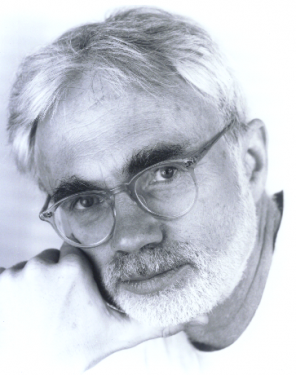
John Adams was born in Worcester, Massachusetts in 1947 and graduated from Harvard University in 1971. He moved to California where he taught and conducted at the San Francisco Conservatory of Music for ten years. His innovative concerts led to his appointment firstly as contemporary music adviser to the San Francisco Symphony, and then as the orchestra's composer-in-residence between 1979 and 1985, the period in which his reputation became established with the success of such works as Harmoniumand Harmonielehre. Recordings on the New Albion and ECM labels were followed in 1986 by an exclusive contract with Nonesuch Records, an association that continues today. In 1999 Nonesuch released The John Adams Earbox, a critically-lauded 10-CD retrospective box set.
Of John Adams's compositions, the best known and most widely discussed is his opera Nixon in China, given its premiere by Houston Grand Opera in 1987 and winner of the 1989 Grammy for 'Best Contemporary Composition.' With Nixon in China, the composer, along with director Peter Sellars, librettist Alice Goodman, and choreographer Mark Morris, brought contemporary history vividly into the opera house, pioneering an entire genre of post-modern music theater. The original staging of the work by Sellars has subsequently been seen in New York, Washington, Amsterdam, Edinburgh, Los Angeles, Paris, Adelaide, and Frankfurt. New productions of the opera have been presented in Helsinki (in Finnish) and Bielefeld (in German), while concert performances have recently been given in London and Tallinn, Estonia.
Adams's second opera, The Death of Klinghoffer, again a collaboration with Sellars, Goodman, and Morris, had its premiere at the Brussels Opera in 1991. Described by Newsweek critic Katrine Ames as "a work that fires the heart," it has also been seen in Lyon, Vienna, New York and San Francisco. His next stage work was a collaboration with Peter Sellars and librettist June Jordan; entitled I Was Looking at the Ceiling and then I Saw the Sky, it is described by its creators as a ‘song play’, scored for seven singers and an onstage band of eight instrumentalists. Ceiling/Sky, which made its debut in Berkeley in May 1995, has since been performed throughout North America and Europe.
Initially known as a Minimalist, Adams has in his mature work harnessed the rhythmic energy of Minimalism to the harmonies and orchestral colors of late-Romanticism. Concurrently he has introduced references to a wide range of 20th-century idioms - both 'popular' and 'serious' - in works such as his two operas and the wittily eclectic orchestral piece Fearful Symmetries, which touches on Stravinsky, Honegger, and big-band swing music.
In a similar vein, Adams's Chamber Symphony, premiered in January 1993, merges the virtuosic expressionism of Schoenberg with the manic world of cartoon soundtrack music. Scored for fifteen instruments, Chamber Symphony has met with extraordinary success: more than 40 ensembles have performed or scheduled the work. In addition, Chamber Symphony won Adams the 1994 Royal Philharmonic Society Music Award for best chamber composition.
Orchestral works by Adams include the two often-heard fanfares Short Ride in a Fast Machine and Tromba Lontana; his acclaimed Walt Whitman setting The Wound-Dresser; and El Dorado, a commission from the San Francisco Symphony that addresses the effects of greed on our environment and society. For his Violin Concerto, written in an unusual three-way commission between the Minnesota Orchestra, the London Symphony and the New York City Ballet, Adams was awarded the 1995 Grawemeyer Award for Music. Other honors include the California Governor’s Award for Lifetime Achievement in the Arts, the Cyril Magnin Award for Outstanding Achievement in the Arts, and the rank of ‘Chevalier dans l’Ordre des Arts et des Lettres,’ awarded by the French Ministry of Culture.
February 1999 brought the world premiere in Los Angeles of Naive and Sentimental Music, commissioned by the Los Angeles Philharmonic, Vancouver Symphony, Sydney Symphony, and Ensemble Modern Orchestra. This 50-minute orchestral essay has been widely hailed as one of Adams’s crowning achievements in the medium. Other orchestral pieces written during the 1990s include Slonimsky’s Earbox (1996), commissioned jointly by the Hallé Orchestra and the Oregon Symphony; Gnarly Buttons (1996), a clarinet concerto given its premiere by soloist Michael Collins and the London Sinfonietta with the composer conducting; and Century Rolls, a piano concerto written for Emanuel Ax, and premiered in 1997 by Ax with the Cleveland Orchestra under Christoph von Dohnányi.
In December 2000 Adams’s oratorio on the theme of the Nativity, El Niño,created in collaboration with Peter Sellars, was given its premiere in Paris with singers Dawn Upshaw, Lorraine Hunt-Lieberson and Willard White and the German Radio Symphony Orchestra Berlin under Kent Nagano. The work has recently been released on disc by Nonesuch. Another large-scale orchestral score, Guide to Strange Places, co-commissioned by the Matinee series in the Netherlands, the BBC Symphony Orchestra and the Sydney Symphony Orchestra, received its first performances in the 2001/2002 season.
September 2002 brought the premiere of On The Transmigration of Souls, a work for chorus, children’s chorus, orchestra, and electronic sound. On The Transmigration of Souls, commissioned by the New York Philharmonic as a memorial to the September 11 attack on New York, was premiered to widespread acclaim by the orchestra under Lorin Maazel. The Independent [UK] called it "a work that will last beyond the generation that watched their televisions that day and given voice to the individuals behind the icons."
In 1996, a survey of major orchestras conducted by the American Symphony Orchestra League found John Adams to be the most frequently-performed living American composer.
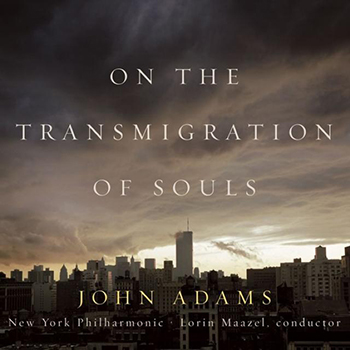 When the New York Philharmonic asked John Adams to create a musical commemoration for the victims of the 9/11 attacks, to be premiered a year after the tragic events, it must have seemed one of the most challenging commissions in the history of music, whether in terms of subject, timescale or expectations. Adams responded with On the Transmigration of Souls, a work that is neither an official public memorial, nor a personalised response, but rather what he describes as "a memory space - a place where you can go and be alone with your thoughts and emotions."