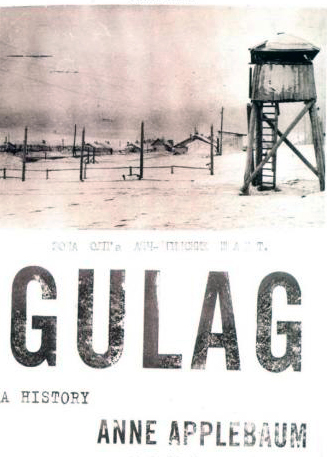
 The Gulag entered the world's historical consciousness in 1972 with the publication of Alexander Solzhenitsyn's epic oral history of the Soviet camps, The Gulag Archipelago. Since the collapse of the Soviet Union, dozens of memoirs and new studies covering aspects of that system have been published in Russia and the West. Using these new resources as well as her own original historical research, Ann Applebaum has now undertaken, for the first time, a fully documented history of the Soviet camp system, from its origins in the Russian Revolution to its collapse in the era of glasnost.
Anne Applebaum first lays out the chronological history of the camps and the logic behind their creation, enlargement, and maintenance. The Gulag was first put in place in 1918 after the Russian Revolution. In 1929, Stalin personally decided to expand the camp system, both to use forced labor to accelerate Soviet industrialization and to exploit the natural resources of the country's barely inhabitable far northern regions. By the end of the 1930s, labor camps could be found in all twelve of the Soviet Union's time zones. The system continued to expand throughout the war years, reaching its height only in the early 1950s. From 1929 until the death of Stalin in 1953, some 18 million people passed through this massive system. Of these 18 million, it is estimated that 4.5 million never returned.
But the Gulag was not just an economic institution. It also became, over time, a country within a country, almost a separate civilization, with its own laws, customs, literature, folklore, slang, and morality. Topic by topic, Anne Applebaum also examines how life was lived within this shadow country: how prisoners worked, how they ate, where they lived, how they died, how they survived. She examines their guards and their jailers, the horrors of transportation in empty cattle cars, the strange nature of Soviet arrests and trials, the impact of World War II, the relations between different national and religious groups, and the escapes, as well as the extraordinary rebellions that took place in the 1950s. She concludes by examining the disturbing question why the Gulag has remained relatively obscure in the historical memory of both the former Soviet Union and the West.
Gulag: A History will immediately be recognized as a landmark work of historical scholarship and an indelible contribution to the complex, ongoing, necessary quest for truth.
(From the book jacket)