Bristol (VA) Herald Courier, by Bristol (VA) Herald Courier
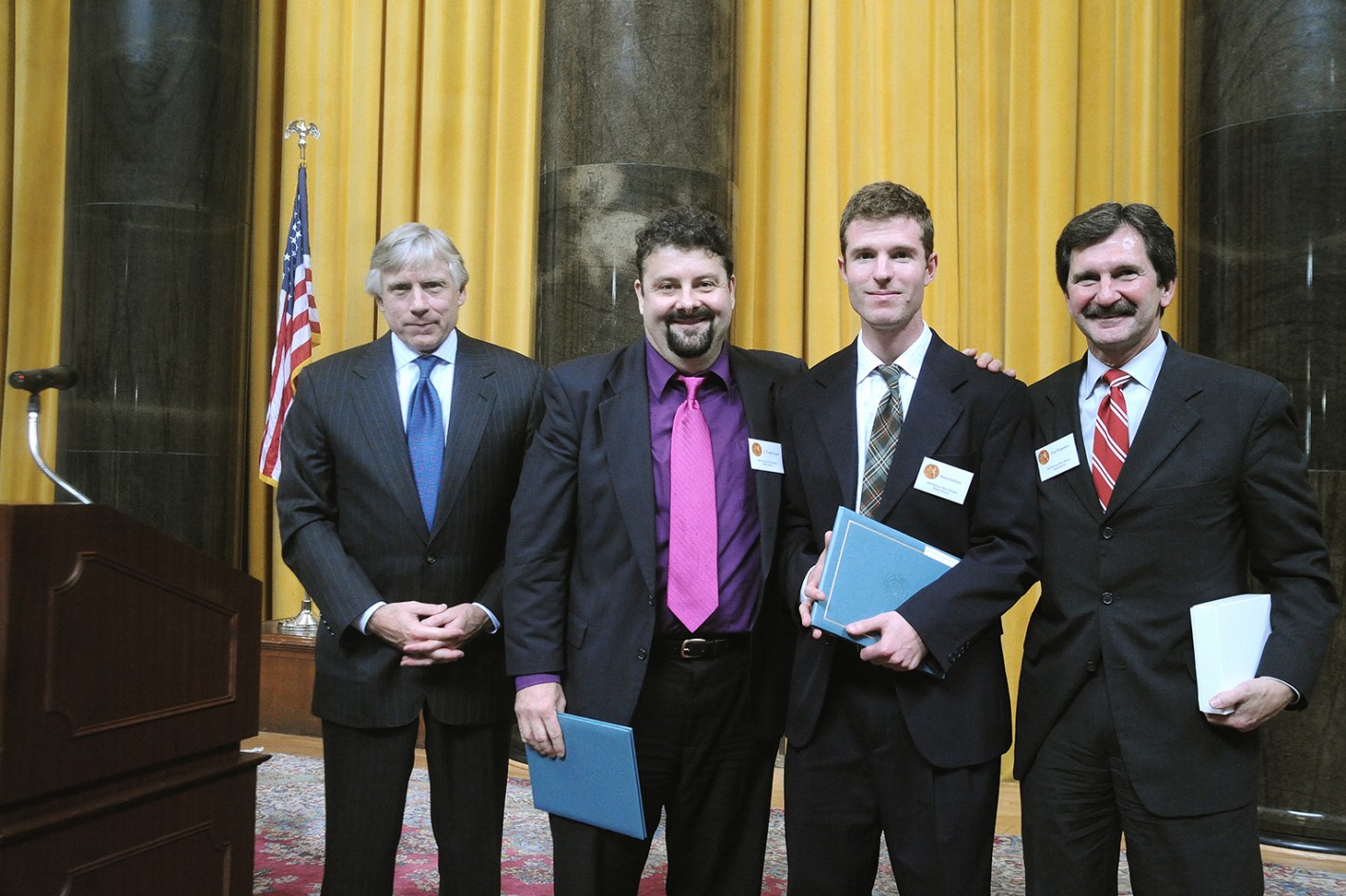
Lee C. Bollinger, President of Columbia University (left), presents the 2010 Public Service prize to (l-r) J. Todd Foster, Daniel Gilbert and Carl Esposito of the Bristol Herald Courier.
Winning Work
Underfoot, out of reach
By Daniel Gilbert
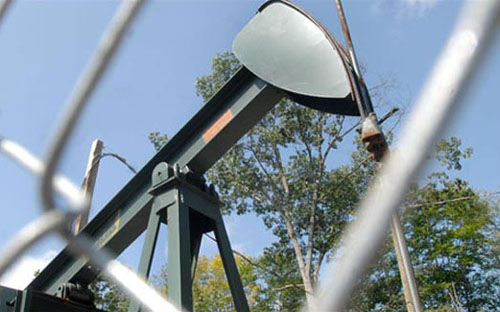
A pump pulls gas from a well in Southeast Virginia. (David Crigger/Bristol Herald Courier)
Every month, a bank in Roanoke receives checks for thousands of dollars belonging to people who might never cash them.
The checks are royalty payments for people whose mineral rights the state of Virginia has leased – against their will or without their knowledge – to private energy corporations. These payments represent the financial crumbs of natural gas production in Southwest Virginia – a multibillion-dollar industry that in 2008 produced enough gas every second to heat the average home for 16 days.
But instead of reaching the pockets of mineral owners, the money is funneled into an opaque state-run escrow fund, where it has accumulated with scant oversight for nearly 20 years. As of October, the fund held more than $24 million – and that isn’t everything it should hold.
An untold number of people in the region, throughout the state and across the country have a claim to this money through their ancestors’ deeds. Some are entitled to hundreds of thousands; others just pennies. But they are linked by this common dilemma: They receive no accounting of their royalties in escrow, and they face enormous legal barriers in collecting them.
The escrow fund is an obscure, untidy legacy of state lawmakers’ determination to develop Virginia’s most abundant gas, coalbed methane, without tackling the thorny question of who owns it. In passing the 1990 Virginia Gas and Oil Act, the legislature created a kind of eminent domain, known as forced pooling, that authorizes gas companies to produce gas belonging to others and to pay royalties into escrow when they cannot find mineral owners or if the gas ownership is in dispute.
But the state has done little to monitor the gas industry’s compliance, and the billion-dollar energy conglomerates don’t always make the required payments into escrow. Of about 750 active individual accounts in escrow, between 22 percent and 55 percent received no royalty payments during months when the corresponding wells produced gas over an 18-month period, a Bristol Herald Courier investigation has found.
The job of regulating the industry officially belongs to the Virginia Gas and Oil Board, a governor-appointed body that meets monthly in Lebanon, Va., and whose seven members serve six-year terms and receive $50 a hearing. The board is composed of a retired college professor, two college administrators, a former cattle farmer, a representative of the coal industry, a representative of the gas and oil industry, and a state energy official from the Department of Mines, Minerals and Energy who acts as board chairman.
But the real work of ensuring that gas companies follow through with payments into escrow, fielding inquiries from mineral owners about the royalties they cannot see, and sorting out mind-numbingly complex ownership questions for close to 1,000 separate production units falls to just two employees of the Division of Gas and Oil.
That level of staffing, combined with the lack of any audits or compliance checks in the DGO’s data-collection systems, means that gas operators are essentially on the honor system. The DMME, the DGO’s parent agency, has acknowledged discrepancies between production and escrow deposits and vows it is taking steps to fix the problems and improve its ability to chart compliance.
The two corporations that dominate natural gas production in Virginia don’t deny they’ve made mistakes, but they credit any missing royalty payments to accidental oversights and the complexity of mineral ownership in Southwest Virginia.
The escrow account
There are two primary scenarios that require gas companies to escrow royalties. The first arises when the well operator cannot locate mineral owners entitled to a share of production and then successfully petitions the board to lease those owners’ rights.
The second scenario kicks in when different people own the coal and the gas for the same tract of land – a common occurrence in Southwest Virginia, where many landowners sold the coal beneath their surface a century ago. Splitting a mineral estate like this has created a conflict between the coal owner and the gas owner over who is entitled to royalties from coalbed methane – a gas developed by fracturing and stimulating the coal seam that accounted for 80 percent of all gas produced in Virginia in 2008.
The DGO in June estimated that 83 percent of royalties held in escrow belongs to owners in dispute over coalbed methane ownership.
The legal conflict over coalbed methane reached the state Supreme Court in 2004, when justices unanimously upheld a lower court ruling that a gas owner who sold only coal retained full rights to coalbed methane. But that hasn’t made it easier for other gas owners to retrieve their royalties from escrow.
To do this, state law requires a gas owner to sue to prove ownership, or agree to split royalties with a coal owner – generally a corporation. These requirements effectively force mineral owners to give up a portion of their royalties, either to an attorney or to a coal company, and the process can drag on for years.
Until one of those two conditions is met, gas well operators are required to deposit royalty payments into escrow, where the supporting documentation – including gas volume, sale price and any deductions taken out of the royalty – is sent to a bank branch in Roanoke, electronically imaged, archived and virtually never examined.
Some of the time, the escrow fund works as intended and disburses checks to royalty owners who have a court order or a split agreement. Most of the time, it functions like the banking equivalent of an oubliette – a money prison where royalties languish until they are presumed abandoned. Since the Virginia high court’s ruling in 2004, the value of the escrow fund has tripled, state records show.
Wachovia Bank, now part of Wells Fargo, manages the escrow fund and generates monthly reports that list the deposits, interest and balance for some 950 individual sub-accounts, active and inactive. Each sub-account corresponds to one or more wells that are producing gas that belongs to owners who are unknown or whose ownership is in dispute.
In such a case, any gas that a well produces should generate a royalty payment into escrow.
Discrepancies
The Herald Courier compared gas corporations’ deposits into escrow with production numbers they reported for the corresponding wells between January 2008 and June 2009 – a period that included historically high prices for natural gas. The analysis revealed:
- On average, 30 percent of sub-accounts in escrow each month received no royalty payments even though they corresponded to wells producing gas.
- For 10 of the 18 months, 190 sub-accounts received no deposits even though the corresponding wells produced gas.
- For all 18 months, 94 sub-accounts received no deposits even though the corresponding wells produced gas.
- Gas operators sometimes failed to submit the necessary paperwork for royalties to be escrowed, meaning that some wells have produced for years and no royalties have been deposited into escrow, creating the false impression that they are inactive.
- The escrow fund is rife with accounting and administrative errors, including duplicate sub-accounts, overpayments and inactive accounts that should have been closed out.
Some of the production and escrow discrepancies could be explained by changes in the status of a well, such as when a coalbed methane well becomes part of a larger unit and a separate account is created to receive royalties. Other missing payments are the result of “clerical errors,” according to officials with the Division of Gas and Oil and for gas corporations.
“There have been mistakes, as far as things slipping through the cracks,” acknowledged a senior executive for EQT Corp., the Pittsburgh-based corporate parent of Equitable Production Co.
Partly to blame was a computer glitch that held payments in suspense until they reached a $50 threshold, said Kevin West, EQT’s managing director of external affairs.
“We’re not making any excuses,” West said, adding that EQT will deposit outstanding royalties into the state escrow fund with interest. “In this case, a mistake was made, and we’re glad it was pointed out so that we could get it fixed.”
Officials for CNX Gas Co., a subsidiary of Canonsburg, Penn.-based Consol Energy, refused to get into a “well-by-well discussion.”
“Each well and each unit has its own set of characteristics, and without going into the history on each well, I think it’s impossible to portray an accurate picture of what happened in a particular well,” said Cathy St. Clair, a CNX spokeswoman.
She added, “I don’t think you can infer that because a well had no deposits that deposits should have been made.”
In response to the Herald Courier’s analysis, the Department of Mines, Minerals and Energy issued a statement that it has “been aware of the discrepancies between reported production and deposits to the escrow account” and “has taken a number of steps to fix the problems. Your questions have been addressed to DMME in the middle of this work.”
The agency also acknowledged that companies have failed to file the required paperwork for royalties to be escrowed – a misdemeanor offense that is punishable by a $10,000 fine for every day of the violation, according to state law. In a case where the paperwork is four years late – the Herald Courier identified several – the DMME could impose a fine of $14.6 million per case.
It is unclear whether the agency will impose any fines. Queried about enforcement, a DMME spokesman wrote that the agency will only pursue civil penalties “in cases where we raise such issues with the operator, if the operator fails to be responsive.”
The reaction of board members – those actually in charge of administering the escrow fund, with ultimate authority over how to enforce state regulations – ranged from concern to disinterest; some did not respond to requests for comment, or refused to do so.
“Any appearance of wrongdoing or alleged discrepancy regarding the escrow account should be investigated by the Virginia Gas and Oil Board,” Katie Dye, a public member from Buchanan County, e-mailed the newspaper.
When presented with the Herald Courier’s findings, Bruce Prather, the board member who represents the gas and oil industry, referred a reporter to the Division of Gas and Oil.
“We don’t generate our own business on that board. It’s brought before us,” he said.
Asked if the discrepancies concerned him, Prather said, “I’ve heard of this in the past,” and suggested that a court would be a more appropriate venue to address the irregularities.
“That is where something like this ultimately is going to end up,” he said.
© 2009, Bristol Herald Courier
By Daniel Gilbert
The goals of forced pooling are to maximize natural gas production and prevent the waste of gas resources. The state of Virginia creates production units, generally a square containing 60 to 80 acres for coalbed methane wells, and then approves an application from a gas company to drill a well in that unit. Forced pooling is designed to prevent a scenario in which one person with a fractional interest in a unit refuses to lease his gas rights, denying every other owner in the unit the ability to receive royalties from gas production.
The process goes roughly like this:
1. A gas well operator offers to lease the mineral interests of owners in a unit, and then petitions the Virginia Gas and Oil Board to pool the interests it is unable to lease. The operator must have at least 25 percent of the acreage leased in a conventional gas unit, but a coalbed methane unit does not need any leases.
2. The board grants the pooling application, and if there are owners who are unknown or whose coalbed methane ownership is in dispute, establishes an individual sub-account in the escrow fund to receive proceeds owed to such owners.
3. The gas well operator sends a copy of the board’s pooling order to mineral owners who have not agreed to lease and offers them 30 days to choose whether they want to participate in the well.
4. Force-pooled mineral owners have three choices: participate by footing their proportion of the well costs upfront, and fully share in the risk and net proceeds from gas sales; participate on a “carried basis,” which means they receive nothing until the well has paid for itself twice, and then they share fully in their portion of the net proceeds; or receive a “bonus payment” of $1 to $5 an acre, and a one-eighth royalty from gas sales corresponding to their acreage, minus the costs of getting the gas to market.
5. If an owner makes no choice, the board deems the owner to have leased his interest at the one-eighth royalty. Owners who are unknown or unable to be located also are deemed to have leased.
6. The gas well operator files a proposed “supplemental order” with the board and states how each owner elected, and whether anyone is subject to escrow due to conflicting claims over coalbed methane, and/or the operator’s inability to locate an owner. The supplemental order must be filed with the Division of Gas and Oil before the account can begin receiving monthly payments.
© 2009, Bristol Herald Courier
'Nothing a poor man can do'
By Daniel Gilbert
The low hiss from a rusty pipeline is the sound of an energy corporation sucking coalbed methane from beneath Jamie Hale’s property.
On a hot August day, the gas is flowing out of the well at the rate of 1.2 cubic feet per second – producing in one day enough gas to satisfy the heating and cooking needs of the average American home for more than a year. The well – one of seven that surround Hale’s 40-acre property in Buchanan County, Va. – coaxes the colorless, odorless gas to the surface by pumping water and sand at high pressure into the coal seam.
As the gas reaches the surface, it is shunted into a small pipeline, whisked off to a treatment facility, prepped for passage on an interstate pipeline to be sold to a utility provider, and ultimately delivered to homes and businesses in Virginia and other states.
The company draining Hale’s coalbed methane is CNX Gas, a subsidiary of Pittsburgh-based Consol Energy and the largest gas producer in Virginia. In 2008, CNX operated 3,000 wells in Southwest Virginia and raked in gross income of $4.65 billion from its national operations.
Hale, 37, drives trucks and operates a silo at a power plant in Buchanan County, the largest gas-producing county in the state. His wife is a teacher’s aide, and they have a daughter in high school.
The Hales are entitled to a share of the proceeds from their gas, but since the wells rimming the family land began producing in 1998, they have not received a penny.
Instead, CNX cuts a check for the royalties it owes the Hales – and countless others whose gas it produces – and transmits the money into a state-run escrow account that landowners cannot monitor or access without clearing enormous legal and administrative hurdles.
Hale himself triggered this scenario by refusing to lease his gas to CNX, unaware that Virginia did not give him that choice.
“I didn’t realize they could take your gas without a lease,” he said.
In 1990, the Virginia legislature resolved that it could not allow stubborn individuals to hamper the development of coalbed methane – an abundant resource whose peculiar characteristics had prevented it from being commercially produced. Up to this point, state law provided that surface owners like Hale owned all the migratory gases beneath the surface of their land, unless they had previously sold the rights to their gas.
This statute had been unpopular with gas corporations eager to exploit the coalbed gas; they feared that doing so could trigger civil penalties for taking gas owners’ property, according to a 1990 report by the Virginia Coal and Energy Commission.
The question of coalbed methane ownership is particularly nettlesome in Southwest Virginia, where many landowners sold the coal from beneath their land but retained gas rights. Splitting the mineral estate has created a conflict between the gas owner and the coal owner, each of whom lay claim to a gas that is produced by fracturing and stimulating the coal seam.
Further complicating the ownership question is that at the time most landowners sold their coal, no one knew that coalbed methane – long known as “miner’s curse” for its lethally explosive properties – would turn out to be a valuable commodity.
The General Assembly in 1990 was in a mood to stimulate development, and it had a reason to act quickly. A federal tax credit for alternative fuels was expiring at the end of the year, and industry lobbyists argued that corporations could not profitably develop coalbed methane without the benefit of the tax credit.
“The production of this gas represents a potential ‘shot in the arm’ to the economy of Southwest Virginia,” the commission wrote in its 1990 report to the General Assembly.
The legislature devised a way to develop the commonwealth’s coalbed methane resources while skirting the thorny question of ownership. The 1990 Gas and Oil Act created one regulatory body, the Virginia Gas and Oil Board, which would apply a loose grid over the gas fields and create square units of generally 60 to 80 acres for coalbed methane wells. Whenever different people owned the gas and the coal for a single tract of land, gas operators would be required to escrow royalties according to the owners’ interest in the unit until they reached an agreement or a court determined ownership.
This seemingly elegant solution paved the way for a massive expansion of coalbed methane production in the state’s most economically depressed region. But the 1990 law has another kind of legacy, too.
By requiring a royalty owner to sue for ownership or split proceeds with a conflicting claimant, the law set up an asymmetrical, David-versus-Goliath type of legal conflict that pits an individual owner against an energy conglomerate.
If Jamie Hale wants to retrieve his coalbed methane royalties from escrow, he’ll have to sue the coal company that owns the coal beneath his 40 acres. Or he’ll have to give up some of his royalties to the corporation.
Neither option looks good to Hale.
“They just came in here and started taking our gas, and there’s nothing that a poor man can do about that, honestly,” he said. “I may never get nothing.”
And Hale is several steps ahead of many mineral owners: He knows what he owns.
“We do not have an inkling”
Theresa Brents lives in Stuarts Draft, Va., some 250 miles from the two large tracts of land she inherited from her grandparents in Buchanan County.
About 12 or 13 years ago, Brents agreed to lease her mineral rights beneath 150 acres to CNX Gas. She’s never received a royalty payment and had never heard of the Virginia Gas and Oil Board’s escrow fund until contacted by a reporter in October.
“I’ve wondered about that, but not ever pursued the issue,” the retired librarian said by phone. “You get this paperwork that basically says there’s going to be a hearing, but it’s not cost effective or generally time effective when you don’t know what’s going on. It’s a fairly complicated matter, and I figured it was probably not worth it.”According to Gas and Oil Board records, Brents owns the gas beneath 28 percent of the acreage in unit W-9 – an 80-acre square; a coal company owns the coal, and the corresponding sub-account in escrow contains $150,000.
Gas still flows from the original well in W-9, but the unit no longer exists as such; it is now part of a larger unit known as a gob, where multiple wells siphon coalbed methane from a mined-out panel of coal. The change in the well status required a new sub-account in escrow, in which Brents owns gas rights to 9 percent of the acreage. That account contained almost $75,000 as of October.
And these are only two units in which Brents has an interest; her two tracts of land almost certainly spill into other units, meaning she is entitled to royalties from gas production there, too.
When informed of how much money is in escrow, Brents said, “Oh, my goodness. Oh, my word.”
She would like to figure out how to collect her royalties, she said, “But I’m not even sure where to start.”
She is far from alone.
The number of people entitled to royalties in escrow stretches across the country, but even local residents and state agencies are oblivious to what they own, let alone how to collect it.
Shirley Keene, of Raven, Va., and her siblings are regulars at Virginia Gas and Oil Board hearings, and have been more or less disgruntled with gas industry practices since 1993.
By her calculation, CNX has 28 producing wells on her family’s two tracts of land – one 43 acres and the other 15 acres. Over the years, the Keene heirs have hired three attorneys to help them get their royalties out of escrow – so far, without success.
Keene, disabled from a car accident six years ago, has never seen an accounting of what goes into escrow. After 16 years, she has no notion of what her share of the escrow proceeds are.
“We do not have an inkling whatsoever of what we have in there,” she said in a recent interview. “I don’t even know how to go about it.”
Neither does the Virginia Department of Corrections, which – in addition to running the Keen Mountain Correctional Center in Buchanan County – owns gas rights to 47 percent of the acreage in unit W-9.
“We don’t have anyone who oversees our mineral interests, and we would have the Attorney General’s Office look over our contract,” said department spokesman Larry Traylor. “We’re not even sure the documents exist.”
Traylor’s agency has some bureaucratic kin in W-9, where the Virginia Department of Transportation owns the gas to 3 percent of the unit’s acreage. VDOT owns another 3 percent in unit AY-101 – whose corresponding escrow sub-account holds only $34. It is impossible to know what should be in that account because CNX, the unit operator, never filed the necessary paperwork to escrow royalties. The gas company refused to comment on specific wells.
Asked whose job it is to oversee VDOT’s mineral interests, Ken Brittle, the agency’s district administrator for Southwest Virginia, said, “We don’t have a person.”
Both VDOT and VDOC referred a reporter to the Office of the Attorney General, where a spokesman pointed to the Department of Mines, Minerals and Energy. There, the director of the Division of Gas and Oil answered, “Each agency is independently responsible for their land management responsibilities.”
“People are getting royalties”
Bureaucratic quandaries aside, an architect of the Virginia Gas and Oil Act recently said the legislation accomplished its intent.
Tommy Hudson, who runs the Richmond lobbying firm W. Thomas Hudson & Associates, was part of the 1989-90 task force that proposed the 1990 act. When asked if he was surprised that the 20-year-old question of coalbed methane ownership persists, he called it an “interesting question.”
“I think the legislature set up a mechanism that will drive all parties to the negotiating table and allow a valuable resource to be developed,” Hudson, who is president of the Virginia Coal Association, said by phone.
It is unquestioned that the 1990 act expanded coalbed methane production and supercharged the mineral severance taxes that local governments receive.
In one year, 1990-91, severance taxes from natural gas production in Wise County quintupled, county records show. In Russell County, gas severance taxes have risen steadily to nearly $2 million in 2009, and Buchanan County last year banked more than $5 million from a methane tax.
As for the question of coalbed methane ownership, Hudson said, “Perhaps the fact that there has been no final resolution shows you that it has worked as intended. People are getting royalties and apparently [. . .] there are no disputes that have risen to the point of being final and litigated.”
Hudson was unaware of the $24 million parked in escrow that royalty owners are not getting. He also seemed unaware that the ownership of coalbed methane has been litigated at length, and that the Supreme Court of Virginia has ruled on it.
The state’s highest court in 2004 determined that a surface owner who sold only coal retained the rights to all other minerals, including coalbed methane. And it is that ruling that keeps people like Jamie Hale and Shirley Keene away from the negotiating table, hardening their conviction that they own 100 percent of the royalties from their coalbed methane.
© 2009, Bristol Herald Courier
Captive assets: lingering conflict over coalbed gas ownership traps royalties in escrow accounts
By Daniel Gilbert
In 2000, a country lawyer named Peter Glubiak listened to his secretary’s story of an energy giant draining coalbed methane gas from her family’s land, and of the royalties that were locked up in a state-run escrow account.
The source of Ann Graham’s dilemma, Glubiak realized, was a question that legislators ducked when they passed a 1990 law to spur the development of coalbed methane gas: the all-important question of ownership.
Until passage of the Virginia Gas and Oil Act, no one in the state had given much thought to who owned a gas that clings weakly to a coal seam, long considered nothing but dangerous to miners for its explosive properties. By creating a legal mechanism for energy corporations to commercially produce coalbed methane, the General Assembly dramatically raised the stakes of that question – particularly when different people owned the coal and the gas rights for the same tract of land.
A circuit court’s decision could tip millions of dollars in royalties one way or the other, Glubiak calculated, and either result would unquestionably end up in front of the Supreme Court of Virginia.
As it turned out, that projection proved half true.
In Buchanan County Circuit Court, Glubiak argued that Graham and another family, the Ratliffs, had severed only the coal from their land and owned all of the gas beneath it, including coalbed methane. Opposing him was a North Carolina-based coal company, Harrison-Wyatt, represented by J. Scott Sexton, a prominent mineral lawyer out of Roanoke, Va.
Glubiak prevailed in the trial court and in 2004, the Supreme Court of Virginia unanimously affirmed the lower court’s decision.
Citing common definitions of coal at the time the Ratliffs sold the mineral, the Supreme Court held that the “title to the [coalbed methane] did not pass to the coal owner,” and ruled that the Ratliffs were entitled to all royalties in escrow and future royalties from gas beneath their land. About a year later, the family collected their royalties from escrow and began receiving monthly royalty checks for 100 percent of their interest in the gas.
“When we got the Supreme Court ruling in the Ratliff case, my hope was that this would evolve into a pretty lucrative practice,” Glubiak said in a recent interview. “Very disappointingly, it has not.”
In the five years since Glubiak’s high court victory, millions of dollars from coalbed methane royalties have flowed into the Virginia Gas and Oil Board’s escrow fund, tripling its balance. Despite the Harrison-Wyatt precedent, those royalties are no easier to extract from escrow today than before the court rulings.
Already tested
Four days after the Supreme Court’s decision, the Department of Mines, Minerals and Energy issued a statement making it clear that the ruling changed nothing in how it regulated coalbed methane production.
The case “specifically applies to three particular tracts of land in Buchanan County,” the state agency wrote.
Not only did the DMME and the Virginia Gas and Oil Board lack the authority to determine coalbed methane ownership, the agency wrote, “neither the Virginia courts nor the legislature has addressed this ownership issue other than on the basis of analysis of individual deeds.”
In other words, the board still would escrow royalties from coalbed methane production whenever the coal and the gas were separately owned for the same tract of land. For a surface owner who had severed only the coal from his land to collect coalbed methane royalties, he would have to fight Glubiak’s fight all over again.
This is incomprehensible to many landowners who, like Ann Graham and the Ratliffs, own the gas under their land.
Force-pooled owner Jamie Hale has read his deed and the Supreme Court’s opinion that gave Graham and her family 100 percent of the coalbed methane.
“My case is identical to hers,” Hale said as he drove with a reporter through the mountainous 40 acres he owns, where seven wells are draining coalbed methane.
“Now we’re told we have to prove something we’ve already proved. Why should we have to hire a lawyer to prove what already belongs to us?” he asked. “If you do hire an attorney, you might as well take a split agreement. I really don’t know where to go or what to do.”
Shirley Keene is an heir to two tracts of land that contain 28 gas wells. She has always believed she and her family should receive 100 percent of the royalties from coalbed methane, she said recently.
“When the Ratliffs won their case, then we knew that it was ours,” Keene said. “If Ratliff had turned the other way, you would never have heard a word from us.”
At his home outside Richmond, Va., Graham Tiller and his wife have been waiting on a decision that will settle, once and for all, who owns coalbed methane.
Tiller, 77, is a Dickenson County native with an interest in more than 700 acres. His great-grandfather sold the coal and left him, in the eyes of the state, in conflict over coalbed methane with the current coal owner, Range Resources.
“I can’t afford a lawsuit by myself, but I’m not going to give it to them,” Tiller, who retired as a utilities coordinator for ICI, a chemical company in Hopewell, Va., said of splitting with the company. “If I had plenty of money, I’d have done had a lawsuit with them.”
The DMME’s logic – in continuing to escrow royalties when coalbed methane ownership is in dispute – escapes several state legislators.
“I think the Supreme Court’s already tested that,” Sen. William Wampler, a Bristol Republican, said when asked about the lingering controversy over coalbed methane ownership.
“If you are a small royalty owner, and you have $500 in escrow, how do you have the financial resources to claim those dollars when that probably doesn’t even cover attorney fees?” Wampler asked. “If we have $25 million in escrow, that’s a lot of money. I don’t know why the DMME wouldn’t hire a dedicated person to contact the names of those who have been force pooled.”
The answer is that once royalties go into escrow, members of the Virginia Gas and Oil Board have their hands tied; the board can only release funds from escrow with a court order, or an agreement between people who dispute coalbed methane ownership.
One legislator believes the board should not be placing coalbed methane royalties in escrow at all.
“It should never go into escrow,” Sen. Philip Puckett, a Lebanon Democrat, said in an interview.
This might run counter to his personal interest: In a recent twist, the bank that employs Puckett, First Bank & Trust, has won the contract to manage the escrow fund for the next four years beginning in January.
Puckett repeatedly has said that if an individual has a deed similar to the Ratliffs’ – severing only the coal – then the owner should be able to present that to the board and claim the royalties. The senator is looking into the possibility of amending the Virginia Gas and Oil Act to codify the Supreme Court’s ruling.
“Most of our people can’t afford to go to court,” Puckett said.
But suing for ownership remains virtually the only way for a surface owner to collect 100 percent of the coalbed methane royalties.
Leveraging a precedent
The coal industry likewise has taken the stance that coalbed methane ownership hinges on the language of specific deeds, and the Harrison-Wyatt decision did not conclusively resolve the ownership question.
In private, though, at least one major corporation acknowledged the significance of the Supreme Court’s ruling, and waived its claim to coalbed methane royalties, according to correspondence obtained by the Bristol Herald Courier.
In 2004, a few weeks after the Supreme Court ruling, an agent of three heirs with substantial landholdings in Dickenson and Buchanan counties contacted the energy company with whom they had previously agreed to split coalbed methane royalties down the middle.
Charlie Bartlett, a consulting geologist and agent for the 1,000-acre William Baker estate, wrote to the president of Pine Mountain Oil and Gas and requested 100 percent of the royalties.
On June 9, 2004, Richard Brillhart, then president of Pine Mountain, contacted the operator of the coalbed methane wells on the Baker land about Bartlett’s request.
“Given the close similarity of the language in the severance deed at issue and the severance deeds analyzed by the Virginia Supreme Court, it appears that, at this point in time, Pine Mountain would not be successful in a claim for the coalbed methane on this tract,” Brillhart wrote.
Brillhart waived his company’s claim to the gas produced by six wells; the next month, he waived a claim to royalties from two additional wells.
The three Baker heirs – a doctor, an investor and a former university executive – all had moved away from Southwest Virginia but have several advantages most royalty owners do not enjoy.
Bill Baker, the original heir to his father’s estate, was an engineer and kept detailed records of the family holdings. He became friends with Bartlett, a longtime geology professor at Emory & Henry College who agreed to look after the estate following Baker’s death. Bartlett testified as an expert for Glubiak during the Harrison-Wyatt case.
“We were fortunate enough to have Dr. Bartlett’s assistance,” Betty Anne Cox, one of the heirs, said by phone. “All of my generation were living away,” said Cox, who lives in Hartford, Conn., and retired as the director of external affairs for Trinity College.
“It was very good to have somebody who was both knowledgeable and who we trusted and who knew all the players,” she said.
Even so, their struggle did not end with Brillhart’s 2004 letter that waived a claim to all coalbed methane royalties.
In late 2007, tiring of requesting royalties in piecemeal fashion, Bartlett asked Pine Mountain, which had since been acquired by Range Resources, to authorize a “complete release for these wells and any other remaining wells that may be drilled in the future on this same tract.”
Bartlett said that when he approached Jerry Grantham, a vice president at Range Resources, to ask him to waive his claim, Grantham offered to split the royalties, giving 75 percent to the Bakers.
Grantham, who is also president of the Virginia Oil and Gas Association, declined to comment on a private contract, but said his company found such a split “to be a pretty effective agreement in trying to get money out of escrow, benefiting all parties involved.”
In a March 7, 2008, letter, Range Resources registered a change in its approach toward the Baker heirs. Grantham wrote that the company would waive its claim for certain wells if the heirs signed a confidentiality agreement.
The Baker heirs retained Glubiak to help them collect money from escrow, and on March 19, 2008, Glubiak wrote to Grantham with a 10-day ultimatum.
“We have no intention of signing any confidentiality agreement,” he wrote. “In the alternative, I have been authorized to pursue a declaratory judgment action in Dickenson County pursuant to the Harrison-Wyatt case, and I feel confident of a successful result.”
The company agreed, and the Baker heirs began receiving their royalty payments, Cox said.
But at the time of Glubiak’s letter, the Harrison-Wyatt case was quickly losing currency as a decisive precedent on coalbed methane ownership.
© 2009, Bristol Herald Courier
'They're ripping us off'
By Daniel Gilbert
On an early November day, Michael Whited, mounted on an all-terrain vehicle, checked the meter at a highly productive well named AY-112. Coalbed methane was flowing out of the ground and into a pipeline at the rate of 176,000 cubic feet a day – enough gas to satisfy the heating and cooking needs of the average American home for almost two years.
“I just check it to see how much they’re ripping us off,” Whited said.
Since 2001, 14 wells on the Whited land have produced 4.4 billion cubic feet of coalbed methane. That volume would generate about $30 million in gross proceeds for the gas operator, based on historical monthly averages of natural gas prices for two major interstate pipelines in the region.
As the owners of the surface land and the gases beneath it, the Whiteds are entitled to a one-eighth sliver of the proceeds from coalbed methane drained from their property. But because they do not own the coal, the Virginia Gas and Oil Board ordered that their royalties be placed into an escrow fund until the ownership of coalbed methane could be decided.
In the spring of 2004, the Supreme Court of Virginia issued a decision that spread like wildfire among mineral owners in Southwest Virginia, upholding a lower court ruling that a surface owner who sold only the coal from his property retained rights to all of the coalbed methane. The ruling in Harrison-Wyatt v. Ratliff buoyed landowners like the Whiteds, who had stood by empty-handed as gas companies drained their coalbed methane.
Earl Whited, the family patriarch who started out as a school bus driver, knew he had a claim to at least several hundred thousand dollars in escrow. In 2005, he retained Peter Glubiak, the attorney who had won for the Buchanan County surface owner in the Harrison-Wyatt case.
Glubiak had spent four years litigating the ownership of coalbed methane, and armed with the high court’s ruling, he figured getting the Whiteds’ royalties out of escrow would be smooth sailing.
But it didn’t turn out that way.
A trial of each tract
The large amount of royalties at stake had made it possible for Earl Whited to hire Glubiak, who worked on a contingency basis and charged a percentage of whatever his client recovered from escrow. But it also stirred a vigorous defense from another party – the company that owned the coal beneath the Whited land, who asserted a right to the coalbed methane royalties in spite of the Harrison-Wyatt ruling.
From the outset, Buckhorn Coal Co. made it clear it would not respect the Supreme Court’s ruling that a surface owner who sells only the coal retains rights to the coalbed methane.
“We think it’s a bad decision,” Charles Hart, managing partner of Tazewell, Va.-based Buckhorn, said in a phone interview. “You have to defend your interests. You can’t just roll over and say, ‘Here it is.’ ”
The defense went like this, as argued by Buckhorn’s lead counsel, Eric Whitesell: Coalbed methane ownership “can be reached only after a trial of the title of each tract” of land.
With that, Buckhorn heaved the burden of proving ownership squarely onto the Whiteds.
The plaintiffs, Buckhorn claimed, failed to identify the exact location of the boundaries where they claimed mineral interests. They failed to include a survey. They failed to name other parties who might have mineral interests in the same drilling units. They got the names wrong on the pleadings.
Complicating the plaintiffs’ case was that Earl Whited died early on in the litigation, in October 2006, and left his estate – and his active lawsuit – to his six children. Discord broke out among the heirs, and the two who had been designated executors ceded their authority to a professional administrator, Ralph Snead.
In a June 2007 letter briefing Snead on the case, Glubiak wrote, “We have been battling Buckhorn Coal over what proved to be extremely complex title issues, as well as boundary and ownership issues.”
A year later, with Buckhorn promising an appeal to the state Supreme Court if it lost, Snead presented the Whited heirs with three options: Pay $12,000 out of pocket for a survey and title opinion; negotiate with Buckhorn to split royalties; or none of the above, and Glubiak would withdraw from the case.
The heirs balked at the fee for additional title work, but could not agree on how to proceed. Snead, as administrator of the estate, unilaterally decided to authorize Glubiak to negotiate a split agreement.
Coal goes on the offensive
Buckhorn Coal has never won 100 percent of coalbed methane royalties, and Charles Hart never expected to in the Whited case.
“When there’s a conflict, we will split the royalties 50-50,” he said. “We like to do that, because once it gets into that escrow account, if nobody pushes the issue, you’ll never get any money.
“Fifty percent is better than nothing,” he said.
And Hart is adamant that the Supreme Court got it wrong in the Harrison-Wyatt case.
J. Scott Sexton, a Roanoke, Va., lawyer, represented the losing coal owner, Harrison-Wyatt, in that case. Asked recently whether he thought the Supreme Court’s ruling resolved the ownership of coalbed methane, Sexton reflected, carefully parsing his words.
“The Harrison-Wyatt decision established the law in Virginia that a coal owner claiming title under an unambiguous coal-only deed does not own the coalbed methane,” he said.
In plain language, when a surface and gas owner sells only coal, the coal does not include coalbed methane; the surface owner keeps that. But that decision has come under increasing assault – in and out of court – by coal owners in the years since the courts ruled on coalbed methane ownership.
Coal owners routinely propose royalty split agreements they tout as “the most economical and expedient way” to collect money from escrow, according to split agreements reviewed by the Bristol Herald Courier.
Some outright deny the Supreme Court’s ruling in Harrison-Wyatt.
In November 2008, one coal owner wrote to Jimmy Smith, of Coeburn, Va., and proposed to split royalties: “The Commonwealth of Virginia has not made a judicial determination of ownership of coalbed methane.”
The offer was signed by John Mooney, vice president and regional manager for NRP Operating LLC, a subsidiary of Houston-based Natural Resource Partners LP, which earned gross revenues of $292 million in 2008 – including $8 million in gas and oil royalties, according to its financial filings. Mooney did not respond to phone or e-mail messages seeking comment.
Glubiak, in representing various clients’ mineral interests, has encountered this assault firsthand.
“It’s my contention that the coal industry decided that if they put up a united front, then they can scare people off and into doing these godforsaken split agreements,” he said. “Most people say, ‘I can’t pay some lawyer $50,000 to fight my case with you.’ There are millions of dollars at stake, and [coal companies] used this as a bludgeon to beat up people and threaten what they’re going to do.”
As for the argument that the Harrison-Wyatt decision is limited to the deeds in one case, Glubiak said, “I will defend to my dying breath [against] this crap that’s going on now that it’s only a Buchanan County case. If the severance deed says ‘coal only,’ the surface owner wins; the surface owner owns the gas.”
The split
By 2008, Glubiak was pursuing for the Whiteds the very type of agreement he abhors – a 50-50 split – and four of the heirs retained another law firm to halt the negotiation. They spent $7,500 before eventually, in February 2009, endorsing the split.
The upshot is this: The Whited heirs will receive 50 percent of the royalties in escrow, minus 30 percent for the services of Glubiak and Snead. After that payout, the Whiteds and Buckhorn evenly will split the one-eighth royalty. As of October, Snead had collected more than $300,000 from escrow to distribute among Glubiak, the Whiteds and himself.
“We didn’t really have much choice, I don’t guess you’d say,” Cathy Ward, a Whited heir who favored the split agreement, said in an interview. “When you’re up against these big companies, you’re not going to win. You don’t have much of a chance. I knew the way Buckhorn was dragging it out in court, they was just going to keep fighting us.”
Ferrell Whited, a disabled coal miner and the oldest of the heirs, is still angry about the split.
“Glubiak sold us out. And the judge. They sold us out. And our administrator – they sold us out.”
Glubiak and Snead, for their part, contend they did their all for the Whiteds – a difficult, conflictive group of clients, they said, and that the unhappy result is a reflection of the extraordinarily complex requirements of collecting royalties from escrow. The Whiteds still will receive many thousands of dollars each in royalties, they pointed out.
“It is a lousy system,” Glubiak mused. “Could they have done a split at the beginning? I don’t know, maybe, maybe not.”
Turning to Buckhorn and the coal industry, Glubiak said, “You know what the most embarrassing part of this is? They beat me.”
After four years of absorbing the costs of the litigation, Glubiak said, “I just couldn’t do it anymore. I just gave up.”
This, he acknowledged, handed the industry “tremendous support emotionally and legally” in its fight for coalbed methane royalties.
The split agreement did not settle everything for the Whiteds. They still have interests in other coalbed methane wells, and the Virginia Gas and Oil Board is funneling those royalties into escrow. None of the heirs seemed willing to go through another lawsuit, or to split them with Buckhorn.
Said Ferrell Whited: “We’ll just sit back and let the escrow build and just will it to our grandkids."
© 2009, Bristol Herald Courier
Bleeding Money
By Daniel Gilbert
On the morning of Sept. 29, 2008, as the world woke up to unprecedented turmoil in financial markets, the normally placid director of the state Division of Gas and Oil considered a worst-case scenario for the $23 million escrow fund he administered.
The millions were compensation for Virginia landowners whose mineral rights the state had leased to private energy corporations, often against owners’ will or without their knowledge. The money waited in escrow for safekeeping until the question of individual ownership could be resolved.
Suddenly, it seemed in jeopardy.
Managing the fund was Wachovia Bank, which by the fall of 2008 had been brought to its knees by its ill-fated acquisition of junk mortgages at the height of the housing bubble. With investor confidence plummeting, the Federal Deposit Insurance Corp. swooped in to facilitate an emergency sale of Wachovia to Citigroup early on Sept. 29.
At 9:06 a.m., DGO Director David Asbury e-mailed his contact at Wachovia and floated a question with a quivering parenthetical: “Under a worst case scenario, assuming Wachovia fails. . . what value (if any) would remain in the Escrow Account?”
It also occurred to Asbury, who had been in the job for just five months, to ask if each sub-account in the fund was FDIC-insured. The answer, it turned out, was that the entire $23 million fund was insured for $250,000.
This particular financial drama unfolded out of the view of thousands of royalty owners, who receive no accounting of their funds in escrow. At the end of the tumultuous week, Wachovia was acquired by Wells Fargo, and the escrow fund did not lose value – at least not immediately.
What the episode reveals is how little members of the Virginia Gas and Oil Board – the state regulatory body with exclusive authority over the escrow fund – know about the fund’s operations, leaving the details to Asbury, according to interviews, hundreds of pages of board hearing transcripts and internal correspondence obtained by the Bristol Herald Courier through a Freedom of Information Act request.
Board members often lack seemingly important information, such as the interest the escrow fund is earning and how its deposits are insured. They do not receive monthly statements from the bank, and some were unaware – as recently as November, when they voted on awarding a new contract for escrow services – that the fund has been losing interest on its deposits for more than half a year.
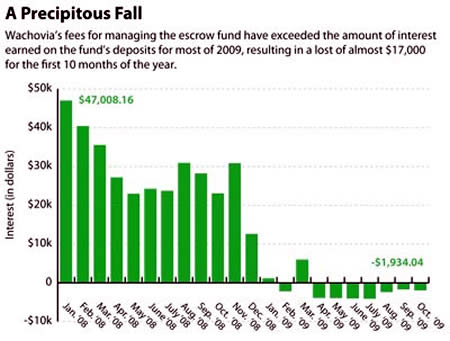
A precipitous fall
The man in charge of administering the escrow fund has a quiet, polite manner in person. He is responsive to media inquiries, but speaks only through e-mails; he declined interview requests for this story and others.
As director of the Division of Gas and Oil, David Asbury is also the “principal executive to the staff of the [Virginia Gas and Oil] Board” – a somewhat grand-sounding job title for a staff of just two. Asbury and Diane Davis, programs administrator for the DGO, are the only state employees who handle the escrow fund and the board’s records.
“He’s not a guy who goes home when the clock goes off,” Donnie Ratliff, a board member who represents coal interests and who worked with Asbury at Pittston Coal Co., where the director was an engineer, said in an interview. “There is no one more dedicated and conscientious than David.”
On Oct. 10, 2008, Wachovia representatives traveled to Abingdon, Va., to meet with Asbury at the Division of Gas and Oil’s former office there. After several tense weeks, the bank officials were eager, as one wrote, “to more broadly discuss our mutual relationship and services being provided.”
At the meeting, Wachovia recommended that the board shift its investment policy to a more conservative asset allocation.
Eleven days later, at the board’s October hearing, Asbury advised members to adopt the bank’s suggestion.
“We are giving up about a percent of earnings potential, but it is also reducing our risk to as close to zero risk as we can,” he said.
Bruce Prather, a consulting geologist who represents the gas and oil industry on the board, asked Asbury, “During the upheaval [. . .] did we lose any money?”
Asbury replied, “No, we did not.”
But even as he spoke, the fund’s interest income had begun to flat-line.
The escrow fund started off January 2008 by earning $47,000 in interest. By October, interest had dropped by half to $23,000.
Now, with the fund’s more conservative investment mix, the interest income plunged – to $1,170 in January, and into negative territory in February at a $2,173 loss.
The reason for this, as a bank representative explained to the board six months later, was that interest rates were “very, very compressed” – so much so that the bank’s servicing fees were higher than the interest that escrow deposits were earning.
It is unclear if any board members were aware of this when, in March 2009, they voted to extend Wachovia’s contract through the end of the year. The evidence suggests that they were not.
At the board’s June 16, 2009, hearing, Asbury presented members with the first-quarter report for the escrow fund, which had a net interest income of $5,000 – $118,000 less than what it netted over the same period the previous year.
The first-quarter report masked the worsening situation; by May, the escrow fund had experienced three months of income loss since the beginning of the year. But Asbury did not address this during the hearing, and board members asked no questions. The “investment risk assessment” on the docket was continued.
Two days later, on June 18, Asbury and Diane Davis traveled to Roanoke to discuss the escrow fund with the Wells Fargo-Wachovia investment team.
Late that night, Asbury sent an e-mail to Butch Lambert, chairman of the Gas and Oil Board, and copied Sharon Pigeon, the senior assistant attorney general who advises the board, on what he learned.
“Recent analysis of the Escrow reflects a significant decline in monthly interest income,” Asbury e-mailed at 10:57 p.m.. “For the second time in the account’s history, monthly expenses have exceeded monthly interest income.”
In conclusion, Asbury wrote, “We were very pleased with today’s focused but productive meeting and have a high level of confidence in the new Wells Fargo-Wachovia.”
June would be the fourth month of the year that the escrow fund lost interest. But Asbury’s e-mail was the first written acknowledgment to a board member of the negative income.
“He handles this account”
In July 2009, with the escrow balance now at nearly $25 million, board members received the fund’s second-quarter report from a Wachovia official, who broke the bad news this way.
“Income from investments and then netted from expenses of servicing the account were negative $6,793,” Patrick Dixon, a senior vice president for Wachovia, told the board.
Board members also learned that although the bank charged a service fee of $8 per sub-account – nearly $6,000 a month – the entire fund was FDIC-insured for only $250,000. For the other $24.5 million, Wachovia pledged collateral to a third-party trustee, the Bank of New York.
This was in fact a substantial improvement in the security of the fund, thanks to a February change adopted by the Treasury Board of Virginia to require banks holding more than $250 million in public funds to pledge 100 percent collateral for every dollar not insured by the FDIC. As of September, Wachovia held $487 million in public deposits, according to treasury records, making it the second-largest such holder in the state.
In September 2008, Wachovia had collateralized only half of the assets it held for the board.
“With the instability last fall, there was concern that possibly that requirement was not adequate,” Kristin Reiter, director of operations for the Virginia Department of Treasury, said in explaining the new regulation.
The escrow fund’s negative income, in particular, caught board members by surprise.
“Do you let somebody know when you think that we’re going to run a deficit on these costs?” Bruce Prather asked Dixon, the Wachovia vice president. “It’s rather a surprise to us that we find out we’re running in the deficit because we’ve got a lot of money in there.”
The ensuing discussion focused on whether to shift assets into a higher-earning combination; only one board member, Katie Dye, asked the bank if it was “negotiable” on the $8 charge per account.
Dixon, noting that the board soon would solicit bids for a new contract to manage the escrow fund, said Wachovia would wait to negotiate until submitting a bid.
As the discussion wore on, Asbury’s central role in handling the fund emerged.
“See, we as a board, we never have access to the information that you’re talking about because it comes through David,” Prather said to the bank representatives. “In other words, he handles this account.”
Asbury defended the investment policy.
“I think the board made a smart decision last fall during turbulent times to place them in the very lowest-risk potential that there was,” he told board members. “And although we are showing negative income during the second quarter, I believe there is a potential to reverse that by the calendar year end.”
Seeking to staunch the bleeding, the board voted to move half of its funds invested in AAA-rated U.S. government obligations into a higher-earning Wachovia money market fund.
The escrow fund lost $4,000 in July, and it has lost money every month since April, for a nearly $17,000 loss for the first 10 months of the year.
Asked by a reporter about the losses that are eroding the fund’s value, Asbury noted that the fund has not lost its principal – meaning that royalty deposits from gas operators are still higher than the losses of interest income.
“The negative interest income for 2009 is disappointing but is a result of financial market conditions,” Asbury e-mailed the newspaper. “Losses may have been worse but for the safe investment posture required for public accounts and adopted by the Board.”
Prather, asked the same question, said: “We’re trying to resolve that.” He would not elaborate.
Bill Harris, a public board member from Wise County, said it was “not a good situation to be in.”
It was worse than he knew.
When informed of the total losses so far this year, he said, “No, I was not aware we were losing like that.”
Neither was Donnie Ratliff, the board member who represents the coal industry and who was not present at the July 2009 meeting when Wachovia officials explained the negative income.
“I don’t see those numbers,” Ratliff said when asked at the Nov. 17 board hearing, hours before the board voted on awarding a new contract for escrow services. “I don’t know how that happened.”
At that meeting, board members had to choose between Wells Fargo-Wachovia or First Bank & Trust, an Abingdon-based bank.
An evaluation team of five state employees – including Asbury and Diane Davis – ranked Wachovia higher in every category. First Bank, though, offered less expensive services.
The board voted to award the contract to First Bank, beginning in January.
© 2009, Bristol Herald Courier
Where are the royalties?
By Daniel Gilbert
In one 80-acre square in Buchanan County, a gas company sucked up 1.6 billion cubic feet of coalbed methane gas in 2½ years – enough to satisfy the heating and cooking needs of about 18,000 homes for a year.
Some of the gas in that unit – dubbed W-8 by state regulators – is the property of owners who are not getting paid for it, including Buchanan County, which owns 14 acres. The producer, CNX Gas Co., should have been making royalty payments into a state-run escrow fund for those owners.
For 2½ years, it didn’t.
In March 2008, CNX discovered it never filed the necessary paperwork with the state Division of Gas and Oil to escrow royalties. Two months later, the company deposited more than $861,000 into the escrow sub-account for W-8, making it the largest account in the $24 million fund.
The W-8 case points to a significant regulatory gap, one in which the state agency overseeing the escrow fund didn’t notice nearly a million dollars missing from an operator for years.
The company caught its own error. But W-8, it turns out, is not an isolated case.
The Bristol Herald Courier compared monthly gas production in units like W-8 that should generate payments into escrow with actual payments into escrow from January 2008 through June 2009.
The analysis revealed that about one-third of the 750-plus active sub-accounts in escrow received no deposits for the months when the corresponding wells produced gas. Of those, nearly 100 sub-accounts received no deposits for all 18 months.
The Division of Gas and Oil has offered a series of evolving explanations in response to the Herald Courier’s analysis. Initially, the DGO posited on Nov. 6 that the discrepancies were the result of changes in the status of a well, such as when a coalbed methane well is swallowed up into a larger unit and owners begin receiving royalties in a separate escrow account. Or, the DGO suggested, gas companies were waiting to pay royalties until they reached a $1 threshold.
When presented with specific examples of escrow sub-accounts with very low balances – from 12 cents to $2.30 – despite high production from corresponding wells, the DGO responded that they were reasonable given the small amount of acreage subject to escrow. That explanation, however, ignored the fact that in several of the cases, no royalties were escrowed because the necessary paperwork has never been filed.
When presented with specific examples of missing paperwork, the DGO’s parent agency, the Department of Mines, Minerals and Energy, issued a statement Nov. 16 that it “has been aware of the discrepancies between reported production and deposits to the escrow account” and “has taken a number of steps to fix the problems. Your questions have been addressed to DMME in the middle of this work.”
The statement also acknowledged that DMME has been aware of a “backlog” of incomplete board files since “early 2009,” and declared that the agency has assigned additional staff to clear it, as well as review individual account information. These incomplete files raise questions about how much money is missing from the escrow fund, as well as the DGO’s ability, at current staffing levels, to ensure that gas companies comply with the governing law and regulations.
There are also uncertain implications for sub-accounts in escrow that should be receiving royalty payments but are not, landing awkwardly at the intersection of the Virginia Gas and Oil Act and the Uniform Disposition of Unclaimed Property Act. In all, 190 sub-accounts in escrow received no royalty payments for the entire 18-month period, which makes their combined contents of $3.8 million look like unclaimed property, ripe for the Virginia Department of Treasury to seize.
Queried about how the DGO determines when funds in escrow are unclaimed property, its director, David Asbury, responded that royalties in an escrow sub-account would be considered abandoned “once active production payments stop and there is no evidence of activity for one year.” The DGO has no records of surrendering any funds to the state treasury.
In fact, the Treasury’s Unclaimed Property Division only recently became aware of the escrow fund, and division officials met with their DMME counterparts in October, a Treasury official said.
“We really haven’t made a determination. We’re still in discussions,” Vicki Bridgeman, the Unclaimed Property Division’s director, said in late November.
Any money seized from escrow would go into a state fund that provides low-interest loans to localities that build public schools and could be claimed, in theory, at any time by owners.
Missing for years
What happens when a gas corporation authorized by the state to produce someone else’s gas fails to file the proper paperwork?
A 90-year-old woman whose family did not want her named is owed thousands of dollars but doesn’t get paid for four years.
The heirs of Ercil Cook check his balance in escrow and think they are entitled to 12 cents.
And it’s impossible to know what happened to the mineral interests of Ducinia Stacy, of Grundy, Va.
Instead, the royalties that should go into the pockets of owners, or into escrow, stay parked in limbo within corporate accounts of gas operators.
Denny Sutherland knew he should be getting paid. He signed a lease, and he could read the gas meter on well V-505254 – a very hot well that drained as much as 26.5 million cubic feet a month – approximately enough to heat 10 households for about 30 years.
Four years passed, V-505254 drained half a billion cubic feet of gas, and Sutherland never received a check. Whenever he spoke with an agent of the gas operator, Equitable Production Co., he got a different answer.
Sutherland, a 63-year-old builder and ex-Marine who lives near Haysi, Va., wasn’t thinking of himself; he had very little acreage in the gas unit. But a 90-year-old relative of his in Bristol had a substantial interest.
“I knew if she didn’t get it pretty soon, she never would,” Sutherland said in an interview.
In July, Sutherland and a cousin visiting from New Mexico decided to get to the bottom of the issue.
Lois Wark, who retired as an assistant managing editor at The Philadelphia Inquirer, trekked to the Division of Gas and Oil in Lebanon, Va., to inquire about the royalties. There, Diane Davis, one of two DGO employees who monitor Virginia Gas and Oil Board’s records, discovered that Equitable had never filed a supplemental order – the crucial document that shows which owners in a gas unit have leased, and which should receive royalties in escrow.
Within the month, Denny Sutherland received a check for $4,900; his 90-year-old relative received $23,000. The royalty statements each received do not indicate whether the royalties earned interest, according to copies reviewed by the Herald Courier.
The system did not self-correct in the case of V-505254. It took someone who was expecting a payment to discover the error and push for answers. In the case of someone whose royalties are escrowed, no one is waiting for a check.
The board files
The Division of Gas and Oil keeps a file for gas units in which the Virginia Gas and Oil Board has forced landowners to lease their mineral rights to a private energy company, a practice known as forced pooling. The files correspond to individual sub-accounts in escrow, and they contain the details that reveal which owners have royalties in escrow.
Anyone can examine the files, as long as they do so where a DGO staff member can see them.
In recent months, on the advice of its attorney, the DGO has zealously guarded its files, requiring anyone who wants to look at them to do so “where we can oversee the process,” a spokesman explained.
“It’s not a mistrust of anyone in particular,” said Mike Abbott, public relations manager for the Department of Mines, Minerals and Energy. “We’re the sole keeper of those files. These are the original copies of records, and we may not have duplicates.”
Abbott said he knew of no cases when documents had been taken or compromised. Actually, at least two files are missing.
The files for units Z-12 and V-12, both for wells in the Vansant area of Buchanan County, could not be located three months after the Herald Courier requested access to them. Neither unit received any deposits in escrow from January 2008 to June 2009; combined, their balances total almost $690,000.
Davis, programs administrator at the DGO, said the files were not lost, but that she would recreate them by going to local courthouses and copying the orders that have been recorded there.
Occasionally, a board file contains a forlorn objection from a force-pooled owner, like the letter Ducinia Stacy wrote on July 6, 2004.
“I do not think the Gas Company should be allowed to just take people’s property (the gas rights) when they do not own them and the property owner does not want them to have them,” she wrote. “I don’t think this is right and I object for all the good it does me.”
It isn’t clear what happened to Stacy and other force-pooled owners in unit I-39 because the gas operator, CNX, has not submitted a supplemental order.
Gas operators are required to file this paperwork within two months of the board’s order giving a company the right to produce gas belonging to force-pooled owners. Without a supplemental order, the escrow account for a unit cannot receive any royalties, and many contain only the initial “rental” payment of $5 an acre for force-pooled owners.
“I’m unaware of any case where our system hasn’t caught up with [paying royalties] as it did in the W-8 instance,” said Cathy St. Clair, a CNX spokeswoman. “We’re convinced we’re paying royalty monies that are required on wells we drill into that state account, or into an internal suspense account awaiting transfer” to the escrow fund, she said.
In reviewing 12 board files for gas units with high percentages of owners who did not agree to lease, the Herald Courier identified six units operated by CNX that lacked supplemental orders. The combined balance of those units is less than $250, even though the wells have been producing for at least four years.
St. Clair would not comment when presented with the unit names and identification numbers that lacked supplemental orders.
Two of these units show only one unknown owner, Ercil Cook, who has 1/100th of an acre in one tract, and 7/100ths of an acre in another. Over the six years that wells in these units have produced gas, Cook’s interest would entitle him or his heirs to about $938, according to average monthly prices on the Columbia Gas Transmission, an interstate pipeline on which CNX moves gas.
The combined sub-accounts for Cook’s interest show 12 cents.
Open questions
The Herald Courier’s analysis found 11 gas units in Dickenson County in which an unknown owner, the now-defunct Yellow Poplar Lumber Co., has rights to 100 percent of the gas underground. The wells on those units have produced 700 million cubic feet of gas since 2006, meaning substantial royalties should have been deposited into escrow.
Yet the sub-accounts in escrow received no deposits for a year and a half, and contained only the standard rental payment of $5 per acre.
When presented with this information, Kevin West, managing director of external affairs for EQT, Equitable’s corporate parent, acknowledged that his company had failed to make required monthly payments into escrow, and pledged to deposit the correct amounts with interest.
With regard to the Yellow Poplar units, he said, “There are some situations which I can’t explain, you know, somebody made a mistake in the manner of making the instruction on things getting paid. Yellow Poplar could well have been one of those situations.”
The DGO already was aware of the Yellow Poplar discrepancies before fielding the Herald Courier’s questions, Director David Asbury responded.
“Staff expects the [. . .] subject issues to be resolved before year’s end,” he wrote.
In fact, the DGO was alerted to the Yellow Poplar issue more than a year ago. Catherine Jewell, a Bristol, Va., resident who has been a relentless critic of the Virginia Gas and Oil Board, e-mailed the DGO in November 2008, noting the low balances in several Yellow Poplar units.
She received no reply.
On Sept. 25, a Tazewell, Va., attorney named T. Shea Cook wrote a letter to Butch Lambert, chairman of the Virginia Gas and Oil Board, and copied several Southwest Virginia legislators. Cook attached an affidavit from Jewell, stating she had audited 24 gas units in which Yellow Poplar owned gas interests and estimating that the accounts were missing close to $750,000.
“Your board has been charged with guarding these accounts and protecting the interests of the gas owners whose gas was essentially seized by the board,” Cook wrote. “These accounts need to be audited, and not just a checkbook audit.”
© 2009, Bristol Herald Courier
A $34 million fund - unaudited
By Daniel Gilbert
Since 1999, energy companies have more than doubled the number of wells that drain natural gas in Southwest Virginia, producing 128 billion cubic feet of gas last year - a quantity that would fetch $1.2 billion for gas producers at average regional prices for 2008.
As natural gas profits have soared, so has the balance of an obscure state-run escrow fund, which holds royalties belonging to thousands of landowners whose ownership is in dispute or whose whereabouts are unknown. In 10 years, the total funds in escrow have ballooned from $3.6 million to more than $24 million – all without a single audit to determine if energy companies are making the legally required deposits into escrow.
For the past year, members of the state regulatory board charged with overseeing the escrow fund have been locked in debate over how deeply to probe gas corporations’ compliance with making royalty payments into the fund. Some on the board have called for a forensic audit, while another member strenuously objected that such an audit “will be opening a door that I do not think we want to or need to go through,” according to interviews and internal communications obtained by the Bristol Herald Courier through a Freedom of Information Act request.
The documents shine a light on the board’s private deliberations, and the deep division among members that discussion of an audit has provoked. They also reveal that board members actually voted to award a contract for an audit nine months ago.
On March 5, David Asbury, the main state official responsible for managing the Virginia Gas and Oil Board’s business, announced to board members that they had voted 4-3 to hire a Colorado accountant to perform the audit. The accountant, Mary Ellen Denomy, came with a string of letters attached to her name, including abbreviations for “Certified Fraud Deterrent Analyst” and “Certified Forensic Financial Analyst.” Her price tag for the audit: $106,000.
At 11:57 a.m., Asbury e-mailed board members that they had selected Denomy and that all bidders would be notified of the board’s decision that afternoon.
It never happened.
At 12:25 p.m., Sharon Pigeon, the senior assistant attorney general who advises the board, sent an urgent reply to Asbury, voicing a concern that he was about to take action “in an illegal closed session.”
“Board action is not official until taken in an open meeting, so I assume you plan to call for a vote on this on the 17th,” she wrote, referring to the board’s hearing later in March. “I also assume there is reason to support the decision in the event there is a challenge to accepting the highest bid, so someone needs to be prepared to offer that information at the meeting.”
Butch Lambert, the board chairman who Pigeon copied on her e-mail, responded at 1:06 p.m.
“Just so that we are above board with this, I think that we should follow Sharon’s recommendation. We can do this first thing.”
At the March 17 hearing, the board members went into a closed session to discuss the audit. When they re-emerged, public board member Mary Quillen moved to “drop those proposals that were received as not meeting the guidelines.”
Bruce Prather, the board member who represents the gas and oil industry, seconded the motion, and the board voted to readvertise the contract.
“We’re not auditing it”
Whenever gas companies make payments into escrow, they attach statements that show the volume of gas that a well produced, what it sold for and whatever deductions the company made in getting the gas to market. But bankers at Wachovia, which has managed the account since 2001, don’t look at these statements.
“I will tell you that the information is on there,” Patrick Dixon, a senior vice president for Wachovia, told Gas and Oil Board members at a July hearing. “We’re just not doing anything with that information. We’re not auditing it. We’re not in any way proving whether it’s right or wrong.”
It’s unclear how long board members knew they had access to this information; Asbury in April asked Wachovia for a “sample of the checks and the accounting that they receive [from gas operators] month over month,” which he said he provided to board members.
The last audit of the escrow fund was in 1999. It cost $4,000. In their report, accountants at the Central Virginia firm of Robinson, Farmer, Cox Associates wrote that though they performed compliance tests with state laws and board regulations, “providing an opinion on compliance with those provisions was not an objective of our audit and, accordingly, we do not express such an opinion.”
Asbury, in an e-mailed response to Herald Courier inquiries, wrote: “We balance the need to audit against the need to keep management fees charged to the account to a minimum.” Meaning: The people whose royalties are in escrow will foot the bill for any audit, not the agency in charge of ensuring the integrity of the fund.
Only two state employees are responsible for monitoring payments into about 950 sub-accounts in escrow – active and inactive – and ensuring that companies file the required paperwork: Asbury, the director of the Division of Gas and Oil, and Diane Davis, the DGO’s programs administrator.
Asbury said that the DGO’s parent agency is expanding its electronic reporting system with “automated quality checks” to include the escrow fund. Currently, the DGO has no such system in place.
Perhaps out of necessity, Asbury has outsourced part of his watchdog function to the companies he watches.
Asked if it was anyone’s job to review operators’ monthly accounting statements sent to Wachovia, Asbury sidestepped the question in a written response, noting that “major gas producers are publicly held companies” and that “payments into escrow [. . .] are internally and externally ‘audited’ transactions.”
The Herald Courier, in comparing escrow deposits with gas production during 2008 and 2009, found that hundreds of individual accounts did not receive royalty payments for months when the corresponding wells produced gas.
The analysis also revealed 20 duplicate sub-accounts that appear to receive payments from the same gas wells, underpayments and overpayments, accounts that should have been closed out years ago – and one account that was closed out, only to reappear months later with a negative 37 cents.
There is a cost to extraneous accounts: Wachovia charges $8 per account each month. The bank’s servicing fees have exceeded the amount of interest earned on the fund’s deposits for most of 2009, resulting in a loss of nearly $17,000 for the first 10 months of the year.
Board divisions
On March 6, the day after Asbury notified board members the results of their votes on who would audit the escrow fund, an agitated Bruce Prather phoned the DGO director.
At 3:50 p.m., Asbury e-mailed Lambert about the conversation. “Board member Prather called and was upset about the pending decision for the [request for proposal] Escrow Audit,” he wrote.
“Do you know what he is upset about?” Lambert replied.
“He had done research regarding the chosen candidate/proposal,” Asbury wrote, referring to Mary Ellen Denomy, the Colorado CPA. “He has concerns about the candidate’s testimony against certain gas companies and their interests out west in state court.”
In his research, Prather may have seen a March 2007 article in the now-defunct Rocky Mountain News, in which western royalty owners christened Denomy “Erin Brockovich” – a reference to a tenacious woman who took on an energy giant in a pollution case and was lionized on the big screen by actress Julia Roberts.
When asked about his concerns in November, Prather said, “Me? I don’t know where that came from.” Asked if he denied making the comments Asbury referenced, Prather said, “I’m not saying anything.”
In a phone interview, Denomy said, “There should be no reason for a company to feel threatened by an accountant. I’m trying to make sure monies are not being misappropriated. I’m just a bean-counter.”
For a year, board members have clashed over how thorough of an audit they wanted.
In February, public member Peggy Barber, without having seen the bids from would-be auditors, informed Asbury, “I would like to choose the lowest bidder for this project as the end result should ultimately be the same.” Barber, dean of workforce development and continuing education at Southwest Virginia Community College, did not return phone calls or an e-mail seeking comment.
Katie Dye, a public member from Buchanan County, has called for a “forensic audit,” and Bill Harris, a public member from Wise County, has supported a more thorough audit.
On the other side, Mary Quillen, another public member, voiced a strong objection to auditing the financial records of gas operators. On Aug. 10, Quillen e-mailed Asbury with her comments on the pending escrow audit.
“I do not want this to be misinterpretated (sic) to mean we are going to audit each operators financial records,” Quillen wrote. “This will be opening a door that I do not think we want to or need to go through. There are some on The Board and members of the public (regular attendees of the meetings) who will take this opportunity to jump on this as a means of addressing their own agendas.”
Quillen, director of programs for the University of Virginia’s Southwest Center in Abingdon, did not return phone messages or an e-mail seeking comment. When approached by a reporter during a break at the Nov. 17 board hearing, Quillen said, “This is not an appropriate time to have a discussion with you.”
Asked to suggest an appropriate time, Quillen said, “I have no comment at this time. No comment.”
Prather seems to share Quillen’s view on the scope of the audit. When asked to verify his position, Prather said, “It sounds to me like you have access to our closed meetings.”
When pressed, he said that Pigeon, the board’s attorney, advised them against a forensic audit.
“Ms. Pigeon told us that this was our legal position,” Prather said. “She told us we couldn’t, we can’t take this thing outside the board and allow a forensic audit of these companies.
“That’s absurd,” he added. “Do you know how much that would cost?”
The upshot
On Sept. 21, the board published a revised request for bids for the audit, adopting much of Dye’s proposed language. The successful bidder will randomly audit 35 individual accounts in the escrow fund and compare actual payments against expected payments based on the board’s files, which detail how much production in a gas unit is subject to escrow.
The auditor’s task could be significantly complicated by missing supplemental orders – the crucial document that shows what percentage of royalties should be escrowed. The Herald Courier, in reviewing 12 Gas and Oil Board files with large percentages of owners who did not agree to lease, found that six of them were missing supplemental orders. When confronted with this, the Department of Mines, Minerals and Energy – DGO’s parent agency – acknowledged a “backlog of incomplete supplemental board orders.”
Without a supplemental order, it is impossible to determine what should be in an individual account in escrow.
Some board members are still unsatisfied with the audit’s scope.
“We would like for it to have taken a different direction,” Harris, the public member from Wise County, said in an interview. He described the published proposal as a “verification process rather than a forensic process.”
“I’m still not sure we’ll get some of the answers to the questions you’re raising,” Harris said. “We’re going to sort of wait and see what comes out of this.”
© 2009, Bristol Herald Courier
'The industry always wins'
By Daniel Gilbert
In three minutes, the Virginia Gas and Oil Board can force a property owner to lease his mineral rights to a private energy company.
The state regulatory body exercises this power more than a hundred times a year, converting Southwest Virginia’s vast underground pools of natural gas into the fuel that heats homes and businesses, and tipping millions of dollars to the companies that harvest it.
But for the mineral owner forced to lease, the monetary rewards come far less easily – or not at all. By the time Earl Whited, of Russell County, Va., died in 2006, more than a dozen gas wells on his property had sucked up over 2.5 billion cubic feet of gas in five years. The former bus driver never saw a penny.
People like Whited, forced by the state to lease their mineral rights, are supposed to be compensated by the corporations that drain their nonrenewable resource. But ongoing conflicts over who owns the gas mean that millions of dollars in royalties are funneled into an opaque escrow account that the state does not routinely monitor for compliance. Getting royalties out of the $24 million escrow account requires “sticks of dynamite,” in the words of one attorney who has spent years trying.
Jamie Hale, a 37-year-old truck driver in Buchanan County, Va., wants his royalties for his ailing mother.
Graham Tiller, 77, a retired chemical plant worker in Chester, Va., wants his royalties to help send his grandson to college.
Shirley Keene, 60, a disabled diabetic from Keen Mountain, Va., wants her royalties to take the edge off her insurance premiums.
Theresa Brents, a retired librarian in Stuarts Draft, Va., had never heard of the escrow fund where her royalties are held.
The plight of the force-pooled landowner sometimes pricks the conscience of one of the seven board members who enable the system.
“I don’t always feel comfortable about what I’m doing,” Bill Harris, a public member from Wise County, said in a November interview. “It’s the whole ‘industry-versus-citizen’ thing where the industry always wins, and to me, it’s just real disturbing.”
Harris, who taught physics, math and photography at Mountain Empire Community College before retiring in June, votes to force-pool mineral owners because state law leaves him few alternatives.
“The state says that if certain things are in place, we have to have a really good reason not to approve that,” he said. “I’d love to see the laws rewritten to give citizens more power. I just don’t think people get enough money.”
The methane gas that inhabits the coal seams of Southwest Virginia is now big money – and the subject of a legal tug-of-war between people who own the gas beneath their land, and the coal companies that purchased their coal. Despite a 2004 Supreme Court of Virginia ruling in favor of gas owners, coal companies have shown their willingness to spend years in court fighting for their share of coalbed methane royalties.
Unless a gas owner sues or agrees to split such royalties with a coal company, the funds will accumulate in escrow, and Ferrell Whited is resigned to this third option.
Whited and his siblings – the heirs of Earl Whited – went through four years of litigation with a coal company over coalbed methane royalties and emerged with 50 percent – half of what they sought. The former coal miner has lost his appetite for lawsuits and split agreements; he’ll deed his remaining mineral interests to his grandchildren and leave it to them to extract royalties from escrow.
Except that by that time, Whited’s money may no longer be in escrow. Once an individual account in escrow ceases to receive payments from gas production, it is considered unclaimed property and may have to be surrendered to the state treasury, throwing up a new series of bureaucratic barriers to collecting the money.
In June, David Asbury, the state official who oversees the escrow fund on behalf of the Gas and Oil Board, told an assembled crowd at a public meeting in Grundy, Va., “We would like for that escrow account to be zero. We don’t have a goal to grow the escrow account.”
Yet the fund continues to accumulate royalties faster than Asbury and the board can disburse them. Two months after Asbury spoke, on Aug. 11, the board published a request seeking bids from banks to manage the escrow fund. Buried in the 71-page document is a sentence that powerfully, if casually, underscores the difficulty of getting the fund to zero: “It is estimated that twenty-five to fifty million dollars may be held in escrow at any one time.”
The size of the escrow fund has dismayed some area legislators and stunned others.
“We have got to find some better way of getting those monies out of escrow,” Delegate Terry Kilgore, an attorney and senior Republican lawmaker from Gate City, Va., said in an interview.
“I was shocked to see your number, $24 million?” Kilgore said. “I don’t think it was ever the intent of the General Assembly to have that kind of escrow account.”
Peter Glubiak, the attorney who won the 2004 Supreme Court ruling for gas owners in Buchanan County, believes legislators could fix the escrow problem with the stroke of a single sentence.
Noting that an earlier law presumed that people owned the gas beneath their surface, Glubiak said, “What needs to happen is a simple reversal, reinstituting the presumption that if you own the land, you own the gas. That way, the burden would be on the coal company to come in and affirmatively prove [coalbed methane ownership]. It isn’t the poor landowner who has to hire a lawyer and go to court and spend a lot of money. And you would get rid of 75, 80, 90 percent of what’s in escrow.”
Failing any better way to retrieve royalties from escrow, mineral owners are considering their options.
At his home outside Richmond, Va., Graham Tiller reads the minutes of the board hearings online, scanning them for details on what kind of deals gas owners are striking with coal companies over coalbed methane royalties. Recently, he saw one in which the gas owner received 80 percent of the royalties, and he’s been talking with an agent of the company that owns the coal where he owns the gas.
“I’m thinking strongly about seeing if I can make a deal with them – if I can get the right kind of deal,” he said. “I’m getting old, and I’ve got a grandson to send to school. I can’t afford a lawsuit by myself, but I’m not going to give it to them.”
Theresa Brents is looking for a lawyer.
Shirley Keene is looking for her fourth lawyer.
Jamie Hale is working on a plan that does not involve a lawyer. During the 10 years that CNX Gas has sucked coalbed methane from beneath his 40-acre property, he has not received a dime. Assuming the Hales could recover 100 percent of the royalties in escrow, their interest would entitle them to approximately $266,000 – less whatever CNX deducts to get the gas to market.
“What I had in mind – I don’t know that I’d get anywhere with this – is my next day off, going to the courthouse and speaking with the judge if I can,” he said.
“If I can, I’ll get a declaratory judgment order against CNX Gas or whoever,” he said, although his conflict is actually with the coal owner, Hugh MacRae Land Trust.
“That’s my next step – talking to a judge or a legal representative at the courthouse. I can’t see us having to get an attorney to get what is rightfully ours. I mean, it’s not right. If you do hire an attorney, you might as well take a split agreement,” he said.
Then he sighed.
“I really don’t know where to go or what to do.”
© 2009, Bristol Herald Courier
By Daniel Gilbert
LEBANON, Va. – For the first time in a decade, a state-run escrow fund holding millions of dollars in royalties from natural gas production belonging to mineral owners will undergo an audit, a regulatory board determined Tuesday.
Gas corporations operating in Virginia are required to pay royalties into escrow whenever they produce gas belonging to people they are unable to locate, or whose mineral ownership is in dispute. The fund was established in 1990, and has grown to more than $24 million with minimal state oversight.
A bare quorum of the Virginia Gas and Oil Board on Tuesday voted 3-1 to award the contract to the Central Virginia accounting firm of Robinson, Farmer, Cox Associates. The board’s move follows nearly a year of divisive deliberations over how thoroughly to probe gas corporations’ compliance with payments into escrow.
It comes within days of a series of articles published by the Bristol Herald Courier revealing that gas corporations don’t always make the required payments, raising questions about what is missing from escrow.
The seven members of the Gas and Oil Board had sparred over the scope of an audit, with some advocating a forensic analysis and others arguing for a more limited review. The board voted in March to award the contract to a Colorado-based petroleum accountant, but dropped the results of the vote in April and readvertised the contract in September.
Five accountants submitted bids and two were rejected, board members said Tuesday. Copies of the bids were not available by press time, and it was not immediately clear why the two bids were rejected.
Katie Dye, a public member from Buchanan County, was the lone member to vote against awarding the contract to Robinson, Farmer, Cox – the same firm that performed the last audit of the escrow fund in 1999, when it contained $3.6 million.
“My concern is that the individual who looked like she could potentially be the most qualified to perform the audit” was eliminated from consideration, Dye said before the vote.
Donnie Ratliff, the board member representing the coal industry, made the motion to award the contract to Robinson, Farmer, Cox, and it was seconded by Bruce Prather, the member representing the gas and oil industry. Butch Lambert, the board’s chairman, also voted in favor.
The Herald Courier compared production numbers gas companies report to the state with royalty payments into escrow over 18 months spanning 2008-2009. The newspaper’s analysis found:
* Between 22 percent and 55 percent of individual accounts in escrow received no payments for months when the wells corresponding to those accounts produced gas;
* Nearly 100 accounts in escrow received no payments for months when the corresponding wells produced gas for all 18 months.
Some of the discrepancies could be explained by the change in the status of a gas well that would create a separate account in escrow to receive royalties. Other discrepancies pointed to gas corporations that failed to file the necessary paperwork for royalties to be escrowed, or otherwise failed to transmit the payments into the state-run fund.
In response to the Herald Courier’s analysis, those at the Department of Mines, Minerals and Energy issued a statement acknowledging the discrepancies as a problem, and pledged to improve their ability to monitor gas corporations’ compliance.
The two corporations that dominate natural gas production in the region, EQT Corp. and CNX Gas Co., acknowledged some lapses in making payments, which company representatives credited to accidental oversights and the complexity of mineral ownership in Southwest Virginia.
The revised scope of the audit calls for the accountant to randomly select 35 individual accounts in escrow and analyze monthly payments into those accounts. The accountant should then compare the payments with expected payments based on the acreage that is subject to escrow, the monthly production gas operators report to the state, the selling price of the gas and deductions and fees taken out of the payment.
The board’s proposal for the audit authorizes the accountant to obtain relevant records from the gas operators required to pay into the selected escrow accounts, and perform a “financial and compliance audit” from Jan. 1, 2000, through Dec. 31, 2008, according to board documents.
When Robinson, Farmer, Cox last audited the escrow fund, the firm’s accountants noted that although they performed tests gauging gas corporations’ compliance with state laws and board regulations, “providing an opinion on compliance with those provisions was not an objective of our audit and, accordingly, we do not express such an opinion.”
The escrow fund has been managed by Wachovia Bank – now part of Wells Fargo – since 2001. Beginning in January, Abingdon-based First Bank & Trust Co. will take over managing the fund.
© 2009, Bristol Herald Courier
By Daniel Gilbert
LEBANON, Va. – State officials, gas industry representatives and citizens on Tuesday reacted to a Bristol Herald Courier investigation revealing minimal oversight of a state-run escrow fund containing millions of dollars belonging to mineral owners, and corporations that failed to make the required payments into the fund.
Two industry representatives sharply criticized the eight-day series as biased, while citizens praised it and the chairman of the Virginia Gas and Oil Board added a nod of approval.
Gas corporations are required to pay royalties into the escrow fund whenever they produce gas belonging to people they cannot locate, or whose mineral ownership is in dispute. The fund contains more than $24 million, and is owed to thousands of Southwest Virginia landowners.
“The Department [of Mines, Minerals and Energy] and the board have and will continue to address issues related to the timely filing” of the necessary paperwork for royalties to be escrowed “and deposits into the escrow account,” Virginia Gas and Oil Board Chairman Butch Lambert said in a prepared statement.
The DMME, he noted, has designated staff to clear a “backlog” of missing orders, and the department “continues to review deposits and direct companies to fix these errors. This has been a very slow process,” Lambert said, adding that it has resulted in corrective payments into escrow.
“We wish to acknowledge the considerable and thorough research into these issues by the Bristol Herald Courier,” Lambert said.
He also thanked David Asbury and Diane Davis – the two state officials who handle virtually all of the work of monitoring payments into escrow – in responding the Herald Courier’s queries and requests for documents.
The chairman’s assessment contrasted starkly with views expressed by the gas industry.
“I was sorry to read the recent series of articles that attacked the board, the Division of Gas and Oil and the natural gas industry,” Jerry Grantham, president of the Virginia Oil and Gas Association, told board members Tuesday. “In my opinion, these articles were one-sided and in many cases inaccurate,” he said, pointing out one incorrect sub-headline in Sunday’s edition.
“I kept waiting for at least a portion of an article discussing the many benefits of the natural gas industry here in Southwest Virginia, but that side was not represented,” Grantham concluded.
Frank Henderson, president of Appalachian Energy, also criticized the articles.
“The articles made the industry, the board and the regulators out to be villains, incompetent, the whole nine yards,” he said during the public comment period.
The important issue, Henderson said, is the ownership of minerals.
“Unfortunately, that whole issue was not explained in those eight articles and 15-some thousand words. And that’s the core issue.”
In Lambert’s view, the series covered issues relating to the ownership of coalbed methane gas; the 1990 law that established the Virginia Gas and Oil Board and the escrow fund; different interpretations of a Supreme Court of Virginia ruling on coalbed methane ownership; discrepancies between gas production and deposits into the escrow fund, and the state’s management of the fund.
Harry Anderson, a North Carolina resident with 131 acres near Haysi, Va., called the Herald Courier articles a “great series, an important series” during public comment.
Expressing sympathy for board members who hold down day jobs, Anderson said, “if you can’t stand the scrutiny of the press, there’s a problem.”
Martha Guilliams, a Salem, Va., resident who has been attending board hearings for 12 years, praised the articles and vented her ongoing frustration over her inability to collect coalbed methane royalties from escrow. She noted that the Supreme Court of Virginia had already ruled that when a landowner sells only coal, he keeps rights to coalbed methane.
“The Supreme Court of Virginia has ruled on three very specific severance deeds,” Sharon Pigeon, the senior assistant attorney general who advised the board, told Guilliams.
The high court’s 2004 ruling, Pigeon explained, “only applies to those parties. We don’t know that you have the same deeds.”
Guilliams was not satisfied.
“Something has got to give. Where are we heading?”
Lambert replied, “I don’t think this board can answer that for you.”
© 2009, Bristol Herald Courier
Escrow audit's scope remains a Virginia issue
By Daniel Gilbert
Auditing a state-run escrow fund holding more than $24 million in natural gas royalties could cost $27,000. Or it could cost $1.25 million.
The auditor’s fee hinges on a question that members of the Virginia Gas and Oil Board have debated for a year: how thoroughly to probe gas corporations’ compliance with making legally required payments into escrow. And though the board voted Tuesday to authorize an audit – the first in a decade – the level of scrutiny remains an open question, according to the firm that will conduct the audit and state documents obtained by the Bristol Herald Courier.
State law requires gas corporations operating in Virginia to pay royalties into escrow whenever they produce gas belonging to people they cannot find or whose mineral ownership is in dispute. Thousands of people have a claim to these royalties, but they receive no accounting of what they have in escrow and face costly legal obstacles in collecting their money.
For almost 20 years, the state has essentially trusted gas corporations to make the required payments into escrow – which some don’t always do, a Herald Courier investigation found. In response to the newspaper’s analysis, the Virginia Department of Mines, Minerals and Energy acknowledged that discrepancies between gas production reported by companies and their corresponding escrow payments were a problem, and the agency pledged that it had begun taking steps to improve oversight of the process.
One of those steps has been to contract an independent auditor to gauge gas corporations’ compliance with escrow requirements. In September, the Gas and Oil Board published a request for bids to perform a detailed audit of 35 individual accounts in escrow, selected randomly, from 2000-2008.
On Tuesday, the board awarded the contract to the Central Virginia accounting firm of Robinson, Farmer, Cox Associates, a large operation which primarily performs audits for municipalities. The firm was the last one to audit the escrow fund in 1999 – a $4,000 affair that stated no opinion about compliance.
The firm’s current bid contains few specifics about how its accountants would perform the detailed audit, which is expressly not covered in the $27,000 fee quote. That fee is for verifying that the receipts from escrow payments match the gas companies’ deposits.
Auditing the 35 individual accounts over the eight-year period would entail between 8,000 and 12,500 hours of work, Robinson, Farmer, Cox estimated. That would translate to a fee of between $800,000 and $1.25 million, based on the lowest hourly rate charged by an accountant performing the audit.
Given the high anticipated costs, the firm recommended that the board create its own internal process to perform the detailed audit, and it volunteered to assist in developing one.
That doesn’t mean the firm isn’t going to conduct a detailed audit, Corbin Stone, managing director, said in a telephone interview Friday.
“We do plan to do a detailed audit,” Stone said. “The scope of that can change with what we find. If you don’t find noncompliance, you reduce the scope. You just don’t know. Ultimately, [board members] can decide to expand the scope or reduce the scope.”
Stone also expressed a desire to recover any royalties gas corporations have failed to deposit into escrow.
“We want to make sure that the people that own the mineral rights to these properties are being remunerated for them,” he said.
In fact, people with royalties in escrow cannot access them without suing to prove ownership, or splitting them with someone else who claims them. But they are the ones who will foot the cost of the audit.
From last to first
A year ago, the Gas and Oil Board received three bids to perform the audit. A panel of state officials evaluating the proposals ranked Robinson, Farmer, Cox last.
The highest ranking went to a Colorado-based accountant named Mary Ellen Denomy, who holds an apparently unique combination of certifications as a petroleum accountant, mineral manager, fraud deterrent analyst and forensic financial analyst. Denomy estimated her maximum fee at $106,000, and in March, board members voted 4-3 to hire her to audit the escrow fund.
But at its April meeting, board members dropped the bids and voted to craft a new request for the audit. Board members sparred over how thorough of an audit to authorize, and expressed concern about the wide range in cost – from Denomy’s six figures, to another firm’s $5,000 quote. Robinson, Farmer, Cox had estimated a $13,500 fee.
“This discrepancy between lower proposals and higher proposals was so great,” Sharon Pigeon, the board’s attorney, said Tuesday in reminding members why they had decided to readvertise the contract. “We felt like someone didn’t have the right information.”
The board published its revised request in September, adding a requirement for a detailed audit of the 35 accounts, and received five bids. Two of the bidders – Denomy and a Winchester, Va.-based firm – were eliminated for failing to meet a requirement 26 pages into the board’s request. No one appears to have noticed during the first round that Denomy and the other firm, Accounting Associates, had not registered with Virginia’s electronic procurement service.
On Nov. 3, Steve Cooney, a DMME official, e-mailed David Asbury, the director of the state Division of Gas and Oil, that the two bidders had not registered on the online service and would be disqualified.
“Let’s double check this again please,” Asbury replied.
“We’ve double and triple checked it,” Cooney wrote the next day.
That day, Cooney, Asbury and two other state officials scored the three remaining bids.
In its bid, Robinson, Farmer, Cox offered few specifics about how it would perform the detailed audit beyond reviewing “official minutes of the Board and administrative policies,” and using “analytical review procedures” to determine the reasonableness of escrow payments. Stone would not go into detail about his methodology when asked Friday by a reporter.
The state officials scoring the bids gave Robinson, Farmer, Cox the highest rating for “thoroughness and responsiveness,” and a perfect score across the board for “cost/pricing,” even though the firm’s price quote did not include the cost of the detailed audit.
The difference in cost between the high and low bidders, it turned out, was almost as large as it was in the previous round that had concerned Pigeon, the board’s attorney: A Chesapeake, Va., firm represented the high end at almost $120,000, and Robinson, Farmer, Cox quoted the least expensive fee at $27,000.
Stone’s firm is now charging twice what it estimated in January to perform same type of audit. The difference, Stone explained, is that the addition of a detailed audit is likely to add to the difficulty of the simple verification audit.
“It complicates it on a pretty grand scale – or it has the potential to,” he said.
The vote
Discussion of an audit has sparked sometimes heated debate among board members, with some calling for a forensic audit and others arguing to exclude gas corporations’ financial records from the analysis. Only four of the seven members were present for Tuesday’s vote.
In an unusual step, board Chairman Butch Lambert moved the vote on awarding the contract for the audit from the last to the first item of business – ahead of the public comment period.
That decision dismayed at least one person who had signed up to speak – a Gate City, Va., accountant named Charles Bridwell, who read about the pending audit in the Herald Courier on Dec. 12, and hoped to make a last-minute pitch to board members for his services.
The two board members representing the coal and gas industries, Donnie Ratliff and Bruce Prather, made the motion to award the contract to Robinson, Farmer, Cox, with Lambert also voting in favor.
Katie Dye, a public member, was the only one to object; she still believed Denomy was the most qualified to perform the audit, and was unsettled by Stone’s firm’s cost estimates. The other three public members missed the vote.
A week earlier, public member Mary Quillen had written to Asbury seeking additional information about each of the three bids.
“I think all of the proposals sufficiently address the main issue and that is the audit of the escrow account,” Quillen, who earlier opposed auditing financial records of gas corporations, e-mailed Dec. 8.
Quillen was a no-show for the vote Dec. 15, but appeared minutes after it was taken.
Asked Friday by phone why she missed the vote, Quillen said, “Excuse me? Well, you know, that’s my personal business.”
When pressed, Quillen said, “Yes there was a particular reason for not being there.” She would not elaborate.
“I have a full-time job with many responsibilities that I do not believe is in any way related to anything to do with whatever it is you’re doing. Thank you so much,” she said, hanging up.
The other two public members, Bill Harris and Peggy Barber, did not return phone messages Friday seeking comment.
The audit is slated to begin in January, and the results should be in by March.
Stone said his approach would be to identify whether gas corporations have not paid money into escrow that they should have, and then evaluate the likelihood of retrieving that money.
Noting that companies might not want to comply, Stone said, “You would want to collect all of it, but are you going to wind up in litigation with these companies? What are the chances we’re going to collect this money?”
Robinson, Farmer, Cox accountants will update the board about what it can recover against what the firm charges in hourly fees.
“When it’s no longer beneficial, then the audit stops – at the board’s discretion,” Stone said.
The contract, he added, “will be written in such a way that they have the ability to stop the audit.”
© 2009, Bristol Herald Courier
By Daniel Gilbert
For six years, the natural gas royalties belonging to heirs of a Buchanan County landowner named Fielden Sanders should have been accumulating in a state-run escrow account.
Until last month, the account contained $1.56 – a seemingly small sum for the heirs’ 13 percent interest in a well that has sucked up 500 million cubic feet of coalbed methane.
It should have held more.
In November, the energy corporation draining the Sanders’ gas deposited $44,440 into the account holding their royalties. It was one of 20 accounts in escrow that received more than $700,000 in deposits that month, after a Bristol Herald Courier investigation showed they had not received payments for months when the corresponding wells produced gas.
Before November, the 20 accounts contained $4,600 combined.
In all, energy corporations deposited more than $825,000 into the escrow fund in November – five times as much as the average month in 2009 – bringing the fund’s total balance to $24.9 million. At least 10 percent of the 766 active individual accounts in escrow received their first payment in a year or longer, according to a Herald Courier analysis.
Gas well operators pay royalties into escrow whenever they produce gas belonging to people they cannot find or whose mineral ownership is in dispute. The escrow fund was established in 1990 with the aim of allowing gas corporations to develop the commonwealth’s coalbed methane reserves, regardless of who owns the gas. It is overseen by the Virginia Gas and Oil Board.
The corrective payments into escrow come just ahead of the board’s Dec. 15 vote to authorize an audit of the escrow fund, the first in a decade.
The lion’s share of the corrective payments was made by Pittsburgh-based EQT Corp., the corporate parent of Equitable Production Co., and the second-largest gas producer in Virginia.
“There were some things that had fallen through the cracks,” Kevin West, EQT’s managing director of external affairs, said in a telephone interview last week. “Once it was brought to our attention, we kind of did an audit of our accounts to make sure there wasn’t something missing that was not identified in what was brought to our attention, and immediately then made those payments into the accounts.”
The Herald Courier in late October provided EQT with a list of 100 individual accounts in escrow corresponding to gas wells that the company operated. The accounts had not received payments for months when the corresponding wells produced gas for at least 10 months during an 18-month period.
West said that his company had a program in place that periodically reviews payments into escrow, but credited the Herald Courier with expediting the process.
“I think they would have come to our attention eventually and we would have fixed it, but this helped it get done a little bit quicker,” he said.
CNX Gas Co., a subsidiary of Canonsburg, Pa.-based Consol Energy, made what appears to be a corrective payment into the account containing royalties for the Sanders heirs. The account, named for the gas well AZ-100, was one of 90 corresponding to CNX-operated wells that did not receive payments for at least 10 months when the wells produced gas.
When asked to comment, a Consol spokeswoman reiterated the company’s position that it would not engage in a “well-by-well discussion” with a reporter. The company is willing to discuss individual wells with royalty owners, said the spokeswoman, Cathy St. Clair.
“Every well has its own set of characteristics, and without looking into the history of everything to do with that well, you can’t make the inference that there’s something that should be there that isn’t there,” she said.
Two of the surviving heirs of Fielden Sanders list addresses of Gordonsville and Bedford, Va., state records show. They did not respond to phone messages left last week.
Hundreds of individual accounts in escrow have not received payments for months with the corresponding wells produced gas, the Herald Courier found.
An account might not receive monthly royalties for a variety of reasons, state regulators and industry representatives say. A mineral owner might have a tiny interest in a well, causing the corporation producing the gas to allow royalties to accumulate to at least $1 before paying into escrow. Or the well might be swallowed up into a larger unit, and a separate account is created to receive royalties.
Some discrepancies, though, are because gas corporations have failed to file the required paperwork with the state for the royalties to be escrowed. The Virginia Department of Mines, Minerals and Energy has acknowledged a “backlog” of such missing documents, and pledged to assign additional staff to clear it.
Other missing payments are the results of computer glitches and human errors.
West, of EQT, said the company’s computer system had set a threshold of $50 before royalties would appear ripe for payment into escrow.
And sometimes payments slip through the cracks, West said.
Of the 20 accounts that received large, corrective deposits in November, 11 correspond to coalbed methane wells operated by EQT. The accounts hold royalties for unknown heirs to the now defunct Yellow Poplar Lumber Co., which owns 100 percent of the gas interests in the drilling units. Until last month, those accounts contained only rental payments of $5 per acre.
In November, after the Herald Courier’s analysis, EQT deposited $537,575 into those accounts.
The November escrow statement, obtained by the Herald Courier from Virginia Division of Gas and Oil, also shows that the fund continued to lose interest income for the eighth consecutive month, bringing the loss to $18,700 so far this year.
The fund has been losing money because the bank’s fee for servicing the accounts exceeds the interest earned by the fund’s deposits. Wachovia Bank, now part of Wells Fargo, has managed the escrow fund since 2001. In January, Abingdon-based First Bank & Trust will take over the contract.
© 2009, Bristol Herald Courier
By Daniel Gilbert
As some energy corporations add missing payments to a state-run escrow fund holding natural gas royalties, area lawmakers are seeking ways to distribute the fund’s $25 million to the people who own it.
Those millions belong to thousands of people who own mineral rights to property in Southwest Virginia, where the industry drained 128 billion cubic feet of gas last year. Gas operators pay royalties into escrow whenever they produce gas belonging to people they cannot find or whose mineral ownership is in dispute.
But retrieving the royalties from escrow requires mineral owners to sue to prove ownership, or split their royalties with someone else – generally a coal company – who also claims them, effectively trapping millions of dollars in escrow.
“The key thing that shouldn’t be lost is, we appreciate what the gas people are doing,” state Sen. Philip Puckett, a Lebanon Democrat, said in a telephone interview last week. “But we’ve got $24 million-plus sitting in escrow, and we need to be about fixing that.”
The escrow fund was created to facilitate the production of coalbed methane, a gas produced by fracturing and stimulating the coal seam, which now accounts for 80 percent of the natural gas produced in Virginia. Many Southwest Virginia landowners long ago sold their coal but retained the remainder of their minerals – creating a lingering conflict over coalbed methane ownership between the original mineral owners and the corporation that bought their coal.
The 1990 Gas and Oil Act allowed the state to force people to lease their mineral rights to private energy companies, and directed the companies to pay royalties into escrow when coalbed methane ownership was in dispute.
Coalbed methane royalties make up about 83 percent of the royalties in escrow, according to a recent state estimate. The rest belongs to owners gas producers cannot find.
In 2004, the Supreme Court of Virginia unanimously upheld a circuit court ruling that mineral owners who severed only their coal retained full rights to coalbed methane. But the Virginia Department of Mines, Minerals and Energy interpreted the high court’s ruling in Harrison-Wyatt v. Ratliff as applying to the specific deeds at issue, and the state has continued to direct gas producers to escrow coalbed methane royalties when different people own the coal and the gas for the same tract of land.
If mineral owners want to collect 100 percent of coalbed methane royalties, they have to go to court – a process that can take years, especially when the royalties at stake are substantial.
“Most of our people can’t afford to go to court,” said Puckett, who has repeatedly stated that mineral owners with severance deeds similar to the ones analyzed by the state supreme court should be able to collect their royalties without having to sue. He is working on legislation to “keep money out of escrow, and get it to the people who deserve it,” he said.
“In very simple terms, we’re trying to codify the Ratliff case,” said Puckett, who has requested that the Virginia Division of Legislative Services draft language to that effect. Such an amendment would incorporate the central finding in the Ratliff case that mineral owners who severed only the coal from their property own the coalbed methane.
State Delegate Terry Kilgore, a senior Republican lawmaker from Gate City, Va., supports the aim of Puckett’s proposed legislation, but is taking a different approach to reducing the barriers to accessing royalties in escrow.
“After some of the articles came out, I’ve spoken to two or three different legislators,” Kilgore said, referring to a recent series of Bristol Herald Courier articles on the escrow fund. “We believe there is a consensus that we’ve got to figure out some way to get [money from escrow] for those people who are entitled to it, and we need to figure some way of getting it out of there quicker,” he said.
Kilgore is eyeing legislation that would establish a third-party arbitrator to hold hearings on determining ownership of coalbed methane royalties. He compared his approach to systems already in place at the state’s Department of Rehabilitative Services and the Department of Medical Assistance Services, which would have an administrative law judge or hearing officer expedite the determination of ownership.
Kilgore has not yet submitted a request to the Division of Legislative Services, but plans to next week, he said.
© 2009, Bristol Herald Courier
Commentary
By J. Todd Foster
On today’s front page, we launched an ambitious and complex eight-day series that involves millions of dollars and affects thousands of Southwest Virginia property owners.
Between unmasking other forms of malfeasance, corruption and outrage, investigative reporter Daniel Gilbert has spent portions of 13 months – so far – delving into an issue that affects many thousands of residents and absentee landowners from across the country.
Nearly 20 years ago, gas corporations and the commonwealth of Virginia figured out that below the surface of seven Southwest Virginia counties lies vaporous gold – pools of methane gas worth billions of dollars. The legislature crafted a law that allows these companies to extract the gas without the knowledge or consent of private property owners – a subterranean form of eminent domain. Those companies are getting rich. The moms and pops who own the land are getting screwed.
That’s because the state created a system whereby coal companies, who were deeded the coal a century ago by landowners, are fighting with those landowners’ heirs over a paltry portion of the gas royalties. The Supreme Court of Virginia has unanimously ruled that landowners who sold only their coal still get to keep the other minerals beneath their land, including coalbed methane.
That was more than five years ago. And many mineral owners are still getting nothing from companies draining their coalbed methane.
The moms and pops who own the gas beneath their land clearly are due a portion of coalbed methane royalties, but can’t afford to battle deep-pocketed corporate armies of attorneys bent on stringing the process out over years or just flouting the court’s will.
And instead of requiring gas companies to just pay the mineral owners, the state instead funnels thousands of dollars every month into an escrow fund that owners cannot monitor or access without clearing enormous and expensive legal hurdles. In addition, regulators have created an unaccountable and opaque bureaucratic jumble and then mismanaged it by assigning only two employees to monitor it.
As a result, $24 million – it should be more – sits in limbo in an escrow account even as major industry players acknowledge that some accounts are being shorted. In some cases, companies have failed to file the necessary paperwork for royalties to be escrowed years after a gas well began producing.
Here’s where the Bristol Herald Courier’s odyssey began: In November 2008, Gilbert attended a packed hearing of the Virginia Gas and Oil Board and met landowners who were incensed that corporations were draining their gas against their will and not paying them for the intrusion.
“I was struck by the huge asymmetry between the landowners and the deep-pocketed companies and their attorneys who were profiting from their resource,” says Gilbert, who joined this newspaper nearly two years ago. “I began researching the law and learned that because of a presumed conflict between coal and gas owners over coalbed methane, the state had funneled millions of dollars in royalties into an escrow fund, awaiting a determination of ownership or agreement between the parties. As I looked more deeply into the issue, I obtained statements from the escrow fund, and noticed that many individual accounts in escrow were not receiving royalty payments. I wondered: Is it anyone’s job to review these statements to make sure companies are complying with the law? And if not, what do companies pay when there is no one holding them accountable?”
Gilbert learned that the state has placed the burden of monitoring the billion-dollar energy conglomerates required to pay royalties into escrow on just two employees. He also learned that the state has no compliance checks built into its data-collection systems that would alert it to missing payments. And, he discovered, the last audit of the escrow fund was in 1999 – and even then the accountants offered no opinions about whether companies were complying with the law.
After attending a weeklong summer 2009 class on computer-assisted reporting at the University of Missouri, one of the nation’s preeminent journalism schools, Gilbert began a comprehensive analysis of the escrow fund.
He found hundreds of individual accounts in escrow received no royalty payments during months when the corresponding gas wells produced. He also learned that gas corporations failed to submit the necessary paperwork for royalties to be escrowed, and other cases where payments simply weren’t made. All of this raised serious questions about what is missing from escrow, as well as the state’s ability to ensure companies comply with the law.
Gilbert used two sets of data: the monthly gas production numbers that companies report to the state for an online database, and the monthly escrow statements generated by Wachovia Bank, data obtained from the Division of Gas and Oil through a Freedom of Information Act request.
The reporter then created two separate databases of the production numbers and the escrow accounts for 18 months, as well as a query that turned up each escrow account that did not receive a royalty payment during a month when the corresponding well produced gas.
This was more complex than first meets the eye. To make this comparison, Gilbert had to ensure that the names of the gas wells on the escrow statement matched the well names on the production reports. Often, the data were off by a single white space, by a hyphen, or by a combination of letters. Gilbert spent weeks cleaning the data until the well names from both data sets conformed.
The reporter ran into resistance from some companies and got concessions from others. The state agency responsible for overseeing the process has waffled in its responses but ultimately acknowledged discrepancies between production and escrow, and vowed to improve corporate compliance.
Even so, Gilbert presented to regulators several examples of companies that failed to file the required paperwork – misdemeanors punishable by $10,000 daily fines – but was told the Virginia Department of Mines, Minerals and Energy will pursue fines only if the company in question “is not responsive.”
Gilbert’s tireless pursuit of this story proves why newspapers will always be relevant – even if more and more readers change their reading habits to free online content.
The fact is, local Web sites and bloggers are not going to spend hundreds of hours and thousands of dollars paying for training classes and public records requests to chase any story, let alone one that is mind-numblingly complex.
This is a classic example of how a newspaper dedicated to a community can mine a story that no one else would have ever tackled for its sheer complexity and obscurity. We won’t let up either.
This newspaper soon will begin an editorial campaign that we ultimately hope will benefit the moms and pops who own the tracts where these methane gas pools are located.
If the legislature does the right thing and requires gas corporations and coal companies to honor a state Supreme Court decision that favored individual landowners, then those landowners will be the big winners.
The rest of you also need to ponder this fact: If newspapers fall by the wayside as victims of a fragmented media landscape, much of it free and offered on the Internet by authors untrained in journalism or its ethics, then you can kiss goodbye watchdog reporting that keeps government and the private sector from straying outside the lines of the law.
© 2009, Bristol Herald Courier
Our View
If state legislators don’t fix the Virginia Gas and Oil Act, here’s what’s going to continue to happen:
Thousands of Southwest Virginia landowners, many of them forced by the state to lease their mineral interests to private companies, will not get paid for what rightfully belongs to them. And the escrow fund that now holds their royalties – currently more than $24 million – will continue to swell to the benefit of no one but the bank that manages it.
For almost 20 years, energy corporations have pocketed enormous profits from natural gas belonging to these mineral owners, some of whom have died without seeing a penny. This is a colossal failure of government to pay people for their property, and it requires immediate action from state lawmakers.
The $24 million in escrow reeks of scandal. It is both scandalously large – as money that belongs in the pockets of mineral owners – and scandalously incomplete, because companies have failed to make the legally required payments, as a Bristol Herald Courier investigation revealed. The fund also is scandalously monitored: Just two state employees have the job of overseeing the royalties in escrow, answering questions from royalty owners and ensuring gas corporations pay the required amounts. And the officials at the Division of Gas and Oil do this without the help of any electronic compliance checks that would flag things like missing payments.
At the heart of the problem is the lingering question of coalbed methane ownership – an issue the 1990 legislature left to the courts to decide. And more than four years ago, the Supreme Court of Virginia did decide – in favor of landowners. The high court ruled landowners were entitled to full rights to the coalbed methane beneath their land, even if their ancestors had sold the coal rights a century ago.
Yet, that high court decision is not enough for the state agency that determines how royalty owners are paid.
The Department of Mines, Minerals and Energy decided that mineral ownership in Southwest Virginia is too complicated to be resolved by a one-size-fits-all judicial ruling, even from the commonwealth’s highest court.
Simply put, the legislature’s decision to let courts determine coalbed methane ownership has failed, and so it comes back to the legislature like a boomerang.
There is a simple fix, recommended by at least one area legislator and the attorney who won the Supreme Court ruling for Buchanan County surface owners: amend the law to reflect the high court’s ruling that if you sold only your coal, you have full rights to coalbed methane royalties.
This newspaper supports such a fix, which would shift the burden of proving ownership onto the mineral owners best able to shoulder it: The coal companies that bought the coal, and sometimes other minerals, from surface landowners. The current burden effectively forces landowners of often limited means to hire attorneys, or agree to split their royalties. This extraordinary burden is the reason why royalties pour into escrow and trickle out.
Who is to blame for the escrow problem?
It is tempting point the finger at the multibillion-dollar energy conglomerates that have failed to pay into escrow sums that are pocket change for them. It is tempting to blame the seven-member regulatory board that is supposed to regulate the industry, or the two officials, David Asbury and Diane Davis, who handle all of the board’s work. But the task is too much for a two-person staff, and maybe too much for a board that meets monthly and whose members hold down day jobs or are retired.
The largest share of the blame goes to the legislature that created a way to tap the state’s vast coalbed methane reserves, but neglected to figure out how to compensate people for the use of their gas and then neglected to be a responsible custodian of their money.
Legislators need to find a better way to retrieve money from escrow, and they need to provide Asbury, Davis and company with reasonable resources to monitor what goes into the fund.
They need to do it now.
© 2009, Bristol Herald Courier