Finalist: Tampa Bay Times
Nominated Work
By Nathaniel Lash
By Cara Fitzpatrick, Lisa Gartner and Michael LaForgia
Photographs by Dirk Shadd
Publication dates reflect print editions.
By Lisa Gartner and Michael LaForgia
Photographs by Dirk Shadd
Written by Lisa Gartner
Designed by Martin Frobisher
Developed by Alexis N. Sanchez
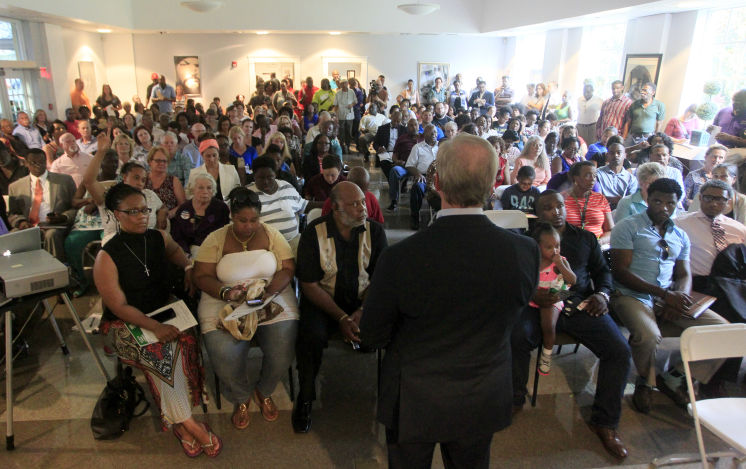
A Pinellas district event to address low-performing schools in south St. Petersburg draws a standing room only crowd, many of whom are skeptical about improvement plans.
By Lisa Gartner and Michael LaForgia
Photos by Dirk Shadd
Superintendent Mike Grego on Friday sought to reassure members of the city's black community in the wake of a Tampa Bay Times investigation that traced the district's role in resegregating five elementary schools and then turning them into some of the worst in Florida.
Speaking to a standing-room-only crowd of more than 150 parents, grandparents, community leaders and school employees, Grego described the steps he already has set in motion to improve the schools, including steering them more money and adding classroom aides, social workers and mental health counselors.
Some in the audience were skeptical.
"Stop coming and telling me stuff that makes me feel good," said Deveron Gibbons, a member of the board of trustees at St. Petersburg College. "You keep coming down here and telling me about your plan. Include these people in your plan. It's time to include us."
Echoing others in the crowd, Gibbons asked Grego why it took a newspaper series to get district leaders to visit St. Petersburg. "If your intent is to help this community, why did you not come here first?"
"It appears to me that this meeting was called as a means of damage control," said another audience member, retiree Moses Holmes. "What's the plan to help these kids?"
Retired teacher Myrna Starling, who taught at Maximo Elementary for 29 years, called on the district to shake up the student enrollment plan and once again bus students out of south St. Petersburg. She said airports, movie theaters and stores are no longer racially segregated.
"So why are we accepting black schools?" she said, referring to the School Board's vote to abandon integration in 2007. "Why have we had 7 or 8 years of this craziness?"
For his part, Grego repeatedly acknowledged the district's role in creating problems in the schools — Campbell Park, Fairmount Park, Lakewood, Maximo and Melrose — but urged the crowd to look forward instead of backward. "We have to stay together, and we have to stay united, and we have to begin to trust one another," Grego said.
Held at the Dr. Carter G. Woodson African American Museum on Ninth Avenue S, the meeting was billed as a chance to discuss the district's "solutions for low-performing schools."
Also present were St. Petersburg Mayor Rick Kriseman and School Board members Renee Flowers, Linda Lerner and Carol Cook. Not present at the meeting were Peggy O'Shea, who was traveling Friday, and Ken Peluso, who was recovering from surgery. Terry Krassner and Janet Clark also were not at the meeting. They didn't return calls for comment ahead of the forum.
The meeting came in the aftermath of "Failure Factories," a Times investigation that exposed the district's role in creating five of Florida's worst schools in the county's black neighborhoods.
The first installment showed that the five schools all were average in 2007, when the School Board voted for neighborhood schools. In the next eight years, they became the most segregated schools in the county — and their failure rates became among the highest in the state.
The second installment, published online Friday, revealed that violence and disruptions have spiraled out of control in the schools while district leaders neglected programs that would have made them safer.
Before the meeting, in their first public comments since the series began, three School Board members defended the district while expressing a willingness to consider new ways of improving the schools.
Lerner, the board chairwoman, said she wanted to study what other districts were doing to aid black children. Peluso pointed to solutions already in the works. O'Shea said she was open to considering a new student enrollment plan. "It is time to have more creative discussions," O'Shea said.
The forum was the latest move by a district seeking to reassure the county's black community.
After the Times series began, district officials launched a public relations campaign outlining efforts to improve the schools. They posted a documentary-style video on the district website that touted the schools' "sense of pride and belonging."
In spite of those efforts, leaders across the area are expressing outrage.
On Wednesday, State Rep. Darryl Rouson, D-St. Petersburg, called on the state Attorney General's Office to investigate whether the Pinellas school system has discriminated against black students.
On Tuesday, U.S. Rep. Kathy Castor, D-Tampa, asked the U.S. Department of Education to review whether Pinellas is equitably funding its most segregated schools, calling the situation a "crisis."
By Lisa Gartner, Michael LaForgia and Nathaniel Lash
Photos by Dirk Shadd
By Cara Fitzpatrick and Michael LaForgia
Photos by Dirk Shadd
By Cara Fitzpatrick, Lisa Gartner and Michael LaForgia
Photos by Dirk Shadd
Photos and multimedia by Dirk Shadd
Multimedia editing by Tracee Stockwell
Developed by Alexis N. Sanchez
The Pinellas County School District has corrupted the mission of fundamental schools. Created as a tool to promote integration and establish focused, disciplined learning environments in poor black neighborhoods, they have become exclusive schools that cater to white families. That happened not by chance but by policies adopted by the school district that discriminate against the very black students they were intended to help. This is wrong, and at the very least the district should provide buses to all fundamentals.
It is imperative to understand history to realize just how shabbily the Pinellas School Board has treated so many of its black students, from warehousing them in failing schools to shutting them out of successful ones.
For decades, black students bore the brunt of court-ordered busing for desegregation. So when the School Board closed the high-achieving Southside Fundamental Middle School in the heart of a black neighborhood in St. Petersburg — moving the program miles away to nearly all-white Madeira Beach — a fair-minded, forward-looking board would have provided busing to allow students from Midtown access to a program that once was within walking distance. But the board did not. Involved parents shouldn't have to own a car to demonstrate how much they care about their children's education. Buses should be provided to all fundamental students just as they are to students at speciality magnet schools.
And yet, that's just one of the many travesties the Tampa Bay Times series "Failure Factories" has exhaustively detailed in a school system that has shorted its African-American students again and again. It set up five elementary schools for failure by refusing to anticipate the challenges of letting those schools resegregate and become overwhelmingly low-income, facing serious problems, staff turnover and burnout. Across the district, African-American children are suspended at rates seen in virtually no other large school system in Florida. But the situation with back-to-basics fundamental schools, and Southside in particular, is arguably worst of all.
The Pinellas School Board closed the highly regarded Southside Fundamental in 2009, citing costs of keeping up the building, and moved the program to Madeira Beach. As Times staff writers Cara Fitzpatrick and Michael LaForgia reported, more than 26 percent of the students were black before the move. By this fall — including an expansion of the program to add kindergarten through fifth grade — only 30 of the school's 1,394 students were black. That's 2 percent. The bottom line: The School Board took a successful program that was wildly popular with African-American parents and students and literally moved it out of their reach.
This is the height of outrageous irony because fundamental schools — and magnet schools that offered special programs in the arts or sciences — were originally intended as a way of voluntarily desegregating Pinellas public schools.
In fact, in the 1980s in St. Petersburg, there were two fundamental elementaries (Lakeview and Childs Park) and one fundamental middle (Southside), and all were in predominantly black neighborhoods. They worked. Parents of all races and incomes clamored for their students to attend, and waiting lists grew.
Board members may forget, but their predecessors closed Childs Park Fundamental 20 years ago — citing costs of cleaning up mold and other problems — and moved it to Pasadena Elementary in a predominantly white area, a harbinger of what was to come years later for Southside.
School officials retorted then and will do so now that it is simply a matter of cost. But what is the cost of not giving those African-American students the chance at success they had at Southside? This was an opportunity that school officials snatched away. Officials will say that busing is not provided for fundamental students, that parents have to show their involvement, in part, by getting their children to school. A car is not a commitment. A parent's dedication is.
In the last decade as the district has added more than 3,000 fundamental seats, the number of black students has actually dropped by 12 percent, because the new seats are mostly outside of Midtown. The African-American share of total fundamental enrollment is half what it was a decade ago.
School officials will say they never meant for any of this to happen, that it is a series of unintended consequences of the decisions of well-meaning people. Worse, some don't even see the point. "I'm not a huge believer that having a black, Hispanic and white student sitting together improves education," said Carol Cook, a board member since 2000. She is wrong, and such tone-deaf attitudes show why the board keeps making these mistakes.
Throughout their early decades, Pinellas, St. Petersburg and their schools suffered from institutional racism. A century ago, a black man was lynched in downtown St. Petersburg. The city redlined its neighborhoods, dictating where African-Americans could and couldn't live. As recently as the 1950s, city directories listed African-American families with a "c" for colored. And, of course, the schools were segregated until federal courts intervened. It's only been 20 years since racial disturbances rocked Midtown and buildings burned.
Some will dismiss all of this as so much ancient history. But while those rules enforcing racism are long gone, their effects linger to this day in housing patterns — as well as in patterns of opportunity. That is why leaders of the school system and the city must consider this history in every decision.
No single vote might be intended to hurt black students. But that is the effect again and again. And failure to understand this history, to acknowledge it and to own it, means that school leaders will let history keep repeating itself. They should stop this cycle, first by providing busing to all fundamental schools, particularly so Midtown students can reach Madeira Beach Fundamental. That is an easy first step. The rest will be harder, but there is no moral alternative.
Despite years of attention, the Pinellas County School District's approach to student discipline remains seriously flawed and unquestionably imbalanced. Black students are suspended at rates far higher than in most other large school districts in Florida, often for vague offenses such as "defiance.'' There is strong evidence the rules are unevenly enforced, yet the School District stubbornly refuses to adopt widely accepted discipline strategies used by other districts. There has to be a better way.
In the latest installment of the ongoing series "Failure Factories,'' Tampa Bay Times staff writers Lisa Gartner, Michael LaForgia and Nathaniel Lash analyzed more than 600,000 punishments given to children in the district from 2010 to 2015. The trends are striking and disturbing. Pinellas schools give out-of-school suspensions to black students at four times the rate of other students. Schools have to be kept safe, but more than half of the suspensions given to black students were not for violent offenses but for nebulous infractions such as "not cooperating'' or "class disruption.'' The inescapable conclusion is that black students are more likely to get harsher punishments than other students for the same offenses.
The districtwide discipline findings are as disturbing as those in earlier installments of the Times series, which examined five high-poverty, high-minority, low-performing elementary schools in St. Petersburg. Those schools are among the worst in the state, where eight in 10 students fail reading and nine in 10 fail math. They were left behind as they were resegregated, and the district's failure to send additional staff and resources to them over the years created what U.S. Education Secretary Arne Duncan calls a "man-made disaster.''
Beyond the stark numbers, the common threads running through the Times series are particularly troubling. Pinellas School District officials and their defenders suggest Pinellas is no different from other large urban districts dealing with broad societal issues such as crime, poverty and single-parent homes. Yet Pinellas performs worse than nearly every other school district in Florida in educating black students, even when those districts are coping with higher poverty and more crime. The same trends are true with discipline. Black students are 17 percent more likely to be suspended in Pinellas than in Hillsborough County, 41 percent more likely than in Palm Beach County and 85 percent more likely than in Miami-Dade. The argument that Pinellas is no different from any other district in coping with these challenges does not hold up.
Second, Pinellas has had a bad habit of ignoring common approaches used by other school districts to help low-performing students, keep high-quality teachers in challenging schools and fairly discipline children. Unlike other Florida districts, it did not invest in real-time computer systems to track student discipline and performance, or significant bonuses for teachers in low-performing schools, or a special office focused on the success of minority students. Just last week, the Pinellas School Board approved hiring a new administrator to help oversee the efforts at the five failing St. Petersburg elementaries.
Pinellas also stubbornly stands apart in its approach to student discipline, which calls for every school to write its own discipline plan. The district is one of just two of Florida's 20 largest school districts that does not use a discipline matrix aimed at handing out more uniform punishments and making the process more colorblind. Miami-Dade does not give out-of-school suspensions. Hillsborough students are not disciplined for being in an "unauthorized location,'' yet Pinellas suspended children more than 1,700 times over five years for that infraction. Pinellas even prohibits suspended high school students from getting full credit for makeup work, a counterproductive policy dropped by other districts.
For too long, Pinellas considered itself to be no different from its peers in educating black students from poor families when the results were significantly worse. It resisted change while other districts invested, experimented and embraced common best practices. The students and the entire community have paid a terrible price for the neglect, and change still is not coming fast enough.
A systemic poisoning. A battlefield. Destroying futures. Those are the depressing descriptions former teachers use to recall how five south St. Petersburg elementary schools devolved after they were resegregated nearly a decade ago and became some of the worst-performing schools in Florida. Yet the Pinellas County School Board and a revolving door of superintendents did little or nothing to help, often embracing policies that made things worse. Superintendent Mike Grego has made significant strides in recruiting better teachers, expanding training and steering more resources to these schools. But it will take more money and a stronger commitment from the entire community to make a permanent difference.
The latest installment of the Tampa Bay Times investigation "Failure Factories" recounts the shameful systemic failure of a public school system. First it abandoned an expensive, unpopular school choice system in 2007 and watched these schools become overwhelmingly black and poor. Then it abandoned the teachers in those schools struggling with so many low-performing students, discipline issues and the high poverty. They were largely left to fend for themselves without additional staff and resources, creating what Education Secretary Arne Duncan aptly described Friday as a "manmade disaster.''
The teaching faculty was decimated by high turnover at Melrose, Campbell Park, Fairmount Park, Lakewood and Maximo elementaries. Times staff writers Cara Fitzpatrick, Michael LaForgia and Adam Playford reported teachers were less experienced, less likely to stay and more likely to have employment issues than teachers in whiter, more affluent schools. More than 100 teachers with 10 or more years' experience have left the five schools since 2008. Such chaos created environments where student discipline was a constant problem and at least eight in 10 students failed reading or math.
This was worse than benign neglect by an indifferent school district. As these schools suffered, the district offered teachers no extra support or money between 2008 and 2012. Openings for teachers first had to be filled from a pool of teachers who were transferred involuntarily from other schools in the district, including those forced out because of poor performance. One superintendent, Clayton Wilcox, said he was against incentive pay for teachers in challenging schools. An interim superintendent, John Stewart, dismantled a well-regarded teacher training partnership with the University of Florida after School Board members complained about the cost.
To his credit, Grego has been far more aggressive addressing these issues. He installed experienced principals, gave them more discretion over hiring and firing teachers, and added resources such as classroom aides, counselors and social workers. He recognizes the importance of adding experienced, well-trained teachers and he got rid of the involuntary transfer pool. Teacher turnover has been cut almost in half, and this year for the first time $3,000 teacher recruitment bonuses are being offered at all five elementaries — plus another $4,000 bonus if the teachers stay at least three years. That is a solid start, but there is much more to be done.
From Jacksonville to Miami to Tampa, other large school districts offer thousands of dollars more than Pinellas in incentive pay and bonuses to teach in struggling schools. There has to be a sustained commitment to more teacher training. The network of classroom aides, counselors and social workers has to remain in place. After years of negligence by the School Board and previous superintendents, it is going to take years of devoting the human and financial capital necessary to make up lost ground and transform these schools. Our children and our neighborhoods deserve no less.
They don't get it. The Pinellas County School Board, superintendent Mike Grego and the Pinellas Education Foundation don't grasp the severity of the crisis in failing south St. Petersburg elementary schools, the desperate demand in the community for change or the scope of the response required for meaningful improvements. If they don't listen more, think bigger and act faster, it will take the federal government or the courts to deliver hope and a quality public education to students who deserve better.
A yearlong Tampa Bay Times investigation of five predominantly black, poor elementary schools and how they have fared since Pinellas abandoned integration efforts in 2007 has triggered a powerful public reaction. Academically, the schools are among the worst in the state, with eight in 10 students failing reading and nine in 10 failing math. In 2014, there were more violent incidents at these five elementary schools than in Pinellas County's 17 high schools combined. The individual stories from children struggling to learn and fearing for their safety, and from their parents seeking better for their kids, are gut-wrenching pleas for help.
Yet the school district's response has been less robust, too defensive and astoundingly tone deaf. Grego kicked off a crowded community meeting Friday night with a 45-minute PowerPoint presentation better suited for bureaucrats that focused on improvements already in place. The Pinellas Education Foundation chair distributed a two-page letter this week listing its worthy initiatives and complaining "a negative perception now dampens spirits" at the beginning of the school year. Most disappointing has been the reaction by School Board Chairwoman Linda Lerner, who was first elected to the board 25 years ago and has transformed from a progressive bright light to an apologist for a district that has failed its neediest children.
"Absolutely, the students at those five schools are among the very most struggling students in the state,'' Lerner said at Tuesday's School Board meeting. "I understand that. But just to clarify, many of them can read and do math.''
Just to clarify: Many of them cannot read and do math at grade level. Look at the test scores. Visit a classroom. Ask their teachers.
It is a mistake for the school district to focus on damage control. Grego and the School Board can take credit for recent initiatives to steer more human and financial resources to the county's most segregated elementaries: Melrose, Maximo, Lakewood, Campbell Park and Fairmount Park. But the size of their efforts does not match the magnitude of the challenge. There has been an outpouring of public concern for these schools that stretches far beyond their neighborhoods, and the district would be better served by capitalizing on this opportunity to enlist businesses, families and city government in a broader effort to more quickly make a real difference.
Fortunately, waiting for an epiphany by an insular school district is not the only option. U.S. Sen. Bill Nelson and U.S. Rep. Kathy Castor, D-Tampa, have asked the U.S. Department of Education to intervene and examine questions about funding and education quality. The Concerned Organization for Quality Education of Black Students, the court-approved group assigned to monitor and enforce the school district's commitment to a quality education for black students, has finally lost its patience with the lack of progress. Rick Escarraz, the lawyer who represents the plaintiffs in a 1964 federal desegregation lawsuit, has heard the frustrations of black families and demanded improvements.
The federal government and the courts should not have to force Pinellas County to make the large-scale investment needed to improve these elementary schools and provide a quality education to black students in the poorest neighborhoods. But the school district has yet to rise to the challenge, and intervention from Washington or a federal judge may be the last options left.
Children cannot be expected to learn when they fear being bullied or physically attacked by other students. Yet for years, students in five of St. Petersburg's poorest, predominantly black elementary schools struggled in often violent classrooms as teachers received little training and even less help in keeping order. While some progress has been made in restoring discipline, the Pinellas County School District should redouble its efforts as school opens this week to ensure that all students are safe.
No student in any school should have to cope with the dangerous situations described by Tampa Bay Times staff writers Lisa Gartner and Michael LaForgia. The heartbreaking examples of students who were verbally abused or physically attacked in these elementary schools in recent years would not be tolerated at more affluent schools in Pinellas or elsewhere. Yet for years helpless parents too often felt they had no choice but to move and find other schools where their children could learn without fear.
Every school has its discipline issues, but violent incidents in these elementary schools have more than doubled since 2010 as they have dropped at other Pinellas schools. One statistic particularly stands out: In 2014, there were more violent incidents at these five south St. Petersburg elementary schools than in Pinellas County's 17 high schools combined. No wonder eight in 10 students failed reading and nine in 10 failed math at Campbell Park, Fairmount Park, Lakewood, Maximo and Melrose elementaries. They were too scared to learn, and the teachers were too busy struggling to keep order to focus on academics.
This is an egregious example of institutional neglect for years by an out-of-touch district administration. Discipline incidents were underreported to the state in apparent violation of state law, creating the impression that the schools were safer than parents and teachers knew they were from firsthand experience. Staffing was not beefed up, and technology such as panic buttons is going first to other schools. Teachers were often inexperienced and not properly trained to handle such disruptive or disturbed students. And when they called for help from school administrators, too often that help was delayed or never came.
This is what happens when the poorest children in need of the most services are clustered in the same schools — which is exactly what Pinellas did when it abandoned an unpopular school choice program in 2007, resegregated the schools and failed to deliver on its promises of a quality education and a safe environment. This is what happens when a school district does not provide the additional human and financial capital to deal with such overwhelming need. This is what happens when School Board members and district administrators do not recognize that too many black families are not happy in these schools but feel trapped in them and fear for the safety of their children.
The answers are not adding police officers to elementary schools, mass arrests of such young students or drastically increasing out-of-school suspensions that leave students further behind academically. Education experts say restoring discipline and improving student safety involves better teacher training, more immediate responses to help teachers when situations escalate, clearer discipline policies, and more counselors and other resources to address the root causes of disruptive behavior. Other school districts have figured this out, and so should Pinellas.
There are glimmers of hope. The principals at these elementary schools say they are confident most of their students are safe. Pinellas superintendent Mike Grego says the errors on reporting discipline cases to the state have been fixed, and a uniform behavior management system for teachers and administrators is in place. Extra counselors and specialists finally have been added at these five schools. Student referrals for violent behavior, though still remarkably high, are down from previous years.
Schools have a paramount duty to ensure the safety of their students, and there remains much work to do at these five poor, black elementary schools as classes resume this week. Asked at a Times editorial board meeting last week if he would send a 5-year-old to one of these schools, Grego answered unequivocally answered, "Yes.''
Would you?
Strong magnet schools with imaginative themes are excellent ways to promote racial diversity, energize students and stimulate learning environments. The best ones require a substantial commitment of time and money, and it can take years for them to fully blossom. The failing elementary schools in St. Petersburg that are overwhelmingly black and poor don't have that much time, and Pinellas County school superintendent Mike Grego's proposal to convert three of those schools into magnet programs lacks the sense of urgency needed to confront an immediate crisis.
Grego told the Tampa Bay Times editorial board Tuesday that establishing magnet programs at Lakewood, Fairmount Park and Maximo elementaries are a "piece of the puzzle'' that would help improve academic achievement. They are among the five elementary schools featured by the Times in a yearlong investigation that examined how those schools have become some of the worst in Florida, even as schools elsewhere are achieving better academic results in communities with greater poverty and higher crime rates. The five elementary schools in south St. Petersburg have become even more segregated and under-performing since 2007, when the school district scrapped an unpopular school choice program and then failed to deliver on promises of more money and resources.
Pinellas County has had success with magnet schools over the years, including the long-popular arts magnet at Perkins Elementary and the more recent Sanderlin PK-8 IB World School in south St. Petersburg. They encourage diversity, attract parents focused on their child's education and create engaging learning environments that often lead to higher student performance. But Grego acknowledges new magnets at these three failing elementary schools could take three years to launch — and they will take longer than that to take root among Pinellas families searching for the best options for their kids.
The children in those five schools cannot afford to wait that long. Those five schools are among the 15 worst in Florida. Eight in 10 students at those schools fail reading and nine in 10 fail math. Grego insists there is a sense of urgency to improve these elementary schools and points to changes he already has made, from replacing principals to changing teacher recruitment. He says there is more parental involvement now at Melrose and Campbell Park, and every child at Campbell Park this year is moving from kindergarten to first grade ready to work at grade level. Those are positive developments. But Grego's optimism does not reflect the latest test results or the serious concerns raised by U.S. Rep. Kathy Castor, D-Tampa, whose district covers much of south St. Petersburg; St. Petersburg Mayor Rick Kriseman; and many parents whose children attend those schools.
To her credit, Castor is asking the U.S. Department of Education to review how the school district is spending federal money in those five elementary schools and the overall quality of education of their students. The Times reported Sunday that in some recent years some of these schools received less state and local money than more affluent, better-performing Pinellas schools. Federal money that was supposed to be used for enhancements was used to make up the difference. Grego said Tuesday that these five elementary schools now are receiving $5.2 million "above and beyond" what other schools are getting to pay for extended learning time before and after school, and for other programs. An independent review by the federal government would be useful.
Schools with such serious issues and low-performing students cannot be turned around on a dime. But more needs to be done for these five St. Petersburg elementary schools now. Those kids and their families cannot wait three years for new magnet programs.
Seventeen years ago, this newspaper published a series of editorials about the consequences of ending the court-ordered busing plan that had been in place for 27 years in Pinellas County. The School Board had asked U.S. District Judge Stephen Merryday to lift the busing order and the rigid racial ratios for the county's public schools, and it was clear a new era was about to dawn. The Times has long supported school integration, and those 1998 editorials spoke of our collective moral obligation to continue to promote diversity and provide all Pinellas children with a quality education. "For too long we have valued desegregation ratios more than the education of African-American children. Now the School Board is saying the price of better education is less integration. Many parents are prepared to accept that. Our concern is that, in the end, the result could be less integration, with little or no improvement in the education of African-American children. That would be a cruel betrayal of black parents and their children, and a tragedy for all of Pinellas.'' That tragedy is now upon us.
It is worse than anyone could have imagined 17 years ago. It is worse than most anyone expected eight years ago when the School Board — with this editorial board's support — abandoned an expensive, unpopular school choice plan that served as a rickety bridge between the strict court-ordered busing of the past and today's resegregated neighborhood schools. The Pinellas school district, with its revolving door of superintendents and unimaginative School Board, has failed to deliver on its promises to African-American families. And we are failing to meet our moral obligation to provide a quality education for all of our children.
A yearlong Times investigation details how far black students have fallen behind in Pinellas. Overall, they are failing at higher rates than black children in virtually every other school district in Florida. In St. Petersburg, five elementary schools that are overwhelmingly black and poor are among the 15 worst in the state: Melrose, Fairmount Park, Maximo, Lakewood and Campbell Park. In those schools, eight in 10 students fail reading and nine in 10 fail math. The downward slide has been clear for years as teachers attempted to flee those schools and black parents desperately searched for better options. Yet the School Board has not invested enough and the broader community has not raised its voice enough to treat this embarrassment as a crisis.
The familiar excuses for failing schools ring hollow. It is not a lack of school readiness in the youngest students. As Times staff writers Cara Fitzpatrick, Lisa Gartner and Michael LaForgia report, the students arriving at the most segregated schools in Pinellas are no less prepared than students in other high-poverty schools. It is not poverty; the poverty rate among blacks in Pinellas is lower than in counties such as Alachua and Volusia. It is not crime; the crime rate in St. Petersburg is lower than in Orlando, Daytona Beach and other places. Yet black students in Pinellas and particularly in St. Petersburg are failing at higher rates than black students most anywhere else in the state.
What is clear is that the Pinellas School Board failed in recent years to invest enough financial and human capital in the most segregated, underperforming elementary schools. The teachers at those schools are among the least experienced and promises for more robust programs went unfulfilled or were abandoned. Other large counties, from Broward to Duval to Orange, have invested in real-time computer systems to track student discipline and performance, or significant bonuses for teachers in low-performing schools, or a special office focused on the success of minority students. Pinellas offers none of those programs, and in some recent years some of the worst-performing schools actually received less state and local money than more affluent, better-performing schools. That is worse than benign n eglect.
To his credit, Pinellas superintendent Mike Grego is not satisfied and has moved more aggressively since he was hired in 2012. He has launched initiatives in the five St. Petersburg elementary schools that include extended learning programs, more summer instruction and more direct connections to outside services. Some principals have been replaced and there is a sense of urgency in some of the schools that has not been there in previous years.
It is not enough. Grego cannot turn this around alone. The School Board has to be more willing to invest human and financial resources, particularly in these five St. Petersburg elementary schools. St. Petersburg Mayor Rick Kriseman and the City Council have to become more engaged. So does the business community. This is a priority that should unite us all for a common purpose.
As this editorial board wrote 17 years ago as it looked ahead to the end of court-ordered busing, "Once the court order is lifted, we will have nothing to guide us but our values and our moral obligation to do right by all our children.''
For black students in Pinellas County, we are not meeting our obligation.
The School Board downplays the issue, then hires an educator to fix it.
By Cara Fitzpatrick, Michael LaForgia and Colleen Wright
LARGO — The Pinellas County School Board on Tuesday aired a video in which local business leaders praised district officials and downplayed the troubles at five failing elementary schools in south St. Petersburg. Minutes later, however, board members voted to hire a new administrator whose job will be to help turn those schools around.
The moves sent conflicting signals about how board members view the condition of the five schools, even as superintendent Mike Grego works to fix them.
Board member Linda Lerner said the video shows "what's really happening."
But key members of St. Petersburg's black community said that the district isn't doing enough. Lawyers for Concerned Organization for Quality Education of Black Students, known as COQEBS, filed a motion Tuesday to resurrect a 15-year-old classaction lawsuit, saying the school district has fallen down on legal commitments to aid struggling black students districtwide.
Lerner said that board members were instructed by the district's attorney not to comment on the legal action.
The yearlong Tampa Bay Times investigation, "Failure Factories," showed how the school district abandoned integration efforts in 2007 and then failed to follow through with promised resources for elementary schools that became predominantly poor and black. Today, the five schools — Campbell Park, Fairmount Park, Lakewood, Maximo and Melrose — are the county's most segregated and are failing at rates far worse than almost any other schools in Florida. Dozens of schools with similar demographics outperform them.
The series also detailed how violence and disruption in the schools soared and experienced teachers fled after 2007. Last year, there were more violent incidents in the five schools than in all of the county's 17 high schools combined.
In the two-minute video shown at Tuesday's board meeting, Pinellas Education Foundation chairwoman Cathy Collins said the reports caused some of the group's members to worry about what they would see on a bus tour last month to Campbell Park and Maximo. Foundation members spent about an hour at each school. They visited classrooms, spoke to some teachers and students, and watched a dance performance at Maximo.
"I was pretty confident that things would be in order and that there was progress being made, because I have watched the leadership of Mike Grego over the last three years, and he is a true leader," Collins said in the video. "And there is no way that some of the issues that were described in those articles were going on in those schools."
Reached by phone Tuesday, Collins said the tour was the first time she had been in any of the five schools. She said she was pleased to see that the two schools on the tour were "amazingly clean and well put together."
"Melrose was like a college campus," she said.
When a reporter reminded Collins that she had been at Maximo, not Melrose, she said her description of the school as a college campus "might be overstating it." She said she couldn't "validate" data used by the state Department of Education to rank the five schools in the bottom 15 of all elementary schools in Florida.
"We were just doing a tour of the physical plant," she said. "We felt good about what we saw."
Debra Faulk, a foundation member, said in the video that the schools had been "represented" as underperforming, but "we saw just the opposite." Faulk couldn't be reached for comment.
After the video played, Lerner read aloud a few sentences from a letter written by foundation member Alex McKenna. In it, McKenna wrote that the "public is being held hostage to information which does a disservice to children" and said it was time to "debunk the Failure Factories myth."
Reached on Tuesday, McKenna said that he, too, hadn't visited any of the schools before the guided tour. He also was impressed by how clean they were. He said he couldn't speak to test scores and discipline referrals.
He said he could only comment about what he saw — happy teachers and engaged students.
"Overall, there's a movement here that says progress," he said. "I saw more success there than failure. Maybe I'm wrong."
The foundation is funding 25 Florida prepaid college scholarships for students in the five schools through its Take Stock in Children program.
After the board meeting Tuesday, Grego said there shouldn't be any confusion about how much work needs to be done to improve the schools. He said the purpose of the video was to highlight the positive experiences that foundation members had on the tour.
"Everything is not fine. I don't think anyone thinks that. I hope nobody walks away with that," he said.
Grego said that the role of the new administrator hired Tuesday will be to oversee improvement efforts in the schools and build on the work that's already taking place. As director of school leadership, Antonio Burt, a former principal and "turnaround" leader, will provide "day-to-day guidance" to principals, help recruit and retain good teachers, and monitor academic progress. His annual salary will be about $98,000.
The board approved the hiring with no discussion.
Burt most recently served as an administrator in Tennessee's Achievement School District, which was created to improve the bottom 5 percent of schools in the state.
Ricardo Davis, head of COQEBS, said on Monday that were was a "lack of clarity" about how the new role would fit into other district initiatives. But he said the issue of black student achievement wasn't limited to the five schools and there hasn't been enough improvement over the years.
Because of that, COQEBS, the plaintiff in Crowley vs. the Pinellas County School Board, is asking a state judge to force the school district to spend more money and resources on closing the gap in test scores between black students and other students in the district.
"The School Board, despite five years of negotiations with COQEBS, has failed and refused to find programs and ways to reduce and eliminate the achievement gap," the group's attorney, Guy Burns, wrote in the court motion filed Tuesday. "The Florida Constitution's promise of a high quality education has been broken, and the problem is both chronic and urgent."
A judge has yet to schedule a hearing on the motion.
A “turnaround” specialist is hired to improve the county’s five lowest-rated elementaries.
By Cara Fitzpatrick
Faced with five of the lowest-performing elementary schools in Florida, Pinellas County school superintendent Mike Grego is hiring a new administrator to oversee improvement efforts.
As director of school leadership, Antonio Burt, a former principal and "turnaround" leader, will provide "day-to-day guidance" to principals, help recruit and retain good teachers, and monitor academic progress.
For now, his focus will be only on Campbell Park, Fairmount Park, Lakewood, Maximo and Melrose elementary schools — the schools featured in "Failure Factories," a yearlong investigation by the Tampa Bay Times.
The series has detailed how the school district abandoned integration efforts in 2007 and then failed to provide promised resources for the five schools, which became predominantly black and poor. Today, the schools are failing at rates worse than almost any other schools in Florida.
The Times also detailed how violence and disruption soared at the schools and teachers fled after 2007. The five schools now have the hardest time finding and keeping experienced teachers.
In his new job, Burt will be responsible for addressing many of those issues. That includes helping principals create school improvement plans, monitor the use of behavior management programs and ensure that employee training programs are relevant.
Grego said Burt's role will be similar to a coach, and he will be based largely at the schools in St. Petersburg, not district headquarters in Largo. The goal is to make improvements as fast as possible, he said.
"He will spend the majority of his time at those five schools," Grego said.
Black leaders said Monday that they had reservations about the new position.
Ricardo Davis, head of the Concerned Organization for Quality Education of Black Students, said he had a lot of questions about how the new position would fit into other strategies for improving the five schools and black student achievement overall.
"At the end of the day, whatever the district does or doesn't do, the question is: How does that change what's happening in the classrooms with these children?" he said. "That's the important question."
The Rev. Manuel Sykes of Bethel Community Baptist Church in St. Petersburg said he thought it could help if one person focused on the schools' needs. But he said that person would need to be free to try new ideas, rather than enforce old strategies.
"When you look at what works nationally, it's not what our current strategies are," he said.
Grego, who was hired in 2012, eliminated a similar job, the turnaround officer, eight months into his tenure. He shifted the responsibilities to another administrator. At the time, he said improving low-performing schools was "everyone's responsibility."
Grego said Monday that the new position doesn't represent a change in philosophy. Everyone still is involved in the improvement efforts at low-performing schools. He said Burt's role will be to build on the work of TNTP, a nonprofit group that the district hired in January to train teachers and administrators in the five schools.
"He's truly training and elevating the strength of the leadership," Grego said.
District officials advertised the new position in late October, interviewing three finalists for the job in mid November. Burt will start in late January, pending School Board approval today. He will make about $98,000 a year.
Burt currently serves as an administrator in Tennessee's Achievement School District, which was created to improve the bottom 5 percent of schools in the state.
He has worked in education for a dozen years, and as a principal, he helped make dramatic improvements at one of Tennessee's lowest-performing elementary schools. He also worked briefly as a leadership coach with TNTP.
The new job is Grego's latest effort to improve the five elementary schools in south St. Petersburg. He has replaced principals, stepped up teacher training and added classroom aides and mental health counselors. He is working on long-term plans to transform three of the neighborhood schools into magnet programs. He also created a broad plan to improve black student achievement districtwide.
Data reporter Nathaniel Lash, researcher Caryn Baird and data director Adam Playford contributed to this report.
January 25, 2016
To the Judges:
Just five days after the Tampa Bay Times published “Failure Factories,” the opening of its investigation into the re-segregation of Pinellas County schools and the neglect of black students, the superintendent stood before a meeting of angry parents and grandparents. He told the crowd things weren’t so bad, or at least were getting better.
Audience members shook their heads in disgust. “Stop coming and telling me stuff that makes me feel good,” said one community leader. A retiree stood up and quieted the room with a simple, poignant question: “What’s the plan to help these kids?”
For years, the people in charge of Pinellas County schools blamed abysmal black academic performance on poverty. They excused it as the natural state of things, saying it was no different than the challenges faced by any other school system across the nation.
Nothing could be further from the truth. The Tampa Bay Times investigation found that in just the past seven years, school leaders – through their actions, their neglect and a blind-eye to the consequences of both – created five of the worst schools in Florida. Compared with black students in urban and rural communities poorer and socially rougher, the kids in well-to-do Pinellas fared badly, the Times found.
A team of Times reporters spent 18 months analyzing millions of rows of data on black student performance and behavior. The reporters embedded in historically black neighborhoods for months to chart the personal stories of hundreds of students and teachers from the schools. Then they interviewed top officials and gathered documents from the 20 largest school systems in Florida to compare them to Pinellas County.
That deep journalistic dive revealed the genesis and consequences of the problem. School leaders abandoned integration. Then, when five schools became overwhelmingly black and poor, the district neglected the schools until they essentially became “failure factories.” The power of the stories and digital graphics was their clarity:
Pinellas County has the highest concentration of black student failure in all of Florida.
Black students here get the least qualified teachers, go to school on the most violent campuses and are far more likely to be suspended for minor infractions.
The school board broke promises of money and resources. Then as black children started failing at outrageous rates, as overstressed teachers walked off the job, as middle class families fled en masse — the board failed to act and refused to embrace the best practices underway in school districts across the state.
No Times investigative series in recent memory has led to so much action in such a short time.
U.S. Sen. Bill Nelson and U.S. Rep. Kathy Castor called for an investigation into the district’s use of federal Title I dollars. That investigation is underway.
U.S. Secretary of Education Arne Duncan read the series, flew to St. Petersburg and met with many of the families mentioned in the stories. He publicly chastised the School Board, accusing the district of “educational malpractice.” He has vowed to follow-up.
Despite a largely defensive posture toward the stories, school officials, acknowledged the broader issues and have taken the following actions:
1) The school board hired a turnaround specialist at a salary of $100,000 specifically responsible for improving the schools and ensuring they get attention and resources.
2) The district announced plans to convert three of the schools into magnet programs to improve diversity and attract better teachers.
3) The district said it will expand the ranks of teacher’s aides and committed to direct more resources to training and recruitment.
There was widespread reaction outside the school district offices, as well. Local businesses including the Tampa Bay Rays baseball team turned out in force to help, investing thousands of dollars and hundreds of volunteer hours in the struggling schools.
Maybe most importantly, the Times’ journalism has brought new light to the consequences and subtleties of structural racism. Too many people wrote off the five schools as just a sad social fact of life. The Times didn’t settle for that.
I am very proud to submit Failure Factories for your consideration.
Sincerely,
Neil Brown