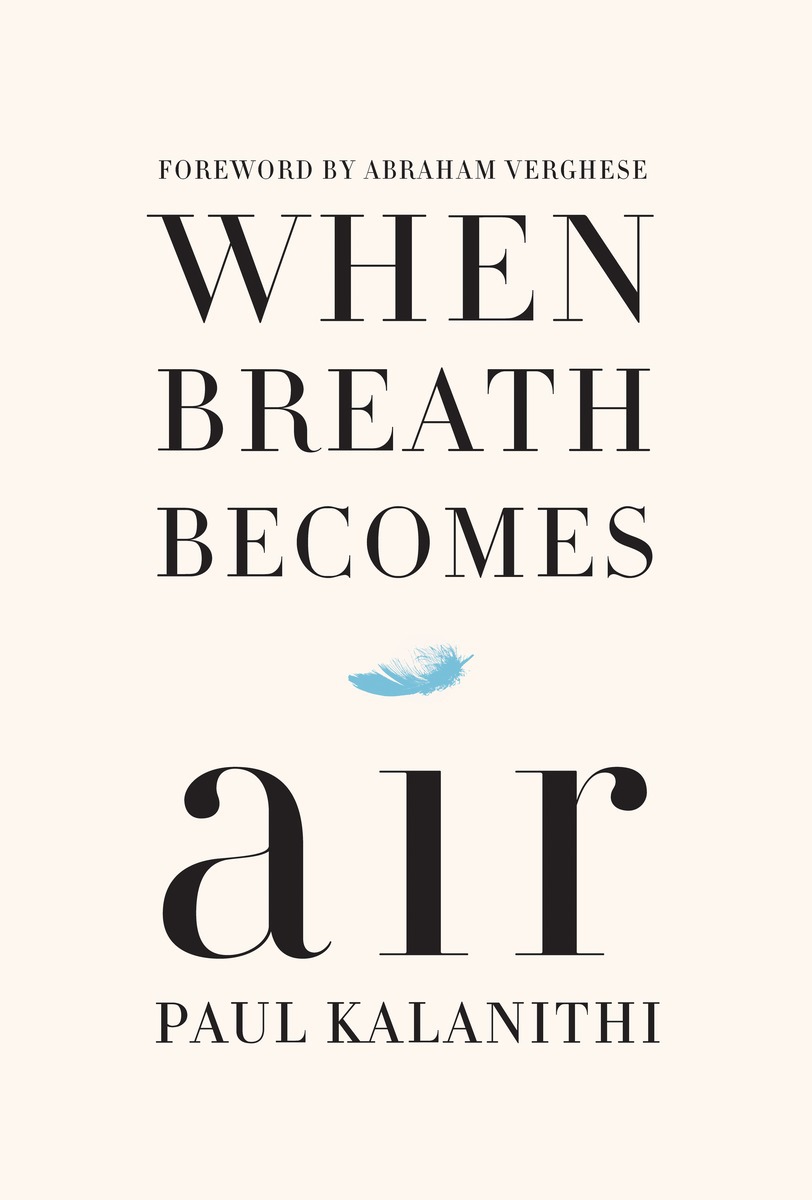
Finalist: When Breath Becomes Air, by the late Paul Kalanithi (Random House)

For an elegant memoir of the author’s turn from gifted physician to terminal patient, told without a hint of bravado or self-pity.

Nominated Work

When Breath Becomes Air

At the age of thirty-six, on the verge of completing a decade’s worth of training as a neurosurgeon, Paul Kalanithi was diagnosed with stage IV lung cancer. One day he was a doctor treating the dying, and the next he was a patient struggling to live. And just like that, the future he and his wife had imagined evaporated. When Breath Becomes Air chronicles Kalanithi’s transformation from a naïve medical student “possessed,” as he wrote, “by the question of what, given that all organisms die, makes a virtuous and meaningful life” into a neurosurgeon at Stanford working in the brain, the most critical place for human identity, and finally into a patient and new father confronting his own mortality.

What makes life worth living in the face of death? What do you do when the future, no longer a ladder toward your goals in life, flattens out into a perpetual present? What does it mean to have a child, to nurture a new life as another fades away? These are some of the questions Kalanithi wrestles with in this profoundly moving, exquisitely observed memoir.

Paul Kalanithi died in March 2015, while working on this book, yet his words live on as a guide and a gift to us all. “I began to realize that coming face to face with my own mortality, in a sense, had changed nothing and everything,” he wrote. “Seven words from Samuel Beckett began to repeat in my head: ‘I can’t go on. I’ll go on.’” When Breath Becomes Air is an unforgettable, life-affirming reflection on the challenge of facing death and on the relationship between doctor and patient, from a brilliant writer who became both.

-- from the publisher
Biography

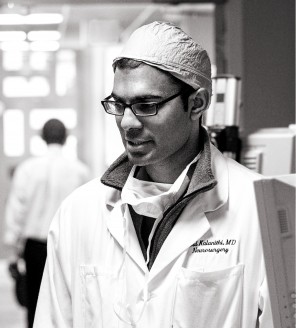
Paul Kalanithi was a neurosurgeon and writer. He graduated from Stanford with a B.A. and M.A. in English literature and a B.A. in human biology. He earned an M.Phil in the history and philosophy of science and medicine from Cambridge and graduated cum laude from the Yale School of Medicine, where he was inducted into the Alpha Omega Alpha national medical honor society. He returned to Stanford to complete his residency training in neurological surgery and a postdoctoral fellowship in neuroscience, and received the American Academy of Neurological Surgery's highest award for resident research. He died in March 2015. He is survived by his family, including his wife Lucy, and their daughter Elizabeth Acadia.

Winners

Prize Winner in Biography in 2017:

Hisham Matar

For a first-person elegy for home and father that examines with controlled emotion the past and present of an embattled region. Biography

Finalists

Nominated as finalists in Biography in 2017:

Susan Faludi

For an extraordinary familial study of history, religion and gender that becomes, in the end, a parable of understanding and forgiveness.

The Jury

Gretchen Holbrook Gerzina(Chair)

Dean, Commonwealth Honors College and Paul Murray Kendall Professor of Biography

Megan Marshall*

Charles Wesley Emerson College Professor of Writing, Literature and Publishing

David M. Oshinsky*

Director, Division of Medical Humanities and Professor of History and Medicine

Winners in Biography

William Finnegan

A finely crafted memoir of a youthful obsession that has propelled the author through a distinguished writing career.

David I. Kertzer

An engrossing dual biography that uses recently opened Vatican archives to shed light on two men who exercised nearly absolute power over their realms.

Megan Marshall

A richly researched book that tells the remarkable story of a 19th century author, journalist, critic and pioneering advocate of women's rights who died in a shipwreck.

Tom Reiss

A compelling story of a forgotten swashbuckling hero of mixed race whose bold exploits were captured by his son, Alexander Dumas, in famous 19th century novels.

2017 Prize Winners

C. J. Chivers

For showing, through an artful accumulation of fact and detail, that a Marine’s postwar descent into violence reflected neither the actions of a simple criminal nor a stereotypical case of PTSD.

Peggy Noonan

For rising to the moment with beautifully rendered columns that connected readers to the shared virtues of Americans during one of the nation’s most divisive political campaigns.

Hilton Als

For bold and original reviews that strove to put stage dramas within a real-world cultural context, particularly the shifting landscape of gender, sexuality and race.

Art Cullen

For editorials fueled by tenacious reporting, impressive expertise and engaging writing that successfully challenged powerful corporate agricultural interests in Iowa.