Finalist: The Washington Post, by Eli Saslow
Nominated Work
Paul Gayle had no job, no money, a new baby and 16 lessons from the Obama administration to teach him what to do next
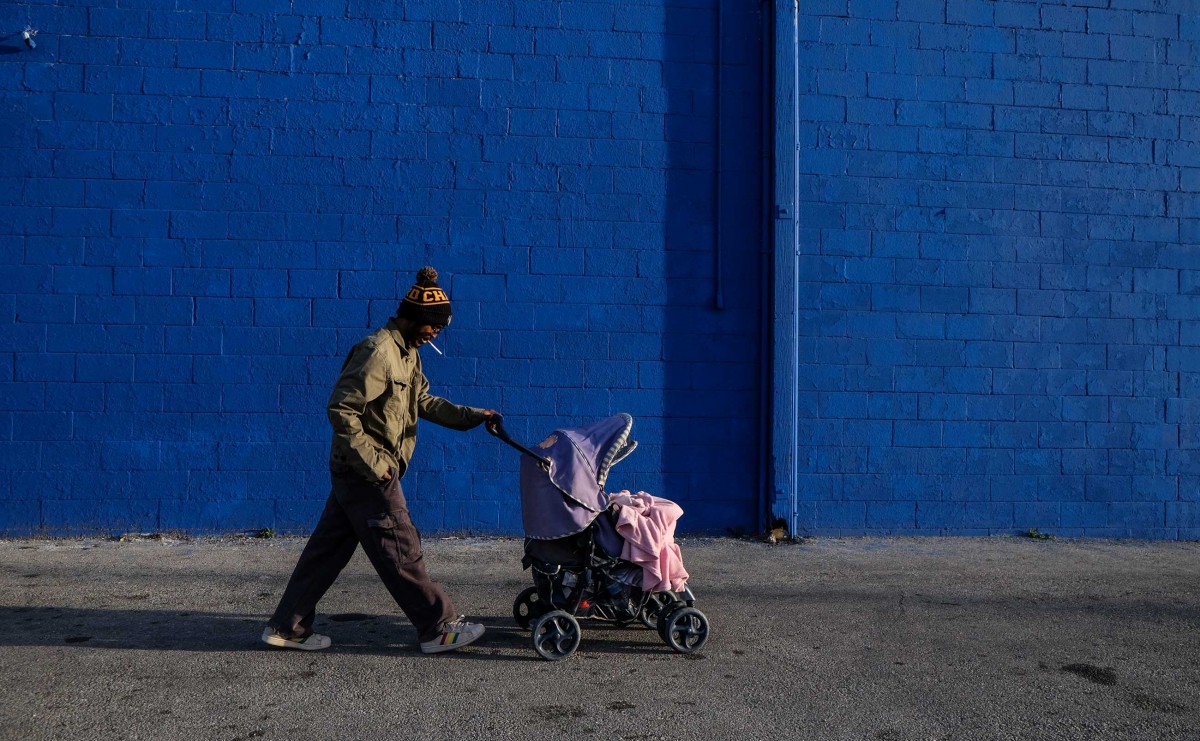
Paul Gayle and his daughter head home after a fatherhood development class at the nonprofit Next Door Foundation. (Jahi Chikwendiu)
By Eli Saslow
In Milwaukee
The last student to arrive for fatherhood class was the only one holding a baby, and a dozen men looked up from their desks to stare. Paul Gayle, 19, had a pink diaper bag hanging off a shoulder decorated with tattoos of marijuana leaves, and a crying 7-month-old in his arms. “Come on, girl, chill out,” Paul said, carrying the baby to a seat in the corner. He offered her a rattle, and she swatted it away. He gave her a bottle, and she only cried louder. Finally, he reached into the diaper bag and took out a pacifier for her and a shot of Goody’s Headache Relief for himself.
“Sorry for the noise, y’all,” he said. “We’re both a little mad at the world today.”
“No problem,” the teacher said. “I’m up here talking about being a dad, and you’re doing it.”
“I’m trying,” Paul said. “But damn.”
He had pushed a creaky stroller through one of Milwaukee’s worst neighborhoods and ridden a bus across the city not because he wanted to attend a class called Fragile Families and Responsible Fatherhood, but because, like everyone else in the room, he saw no other choice. Some of the men had been told to take the class as a condition of visiting their estranged children. Others had been lured by the promise of job referrals or reduced child-support payments. Paul had come mostly because of the promise of free baby supplies, and lately he had been purchasing his Pampers one at a time, repeating the same transaction so often at a corner store that a clerk had dubbed it the Daddy Paul Special, 75 cents for a single cigarette and a size-3 diaper.
Here in one of America’s most segregated cities, the biweekly fatherhood class has become President Obama’s preferred antidote to so many of the problems facing black men. His administration approved the 16-course curriculum and devoted more than $500 million to funding hundreds of fatherhood classes around the country. One of the biggest grants went to North Milwaukee, where, according to studies of census data, black children face disadvantages that accumulate from birth: three times as likely as white children to die in their first year; five times as likely to live with a single parent; nine times as likely to attend failing schools; 15 times as likely to live in poverty; 18 times as likely to go to prison. “Strong fathers can be the first and best step toward fixing these communities and helping our children reach their goals,” Obama said last year while promoting the classes.
Paul had written down his goals as part of an exercise on the first day of class: “Brush Sapphire’s teeth every night.” “Stay calm.” “Find a stable apartment.” “Get a job — any.”
Now it was his 15th class, nearing the end, and despite the hopeful language in a course guide — “End the cycle of intergenerational poverty!” “Help turn your child turn into a success story in 16 lessons.” — so much about his life remained unstable. He had moved nine times in seven months. He had been offered two jobs but failed the drug tests. It had been several days since he had seen the baby’s mother, a former longtime girlfriend who was no longer living with them. “Sapphire misses you. Are you coming over to see her??” he had texted once, and the silence that followed made him think Sapphire might become another black child whose long odds depended on a single parent, and that parent was him.
In the first fatherhood class he had recited 20 strategies for managing anger. In the fifth he had role-played effective methods of child discipline; “Say ‘no’ firmly and repeat as necessary,” the course book read. Now the teacher asked the students to stand for a group exercise, so Paul grabbed the baby and joined his classmates in the center of the room. The teacher said he would read a series of “value statements,” and students would go to the right side of the room if they agreed with the statement, the left side if they disagreed or stay in the center if they were unsure. “Men and women are equally capable of caring for children,” the teacher said, and all at once the men began to move, half to the right and half to the left, jarring at each other as they went. “Oh, hell, no,” one said. “Damn right I’m capable,” said another. Paul stood alone in the center of the room, unsure.
“A man who cries easily is weak,” the teacher said, and the men hurried around the room again.
“It’s okay to use violence if you’re disrespected,” the teacher said.
“A man should be willing to take any job to support his children.”
Paul still stood alone in the center of the room, watching everyone move, cradling the baby against his shoulder. “Paul, come on man, what are you sure about?” the teacher asked.
“Me being honest?” he said. “You’re asking us for simple yes/no answers, and I can see it both ways. It’s a whole lot more complicated than you’re making it seem.”
She was his first child, and when he found out he was oing to be a father, he felt both excited and scared. He was unemployed, broke, single and still pursuing his high school diploma — an accidental teenage father, the exact thing his mother had warned him not to become. He hid the pregnancy from his mother for several months, hid it from nearly everybody, until his daughter arrived in August at 6 pounds and 13 ounces, with tousled hair, soft skin and normal results on her first hospital check-up. “Health: Good.” “Ethnicity: Black.” “Risk factors: None.”
The first crisis of her life had come a few hours later. “I need a car seat ASAP,” Paul had written on his Facebook page, when the nurse explained they couldn’t take the baby home without one. He didn’t have a phone or a computer, so he logged onto Facebook using a cheap tablet he shared with a friend. “I need one now!” he wrote. “I am at Sinai hospital. Please someone help or let me borrow $50. They sell one here. Please help.”
He managed to borrow a car seat from a relative, borrow a car from a friend, buy a few baby supplies from Goodwill and take the baby and her mother home to a friend’s one-bedroom apartment. “I’m gonna be the best daddy for this girl,” he wrote on his Facebook page, and only in the next months did he begin to understand what that would require.
“Fittin to walk everywhere and do whatever to find me a job,” he wrote, in September.
“Job interview. Keep praying,” he wrote, in November.
“Kills me to be missing so much of my baby’s life,” he said, in December, when Sapphire and her mother left to stay with relatives in Minnesota.
“Headache outta this world,” he wrote, in January, when the baby and her mother returned from Minnesota, and the baby moved in with him.
“Tired, irritated, stressed and plus,” he wrote, in February, when the mother started to visit less, and when he began to wonder if he should fight for custody in court.
“Anyone trying to buy a Play Station?” he asked in March, when he had run out of money and used up his $198 in food stamps. “Asking $130 but would be willing to work something out. Need baby stuff.”
Now it was the end of April, and he left fatherhood class and took Sapphire back to his mother’s rental house in North Milwaukee, where they had been staying for the last several weeks. His mother, Bindu, was sitting in the living room and watching a report on the local news about a family that lived a mile away. The family had hosted a barbecue the previous afternoon, and an unsupervised 2-year-old had run into the street and been hit by a van. The driver stopped and shouted for somebody to call 9-1-1, but instead the toddler’s uncle came off the porch, shot the driver in the head and then shot the toddler’s 15-year-old brother for failing to watch him. “A total loss of control on our streets,” the mayor was saying on the news, in a news conference to address the seventh and eighth murders of the week.
“I just want to take Sapphire and myself and go dig a hole like Bugs Bunny,” Paul said, once the report finished.
“Get yourself out of this neighborhood,” Bindu said. “It’s a mess, and it’s only getting worse.”
“Believe me, I’m trying.”
“Get an education,” she said. “Get a phone. Get a car. Get a job. Get an apartment. Get a bank account. Get a plan for your life.”
“I said I’m trying.”
“A baby needs stability, Paul. It can’t be day-to-day for 18 years. Give her something to depend on.”
“Okay. I get it,” he said, turning back to the TV.
Paul was Bindu’s youngest child, and he reminded her of his father: soft-hearted and hard-headed, all the right intentions without the necessary follow through. Paul had tattooed the names and birth dates of his siblings on his arms as a tribute to family, but he had gotten one of the birth dates wrong. He had skirted the edges of trouble — suspended from school but never expelled, using marijuana but not dealing it. And at 19 he possessed what few other black men in his neighborhood did: He was among the 42 percent with no criminal record; the 35 percent with a high school diploma; and the 14 percent of fathers who lived with their child. “A master at barely avoiding disaster,” Bindu said of him, but she had said the same thing about Paul’s father until he was shot and killed during an argument at 39, when Paul was in eighth grade.
The police hadn’t solved that murder, had never even reported a lead, and Bindu’s experiences with Milwaukee gave her little faith that they would. She worked for an anti-homelessness organization, handing out water under bridges and listening to stories about how the city’s infrastructure had failed its minorities: public schools that graduated well below half of their students, long wait lists for public housing, jails that imprisoned black men at twice the national rate and a racial health disparity so vast that whites lived nearly a decade longer than blacks. “If you want to be healthy as a black person, you don’t want to live in Wisconsin,” the city’s health director had once advised.
But Bindu did live in Wisconsin, in one of its worst neighborhoods, where Obama’s fatherhood initiative was advertised on fliers posted at barber shops, food banks and homeless shelters. “Strong Fathers Take Family Matters Into Their Own Hands,” one read. And even if some considered that a thin solution to so much systematic racism and decay, Bindu thought that a fatherhood class could at least be a safe and constructive place to go. She had encouraged Paul to enroll and said he could stop sleeping on friends’ couches and live with her, so long as he followed her rules: no wandering the neighborhood at night; no visits from the baby’s mother, whom she didn’t trust. “I can’t be your safety net forever,” she had told him, and she had decided against giving him his own key.
Now he carried Sapphire upstairs to their bedroom, where his mattress was on the floor under a string of Christmas lights. He brushed her teeth and rocked her down into her crib. Then he sat on the window ledge, lit a cigarette and blew smoke into the alleyway.
“Bedtime,” he said, as Sapphire played in the crib. “Come on now. Daddy needs a break, girl.”
“We’re getting up early tomorrow, making something happen. We’re starting out fresh, you and me.”
“Close your eyes,” he said, but as Sapphire kept looking up at him, he closed his.
He awoke the next morning to a hopeful message on is Facebook page: “Might have a job lead. Call if you can,” his former high school counselor had written, and since Paul didn’t have a cellphone and didn’t want to wait, he packed his diaper bag, wrapped Sapphire in a blanket and traveled across the city to find the counselor at Pulaski High.
Paul had graduated from Pulaski the year before, and he had been celebrated that day as one of the principal’s handpicked “turnaround stories.” He had started high school just months after his father’s murder, a stormy freshman who dented lockers in the school hallways, but he had become one of the school’s most popular eccentrics, with fluorescent socks and wild hair. He cooked his father’s native Jamaican food and sold it in the cafeteria. He made honor roll his last semester, and a teacher suggested he apply to culinary school or even to college. “You can make it,” that teacher had written in an evaluation.
Now Paul walked into the lobby and ran into that same teacher, who looked down at the baby in his arms. “Yours?” he said. “Yep,” Paul said. “Congratulations,” the teacher said, before continuing down the hall.
Paul changed Sapphire’s diaper, went upstairs and found the counselor in his office. “You mentioned something about a job?” Paul said, and the counselor explained that his friend was hiring for a caretaking position in an elderly home, no experience necessary, paying $10 an hour. “They need somebody who can start right away,” the counselor said.
“Do they drug-test?” Paul asked, thinking about the urine tests he had failed at Target and Milwaukee Sanitation.
“No,” the counselor said. He pointed to Paul’s tattoos. “You might need to cover up all those marijuana leaves on your arm, turn them into hearts or something. But the main thing is you need to call her tonight.”
“I’ll borrow a phone,” Paul said.
“Or you can just drive out there and see her,” the counselor said.
“I don’t have a car, but I’ll bus.”
“It’s way out in Waukesha.”
“What? The job is in Waukesha?” Paul said. Waukesha was three bus transfers to the west, a mostly white suburb where 83 percent of children lived with both parents, 90 percent of families were middle class or better, 93 percent of adults were high school graduates and 95 percent were employed. “What are they going to let me do in Waukesha?” Paul said, but he listened as the counselor outlined a plan: Cover the tattoos. Get the job. Save enough money to rent an apartment near work and move with Sapphire to Waukesha, where she could enjoy all the advantages of an America that Paul had never experienced, an America nine miles away.
“Waukesha,” the counselor said, stretching the word out, nodding his head. “That could be the answer right there. She’ll grow up right. She’ll have some rich friends.”
“She could go to one of those day cares with a garden and a big old playground,” Paul said, nodding now, too.
“She’ll go to college,” the counselor said.
“She’ll become a doctor or something,” Paul said.
He promised the counselor he would call about the job, and he started traveling back across the city. Sapphire fussed and he cradled her to his chest. She spit up on his shoulder and he didn’t bother to wipe it off. “Waukesha,” he said, still getting used to the idea, because maybe it could work. He would get a bank account. He would save money to put himself through school and win full custody of Sapphire. “Gonna overcome everything for this little girl right here,” he wrote, posting a photo of Sapphire to his Facebook page, and by the time they arrived back at his mother’s house it looked to him like a place he was already preparing to leave. “A week tops and I’ll be out,” he said, carrying Sapphire up to the front door. He reached for the knob, but it didn’t turn. He knocked, and nobody answered. He pushed his shoulder against the door just to be sure. “Damn,” he said. “Locked out.”
They sat on the curb, waiting for his sister to come home with a key. After a few minutes, Sapphire started to cry, so he wrapped her in the blanket and gave her the rest of her milk. After 10 minutes, two teenagers walked by, and Paul stopped them. “Hey, give me a dollar,” he said, but the kids kept walking. He smoked one cigarette and lighted another. He wrapped the blanket tighter around Sapphire. “I’m sorry,” he told her.
A neighbor came out to talk to Paul while they continued to wait. “What’s happening?” he asked, and Paul told him about the trip back to his high school, the counselor and the $10-an-hour caretaking position. “Waukesha? Yeah, you’d fit in real good in Waukesha,” the neighbor said, laughing at the idea, and something about his reaction made Paul realize how ridiculous it seemed. He didn’t have a job. He didn’t have hearts on his arms, or a car to get him to work, or money to rent an apartment in the suburbs. He didn’t even own a key to his own home.
“Waukesha,” he said. “I know. Pretty stupid, right?”
What he has was a baby and one more fatherhood lass the next afternoon, the last of Obama’s 16 sessions. The teacher talked about the five developmental stages of childhood. He talked about treating mothers with respect. “Congratulations, Graduate!” read a certificate with Paul’s name printed on it, but before he left the teacher pulled him aside. “This isn’t really the kind of thing you finish,” the teacher said. “This is about achieving self-discipline. That’s the essence of manhood. We want to keep giving you help,” and so Paul agreed to continue coming, thinking about the free baby supplies, and thinking that help might be something he would need.
“Are you coming over today?” he texted Sapphire’s mother, on his way home, and she told him that she was.
He brought Sapphire back into the house, turned on cartoons and waited. This was where they spent much of their time together, rotating from a chair to a couch to another chair as empty soda cans and baby formula piled up around them. He bounced Sapphire on his knee as a cartoon about a talking car gave way to another about a talking horse. “Still coming??” he texted the mother, and then waited for her to write back. He cooked potatoes and fed them to Sapphire by hand. She spit up on his shoulder, and he changed his shirt.
“Soooo bored,” he wrote on his Facebook page. “Who wants to hang with me and Sapphire?” and finally he heard the front door open. It was Bindu, home from work, and she squeezed his shoulder and kissed the baby. “Did you call about the job in Waukesha?” she asked. “Not yet,” he said.
He switched from cartoons to MTV, and then to “American Idol” as the sun went down. He started to fall asleep on the couch, but Sapphire grabbed at his beard. “Let me sleep,” he said, but now she was chewing on the remote control, pulling his arm, asking for attention. “What do you want?” he said, and what she wanted was to be held, then to crawl, then to eat, then to play peek-a-boo, then to crawl again. “Ugh, are you serious?” Paul said, strapping her into a bouncy chair, closing his eyes. Bindu came back into the room and put a hand on his shoulder. “Did you call yet?” she asked.
Paul stood up and walked out of the living room, out the back door and into the alley. “How long are we going to be stuck like this?” he said, lighting a cigarette. “Weeks? Years?” He looked down the alley to the street, and on that street was a bus stop, and for a few seconds he wondered what it would feel like to leave: just quiet, no questions, no stroller, no baby.
But even now he could hear Sapphire crying. He stomped out his cigarette and walked back into the house. She saw him and held up her arms. He lifted her from the bouncer, pulled her into his lap and offered what he could.
“It’s all right,” he said. “I’m right here.”
Another mass shooting was over. The country had moved on. But inside one house in Oregon, a family was discovering the unending extent of a wound.
By Eli Saslow
In Roseburg, Ore.
She approached her daughter just as the doctors and psychologists had suggested: calmly, deliberately, stepping on the carpet so the floorboards didn’t squeak, picking her way around the wheelchair, the walker, the sagging balloons and wilted flowers. She held her arms out in front where her daughter could see them. She announced her arrival so as not to surprise her. “It’s just me, your mom,” she said, and then she reached out to place a reassuring hand on her daughter’s back, making sure to touch below the bullet wound and away from the incision.
“I was thinking, if you’re ready for it, maybe I’d make a quick run to the store,” said Bonnie Schaan, 52.
“Wait. For how long?” asked Cheyeanne Fitzgerald, 16.
“Not long. Are you ready to be alone? I’m not sure.”
It had been 20 days since the last time Bonnie left Cheyeanne by herself — 20 days since she was shot along with 15 others in a classroom at Umpqua Community College. Nine people were killed that day, adding to the hundreds of Americans who have died in mass shootings in recent years. And seven people were wounded but didn’t die, joining the ever-expanding ranks of mass-shooting survivors. There are thousands of them. Fifty-eight gunshot survivors at the movie theater in Aurora, Colo. Three at the Washington Navy Yard. One at a church in Charleston, S.C. Nine in Colorado Springs. Twenty-one in San Bernardino, Calif. And seven more in Roseburg, Ore., where Cheyeanne had been sent home from the hospital to a flea-infested rental with reinforced locks and curtains darkening the living room.
A doctor had given her a booklet called “Creating a Safe Space to Recover,” and Bonnie had taken a break from waitressing to become a full-time caregiver. She had turned a $5 garage-sale recliner into Cheyeanne’s hospital bed and posted a sign on their front door: “No loud noises! Please do NOT knock.” She had set her alarm for every four hours to bring Cheyeanne her medicines and anything else that might make her feel safe again. Here came more Percocet to numb the pain and anti-anxieties to ease her panic attacks. Here came her purple blanket, her new puppy and her condolence letter from President Obama. Here came the old Little League baseball bats she wanted nearby for protection and the rifle she had used to kill her first deer.
“I’m talking about five minutes,” Bonnie said. “We need juice and ice.”
“Fine. Go,” Cheyeanne said.
She had been the youngest one shot on just her fourth day of college, and she was also one of the survivors in the worst shape: Lung punctured. Kidney pierced. Ribs cracked. Nerves compressed. Stomach stapled. Abdominals torn. She couldn’t yet sleep flat in bed, or walk unassisted, or do much of anything beyond lie in the recliner on her left side. “Very lucky, considering,” was what she had been told by one trauma medic, who specialized in treating soldiers after combat. But Cheyeanne had signed up for Writing 115, not a war, and the idea of luck hadn’t occurred to her yet.
“Do you want me to call someone to come sit with you?” Bonnie asked.
“No. Jesus. I can take care of myself.”
“Blinds opened or closed?”
“Damn it, Mom. Just go!”
Bonnie grabbed her coat and opened the door. She could see the market across the street.
“You’ll be okay?” she asked, but Cheyeanne didn’t answer.
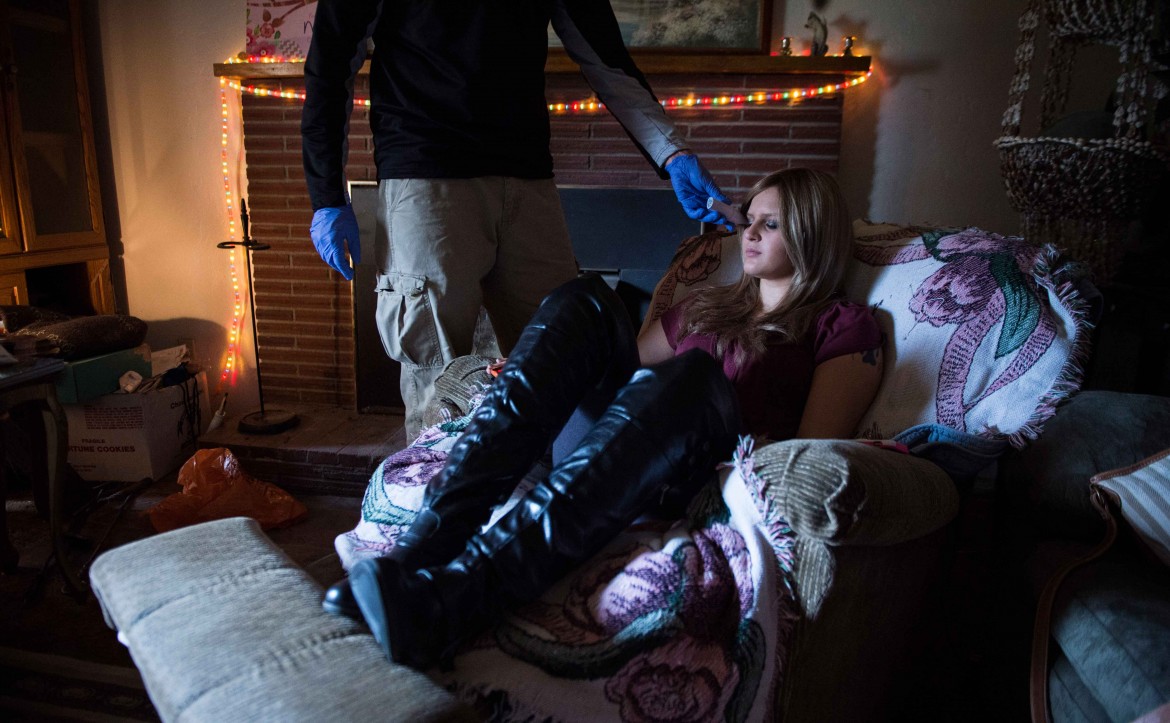
Cheyeanne Fitzgerald, 16, has her temperature taken by a physical therapist in her home. She was shot in the back during the massacre at Umpqua Community College in Roseburg, Ore.
This, she was realizing more and more, was the role of a survivor in a mass shooting: to be okay, to get better, to exemplify resilience for a country always rushing to heal and continue on. There had been a public vigil during her surgery, a news conference when she was upgraded from critical to stable and then a small celebration when she was sent home after two weeks with a handmade card signed by the hospital staff. “Strong and Moving On,” it had read.
By then, the college had reopened. What remained of her Writing 115 class had been moved across campus to an airy art building with windows that looked out on Douglas firs. They were forging ahead and coming back stronger, always stronger. That’s what the college dean had said.
Except inside the rental, where every day was just like the one before: Awake again in the recliner. Asleep again in the recliner. Cheyeanne dressed in the same baggy pajamas that hung loose and away from her wounds. She was wrapped in an abdominal binder that helped hold her major organs in place. Her hair was greasy because her injuries made it painful to take a bath. Five medications sat on the coffee table, next to a bucket she reached for when those medicines made her throw up. She couldn’t go back to school, or play her guitar, or drive her truck, or hold a long conversation without losing her breath, so she mostly sat in silence and thought about the same seven minutes everyone else was so purposefully moving past. The shooter was standing over her. The hollow-point bullet was burning through her upper back.
She wanted to talk about it. She needed to tell someone who knew her — someone other than a psychologist — what she’d been thinking ever since that day: “I just lied there. I didn’t save anybody. I couldn’t even get up off the ground.” But what everyone else around her seemed to want was for the shooting to be over and for her to be better, so they came to urge her along at all hours of the day and night.
In came the assistant district attorney with a bouquet of flowers and a check for $7,200 in victim restitution. “On to better days,” he said.
In came her best friend, Savannah, with a special anti-stress coloring book. “For your nightmares,” she said.
In came Bonnie, always Bonnie, rushing between the kitchen and the living room, her eyes bloodshot from sleep deprivation and hands shaking from a heart condition. “Think positive. Think positive,” she said, because a therapist had suggested that as a mantra.
In came one of her brothers, Raimey, 24. “Can I get you something?” he asked. And then in came her other brother, Jessy, carrying two large boxes and handing one to her. “A present,” he said. “Open it.” She lifted the lid and reached inside, removing what looked like a small gun.
She had owned guns since she was 6, when her father had given her a hot-pink youth model .22 for Christmas. She’d killed her first deer at 12 and another two years later. “A gun person all the way,” she had said of herself, and now she was fingering the trigger of what was not a real gun but a replica, a self-defense weapon designed to shoot lasers and pepper spray. Her palm found the barrel. Her index finger found the trigger.
“It’s got a nice feel to it, right?” Jessy said, as Cheyeanne began to think about the last time she had been this close to a gun.
“It’s small enough you could put it in your purse for school,” Jessy said, and suddenly Cheyeanne was smelling salt, metal and blood. It had smelled nothing like deer.
“Do you want me to set it up for you?” Jessy asked, and Cheyeanne shook her head. She put the weapon back in the box. “Not yet. Thanks.”
They turned the TV to an old western. It got dark and Jessy left. “Do you want to watch something else?” Bonnie asked, but Cheyeanne wasn’t paying attention. She was still thinking about the school. She had told the story of those seven minutes only once, to the psychologist from Veterans Affairs while Bonnie sat nearby, and before Cheyeanne had finished Bonnie’s pacemaker had started acting up. “This is too hard for me to hear,” she had said, and then she had gone outside to feed their hens. Now Cheyeanne decided to try again.
“The thing I keep thinking about is how that bastard stepped on me,” she said.
Bonnie shifted on the couch. She flicked dust off the armrest. She noticed a dirty plate on Cheyeanne’s bedside table and reached over to grab it.
“Like I wasn’t even human,” Cheyeanne said. “Like I was nothing.”
Bonnie stood up. “Can I get you something? Maybe some juice?” She walked into the kitchen before Cheyeanne could answer and filled a glass. She could feel her heart trying to accelerate and the pacemaker working in her chest. She reached into the freezer to add ice cubes to Cheyeanne’s drink, but the bag had frozen into one gigantic mass. She called out to Cheyeanne in the living room. “I’m going to break apart some ice,” she said. “You’re going to hear a few loud bangs.”
“How many bangs?” Cheyeanne asked. Bonnie lifted the bag up over her head. “One or two,” she said. She dropped it onto the counter. Bang. She lifted it again. Bang.
Cheyeanne covered her ears. She grimaced and stared at her phone.
Bang.
Her eyes went wide. “What the hell was that?” she screamed. “What was the third bang?”
“It’s still stuck together,” Bonnie said. “Get ready for another.”
Bang.
“Jesus. How many more?”
Bang, bang, and by the time Bonnie returned to the living room, Cheyeanne had lifted her legs into her chest and pulled the blanket up to her head.
“Somedy get me the hell out of here,” Cheyeanne was saying one afternoon. “I don’t even care where I go. I just need to leave.”
Bonnie brought Cheyeanne an outfit. She helped tie her shoes. She loaded the walker and the wheelchair into the car. She cushioned the passenger seat with pillows so Cheyeanne could lie down on her side. She put a baseball bat within reach behind the seat. Then off they went for drive-through coffees.
Bonnie had always considered Cheyeanne, her third and final child, to be the most capable member of their family — its true “independent adult,” she said. Raimey was awaiting a court date on a drug charge, and Jessy had also fought addiction before getting a good job and steadying his life. Cheyeanne was the one who stayed away from drugs, who helped track the family finances, who cared for their pets, who figured out how to fix her own truck, who was always in a hurry to grow up and move away. She had dropped out of high school midway through her sophomore year, scored well on her GED and then enrolled in community college — the first in her family to go. On the second day of class she had decided she wanted to become a nurse. On the third day she had said maybe neonatal. On the fourth day she had shown up early for Writing 115 and came home utterly dependent.
They drove under a billboard that read “UCC Strong,” past a banner that said “Roseburg Will Prevail” and up to a coffee shop with a sign posted on the window: “Ten percent of proceeds go to victims!”
“I actually was a victim,” Cheyeanne told the girl at the counter, after she’d ordered her drink.
“Of what?” the girl asked.
Cheyeanne pointed to the sign.
“Oh. No kidding?” the girl said. She smiled. She handed out the drink. “Straw?” she asked.
On Cheyeanne’s only other trip out of the house since coming home, she had tried going to the mall with friends who offered to push her wheelchair, and she had ended up back in the hospital, dehydrated and running a fever. But now she was feeling good and wanted to stay out. “I need a new sweatshirt,” she said, because she had lost 20 pounds since the surgery and none of her clothes fit. Bonnie drove Cheyeanne to a store she liked and lifted the wheelchair from the trunk. She rolled Cheyeanne toward the entrance, but it was an old store with no ramp. She tried to lift up the chair over the curb and fell just short. The metal frame banged back against her ankle and the wheel slammed down on her foot. “What was that?” Cheyeanne asked. “Nothing,” Bonnie answered, as a welt rose up on her leg. She gritted her teeth and lifted the chair over the curb again. They waited at the door for someone to open it. They wheeled circles through tight clothing racks. The women’s sweatshirts were upstairs. The store had no escalator or elevator.
“Screw this,” Cheyeanne said, climbing out of the chair, starting up the stairs on foot.
“What are you doing?” Bonnie said, chasing after her.
“I’m fine,” Cheyeanne said, but now she was halfway up and out of breath. Her right leg buckled. She leaned hard on the railing.
“You can’t do this,” Bonnie said.
“Stop telling me what to do!” Cheyeanne said, and now she was at the top of the stairs, where there were no women’s sweatshirts either. “Are you kidding me?” she said. Her legs began to wobble. She wheezed and gasped for air. Her chest expanded and her ribs throbbed. She turned around, went back downstairs and collapsed into the chair.
“Get me out of here,” she demanded, and Bonnie hurried over to push the wheelchair.
“Move!” Cheyeanne said, and Bonnie searched for a path back through the racks.
“Jesus! Are you this stupid? Can’t you do anything right?” Cheyeanne shouted, as Bonnie tried to navigate the curb again, her body buckling under the weight of a 16-year-old girl and a 50-pound wheelchair, its frame slamming back into her ankle.
“Hey, I’m a waitress, not a nurse,” Bonnie said. “Quit giving me alligator ass. I’m trying.”
She loaded Cheyeanne back into the car and started to fold the wheelchair so it would fit in the trunk. She pushed the sides together but the chair wouldn’t fold. She tried again and nothing happened.
“Are you serious?” Cheyeanne said, watching her. “How many times until you figure this out? Lift and then pull. Lift and then pull. How hard is that?”
“Okay. Thanks,” Bonnie said. She stepped back and studied the chair. Think positive, she thought to herself. She pulled and then lifted. The chair didn’t move.
Cheyeanne stepped out of the car. She stumbled and caught herself on the door. She pushed Bonnie away and reached for the wheelchair.
“Stop. I’ll do it,” she said. “Apparently you’re too stupid to figure it out.”
Se knew how she could sound in those moments. “Sorry, Mom,” she would eventually say after each outburst, but another always came. The fact was it felt good to be angry, to yell and curse, because if she wasn’t angry then she was mostly afraid: of nightmares, of being alone, of the shadows in the church parking lot across the street, of cars backfiring, of the sound of knocking coming now at the door. “What the hell is that?” she said, twisting deeper into the recliner, covering her ears.
It was Dustin, one of her brother Raimey’s friends. “Oh, hey Chy,” he said. He looked her over, taking account of her injuries. “Would it be okay if I asked you some questions about it? I’m kind of curious.”
“Yeah,” she said. “That would be good.”
“Okay,” he said. “I’ll be right back.”
She sat in the recliner and waited. Maybe she couldn’t get her mother to listen to what had happened in the classroom, but Dustin wanted to know. Other than the psychologist, only one person had asked her about it directly, a hospital nurse who wondered what it felt like to get shot. Everyone else had come with balloons and greeting cards with slogans about courage and perseverance without ever asking how, exactly, she had persevered or if, in fact, she had been courageous. Dustin would ask. She would tell him.
She adjusted her heating pad and took a Percocet. Dustin went into Raimey’s bedroom and locked the door. He came back out and walked past her to the porch. She watched him smoke a cigarette and dance to music nobody else could hear. She watched him go back to her brother’s bedroom, this time for more than an hour. She took a second Percocet. She practiced standing up from the chair with the support of her walker and then sitting back down, just as the physical therapist had taught her. Dustin came back into the living room, this time wearing headphones. He pulled at the fuzz on his socks.
“Mom, I’m starving,” Cheyeanne said. Her right leg had gone numb. Her side ached. “Why isn’t there any food in this house?” she said. “I want Chinese.”
“Okay, honey,” Bonnie said, and since Raimey and Dustin were there and Cheyeanne wouldn’t have to be alone, Bonnie got in her car and drove to a takeout restaurant. Sunlight flooded the truck. She rolled down the window. “Air,” she said.
A few weeks earlier, when Cheyeanne was still in the hospital, Bonnie had gone out for a drive and found herself retracing Cheyeanne’s path on the morning of the shooting: onto the freeway, up toward the UCC campus on the north side of Roseburg, and then stopping at a market where she knew Cheyeanne had stopped to buy drinks. Bonnie had asked the clerk if he remembered Cheyeanne, and when he said he wasn’t sure she asked if he had surveillance footage from that day. The clerk had found the tape and played it for her, and Bonnie had watched as her daughter walked onto the screen. She was carrying three energy drinks. She was walking without a limp. She was smiling at the clerk, thanking him, waving, laughing at a joke, and then walking back toward her truck. She was going to college. She was going to become a nurse. She had called Bonnie a few minutes later: “Love you as big as the roads,” she had said, which was something they had always said to each other. “Can we watch the tape again?” Bonnie had asked the clerk, and after the third time through he had offered to make her a copy.
Now she picked up the Chinese and drove it home to Cheyeanne. The chicken was too spicy for her. The rice wasn’t as sticky as she liked it.
“I lost my appetite,” she said. “Get this stuff away from me.”
They sat together in the living room and looked at their phones. The dog was whimpering. The plumbing had broken and now sewage was coming up on their front lawn. Bonnie turned on the TV as Dustin emerged again from Raimey’s room. It had been eight hours since he had told Cheyeanne he wanted to hear about the shooting. “Are we going to talk or what?” Cheyeanne asked him. He stared back at her blankly. He shrugged his shoulders. She watched him go back to her brother’s room for another hour. She watched him come out again and eat her leftover Chinese.
“Dustin has to leave,” Cheyeanne told Bonnie. “He’s bothering me.”
“Get out of here,” Bonnie told Dustin, throwing him $10 for a cab.
He said he was hoping to spend the night. He said he didn’t have anywhere to go. “I never got to ask my questions,” he told Cheyeanne, but now she didn’t want to talk to him anyway because it was getting dark and soon she would be trying to sleep. “I can’t talk about this right before bed,” she said.
She had been sleeping in the same room as Bonnie and awakening in the night to sore ribs, to nausea, to nightmares. She had dreamed the night before about shopping for a car with her father, who lived across town. They had found a used truck, and Cheyeanne was about to use her victim compensation money to make the purchase when a gunman barged into the dealership. “Don’t shoot!” Cheyeanne had shouted, and for some reason the gunman had nodded and then turned. He had pointed the gun instead at her father and fired.
Se had so many reasons to be afraid, to be angry. Meanwhile, Bonnie could feel the battery running low inside her fourth pacemaker, and what she needed most of all was to stay calm. She took her Valium. She scheduled an extra visit with her heart doctor. She repeated her mantra. She worked to memorize the names of Cheyeanne’s 11 new doctors, and when she continued to forget she wrote them down on her hand.
She had spent much of her life dealing with crisis: pregnant at 17, an abusive relationship, eight heart surgeries, jail for one son and addiction for the other. She wore a locket around her neck that Jessy had given to her: “A mother understands what a child never has to say,” it read, and somehow Bonnie had known what to do on the morning of the shooting, too. “Where are you?” she had texted Cheyeanne in those first minutes. “ANSWER!” she had texted again. And then even though UCC was directing all parents to meet at the fairgrounds, Bonnie had driven instead to the local emergency room. She had arrived just in time to see a stretcher rolling by into surgery, and on that stretcher was Cheyeanne — blood caked into her hair, clothes cut off, a medic asking her to repeat her birthdate in an attempt to keep her awake.
Bonnie had spent the past weeks trying to forget those images. She’d left Cheyeanne’s clothes from that day untouched in a bag in her car that she was too afraid to open or even carry inside. She knew her daughter needed to talk about the shooting, but she didn’t think she could deal with hearing it. “It’s pure evil, and it gives me the shakes,” Bonnie had told her own doctor. It was hard enough for her to sit through Cheyeanne’s medical consults and hear her daughter discussed in clinical terms, each appointment bringing a new revelation about what recovery would require.
Her right leg was buckling because of damage to her sciatic nerve, the physical therapist said.
Her anger and insomnia suggested a possible anxiety disorder, a psychologist said.
Her high pulse needed to be examined by a specialist, the home nurse said.
A small piece of the bullet was still embedded in her rib, where it would remain, the urologist said.
“Positive thinking leads to positive results,” Bonnie said to Cheyeanne as they prepared to leave for one of the five doctor appointments they had scheduled for a single day. This one was at the hospital for a follow-up with the surgeon. Bonnie readied the wheelchair. She helped Cheyeanne zip her boots. She drove them to the hospital and they met with the surgeon, who took X-rays and noticed more fluid building in her lungs. “Something to watch,” he said, explaining that she would need to come back for another follow-up. If there was still fluid, they would go in and drain it.
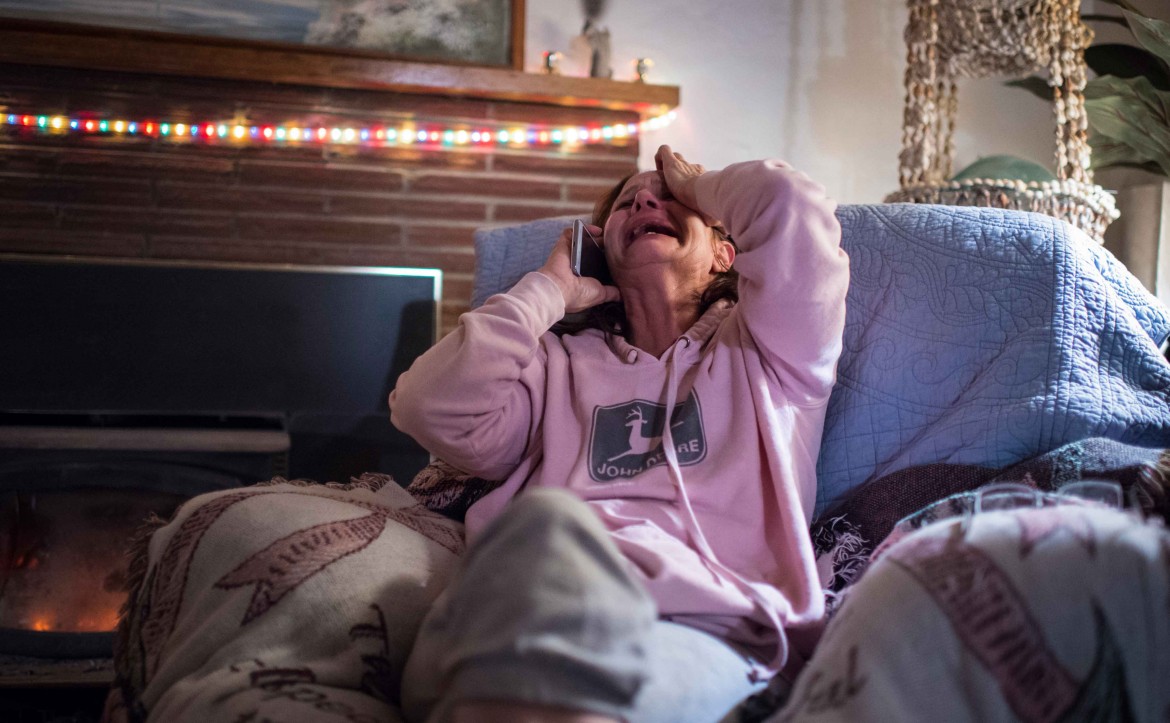
Bonnie cries as she calls friends and family while trying to figure out if her daughter will ever be okay after another chaotic day at the hospital.
Bonnie pushed Cheyeanne back toward the office lobby, and she banged the side of the wheelchair against the frame of the door. “You idiot. You’re unbelievable,” Cheyeanne said, taking control of the chair with her arms, wheeling herself toward the exit. Bonnie stopped at the front desk and the receptionist handed her paperwork. “How about you don’t spell my name wrong this time, okay?” Cheyeanne said. She sat in her wheelchair and tapped her foot against the floor. “Jesus. Hurry up,” she said a minute later. “Do you need me to do it for you?”
“I think she’s doing just fine, thanks,” the receptionist said, glaring at Cheyeanne.
“Screw this. I’m going downstairs,” Cheyeanne said. She wheeled to the door, kicked it open and disappeared into the hall.
Bonnie looked up at the receptionist and smiled. “Sorry about us,” she said.
“I know she has a right to be angry, but are you okay?” the receptionist asked.
“Yeah. I am,” Bonnie said, but she set the paperwork on the counter and started to shake her head.
“Yeah. I really am,” she said again, but now her hands were shaking and she was beginning to cry. The receptionist reached over to touch her arm. “What’s going on?” she said, and since no one else had asked, Bonnie began to explain what her life had become. The tiptoeing. The whispering. The alligator ass. The cursing. The panic attacks. The baseball bats in the living room and the guns in the bedroom. The way Cheyeanne would twitch and grimace and then cry out for her in the night, reaching for her hand, asking her to stay close, until the night ended and the sun rose and Cheyeanne cursed and pushed her away.
“She didn’t used to be like this,” Bonnie said. “Every day just rolls into the next day, and none of them get better. I’m not seeing my daughter anywhere. Does that make sense? Is that crazy?”
“No. That’s not crazy, ” the receptionist said, and she started to say something more but Bonnie interrupted.
“I don’t know what I’m supposed to do,” she said. “I’m a waitress, okay? I don’t know where I’m supposed to draw the line with her and what will make her better or what will make her worse. She’s scared. She’s angry. She doesn’t listen. Everybody is moving on and we’re supposed to be getting back to normal and I think she’s getting worse. We need help. That’s what I’m saying. We need help right now because I don’t know what she’s going to do. I can’t take this much longer. My heart — okay? I run on batteries — okay? We’re coming right up to the edge.”
Her cellphone started to ring. It was Cheyeanne. She took a deep breath and answered. “Hi, Chy-Chy,” she said. On the other end of the line there was muffled yelling. Bonnie held up the phone so the receptionist could hear. She pressed the phone back to her ear. “I know, Chy. I’m sorry. You’re right. I’m coming. I’ll be right there.”
Bonnie put the phone back in her purse and thanked the receptionist. “I have to go,” she said, and the receptionist handed her a number for a psychologist, in case she wanted to call. Bonnie hurried out to the hall, where she caught her reflection on the elevator door. Her makeup was smudged. Her eyes were bloodshot. “I can’t let her see me like this,” Bonnie said, so she went into the bathroom to clean up. She took the elevator downstairs and saw her daughter sitting in her wheelchair — bullet in her rib, back hunched, fists clenched, fluid building in her lungs. “Think positive,” Bonnie thought to herself. She walked over and put her hand on Cheyeanne’s back, just below the bullet wound, just away from the incision. “I’m here,” she said.
“What took you so long?” Cheyeanne said. “Is there something wrong?”
“No, it’s just that you know me with paperwork,” Bonnie said, laughing at herself, wheeling Cheyeanne out the door. “I didn’t understand some of the questions. I’m a little bit slow.”
“Yeah,” Cheyeanne said. “No shit.”
“Btard shot me in the back.”
Cheyeanne was trying again. It was the same detail she had told her mother, but this time she was saying it to Raimey as he walked by her in the living room. If it couldn’t be Bonnie, or Dustin, or anyone else in a town that was moving on, then maybe Raimey would stop for a minute and listen. He had headphones in his ears. “Hey, sis,” he said.
“He shot me in the back,” she said again.
Raimey slowed down and pulled out one of his ear buds. “Can I get you something?” he asked. He started to walk away into the kitchen.
“No. Jesus,” she said. “Sit down, will you?”
Raimey came back into the room and leaned against the armrest of the couch. He took out his ear buds. “What’s up?” he said.
“When you see me sitting here, I’m always thinking about the same thing,” she said, and then when he didn’t get up she began to tell him about her writing class: 35 or so people. And her seat: “back right corner, furthest from the door.” And her teacher: a man in his late 60s who had just distributed a handout when they heard two deafening bangs. A young man Cheyeanne didn’t recognize came through the classroom door carrying a backpack and two handguns. “I’ve been waiting for this,” he said, and before Cheyeanne could make sense of what he meant or what was happening, he had walked to within a few feet of the teacher, pointed the gun and pulled the trigger. “One shot and then blood,” Cheyeanne said.
“Jesus,” Raimey said, putting down his remote-controlled car, sliding off the armrest onto the couch.
“He was almost casual about it,” Cheyeanne said, describing how the shooter had ordered the students to gather in the center of the room. She began to tell Raimey how she had huddled next to her friend, Ana, and how she had watched from the floor as the gunman shot a woman pleading in her wheelchair, and then a man who said, “I’m so sorry for whatever happened that made you this way,” and then a woman who tipped over her desk and ducked for cover. He had kept going into his backpack to reload. Cheyeanne had stayed on the ground as blood pooled closer, and then as footsteps came closer, too. She had reached for Ana’s hand. She had felt that hand flinch when Ana got shot. She had heard the shooter move above her and then felt the burn of the bullet and wetness on her back. She had closed her eyes and wished for shock, but it had never come.
“What’s your religion?” the shooter had asked, once it was clear she was still alive, and she had told him that she didn’t know, that she was 16 and needed time to figure it out. “I don’t want to die,” she said, and for some reason he had given her a chance. “Get up and I’ll shoot somebody else,” he said. She tried to push herself off the floor but her leg wouldn’t move. “Get up,” he said, but this time he was standing on her arm, pinning her down. “Get up,” he said again, but all she could do was lie there next to her injured friend and wait for the next bullet. She knew it was coming. Any second now. But instead what came were sounds at the classroom door, and the shooter ran over to look. Then there were voices down the hall, and more gunshots, and then the shooter was back into the classroom and pointing the gun at his head, pulling the trigger.
“That’s when I got hysterical,” she told Raimey now. “I was coughing and spitting up all this blood. I basically knew I was going to die.”
“Oh man. Chy,” Raimey said. He sat on the couch and looked over at her. She had her baseball bats nearby, her pink hunting knife, her replica gun. He had accused her once of exaggerating her trauma to take advantage of Bonnie’s sympathy. “Milking it,” he had said then. Now he wasn’t sure what to tell her. “I’m sorry,” he said, finally. “I had no idea you were strong like that.”
She looked back at him. She adjusted her blanket.
“I wasn’t strong. That’s the thing,” she said. “I couldn’t even get up. I just laid there, like nothing.”
She leaned her head back against the recliner and closed her eyes. She was still in her pajamas and the binder was wrapped tightly around her waist. Her ribs ached, so she twisted over onto her side. “Ugh. Just make it stop,” she said. Raimey stood from the couch and came over to her chair. He reached down to grab the puppy and set it in her lap. “What do you need?” he asked. “What can I get you?”
“Nothing,” she said, and now the anger was gone and her voice was quiet. She had said it. She had finally told someone, and wasn’t that supposed to be progress in the life of a survivor? Wasn’t that resilience, recovery, moving on? Then how come she still felt anything but okay? She grabbed her blanket and pulled it up to her neck. She took out her coloring book and started filling in a dragon. Bonnie came in offering sushi, offering pizza, offering a frozen coffee drink.
Bang.
“What was that,” Cheyeanne said, sitting back up in the chair. Bang, bang. Somebody was knocking at the door. It was Dustin. “Oh, sorry. No knocking,” he said, letting himself in.
“Ugh, you scared me,” Cheyeanne said. Outside it was getting dark. The streetlamp was casting shadows against the house and headlights from the road reflected off their window. She pulled the blanket up a little higher and returned to her coloring book.
Bang, bang. More knocking.
“Jesus,” Cheyeanne said, twisting onto her side, clutching at her chest. It was Raimey’s girlfriend. “Sorry, Chy,” she said.
Bang. Cheyeanne covered her ears. “What the hell?” she screamed. It was Dustin again. “Whoops,” he said.
“I can’t breathe,” Cheyeanne said, and Bonnie rushed in with water. She opened up the shades and Cheyeanne looked out the window, where now she could see somebody wandering in the parking lot of the church across the street. It was just another one of Raimey’s friends, but Cheyeanne didn’t recognize him. All she could see was that he was young. He was tall. He was holding something in his hand. A handbag? A backpack? “Who’s that?” she asked, squeezing the armrests of her recliner. “What does he want? Where is he going?”
He was on their lawn.
He was at the porch.
He was coming toward the door.
“Stop!” Cheyeanne said. He was knocking, knocking, knocking.
“Mom!” she cried, forcing herself up from the recliner. “Mom, help! Please. I need you.”
10 YEARS AFTER KATRINA: The displaced: The Williams family fled to rural Nebraska for the promise of a fresh start. Now they’re in need of rescue again.
By Eli Saslow
In Auburn, Neb.
The sunlight bothered his eyes and the dry air gave him chills, so Troy Williams, 46, closed the living-room window and shut the blackout shades. Outside was prairie, corn and miles of clear Nebraska sky, but increasingly he liked it better here, inside a Section 8 apartment with the TV blaring. He locked the front door even though nobody but family had visited for three weeks. He turned down the volume on a phone that rarely rang.
He put on sunglasses, lay on the couch and closed his eyes. His wife, Andrea, sat nearby, playing Candy Crush on her computer and listening to him breathe. She had seen him survive Hurricane Katrina in a stairwell and the post-traumatic stress disorder that followed. Now he had cancer, in his spleen and in his bone marrow, and she was beginning to think this was the setback they couldn’t withstand.
“Are you sure it wouldn’t help to get some fresh air?” she asked.
“You know there’s nothing for me out there,” he told her.
It had been a decade since they arrived in Nebraska, a state they had known nothing about until Hurricane Katrina stripped their New Orleans home down to its floorboards on Aug. 29, 2005. They had traveled with their five children to shelters, church basements and an overcrowded motel, where one day a FEMA official announced that a church in Nebraska was offering to sponsor a family and asked whether anyone wanted to go. Nine hours later, they were on their way to the airport, a family of seven with a single carry-on bag and no idea where they were headed. They landed in Omaha, where the streets were wide and quiet; and then they were driven into the surrounding farmland, which started to smell of manure; and then they came into tiny Nebraska City, which at least had a Wal-Mart; and then they continued through 25 more miles of absolute emptiness until they arrived at what looked like nothing more than a junction in the road. One bar. Two gas stations. A main street of vacated shops and a squat municipal building decorated with a freshly painted sign. “Welcome Home Katrina Evacuees!” it read.
The town of Auburn, population 3,200, had provided them with a car, a four-bedroom house, job leads and free medical checkups. The Ladies Club stopped by with homemade casseroles. Goodwill delivered jeans and pearl-snap shirts.
“You’re one of us now,” a city councilman had written to them, even though no one else in Auburn was black, Southern, urban and poor. “We’re a close community that leaves no one behind in a time of need. You’ll be taken care of here.”
In the days after Hurricane Katrina, this was what Auburn wanted to believe of itself, and what so many Americans wanted to believe of their own communities, too.
A decade later, the councilman’s note was at the bottom of a closet, buried underneath the paperwork of what the Williamses’ time in Nebraska had become: police reports, doctor’s bills, grievance letters to the NAACP and dozens of collection notices. They owed the city for water, gas, trash collection and school supplies. They owed $15,000 to the hospital for Troy’s first round of cancer treatments, which he was supposed to be getting every week but instead was receiving only every three months at a clinic in Lincoln that had agreed to give him infrequent treatments at no charge.
“This matter concerning the Williams’ family has exhausted our patience,” read one bill, for $60, from an appointment to check Troy’s blood levels.
“We cannot and do not operate as a charity,” read another.
Ten years since the hurricane and still they needed so much help. Andrea quit her game of Candy Crush and logged onto an Auburn community Web site called “Families in Need!” She had posted on the site a few months earlier and set up a fundraising page. They had been living on a few hundred dollars each month, which Troy made by working 10 hours each day buying and reselling cellphones on the Internet. “Dear Friends & Family,” she had written. “Whatever God put in your heart to give, it will be well appreciated. Thanks so much for your love, support, prayers and concern.”
Now she checked the page for donations while Troy watched from the couch.
“Are they sending us anything yet?” he asked, even though he already knew the answer.
Andrea opened a new game of Candy Crush and washed down a Xanax for her anxiety.
“You can bet they’re sending us some prayers,” she said. “You know they’re real generous with that.”
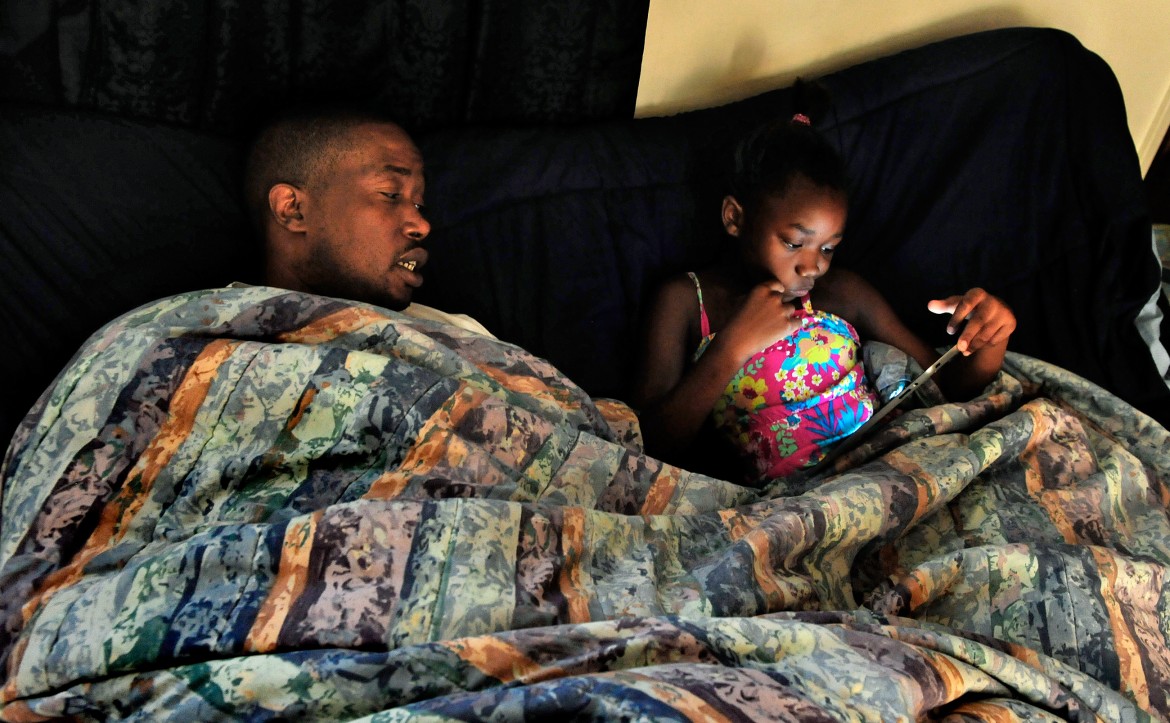
Since he sweats a lot because of his cancer treatments, Troy Williams likes to keep the apartment cold. Although tired, he tried to stay engaged while watching his daughter Taja, 10, play a game on a tablet.
They lived now in the last building before Auburn disappeared back into countryside, in a small housing project known by residents as “No Daddy Land.” It was a squat apartment building with about a dozen units, some vacant and others with children’s toys piled high on the front porch. Their neighbors were mostly single mothers on public assistance and low-income drifters who rented month-to-month, but the Williamses had been there for five years.
One morning in late July, Andrea walked out the front door with the last $50 from her Social Security payment to buy food and medicine. There was a discount grocery across the street, but she wanted to leave town. “Going to Wal-Mart,” she said, and her three youngest children, ages 14, 10 and 5, rushed to join her in Troy’s SUV. There was duct tape holding together the windows and a breathalyzer machine attached to the steering wheel. A judge had required the machine on account of Troy’s drinking, which had worsened after he was diagnosed with PTSD, which a psychiatrist in Auburn had attributed less to the hurricane itself than to what he had called the “transitional trauma” of adjusting to life in rural Nebraska.
“Ready,” the machine instructed, and Andrea drew in her breath.
“Blow,” it instructed, and she did.
“Pass,” it indicated, and the engine came to life.
She pulled onto Highway 75, the main road through Auburn, where the posted speed was 25 mph and the town moved in slow motion around her. It was early August, halfway between planting season and the corn harvest, when the only thing to do in Auburn was wait. She drove by Casey’s General, where a group of farmers sipped coffee at the window table. She passed the gas station with its new sign — “We Now Have Premium!” — and then rose up a hill toward the community bandstand, where the town had thrown a welcome party that first night. Andrea had stood up to make a short speech, her voice trembling. One of the few other times anyone had given them anything, it was a small settlement for the lead poisoning her children had suffered in the New Orleans housing projects. “Nobody has ever paid attention to us and taken care of us like this,” she had said then. “You have given us faith to start over. This is home.”
A car traveling in the opposite direction beeped its horn and slowed to a crawl. In the driver’s seat was a former neighbor, and Andrea tapped on her brakes.
“Ms. Dre,” the neighbor said, rolling down her window, idling in the road. “I haven’t seen you in forever. Thought maybe you’d left. How you been?”
“Been just fine, thanks,” she said, before waving and driving on.
She passed the veteran’s memorial downtown and the stocked fishing pond in Legion Park. A light flashed on her dashboard and the car started to beep. The breathalyzer required a new test every 10 minutes. “Blow,” it said, and she did. “Pass,” it said.
How quickly had some people in town started expecting them to leave? How suddenly had so much generosity begun to unravel? During their third week in Auburn, the dealership had replaced their new Expedition with a used minivan, explaining that the Expedition had been a short-term loan. During the fifth week, their oldest son had been sent home from school for wearing a Bob Marley T-shirt. “A drug culture we don’t embrace here,” the administrator’s note had read. During the seventh week, the city had asked them to start paying rent on the four-bedroom house, $520 a month, which they couldn’t afford on Troy’s salary as a machine operator. During their eighth week, vandals had carved “Niggers” into the Halloween pumpkins on their front porch, and they had gone for the first time to see the police.
The community newspaper published all police activity each week in a section called “The Docket,” and soon the Williams family had become regulars. There was Andrea, ticketed for speeding 7 mph over the limit. There was Troy for failing to pay the trash. There was Troy again for driving under the influence, his first offense.
“Blow,” the breathalyzer machine said. Andrea drew in her breath. She exhaled into the machine.
“Troy, you idiot,” she said.
“Pass,” the machine said.
He had gotten his first DUI at an Auburn gas station, when he was idling in the car and a police officer pulled up alongside him. Troy had rolled down his window to say hello. The officer had smelled whiskey on his breath. “We are the targets of constant racism,” Troy had written not long after that, to the president of the NAACP chapter in Omaha, because he said the police were constantly following him and his sons, even if he sometimes did give them cause. He got his second DUI on the way back from Lincoln, his third coming home from a club in Omaha, then his fourth. He had been a drinker in New Orleans, too, but there it was different. He was popular. He owned a small clothing store. He DJ’d at parties. In Auburn, he drank to escape. He was always venturing farther out, staying away for a few nights at a time, until finally he left to stay with a friend in Nebraska City and begged Andrea to come, too. Nebraska City was twice as big as Auburn, a onetime stop on the Underground Railroad where Troy thought there was at least a semblance of diversity. “Aren’t you tired of living in a fishbowl?” Troy had asked her. “Aren’t you losing your mind in that place?”
Blow. Pass. Auburn was behind her now, receding in the rearview mirror, and she could see from one side of the town all the way to the other. It looked flat and small beneath the sky, like an island in the corn.
She had considered moving — maybe back to New Orleans, or to Texas where she had a sister — but she was terrified of living near water and had zero money saved. Their apartment in Auburn cost $34 in subsidized monthly rent. Their three oldest children had graduated and moved to Lincoln, an hour away, but the three youngest didn’t remember a hurricane, or New Orleans, or any life at all before Auburn. Tyler, 14, was about to start high school as a basketball standout. Taja, 10, spoke in the matter-of-fact drawl of southeastern Nebraska. Tamia, 5, had been born in a hospital up the street, growing their family to eight.
Blow. Pass. “Stupid Troy. Stupid town,” she said. She pulled into Wal-Mart and bought food and candy apples for the children before turning back home. She stopped by the utility company in Auburn and then the secondhand store downtown where every item was priced at 88 cents.
Blow. She exhaled into the machine but the car wouldn’t start. Blow. Blow. The breathalyzer kept recalculating. She banged her fist against the dashboard and jerked the wheel from side to side. “Why does everything have to be so hard?” she said.
Another former neighbor came walking up the street toward the thrift shop. “Is that you, Dre?” she asked. “I thought you all had moved on to Omaha.”
She forced a smile and squeezed the steering wheel.
“No ma’am,” she said, as the engine finally came to life. “Our family’s still right here.”
Recently, their family had grown to include one more, a nephew, Cornelius Weaver, 27, who had arrived in Auburn several months earlier and now came banging again on their door in No Daddy Land. By the time Andrea opened the blackout shades to see who was outside, Weaver had started pacing circles in the parking lot, music blasting from his headphones. He wore a bandanna over his head, low-rise jeans and a tank top that exposed a 10-inch scar on his stomach. She could hear his music from 20 yards away, and he was shouting lyrics while punching at the air.
“Get in here!” she yelled. “Hurry up. You’re going to scare people acting like that.”
“Acting like what?” he said. “I’m just blowing off steam. I think these people are getting ready to fire me.”
“Again?” she said, and she brought him into the apartment. He sank into the futon while Andrea sat next to Troy on a couch. They had been married for 27 years, and together they had helped raised Weaver in New Orleans after his father started to deal crack and his mother got hooked on it. “Smoky” is what they had always called him, because his skin was darker than the rest of the family’s and wherever he went trouble seemed to follow.
He had come to them in February, because he needed to escape New Orleans and Auburn was the farthest place he could think to go. He had been shot in New Orleans after an argument, the bullet hitting his stomach, nicking his intestines, splicing his kidney and then exiting through his lower back. “Lucky by about two inches,” the doctor had told him after surgery, and Smoky thought the shooter would probably try again. He borrowed money from his grandmother, checked out of the hospital after his fourth night and went straight to the Greyhound station, where he boarded a bus for Nebraska. He saw his first snow in Omaha, his first herd of cattle in Nebraska City and then arrived in the dead quiet of Auburn with a gunshot wound that was still seeping. The first place he went was to see Andrea and Troy at their apartment. “All this way and we’re still in the projects?” he had asked that day, and his disillusionment had been building since.
He’d been fired from his first job at a car dealership for what he remembered the manager describing as “cultural differences,” and then from a downtown cafe for flirting with the waitresses, and then from a barbecue restaurant for “aggressively talking back.” Now he was starting his fourth job, at Casey’s General, where he had applied to work in food prep but was instead being trained to wash floors and unload delivery trucks.
“They’re acting like I can’t wrap a sandwich,” he said now. “I keep telling them I went to culinary school, but they don’t listen.”
“See, that right there is why we don’t associate,” Troy said. “The more you try to explain and interact in this town, the worse it gets.”
“Don’t say nothing to them,” Andrea said.
“But I’m a social person,” Smoky said. “I’m just trying to show them how their thinking is backwards.”
“We stay out of all that,” Troy said. “We are captive in our house. That’s how we feel sometimes. I’m just keeping it honest.”
They had been introduced to the town on the front page of the newspaper in September 2005, under the headline: “Hurricane Katrina Evacuees Glad to be in Auburn.” In the photo they were dressed up and beaming, outfitted in new clothes, and it had felt during those first weeks like they were the stars of a national telethon. “What can we get you? What do you need?” everyone had asked, and so Troy had told the newspaper reporter that what people said about the United States was true: There was no place so giving in a time of crisis. “We feel like we’re part of a family,” he had said then. “We feel that somebody does care for us. We are so happy and so thankful for everything.” The federal government had offered them cash. Public officials had coordinated their emergency shelter. Church congregations had sent prayer books and blankets. A town in Nebraska with only a handful of black residents had watched the Ninth Ward flood on TV and then decided to rescue a family of strangers.
The Sept. 30, 2005, edition of the Nemaha County Herald announced the arrival of the Williams family as evacuees from New Orleans. Taja Williams, 10, points to herself in the photo when she was just a month old.
But then they had stopped being strangers, and their crisis was not a single hurricane but an accumulation of disadvantages that were harder to address: poor, jobless, sick and troubled. And after a while it felt to them like there was no real desire to help, no telethon, just a community and a country that was finding it easier to look away.
“Reduced,” the federal government had written, when it halved their food stamps because of a government cut.
“Denied,” the government had written, when Troy applied for Social Security disability insurance after receiving his cancer diagnosis.
“No thank you. Not here,” the governor of Nebraska had said, when he declined to expand Medicaid under the federal health-care law, which left Troy uninsured.
“A drain on the community of Auburn,” one neighbor had written about them on the town’s community message board.
Troy looked back across the room at Smoky. Troy had continued to work 60 hours each week in a dog food factory even after his diagnosis, rarely missing a shift until a combination of the cancer and his medication made him so sick that he had to quit working.“Even if you do it all right here, you are an outsider,” he said now. “You can’t count on anybody but yourself. Do you see that?”
“I’m starting to,” Smoky said. “But then why in the hell did you stay?”
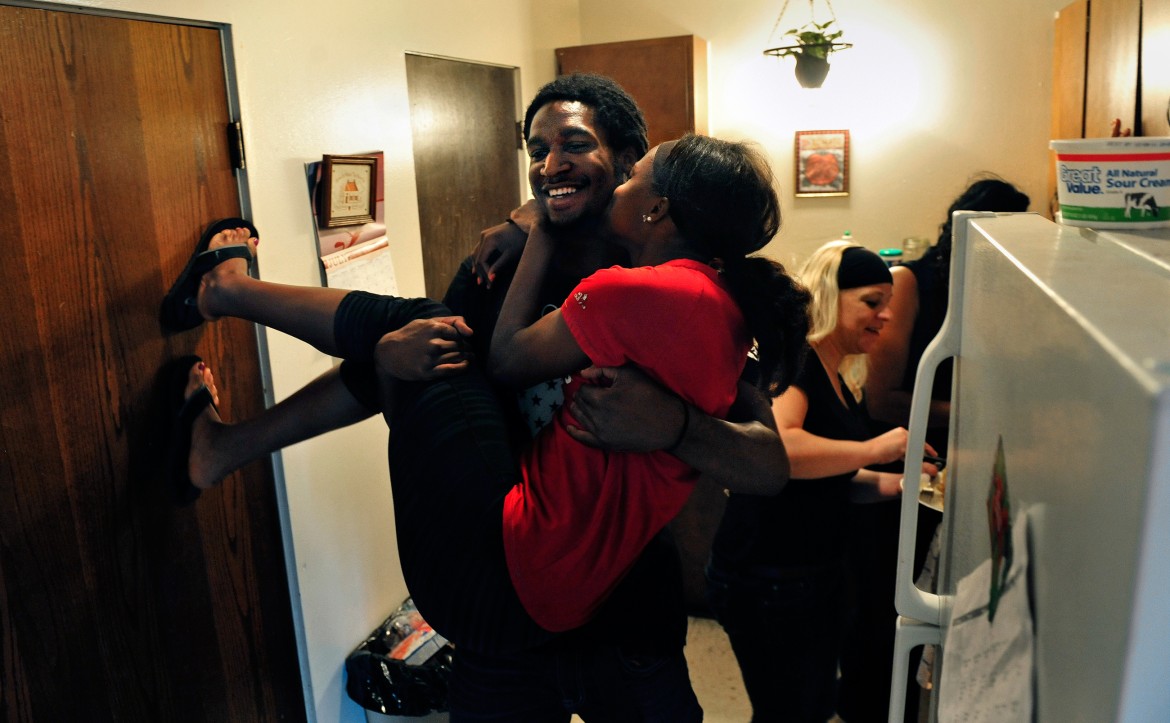
Tierra Williams and her brother, Troy Jr., goof around in the kitchen for a photo taken off camera by a friend. In the background, family friend Barbie Gardner helps cook dinner.
One of their reasons for staying showed up at the apartment later that same afternoon: Tierra, 20, home on a short break from college at the University of Nebraska in Lincoln. She had just gone on a charter jet to the national track and field championships in Oregon, and then to Disneyland after that, and now she carried in a few gifts for her siblings.
“Why is it so dark in here?” she asked, and her mother opened up the blackout shades.
“Does the TV really have to be on this loud?” she asked, and her father turned it down.
She was back in Auburn for a few days before returning to Lincoln for her junior year. She would be on full academic scholarship, a resident adviser in the dorms and a preseason All-American in the long jump. “Auburn’s local superstar is taking her act national,” the newspaper had written of her once, in a section that wasn’t The Docket, and whenever she came home there were so many people she wanted to visit. She’d already seen Ms. Hamman, the high school cheerleading coach who had bought Tierra her first cellphone and paid the bill for six years; and Ms. Oliver, the former babysitter who gave Tierra a place to stay; and Mr. Golladay, the high school principal, who had spent hours fighting the NCAA when it questioned her college eligibility. About the only people she hadn’t seen yet were her parents.
“Nice to be back,” she said now, looking over the apartment. Her mother was playing Candy Crush on the computer. Her father was lying on the couch in his sunglasses, too sick lately to drink. The air was stale, and the room smelled faintly of smoke.
“Not much here compared to Disneyland, ” Troy said.
“That’s true. But it’s home,” she said.
Her family had moved to Auburn a few months after she turned 10. Up until then, she had been attending the worst-performing elementary school in New Orleans, where in fifth grade she was just beginning to read. “Three years behind expected grade level,” the Auburn School District had concluded, in its initial evaluation, and the school had provided her with a teacher’s aide in the classroom and a tutor to help with homework. By eighth grade, she was reading at grade level. By 10th grade, she was the first in her family to make honor roll, and later the first to attend college.
She was also the first to lose her Southern accent, to correct her parents’ grammar and to say what they rarely said: that she liked living in Auburn. She liked the town and loved the people, so much so that sometimes she chose to stay with friends instead of going on the family’s occasional trips back to New Orleans. Her college boyfriend was German. Her best friend lived in Spain. And even though Troy and Andrea referred to her success as an example of what was possible for their other children — even though they preserved each one of her certificates and news clippings in a folder labeled “Way to go Tierra!” — the way she credited those accomplishments sometimes hurt.
“This town basically saved my life,” she said now, in the living room.
“You got this far on your own,” Troy said.
“Really?” she said. “Is that really what you think?”
“There are some good people here. Don’t get me wrong,” Troy said. “But we guarded you from the bad stuff. Like those pumpkins, we threw them out before you even woke up.”
Tierra just stared back at him.
“Let’s keep it straight now,” Troy said. “Don’t you remember what they did with little Troy that first year when he was playing football at the high school? How he was taking them to the state championship, but the principal sent us that letter saying we were being too rowdy and cheering too loud at the games?”
“I don’t remember it that way,” Tierra said, because what she remembered was the Jack Daniel’s that sometimes preceded those games, and how Troy would yell until she found an excuse to go sit somewhere else.
What she remembered was her family moving five times in Auburn because of conflicts with landlords and arguments with neighbors. She remembered the police being called to their house and the way her father would argue with them, calling them racists, retreating upstairs, closing the shades. She remembered the fight she had gotten into with her father at the beginning of her senior year — a fight so awful that this time she was the one who called the police, and after the officers left her father had given her a choice. She could stay and be respectful or she could leave. “Proper, white girl Tierra,” he had called her, and even though she loved her parents she had decided to leave. For the next several months, she had stayed with friends, borrowed money and asked her teachers for rides to school. She had relied on the generosity of the town.
“Stop blaming everyone else and expecting them to fix your problems,” she had told her parents then, and it had been one of the last things she said to them for months.
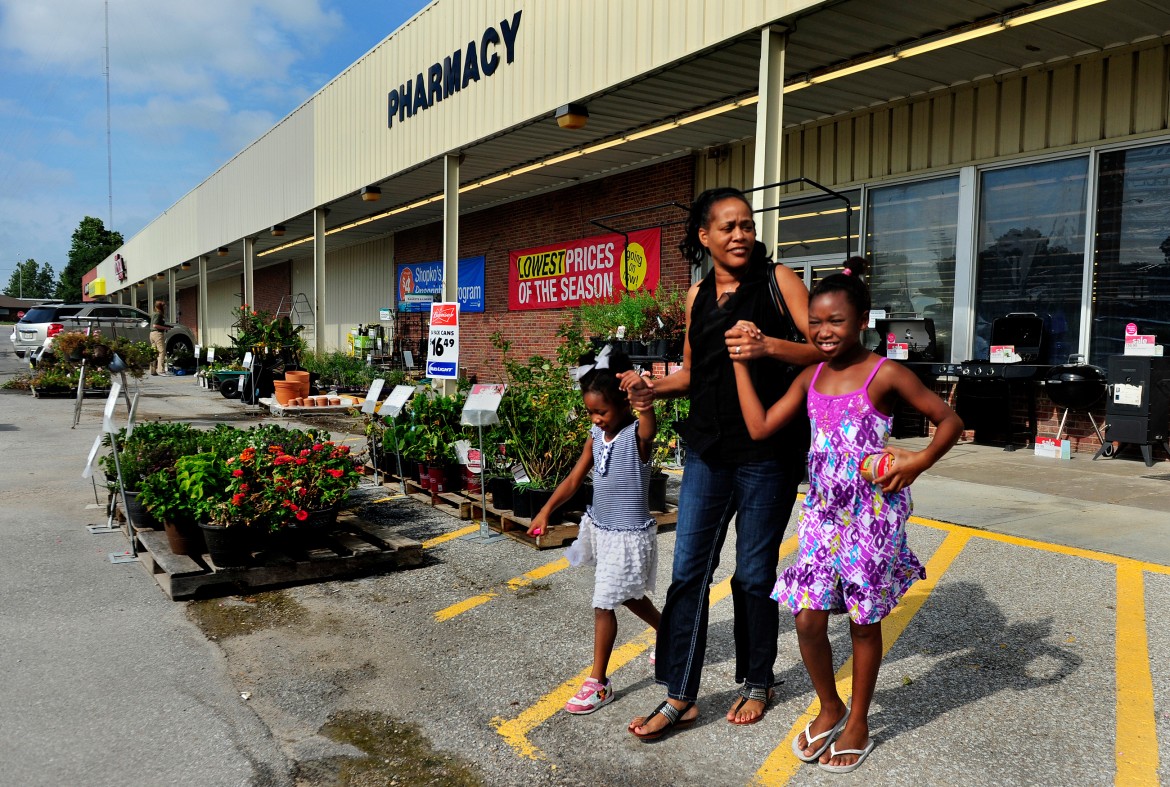
Andrea Williams leaves the store with daughters Tamia, 5, left, and Taja, 10, after purchasing some ice cream.
“How did it get this bad?” Andrea asked herself one morning, surveying the disrepair of their apartment. There was a hole in the bathroom floor and a leak spilling into the kitchen. “When did everything start seeming so impossible to solve?” she said.
She remembered a time when she had been the person to whom neighbors came for help. “Mama Dre” was how she had referred to herself in New Orleans and then for a while in Auburn, too, because she had offered her bedroom to a woman who was being abused, taken over an addict’s finances so his children could buy food and sometimes driven a caravan of children from their apartment complex to the elementary school. She had worked for a while as a waitress in Auburn and later at a retirement home. “A giving, generous personality type,” Tierra said of her mother at her best, but the restaurant customers hadn’t always been generous in return, promotions had gone to co-workers, and the town had begun to feel increasingly remote. Troy had started drinking more, and Andrea had gone to see a therapist who prescribed anti-anxieties and antidepressants.
Lately it was all she could do to address one problem, just one, so she decided to see the landlord about their carpet.
It was gray, dusty, fetid and so threadbare in parts that cleaning it was like trying to vacuum concrete. She remembered the management company promising to replace the carpet every two years, but now it had been almost five. Troy thought it was the carpet that was making him cough and sneeze, with his immune system weakened by cancer treatments. Andrea had been calling the management company for weeks, but her landlord had a new baby and kept putting her off.
Andrea walked from their apartment toward the rental office, a half-mile in the heat. The posted hours said the office opened at 9 a.m., but now it was after 10 and the lights were off. “This is how they do it, just dodging all communication,” Andrea said. She walked home and returned in the afternoon.
This time the landlord’s mother-in-law was the only one in the office, and she explained that the landlord was home with her baby. “Oh, that’s nice,” Andrea said. “What can I help you with,” the mother-in-law said, because every month when Andrea came to the office she wanted help with something. She wanted a new screen. She wanted the window fixed. She wanted to pay her monthly rent in cash with two $20s and wait for her $6 in change, even though the rental office didn’t have a cash register and somebody had to go break the bills at the store across the street.
This time she wanted carpet. “It has gotten pretty bad,” she said.
“We’re working on that,” the mother-in-law said.
“You’re working on it,” Andrea said.
“We’ll get it fixed,” the mother-in-law repeated.
“You will,” Andrea said.
They stood in silence, smiling awkwardly at each other, until finally Andrea said thank you and walked out. “I don’t want to get us evicted,” she said, but the closer she got to home the angrier she became. She passed the new sign posted in Legion Park: “Visit Nebraska. Visit nice,” it read. “How much fake niceness do you have to put up with in this town?” she said. She passed the farmers sipping coffee at Casey’s General. “Bet they’d be getting their carpet,” she said.
And there, coming out of Casey’s and stomping his way toward No Daddy Land was Smoky, punching again at the air, undoing the buttons on his work uniform.
“Isn’t this the middle of your shift?” Andrea asked him, when they both reached her parking lot.
“They sent me home,” he said. He was pacing circles around her. “I can take it and take it and take it up to a certain point, but eventually I just pop off.”
“Slow down. What happened?” Andrea asked, and so Smoky began telling her about his shift, and how well it had started, since the manager had finally let him make sandwiches. The regular sandwich maker had called in sick, so suddenly Smoky had found himself behind the counter, a culinary graduate plying his craft, first working on the ready-to-go sandwiches and then moving on to the wraps. “Some meat, some nice crisp lettuce and then provolone, just like they trained me,” he said, and for a while behind the counter he had felt pretty good about Auburn. The customers were nice. They left their trucks running in the parking lot and knew each employee by name. They seemed to like his sandwiches. But then the manager had come back to check his work and told him his wraps needed to have American cheese, not provolone. She told him to remake the wraps, and he told her that in fact provolone was better, based on his experience in culinary school. She said then maybe he should go back to working in the stock room, and when he continued to argue she had sent him home.
“That’s four hours of my shift that I’m missing,” he said. “That’s 32 dollars I just lost.”
“Of course they want you in the stock room,” Andrea said, and now she was pacing, too. “They’re railroading you. They’re going to give you an emotional breakdown just like the one they gave me.”
“They trained me wrong. They told me provolone,” he said.
“I bet they did it on purpose. They’re setting you up for a fall,” she said, and then she stomped out her cigarette and started walking up the road toward Casey’s with Smoky trailing behind her. The streets were empty and the sky was clear but she was heating up, spinning, so much pressure colliding into a storm that built in her chest and rose into her throat.
“I’m tired of it!” she said. “You and I both know why they sent you home. Let’s see if they’ll say it to your face.”
“I’m not so sure . . . ” Smoky said, but she cut him off.
“They think we’re just going to keep taking it?” she said. “No way. No way.”
“But what good is . . . ”
“You better believe we’re going to make a fuss,” she said. They were almost at the gas station now, and Smoky ran up in front of her and grabbed her arm. “Please. No. Please,” he said, because didn’t she remember what she had been telling him all this time? How it was best to disassociate? To stay at home, invisible? “If we go in there, it can only end one way,” he said. “I’m going to lose my job.”
Andrea stared at him for a moment. Her shoulders dropped, and she looked depleted. “I’m just tired of it,” she said again, but this time her voice was quiet, resigned. The storm was over and this was what was left. He grabbed her shoulders and turned her away from town, back toward the apartment.
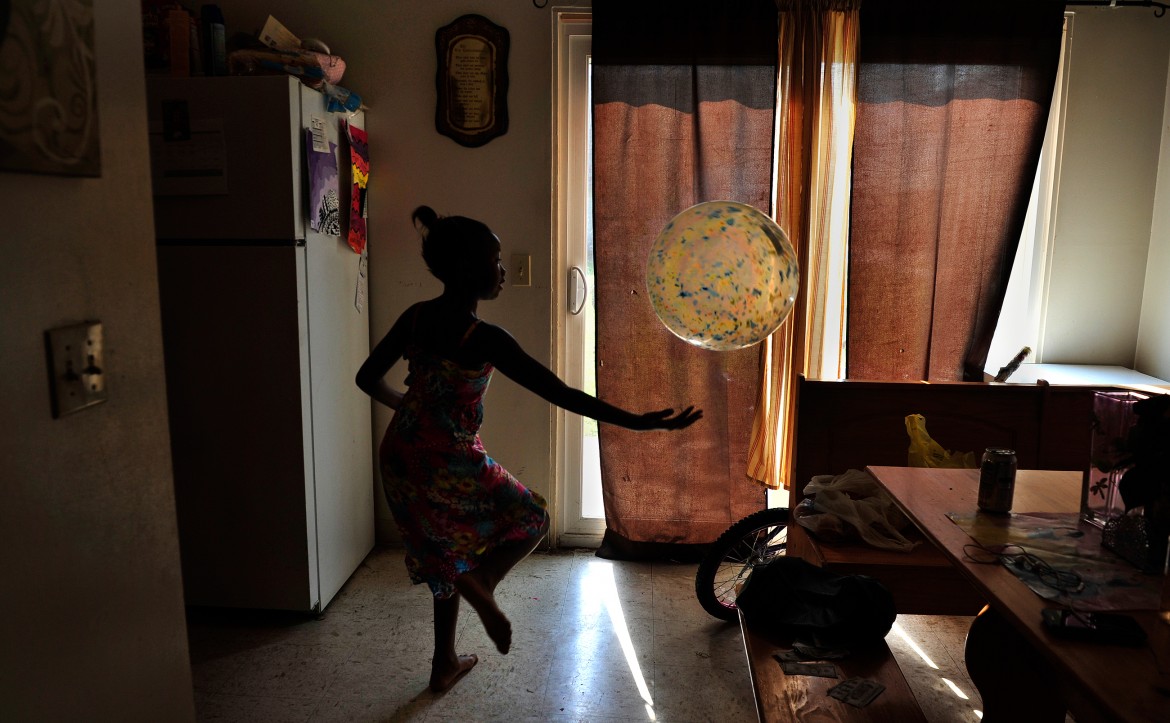
After getting bored from playing for hours on the phone, 10-year-old Taja bounces a rubber ball in the area that leads from the kitchen to a small patio.
Washington Post Staff Writer Eli Saslow is regarded as one of America’s finest narrative journalists, and these three stories will show you why. The reporting and writing are, quite simply, extraordinary. And because the topics Saslow has taken on are so crucial to a country dealing with mass shootings, single fatherhood, and racial disharmony, all three stories could not be more timely or necessary.
The first of the three, “A Survivor’s Life,” tells the story of 16-year-old Cheyeanne Fitzgerald, a victim of the mass shooting at Oregon’s Umpqua Community College in October. As Saslow wrote in the story’s set-up, “Nine people were killed that day, adding to the hundreds of Americans who have died in mass shootings in recent years. And seven people were wounded but didn’t die, joining the ever-expanding ranks of mass-shooting survivors. There are thousands of them.”
Cheyeanne Fitzgerald is one of those survivors. Saslow’s reporting begins six days after she came home from the hospital and lasted for two weeks, and the story he tells of her life as a survivor is brutally honest and utterly heartbreaking. It is also a story that Washington Post readers flocked to — nearly four-million online page views, with an average time spent per unique visitor in excess of nine minutes — which is further testament to the power of Saslow’s journalism. As one reader said, “I didn’t want to read this story, but once I started I didn’t want to stop.”
The same holds true for “You’re One of Us Now,” which will tell you a little more about the kind of reporter that Saslow is. Asked to write about Hurricane Katrina refugees, he didn’t take the easy route of finding people in Houston or Baton Rouge or anywhere else where refugees were plentiful.
Instead, his desire to find something surprising led him to tiny Auburn, Nebraska, population 3200, where the very few black residents included Troy Williams and his family, who had ended up in Auburn through improbable circumstances and, more improbably, were still there ten years later. As Saslow wrote of a journey that began when a FEMA official asked if anyone wanted to go to Nebraska and the Williamses said yes: “Nine hours later, they were on their way to the airport, a family of seven with a single carry-on bag and no idea where they were headed. They landed in Omaha, where the streets were wide and quiet; and then they were driven into the surrounding farmland, which started to smell of manure; and then they came into tiny Nebraska City, which at least had a Wal-Mart; and then they continued through 25 more miles of absolute emptiness until they arrived at what looked like nothing more than a junction in the road. One bar. Two gas stations. A main street of vacated shops and a squat municipal building decorated with a freshly painted sign. ‘Welcome Home Katrina Evacuees!’ it read.” That was how the Williamses got to Auburn, and then Saslow tells of what life has become in Auburn since those first hopeful moments. It, too, is heartbreaking and brutally honest.
And so it is with the third story, “A Father’s Initiative,” which tells of Paul Gayle, a single father who had no job, no money, a new baby and 16 lessons from the Obama administration to teach him what to do next. Here, in the earnest and doomed character of Paul Gayle, is the truth of Obama’s initiative to promote fatherhood for young black men. As Saslow writes of Gayle’s motivations for attending the classes: “Paul had come mostly because of the promise of free baby supplies, and lately he had been purchasing his Pampers one at a time, repeating the same transaction so often at a corner store that a clerk had dubbed it the Daddy Paul Special, 75 cents for a single cigarette and a size-3 diaper.” And as he writes about what happened in class one day: “ ‘Paul, come on man, what are you sure about?’ the teacher asked. ‘Me being honest?’ he said. “You’re asking us for simple yes/no answers, and I can see it both ways. It’s a whole lot more complicated than you’re making it seem.’ ”
That word — complicated — may be the best way to describe Paul Gayle, the Williamses, and Cheyeanne Fitzgerald, who are three versions of life not on America’s margins but at its unraveling core. The lives Saslow has documented matter greatly in these urgent times, and they would have remained hidden if not for Saslow’s unequaled skills as a reporter and writer. His work, as always, is revelatory, without judgment, and, most of all, humane. He has given us three stories that are journalistic acts of understanding, and for that we are proud to nominate him for a 2015 Pulitzer Prize for Feature Writing.
Sincerely,
Martin Baron