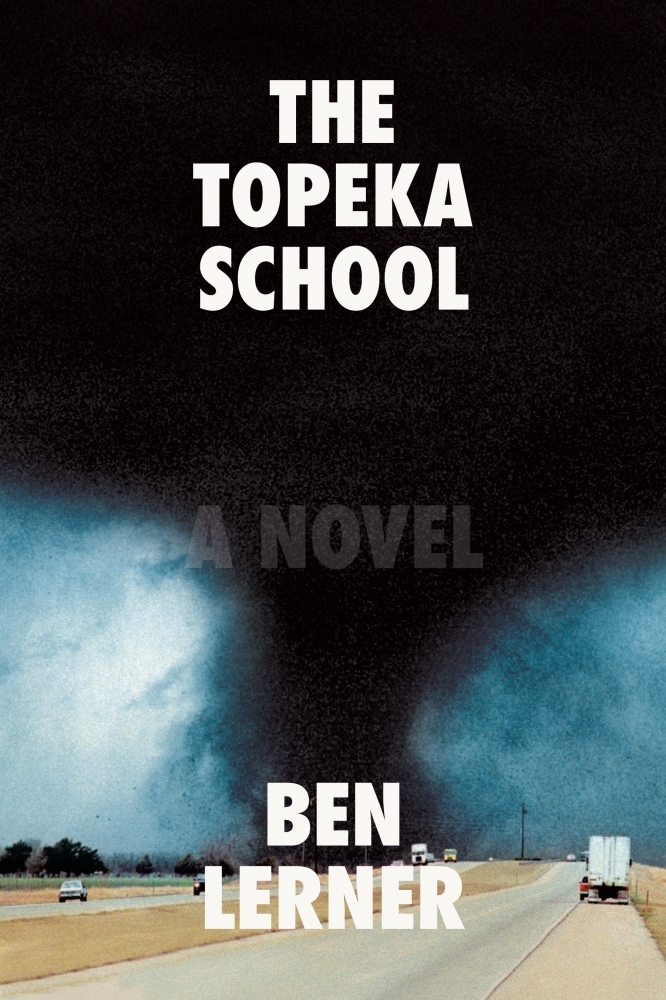
Finalist: The Topeka School, by Ben Lerner (Farrar, Straus and Giroux)

A brilliant and ambitious exploration of language, family and American identity as exemplified by the life of a Midwestern high school debate champion.

Nominated Work

The Topeka School


From the award-winning author of 10:04 and Leaving the Atocha Station, a tender and expansive family drama set in the American Midwest at the turn of the century: a tale of adolescence, transgression, and the conditions that have given rise to the trolls and tyrants of the New Right.

Adam Gordon is a senior at Topeka High School, class of ’97. His mother, Jane, is a famous feminist author; his father, Jonathan, is an expert at getting “lost boys” to open up. They both work at a psychiatric clinic that has attracted staff and patients from around the world. Adam is a renowned debater, expected to win a national championship before he heads to college. He is one of the cool kids, ready to fight or, better, freestyle about fighting if it keeps his peers from thinking of him as weak. Adam is also one of the seniors who bring the loner Darren Eberheart—who is, unbeknownst to Adam, his father’s patient—into the social scene, to disastrous effect.

Deftly shifting perspectives and time periods, The Topeka School is the story of a family, its struggles and its strengths: Jane’s reckoning with the legacy of an abusive father, Jonathan’s marital transgressions, the challenge of raising a good son in a culture of toxic masculinity. It is also a riveting prehistory of the present: the collapse of public speech, the trolls and tyrants of the New Right, and the ongoing crisis of identity among white men.

-- from the publisher

Biography

Ben Lerner was born in Topeka, Kansas, in 1979. He has received fellowships from the Fulbright, Guggenheim, and MacArthur Foundations, and is the author of the internationally acclaimed novels LEAVING THE ATOCHA STATION and 10:04, and an essay, THE HATRED OF POETRY. His poetry collections include THE LICHTENBERG FIGURES, ANGLE OF YAW, and MEAN FREE PATH. Lerner is a professor of English at Brooklyn College.

Winners

Prize Winner in Fiction in 2020:

Colson Whitehead

A spare and devastating exploration of abuse at a reform school in Jim Crow-era Florida that is ultimately a powerful tale of human perseverance, dignity and redemption. Fiction

Finalists

Nominated as finalists in Fiction in 2020:

Ann Patchett

A masterful and beautifully rendered allegory of the destructive force of social ambition on several generations of a Pennsylvania family.

The Jury

Danielle Trussoni(Chair)

Novelist and Book Columnist at The New York Times Book Review

Marie Arana

Author and Senior Advisor

Eric Banks

Director, New York Institute for the Humanities

Min Jin Lee

Author

Oscar Villalon

Managing Editor, ZYZZYVA, San Francisco

Winners in Fiction

Richard Powers

An ingeniously structured narrative that branches and canopies like the trees at the core of the story whose wonder and connectivity echo those of the humans living amongst them.

Andrew Sean Greer

A generous book, musical in its prose and expansive in its structure and range, about growing older and the essential nature of love.

Colson Whitehead

For a smart melding of realism and allegory that combines the violence of slavery and the drama of escape in a myth that speaks to contemporary America.

Viet Thanh Nguyen

A layered immigrant tale told in the wry, confessional voice of a "man of two minds" -- and two countries, Vietnam and the United States.

2020 Prize Winners

Nikole Hannah-Jones of The New York Times

For a sweeping, provocative and personal essay for the ground-breaking 1619 Project, which seeks to place the enslavement of Africans at the center of America’s story, prompting public conversation about the nation’s founding and evolution.

Christopher Knight of the Los Angeles Times

For work demonstrating extraordinary community service by a critic, applying his expertise and enterprise to critique a proposed overhaul of the L.A. County Museum of Art and its effect on the institution’s mission.