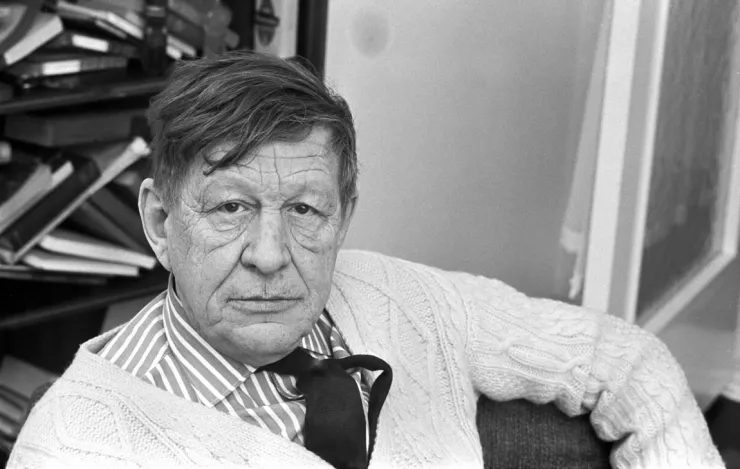
Wystan Hugh Auden, the British poet, moved to the United States in 1939. He taught at the University of Michigan and Swarthmore College during World War II. After the war he went to Germany with the U.S. Strategic Bombing Survey to help assess the effect of the Allied bombing campaign. He returned to the United States, settled in Manhattan and became an American citizen.
Pulitzer Prize juries considered poetry collections by Auden in 1945 and 1948. In each case, his book had competition.
By the mid-’40s three literary scholars, Henry Seidel Canby, Louis Untermeyer and Arthur Kreymborg were serving regularly on Pulitzer Prize juries in Poetry. This led to far more detailed commentary on the leading entries than had occurred in the early years of the prizes.
Here are the duels of 1945 and ’48 as the juries judged them.
1945
W.H. Auden vs. Karl Shapiro
From the report by Chairman Wilbur L. Cross (though the commentary is probably Untermeyer’s):
The number of volumes in the competition has fallen to 36 from an average of 50 in previous years. Nevertheless nearly as many volumes as usual represent distinguished work.
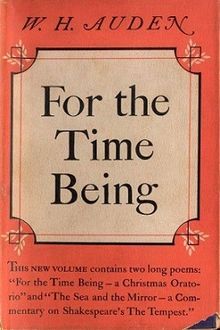
Auden's For the Time Being
By far the most distinguished is the volume entitled For the Time Being by W.H. Auden, a resident (but perhaps not yet a citizen) of the United States. Born in York, England, in 1907, Auden came to this country several years ago and is now (or has been) on the faculty of Swarthmore College.
His book comprises two long poems cast in partially dramatic form. The first poem, which is called “The Sea and the Mirror,” is described as “A Commentary on Shakespeare’s The Tempest.” The second poem, which takes its name from the title of his book, is described as “A Christmas Oratorio.” It is a very musical “Nativity Play,” but it is not a formal drama. It is dedicated to the memory of his mother.
In his first poem Auden brings The Tempest right down into the present and in the second he is equally modern in his treatment of the main incidents in the life of Christ. Throughout both poems are present overtones of ancient days. Still abide with us, problems of good and evil, justice and injustice, soul and the body. Auden’s conclusion seems to be:
There is one World of Nature and one Life
Sin fractures the Vision, not the fact.
In maintaining this thesis Auden is often as searching as Browning, while in the technique of his lyrics he is at times as perfect as Tennyson in form and rhythm. He is taking a high place among the outstanding English poets of his generation.
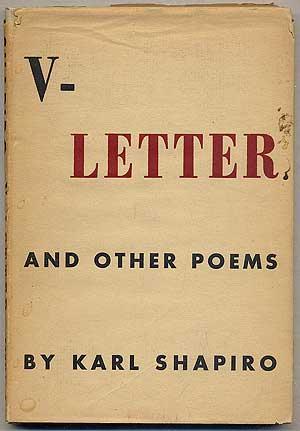
Shapiro's V-Letter and Other Poems
Next to Auden’s volume comes in the order of merit, it is the opinion of the Jury, V-Letter and Other Poems by Karl Shapiro, whose first poems, collected in 1942, showed so much promise that they won for him a Guggenheim Fellowship and a special grant from the American Academy of Arts and Letters. The promise of those first poems has been largely fulfilled in the new volume. His former often-misplaced bitterness has mostly disappeared while his pungency remains. In other words he has got better control over his emotions.
For upwards of two years, Shapiro has been active in military service out in the Pacific where he has written all but one of his latest poems. They may be called war poems, but they are not such in the usual sense of the designation. He nowhere deals with the glory or hatreds of war. He gives expression to the emotions awakened in a soldier by the incidents of war; for example, when he sees a companion killed and afterwards buried, or when he learns how another feels who has lost a leg. Some of the poems are written in a light vein. In brief, Shapiro’s subject is the change wrought in a man’s spirit and view of life and death by his experiences at the front in far-distant alien islands. The contrast between war and peace is finely expressed in the poem entitled “V-Letter,” which is a letter home.
Shapiro has not the technical skill of Auden in versification. But he writes well in a straightforward natural manner. Auden addresses the intellect, Shapiro addresses the emotions.
Winner: Karl Shapiro, for V-Letter and Other Poems
1948 W.H. Auden vs. Wallace Stevens
From Louis Untermeyer on Auden’s The Age of Anxiety:
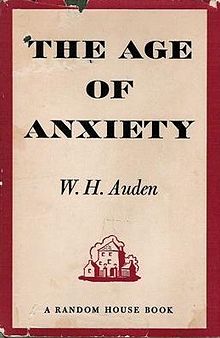
Auden's The Age of Anxiety
Auden is without doubt the most brilliant “younger” poet of our time. With the exception of T.S. Eliot and Robert Frost, I consider him the best contemporary poet regardless of his age. He is just forty, the author of some dozen volumes, some of which have been written in collaboration, most of which are poetry of an extraordinarily high order.
Auden would have been recommended twice for the Pulitzer Prize in the last few years — once for The Collected Poetry of W.H. Auden, once for For the Time Being. But until recently Auden was not an American citizen. He is one now, and in view of his past work, as well as the present volume, there is no reason why he should not finally be given the much-deserved award.
The Age of Anxiety is, like all of Auden’s work over the last five years, much less obscure than his early verse. It combines astonishing craftsmanship — the envy of his colleagues — with what could only be called clairvoyance, technical virtuosity with deeply probing analysis.
The present volume is subtitled A Baroque Eclogue. Structurally the work is both experimental and orthodox. Auden uses many of the old forms and the old rhetoric — the whole work is a reanimating of classic rules. He employs the severely stressed line with triple alliteration — a device that goes all the way back to Beowulf. But his language is modern in every phrase, and his “eclogue” is anything but pastoral — it starts with a wartime conversation in a bar. The four people who are the dramatis personae reenact the seven ages and seven stages of man, from reminiscence, through the wasteland of disillusion — including a dirge lamenting the lost leader (the “lost dad,” the vanquished God) — to a half-mystical, half-valedictory hope.
Auden thus steps forward and backward in time and technique. He fuses his prose “Argument” of an earlier day with the stream-of-consciousness monologues of the present. In his combination of precision and imagination he piles Pope on top of Hopkins. The result is surprisingly successful work; the eccentricity is held within the framework of a fastidious intellect, and the final effect is that of clarity distilled from confusion. In short, this is a subtle, marvelously varied, and continually exciting creation.
Stevens' Transport to Summer
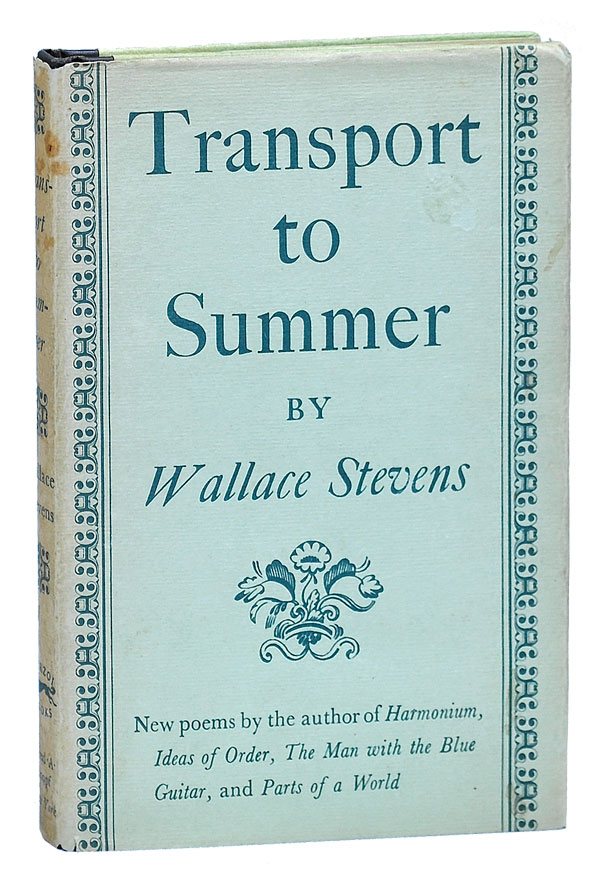
The one volume which the judges agreed deserved secondary consideration is Wallace Stevens’ Transport to Summer. It is not only a work of high distinction; it maintains and develops his ebullient philosophy, profound sensitivity, esthetic grace and uncompromising integrity. Now in his 69th year, he has never won a Pulitzer Prize, although he has received the growing praise of older and younger poets and critics here and abroad. Because of his esoteric nature and individual style, his public appeal is narrower than Auden’s. He is, in fact, and has always been indifferent to popularity. Wallace Stevens is nonetheless an artist whose dedication to ordered poetry is rare at a time of disorder in the world at large.
Winner: W.H. Auden, The Age of Anxiety
(Wallace Stevens won a Pulitzer Prize in 1955, at the age of 75, for his Collected Poems. He died a few months later.)