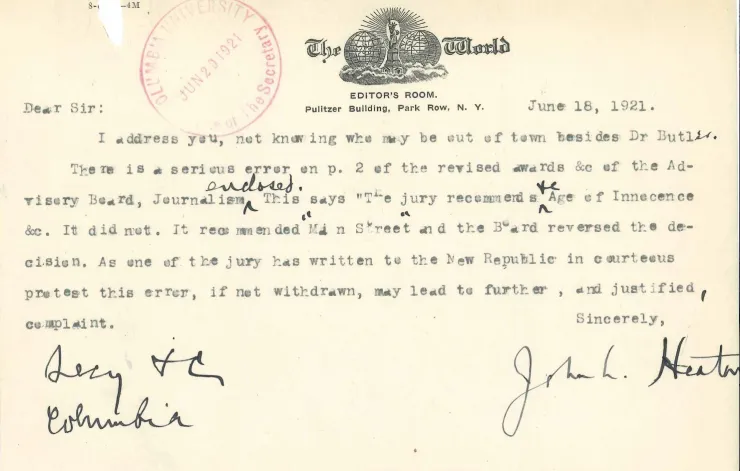
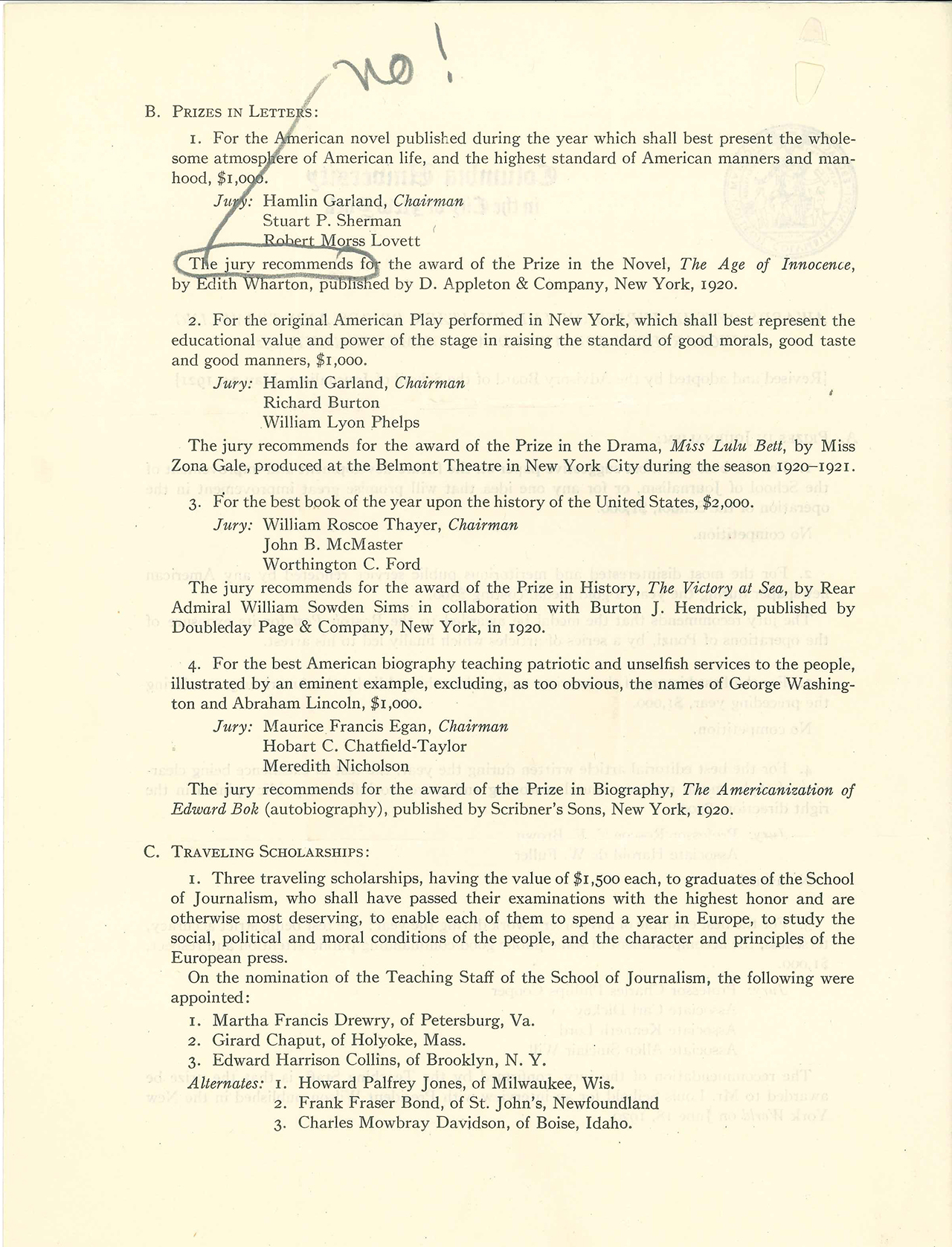
The document enclosed with the note above.
In 1921, Edith Wharton became the first woman to win the Novel Prize. It was the fourth year of the Prizes’ existence. "The Age of Innocence," Wharton’s book about New York high society during the 1870s, captured the Novel Prize, as the Fiction award was known for the first three decades of its existence.
Last year, for the 100th anniversary its publication in 1920, Penguin Classics and Scribner offered new editions of the book with introductions by Elif Batuman and Colm Toibin respectively.
The Mount, Wharton's historic home and cultural center, also has hosted events to revisit both the book and the 1993 film adaptation starring Daniel Day-Lewis, Michelle Pfeiffer and Winona Ryder. Learn more about live programming at the Mount, Located in Lenox, Mass., here.
The Pulitzer board's choice to award Wharton the prize, though not her gender, ignited public controversy even before it was formally announced.
In the June 22 edition of The New Republic, Robert Morse Lovett, a juror for the Novel prize, wrote that "The Age of Innocence" had not, in fact, been the jury’s choice. The jury favored "Main Street," by Sinclair Lewis. The Pulitzer board overturned its decision. Lovett did not say so, but the man behind the switch was most likely Nicholas Murray Butler, president of Columbia University.
Lovett, a literary scholar, joined The New Republic as an associate editor in 1921. His fellow Pulitzer jurors were Hamlin Garland, a writer who would go on to win the 1922 Pulitzer Prize for Biography, and Stuart Pratt Sherman, a college professor and critic.
In his New Republic piece, Lovett wrote that although the 59-year-old Wharton had earned her status as “one of our best artists in prose,” the public had a right to know that the jury had chosen another book. Main Street, a bestselling satire on small-town life in America, was “clearly in the lead” from the outset of the jury’s deliberations, he wrote.
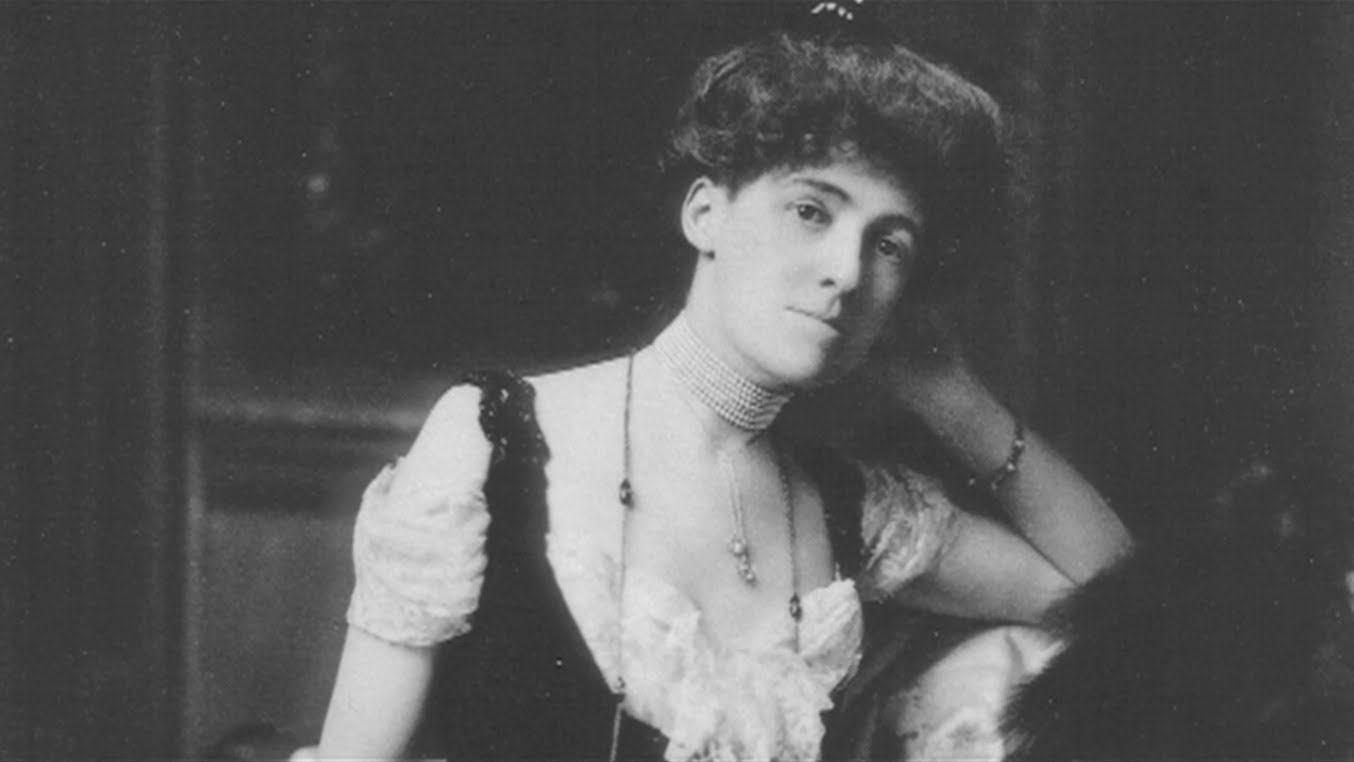
Edith Wharton.
In his commentary Lovett included the admiring appraisal of Main Street of his fellow juror Sherman.
“Lately I’ve made three canons for the literary critic — simple and unacademic,” Sherman wrote. “The critic is to ask of a work of art:
“I. Is it alive?
“II. Am I glad that it is alive?
“III. Why?
“I answer the first two questions about 'Main Street' in the affirmative. The characters persist in memory as three-or-four dimensioned robust beings months after they are met. I remember nearly all of them, after the other people I have encountered in the year’s fiction have faded flat. That, in my experience, is the most decisive test of the vitality of a novel. It has also abundant comic spirit and critical as well as representational force. It does something to the mind as well as to the feelings. It has communicated more life to the reading public than any other novel I can recall the fortunes of. ... Once in a great while the public does make a best seller out of a perfectly sound book. I think this is one of the cases; and it’s a thing to be rejoiced over.”
Joseph Pulitzer’s will had specified a $1,000 annual prize “for the American novel published during the year which shall best present the whole atmosphere of American life, and the highest standard of American manners and manhood.” By 1921, “wholesome” had replaced “whole.”
The change did not go unnoticed. Angry as Lewis was at being passed over for the prize, he wrote a note congratulating Wharton. She responded:
“When I discovered that I was being rewarded — by one of our leading Universities — for uplifting American morals, I confess I did despair. Subsequently, when I found the prize shd really have been yours, but was withdrawn because your book (I quote from memory) had ‘offended a number of prominent persons in the Middle West,’ disgust was added to despair.”
Sources: The New Republic, June 22, 1921, p. 114; The Novel: A Biography, by Michael Schmidt, p. 518; Pulitzer Prize files.