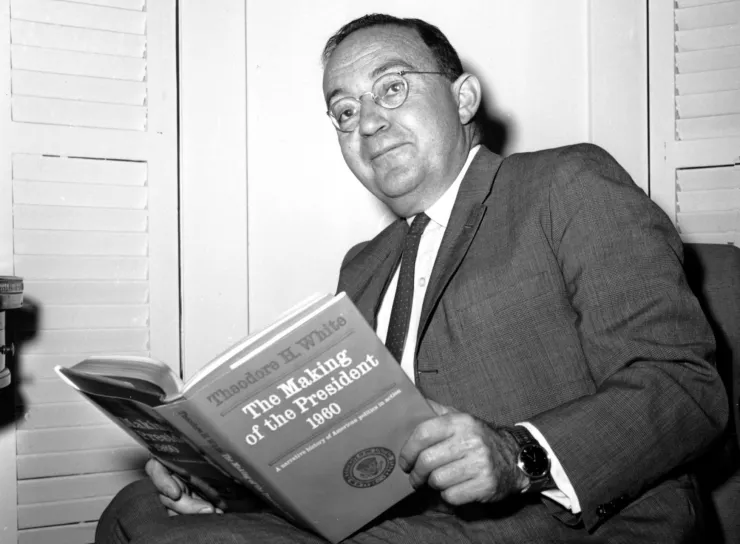
"A primary fight, at any level, is America's most original contribution to the art of democracy — and, at any level, it is that form of the art most profoundly reviled and intensely hated by every professional that practices politics as a trade." — Theodore White
White, who received the first Pulitzer Prize for General Nonfiction, was a key transitional figure in American journalism.
A contemporary of such Washington insiders as Walter Lippmann, Arthur Krock and Scotty Reston, he shared their vizier-like affinity for political access in a city whose patrician mores were still governed by alumni networks and memberships in social organizations such as the Alibi Club. Yet a meritocratic upbringing that catapulted White from Boston's public schools to a summa cum laude degree at Harvard under preeminent China hand John Fairbank inculcated a degree of defiance that he was unafraid to brandish, most notably as a thorn in the side of Chiang Kai-shek's Nationalist government while working as a correspondent for Time during World War II.
Appropriately, White's Pulitzer-winning work served as a bridge between this Washington of yesteryear — where the proverbial "smoke-filled rooms" of convention delegates (definitively chronicled by Vice President Henry Wallace in his wartime diary) could be so opaque that Supreme Court Justice William Douglas came within a hair's breadth of replacing Wallace on the eventual 1944 Roosevelt-Truman ticket — and the birth pangs of a new phenomenon: the circuitous, pollster-driven, media-savvy campaign. As White wrote (perhaps a little hastily): "The 'smoke-filled room' as political reality is now as dead as Prohibition."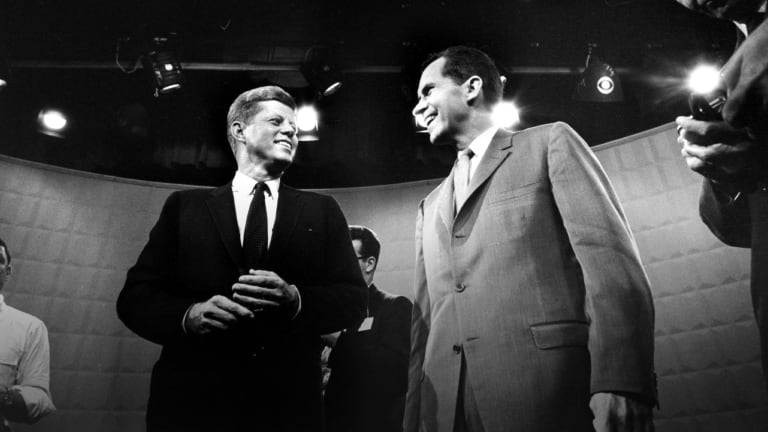
Kennedy and Nixon as they embarked on the first of four televised debates. (Francis White/Getty Images)
With this new frontier came two indelible figures: 1957 Biography winner and Massachusetts Senator John Kennedy, the "lace curtain" aspirante who sought to manifest his influential father's unlikely dream of attaining the White House; and Vice President Richard Nixon, who overcame a childhood of depredations in rural California and embraced scorched-Earth political tactics (exemplified by a particularly vitriolic 1950 Senate campaign against Rep. Helen Gahagan Douglas) to be within a heartbeat of the presidency at the age of 40.
From the wholly novel use of television as a debate medium ("The future was thus obscure when the representatives of the two candidates and the spokesmen for the broadcasting networks first met at the Waldorf-Astoria in September") to the intricacies of what White described as "the art of the primary" (still contingent on future Vice President Hubert Humphrey's selective enrollment model in which "big city bosses can usually be swayed only by a national candidate's demonstration of surplus power at the polls"), he conscientiously chronicled the birth of the modern political campaign.
Within a decade — during which the influence of television and the primacy of primary season, particularly following Democratic reforms instituted by George McGovern, blossomed — his work served as a lodestar for the next generation of political journalists. Although he authored tomes on the 1964, 1968 and 1972 campaigns, political journalists such as 1979 International Reporting winner Richard Ben Cramer ("What It Takes"), syndicated columnist Jules Witcover ("Marathon") and maverick Rolling Stone correspondent Hunter S. Thompson ("Fear and Loathing: On the Campaign Trail '72") updated the White template.
Of the three, however, only Witcover would fully succeed in maintaining the requisite distance from the personalities of the trail. In digressive encomiums about McGovern (Thompson) and future Vice President Joe Biden (Cramer), the younger journalists sought to invoke White's Kennedy, memorably characterized by 2008 History finalist Robert Dallek as "a kind of knight in shining armor." Yet that Kennedy was almost a mirage wrought large, with White readily conceding throughout his text that Kennedy was dependent on "many servants, many aides, many helpers" — individuals like future Press Secretary Pierre Salinger and two-time Pulitzer winner Arthur Schlesinger, Jr.
Appropriately for one of the closest presidential campaigns in American history, "The Making of the President 1960" inspired a near-stalemate among the inaugural General Nonfiction jury. H. Roderick Nordell, a critic for the Christian Science Monitor, favored White's book. But fellow juror Edward Weeks of the Atlantic Monthly was captivated by another highly influential work that also reflected a transitional discipline (in this case, urban planning): Jane Jacobs' "The Death and Life of Great American Cities," which he cited as "the most revolutionary book in its field in 20 years." However, the Advisory Board succeeded in forestalling a controversy by unanimously awarding the Prize to White.
"Once you have a Pulitzer," he subsequently quipped, "there's nothing left to look forward to."
As another campaign season comes to a close, read the original jury report here.