
September means back to school, whether in person or online. This month, take a look back at Pulitzer winners and finalists who have explored student life — such as Manny Crisostomo's photographs from a Detroit high school, or Athelia Knight's lyrical descriptions of studying in Northeast D.C.
Other winners have taken deep dives into how policy impacts young people — such as reporting by the South Florida Sun Sentinel on a school shooting, or busing practices in Boston as covered by Farah Stockman in the Boston Globe.
Read a selection of these works below. Across Pulitzer.org readers can find more journalism, as well as books, that speak to the realities and aspirations of American education.
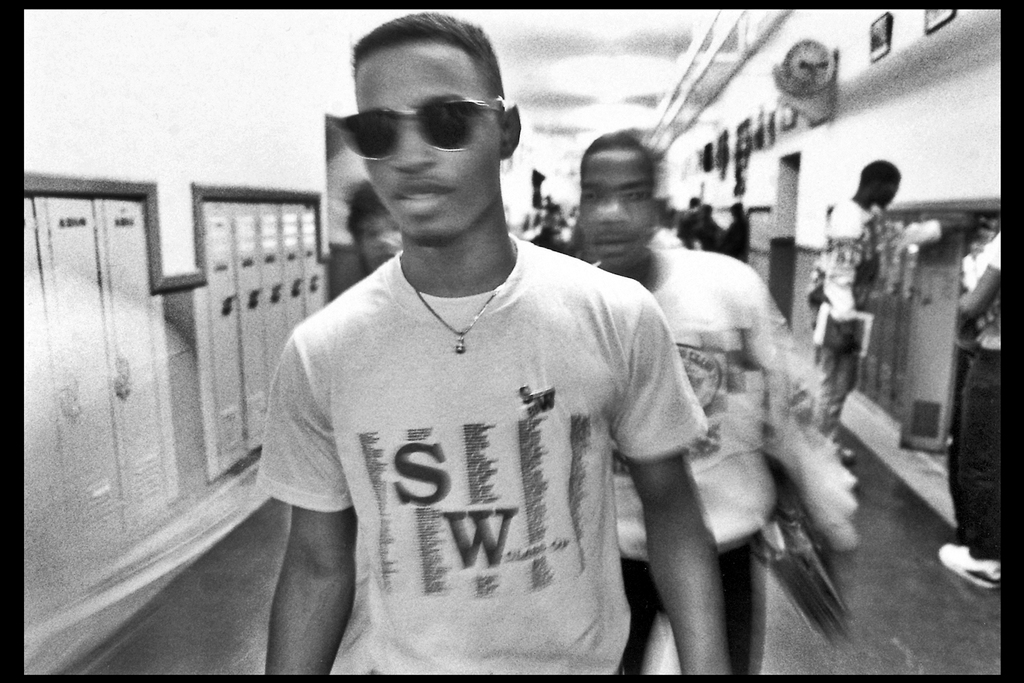
A student at Southwestern High School in Detroit, in an image from Manny Crisostomo's 1989 Pulitzer-winning Feature Photography portfolio. Photo: Manny Crisostomo
1. Manny Crisostomo, winner, Feature Photography, 1989
Photographer Manny Crisostomo spent a year at Detroit’s Southwestern High School, where he captured students learning how to navigate violence and drug use in their troubled neighborhoods, while enjoying the pep rallies and football games of their teenage years. His black-and-white images capture unfiltered emotion — a serene couple slow-dancing, a choir booming out in unison, a student jumping around at a crowded party. The portraits of American youth freeze in time the ephemeral highs and lows of high school. Viewers can’t help but succumb to the chaotic thrill of growing up, all over again. The full portfolio of images, along with the layouts of the original photo essay as published in the Detroit Free Press, are available on Crisostomo's website.
2. South Florida Sun Sentinel, winner, Public Service, 2019
Staff at the South Florida Sun Sentinel met tragedy with tenacity. Their meticulous coverage of administrative failures before and after the shooting rampage at Marjory Stoneman Douglas spurred a nationwide flood of reform. Student survivors joined the reporters who covered them at the Pulitzer ceremony last April. Their commitment to creating a legislative legacy from this horrific day gets to the heart of journalistic purpose. The Pulitzer-winning coverage highlights the mishandled actions of school and law enforcement officials, as well as profiles of those now fighting for the safety of our educational spaces. The material can be accessed via the link above, or via the Sun Sentinel site, here.
3. Athelia Knight of The Washington Post, finalist Explanatory Journalism, 1988
Athelia Knight’s immersive, year-long account of life at McKinley High School is a model of explanatory storytelling. Both an exposé of the threats to American education — declining enrollment, insufficient funding — and a celebration of the resilient educators who persevere nonetheless, Knight presents an enduring snapshot of student life in Northeast Washington, D.C. Her prose is clear and striking. Her vignettes shatter the time and distance between readers and the students described, establishing an intimacy that resonates so many years later. A finalist for the 1988 Prize, Knight reminds us of narrative’s preserving and empathizing power. Her portfolio is available at her website, here.
4. Farah Stockman of The Boston Globe, winner, Commentary, 2016
In a series of 10 articles, Farah Stockman turns a critical eye on Boston’s legacy of busing and its contribution to ongoing racial tensions in the city. The scope of her commentary stretches from “unfinished business” of the '60s and '70s to the Black Lives Matter movement and beyond, reminding us that the past is inseparable from the present. The measurable impact of Stockman’s work reverberated through the city, most notably when Massachusetts' governor and other policymakers dubbed this series a signal of public education’s mission: to create equitable opportunities for students of all backgrounds. Her fusion of alarming investigation with unmistakable hope renders this account uniquely captivating.
5. Staff of the Shreveport (LA) Times, finalist, Public Service, 1989
The Staff of the Shreveport (LA) Times turned their articles into activism during a campaign urging state-wide public education reform. One of the standout pieces spoke to the merit of vocational curricula and advocated for students hoping to enter a skill-based trade upon high school graduation. The coverage culminated in legislative change to statewide education policies, reasserting journalism’s power to foster tangible shifts. There may be a paywall to this content depending on the frequency of your visits to the Times' website, but the pieces are available here.
6. Tampa Bay Times, winner, Local Reporting, 2016
After a shocking investigation, the Tampa Bay Times found that a school board knowingly transformed five average school districts into “failure factories,” the worst districts in the entire state. Meticulous reporting culminated in a nine-part series that features voices of both the students suffering through the neglected institutions and the school board members culpable in the decline. The series led to ongoing activist efforts to improve the affected districts, an update of which can be found on the Tampa Bay Times page dedicated to this mission.
Journalists have demonstrated persistence in monitoring and exposing inequities, advocating for underrepresented youth, and immortalizing the experience of growing up through timeless photography and prose. Often, these accounts have impacted the legislation of affected communities.
As students head back into the classroom this fall, it’s reassuring to reflect on all the eyes and ears looking out for them.