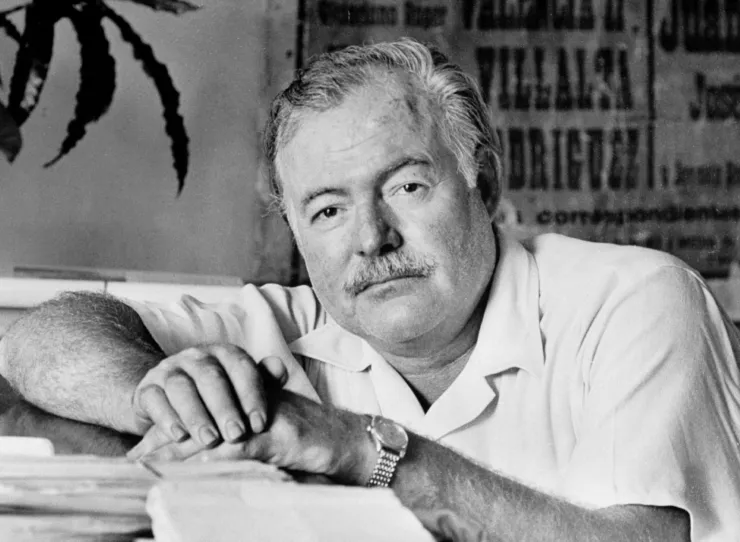
This week marks the premiere of "Hemingway," a three-part, six-hour PBS documentary series by Ken Burns, Lynn Novick and Sarah Botstein that chronicles the prolific career and enigmatic personal life of the 1953 Fiction winner.
With contributors ranging from Penn State literary scholar and Hemingway Letters Project General Editor Sandra Spanier to the late Sen. John McCain, the filmmakers explore a life marked by contradiction: the Midwesterner who found professional transcendence through expatriation in Europe and Cuba; the war-weary observer who embraced big-game hunting; the Poundian-Steinian experimentalist of "In Our Time" who also set an enduring template for hard-boiled crime fiction and the mise en scène of film noir.
Having shunned the prolixity of academic study and media inquiries for wide swaths of his career, Hemingway's most astute interlocutors often proved to be his fellow writers. From antecedents to contemporaries and later writers, the following Pulitzer winners offered probing reflections on one of the most prominent archetypes (and sobering realities) in the history of American culture.
1. John Updike (Fiction, 1982 & 1991)
A quarter-century after Hemingway died by suicide at his home in Ketchum, Idaho, the publication of "The Garden of Eden" riveted readers with a new conception of the writer's identity. Composed in fits and spurts between 1946 and 1961 as depression, substance abuse and the deleterious effects of cognitive damage (including concussions and possible chronic traumatic encephalopathy) dulled his ability to bring projects to completion, the voluminous, semiautobiographical manuscript (whetted down to 247 pages by longtime publisher Charles Scribner's Sons) found the writer drawing upon the androgynous undercurrent in his second marriage to Pauline Pfeiffer in a langorous milieu far removed from the contemporaneous sentimentalism of "A Moveable Feast" and his Pulitzer-winning "Old Man and the Sea."
Upon release, the work was lauded by two-time Fiction winner John Updike. "In the trim published text of sixty-five thousand words, a daily repetition of actions remains (wake, write, drink, lunch, siesta, drink, eat, make love, sleep), but the dialogue never covers exactly the same ground and the plot advances by steady, subliminal increments, as situations in real life do," he wrote. "The basic tensions of the slender, three-cornered action are skillfully sustained. [...] A chastening, almost mechanically rhythmic order has been imposed, and though an edition with a scholarly conscience would have provided some clues to the mammoth amounts of manuscript that were discarded, this remnant does give the reader a text wherein he, unlike the author in his travails long ago, never feels lost."
2. Robert Frost (Poetry, 1924, 1931, 1937 & 1943)
More than a generation older than Hemingway, four-time Poetry winner Robert Frost's relationship with the younger writer remain nebulous, but both men frequented Key West and shared a mutual friend in 1955 Poetry winner Wallace Stevens. Upon Hemingway's death in 1961, Frost, who died less than two years later, issued the following statement:
"Ernest Hemingway was rough and unsparing with life. He was rough and unsparing with himself. [...] Fortunately for us, if it is a time to speak of fortune, he gave himself time to make his greatness. His style dominated our storytelling long and short. I remember the fascination that made me want to read aloud 'The Killers' to everybody that came along. He was a friend I shall miss. The country is in mourning."
3. Toni Morrison (Fiction, 1988)
One of only a handful of authors (including Hemingway, four-time Drama winner Eugene O'Neill, two-time Fiction winner William Faulkner and 2008 Special Citation recipient Bob Dylan) to share the Nobel Prize in Literature and a Pulitzer, Toni Morrison was poised to reflect on the ramifications of the elision of Black identity throughout Hemingway's work at an important inflection point in world history.
Based on the 1990 William E. Massey Sr. Lectures in the History of American Civilization at Harvard University, the criticism collected in "Playing in the Dark" (1992) offers what the religious scholar Rev. Michael Eric Dyson has characterized as an "interpretive space within a racially ordered hierarchy of cultural criticism. Blacks are usually represented through the lens of white perception rather than the other way around [...] With ['Playing in the Dark'], a substantial change is portended."
Morrison begins her assessment of "To Have and Have Not" (largely superseded in the popular consciousness by a divergent 1944 Howard Hawks film adaptation and widely perceived as Hemingway's most racially problematic work) and "The Garden of Eden" with a key qualification informed by the deconstructive methodologies of Jacques Derrida: "Hemingway's work could be described as innocent of nineteenth-century ideological agenda as well as free of what may be called recent, postmodern sensitivity. With that in mind, a look at how Hemingway's fiction is affected by an Africanist presence—when it makes the writing belie itself, contradict itself, or depend on that presence for attempts at resolution — can be taken by way of a 'pure' case to test some of the propositions I have been advancing."
The analysis that unfolds is both incisive and equanimous, percipient yet sympathetic. "Hemingway, who wrote so compellingly about what it was to be a white male American, could not help folding into his enterprise of American fiction its Africanist properties," she concludes. "But it would be a pity if the criticism of that literature continued to shellac those texts, immobilizing their complexities and power and luminations just below its tight, reflective surface. All of us, readers and writers, are bereft when criticism remains too polite or too fearful to notice a disrupting darkness before its eyes."