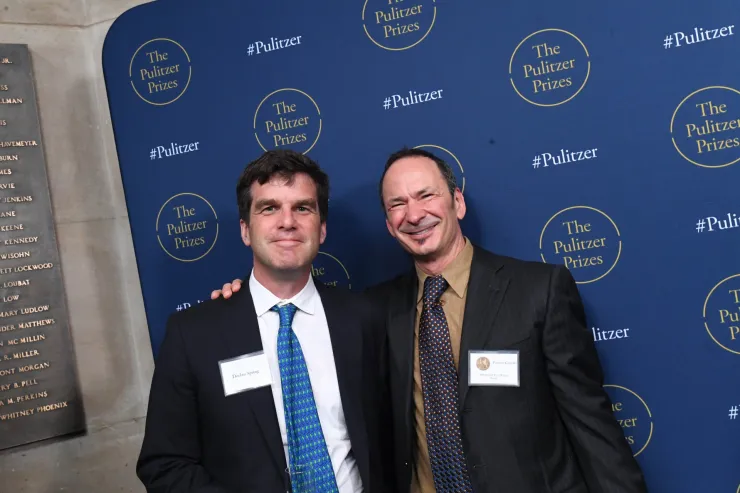
Forrest Gander was awarded the 2019 Pulitzer Prize in Poetry for his book, "Be With." The board described the work as, "A collection of elegies that grapple with sudden loss, and the difficulties of expressing grief and yearning for the departed."
Gander lost both his mother and wife, fellow poet C.D. Wright, in the same year, and his prize-winning book confronts loss from myriad angles.
He was a Pulitzer finalist in 2012 for "Core Samples from the World," described by the prize board as "A compelling work that explores cross-cultural tensions in the world and digs deeply to identify what is essential in human experience."
The poet shared notes on his inspiration and process.
PULITZER PRIZES: How and when did you know you wanted to become a poet?
FORREST GANDER: My grandfather, a Swede, loved to recite 19th century poetry in English. His daughter, my mother, was an elementary schoolteacher who read to me, when I was quite small, poems by Edgar Allan Poe and Carl Sandburg, among others. So I began writing poems at a very early age. In high school, I thought I was a hotshot poet. It wasn’t until I was in my freshman year at college that a professor saw my work and told me, “Forrest, these poems are terrible.” That was the moment when I became serious about reading contemporary poetry.
PP: How did you choose the title for your prize-winning book? The poems deal so often with loss, but "Be With" connotes warmth and companionship.
FG: “Be with” is a line from a poem by C.D. Wright, my late wife. I will always be with her. In some ways, I feel more with her than I am, anymore, with others.
PP: Can you talk a little bit about how you balance the cerebral and the emotional in your work?
FG: I was just listening to a podcast interview with Alice Quinn, the former director of Poetry Society. The interviewer was clearly trying to make the point that poetry should be immediately obvious and rewarding and accessible to everyone, regardless of their interest in or experience with literature. But art isn’t about passing back and forth received ideas and ready-made emotions. Most of us use language without thinking much about it. "Hi, how are you doing? Fine, how ‘bout you?" We all fall into our regular ruts of perception and response. But our routines and our desire for what is comfortable can keep us from making discoveries that expand the range of our engagements with language, with others, and with the world.
I think art has the capacity to deepen whatever it means to be human. It can articulate feelings and intuitions and, yes thinking as well, so that we have more of an awareness of their nuance and power. Of course a poem can be made up of familiar language — the very language of “Hi, how are you doing? Fine, how ‘bout you.” But that’s not the only thing it can do. I’m after a poetry that doesn’t reward my expectations, but unsettles them. A poetry that doesn’t congratulate me for what I know, but asks me to question what I know. For me, cerebral and felt experience are always braided.PP: How did you learn you had won the Pulitzer? What were some of your first thoughts that day?
FG: It was a complete surprise, as though a meteorite had shot into my living room. Michael Wiegers, the editor of Copper Canyon Press, called me to say that he had just seen a live feed of the Pulitzer announcements on TV and that "Be With" had won. His tone wasn’t jokey. I didn’t know that my book was in consideration. Within two hours, I had 400 emails.
PP: What guidance might you give to an aspiring poet?
FG: Read intensively. Find someone whose critical observations of your work you trust.
And make your heart large enough so that you can sustain yourself through all the disappointments, which are endless. I’d also say that if things aren’t happening in obvious ways for you, make things happen for others whose work you admire. Literature isn’t an enterprise only for self-valuation. Start a press, a reading series, write and publish reviews, launch a blog, apprentice yourself to the whole hog of the art. Your efforts will come back to you.