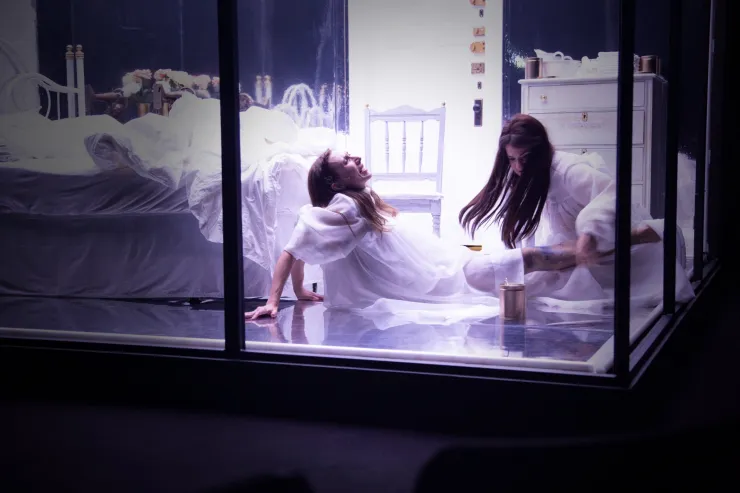
Composer Ellen Reid's 2019 Pulitzer Prize winner in Music, "p r i s m," releases digitally across major digital media services today, via Decca Gold.
In a statement on this digital debut, Universal Music Classics US President Graham Parker said, "Ellen is a fearless artist and composer who pushes the envelope with her musical works. She is at the forefront of classical contemporary music and I’m thrilled to have such an incredible talent join our growing Decca Gold family."
The Pulitzer board described "p r i s m," which features libretto by Roxie Perkins, as "A bold new operatic work that uses sophisticated vocal writing and striking instrumental timbres to confront difficult subject matter: the effects of sexual and emotional abuse."
Reid spoke to the Pulitzers about her inspiration and process.
PULITZER PRIZES: Your winning work, "p r i s m," addresses sexual assault. What about opera as an art form makes it an effective medium for confronting difficult subject matter?
ELLEN REID: "p r i s m" in our minds was always an opera. Opera is a powerful medium that reaches all of our senses, and we needed to use all of our senses to tell our story in an effective way. When we worked on "p r i s m," we envisioned the piece musically, physically and visually. We wanted to utilize the unique interdisciplinary power of opera to illuminate the psychological realm of the work.
I believe that music opens us up. Through music we can experience things more deeply. It’s almost like the boundaries between us fall away, and the boundaries between the audience and the characters fall away, then we’re all a little closer to understanding lives that aren’t our own. We understood that for "p r i s m" to work, we needed the audience to truly feel where the character was coming from and so we relied heavily on the music to do this.
Each medium has its own type of magic. We built "p r i s m" to revel in the magic that is particular to opera.
PP: Could you describe your philosophy on working with performers as you develop new work?
ER: I really love working with performers to develop new work. Each person brings their own perspective, sensibility and (in opera a literal) voice to the work. My favorite experiences are when the parts are crafted specifically for certain musicians’ strengths and personalities. In "p r i s m," I was in constant contact with Anna Schubert and Becca Jo Loeb (the two leads) about how things sat in their voice. Becca and I would FaceTime and she would sing things to me. Anna would come over and look at the score. The vocal range and stylistic range of their parts are crafted to their voices. This makes the performances both personal and possible.
I think that a wide range of performers would absolutely kill the roles of Bibi and Lumee, and I hope they do, but writing for a specific person and a specific voice keeps everything a little more real and exciting when the piece is being brought to life.
PP: This piece has so many elements — how does it translate to recording? Could you offer any thoughts about the value of live performances in this day and age?
ER: The album's producer, Lewis Pesacov, and I wanted to bring the charged theatricality of the live performance into the recording. In the studio, we used effects to subtly create aurally what was happening visually on stage. In one moment, the opera morphs from lush strings into a throbbing club pulse with a synth hook. We mixed that club section completely differently, like a pop song, so the listener will intuitively know that we are somewhere different than we were before.
"p r i s m" is a theatrical work, so we never considered any other type of recording besides a live recording. We wanted to harness the raw power of the performances. I’m amazed every time I listed to the piece that the performers can evoke such depth each and every performance.
PP: What does winning the Pulitzer Prize mean to you? Are there past winners, either in Music or other categories, whose work you particularly admire?
ER: I think that awards like the Pulitzer Prize, for better or for worse, influence the way we perceive who is "allowed" to make music and what music is.
I run a mentorship program for young female identifying, gender non-conforming and non-binary composers with Missy Mazzoli. The first thought I had when I heard the Pulitzer news was that I can’t wait for these young composers to skyrocket past us! Through our successes, they can see a future for themselves in the field. I am grateful to be part of the conversation. We have so much further to go.
There are numerous winners of the Pulitzer Prize in various categories that I admire. In music, Julia Wolfe, Caroline Shaw and Du Yun's work has been particularly influential, and I am a huge Kendrick Lamar fan. Being in the room the day of the ceremony brought home to me the gravity of the award. There were journalists in the room who had been imprisoned for seeking the truth. There were reporters who worked tirelessly to change unjust laws. There were survivors from Marjory Stoneman Douglas High School who had written obituaries for their classmates. And amid all of the depth and pain, Aretha Franklin’s music brought light to the darkness of the world.
It is such a huge honor have won this year’s Pulitzer Prize. "p r i s m" was a very collaborative piece, and I share the excitement of this honor with the whole team, especially the brilliant librettist Roxie Perkins.