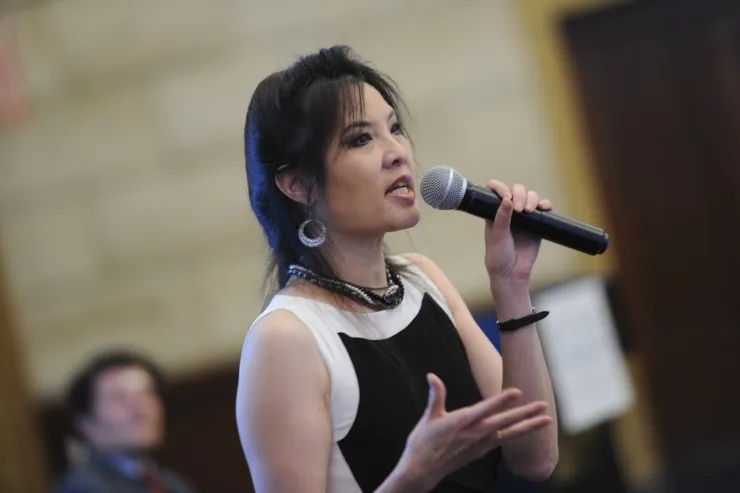
Initially envisioned following America's bicentennial celebration more than 40 years ago, and situated in May to commemorate the arrival of the first Japanese immigrant to the United States (May 7, 1843) and the completion of the First Transcontinental Railroad (May 10, 1869), Asian American and Pacific Islander Heritage Month recognizes the vital contributions of Asian Americans and Pacific Islander Americans to the country's history and culture.
A microcosm of this rich endowment can be found in the annals of the Pulitzer Prizes, where AAPI winners and finalists have been recognized for pioneering new forms of journalism, novel timbres in music, innovative forms of literary expression and compelling first drafts of history. As the celebration continues, we are proud to offer précises on some of their lives and careers.
Gobind Behari Lal (Reporting, 1937)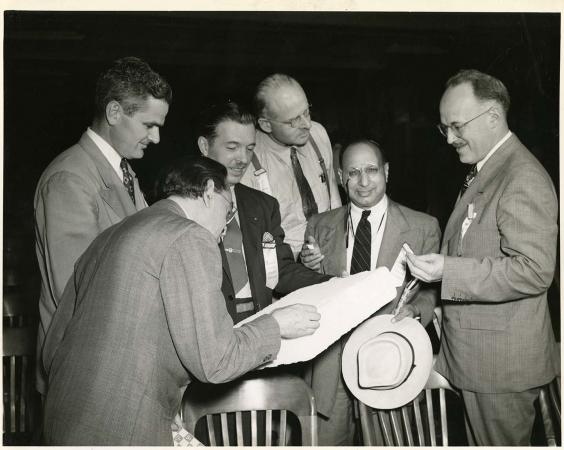
1937 Reporting winner Gobind Behari Lal (center-right, wearing pince-nez) at the dedication of a Goodyear research lab in 1943. (Smithsonian Institution Archives)
Among the first individuals to specialize in science journalism, Gobind Behari Lal was one of five reporters to share the 1937 Reporting Prize "for their coverage of science at the tercentenary of Harvard University," characterized in contemporaneous reports as "the greatest single assemblage of the scholars of the world since the Middle Ages." A close friend of Indian independence activist Har Dayal, Lal earned undergraduate and master's degrees from the University of Punjab before attending the University of California, Berkeley in 1912 on a scholarship established by Dayal to encourage scientific literacy in India. The first journalist to be identified as a science writer in his byline, Lal served as the president of the National Association of Science Writers in 1940 and capped off his career as science editor emeritus for Hearst Newspapers. His winning work was published by the Universal Service, a Hearst-owned news agency that later was folded into UPI.
Huỳnh Công Út, known professionally as Nick Ut (Spot News Photography, 1973)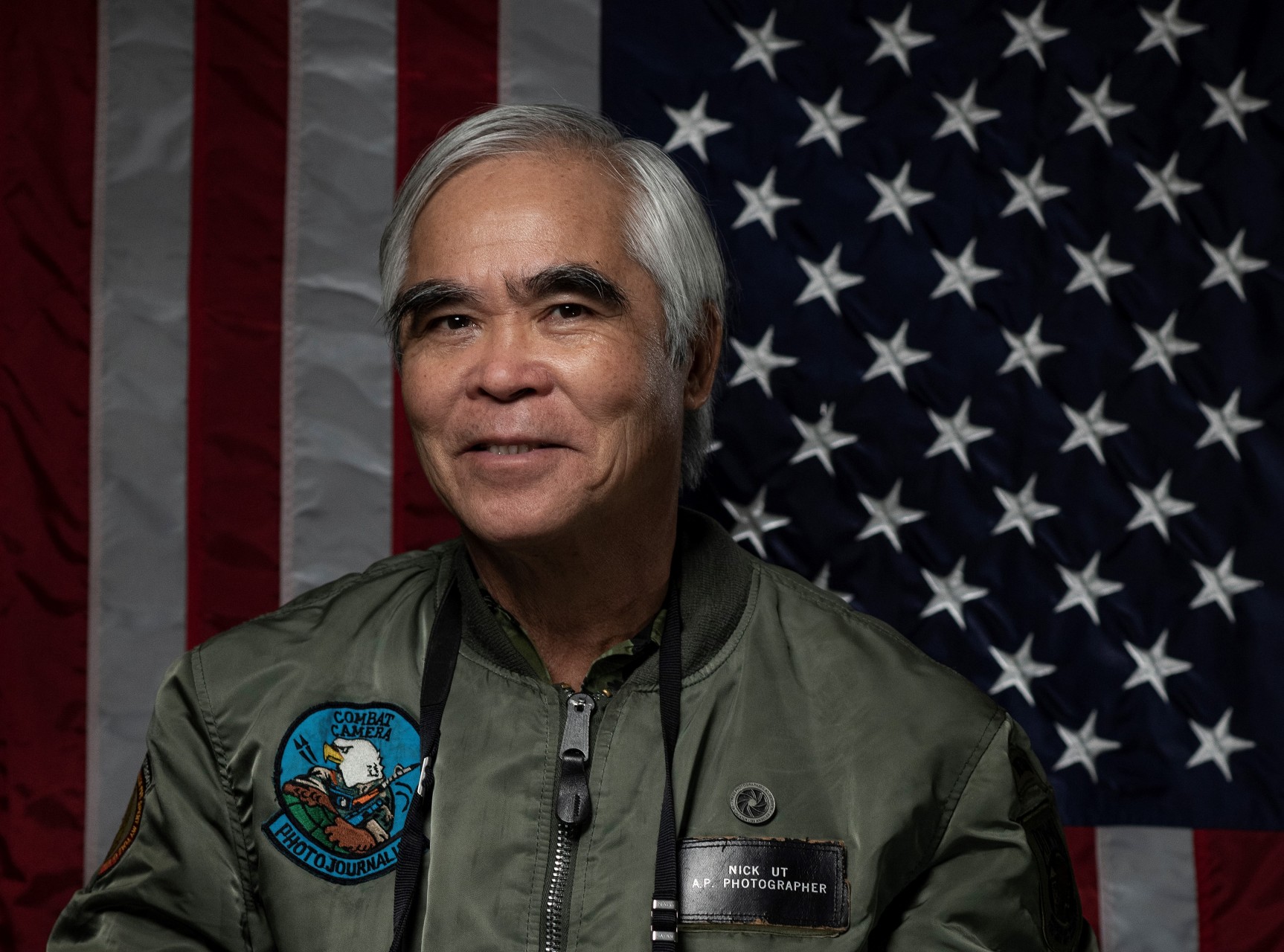
1973 Spot News Photography winner Nick Ut in 2021. (Mark Edward Harris/Newsweek)
The brother of fellow photojournalist Huỳnh Thanh My (who died during a 1965 battle between the Viet Cong and South Vietnamese Rangers in the Mekong Delta), the 22-year-old Ut became one of the youngest Pulitzer winners when he received the 1973 Spot News Photography Prize for "The Terror of War," a tableaux of several children (including a naked 9-year-old girl, Kim Phúc) fleeing a South Vietnamese Army napalm bombing in Trảng Bàng on June 8, 1972. The photo was published at the behest of Vietnam press corps eminence grise and two-time Pulitzer winner Horst Fass, who "argued by telex with the [Associated Press'] New York head-office that an exception must be made, with the compromise that no close-up of the girl Kim Phuc alone would be transmitted [...] The New York photo editor, Hal Buell, agreed that the news value of the photograph overrode any reservations about nudity." The publication of the photo dovetailed with the paranoia of the Nixon administration on the eve of the Watergate scandal; in an audio recording, the president and White House Chief of Staff H. R. Haldeman speculated whether the photo had been staged, much to Ut's enduring chagrin.
Following the war, Ut emigrated to Los Angeles, where his oeuvre ran the gamut from coverage of Formula One racing and nature shots to the "Hollywood Babylon"-esque vicissitudes of Robert Downey, Jr., Mike Tyson and Paris Hilton. He retired from the Associated Press in 2017 and received the National Medal of Arts in 2021.
Viet Thanh Nguyen (Fiction, 2016)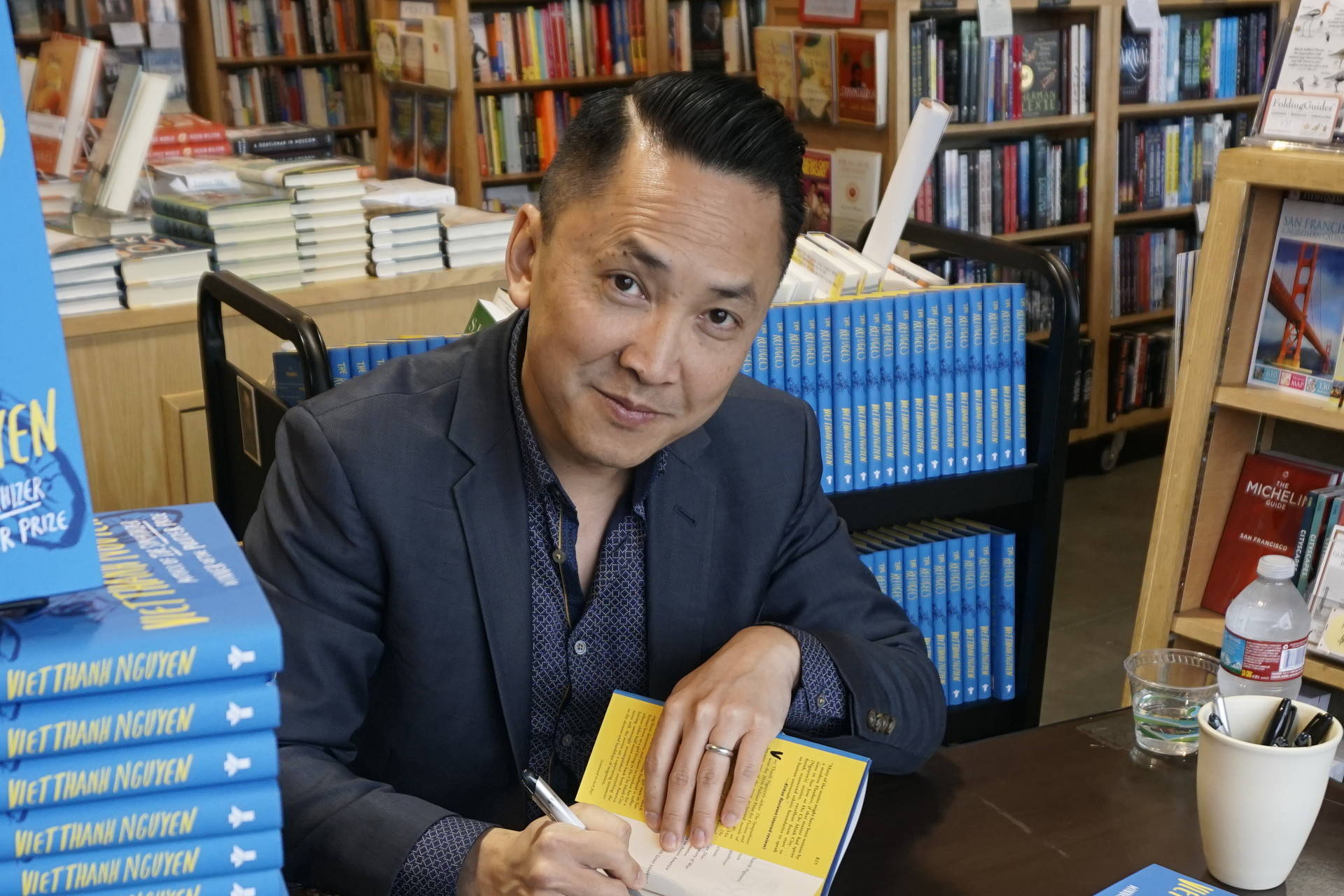
2016 Fiction winner and Pulitzer Prize Board member Viet Thanh Nguyen at a book signing. (KQED)
University of Southern California literary and ethnic studies scholar Viet Thanh Nguyen received the 2016 Fiction Prize for "The Sympathizer," cited by the Pulitzer Board as "a layered immigrant tale told in the wry, confessional voice of a 'man of two minds' — and two countries, Vietnam and the United States." Tracing the transnational experiences of its narrator (a North Vietnamese mole of Vietnamese and French heritage) through a variety of literary modalities and milieux, the novel encapsulates many of the themes that have undergirded Nguyen's scholarly, literary and journalistic work.
In an interview with Longyan Zhang of Consequence magazine, Nguyen — who emigrated to the United States with his family in 1975 — reflected on the disjunction between his family's stories and popular accounts of the Vietnam War: "[I] knew that we were Vietnamese people and Vietnamese refugees, and our version of what happened in Vietnam was not the same as what was happening in American war movies. It would take me decades to be able to articulate this. I understood that the war affected not only soldiers but also civilians. For Americans, when they talk about the Vietnam War or most war stories, they focus on the soldiers' experiences, the experiences of men. But if you grew up in a refugee community that has been shaped by war, everybody’s story is a war story. That was a big difference." Nguyen was elected to the Pulitzer Prize Board in 2020, becoming its first Asian-American and Vietnamese-American member.
Sheryl WuDunn (International Reporting, 1990)
Pulitzer winners Sheryl WuDunn (right) and Nicholas Kristof during their tenure in Beijing. (Nicholas Kristof via Walt Baranger/Twitter)
A third-generation Chinese-American, Sheryl WuDunn transitioned to journalism after working as an international loan officer for Bankers Trust and earning degrees from Cornell, Harvard Business School and Princeton's School of Public and International Affairs. Following her marriage to New York Times reporter Nicholas Kristof in 1988, the couple was assigned to Beijing by the newspaper, where Kristof served as bureau chief. There, they would cover one of the most monumental series of events in an epoch already defined by the imminent end of the Soviet Union: the 1989 pro-democracy Tiananmen Square protests.
Spurred by the Eight Elders' ouster of reformist colleague Hu Yaobang (against the wishes of paramount leader Deng Xiaoping) in April 1989, a student-led hunger strike galvanized much of the country, precipitating the imposition of martial law. On June 4, the military entered Beijing, leading to the deaths of as many as thousands of demonstrators and several police and military officers. Members of the Politburo who opposed martial law were expelled or demoted, while Shanghai-based regional official Jiang Zemin was sent to Beijing, setting the course for Chinese politics over the next decade.
In their winning work, Kristof and WuDunn embraced a bifurcated approach, with the former largely focusing on political machinations and the latter embedding herself in the streets. Indeed, WuDunn's action-laden account of June 4 remains as arresting as ever more than 30 years later:
Amazement had already turned to fear and defiance earlier in the evening as citizens saw the military convoys entering the city. Some troops from other provinces practically paraded their AK-47 rifles as they stood in their trucks, stranded by the human blockades that had formed around the trucks.
By dark, tensions had soared throughout the city. Hundreds of thousands of people were impelled outdoors by their disbelief and anger, yet brought back to their homes by fear of the violence. The sound of tanks whizzing by and reports of open firing fanned their fears.
WuDunn worked in journalism through the 1990s before moving to the business side of The Times and ultimately returning to investment banking as a private wealth investor for Goldman Sachs and thence senior managing director of Mid-Market Securities, a boutique firm. She and her husband have continued to collaborate on several books, most recently "Tightrope: Americans Reaching for Hope" (2020).
Vijay Seshadri (Poetry, 2014)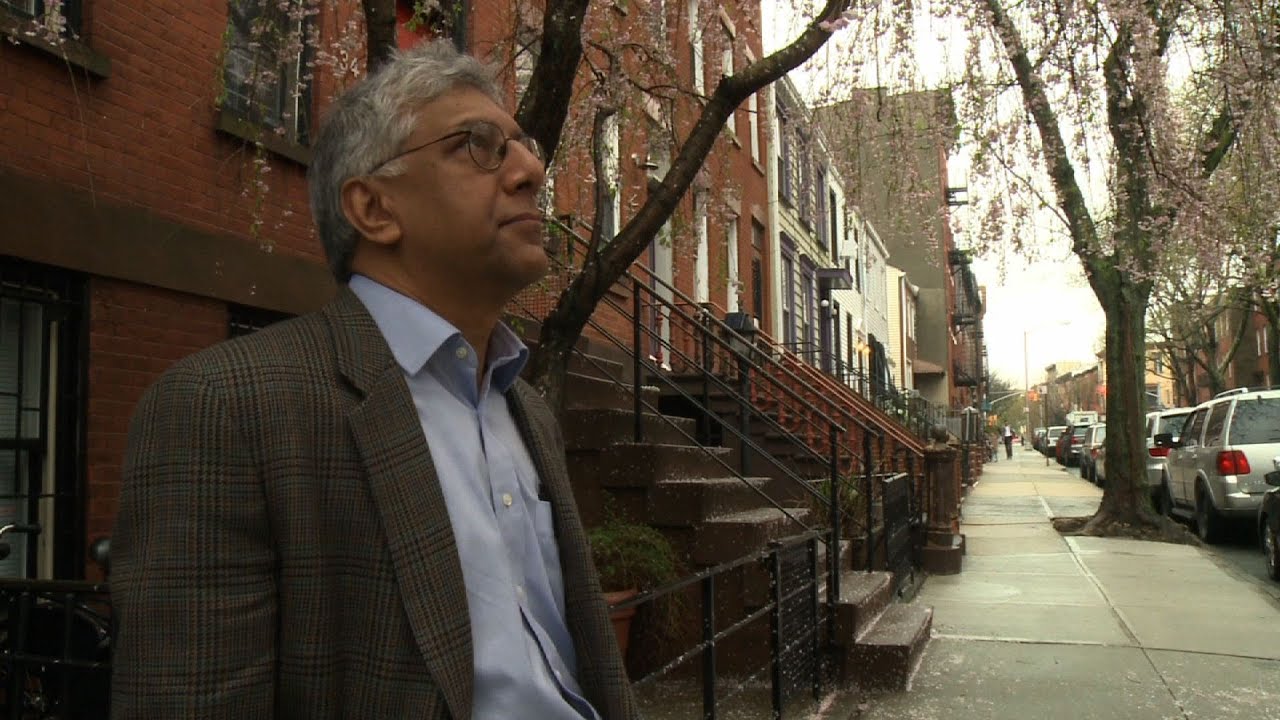
2014 Poetry winner Vijay Seshadri at home in Brooklyn. (PBS Newshour)
Vijay Seshadri received the 2014 Poetry Prize for "3 Sections," characterized by the Pulitzer Board as "a compelling collection of poems that examine human consciousness, from birth to dementia, in a voice that is by turns witty and grave, compassionate and remorseless." A graduate of Oberlin College and Columbia University's MFA poetry program, the Brooklyn-based Seshadri emigrated from Bangalore at the age of 5 in 1959 when his father joined the chemistry department of Ohio State University.
Strongly influenced by the urban romanticism of fellow Brooklynite Walt Whitman and the cabalistic ineffability of William Blake, much of Seshadri's work offers ruminations on what he has described as "the fecundity of life in the city, its overwhelming plenitude." Unfolding as a rough-hewn corollary to John Rechy's "City of Night" and Jerry Garcia & Robert Hunter's "West L.A. Fadeaway," "Purgatory, the Film" eschews the otherworldly sentimentality of David Lynch's "Mulholland Drive" and James Ellroy's L.A. Quartet in favor of pragmatic balefulness: "She went to LA to make it big/and crept back home injured and ashamed." But the city is defined by eternal multiplicities, and the New York-based F train vignette "Trailing Clouds of Glory" finds Seshradi contemplating the contours of his own immigrant experience ("There is a border, but it is not fixed, it wavers, it shimmies, it rises/and plunges into the unimaginable seventh dimension/before erupting in a field of Dakota corn") while observing an undocumented Guatemalan father seemingly enamored of Wordsworth ("The child, he said, is father of the man"). For Seshadri, past and future experiences — whether intrinsically aesthetic or myopically historic — are fundamentally entangled.
Zhou Long (Music, 2011)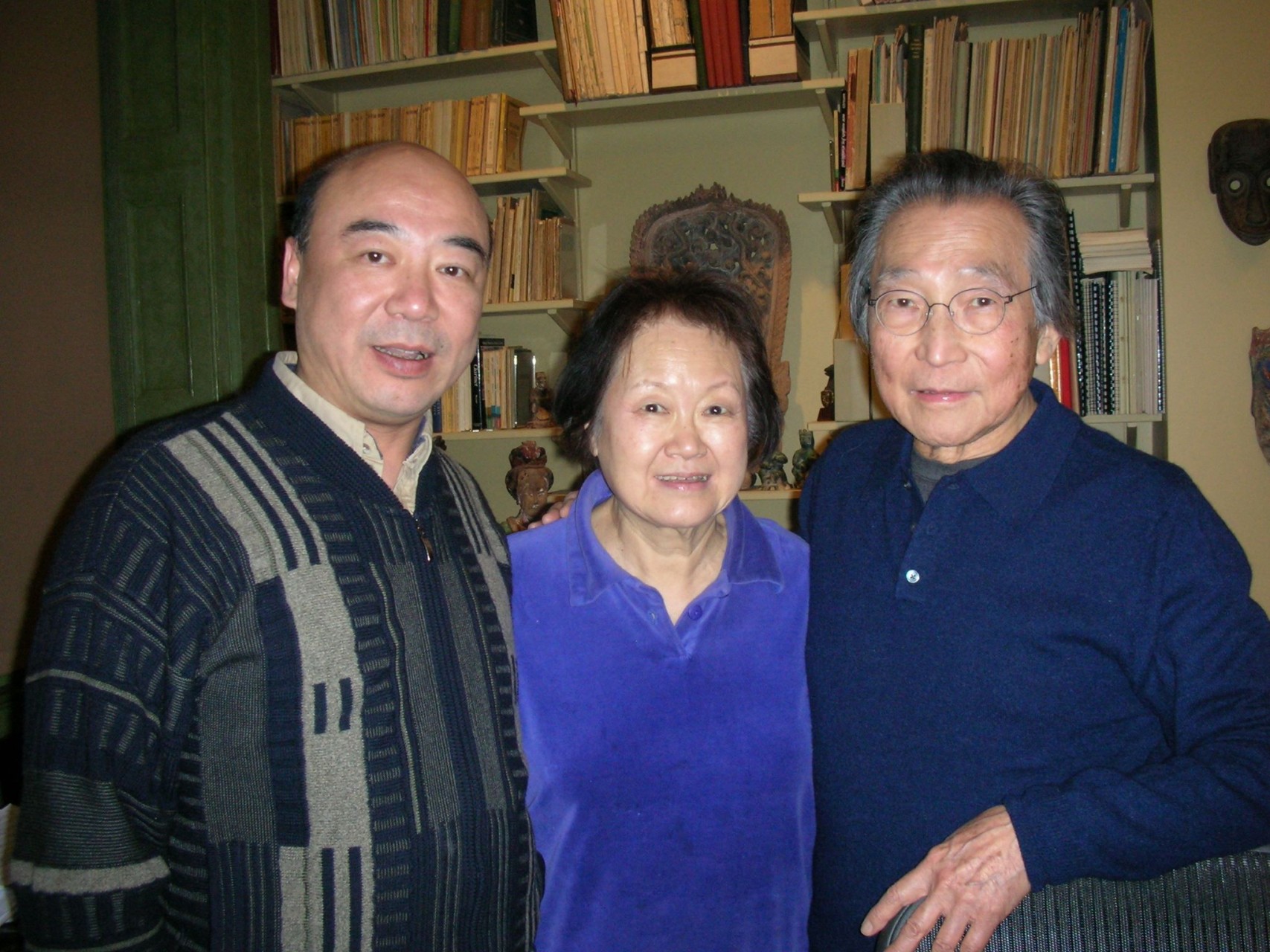
2011 Music winner Zhou Long (left) with mentor and fellow Columbian Chou Wen-chung (right) and the latter's wife, Chang Yi-An (center). (New Music Box)
A formidable composer of the world who has worked in such disparate locales as Beijing and Kansas City, Zhou Long received the 2011 Music Prize for "Madame White Snake," an opera lauded by the Pulitzer Board as "a deeply expressive opera that draws on a Chinese folk tale to blend the musical traditions of the East and the West."
Coming of age amid the rigid impositions of Cultural Revolution, Zhou was forced to operate a tractor on a state-run farm, where the windswept, desolate environment influenced many of his subsequent compositions. One of only 100 (out of 18,000) applicants to earn a spot at Beijing's Central Conservatory upon its reopening in 1977, he briefly served as composer-in-residence for the National Broadcasting Symphony Orchestra of China before emigrating on a graduate fellowship to the United States, where he received his D.M.A. at Columbia University in 1993 under the tutelage of Chou Wen-chung (best known for fusing postwar serialism with musical structures derived from the I Ching) and fellow electronic music pioneer Mario Davidovsky, who received the 1971 Music Prize. While living in Brooklyn during his graduate studies, he became the director of the acclaimed Music from China ensemble in 1985.
Like his mentor Chou, Zhou frequently interpolates modes and insights from other media in his work. "Thinking about what we could do to share different cultures in our new society, I have been composing music seriously to achieve my goal of improving the understanding between peoples from various backgrounds," he said in 2009. "My conceptions have often come from ancient Chinese poetry. There are musical traits directly reminiscent of ancient China: sensitive melodies, expressive glissandi in various statements, and, in particular, a peculiarly Chinese undercurrent of tranquility and meditation. The cross-fertilization of color, material, and technique, and on a deeper level, cultural heritage, makes for challenging work."
He added: "[Musical] inspiration is often born from the beauty of the nature. Verses of poetry may give you the frame; the movements of calligraphy may give you the rhythm; an ancient dark ink painting may give you space, distance and layers; a variety of sound sources may give you the color. Finally, craft ensures your own full expression."
A video comprised of highlights from a 2016 production of "Madame White Snake" may be viewed at the beginning of the article.
Mei Fong (Contributor, International Reporting, 2007)
Mei Fong, a Malaysian-American of Chinese descent, began her career in journalism while enrolled at Columbia University, where she received her M.I.A. degree from the School of International and Public Affairs in 2001. During a stint at Forbes' early digital operation, Fong developed the magazine's highest-paid dead celebrities list, which remains an annual bastion of the publication. Joining The Wall Street Journal as a New York City Hall reporter in the aftermath of the September 11 attacks, Fong soon returned to Asia in the newspaper's Hong Kong (2003-2006) and Beijing (2006-2009) bureaus, where she covered market development, mainland China's nascent consumerism and the 2008 Summer Olympics.
In 2007, Fong received two bylines in a staff entry that received the 2007 International Reporting Prize for "sharply edged reports on the adverse impact of China's booming capitalism on conditions ranging from inequality to pollution."
Fong's main piece in the entry, "So Much Work, so Little Time," profiled Wei Zhongwen, a venerable journeyman construction worker who surmounted myriad injuries (including a lost finger and a "palm-size" skull dent) amid 15-hour days, threadbare secondhand clothes and irregular showers. Although comparatively impecunious, Wei was considered a "man of substance" on the rural fringe of Yushu, Jilin, where his earnings funded the family farm. Fei added:
On another night, Mr. Wei took a walk, wandering around the city's glittering towers and looming cranes. "I have no regrets," he said. "I'm the migrant worker who stays out all year so home is better. I've seen things my neighbors have never imagined — 50-story buildings, planes so big they can carry hundreds."
He stopped in front of a European five-star hotel near his work site.
"I build these things, but I have never been inside," he said.
Timidly, he pushed the swing door and went in.
Since leaving The Wall Street Journal in 2013, Fong has served as a fellow at the New America Foundation and director of communications and strategy of the Center for Public Integrity. Her 2015 book "One Child: The Past And Future Of China’s Most Radical Experiment" served as the basis for a 2019 segment of "Last Week Tonight with John Oliver."
Related
Amid renewed tensions between the United States and North Korea in 2017, 1989 Feature Photography winner Manny Crisostomo shared images from his home island of Guam on Pulitzer.org.