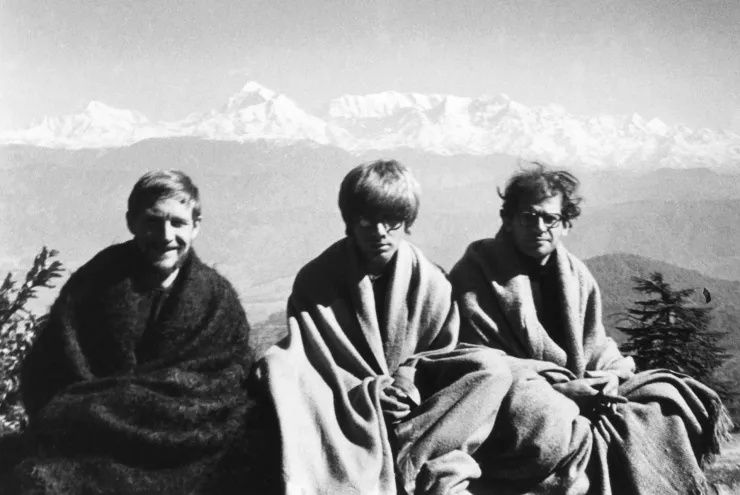
Few American literary figures have proven to be as indomitable as 1975 Poetry winner Gary Snyder.
Snyder, who will turn 92 on May 8, was born in San Francisco but primarily grew up amid truck farms on the rural outskirts of metropolitan Seattle amid the economic tumult of Great Depression. He subsumed his family's affinity for the Wobblies and other strains of utopian politics, while also interfacing with the area's indigenous cultures (including speakers of the Salish language) and becoming immersed in East Asian art at the University of Washington's anthropology museum.
His parents' wartime divorce in 1942 precipitated a move to Portland, Ore. and his most enduring engagement with urbanity, culminating in his graduation from Reed College with a degree in anthropology and literature in 1951. Although he began to write poetry regularly as a teenager and began influential friendships with longtime colleagues Philip Whalen and Lew Welch at Reed, Snyder's immersion in the former discipline was predicated on his interests in indigenous mythologies, encompassing fieldwork on the Warm Springs Indian Reservation and "The Dimensions of a Myth," a thesis that explicated a Haida myth.
Following a semester as a graduate student in anthropology at Indiana University (then a leading center of folklore and linguistics research), Snyder moved to San Francisco to pursue his poetic vocation — and a burgeoning practice of Zen Buddhism that would take him to Japan for a decade of study under such figures as Ruth Fuller Sasaki, an American-born acolyte of Rinzai master Gotō Zuigan, and the Daitoku-ji abbot Oda Sessō. In the interim, he funded his studies of Chinese and Japanese at the University of California, Berkeley with summer fire lookout jobs in the Pacific Northwest. After failing to retain these positions during the Second Red Scare, he worked in logging as a choker setter, responsible for fastening cables to logs.
During this period, informal studies under the Bay Area poetic eminence Kenneth Rexroth would facilitate Snyder's introduction to 1995 Poetry finalist Allen Ginsberg (then based in San Francisco while nominally pursuing doctoral studies at Berkeley) and thence Ginsberg's friend from Columbia College, novelist Jack Kerouac.
Along with his placement in the greater firmament of the Beat Generation, Kerouac's immortalizing rendering of Snyder as the licentious yet preternaturally wise Japhy Ryder in "The Dharma Bums" (1958) became an enduring source of minor obloquy for the poet, who loved his friends but maintained a scholarly distance from the Columbia-era Beat circle's affinities for fluid sexuality and the recreational use of Benzedrine inhalers, not to mention Kerouac's patented brand of "spontaneous bop prosody." (Indeed, as Ginsberg and Kerouac worked with New York-era friend William Burroughs to assemble the proto-cyberpunk landscape of "Naked Lunch" from the latter's vexatious notebooks in the late 1950s, Snyder published groundbreaking, rigorous translations of the legendary Hanshan's "Cold Mountain" poems.)
After surmounting the reputational damage from the Red Scare via a District of Columbia Court of Appeals ruling that granted his passport in 1956, Snyder spent much of the following decade studying Zen in Japan and publishing intermittently. Returning to California in 1968 with a family anchored by his third wife, Masa Uehara, he began to settle in at Kitkitdizze, a compound in the Sierra Nevada foothills that would remain his spiritual and professional home for the remainder of his life.
Snyder's Japanese foray coincided with tectonic changes in American cultural and intellectual life. The proliferation of the Interstate Highway System marked an abnegation of the seedier byways and autochthonous genius loci that had galvanized the likes of Kerouac, Snyder and Neal Cassady as younger men, instead delineating these spaces as anonymous, tract-laden outer suburbs and exurbs. University of Chicago cultural anthropologist Marshall Sahlins argued in 1965 that Neolithic hunter-gatherer kinship networks constituted "the original affluent society," reifying many of Snyder's intuitions about the sophistication of indigenous cultures. In "Saving the Appearances," a 1957 synthesis of Christian hermeneutics and the thought of Rudolf Steiner that was widely disseminated in a 1965 paperback edition, the British philosopher Owen Barfield postulated that humankind was nearing a state of "final participation" in which the world would be perceived as ineffably conscious, including nonhuman life and inanimate matter.
Among others, these themes suffused "Four Changes," a 1969 manifesto by Snyder that served as a lodestar for the early 1970s environmental movement (in which the poet would emerge as a key intellectual voice, participating in the 1972 United Nations Conference on the Human Environment and contributing an op-ed to The New York Times) and the poetics undergirding much of his subsequent work in a manner analogous to Charles Olson's earlier "Projective Verse."
"New schools, new classes, walking in the woods and cleaning up the streets," he asserted. "Create an awareness of 'self' which includes the social and natural environment. Consider what specific language forms, symbolic systems, and social institutions constitute obstacles to ecological awareness. [...] Some communities can establish themselves in backwater rural areas and flourish — others maintain themselves in urban centers — and the two types work together, a two-way flow of experience, people, money, and home-grown vegetables." While Snyder's penchant for long-distance, multi-day walks between population centers would never catch on as a mainstream American pastime — and his "typically independent" take on climate change ("Humans may be in for some difficult times," according to The New Yorker's Dana Goodyear, "but nature will take care of itself...") would prove to be far from assuaging as a bromide — there is little doubt that his ecopoetics of bioregionalism and community action influenced key policymakers, including former California Governor Jerry Brown. By the 2010s, ecocriticism also emerged as a key subdiscipline in American literary theory.
Along with Ginsberg, Snyder's oeuvre retained a dispositive interest in musicality as a facet of the oral tradition, one undoubtedly informed by his experiences as a laborer. (As late as 2012, he cited Joni Mitchell as a key exemplar of "poetry as song," adding: "She is a great singer and has some great songs that will not be forgotten.")
In "I Went into the Maverick Bar," one of the key works in his Pulitzer-winning "Turtle Island," Snyder extols its atavistic and nostalgic power while ruminating on the social and political dislocation of the Long Sixties. Reflecting the contemporaneous plot of the Terry Southern-scripted 1969 film "Easy Rider" (in which two countercultural adherents from California are ultimately murdered in the backwoods of Louisiana), the boilermaker-venerating narrator — explicitly modeled after Snyder, who remains fond of the quintessential blue-collar cocktail — conceals his long hair and earring.
As he observes "two cowboys [doing] horseplay by the pool tables," he takes note of a country band playing "We don’t smoke Marijuana in Muskokie” — that is, Merle Haggard's 1969 No. 41 pop hit "Okie from Muskogee," a seminal salvo in the culture wars that earned the erstwhile felon the sobriquet of the "Poet Laureate of the Silent Majority" and an invitation to the Nixon White House. (Decades later, Haggard would contravene this role by comparing the former president to Hitler and effectively disowning the song, which remained the commercial apex of his career.)
But as "Okie" segues into another tune, the narrator observes a couple "[beginning] to dance [...] [holding] each other like in High School dances in the fifties." This ludic tableaux offers a proscenium for one of the most elegiac verses in Snyder's career, the proverbial nut graph for a quarter-century of estrangement against the American grain and his manifold immersion in different cultures:
I recalled when I worked in the woods
and the bars of Madras, Oregon.
That short-haired joy and roughness—
America—your stupidity.
I could almost love you again.
Heading back "onto the freeway shoulders— under the tough old stars," the narrator "[comes] back to myself/To the real work," a commitment that would endure for the remainder of his career.
"These peoples are not only arguing for cultural authenticity and the right to exist — which is certainly a right — but also for the maintenance of the skills and practices that belong with local economies and that enable them to operate in a sustainable manner, via their own specialized, local knowledges, over the centuries," Snyder reflected in a 1984 interview with Mother Earth News. "Environmental concerns then begin to enter the bioregional perspective, saying, in effect, that if we had political boundaries more appropriate to the regions in which we live — following watersheds or mountain ranges, following plant zones and soil types — that would be a step in the right direction, both socially and ecologically, in that it would enable us to tune our local societies more precisely to the natural resources that are already in place, and to form our human communities and associations more appropriately to the natural communities."
In an off-road New Mexico bar, Gary Snyder sat a very eccentric variant of zazen — and saw the future of America.
Read "I Went into the Maverick Bar" at the Poetry Foundation, here.