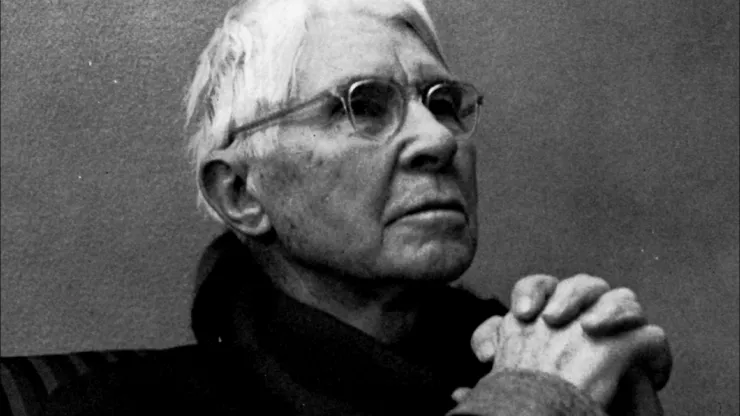
The 1950s proved to be a transitional decade in American poetry. While a new postwar generation of poets emerged, the old guard often held sway when it came time to select winners of the Pulitzer Prize. Among those who won the prize during that decade were 73-year-old Carl Sandburg, 74-year-old Marianne Moore and 75-year-old Wallace Stevens.
In part these choices may have been a reflection of the presence of Louis Untermeyer as a powerful force on the Pulitzer juries for Poetry. Untermeyer was 64 years old when the decade began.
Here is a sampling of the juries’ rationale in recommending winners to the Pulitzer Prize Board.
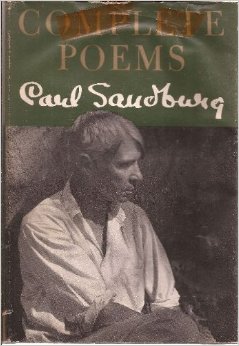
Complete Poems: Carl Sandburg
1951: Complete Poems: Carl Sandburg
‘A monument to the man and the country that bred him’
From juror Alfred Kreymborg:
There is one book which stands so far above the rest as to seem isolated from all of them. That book is Complete Poems: Carl Sandburg (Harcourt, Brace and Company).This is a massive volume of 676 pages which includes the work of six previous books plus an important section of new poems hitherto unpublished.
Although Sandburg’s poetry has grown increasingly authentic, and has been rated as completely autochthonous, it has never been honored with a Pulitzer Award. In 1940 Sandburg’s Abraham Lincoln: The War Years received the Pulitzer Prize in History, but his poems have never won the official accolade.
Sandburg has come a long way since 1916, when his first book, Chicago Poems, was attacked for its “raw realism and brutality.” It is significant that last fall Complete Poems was given the honor of the two most coveted full-page reviews in American journalism: Robert E. Sherwood reviewed the book on the front page of the New York Herald-Tribune book review section, and Henry Steele Commager reviewed it on the front page of the New York Times book section.
It is even more significant that both men — one a biographer and dramatist, the other a historian — reviewed the work as a record of the changing moods and growing taste of America in the past half-century. Sherwood emphasized the running range of Sandburg’s quality: the blood-and-guts virility of the early years, the mystical reaches of his maturity, and the broadly democratic affirmation of his later work. Commager ended his review by declaring: “At a time when we are tempted to betray ourselves, tempted into irrationality, into superficiality and cynicism, Sandburg celebrates what is best in us. He recalls us to our heritage and to our humanity. ...
It is true that Sandburg is often uncritical, that he has lapses and weaknesses, that his work is wildly uneven. But the best of it — and there is a great deal of the best in this big book — is of prime importance. It is alternately powerful and poignant, and always unreservedly native — a monument to the man and the country that bred him.
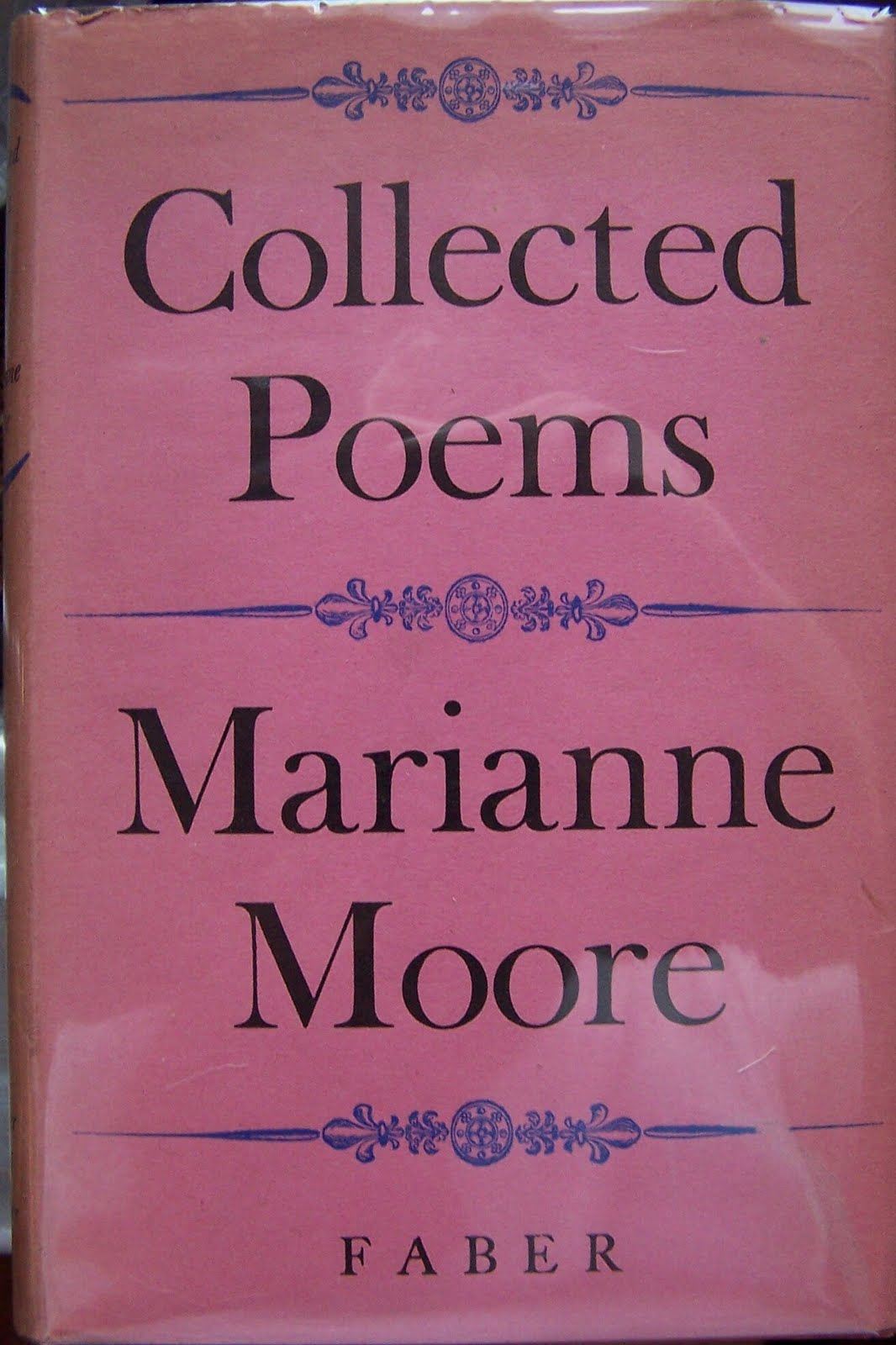
Moore's Collected Poems
1952: Collected Poems, Marianne Moore
A miniaturist working in visual tapestries
From juror Louis Untermeyer:
Marianne Moore, represented by her Collected Poems (Macmillan) is precise, almost microscopically detailed, a perfectionist among craftsmen; William Carlos Williams (New Directions), is impressionistic, hit-or-miss, sprawling but, in effect, powerful. Paterson is a loose panorama, a quasi-epic of a man and a city, a testament which is intense and impassioned and, though much of it seems disorganized, overflowing with energy.
Miss Moore’s power is intellectual and, in the later poems, spiritual. She does not attempt panoramas, for she is a miniaturist, a worker in verbal tapestries, a designer whose details carry surprising information and even more surprising intensity. Her skillful use of multiple quotations (credited in a noteworthy “Note on the Notes”) accomplishes a kind of poetic montage, delicate but not frail, intricate but not obscure.
Both Dr. Williams and Miss Moore are true inventors and it is hard to say which type of invention, which communication — the imperfectly large and forceful or the perfectly made and arresting smaller creation — is the better. ...
This might be a good year to do an unprecedented thing: to split the award between the two poets. If this is neither possible nor desirable, your two advisors — both of whom are practicing craftsmen — lean slightly toward the poetry of Marianne Moore.
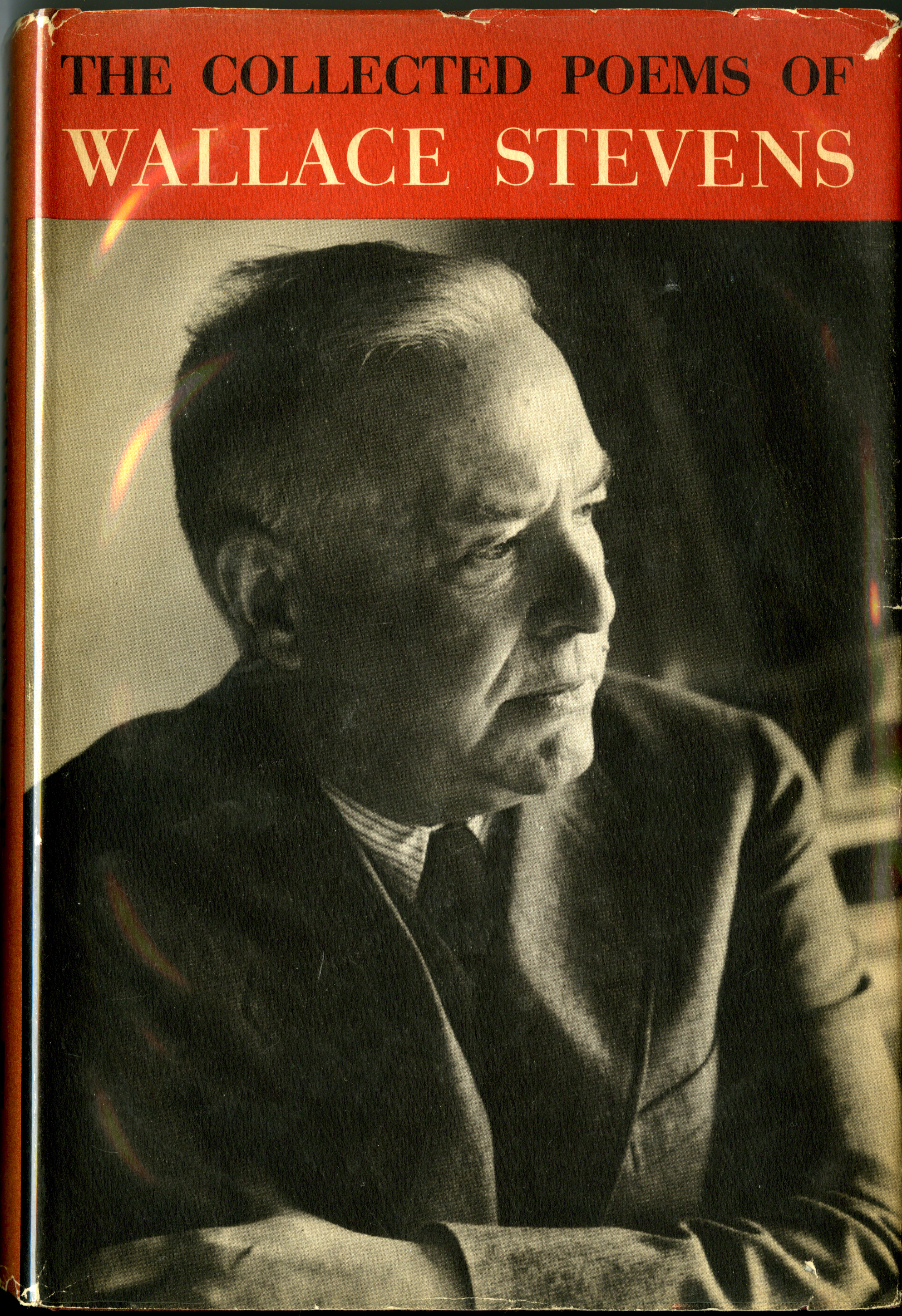
Stevens' Collected Poems
1955: Collected Poems, Wallace Stevens
Verbal power coupled with sudden illumination
From juror Louis Untermeyer:
Rarely has there been such an embarrassment of poetic riches. Were it not for the competition of two major figures, the prize might be awarded to any of three women, Leonie Adams, Louise Bogan, May Swenson, or to a man, Rolfe Humphries. None of these poets, however, has attained the stature of the two whom we consider the chief candidates: Wallace Stevens and E.E. Cummings.
Since Stevens does not offer the convenient aids — rhyme, regular sequence of ideas, easily recognizable images, etc. — he is not always easy to read. Sometimes he is so concerned with words — words as symbols, words as sounds (and sounds for their own sake), with words as words — that meaning often sinks in a rolling sea of syllables. ...
His is a poetry of tangents, of elisions and startling sequiturs, of remote suggestiveness rather than ordinarily acceptable statements. Nevertheless, the suggestiveness is so persuasive, the evocation so powerful, that they achieve a constant play of radiant overtones. The best of Stevens’ poetry — and his Collected Poems (Knopf) contains a great deal of the best — communicates not only by verbal power but by sudden illumination. ...
For a while, your committee wavered between Stevens and E.E. Cummings. But, whereas Stevens gains by the cumulative effect of his comprehensive volume, Cummings loses authority by the very weight of his Collected Poems: 1928-1954 (Harcourt Brace). Cummings’ uncritical gathering of everything he has ever published and his refusal to discard the least of his trivialities reveal his limitations; a repetitious reliance on such standardized properties as “Spring,” “Death,” and “Roses,” to say nothing of tricks of incongruity and attention-demanding typographical distortions. ...
In spite of his ability to make the careless reader stop, look and listen to the implications of his curiously shaped lines, he is, at best, a second choice. He lacks the depth, the dignity, and the degree of accomplishment which mark the poetry of Wallace Stevens.
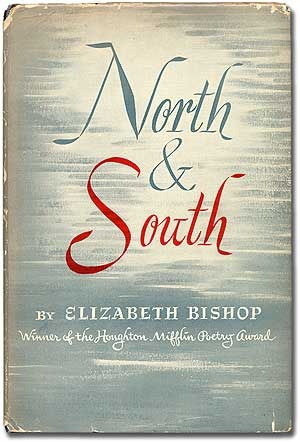
Poems: North & South: A Cold Spring
1956: Poems: North & South: A Cold Spring, Elizabeth Bishop
A whimsical craftsman and a seriously accomplished creator
From juror Louis Untermeyer:
There is one book which speaks with such clarity, authority, and difference that its shining quality is immediately recognizable, Elizabeth Bishop’s Poems: North & South: A Cold Spring (Houghton Mifflin) is noteworthy in every way. First of all, it is highly individualized without depending on mannerisms. Critics have already called attention to Miss Bishop’s combination of precise observation and free-roaming imagination. Arthur Miezner concluded that she “uses without abusing” all the rhetorical resources of verse, that she balances devotion to fact and memory and desire, combining toughness and “elegance of mind.” Robert Lowell praises her for knowing her own tongue and her own tone, “Venetian-gorgeous and Quaker-simple.”
But these are only the most apparent of Miss Bishop’s virtues. It is easy to call her a wit and say that her quaint exactitude remind one of Marianne Moore’s remarkably neat disposals. Particular attention should be called to “The Imaginary Iceberg,” “The Gentlemen of Shalott,” “The Man-Moth,” “Florida,” “Roosters,” and “A Miracle for Breakfast.” The last, for example, is so clear and colorful that it is hard to realize that it is a sestina, one of the most complicated and rigid of the old French forms.
On the other hand, “The Prodigal,” “Little Exercise,” “The Weed,” “At the Fishhouses” and “The Fish” (like a delicate and miniature Moby-Dick) are palpitant with emotion. The poems may start as abstract concepts, intellectualized concepts of speech; but they grow alert with feeling, sensitive as they are subtle, beautifully restrained and memorable.
Miss Bishop has a vocabulary which surprises by its deftness, a twist of thought which, to quote some of her own images, “suddenly turns and shines like flocks of sandpipers flying.” Certainly no book of the last year has such finesse, fantasy, strong but not over-stressed personality and sympathetic responses. A whimsical craftsman who is, at the same time, a seriously accomplished creator, Elizabeth Bishop is well worthy to be chosen as this year’s prize winning poet.
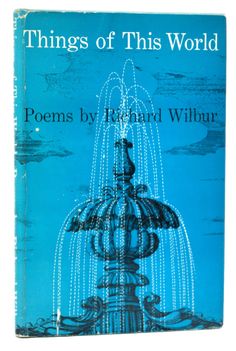
Wilbur's Things of this World
1957: Things of This World, Richard Wilbur
‘A highly personal poetry, witty and grave’
From juror Louis Untermeyer:
Things of This World is Richard Wilbur’s third volume and, in our opinion, his best. Both preceding volumes were praised with equal vigor by his colleagues and his critics. At thirty-six Wilbur is considered one of the best, if not the very best, of his generation. ...
His work is precise and fastidious — “elegant” is the adjective most often applied to his poetry — but there is emotion and even force not altogether concealed beneath the finesse. There is also a great sense of reserve. Wilbur exemplifies Whitman’s “glory of the commonplace” in his half-wondering, half-whimsical way — a washline, a turkey, a morning newspaper, a park statue, a child digging, a railway station ... such ordinary subjects are translated into a highly personal poetry, witty and grave and intellectually provocative.
It is doubtful that a more worthy candidate for the Pulitzer Prize has appeared in years, and the choice of Wilbur would undoubtedly maintain the high standard of previous awards.
Promises: Poems, 1954-1956
1958: Promises: Poems, 1954-1956, Robert Penn Warren
‘A fierce sensibility almost uncommon in today’s poetry’
From juror Louis Untermeyer:
Robert Penn Warren’s Promises is the book which tops all others. Not “neat” or “modish,” it has lasting values. It does not stand in anyone’s shadow. The tone is arresting but not freakish; the wit is biting, but it is Warren’s.
Warren is essentially a storyteller, a narrator who knows how to make his stories sing. In his suggestions of a kind of rough balladry, he revives the almost lost art of the ballad-making poet. Macabre narratives, half-mad evocations, and strange folk-tales mingle with boyhood recollections, strays of memory. The manner is both tart and lusty; breathless, as in “Dragon Country,” mordant, as in the ironically entitled “Ballad of a Sweet Dream at Peace,” deceptively nostalgic, as in “Infant Boy at Midcentury,” and “Dark Woods.” These, and other poems by Warren, reflect intensified experience, a force and an almost fierce sensibility uncommon in today’s poetry.
In quite another vein, Warren’s five poems to his daughter — “To a Little Girl One Year Old,” especially “The Flower” and “Colder Fire” — are unashamedly affecting and splendidly accomplished. No volume of the year has half of Warren’s energy and propulsive power.
Kunitz's Selected Poems: 1928-1958
1959: Selected Poems, 1928-1958: Stanley Kunitz
‘Great verbal felicity and musical overtones’
From juror Louis Untermeyer:
Stanley Kunitz’s Selected Poems 1928-1958 (Atlantic, Little Brown) is a belated gathering. Kunitz is no longer a young man — his fellow poets have been acclaiming him for more than a decade.
In distinction to certain contemporary vogues, his poetry is formal and carefully polished. But it is not academic or stiff; it has great verbal felicity and lingering musical overtones. It is the work of a true craftsman, but it is sometimes done with so much finesse that the emphasis is on the craft rather than on the communication, and the effect is more arresting than the content.
Except for a dozen examples, such as the opening poem, “The Science of the Night,” which is a beautiful love-lyric, most of the others tend to be oversubtle, intellectualized, and a little precious. Exquisite though many of them are, they lack the strong impact of Muriel Rukeyser’s poems, and except when he is willfully eccentric, E.E. Cummings.