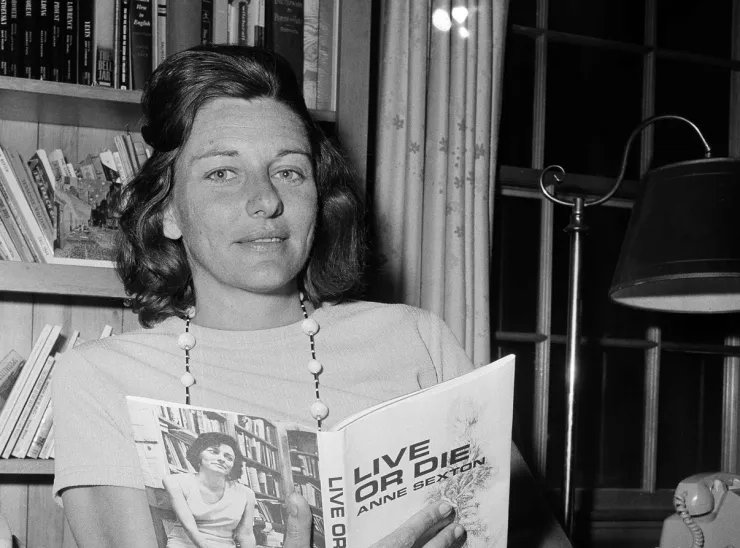
The Pulitzer Prize in Drama for 1967 might easily have been awarded to the Pulitzer Prize jury in Poetry. The jurors deadlocked over a perennial issue: Should dead writers be eligible for the prize? They clashed over which books were worthy. And they failed to reach a unanimous decision on a winner, leading Barry Bingham Sr., a member of the Pulitzer Advisory Board, to intervene.
The three jurors, all Pulitzer Prize winners in Poetry, were Phyllis McGinley, 61 (1960), Louis Simpson, 44 (1964) and Richard Eberhart, 62 (1966).
Other characters in the drama were John Hohenberg, secretary of the Pulitzer Advisory Board, and Bingham, the board member, who was editor-in-chief and president of The Louisville Courier-Journal.
The drama unfolded long before texting and email, but a three-way phone conversation was possible — and even suggested early in the process. But, in part because of Eberhart’s two-week holiday trip to Switzerland, Hohenberg’s Dec. 31 deadline for a nomination passed before the plot was even joined.
Although all the jurors argued for other poets, three main contenders for the prize emerged: Theodore Roethke’s posthumous Collected Poems, Anne Sexton’s Live or Die and Sylvia Plath’s posthumous Ariel.
Here, in key excerpts of their correspondence, is how the script played out by U.S. Mail.
‘I think that principles are fine except when they do not work’
Dec. 2, 1966, John Hohenberg to Richard Eberhart
Because the members of the Pulitzer Poetry Jury are so widely separated, we would like you to serve as chairman to present the final report to the Advisory Board of the Pulitzer Prizes.
The methods you adopt to arrive at an agreed verdict are up to you ...
So far as I know, in the 50 years of the Pulitzer Prizes, the selection of the Poetry winner has been unanimous with only one exception – and in that case the Advisory Board chose to uphold the Chairman. I would hope that three Pulitzer Prize-winning poets would make a decision, out of their expert knowledge, which I am sure the Advisory Board would be glad to adopt. I have never known of a Poetry Jury’s being reversed — and cannot conceive of a circumstance in which it could happen.
Dec. 8, 1966, Hohenberg to Eberhart
The other two jurors, by now, have received copies of my letter to you. ...
Naturally we’d appreciate receipt of your report before Dec. 31; in any event, please try to get it to us as soon as possible after that date.
Jan 6, 1967, Eberhart (just back from a two-week vacation in Switzerland) to Phyllis McGinley and Louis Simpson
May I suggest that you each send me your vote or votes, with any comments. ... We can then have free exchange of views hopefully to achieve the best decision. This is my first experience of having to do all this by letter.
Jan. 11, 1967, McGinley to Eberhart
I have a suggestion: Columbia [University] has told me that they would pay any phone or travel expenses for us, and I think it would be splendid if we could set up a 3-cornered telephone conversation at some specified time. The telephone company is happy to set up such a “conference” and has the facilities. Almost any time except the weekend would do for me.
As for my choices, of a book of poetry — well, it seems to me that the Roethke Collected Poems is so much better than any other on the list that the rest dwindle away. (Whether he’s legal, however, I don’t know, since besides being a posthumous book it is also a re-publication of all the other books.)
Then, I very much like (if I have to make other choices) Anne Sexton’s Live or Die, quite enjoyed Philip Booth, think Plath’s Ariel has excitement even though I do not consider it the masterpiece the reviewers — carried away, no doubt, by her frenetic life — have called it.
Jan. 14, 1967, Eberhart to McGinley
I am opposed to giving it to [Roethke] posthumously on principle. ...
Phil Booth’s book is admirable. I am on record on his jacket and am strongly for him. His election would constitute a sound literary judgment for a man his age [41]. ...
Anne Sexton’s book is the best of her so far for me. I read it with keen interest, yet had a reaction later that in almost every poem she tells us how crazy she is and that this not only becomes monotonous but becomes incredible. Thus later I felt less of it than at first.
Jan. 17, 1967, Simpson to Eberhart
As I understand it, the prize is to be given to the best book published during the year, regardless of whether the author is dead, and disregarding — which is sometimes not easy to do — his reputation. On this principle therefore, I have no hesitation in recommending Theodore Roethke’s Collected Poems for the prize. I am delighted to see that Phyllis is of the same opinion. I agree with Phyllis that this book is superior to all the others. ...
My second choice — that is, to echo Phyllis, “If I had to make other choices” — is Sylvia Plath’s Ariel. ... The book is original in its use of images and has unusual intensity. I prefer her work to Sexton’s for these reasons; Sexton, who is also confessional, does not improve with time.
Jan. 22, 1967, Eberhart to Simpson
This particular prize, which one thinks of in terms of others, should not go to the dead but praise the living. This is especially true in Roethke’s case inasmuch as he won every (or practically every) prize while living so it seems redundant to me to add another. If we had to decide between Plath and Roethke as dead poets, it would be more meaningful for us to credit Plath, although Roethke’s work is more significant than hers. ...
Trying to think of absolute values the best book of poetry published last year was Whitman’s Leaves of Grass in its original form, published by the new Eakins Press in New York. ... However, it was not entered on our list for understandable reasons, yet on absolute values I would vote for Walt.
Jan. 27, 1967, Simpson to Eberhart
Your arguments are reasonable. Roethke died in 1963 and he has had the prize before. ... I don’t think it is fair to compare his book to Whitman’s, who died in 1892. But if Phyllis agrees with your reasons for not wishing to give the prize to Roethke, I am willing to go along.
However, a very serious question arises out of your “principle of dead poets.” ...
When it is applied to Plath a large injustice appears. It seems that poets who die young are not to receive recognition and that poets who live to a great age will be rewarded. This strikes me as giving prizes for longevity, not poetry. I think that principles are fine except when they do not work. Plath’s book is very much alive in the mind of the public; I do not think that it is reasonable to eliminate her because she had the misfortune to die.
Feb. 1, 1867, McGinley to Eberhart
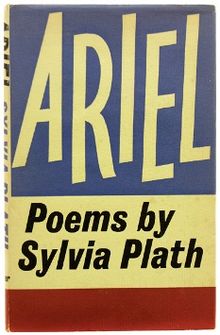
Sylvia Plath's Ariel.
I am afraid I am still backing Roethke.
I cannot get around the fact that his poetry is so much better than the rest that the others tend to disappear. (And after all, it is a book we are supposed to give the prize to, rather than a man.) ...
I still like Sexton and Plath. But I am coming around to Mr. Simpson’s side. Both women are neurotics and their poetry is based on the fact. But except for one wonderful poem in Live or Die (“Pain for a Daughter”), I begin to think Plath’s Ariel has more passion and excitement than Sexton’s book.
Do I seem obstinate? I don’t mean to appear so. I just think Roethke’s verse demonstrates the enchantments and delights that poetry ought to own and so seldom, these intellectual days, really possesses.
Feb 5, 1967, Eberhart to McGinley and Simpson
On further thought I feel stronger against giving the prize to Roethke than I did before. I do not feel the prize will best be bestowed on a dead poet. ... Rather than representing in your view the best book of last year it is a multibook none of it written after 1963 and much of it going back many years. Other prizes are more suited to the life-effort concept. ...
Please send me by return mail two lists. The first is your list of dead poets, first and second. The second is your list of living poets, first, second and third.
Feb. 11, 1967, McGinley to Eberhart
I have been giving long and serious thought to your request for two lists — one of dead poets, one of those alive at the moment. And I find I am unable to compile such a list. ...
I have come to the conclusion that I have no other choice than Roethke. Everything else seems pale, contrived or academic by comparison.
So I’ll just have to go on record as an unregenerate one-woman enthusiast.
If you and Mr. Simpson overrule me I shall, of course, accept your choice gracefully. After all, I lay no claim to infallibility — only to an overwhelming feeling that this is a kind of classic and, whether its author is quick or dead, the book ought to receive the prize.
Feb. 14, 1967, Simpson to Eberhart
It seems that we have come to an impasse. I am sorry about this.
I see that Phyllis wants to give the Prize to Roethke. So do I. You, on the other hand, feel that the Prize should go to someone who is alive at this moment. ...
In order to simplify matters I am simply going to cast my vote for Theodore Roethke. The rest is up to you.
Feb. 25, 1967, Eberhart to McGinley (similar letter sent to Simpson)
Your and Louis’ votes for Roethke make it two to one for him, a majority. I was left with putting in a minority report and plea for giving it to the living rather than the dead, analyzing how we felt about the main living contenders, also Plath, and sending the Advisory Board all relevant documents.
Whatever their decision is will be all right with me as I assume it will be with you and I thank you both for the pleasure of serving with you on the Pulitzer board this year.
Feb. 25, 1967, Eberhart to Pulitzer Advisory Board
[After a long, detailed account of the jury’s deliberations.]
It has been my pleasure to serve you and I regret that I could not turn in a unanimous decision ...
I should like to make three suggestions for the future. First, I feel that by some wording you should rule out posthumous prizes in all fields, except in rare cases. There could be a case, as in an O’Neill year in drama when there was no other book worthy of the prize, but that is not the case this year in poetry, and conceivably might not happen again.*
Second, in future the poetry jury should meet on person in January, no matter what the cost of transportation.
Third, I think you should raise the poetry prize from $500.00 to some figure appropriate for a major literary prize, now and in the future.
[*Eugene O’Neill was awarded the 1957 Pulitzer Prize in Drama for Long Day’s Journey into Night. He had died in 1953. O’Neill wrote the play in 1941-42, but it was not published or publicly performed until 1956.]
March 24, 1967, Barry Bingham of the Pulitzer Advisory Board to John Hohenberg
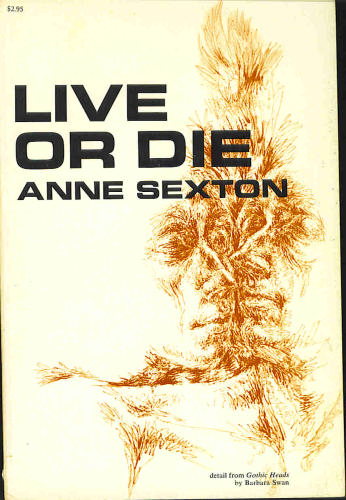
Sexton's Live or Die.
As you know, I have been concerned about the matter of the jury’s recommendation for this year’s Pulitzer award in poetry. ...
I felt that I would like to make one more try to obtain a recommendation from the jury. ... I indicated to [Richard Eberhart] that the members of the Advisory Board would prefer, other things being equal, to give the award to a living poet, as an encouragement to poets who are still producing good work. I made it clear that there was no rule against posthumous awards, and that occasionally they have been made, but I suggested that the board’s preference was for living writers.
Mr. Eberhard [sic] undertook to consult further with the other two jurors, Phyllis McGinley and Louis Simpson. He called back the following day to say that they had held a three-way conference call, and had come up with a unanimous recommendation for Anne Sexton, for her collection Live or Die.
*
Postscript: Sexton killed herself in 1974. Fifteen years after the 1967 Poetry debate, The Collected Poems of Sylvia Plath, who had killed herself in 1963 at the age of 30, was awarded the 1982 Pulitzer Prize. The Poetry jury that year called publication of the book “an extraordinary literary event.”