Twenty years ago, a reporter for the Sacramento Bee asked me when and why I decided to become a historian. Historians often ask similar questions about the causes of decisions people made in the past. But it’s not so easy to answer about one’s own life, where you know so much more and realize that choices are complicated and sometimes reversed. How far back in time should I go to pick out a pivotal moment of decision and a key cause? To 1979, when I entered a graduate program in history? To my college years when I became a history major? To my childhood, when I first began to read many history books?
Where one begins a story shapes the arc of where it will go and what primary cause moves it forward. I opted for childhood and told a story, assuring the reporter that I started to become a historian in first grade on a day when my teacher took our class to the school library. Sharing the fascination of most young boys with dinosaurs, the more violent the better, I expected to get my hands on some illustrated account of Stegosaurus vs. Tyrannosaurus Rex. Alas, my particular class was the last of four such in the school to reach the library and other children were already happily pouring over the dinosaur books, leaving none on the shelves for me.I made the best of a difficult situation by settling for something else. I found an account of Daniel Boone’s adventures on the Kentucky frontier. So at age six I was launched not just on being a historian but upon becoming an early American historian especially interested in frontiers and borders.
Many of us fall in love with reading and then aspire to become writers because of some book or set of books we discovered early in life. Nancy Drew and the Hardy Boys have inspired many writers. As a kid, I did become enamored of frontier stories of adventure, both the fictions of James Fenimore Cooper and the histories of Francis Parkman. Both promoted three conventions of narrative: (1) a linear, essentially chronological unfolding of a story; (2) a rich, detailed descriptive attention to personalities and settings meant to appeal to the reader’s mind’s eye; and (3) a clear tripartite structure of beginning, middle, and end which draws the reader into a sustained conflict that reaches a crisis followed by a resolution.
I went to graduate school hoping to become a narrative historian, one who tells stories of people under duress who reach some resolution, but I discovered that such an approach was considered passé. During the early 1980s at Brandeis University, the New Social History had become the rage. It deemphasized the stories of individuals and the description of particular settings in favor of seeking quantifiable patterns of behavior by many ordinary people. Instead of telling stories, the NSH sought regularities by quantifying variables found in probate inventories, town meeting records, and voting returns. The New Social Historian was a social scientist instead of a storyteller. My teachers and peers insisted that the New Social History offered a more complete picture of life in the past by avoiding spectacular events, like wars, in favor of the routines of social relationships revealed by deeper and collective research. Rather than write narratives, the social historian framed research reports which tested hypotheses about groups and communities in the past.
New social historians sought to construct “history from the bottom up” rather than the top down. They did so to challenge the elitism of class, race, and gender in the present and thereby promote a more egalitarian and democratic society. I recognized that my dear old narrative histories were usually about a few leading men cast in a heroic light without much attention to the conditions and actions of most people in their time. As with Francis Parkman’s books, these narratives tended to be elitist, triumphalist, sexist, and often racist in their portrayal of native or enslaved peoples. How then could anyone cling to the bad old narrative history rather than embrace the bold, democratic, and new social history?
But I worried that the New Social History tended to throw a baby out with the bath water by sacrificing accessibility. Few non-academics wanted to read research reports. Few people of the present had much interest in people of the past if they were cast as types and categories without stories to tell. I wondered how we could change the present if we wrote only for a limited circle of fellow academics. It seemed paradoxical that scholars committed to a more egalitarian society would write only for fellow initiates either with or seeking doctorates in history.
Laurel Thatcher Ulrich
I hoped instead to produce a hybrid history which combined story-telling and description with the deeper, more collective research methods of the New Social History. As a graduate student, I met another scholar working in the same archives in Maine. Laurel Thatcher Ulrich was researching her phenomenal book A Midwife’s Tale, which would win a Pulitzer Prize in 1991. Ulrich closely and carefully analyzed local records to provide a context for the terse accounts of a diary left by a woman who was both ordinary and extraordinary. The midwife Martha Moore Ballard lived along Maine’s Kennebec River in the late eighteenth and early nineteenth centuries. While telling a particular set of stories, Ulrich advanced a larger theme: of how the revolution initiated sweeping social changes that promoted individualism at the expense of the more collective values that had framed Ballard’s life. A Midwife’s Tale offers a moving story that reached thousands of readers while also winning the applause of Ulrich’s scholarly peers. The New Social History could be enlisted to serve a more democratized, a more social form of narrative history.
I adopted that approach in my own book, William Cooper’s Town, which won the Pulitzer Prize for History in 1996. That book also drew inspiration from work by the philosopher David Carr, who argues that we all frame our lives, and act them out, through the stories we tell. Narration and life are intertwined, giving meaning and pattern to one another. He explains that stories “are told in being lived and lived in being told. The actions and sufferings of life can be viewed as a process of telling ourselves stories, listening to those stories and acting them out or living through them.” We relate stories to others to explain who we are, what groups we belong to, what we do and where we think we are going. We also try to live in ways that fit the stories that we tell about ourselves and our groups. If I ask why a student studies history, he or she usually tells me a story about family background or some book or an inspirational teacher: the same sort of story I told the reporter from the Sacramento Bee.
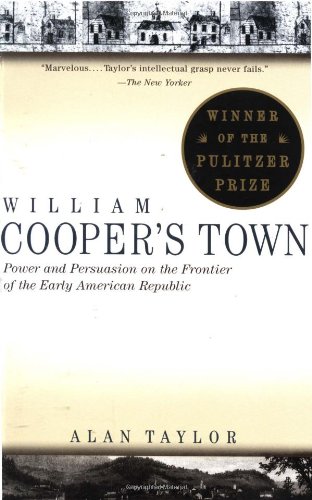
Taylor won a Pulitzer for 'William Cooper's Town' in 1996.
Because we share stories, we talk, behave, and write in patterned — rather than random — ways. We shape our behavior to fit into the stories we tell: we aspire to be consistent. But we also shift our stories as our experiences change. On the other hand, we talk, behave, and write in contradictory patterns because we live in complex societies where we seek to belong to groups with different identities. Every person has multiple, overlapping stories because we belong to different groups. Carr concludes, “Sometimes we must change the story to accommodate the events, sometimes we change the events by acting to accommodate the story.”
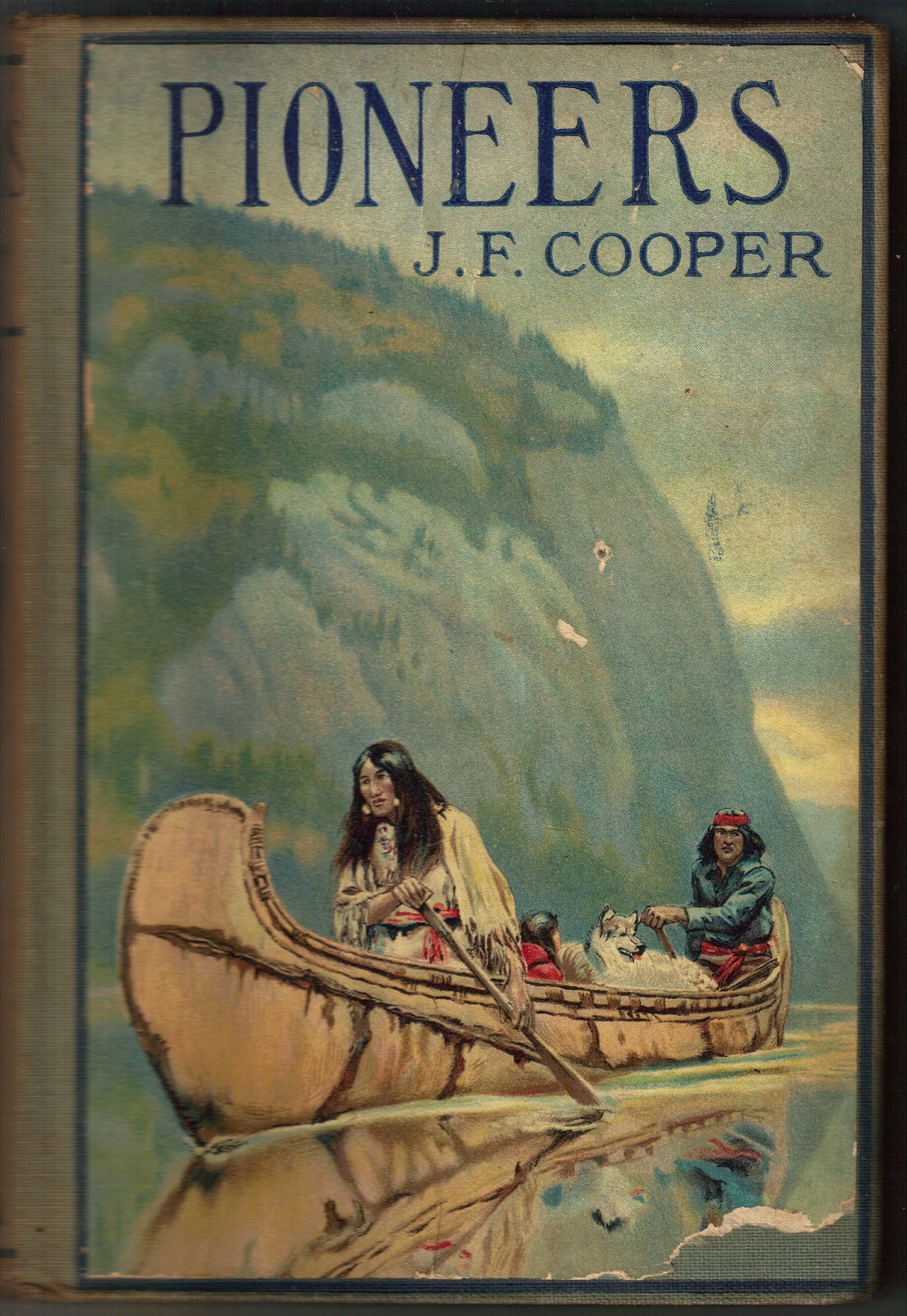
James Fenimore Cooper's 'The Pioneers.'
William Cooper’s Town examined how James Fenimore Cooper came to write the novel The Pioneers, in which he imagined the early history of Cooperstown, New York, and recast his father, Judge William Cooper, as Judge Marmaduke Temple, the founder of the fictional Templeton, New York. The novel hinted at the seeds of Cooper’s rise as a land speculator and politician and his ultimate failure to sustain his popularity and his fortune. Judge Cooper crafted a will describing an immense fortune left to his heirs, including the future novelist. Persuaded by the will, the heirs lived lavishly compounding the debts that they had, in fact, inherited from their father. Within a decade of the judge’s death his heirs had lost that fortune, which drove James Fenimore Cooper, in desperation, to seek money by writing novels. And he rebuilt his fortune as a popular novelist — a phenomenal achievement given that no American before had supported himself as a novelist. He wrote The Pioneers to reclaim in imagination a world that his family had lost in the real history of Cooperstown. But nothing that young Cooper wrote was ever as fictional as the will produced by his father.
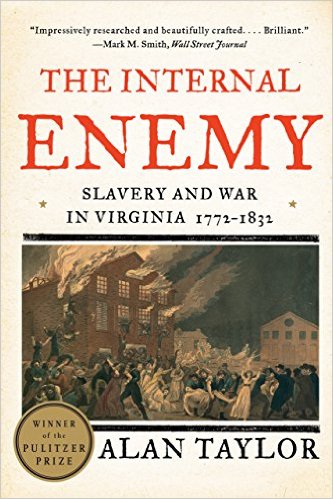
Taylor's second Pulitzer-winning work.
Stories as the fabric of social life also define my other book to win the Pulitzer Prize for History. The Internal Enemy examines Virginia after the American Revolution and especially during the War of 1812. Enslaved people told hopeful stories that the British king wanted them to become free and would send warships and soldiers to free them. The masters of the enslaved told a very different story. They insisted that the British naval officers came to lure slaves away for sale into the even harsher slavery of the distant West Indies. Neither story — of the liberator king or the treacherous Britons — is true. The king was not dedicated to freeing all the slaves of his former colonies. His naval officers were also not in the business of deceiving and selling slaves.
But stories need not be true to be powerfully motivating. Virginians, black and white, devoutly believed the stories they told. The enslaved needed to believe someone powerful would bring them justice. That belief enabled hundreds to endure dangers and hardships to escape to British warships. Their masters longed to believe they were men more just than the British naval officers. The Virginians could not let themselves believe that the British truly came as liberators. By instead casting themselves as paternal masters, the Virginians claimed to have the best interests of slaves at heart. Thereby, the masters could cling to the slave system to sustain their farms and plantations.
As with the masters of the enslaved, sometimes we in the present become trapped by the stories we tell. The next day after this interview, I opened the Sacramento Bee to see my picture beneath a screaming headline: CHILDREN’S BOOK INSPIRES SCHOLAR. This led into a story whose thrust was just how odd academics really are — which is not quite what I intended when I told my story about finding Daniel Boone rather than Stegosaurus on the shelves of the school library.