
After graduating from the Columbia Journalism School in 1956, Bob Giles joined the staff of the Akron Beacon-Journal, ultimately becoming its managing editor. In that capacity, he oversaw coverage of an indelible breaking news event in American history: the shooting of four unarmed college students by the Ohio National Guard at nearby Kent State University during a protest against the Nixon administration's Cambodian campaign on May 4, 1970.
The staff of the Beacon-Journal went on to receive the 1971 Local General or Spot News Reporting Prize (analogous to today's Breaking News Reporting Prize) for its coverage of the massacre and its aftermath, while Kent State student John Paul Filo received the Spot News Photography Prize for his photo, initially published in suburban Pittsburgh's Valley Daily News.
Giles went on to serve as executive editor of The Rochester Democrat & Chronicle, editor/publisher of The Detroit News and curator of the Nieman Foundation at Harvard University, but the tragedy remained one of the defining experiences of his career.
In his new memoir, "When Truth Mattered: The Kent State Shootings 50 Years Later" (Mission Point Press), Giles assembles an engrossing play-by-play of his newsroom's response.
Pulitzer.org spoke to the journalist, who has retired to Traverse City, Mich., about a variety of subjects, including the events of that spring, trauma and journalism education.
Pulitzer Prizes: The situation in Kent devolved into chaos quickly. Did your newsroom investigate the credibility of rumors about militarism within the apparently peaceful protestors? Was there any evidence indicating that non-Kent State affiliates were involved in the vandalism?
Bob Giles: Throughout the early part of the 1960s, Kent State was a campus at peace. The first stirrings of anti-war sentiment emerged with the establishment of a protest group, End the War in Vietnam, in 1965. Each Wednesday, the group would hold silent vigils in front of the Student Union building. Typically, there would be 12 participants and 200 hecklers. The group was disorganized and died in 1968, shortly before the emergence of Students for a Democratic Society and the Black United Students. These groups would join in political activities at the center of student unrest at Kent State.
In the fall of 1968, the two organizations teamed up to protest the visit of recruiters from the Oakland, California, police department. There was a sit-in of about 250 students and a lot of rhetoric. The confrontation led to BUS walking off campus. In extended negotiations that followed, BUS won a concession from the university to offer Black Studies concentrations.
In the spring of 1969, SDS pressed for a set of demands, including an unsuccessful effort to eliminate the Reserve Officer Training Corps. A scuffle with campus police resulted in 58 arrests.
The campus political scene was quiet until April 10, 1970, when Yippie leader Jerry Rubin came to campus. In a speech before 1,500, he urged students to burn books, kill parents and torch their suburban homes. “Quit being students. Become criminals. We have to disrupt every institution and break every law.” Rubin’s comments were thought to be outrageous, but they had little effect.
As I began gathering material for "When Truth Mattered," I found in my files a long report written by one of our reporters summarizing stories about campus unrest contained in boxes of clip and photo files. It contained sketches of the “Original Kent Four” and eight other KSU activists. One faculty member was identified as an “unofficial advisor” to SDS.
As the weekend of May 1-4 approached, we heard talk that student activists were planning a rally against the war that was to begin at noon, Monday, May 4.
President Nixon’s speech on Thursday, April 30, announcing an invasion of Cambodia changed all that. The Akron Beacon Journal gave extensive coverage to the student disruptions over the weekend, which included trashing downtown bars, burning the ROTC building and the appearance of Ohio Gov. Rhodes. The campus atmosphere was dampened by the looming confrontation on Monday, May 4, as the Ohio National Guard began to carry out its orders to prevent all campus gatherings, peaceful of otherwise.
The Black United Students did not participate in the rally and a few SDS leaders may have been scattered among the 1,500 demonstrators and did not appear to have influential roles.
Our newsroom was on edge as we tried to anticipate how the confrontation between the students and the Guard would play out. But in our moments of journalistic speculation, we never imagined violence.
Months and months of reporting on campus unrest had given the Beacon Journal a deep institutional background as May 4 dawned. That intense preparation gave us an advantage during the early hours and days after the Kent State shootings. We could not confirm the identity of militants that would be involved in the noon rally. The militants were not obvious. It was essentially a home-grown gathering of demonstrators expressing anger and resentment at the presence of armed soldiers on their campus.
Thinking back on that time, and who was central in the protest movement, it is hard to say, after 50 years, what influenced student behavior on May 4. The best explanation may be that a lot of frustrated students got caught up in a tide of events –– the war, the draft and the presence of armed soldiers on their campus –– and they demonstrated without much encouragement from a few revolutionaries.
PP: You came of age in an era where public institutions were respected (if not necessarily venerated) across much of society. How did the social and cultural upheaval of the 1960s inform or affect your reporting?
BG: The Beacon Journal’s approach to covering the social and cultural upheaval of the 1960s and 1970s was shaped by the values of truth-telling and trust-building laid down by the newspaper’s owner and editor, John S. Knight. His motto was, “Get the truth and print it.” That value shaped the reputation of the Beacon Journal and became Jack Knight’s journalistic guideline as he acquired newspapers in Detroit, Miami, Philadelphia and Charlotte, and built Knight Newspapers into one of the country’s leading newspaper organizations.
JSK’s opposition to the Vietnam War dated to 1954 and his was a steadfast voice that challenged the policies of four presidential administrations. The economic muscle of the Knight organization was a signal that its newsrooms would tolerate no pressure to influence news coverage nor submit to intimidation from those in powerful positions.
Anti-war rallies and protests against university policies of racial exclusion were stories to be reported. That is how Beacon Journal editors and reporters responded to the rise of counter-cultural politics. Reporters and photographers went off on their assignments respectful of protesters and the mainstream community that opposed them. No hippie attire, no marching in anti-war demonstrations. The newspaper’s level and straightforward coverage had been building trust with its audience. When Kent State exploded on May 4, our readers trusted our reported stories as the best available version of the truth. Readers did not always agree with what the facts told them, but they respected our journalistic effort to give them a truthful account. For us, the era of social and cultural change was just a good story.
PP: It was surprising to learn that the deaths of your colleagues from the Pulitzer-winning Beacon-Journal staff served as a principal motivation to completing your book. Since the mid-2010s, a litany of academic research and journalism has been devoted to the rise in "deaths of despair" over the past two decades, especially among those who were teenagers or younger adults in 1970. Were any of your colleagues affected by this crisis, especially in light of the current economic realities of journalism?
BG: It is difficult and perhaps unfair to attempt link the stress of covering Kent State to the number of deaths over a half century among the journalists who worked that story for the Beacon Journal. There are no recorded suicides among that group.
On May 4 and afterward, Beacon Journal journalists were driven by a passion for seeking the truth. They saw their mission as helping the public understand a terrible wrong. They had been exposed to a tragic event. But they had not begun to confront the burden of stress they eventually would bear. They understood Kent State was a global story. They struggled to get their minds and emotions around a brutal truth: The freedom to speak against the Vietnam War had been shattered by the awful fact that soldiers as agents of the U.S. government had shot, killed and wounded college students on their own campus. Students were exercising their constitutional rights of assembly and speech.
Beacon Journal staffers were left to grieve in their own private ways. Many were Kent State students and found themselves writing about former classmates. In newsrooms of the day, stress counseling was not available. One staffer who witnessed the shootings has refused to talk about it and refused to relate his experiences for this book.
John Filo, who took the iconic photo of a teenager screaming over the body of Jeff Miller, believes that “many of us there on that day suffer in varying degrees from post-traumatic stress disorder.” Filo worked for a year trying to arrange a stress symposium for students and National Guard veterans. He is resigned that the idea will “probably die” with the PTSD issues unresolved. Each survivor will be left “covering their hurt in their own way.”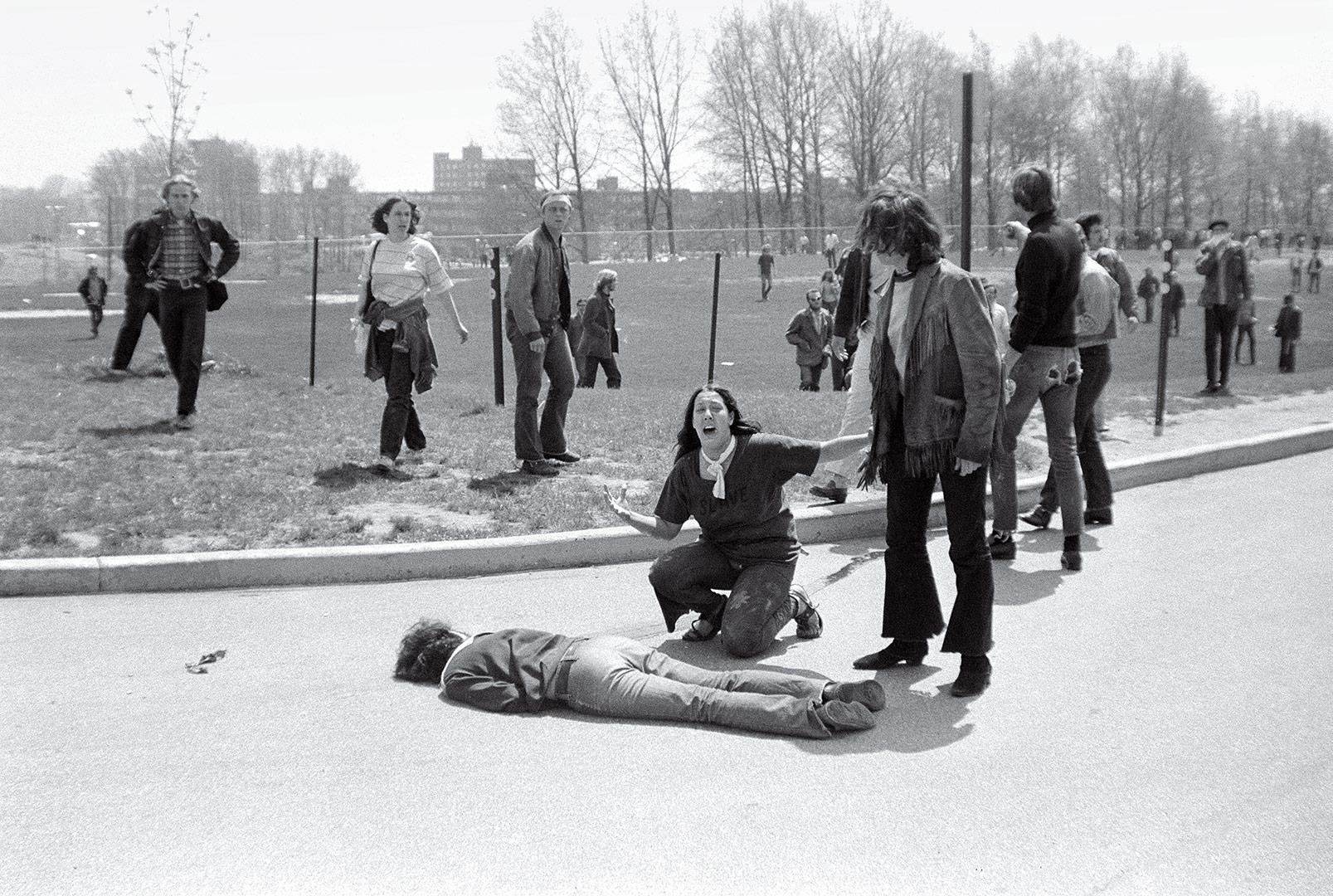
A Kent State student and intern at suburban Pittsburgh's Valley Daily News, John Filo received the 1971 Spot News Photography Prize for this photo of Mary Ann Vecchio kneeling over the body of the late Jeffrey Miller. He is now vice president of CBS Photography Operations. (File)
It wasn’t until 2003, during the Iraq War, that the risks of war leading to PTSD were closely examined. Anthony Feinstein, a neuropsychiatrist from Canada, conducted a series of studies on the impact of war on journalists. In his book, “Journalists Under Fire,” he concluded that the mental and physical exhaustion left many war correspondents depleted and broken.
Applying Feinstein’s research to Kent State reveals a significant difference from America’s long-running wars. The Kent State war lasted 13 seconds. Once the shooting ceased, there was little risk to journalists on the scene. Still, the stress was real, implanting vivid memories of personal loss. We had no way of helping journalists cope with the fear, sadness and nightmares that may have occupied their emotions in the weeks, months and years that followed.
PP: While overseeing the kind of breaking local news coverage that increasingly is jeopardized today, did it cross your mind that authoritarian behavior by the U.S. federal government was a possible endgame in the tragedy that was unfolding? How did you perceive the revelations of Watergate and its ancillary scandals in the context of your local reporting?
BG: It did not occur to us in the Beacon Journal newsroom to characterize President Nixon or Governor Rhodes as authoritarian. Following the publication of the story summarizing the findings of the FBI investigation, Nixon wanted the story “shot down.” We knew that was not a practical expectation because our story ran in newspapers and led newscasts across the country. It seemed a moment of frustration for a president who hated the reality that the FBI had blamed the Ohio National Guard for unnecessarily killing protesting college students.
Our reporting on Governor Rhodes unveiled a series of misjudgments by him that set the stage for Monday’s confrontation and the murder of students. We saw Rhodes’ actions as focused on his efforts to win the GOP primary election for U.S. Senate to be held the following week. At that moment, he was a politician seeking to use a campus confrontation over Vietnam to gain leverage with his conservative base in helping him win a seat in the U.S. Senate.
Beginning in mid-1972, the Beacon Journal gave substantial page-one play to the Watergate stories by The Washington Post. They revealed corrupt behavior that would lead to the White House. Watergate was a great story and we treated it as such, even though its relevance to Ohio was unclear.
PP: As a journalist who ran newsrooms of various sizes and who has also spent considerable time in academia, where would you place the importance of formal journalism education? And do the news-consumer maxims you put forth in a recent interview with MyNorth — a stringent objectivity and reliance on reliable authorities, but also an all-around skepticism, particularly toward false equivalencies — advocate any retrenchment from interpretive reporting?
BG: My experience with formal journalism education began during my year of study at the Graduate School of Journalism at Columbia, 1955-56. The influence of part-time instructors from The New York Times and Herald Tribune and the assignments that gave us students real-time experience in New York shaped me as a young journalist. The values of the Columbia curriculum matched those I found in my first reporting job at the Akron Beacon Journal. Along the way, accuracy, facts, truth and trust had been pounded into my sense of good journalism.
When I won a grant to teach at the University of Kansas as a professional-in-residence, I found a journalism school with the highest standards. The KU faculty in those days was regarded among the nation’s best.
Following my time at Kansas, I became ASNE’s representative to the Accrediting Council on Education and Mass Communications. My commitment to formal journalism education was tested then because many college journalism programs were being required to expand the missions to include emphasis on communications or speech. I considered these to be the language of persuasion that had no relationship to professional journalism. The journalism education programs that excel today, like Columbia, have remained true to their original missions. Strengthening formal journalism education seems essential to me as a means of shoring up the principles in the hearts and minds of journalists confronting efforts to undermine their work with false claims of “fake news.”
My effort to give readers of my book guidance on identifying dependable and truthful news coverage is not intended to advocate retrenchment from interpretive reporting. Interpretation and analysis have great value in today’s news marketplace as long as it is based on information that is true, accurate and relies on sources that can speak with authority.