
I’m standing in line for the buffet at a New Year’s Eve party, breathing the rarified air of the Upper East Side, and feeling woefully out of place. My tuxedo is frayed and my tie doesn’t match my cumberbund. It’s a sophisticated crowd; women with expensive faces drift by with ghostly elegance. Their husbands confer with one another in hushed tones, as if they’re sharing treasury secrets or making discreet plans for war. I’ve heard there’s a prominent congressman in our midst, and a celebrated children’s clothing designer, and the doctor who invented Lasik. A small man with a wizened face and Palm Beach tan tugs on my sleeve.
“And what do you do for a living?” he asks.
“I’m a playwright,” I answer.
He looks at me, bemused, and doesn’t speak, as if he’s waiting for me to offer a more sensible skill. I might just have readily said, “I blow glass for a living,” or “I’m a gothic stone carver.”
It’s not the first time this has happened. In my life, it’s become something of a ritual. I answer the question and people wait politely for the punchline, only to discover that there isn’t one.
To be a playwright is to be a relic of an earlier era, a time of Russian samovars, Renaissance doublets, or even Grecian masks and leather-covered caskets filled with Dionysian wine. Let’s face it: Most of the truly established, canonical dramatists are long dead. Popular novelists today include J.K. Rowling and Robert Ludlum, but the most produced playwrights reliably remain Shakespeare and Henrik Ibsen, in that order. The vast majority of straight plays running on Broadway today are revivals. They may be stately productions, mounted with stodgy fidelity, or rough-and-tumble post-modern affairs, but the scripts themselves are almost always considerably older than I am.
In short, mine is not a tenable profession. I hasten to add that I’m one of the lucky ones. Theaters regularly produce my work and I’ve had the rare privilege of no fewer than four shows on Broadway. None have been seismic hits, a few have been outright failures, most have fallen comfortably in between, but the living they have provided me is modest at best. I earn my real income — the kind that pays credit card bills and mortgages — from my peripatetic career in Hollywood, sprucing up other people’s screenplays or occasionally penning one of my own. And I’m damn lucky to get the work.
Why, then, do I persist in this unfortunate theater habit? Why must I continue to write plays? The monetary rewards are nil, critics can be publicly unkind, and the theater is to popular culture as the Model T is to the Tesla. Yet, I persevere.
A facile explanation might be that I was borne into the wrong era. In the age of Twitter, blogging and fan fiction, I still see myself in a silk smoking jacket, a tumbler of whiskey at the ready, typing bon mots into an Underwood typewriter. But the truth (dangerously enough) is even more pretentious: Deep in the cavernous reaches of my psyche, I still believe that — in a pathologically consumer culture, where we devour an entire Netflix series in a single weekend and can delete The Washington Post or Slate from our Kindles with the touch of a button — good plays lead double lives.
First and foremost, they are blueprints for ephemeral events. A director, a team of designers and a cast of actors gather to realize them in three dimensions, for a finite period, to a living, breathing audience (except, of course, for those somnambulant Sunday matinees).
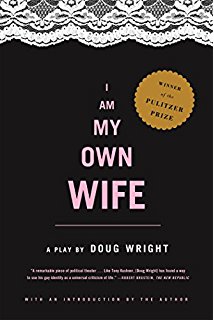
I Am My Own Wife
But plays are also objects, books you can place upon the shelf. And so they share some tiny potential with fiction or poetry to become not just fleeting entertainments, but contributions to our national literature. (How’s that for grandiose?) This may be naïve on my part — alas, I do bear the prejudices of my generation — but I can’t help but think that plays last longer than Instagram pics or Yelp reviews or articles intended to dissolve into the ether once they’ve been perused.
I readily admit that playwrights are notoriously needy creatures; we’re desperate for approval. We carve out our hearts and hold them up on a platter for public scrutiny. If the audience laughs or cries or applauds, we feel reassured of our place in the human sphere. We urgently need to know that our keenest, most dearly held observations are shared ones; that our nightmares are more universal than we had supposed; and that our joys, if communicated with truth and artistry, can be contagious.
We write to save our own lives: to render tomorrow less terrifying, to assure ourselves that we are not alone. The best plays, I think, have all the ardor and passion of a love poem, and all the unresolved pain of a suicide note.
For this fragile art to continue, however, we urgently need to know that others share in the happly delusion that the theater is important. Venerable prizes like the Pulitzer do just that. They remind you that hovering just above you, like an assembly of angels, there exists a core group of impassioned individuals who believe, like you, that a well-turned phrase has the power of any weapon; that life’s most vexing mysteries are meant to bind us together, not tear us apart; and that a humble wooden stage with a velvet curtain can still be a site for soul-shattering revelation.The prize has not, however, guaranteed me future success, nor has it granted me immunity from censure. Every time I author a new work, I am judged anew, sometimes with glowing favor and occasionally with virulent condemnation. The Pulitzer sits on a window sill in my office, reminding me that for one glorious, quicksilver moment there was a happy consensus that I could actually write and that maybe — just maybe — I had something worthwhile to say. On dark days, that is incredibly fortifying.
On brighter days, it liberates you to consider one of the unsung dividends of receiving a Pulitzer Prize. That is, the certainty that your obituary will one day appear in The New York Times.
Rumor has it, these obits are prepared almost the moment you achieve notoriety and held until Fate merits their publication. Fortunately, I was able to achieve an advance copy of my own, and I’d like to conclude by sharing it below.
Acclaimed American playwright Doug Wright died of shock today upon receiving the news of his seventeenth Pulitzer Prize, which he graciously declined, citing a lack of shelf space.
His mother was heard to remark, “His brother Max was really the talented one.” His elderly father reminisced: “Kid couldn’t hit a baseball, but give him a glue gun, some glitter and some macaroni, and he’d make you a masterpiece.”
Mr. Wright is survived by his husband, iconic Calvin Klein underwear model David Clement, also a skilled gymnast, masseur, and a 2019 recipient of the James Beard Award for Culinary Excellence.
The couple divided their time between a fifteenth century palazzo in Umbria, a Rem Koolhaas beach house in the French Riviera, and the Boeing Business Jet that ferried them between these destinations.
Doug will be buried in a private ceremony, following a memorial at Madison Square Garden. Come early for best seats.