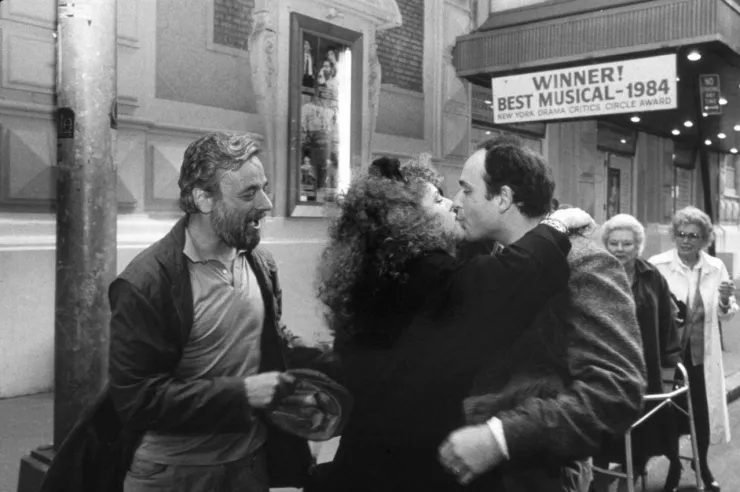
Throughout an inimitable career in the arts, 1985 Drama winner Stephen Sondheim (who died in November 2021 at the age of 91) revolutionized the harmonic and lyrical depth of contemporary musical theater in a series of ambitious works that included the nonlinear "Company" (1970) and the cross-cultural and visionary "Pacific Overtures" (1976). But it was the Pulitzer-winning "Sunday in the Park With George" (1984) that would revive his career at a crucial juncture — and mark the beginning of a fecund collaboration with fellow winner James Lapine.
The early 1980s marked a transitional period for Sondheim. In 1981, the musical "Merrily We Roll Along" (adapted from the 1934 play by the Pulitzer-winning team of Kaufman and Hart) closed after 16 performances amid a litany of negative reviews and a broader economic downturn. Its failure also marked the end of his long collaboration with director and producer Hal Prince, who had worked alongside Sondheim since "West Side Story" in 1957 and would soon helm a series of major commercial successes, most notably "The Phantom of the Opera" (1986).
As he regrouped from "Merrily," Sondheim considered leaving the theater and possibly embarking on a career in the nascent realm of video game design. However, meetings with Lapine (then a downtown theater experimentalist) and a shared affinity for Georges Seurat's neo-impressionist masterpiece "A Sunday Afternoon on the Island of La Grande Jatte" would see "Sunday in the Park With George" gradually coalesce into a triumphant rumination on the difficulties and power of creativity. Although a July 1983 Off-Broadway workshop production (brokered by Playwrights Horizons artistic director André Bishop) elicited praise from Leonard Bernstein and others, the work remained in development until mere days before its Broadway opening on May 2, 1984. During this period, the previews were so precarious that another American cultural icon— Johnny Cash — ballasted the company’s spirits by simply staying through the long-germinating second act.
Reviews were mixed — but influential New York Times theater critic Frank Rich emerged as a key supporter, writing " 'Sunday' [...] is setting the stage for even more sustained theatrical innovations yet to come." The production ultimately ran for more than 600 performances through October 1985, underpinned by the mellifluous voices of Bernadette Peters (soon enshrined as a leading Sondheim interpreter) and the Juilliard-trained Mandy Patinkin.
The jurors that considered "Sunday" for the 1985 Drama Prize were fresh to the process but brought with them a wealth of experience: A venerable critic known for his long association with The Village Voice, chair Julius Novick also held a full-time faculty appointment as a professor of literature and drama studies at Purchase College. Later selected as a 1989 Criticism finalist, Washington Post writer David Richards previously authored a 1979 biography of actress Jean Seberg, while Los Angeles Times critic Dan Sullivan would go on to serve as director of the Eugene O’Neill Theater Center’s National Critics Institute from 1999 to 2013.
In their report, the panel singled out three works per the Pulitzer Board’s stipulations, including "The Dining Room" by A. R. Gurney, best known for the popular "Love Letters" (a 1990 Drama finalist); and "The Gospel at Colonus," a reworking of Sophocles' "Oedipus at Colonus" in the milieu of the Black American church by Lee Breuer and Bob Telson.
The third work captivated the jury so much that they broke with the usual protocol, distinguishing it as their "unequivocal first choice." "Sunday” "concerns itself with the costs and agonies of artistic creation," they wrote. "It shows an American artist experiencing a crisis of faith in his own creativity, and finding strength and courage in a renewed connection with the past [...] The craftsmanship, with song, spectacle, and dialogue inextricably and purposefully woven together, is worthy of the theme. It is heartening that so serious and formally inventive a work should have achieved such a high degree of popular acceptance." The Board concurred with the recommendation, and in April 1985 "Sunday" became one of a handful of musicals to receive the Drama Pulitzer, joining such classics as "South Pacific" and "A Chorus Line."
"It was almost a year since the show opened and this news came as a most pleasant surprise," Lapine would recall in "Putting It Together," his 2021 memoir. "When we got the news, Steve and I were in a meeting with the projection designer Wendall Harrington for an upcoming revival of 'Merrily We Roll Along,' which I was to direct. We ran over to the theater to congratulate the cast at the end of their matinee. Bernadette, who had since left the show, surprised us outside the theater. Sometimes I would wonder what Georges Seurat would have made of our show. Would he be amused or appalled? Maybe a little of both."