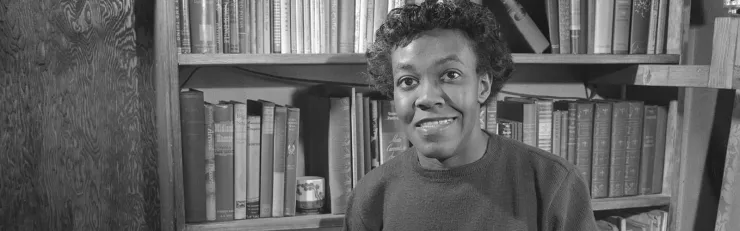
In 1944 an editor at Harper & Brothers contacted Richard Wright, the author of Native Son, to ask his opinion of poems submitted for publication by a Chicago woman named Gwendolyn Brooks. Wright responded:
“They are hard and real, right out of the central core of Black Belt Negro life in urban areas. ... There is no self-pity here, not a striving for effect. She takes hold of reality as it is and renders it faithfully. There is not so much an exhibiting of Negro life to whites in these poems as there is an honest human reaction to the pain that lurks so colorfully in the Black Belt. ... She easily catches the pathos of petty destinies; the whimper of the wounded; the tiny incidents that plague the lives of the desperately poor, and the problem of color prejudice among Negroes. ... Only one who has actually lived and suffered in a kitchenette could render the feeling of lonely frustration as well as she does: — of how dreams are drowned out by the noises, smells, and the frantic desire to grab one’s chance to get a bath when the bathroom is empty. Miss Brooks is real and so are her poems.”
In 1950, the year Gwendolyn Brooks became the first African-American to win the Pulitzer Prize, her editor asked her what made her write. Brooks answered that she wrote “to prove to others (by implication, not by shouting) and to such among themselves who have yet to discover it, that they are merely human beings, not exotics.” She wrote while “scrubbing, washing, ironing, cooking: dropping the mop, broom, soap, iron or carrot grater to write down a line, or word.” Writing, she said, “is the only work in which I am interested.”
When the galleys of Annie Allen were ready, the editor, Elizabeth Lawrence, sent them to Wright, Langston Hughes and Alfred Kreymborg, a poet, anthologist and chess master who had long been a figure in the New York literary scene. His critique: “Though this volume weighs little in the hand, it weighs much in the heart and the mind.”
Kreymborg had been on the Pulitzer Prize poetry juries for 1948 and 1949, and he returned to judge for 1950, with Annie Allen among the books entered.
The jury that year faced some challenges. William Carlos Williams, long a friend and colleague of Kreymborg’s, had published both a Selected Poems and the first parts of Paterson in 1949. He was in his mid-60s and had never won a Pulitzer Prize. Robert Frost’s Complete Poems came out that year as well. He was 75 and had won the prize four times. His friend, Louis Untermeyer, was on the jury with Kreymborg.
The third member, serving on the Poetry jury for the eighth consecutive year, was Henry Seidel Canby, a noted English professor at Yale. Canby described in his letter to the dean of Columbia’s Graduate School of Journalism how the three men had arrived at their choice.
Here is the letter.
‘A volume of great originality, real distinction and high value’
Dean Carl W. Ackerman
Graduate School of Journalism
Columbia University
New York 27, N.Y.
Dear Doctor Ackerman:
I have the honor to submit herewith the recommendations of the Advisory Committee, consisting of myself, Louis Untermeyer, and Alfred Kreymborg, for the Pulitzer Prize in Poetry this year.
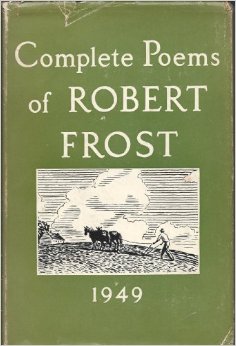
Frost's Complete Poems
The finest book of poetry this year is very naturally the Complete Poems of Robert Frost, which summarizes his whole career. For various good reasons, the Committee feels it would be most unwise to give the award to this book, unless no other worthy candidate was in sight. I quote the statement of Mr. Untermeyer, with which I entirely agree, that a fifth award to Mr. Frost would actually be a double or triple or quadruple award to a body of poems already so distinguished, for these are in all probability much his finest poems:
“If the judges were to award the prize literally to the best book of the year, the prize would have to be given to the Complete Poems of Robert Frost. As the title indicates, this is the cumulative work of the greatest living American poet, possibly the greatest poet living today. But — and it is an important “but” — Frost has received the award four times ... and, with the exception of a few added titles, for the same poems! A further ‘honor’ to Frost would be not only superfluous but so repetitious as to seem silly. In addition, an award to Frost would be a confession that current poetry is so lifeless that we have to turn again to the one poet we can cite as a contemporary tradition.”
There is another important contribution to poetry this year which also deserves a special statement. Mr. William Carlos Williams has been steadily growing in stature and published in 1949 a book of Selected Poems and the first three sections of his long poem called Paterson. A number of Mr. Williams’s briefer poems have already taken their places in anthologies, but he lacks self-criticism, and his total output so far is frequently distinguished by an extreme of obscurity. This is especially true of his long poem. There is every reason to believe that his new Selected Poems, to be published in 1950, will be much more representative of what he can do, and less full of failures. Also, it is at least possible that the fourth section of his Paterson, also to be published this year, may throw some light, at present absent, on the significance of the whole. We do not feel inclined to recommend him for a Pulitzer Prize this year. We believe that next year it will be possible to form a much sounder judgment, either positive or negative.
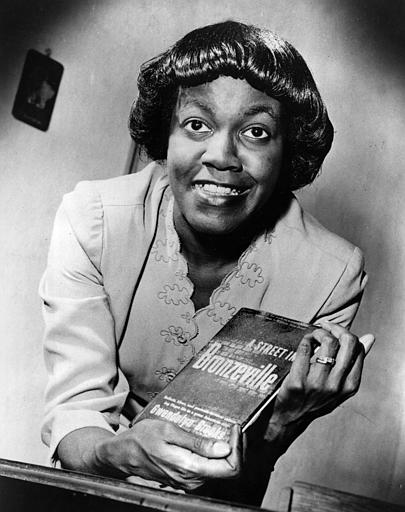
Brooks with a copy of A Street in Bronzeville
Fortunately, among the other books of poems submitted for an award is a volume of great originality, real distinction and high value as a book, as well as poetry. Some years ago, Gwendolyn Brooks, a Negro writer of unusual ability, published A Street in Bronzeville, which made a great impression on all its readers and had what is unusual for poetry today — a wide sale. In 1949 she published Annie Allen, a much better book, and indeed, in our opinion, the outstanding volume of the year, if you exclude Robert Frost. No other Negro poet has written such poetry of her own race, of her own experiences, subjective and objective, and with no grievance or racial criticism as the purpose of her poetry. It is highly skillful and strong poetry, out of the heart, but rich with racial experience. I quote from Mr. Alfred Kreymborg, with whose opinion I entirely agree:
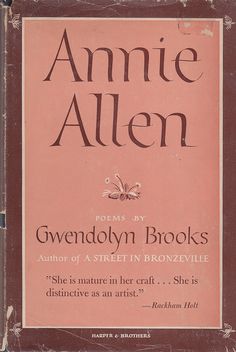
Annie Allen
“A few years ago, Gwendolyn Brooks, the young Chicago poet, made her debut in book form with A Street in Bronzeville, a small Spoon River Anthology of the Negro. This was followed last year by Annie Allen, an even finer volume, which introduces further characters out of her South Side background, with Annie herself as the central figure with her peregrinations from childhood through girlhood to womanhood. These Notes, as the author modestly calls her varied lyrics and ballads, are finally developed in a single short narrative, The Anniad, whose title deftly parodies The Aeneid and whose intellectual sweep over common experience is not only brilliant but profound in its tragic and tragicomic implications. The book as a whole gives evidence that the poet firmly resisted temptations of special pleading, the bane of most social verse in our time. Her work is truly objective, never propagandistic, and above all original.
“Gwendolyn Brooks has twice received Guggenheim Fellowships and a Grant from the American Academy of Arts and Letters. In recommending that she receive the 1949 Award for Poetry from the Pulitzer Committee, for which the judges voted unanimously, they feel that a wider public will be drawn toward an artist of outstanding merit.”
There are, as is usually the case in a Pulitzer contest, a group of seven books, all of them of high competence, and all deserving great praise. These are the following:
Orpheus, Muriel Rukeyser
Elegies, Muriel Rukeyser
An Acre in the Seed (posthumous), Theodore Spencer
Live Another Day, John Ciardi
Aspects of Proteus, Hyam Plutzik
Volume II, Jose Garcia Villa
Walk Through Two Landscapes, Dilys Bennett Laing
The Tears of the Blind Lions, Thomas Merton
There are potential takers of the Pulitzer Prize in the future in this group, but the Committee unanimously does not wish to recommend this year any one of them.
I may say that we have seldom been more satisfied than with our choice of Annie Allen.
I am
Yours very truly,
Henry S. Canby
For the committee:
Henry Seidel Canby
Alfred Kreymborg
Louis Untermeyer
Main sources: A Life of Gwendolyn Brooks, by George E. Kent, Harper, 1990; Pulitzer Prize files. Also consulted: “The Visual Imagery of Gwendolyn Brooks,” by Linda Somers, master’s thesis, English department, Atlanta University, August, 1971; “Bronze by Gold,” by Stanley Kunitz, Poetry magazine, April 1950, pp. 52-56; The Indignant Generation: A Narrative History of African American Writers and Critics, 1934-1960, by Lawrence P. Jackson, Princeton University Press, 2011.