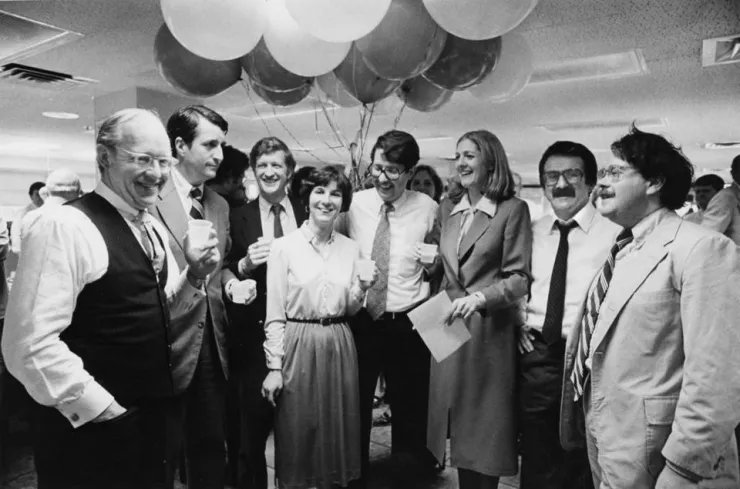
For many years during the flourishing of the women’s movement of the late 20th century, the woman with the biggest soapbox in the country was Ellen Goodman, a nationally syndicated columnist based at The Boston Globe. She helped people think through abortion rights, birth control, women in the workplace, change in marital responsibilities — any social issue that affected American life.
Speaking with the Nieman Fellows at Harvard University last year, Mary Schmich of the Chicago Tribune, who won the Pulitzer Prize in Commentary in 2012, reflected on her own decision to become a columnist.

Ellen Goodman
“The only columnist I knew who wrote the way I’d like to — the only one I felt spoke for me and to me — was Ellen Goodman. But at the time, she was a rare breed of columnist — a woman, a columnist who blended the public and the personal.”
Goodman had graduated from Radcliffe in 1963 and embarked on a newspaper career. After a year as a Nieman Fellow in 1973-74, she began writing an oped column for The Globe. It was soon syndicated. Eventually more than 450 newspapers across the country published it.
She wrote her final syndicated columnist for publication on Jan. 1, 2010. It included this summing up for her generation:
“Looking backward and forward. I belong to a generation that has transformed our culture. We’ve been the change agents for civil rights, women’s rights, gay rights. Now, we find ourselves on the cutting edge of another huge social change. This time, it’s the longevity revolution. Ours is the first generation to collectively cross the demarcation line of senior citizenship with actuarial tables on our side.”
A portfolio of Goodman’s columns won her the 1980 Pulitzer Prize in Commentary. In the two columns from her entry reprinted here, Goodman wrote about two Americans of earlier generations. The columns ran five days apart, on Oct. 25 and 30, 1979.
In one, she used the occasion of the opening of the John F. Kennedy Presidential Library & Museum in Boston to meditate on the country’s progress. The backdrop was the challenge of Sen. Edward M. Kennedy, the late president’s brother, to President Carter, a Democrat of more moderate stripe.
In the second column she wrote about how a current focus on Eleanor Roosevelt’s sex life shouldn’t distract the public from her greatness.
The years have not eased that sense of loss
By ELLEN GOODMAN
At the very end, Jack Kennedy’s voice sailed out over the stillness of the landscape around the library and left a wake of goosebumps across the surface of the crowd. For a few minutes politics was replaced by a profound and silent sense of loss.
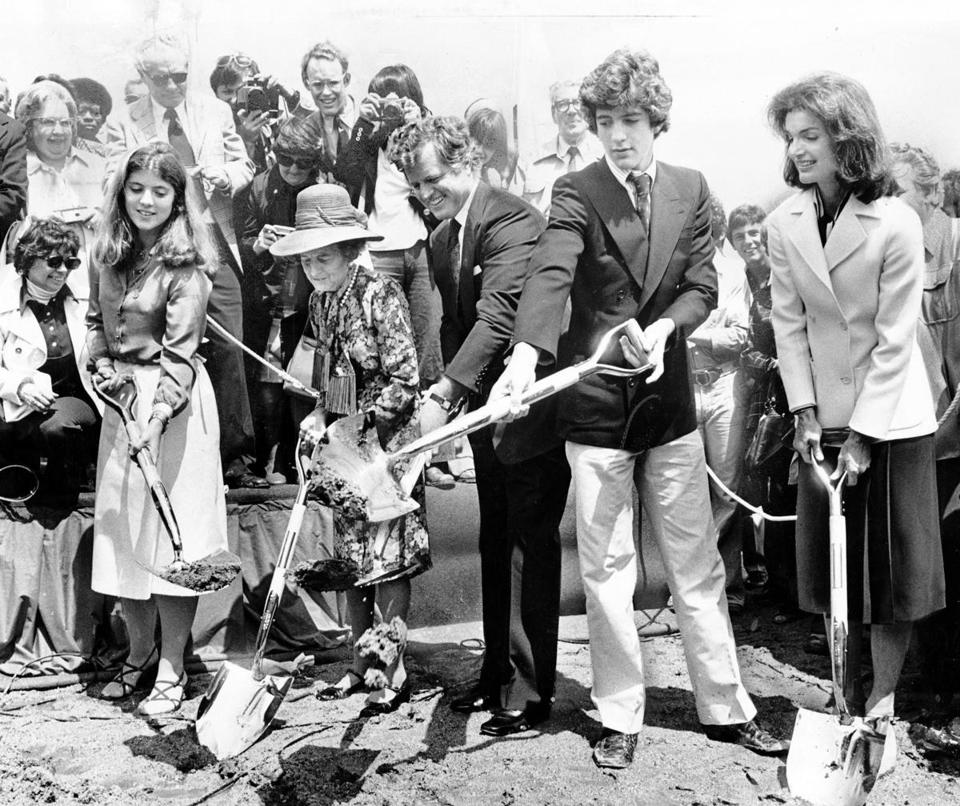
Three generations of Kennedys break ground on the JFK Library. Source: The Boston Globe
The symptoms were all familiar and predictable as the lump in the throat, the hand at the mouth, the tears. But all weekend, after many of the Kennedy people had gone home and the city was basking in Indian summer, I kept wondering about that loss.
What is it that Jack Kennedy’s words invariably tap in so many of us? What button is pushed by the sound of his voice? Is it a sense of loss for the man or for a time in our lives or for a time in our country’s life?
I was in college when Kennedy was president. I was 22 years old and three months into my first job when he was killed. Although I was as realistic as most of those whose family business is politics, my own youthful sense of possibilities coincided with Kennedy’s call to get the country moving again.
Now, according to all the actuarial tables, I am in the middle. Those of my generation have lived through 16 years of public life that sounded alarm bells across the textbooks: Vietnam, Watergate, the energy crisis, inflation. Also we have lived through 16 years of private life in which most of us have made the major decisions about work, children.
Today, like many of my generation, I sense that my choices no longer range from A to Z, but perhaps from A to E. This is not a complaint, just an observation.
In midlife most of us feel these limits. We don’t squander our energy; we allot it with care. We call this maturing. The young call it aging.
But when I hear his voice, his words, I feel a loss. Is it loss for a time and attitude of life which I have outgrown as irrevocably as I have outgrown naiveté? Or is it loss for a time of his country’s life, before lowering our expectations became our best protection from disappointment?I have heard friends wonder about this in other contexts. It is not merely a question about our past and present. It may very well determine the future — whether a “call to battle” rouses us or repels us as a foolish children’s crusade.
Are we just playing possum, as Carly Simon sang, or have we really changed?
Before Jimmy Carter left Boston, he said that he and Ted Kennedy differed on little, only spending and arms. But I heard other differences on the platform that day, different approaches to our psychology.
Carter talked about living in a time of “limits” and an age of “hard choices.” He said that “we are struggling with a profound transition from a time of abundance to a time of growing scarcity in energy.”
Ted Kennedy for his part talked about challenges that are opportunities, and spirits that “soar.” About Jack he said, “He understood that America is at its best when the nation is on the move, when ideas are on the march. … He filled America with pride and made this nation young again.”
Both were, of course, delivering their Saturday sermon versions of the Jack Kennedy text. But they may have opened a dialogue that is really familiar to those of us in mid-life — between limits and opportunities, fiscal realities and challenges, hard choices and historical purpose.
Before the opening of the library, a cast of Jack Kennedy’s people had spread out through the city talking to high school students. Historian Arthur Schlesinger put this argument another way at my former high school. He said, “I do not see American political history in terms of liberal versus conservative, but rather in terms of exhaustion versus vitality.”
Clearly he has associated Jack Kennedy with vitality, Carter with exhaustion, and Ted Kennedy with renewed vitality. The senator echoed that in Philadelphia Oct. 22 when he said Americans want “action, not excuses.” But those of us who were young with Jack might not see it quite that simply.
Whether we back Kennedy or Carter may depend upon whether we see our own political history as an energy cycle or as a progression. It may depend on whether they regard “limits” as a phrase of midlife depression — an excuse for defeat — or of mature realism. Whether we see Carter’s “hard choices” as excuses or facts. Whether we see opportunities as renewed hope or youthful delusions.
In short, it may depend on what we were mourning when he heard Jack Kennedy’s words on the Boston shore.
A first lady and a great lady
By ELLEN GOODMAN
Now it is Eleanor Roosevelt’s turn to have her private life exhumed. Someone has said that the woman we buried was not who we thought she was, and so they have disinterred her letters, dissected their vital organs and sent them to the cruelest corner of all, the public.
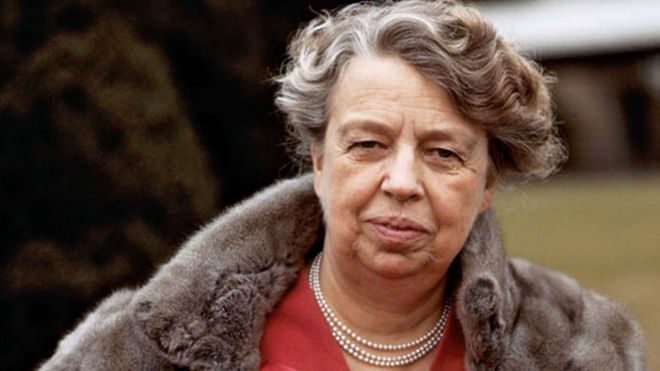
Eleanor Roosevelt
Those who think her prose was purple are arguing with those who think her life was tinged with lavender. Across the tabletops and country, people are talking about her “sexual preference” as if it were hair color: Did she or didn’t she? Only her friend knew for sure.
Well, they say that every generation writes its own history. Ours, it appears, is sexual. We thrust our obsessions back into time and come up with JFK’s promiscuity, Thomas Jefferson’s black mistress and, now, Eleanor’s friend Lorena Hickok.
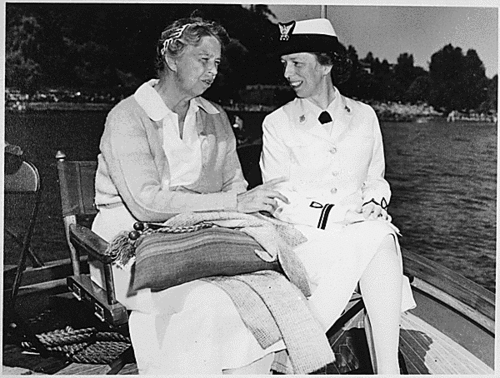
Roosevelt with Lorena Hickok.
It seems, moreover, that we have greater taste for suspicions than for facts, for the unknown than the known. We continually want to unmask our heroes as if there were more to be learned from their nakedness than from their choice of clothing.
It is odd in this case, especially, because what we do know about Eleanor Roosevelt is so much more vital than what we don’t know. A tall woman with a voice that begged caricaturing, she grew up in an era where form dictated feelings — when, as she said, “you dressed not according to the weather but to the date.”
We know that by all accounts, including her own, she had a miserable childhood. Regarded coolly by her mother, who called her “granny,” she was told that, “In a family that had great beauty, you are the ugly duckling of that family.”
We know, too, that she worshipped — and struggled to please — her father long after that attractive, self-destructive and unreliable man was gone.
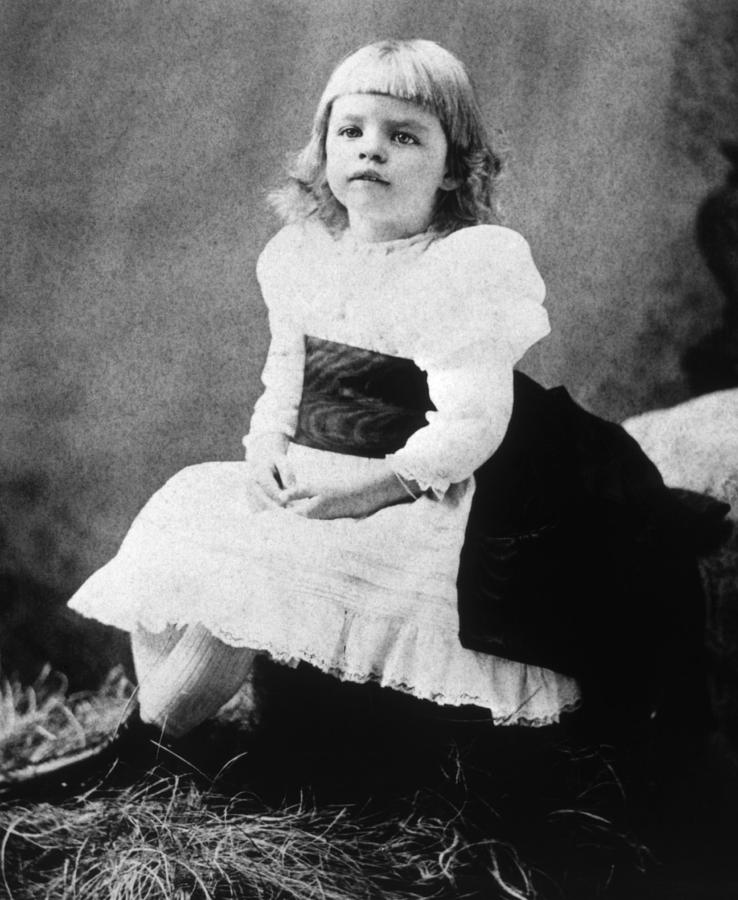
Roosevelt as a child.
At 43 years of age she could still write, “I knew a child once who adored her father. She was an ugly little thing, keenly conscious of her deficiencies, and her father, the only person who really cared for her, was away much of the time … (but) he wrote her letters and stories telling her … she must be truthful, loyal, brave, well-educated. … She made herself as the years went on into a fairly good copy of the picture he had painted.”
From the time she was 10 and an orphan, she spent a neglected childhood with her grandmother in a dark gloomy house where, as a cousin recalled, “We ate our suppers silently.”
At a very young age, then, Eleanor knew too much about life’s blows. As a young wife, she learned more. After 10 years of marriage and six children, her husband fell in love with Lucy Mercer, and: “The bottom dropped out of my particular life, and I faced myself, my surroundings, my world, honestly for the first time. I really grew up that year.”
Even when her husband died, Eleanor knew, “he might have been happier with a wife who was completely uncritical. That, I was never able to be. … Nevertheless, I think I sometimes acted as a spur even though spurring was not always wanted or welcome. I was one of those who served his purposes.”
She became a great lady, then, not because she was a first lady, but because she was able through tremendous will to turn her pain into strength, to turn disappointment into purpose. It was as if her backbone had been permanently strengthened by the brace she wore in childhood.
The facts, just the facts, of her life might have defeated any of us. Add to that a dead child and a husband stricken with polio. But she used them, the way she used her rigorous disciplines of calisthenics and ice-cold showers, to make herself stronger.
With this gutsiness, she cared about the poor even when the press accused her of interfering, and supported civil rights in the days when an anti-lynch law was highly controversial with southern Democrats. She promoted women in government when others disparaged them and, as a widow, worked for human rights in the world and the United Nations when others grew resigned.
And yes, she was effusive and loving in letters to woman friends. She was as intimate as her husband was remote. As James Roosevelt once wrote: “Of what was inside him, of what really drove him, Father talked with no one.”
All this, the important facts, the fundamental truths, are known, not suspected. As Arthur Schlesinger once added them up: “Her life was both ordeal and fulfillment. It combined vulnerability and stoicism, pathos and pride, frustration and accomplishment, sadness and happiness.”
This is still the best epitaph.