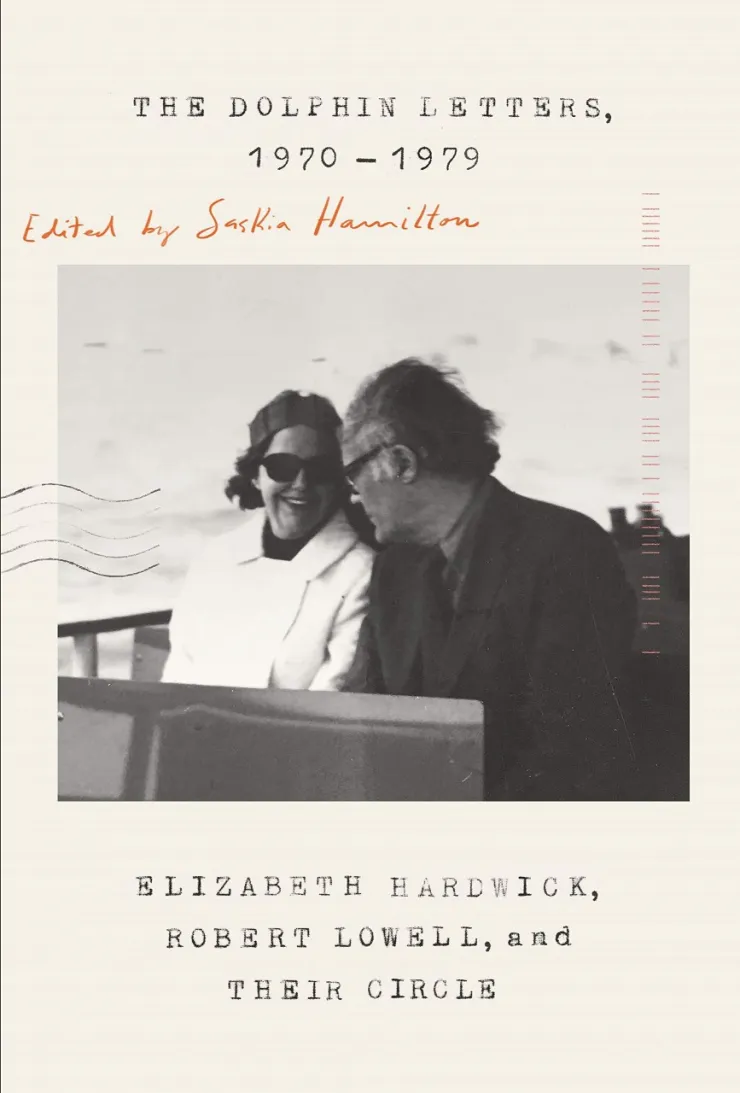
This week, Farrar, Straus and Giroux published two collections that illuminate the legacy of one of the 20th century's great literary couples: two-time Poetry Prize winner Robert Lowell and the novelist and academic Elizabeth Hardwick.
Edited by Saskia Hamilton (a professor of English at Barnard College who previously edited Lowell's correspondence with 1956 Poetry winner Elizabeth Bishop), "The Dolphin Letters" compiles the writers' 1970-1977 correspondence, spanning their separation, divorce and reconciliation while co-parenting and navigating Lowell's manic depression.
Also edited by Hamilton, "The Dolphin: Two Versions, 1972-1973" restores Lowell's Pulitzer-winning collection to print in its own right alongside a hitherto unseen pre-publication manuscript.
The path to "The Dolphin" was perilous. As he entered his sixth decade in 1970, Lowell arguably had reached the apex of his career. Although his early work reflected his background as an acolyte of such Southern Renaissance-based New Critics as Allen Tate and John Crowe Ransom, Lowell gradually incorporated other influences, including the free verse of 1995 Poetry finalist Allen Ginsberg, the ruminative reticence of 1956 Poetry winner Elizabeth Bishop, and the conversational modernism of 1963 Poetry winner William Carlos Williams.
While Lowell's marriage to Hardwick (a prodigious essayist and New York Review of Books co-founder) was marked by strain from the symptoms of his condition, it stabilized after he was prescribed lithium in 1967, enabling him to undertake a vigorous schedule that encompassed such disparate pursuits as surrogate work on the campaign trail for 1968 Democratic presidential candidate Eugene McCarthy; a prose translation of Aeschylus' "Prometheus Bound"; and the intimate, irregular sonnets that comprised the polarizing "Notebook." Norman Mailer hailed Lowell as "the best, most talented, and most distinguished" poet in America and "a fine, good, and honorable man" in "The Armies of the Night," his Pulitzer-winning account of the October 1967 March on the Pentagon in which the newly-medicated Lowell eagerly participated.
It was in this context that the poet was offered a unique position as a visiting fellow at Oxford University's All Souls College in 1970. Arguably the most selective academic institution in the world, the College carries no course requirements and admits a handful of fellows from the University's postgraduate ranks on the basis of a competitive test (often characterized as the "hardest exam in the world") and personal interviews. Unsuccessful candidates have included such erudite luminaries as historian Hugh Trevor-Roper and Prime Minister Harold Wilson.
As delineated by Kay Redfield Jamison in her 2017 life of the poet (a finalist for the 2018 Biography Prize), the All Souls stint did not prove to be a career-topping valedictory lap. While continuing an erratic correspondence with Hardwick, he initiated an extramarital affair with the Anglo-Irish writer Lady Caroline Blackwood, who would become his third wife in 1972 following his divorce from Hardwick.
Adopting Blackwood's antipathy toward psychiatry, he entered a particularly deleterious manic phase, leading to his institutionalization at Greenways Nursing Home in London in July. After resuming his lithium regimen, he recovered sufficiently to establish a household with Blackwood (a Guinness scion who struggled with alcohol) and father his youngest child, Sheridan, in 1971. However, friends such as travel writer Jonathan Raban worried about Lowell's "massively enthusiastic, schoolboyish [and] frantically playful" behavior during this period, embodied by a newfound obsession with dolphins.
Following a lengthy 1975-76 episode (likely triggered by lithium toxicity, the medication unable to fully attenuate his symptoms), Lowell told friend Blair Clark that he "wanted peace." "I feel I make [Blackwood] sick," he told 2018 Poetry winner Frank Bidart, a close friend and collaborator. He returned to Hardwick for much of 1977 — "[N]o great renewed romance, but a kind of friendship, and listening to his grief," she would reflect — and was in a cab en route from Kennedy Airport to her Upper West Side apartment when he succumbed to a fatal heart attack on September 12.
By the time of the Lowell-Hardwick reconciliation, more than four years had elapsed since the publication of "The Dolphin," a collection-exegesis of the divorce that included diction loosely interpolated from Hardwick's letters and telephone calls.
Undertaken without her consent, Lowell's decision to publish the work rankled many of their mutual friends, including Bishop, 1959 Poetry winner Stanley Kunitz ("a cruel invasion"), Adrienne Rich ("a poor excuse for a cruel and shallow book"), future Poet Laureate Donald Hall ("[a] cannibal-poet [...] dining off portions of his own family") and 1948 Poetry winner W. H. Auden, who refused to speak to Lowell during the remaining months of his life. "It was so vituperative to my mother," said their daughter, Harriet Lowell. "She felt he misrepresented her. He made it all about two women fighting over him."
The reaction from the American poetry community did not forestall Lowell's second Pulitzer, which was awarded to "The Dolphin" on May 6, 1974. A jury comprised of longtime Harvard English professor (and Lowell-Hardwick colleague) William Alfred, 1949 Poetry winner Gwendolyn Brooks and 1968 Poetry winner Anthony Hecht wrestled with the ethics of Lowell's achievement.
"In all frankness, I was put off first reading the book by a certain callousness in the name of candor," said Alfred, who served as the jury's chair. "But on comparison with the other works nominated, I had no choice but to cast my vote for it. It embodies an experience of our time, none the less tragic for being common; and it does so in a language worthy of the seriousness of that experience and supple enough to convey its desperately puzzling contradictions." Hecht largely concurred, citing the "strong and plain" language of the poems, while Brooks' attempt to challenge the consensus with Audre Lorde's "From a Land Where Other People Live" was rebuffed.
"I have sat and listened to too many/words of the collaborating muse/and plotted too freely with my life/not avoiding injury to others/not avoiding injury to myself," Lowell reflected in "Dolphin," the concluding poem in the collection.
For the first time — and in proximity to such compelling revisionist accounts as 2016 Drama winner Lin-Manuel Miranda's "Fosse/Verdon" — readers can now view those "injuries" in a more objective context.