The Pulitzer Prize for Criticism was initiated in 1970 and has turned out to be a lively and sometimes surprising category. Critics have won for reviews of books, music, art, architecture, photography and dance as well as news media, film and television.
Only one prize has been awarded for fashion criticism — to Robin Givhan of the Washington Post in 2006. Her entry consisted of 10 fascinating looks at how people dressed. The Pulitzer Prize Board cited her “for her witty, closely observed essays that transform fashion criticism into cultural criticism.”
Givhan, a native of Detroit and a graduate of Princeton and the University of Michigan, sometimes didn’t look far for her subjects.
These two essays from her winning entry give contrasting views of the sartorial habits of two top members of President George W. Bush’s White House team.
They ran on Jan. 28 and Feb. 25, 2005.
Vice President Cheney, dressing down
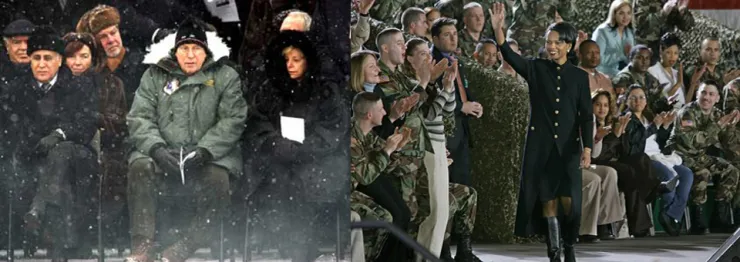
At yesterday's gathering of world leaders in southern Poland to mark the 60th anniversary of the liberation of Auschwitz, the United States was represented by Vice President Cheney. The ceremony at the Nazi death camp was outdoors, so those in attendance, such as French President Jacques Chirac and Russian President Vladimir Putin, were wearing dark, formal overcoats and dress shoes or boots. Because it was cold and snowing, they were also wearing gentlemen's hats. In short, they were dressed for the inclement weather as well as the sobriety and dignity of the event.
The vice president, however, was dressed in the kind of attire one typically wears to operate a snow blower.
Cheney stood out in a sea of black-coated world leaders because he was wearing an olive drab parka with a fur-trimmed hood. It is embroidered with his name. It reminded one of the way in which children's clothes are inscribed with their names before they are sent away to camp. And indeed, the vice president looked like an awkward boy amid the well-dressed adults.
Like other attendees, the vice president was wearing a hat. But it was not a fedora or a Stetson or a fur hat or any kind of hat that one might wear to a memorial service as the representative of one's country. Instead, it was a knit ski cap, embroidered with the words "Staff 2001." It was the kind of hat a conventioneer might find in a goodie bag.
It is also worth mentioning that Cheney was wearing hiking boots — thick, brown, lace-up ones. Did he think he was going to have to hike the 44 miles from Krakow — where he had made remarks earlier in the day — to Auschwitz?
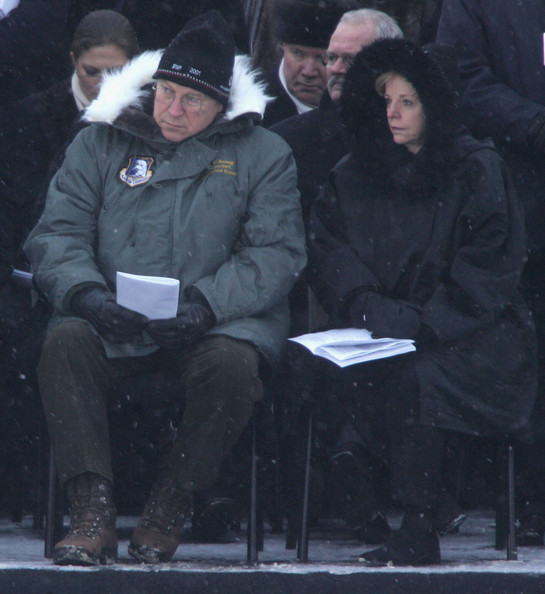
Dick and Lynne Cheney
His wife, Lynne, was seated next to him. Her coat has a hood, too, and it is essentially a parka. But it is black and did not appear to be functioning as either a name tag or a billboard. One wonders if at some point the vice president turned to his wife, took in her attire and asked himself why they seemed to be dressed for two entirely different events.
Some might argue that Cheney was the only attendee with the smarts to dress for the cold and snowy weather. But sometimes, out of respect for the occasion, one must endure a little discomfort.
Just last week, in a frigid, snow-dusted Washington, Cheney sat outside through the entire inauguration without so much as a hat and without suffering frostbite. And clearly, Cheney owns a proper overcoat. The world saw it during his swearing-in as vice president.
Cheney treated that ceremony with the dignity it deserved — not simply through his demeanor, but also through his attire. Would he have dared to take the oath of office with a ski cap on? People would have justifiably considered that an insult to the office, the day, the country.
There is little doubt that intellectually Cheney approached the Auschwitz ceremony with thoughtfulness and respect. But symbolism is powerful. That's why the piercing cry of a train whistle marked the beginning of the ceremony and the glare of searchlights signaled its end. The vice president might have been warm in his parka, ski cap and hiking boots. But they had the unfortunate effect of suggesting that he was more concerned with his own comfort than the reason for braving the cold at all.
Condoleezza Rice’s commanding clothes
Secretary of State Condoleezza Rice arrived at the Wiesbaden Army Airfield on Wednesday dressed all in black. She was wearing a black skirt that hit just above the knee, and it was topped with a black coat that fell to mid-calf. The coat, with its seven gold buttons running down the front and its band collar, called to mind a Marine's dress uniform or the "save humanity" ensemble worn by Keanu Reeves in "The Matrix." As Rice walked out to greet the troops, the coat blew open in a rather swashbuckling way to reveal the top of a pair of knee-high boots. The boots had a high, slender heel that is not particularly practical. But it is a popular silhouette because it tends to elongate and flatter the leg. In short, the boots are sexy.
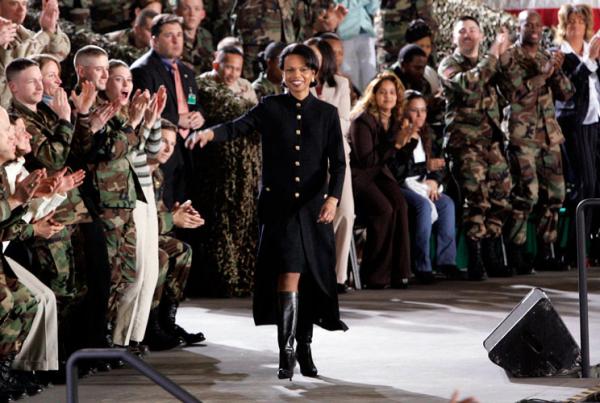
Condoleezza Rice at Wiesbaden Army Airfield
Rice boldly eschewed the typical fare chosen by powerful American women on the world stage. She was not wearing a bland suit with a loose-fitting skirt and short boxy jacket with a pair of sensible pumps.
She did not cloak her power in photogenic hues, a feminine brooch and a non-threatening aesthetic. Rice looked as though she was prepared to talk tough, knock heads and do a freeze-frame "Matrix" jump kick if necessary. Who wouldn't give her ensemble a double take — all the while hoping not to rub her the wrong way?
Rice's coat and boots speak of sex and power — such a volatile combination, and one that in political circles rarely leads to anything but scandal. When looking at the image of Rice in Wiesbaden, the mind searches for ways to put it all into context. It turns to fiction, to caricature. To shadowy daydreams. Dominatrix! It is as though sex and power can only co-exist in a fantasy. When a woman combines them in the real world, stubborn stereotypes have her power devolving into a form that is purely sexual.
Rice challenges expectations and assumptions. There is undeniable authority in her long black jacket with its severe details and menacing silhouette. The darkness lends an air of mystery and foreboding. Black is the color of intellectualism, of abstinence, of penitence. If there is any symbolism to be gleaned from Rice's stark garments, it is that she is tough and focused enough for whatever task is at hand.
Countless essays and books have been written about the erotic nature of high heels. There is no need to reiterate in detail the reasons why so many women swear by uncomfortable three-inch heels and why so many men are happy that they do. Heels change the way a woman walks, forcing her hips to sway. They alter her posture in myriad enticing ways, all of which are politically incorrect to discuss.
But the sexual frisson in Rice's look also comes from the tension of a woman dressed in vaguely masculine attire — that is, the long, military-inspired jacket. When the designer Yves Saint Laurent first encouraged women to wear trousers more than 30 years ago, his reasons were not simply because pants are comfortable or practical.
He knew that the sight of a woman draped in the accouterments of a man is sexually provocative. A woman was embracing something forbidden.
Rice's appearance at Wiesbaden — a military base with all of its attendant images of machismo, strength and power — was striking because she walked out draped in a banner of authority, power and toughness. She was not hiding behind matronliness, androgyny or the stereotype of the steel magnolia. Rice brought her full self to the world stage – and that included her sexuality. It was not overt or inappropriate. If it was distracting, it is only because it is so rare.