 Bradbury came of age as a writer before the postwar ascendancy of the paperback book as a publishing medium. Instead, during the Golden Age of Science Fiction, short stories published in pulp magazines like Astounding Science-Fiction, Thrilling Wonder Stories and Amazing Stories stood at the forefront of the field. As such, many of his novels are actually "fixups"—a term coined by SF legend A.E. van Vogt to describe novels assembled from previously published short stories that were buttressed with new interlinking material.
Culled from Bradbury's late 1940s output, The Martian Chronicles is a sweeping account of the colonization of Mars amid nuclear war on Earth. Its literary structure (patterned after Sherwood Anderson's Winesburg, Ohio) earned plaudits from such notable critics like Christopher Isherwood, who read the book after a fortuitous encounter with the younger writer (and fellow Angeleno) at a bookstore. In his review, Isherwood deemed Bradbury "a very great and unusual talent," a tastemaking assessment that charted the course of the rest of his career.
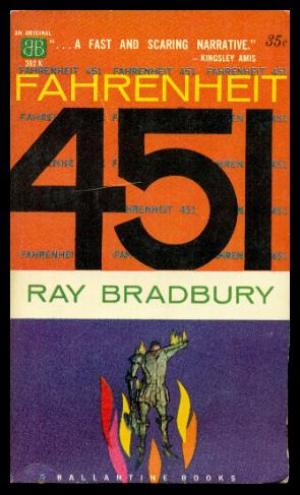 Unlike many of his contemporaries (biochemistry professor Isaac Asimov; Annapolis-educated engineer Robert A. Heinlein), Bradbury was a proud autodidact. He reflected upon this in a long interview with The Paris Review that gestated over several decades: "When I graduated from high school in 1938, I began going to the library three nights a week. I did this every week for almost ten years and finally, in 1947, around the time I got married, I figured I was done. So I graduated from the library when I was twenty-seven. I discovered that the library is the real school." This intimate connection with books and lifelong learning may well have provided the impetus for Fahrenheit 451, the dystopian novel that constitutes his most enduring and resonant work.
In a fatal irony, the novel that chronicled a future America where books were outlawed and burned by "firemen" was published by Ballantine Books in an expurgated edition (encompassing the censorship of several words and seventy-five modified passages, among other changes) from 1967 to 1979; between 1973 and 1979, only the censored version remained in print. After Bradbury was alerted to the changes, he demanded the reinstatement of the original text. It has remained in print ever since.
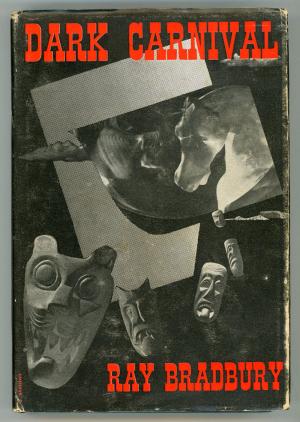 Founded by eclectic litterateurs August Derleth and Donald Wandrei in 1939, Arkham House soon became regarded as the gold standard in fantasy and horror publishing. With each hardcover volume limited to a small printing (anywhere from 500 to around 3,000 copies), virtually every title became a collector's item. To be published by Arkham House was a mark of distinction in and of itself, particularly when genre literature was widely confined to less rarefied environs.
Bradbury's only "Arkham," the anthology Dark Carnival, was issued in 1947. Many of the stories had already been published in various magazines, but the book is considered to be particularly collectable because it served as the basis for The October Country, a mass market anthology published by Ballantine eight years later. In particular, "Homecoming" remained an enduring preoccupation for the writer. One of his first sales to the "slicks" (a term that distinguished magazines that mainly dealt in literary fiction from those that specialized in science fiction and fantasy), it was initially published out of the slush pile in Mademoiselle at the behest of a fellow imaginative autodidact—fiction reader Truman Capote. After seeing print again in The October Country, it served as the basis for one of his final novels, 2001's From the Dust Returned.