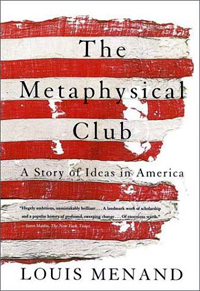
 The Civil War made America a modern nation, unleashing forces of industrialism and expansion that had been kept in check for decades by the quarrel over slavery. But the war also discredited the ideas and beliefs of the era that preceded it. The Civil War swept away the slave civilization of the South, but almost the whole intellectual culture of the North went with it. It took nearly half a century for Americans to develop a set of ideas, a way of thinking, that would help them cope with the conditions of modern life. That struggle is the subject of this book.
The story told in The Metaphysical Club runs through the lives of Oliver Wendell Holmes, Jr., a Civil War hero who became the dominant legal thinker of his time; his best friend as a young man, William James, son of an eccentric moral philosopher, brother of a great novelist, and the father of modern psychology in America; and the brilliant and troubled logician, scientist, and founder of semiotics, Charles Sanders Peirce.
Together they belonged to an informal discussion group that met in Cambridge, Massachusetts, in 1872 and called itself the Metaphysical Club. The club was probably in existence for only nine months, and no records were kept. The one thing we know that came out of it was an idea, an idea about ideas, about the role beliefs play in people's lives. This idea informs the writings of these three thinkers, and the work of the fourth figure in the book, John Dewey -- student of Peirce, friend and ally of James, admirer of Holmes.
The Metaphysical Club begins with the Civil War and ends in 1919 with the Supreme Court decision in Abrams v. U.S., the basis for the modern law of free speech. It tells the story of the creation of ideas and values that changed the way Americans think and the way they live.
(From the book jacket)