For a distinguished book of the year upon the history of the United States, Seven thousand five hundred dollars ($7,500).

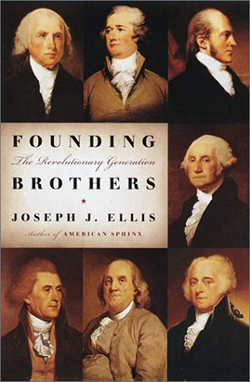
Founding Brothers: The Revolutionary Generation, by Joseph J. Ellis (Alfred A. Knopf)

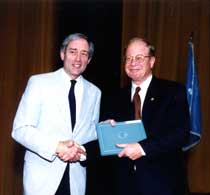
Columbia University President George Rupp (left) presents Joseph J. Ellis with the 2001 Pulitzer Prize for History.

Winning Work

An illuminating study of the intertwined lives of the founders of the American republic--John Adams, Aaron Burr, Benjamin Franklin, Alexander Hamilton, Thomas Jefferson, James Madison, and George Washington.

During the 1790s, which Joseph Ellis calls the most decisive decade in our nation's history, the greatest statesmen of their generation--and perhaps of any--came together to define the new republic and direct its course for the coming centuries. Ellis focuses on six discrete moments that exemplify the most crucial issues facing the fragile new nation: Burr and Hamilton's deadly duel, and what may have really happened; Hamilton, Jefferson, and Madison's secret dinner, during which the seat of the permanent capital was determined in exchange for passage of Hamilton's financial plan; Franklin's petition to end the "peculiar institution" of slavery--his last public act--and Madison's efforts to quash it; Washington's precedent-setting Farewell Address, announcing his retirement from public office and offering his country some final advice; Adam's difficult term as Washington's successor and his alleged scheme to pass the presidency on to his son; and finally, Adams and Jefferson's renewed correspondence at the end of their lives, in which they compared their different view of the Revolution and its legacy.

In a lively and engaging narrative, Ellis recounts the sometimes collaborative, sometimes archly antagonistic interactions between these men, and shows us the private characters behind the public personas: Adams, the ever-combative iconoclast, whose closest political collaborator was his wife, Abigail; Burr, crafty, smooth, and one of the most despised public figures of this time; Hamilton, whose audacious manner and deep economic savvy masked his humble origins; Jefferson, renowned for his eloquence, but so reclusive and taciturn that he rarely spoke more than a few sentences in public; Madison, small, sickly, and paralyzingly shy, yet one of the most effective debaters of his generation; and the stiffly formal Washington, the ultimate realist, larger-than-life, and America's only truly indispensable figure.

Ellis argues that the checks and balances that permitted the infant American republic to endure were not primarily legal, constitutional, or institutional, but intensely personal, rooted in the dynamic interactionn of leaders with quite different visionss and values. Revisiting the old-fashioned idea that character matters, Founding Brothers informs our understanding of American politics--then and now--and gives us a news perspective on the unpredictable forces that shape history.

(From the book jacket)

Copyright: 2000, Alfred A. Knopf

Winning Work

Founding Brothers: The Revolutionary Generation

An illuminating study of the intertwined lives of the founders of the American republic--John Adams, Aaron Burr, Benjamin Franklin, Alexander Hamilton, Thomas Jefferson, James Madison, and George Washington.

During the 1790s, which Joseph Ellis calls the most decisive decade in our nation's history, the greatest statesmen of their generation--and perhaps of any--came together to define the new republic and direct its course for the coming centuries. Ellis focuses on six discrete moments that exemplify the most crucial issues facing the fragile new nation: Burr and Hamilton's deadly duel, and what may have really happened; Hamilton, Jefferson, and Madison's secret dinner, during which the seat of the permanent capital was determined in exchange for passage of Hamilton's financial plan; Franklin's petition to end the "peculiar institution" of slavery--his last public act--and Madison's efforts to quash it; Washington's precedent-setting Farewell Address, announcing his retirement from public office and offering his country some final advice; Adam's difficult term as Washington's successor and his alleged scheme to pass the presidency on to his son; and finally, Adams and Jefferson's renewed correspondence at the end of their lives, in which they compared their different view of the Revolution and its legacy.

In a lively and engaging narrative, Ellis recounts the sometimes collaborative, sometimes archly antagonistic interactions between these men, and shows us the private characters behind the public personas: Adams, the ever-combative iconoclast, whose closest political collaborator was his wife, Abigail; Burr, crafty, smooth, and one of the most despised public figures of this time; Hamilton, whose audacious manner and deep economic savvy masked his humble origins; Jefferson, renowned for his eloquence, but so reclusive and taciturn that he rarely spoke more than a few sentences in public; Madison, small, sickly, and paralyzingly shy, yet one of the most effective debaters of his generation; and the stiffly formal Washington, the ultimate realist, larger-than-life, and America's only truly indispensable figure.

Ellis argues that the checks and balances that permitted the infant American republic to endure were not primarily legal, constitutional, or institutional, but intensely personal, rooted in the dynamic interactionn of leaders with quite different visionss and values. Revisiting the old-fashioned idea that character matters, Founding Brothers informs our understanding of American politics--then and now--and gives us a news perspective on the unpredictable forces that shape history.

(From the book jacket)

Copyright: 
2000, Alfred A. Knopf


Biography

Joseph J. Ellis is the Ford Foundation Professor of History at Mount Holyoke College. Educated at the College of William and Mary and Yale University, he served as a captain in the army and taught at West Point before coming to Mount Holyoke in 1972. He was dean of the faculty there for ten years.

He is the author of five previous books: The New England Mind in Transition; School for Soldiers: West Point and the Profession of Arms(with Robert Moore); After the Revolution: Profiles of Early American Culture; Passionate Sage: The Character and Legacy of John Adams; and American Sphinx, which won the 1997 National Book Award.

He lives in Amherst, Massachusetts, with his wife, Ellen, and their three sons.


Finalists

Nominated as finalists in History in 2001:

The Jury

Pauline Maier(chair )

William Rand Kenan Jr. Professor of American History

William Howard Adams

historian and writer

Helen Horowitz

Sylvia D. Bauman Professor of American Studies

Winners in History

2001 Prize Winners

David Cay Johnston

For his penetrating and enterprising reporting that exposed loopholes and inequities in the U.S. tax code, which was instrumental in bringing about reforms.

Staff

For its balanced and gripping on-the-scene coverage of the pre-dawn raid by federal agents that took the Cuban boy Elian Gonzalez from his Miami relatives and reunited him with his Cuban father.