For a distinguished book of non-fiction by an American author that is not eligible for consideration in any other category, Five thousand dollars ($5,000).

Annals of the Former World, by John McPhee (Farrar)

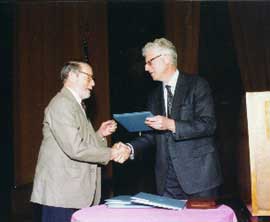
Columbia University Provost Jonathan R. Cole (right) presents John McPhee with the 1999 Pulitzer Prize in General Nonfiction.

Winning Work

Annals of the Former World combines four of McPhee's previous books on geology (published between 1981 and 1993) with a previously unpublished essay. Each volume was excerpted in The New Yorker by McPhee (a longtime staff writer at the magazine) prior to publication. Selections from the series are available below.

"Annals of the Former World: Basin and Range I" (October 20, 1980)

"Annals of the Former World: Basin and Range II" (October 27, 1980)

"Annals of the Former World: In Suspect Terrain I" (September 13, 1982)

"Annals of the Former World: In Suspect Terrain II" (September 20, 1982)

"Annals of the Former World: In Suspect Terrain III" (September 27, 1982)


Twenty years ago, when John McPhee began his journeys back and forth across the United States, he planned to describe a cross-section of North America at about the fortieth parallel and, in the process, come to an understanding not only of the science but of the style of the geologists he traveled with. The structural arrangement of the work never changed, but its breadth caused him to complete it in stages, under the overall title Annals of the Former World.

In Basin and Range, McPhee traverses the Basin and Range province, from Utah to eastern California, accompanied by Kenneth S. Deffeyes, a professor of geology who has done extensive field work in Nevada. In Suspect Terrain follows McPhee from the outwash plains of Brooklyn to Indiana's drifted diamonds and gold, in the company of the United States Geological Survey's Anita Harris, a Brooklyn native. In 
Rising from the Plains, he rides across Wyoming with David Love, a field geologist with a family history on the frontier and an unsurpassed understanding of Western geology. Assembling California takes McPhee across the Sierra Nevada and the Great Central Valley to the wine country of the Coast Ranges, the rock of San Francisco, and the San Andreas family of faults, with tectonicist Eldridge Moores as guide. In "Crossing the Craton," a new and final essay and the last link in the cross-country chain, he and Randy Van Schmus, a geochronologist, explore the midcontinent's Precambrian basement.

Like the terrain it covers, Annals of the Former World tells a many-layered tale, and the reader may choose one of many paths through it, guided by twenty-five new maps and the "Narrative Table of Contents" (an essay outlining the history and structure of the project). Read sequentially, the book is an organic succession of set pieces, flashbacks, biographical sketches, and histories of the human and lithic kind; approached systematically, it can be a North American geology primer, an exploration of plate tectonics, or a study of geologic time and the development of the time scale, As clearly and succinctly written as it is profoundly informed, this is our finest popular survey of geology, and a masterpiece of modern nonfiction writing.

Biography

John McPhee was born in Princeton, New Jersey, and was educated at Princeton University and Cambridge University. His writing career began at Time magazine and led to his long association with The New Yorker, where he has been a staff writer since 1965. The same year he published his first book, A Sense of Where You Are, with FSG, and soon followed with The Headmaster (1966), Oranges (1967), The Pine Barrens (1968), A Roomful of Hovings and Other Profiles (collection, 1969), The Crofter and the Laird (1969), Levels of the Game (1970), Encounters with the Archdruid (1972), The Deltoid Pumpkin Seed (1973), The Curve of Binding Energy (1974), Pieces of the Frame (collection, 1975), and The Survival of the Bark Canoe (1975). Both Encounters with the Archdruid and The Curve of Binding Energy were nominated for National Book Awards in the category of science.

Since 1977, the year in which McPhee received the Award in Literature from the American Academy of Arts and Letters and The John McPhee Reader and the best-selling Coming into the Country appeared in print, Farrar, Straus and Giroux has published Giving Good Weight (collection, 1979), Basin and Range (1981), In Suspect Terrain (1983), La Place de la Concorde Suisse (1984), Table of Contents (collection, 1985), Rising from the Plains (1986), Heirs of General Practice (in a paperback edition, 1986), The Control of Nature (1989), Looking for a Ship (1990), Assembling California (1993), The Ransom of Russian Art (1994), The Second John McPhee Reader (1996), and Irons in the Fire (1997).

John McPhee lives in Princeton, New Jersey, where he teaches writing at Princeton University.

Finalists

Nominated as finalists in General Nonfiction in 1999:

The Jury

Robert D. Wyatt(chair )

professor of journalism, former book editor

Patricia Nelson Limerick

chair of the Center of the American West and professor of History

Jack Miles*

senior advisor to the president

Winners in General Nonfiction

1999 Prize Winners

Duke Ellington

Bestowed posthumously, commemorating the centennial year of his birth, in recognition of his musical genius, which evoked aesthetically the principles of democracy through the medium of jazz and thus made an indelible contribution to art and culture.

Chuck Philips and Michael A. Hiltzik

For their stories on corruption in the entertainment industry, including a charity sham sponsored by the National Academy of Recording Arts and Sciences, illegal detoxification programs for wealthy celebrities, and a resurgence of radio payola.

Staff

For its clear and detailed coverage of a shooting rampage in which a state lottery worker killed four supervisors then himself.