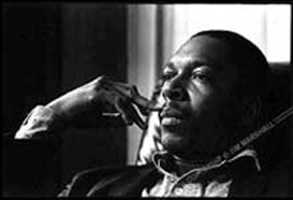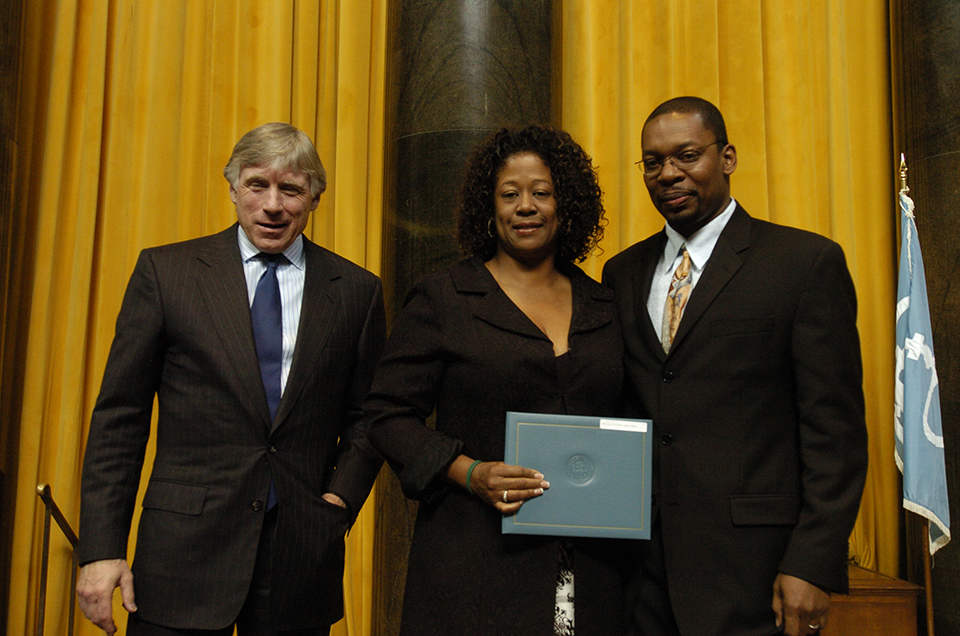
Coltrane's Special Citation is for his life's work in music. Although he recorded as a session musician with the likes of Billy Valentine, Dizzy Gillespie and Earl Bostic from 1949 to 1954, the vast majority of his recorded output—including his celebrated work with Miles Davis's First Great Quintet and fellow Pulitzer Prize Special Citation recipient Thelonious Monk—comes from the eleven-year period between 1956 and his death in 1967. The following selections only skim the surface of Coltrane's impactful contributions to jazz and American culture as a whole during this period.
Miles Davis's Kind of Blue (1959) features the immeasurably talented sextet of Davis (trumpet), Coltrane (tenor saxophone), Cannonball Adderley (alto saxophone), Bill Evans (piano), Paul Chambers (bass) and Jimmy Cobb (drums). Although Coltrane had already recorded Blue Train, his first masterpiece as a bandleader in his own right, Kind of Blue was an understated manifesto for many of these musicians. For Coltrane, it arguably served as the theoretical template for the rest of his career.
By the late 1950s, bebop had emerged as the dominant paradigm in jazz. Harmonically diffuse, it privileged dense improvisation over dissonant chord changes and complex rhythms, providing a stark contrast to the danceable melodicism of the big band era. While practitioners of hard bop (including Davis and Coltrane) attempted to infuse the subgenre with influences from gospel and other forms of traditional African American music as the Eisenhower era drew to a close, the dilemma of needless complexity endured.
In 1953, George Russell published the influential Lydian Chromatic Concept of Tonal Organization. During a 16-month hospitalization and ensuing retail jobs, the future MacArthur Fellow devised a new harmonic framework in which melodic development was emphasized through the use of modes, scales that are not situated in a major or minor key. According to the All Music Guide, "each note in the scale was also the first note of a new mode, which would incorporate all of the notes in the original major scale, but sounded different because the new starting point rearranged the order of distances between notes. Thus, if a musician were improvising over, say, a D chord, he could essentially choose any key center whose corresponding scale included the note D (unless the composer dictated specific modes to be used in the solos). The new order of distances between notes could produce very different moods."
As this maximized improvisatory possibilities while minimizing the number of chords to as little as one per piece, Russell's ideas soon gained traction among Davis, Coltrane, Evans and their contemporaries, culminating in the nearly concurrent development of Kind of Blue and Coltrane's own Giant Steps (1960).
Nearly sixty years later, "So What" continues to exert a profound influence upon music worldwide, from academic jazz students to the more experimental streams of indie rock. Reflecting upon the album as a whole, Chick Corea has said, "It's one thing to just play a tune, or play a program of music, but it's another thing to practically create a new language of music."
From 1960 to 1965, Coltrane recorded and toured with a quartet (briefly a quintet with the controversial addition of Eric Dolphy) that eventually stabilized around bassist Jimmy Garrison, pianist McCoy Tyner and drummer Elvin Jones. Save for Garrison, the "Classic Quartet" was present on My Favorite Things (1961), a modal reconstruction of several standards (namely the enduring title track) that reflected Coltrane's burgeoning interests in Eastern spirituality and Indian music. At the time, Coltrane's use of the soprano saxophone—a recent gift from Davis—was quite atypical in jazz.
Because of its chordal simplicity, Coltrane's rendition of "My Favorite Things" helped to inspire the lengthy "jams" associated with psychedelic rock in the late 1960s. Often grounded in the folk revival, many of these groups enjoyed an eclectic range of music but lacked the technical proficiency to explore bop, thus ensuring the appeal of modal jazz. In his 2005 memoir, Phil Lesh of the Grateful Dead recalled "urg[ing] the other band members to listen closely to the music of John Coltrane, especially his classic quartet, in which the band would take fairly simple structures ("My Favorite Things," for example) and extend them far beyond their original length with fantastical variations, frequently based on only one chord." (An extended 1970 live cover of "Dancing in the Street" ably illustrates the band's debt to Coltrane's modal period.)
Even as he served as an icon for a new generation of bohemians, Coltrane's stylistic innovations and tentative embrace of the avant-garde (via Dolphy) befuddled many critics of the era. He responded by recording a trio of relatively conventional albums in 1963: an intimate collaboration with Duke Ellington in which members of the Ellington Orchestra and the Coltrane Quartet traded off on a number of Ellington compositions and one new Coltrane piece; Ballads, on which no performance exceeded six minutes; and John Coltrane and Johnny Hartman, a comparatively unsung collaboration with the critically-acclaimed pop singer that ranks among the finest vocal jazz albums of any era.
Writing for The Paris Review's website in 2012, Matthew Kassel characterized the collaboration as "the most beautiful half hour of music I have heard on one CD." On "Lush Life," the constraints imposed by the form drive Hartman and the Quartet to new heights in one of the composer's final tonal recordings.
Widely regarded as Coltrane's magnum opus, A Love Supreme (1965) synthesizes Coltrane's spiritual concerns into a rich musical tapestry that continues to resist definition over fifty years after its release. For the last time, hard bop lines (like the solo in this part of the suite, a musical analog to a poem included in the liner notes) are interwoven with the tense clangor of the avant-garde.
The final two years of Coltrane's life were defined by dramatic upheaval, including the birth of two of his three children, a divorce and the illness that would eventually take his life. His long-simmering identification with the free jazz of Albert Ayler, Cecil Taylor and future Pulitzer winner Ornette Coleman (characterized by a lack of chord changes and tempos, a return to the collective improvisation of traditional jazz, and in some cases, involvement with nascent political movements) led to a break with conventional harmony on 1965's sprawling Ascension, a one-off big band effort. Following Meditations (1966), the Quartet evolved into a new ensemble, with only Garrison staying on from the old group; ultimately, Pharaoh Sanders (saxophone), Rashied Ali (drums), and Alice, Coltrane's new wife (piano) would go on to be just as influential in the following decade as their predecessors in the Quartet.
Recorded in early 1967 and released several weeks after Coltrane's death, Expression was the new quintet's first studio album. "Offering" showcases the dramatic interplay between the composer and Ali, a versatile musician with R&B and rock experience who recorded a number of duets (collected on 1974's Interstellar Space) with Coltrane during the sessions. These final and highly extemporaneous recordings are among the most enduring testaments to his artistry.
-- By Sean Murphy
Sources: John Coltrane: His Life and Music by Lewis Porter (University of Michigan Press); Kind of Blue: The Making of the Miles Davis Masterpiece by Ashley Kahn (Da Capo Press); Kind of Blue by Rob DuBoff (Hal Leonard); Searching for the Sound: My Life with the Grateful Dead by Phil Lesh (Back Bay Books)