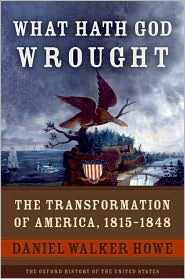
 The Oxford History of the United States is by far the most respected multi-volume history of our nation. The series includes two Pulitzer Prize winners, a New York Times bestseller, and winners of the Bancroft and Parkman Prizes. Now, in What Hath God Wrought, historian Daniel Walker Howe illuminates the period from the battle of New Orleans to the end of the Mexican-American War, an era when the United States expanded to the Pacific and won control over the richest part of the North American continent.
Howe's panoramic narrative portrays revolutionary improvements in transportation and communications that accelerated the extension of the American empire. Railroads, canals, newspapers, and the telegraph dramatically lowered travel times and spurred the spread of information. These innovations prompted the emergence of mass political parties and stimulated America's economic development from an overwhelmingly rural country to a diversified economy in which commerce and industry took their place alongside agriculture. In his story, the author weaves together political and military events with social, economic, and cultural history. He examines the rise of Andrew Jackson and his Democratic party, but contends that John Quincy Adams and other Whigs--advocates of public education and economic integration, defenders of the rights of Indians, women, and African-Americans--were the true prophets of America's future. He reveals the power of religion to shape many aspects of American life during this period, including slavery and antislavery, women's rights and other reform movements, politics, education, and literature. Howe's story of American expansion culminates in the bitterly controversial but brilliantly executed war waged against Mexico to gain California and Texas for the United States.
By 1848 America had been transformed. What Hath God Wrought provides a monumental narrative of this formative period in United States history.
(From the book jacket)